Our next guest post comes from another long-time follower, who joined our journey sometime around the late 1950s. Max (aka Badfinger) blogs on music and pop culture at powerpop.blog, and has kept up with our wanderings through the charts even though we left his preferred ’60s and ’70s eras behind a while back. Today he’s writing about a lost hit from that time, and how it highlights the differences between the charts on either side of the Atlantic…
When I was growing up, my sister had this single. It was cracked, so she taped the B-side with scotch tape, and I would listen to it over and over. Of course, it went like “Crimson and Clov-CLICK-er.” But I didn’t care; it was a great song to me even with the hideous CLICK.
Now to the subject of the post. I’ve always been fascinated by how some bands could be huge in one country and barely make a dent in another. In America, we missed out on a lot of British acts like T. Rex, Status Quo, and Slade. At the same time, the UK never fully embraced some major American artists such as CCR, Bob Seger, and Grand Funk Railroad. They were certainly known there, but they never enjoyed the kind of success they had back home. I always wondered about that in bands and songs.
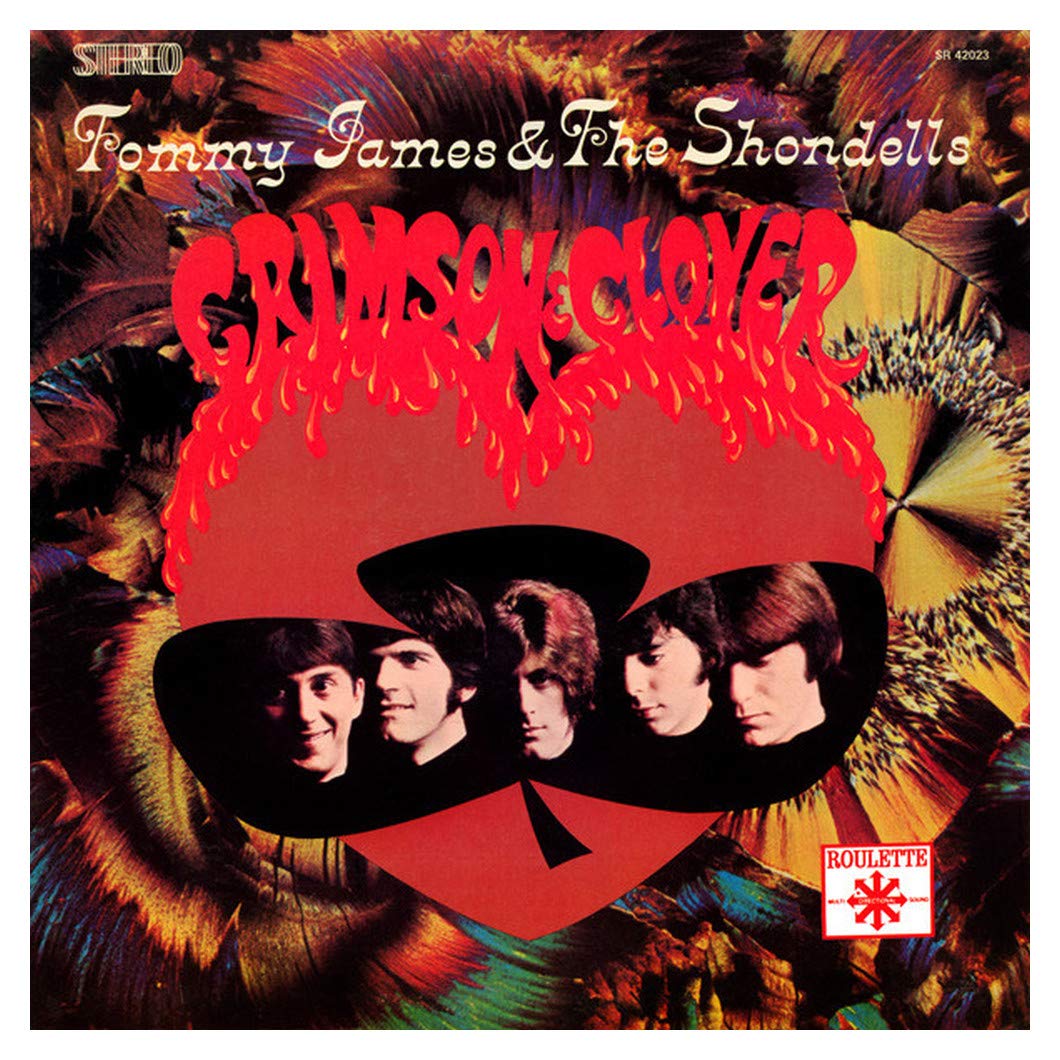
While I was writing up this song up a few years ago and typing out the chart position of it, I was shocked when I saw a blank in the UK chart position. I thought the source was wrong, so I emailed Stewart; no dice, it didn’t chart. This song is one of those records that proves the charts don’t always make sense. Tommy James and the Shondells were no strangers to success in the UK. ‘Mony Mony‘ had reached No. 1 there. But when it was released in early 1969, it failed to chart at all.
Part of the problem may have been that the song was unlike anything else on the radio at the time. It moved at a slower pace at mid-tempo. The tremolo effects on Tommy James’ voice and guitar gave it a dreamy sound. American audiences loved it. British listeners may have found it a little too different, bubblegum, or old hat. The UK music scene was changing quickly in 1969. Harder rock bands and progressive groups were starting to get more attention.
There is also the possibility that the record simply did not receive the promotion it needed. Maybe ‘Crimson and Clover’ (released January 1969) came too close after ‘Mony Mony’ (March 1968). Tommy James was always a bigger act in the United States and Canada than in Britain. In those days, radio play and television appearances could make a huge difference. If a record was not pushed hard enough, a song could get lost among dozens of new releases arriving every week. Of course, there was always the opposite, such as Ian Dury and the Blockheads, ‘Hit Me With Your Rhythm Stick’, and many others that hit number 1 in the UK and did nothing here.
Just so everyone knows, I’m not knocking the UK for it not charting. It’s just amazing to me, though, how one song can be so big in one country and flop in the other…either way! Whatever the reason, Joan Jett actually charted Crimson and Clover in 1982 at #60 in the UK, and her version peaked at #7 in America and #4 in Canada. At least it made an appearance in the UK Charts!
Thanks again, Max. Everyone else be sure to check out his blogs, through which I’ve discovered so many songs over the years. And don’t forget to vote for the Best and Worst #1s! Results out on Sunday!


Thanks Stewart for posting this! And yea, I’m still confused on this but maybe the UK had enough of Tommy James with Mony Mony….I’m glad Jett was able to slip it on the charts. I also hate that bands didn’t go the other way…like T-Rex, Slade, Status Quo, and other bands we didn’t get to hear as much of.
No worries, Max. Thanks for writing it! It’s an interesting take on the topic. Brits often talk about ‘breaking America’, and the big acts that never managed it: the ones you mentioned, plus the likes of Oasis, Robbie Williams, and more… But maybe the Brits can be just as insular when it comes to certain non-British acts. We certainly are if they’re not singing in English!
Oasis I really don’t understand. They did have two big hits here but as I’ve found out…they have many more that could have charted here. Yea that is the same here as well in many ways.
I remember reading this title in the (UK) music weeklies around the time it was in the US charts as I always took a keen interest in them and often compared them to what was in our own Top 30, and was surprised never to hear it even once on the radio, especially as ‘Mony Mony’ had been one of the massive summer hits not long earlier and would have thought there’d bound to be interest in what they did next. You’re right – zero promotion, and I expect a lot of us simply didn’t even know it existed, let alone had a chance to hear it!
Thanks….yes it just shocked me because it was such a huge hit over here. I could understand maybe charting at 30 or something but not to even make it? But the same went the opposite way as well unfortunately.
“Crimson and Clover” is an absolute masterclass of a song. It’s the perfect fusion of bubblegum pop and psychedelic rock. It perfectly captures that feeling of being absolutely intoxicated with someone and your infatuation with them being like a hazy daydream. I’m shocked it didn’t even chart in the UK, I don’t even know how that happened especially coming off the multi-week No. 1 of “Mony Mony”, I guess you’re right it was the case of it not being promoted and plugged properly in the UK. Even the Joan Jett version – which is a great version though not as good as the OG – charted in the UK. “Crystal Blue Persuasion” and “I Think We’re Alone Now” were huge US hits for the Shondells and they didn’t chart in the UK either (though interestingly their first US No. 1 “Hanky Panky” did reach the Top 40 in the UK at #38).
I’m trying to think of songs that were huge US hits, but despite being released in the UK, they weren’t hits in the UK at all (or at least didn’t reach the Top 40, that’s how I define a hit if it reaches the Top 40). Like “Eight Days a Week” and “The Long and Winding Road” by The Beatles weren’t released in the UK as singles but they were both US No. 1s. “To Sir With Love” by Lulu was a B-side in the UK but in the US it was not only an A-side, it was the No. 1 single of 1967. A lot of 70s soul and R&B songs and proto-disco songs barely charted or didn’t chart at all in the UK. “The One That You Love” by Air Supply was a US No. 1 but didn’t chart at all in the UK. The band Journey only had one Top 40 hit in the UK and that was “Don’t Stop Believin'” but none of their other songs reached the Top 40 whereas in the US they were superstars. “I Don’t Wanna Cry” was Mariah Carey’s 4th US No. 1 but I don’t believe it charted at all in the UK. “Bent” by Matchbox Twenty was their only US No. 1 single on the Hot 100 but it didn’t chart at all in the UK.
A lot of Hall & Oates US hits weren’t hits in the UK surprisingly even though nowadays I think a lot of Hall & Oates songs are quite popular in the UK. “Hot Child in the City” by Nick Glider was a US and Canada No. 1 but didn’t chart in the UK
I’m glad I’m not the only one that was surprised by this. I couldn’t believe it. That is why I even emailed Stewart to make sure I was seeing it right. See, I didn’t know that about Journey either. I just turned into a teen in 1980 so Journey here was played to death.
I don’t know if it was just taste or lack of promotion or what…but sometimes like you said…they weren’t even released.
Great choice in Tommy James, Max! Release schedules were often an issue with UK releases of big US hits – they often didnt come out at the same time unless you were a superstar. I think they hoped to build up hype ahead of hoping to get picked up by Radio 1 (there was no other pop station as the Pirate ships were forced out of business and were local anyway, with the exception of Radio Luxembourg). If Radio 1 didnt playlist a track, and the artist wasnt over here plugging it on TV and radio, then most folk never got to hear it. That was the case with Crimson and Clover. Didnt know it existed until the 80’s. I did become aware of Crystal Blue Persuasion, though, as a kid in Singapore I bought 2 songbooks with sheet music and lyrics of 1969 hit songs and that was one of the songs I didn’t know. When I finally got to hear it I loved it, shoulda been a hit! Tommy James has a great back catalogue I’ve been discovering since the 80’s but the only new Tommy James track I ever heard post-Mony Mony on UK radio was Dragging The Line in late 1971. I know I heard it cos I wrote it in my notepad at the time, liked it…and then never heard it again until R.E.M. did a cover in the 90’s. US DJ Paul Gambaccini did a lot for discovering current and old US hits in the UK on his weekly US Top 40 rundown for many decades starting around 1976 or so, and is a virtual goldmine of information on music, and hero of mine in his enthusiasm for all sorts of music, hit or miss. Prior to Gambo, one had to live nearby a US military base (which I did) to listen to Kacey Kasem’s rundown on US Forces radio. The ridiculous situation was we could get US radio locally but UK local music radio was non-existent outside big cities due to strict Government licensing. It was 1967 before we actually got a pop radio station at all!
I guess there’ll be many factors why US and UK charts have traditionally differed, and you’ll know much better than me on this. The UK charts were based on sales alone until the noughties, whereas the Billboard chart has taken things like radio airplay into account since the 1950s. So then you’re looking at the range of stations and their specialities. For many years we had one national pop station (Radio 1) and that didn’t even have a national FM signal until 1987, whereas the US, so I understand, had an FM culture that the bands that I love – your Steely Dans, Bob Segers, Bostons, REO Speedwagons – could really thrive in. But then how do we explain the British Invasion of 1983? It’s a fascinating subject, and a great post.
MTV can explain the Second British Invasion.
Thank you so much! I knew there was a difference between the two and how they did it…but you taught me some things. Yes…FM is what I grew up on in America mostly. In the early seventies, AM was still big…but by the 80s…it was mostly FM here.