Today’s Top 10 – April 19th 1984

In going through the chart-toppers of the time, I was always a bit down on the early to mid-eighties. 1980 was a great year for #1s, one of my favourites, but between 1982 and ’86 things went a bit gloopy.

And yet. Multiple sources claim 1984 as the best year in pop music history. Rolling Stone, Billboard, and the BBC have all pushed the theory, among several others. And on the surface you can see why: Prince, Madonna, Michael Jackson all at the peak of their powers, Springsteen’s ‘Born in the USA’, the rise of MTV, ‘the second British Invasion’…

There’s only one problem with this. It’s all very US-centric. It didn’t seem to translate back across the Atlantic, at least in terms of number one singles. But maybe if we zoom out a little, and take a random Top 10, I might become a mid-1980s convert. Here then, is the UK Top 10 as it stood on this day in 1984, AKA forty-two years ago.

10. ‘Wood Beez (Pray Like Aretha Franklin)’, by Scritti Politti (up 7 / 8 weeks on chart)

A bit of a litmus test at #10, because this is as 1984-sounding as it gets. I know very little about Scritti Politti, other than they’re the sort of band you might name drop as eighties-by-numbers, like Kajagoogoo or Blancmange. And I’ll admit that this track isn’t converting me to their cause. It’s got an interestingly funky bassline and synth riff, but the vocals are buried in the mix. And where the hell does Aretha Franklin come in…? (Okay, there’s a line in the bridge that alludes to ‘Say a Little Prayer’) Part of my problem with mid-eighties pop is that it took itself very seriously, and I’d say this is an issue here. But this was Scritti Politti’s breakthrough record, and first of two UK Top 10s.

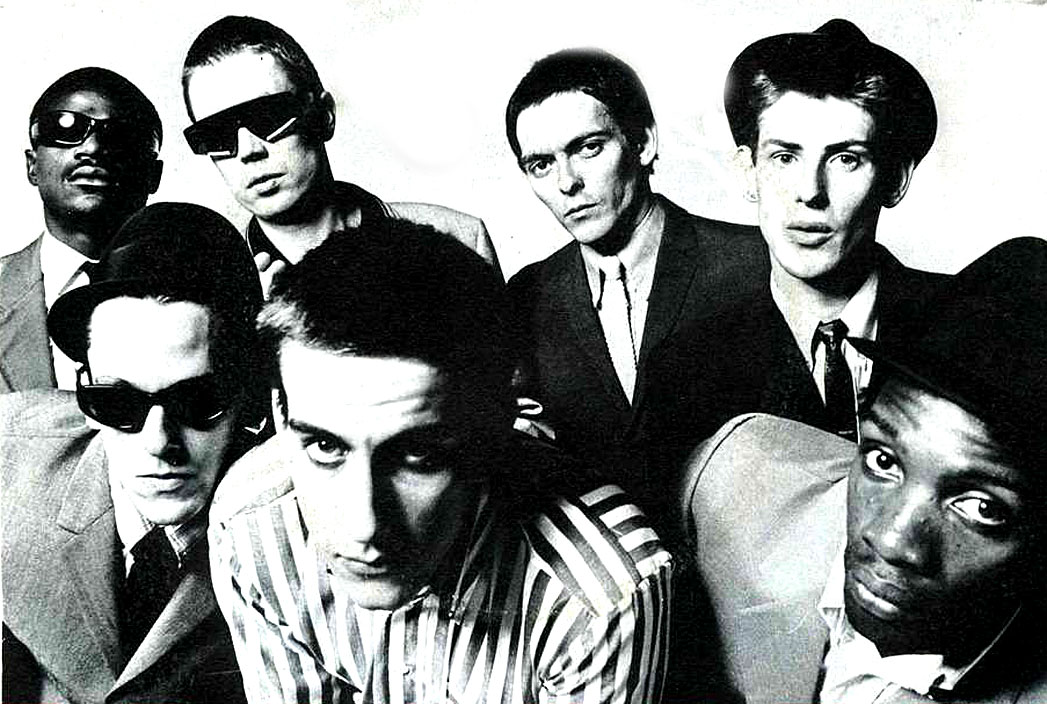
9. ‘Nelson Mandela’, by The Special AKA (non-mover / 6 weeks on chart)

This is a bit more like it. Nelson Mandela was already twenty-one years in captivity when the Specials released this, and brought his name to the wider British public’s attention. Jerry Dammers, who wrote the song, had only found out who Mandela was the year before, when he attended his first anti-apartheid rally. Around the same time as Margaret Thatcher – ever on the wrong side of history – denouncing him as a terrorist.

As protest songs go this is very danceable, with lots of authentic African musical influences. One of the backing singers was Caron Wheeler, who would go on to provide lead vocals for Soul II Soul’s 1989 #1 ‘Back to Life’. It was released as the Special AKA, as The Specials had technically split in 1981, with three members going on to found Fun Boy Three. This was the band’s first Top 10 hit since ‘Ghost Town’, and would be their final UK Top 10.

8. ‘Ain’t Nobody’, by Rufus & Chaka Khan (up 5 / 4 weeks on chart)

Vaulting up into the Top 10 this week, a bona-fide classic. If someone cites a track like this as an example of 1984’s musical pedigree, I will wholeheartedly agree. #8 was this record’s peak, which feels low, though Chaka Khan would outdo it with a chart-topper later in the year.

The enduring popularity of ‘Ain’t Nobody’ is proven by the fact that it has returned to the upper reaches of the UK charts on five occasions over the years through various covers, remixes and samples, including a belated appearance at #1 through LL Cool J in 1997, and a re-peak for Chaka at #6 when re-released in 1989.

I will admit, though, that I always though the ‘Rufus’ credited on the record was a man, Rufus Khan… Chaka’s brother, or husband, perhaps…? Colour me surprised to learn today that Rufus were a funk act with three Top 10s on the Billboard Chart. At least I don’t get paid for this…

7. ‘Glad It’s All Over’ / ‘Damned on 45’, by Captain Sensible (down 1 / 5 weeks on chart)

Captain Sensible, founder of the Damned (releasers of officially the first ‘punk’ record in 1976), had maintained a side solo career since the late-seventies, and had scored an unlikely chart-topper in ’82 with a cover of ‘Happy Talk’. He was also a committed pacifist, and ‘Glad It’s All Over’ refers to the Falklands conflict (more South Atlantic than ‘South Pacific’), making for two protest songs in this week’s hit parade. As nice as the sentiment is, this is a fairly pedestrian number. It could do with some punkish spit and vinegar…

Luckily then we have the flip-side of this double-A. It’s a riff on the popular ‘Stars on 45’ singles, but with a medley of around fifteen Damned and Captain Sensible tunes (including a reprise of ‘Happy Talk’). I’m not going to claim that it works particularly well, or that I enjoyed all seven and a half minutes of it, but at least it injects a bit of variety into this Top 10!

6. ‘People Are People’, by Depeche Mode (down 2 / 4 weeks on chart)

In some ways, Depeche Mode are as ‘eighties synonymous’ as Scritti Politti. However, Depeche Mode outlasted their new-wave roots to become one of Britain’s most succesful chart outfits. I’ve already covered them in my ‘Never Had a #1’ series, as one of the non chart-topping acts with the most Top 10 singles, and this #4 hit remains their joint-highest hit.

Why? Well, I’d say contrast this clanking, choppy, industrial hook-filled track to the weedy ‘Wood Beez’ further down the chart. Yes it’s very of its time in terms of its sound and production – your tolerance for harsh mid-eighties synths will determine if that’s a positive or not – but it’s undeniably catchy. And it’s another somewhat political number: People are people so why should it be, You and I should get along so awfully…?

5. ‘I Want to Break Free’, by Queen (up 13 / 2 weeks on chart)

Breaking into the Top 5 this week, and on its way to a #3 peak, it’s one of Queen’s most famous songs. Famous because it’s a catchy hit, but probably more so because the band do drag in the ‘Coronation Street’ inspired video. In the US this video is widely blamed for ‘ending’ their career – until Wayne’s World resurrected them in the early ’90s – as Reagan-era Americans just couldn’t handle men in dresses (luckily we now live in much more enlightened times…) I don’t know if that narrative is all completely true, as Queen were never guaranteed hit makers in the States, with some smashes alongside a lot of misses. It was banned by MTV, though.

And it could be argued that this is yet another political statement of a song, and not just because of it’s gender-bending. In South America and, in particular, South Africa the I want to break free… refrain was taken up in various fights against repression.

4. ‘Against All Odds (Take a Look at Me Now)’, by Phil Collins (up 4 / 3 weeks on chart)

Two classics of the decade in a row then, as here comes eighties chart mainstay Phil Collins with one of the ultimate power-ballads, in an era chock full of fist-clenchers. The moment before the second verse, when the drums come clattering in, is hard to deny even if you find the rest of the song overwrought.

I’d say that this song has lasted far longer in the public imagination than the Rachel Ward and Jeff Bridges film of the same name, the soundtrack to which this comes from. We have of course already met a cover version of this at #1, from Mariah Carey and Westlife, and we have another chart-topping cover to come very soon. Can’t wait!

3. ‘A Love Worth Waiting For’, by Shakin’ Stevens (down 1 / 5 weeks on chart)

Of course, Britain’s highest selling singles act of the entire decade had to put in an appearance! Shakey might have been beyond his ’81-’82 heyday here but he was still good for a big hit, and this one had been at #2 the week before.

Without doing any research on it, I was convinced that this must be a cover of an oldie by someone like Emile Ford. But no, it’s an original. Which in my opinion makes all the cheesy old rock ‘n’ roll flourishes less enjoyable. Had Emile Ford released this in 1959, I’d have enjoyed it. For Shakin’ Stevens to have churned it out in 1984 feels… meh. Still we can’t knock Shakey too much. This was his 13th of twenty-five career Top 20 hits, and he remains a legend of British pop.

2. ‘You Take Me Up’, by The Thompson Twins (up 1 / 4 weeks on chart)

Like Scritti Politti, the Thompson Twins exist to me as an act that evoke a distant vision of the mid-eighties, rather than as an act I’ve ever really listened to. I can’t help but pin this song as the biggest disappointment in this entire Top 10. In 1984, the year in which I was promised Prince, Madonna, Springsteen and/or Michael Jackson, I ended up with Scritti Politti and the Thompson Twins.

No, I don’t particularly like this. The overwrought vocal delivery, the clunking beat, the processed harmonica… All very of their time. I think that this might also be political in theme, especially going by the video featuring chain gangs, and lyrics about working in a factory. What was it about the 1980s that made everyone take themselves so seriously?

1. ‘Hello’, by Lionel Richie (non-mover / 7 weeks on chart)

Speaking of taking things a bit too seriously… My original post on Lionel Richie’s ‘Hello’ details why I dislike this song, and why I named it as one of my Very Worst Number Ones. It really is tripe. I’ve never been able to enjoy it ironically even, like so many power ballads of the time, because there is nothing, not even a glimmer, in this song (and the preposterous video) to suggest that it isn’t intended as 100% sincere. Yet here it stands, in its fifth of six weeks at #1.

Lionel Richie is a name that sits in the eighties pantheon, at least, alongside Phil Collins and Queen elsewhere in this countdown. They were perhaps what I might have expected to find in this Top 10. Of course, a random week does not sum up an entire decade, but this hasn’t gone any way to explaining why 1984 is considered by many to be the Best Year in Pop Music History.

What is interesting, though, is the fact that two of these songs are overtly political, while three more can be argued to have political (or at least somewhat provocative) themes. That’s half the Top 10! Apartheid and the Falklands conflict are mentioned explicitly, while it’s clear that the Cold War and the Thatcher government were on many musicians’ minds (either side of this Top 10 we had ’99 Red Balloons’ and ‘Two Tribes’ hitting the top of the charts…) I’m not one to argue that pop music shouldn’t be political, as art will always end up reflecting the values of the people making it, but at the same time I’m not one to accept something ‘deep’ as automatically being ‘better’. The mid-eighties does feel like a time when pop acts tried to go ‘deep’, for better or worse. Compared to modern pop music this feels unusual. But also, look ten years further back, to the mid-seventies and the height of glam, and you’d see a chart full of shallow but catchy pop. These things are never linear.

One other notable thing about this chart is that there is only one chart-topping single in it, but seven of the acts in the Top 10 are chart-topping acts.

So, if 1984 has not proven itself to be my favourite year for music, then what is…? In terms of chart-toppers – which is what this blog is all about after all – I have a Top 3, and a definite bottom. I’m planning to reveal them in a special post when we get to the 1000th #1. In the meantime, let me know what your best musical/chart-topping years are!
Random Runners-Up: ‘Let’s Hear It for the Boy’, by Deniece Williams

I hope you’ve enjoyed our latest Random Runners-Up series. We’ve been back to the ’60s, to the ’70s, the ’90s, even the ’50s. For the final runner-up of the weekend, it’s the turn of the 1980s…

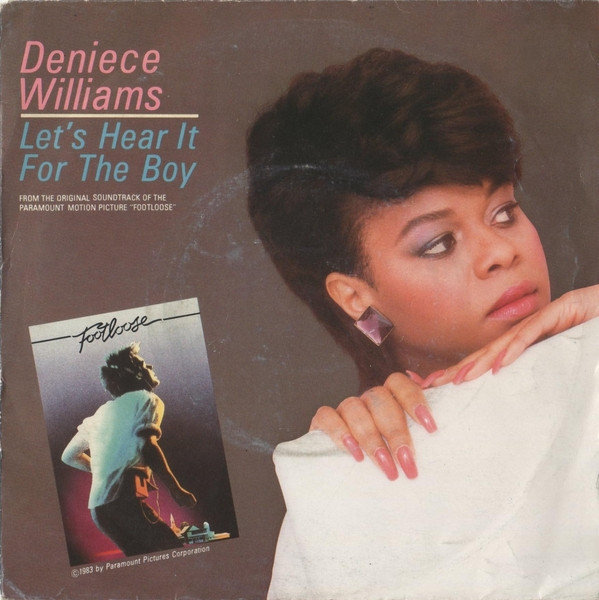
‘Let’s Hear It for the Boy’, by Deniece Williams

#2 for 2 weeks, from 27th May – 10th June 1984 (behind ‘Wake Me Up Before You Go-Go’)

I’m always wary of the term ‘feel good’, as most things specifically designed to make the average person feel good just end up as annoying. But I challenge anyone to hear the intro to ‘Let’s Hear It for the Boy’ and not feel their heart soar, just a teeny a bit.

It is so 1984. The purest, extra-virgin mid-eighties pressing, mixing together drum machine, squelchy bass, and a synthesised piano line. And when Deniece Williams comes in, you can hear the smile on her face as she sings. My baby he don’t talk sweet, He ain’t got much to say… It’s a riff on the old idea that a guy don’t gotta have money, looks, or charisma, as long as he gives good loving… What he does he does so well, Makes me want to yell…

It would be easy to read a smutty subtext into lines like he’s my lovin’ one-man show… or let’s give the boy a hand… but I’m above that. Plus the rest of the song is so bright and breezy, so gosh-darned wholesome, that it would feel forced. Adding to the eighties-ness of this tune is the fact that it’s from one of the decade’s best-loved films, ‘Footloose’, and was kept off top spot by one of the era’s best-remembered pop hits, Wham’s ‘Wake Me Up Before You Go-Go’ (what a joyous guilty pleasure of a top two!)

Deniece Williams had been to the top of the UK charts once, seven years earlier, when the rather more understated ‘Free’ spent a fortnight at #1. This was her fourth and final appearance in the Top 10, but she remains active in her seventies, and in 2021 became one of the first inductees to the Women Songwriters Hall of Fame.

Of course, a song as fun and frothy as this, and with a title like ‘Let’s Hear It for the Boy’, was always going to become something of a gay anthem. I probably first heard it in what may well be the best episode of ‘Will and Grace’, featuring a ‘sneaky hetero’ Matt Damon.

Up next we return to 1998, and the first solo chart-topper for one of Britain’s biggest ever pop stars…

Recap: #541 – #570

To recap, then…

The past thirty number one singles have taken us through the customary year and a half, from late ’84 to the early summer of ’86. Slap-bang in the middle of the decade. I like to, wherever possible, theme my recaps, to brand them with whatever act, or sound, has been prevalent at the time. We’ve had a rock ‘n’ roll recap, an Elvis recap, a Merseybeat recap, a glam recap, a disco recap… This, then, is our nineteenth recap: the charity record recap.

Yep. We went through thirty plus years of chart-toppers without a single one donating its proceeds to charity. But of the last thirty chart-toppers, five have been for a good cause (that’s roughly 16%, maths lovers!) We started with the daddy of all charity singles – ‘daddy’ in that it basically birthed the genre, and also because it’s still one of the best – Band Aid’s ‘Do They Know It’s Christmas?’

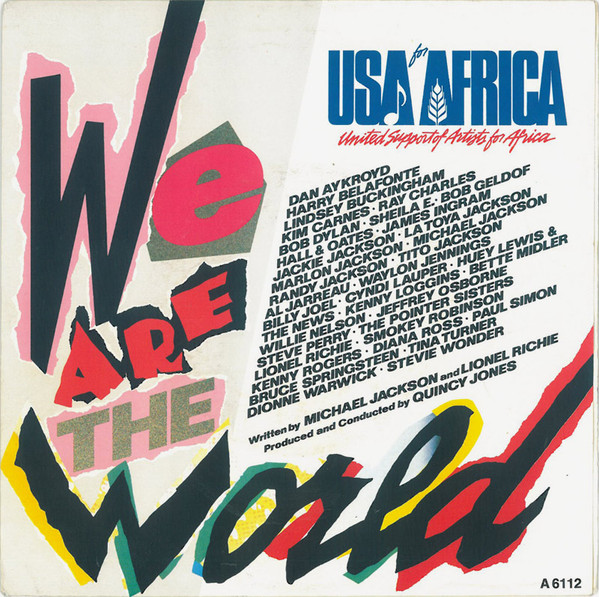
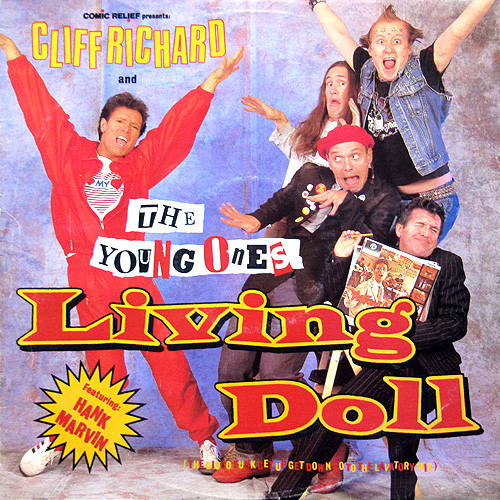
We then moved on to USA for Africa’s ‘We Are the World’ – a bloated, American take on Band Aid. Two original songs, at least, by legends like Geldof, Ure, Jackson and Wonder. Charity singles then started to evolve, and quickly. Next came the cover versions: The Crowd’s take on terrace anthem ‘You’ll Never Walk Alone’, and Mick Jagger and David Bowie’s pantomime dame reading of ‘Dancing in the Street’. Finally, this new genre settled on a format, one that will be plaguing the charts from now until the end of time: the novelty charity single. Cliff and the cast of ‘The Young Ones’ pratted their way through a pretty unlistenable cover of ‘Living Doll’.

I’ve had to take an executive decision when it comes to charity records. While it is unlikely I will ever name one as a ‘Very Best Chart-Topper’ (though you never know), I will always try, if at all possible, not to name one as a ‘Very Worst Chart-topper’ either. Their hearts are in the right place, you see. It would be like kicking a puppy, stealing candy from a baby… No matter how bad they are, there will always be another terrible record that isn’t raising money for the poor and the needy.

Away from charity records, it’s been a bit of a mixed bag. On the downside, we’ve had records featuring the worst excesses of ‘80s production. ‘19’s choppy vocal line, and ‘When the Going Gets Tough…’ with its monstrous intro. Songs that might have been good, spoiled by the pervading electronic cheapness: ‘Frankie’, ‘If I Was’, and ‘A Good Heart’ all tainted by tinny synths and gimmicky effects.

Some acts, though, made the sounds of the time work for them. A-ha used their synths to theatrical effect on ‘The Sun Always Shines on TV’, the Bee Gees and Diana Ross managed to meld eighties production with a sixties Motown sound on ‘Chain Reaction’. While Falco programmed his keyboards to give us a fun and funky take on Mozart’s life story with ‘Rock Me Amadeus’: the first Austrian, and the first German-language, number one.

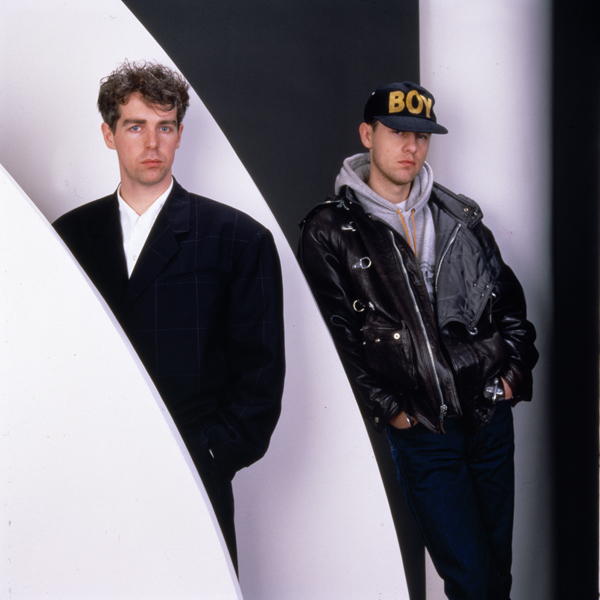
We also met a new set of legends, three acts who will dominate the singles chart in the late eighties/early nineties, and well into the 21st century in the case of one lady. Yes, Madonna finally scored a UK #1 with ‘Into the Groove’: a decent slice of dance-pop, though she’s got much better songs to come. Then Whitney Houston made an understated, jazzy entrance on ‘Saving All My Love for You’. While the Pet Shop Boys scored one of the decade’s strangest and best-loved (just not on this blog…) chart-toppers with ‘West End Girls’.

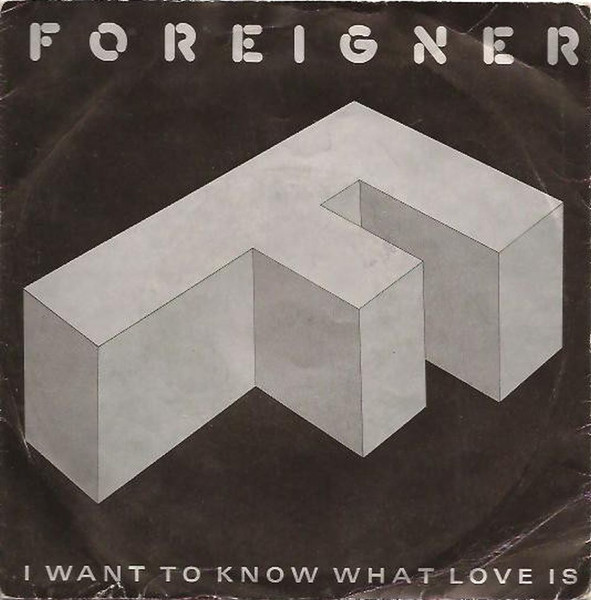
And before we get to the awards, we also have to recognise that we are still firmly in the age of the power ballad. Jim Diamond gave us our first taste of those big eighties drums, while Frankie Goes to Hollywood went spiritual for their final #1. Foreigner gave us what is, in my book, one of the worst examples of the genre. Jennifer Rush, meanwhile, gave us one of the very best in ‘The Power of Love’.

Advertisements

So. Let’s start with The ‘Meh’ Award for the most forgettable of the past thirty number one hits. There were three songs that really failed to get my pulse raising, for good or bad. UB40 & Chrissie Hynde’s plodding take on ‘I Got You Babe’, Midge Ure’s MOR ‘If I Was’, and George Michael’s (too) understated ‘A Different Corner’. The latter two didn’t connect with me simply because they’re not to my taste. ‘I Got You Babe’ didn’t connect because it’s a pretty insipid cover of a classic. UB40 & Chrissie take it.

Onwards, to the The WTAF Award, which rewards the songs that went for being interesting over being particularly good. Again, I have it down to three. Paul Hardcastle’s ‘19’: ground-breaking but gimmicky. Jagger & Bowie’s ‘Dancing in the Street’: camp silliness in the name of charity. And Falco’s ‘Rock Me Amadeus’: German camp silliness in the name of Mozart… I do like me a powdered wig: I’m giving it to Falco!

Now for the two biggies. The 19th Very Worst Chart-Topper. Again, I have three candidates. Cliff, Hank and the Young Ones’ ‘Living Doll’ was pretty dire. Except, it’s a charity record and I’ve literally just promised not to award them this… Bugger. Okay. That leaves us with Spitting Image’s ‘The Chicken Song’, a piss-take of novelty records that manages to be just as bad, if not worse, than the records it parodies. And the ultimate teeth-clenching, constipated, soft-rock power ballad: Foreigner’s ‘I Want to Know What Love Is’.

I should award it to ‘The Chicken Song’, because it is a horrible piece of music. But it’s supposed to be a horrible piece of music. It wants to you to recognise it as a horrible piece of music. It is the naughty child at the back of the class, begging for attention. We must ignore it and hope it goes away. I’m awarding this to Foreigner then, for condensing the worst of the overwrought, over-serious ‘80s into five minutes of fist-clenching earnestness.

Finally, the The Very Best Chart-Topper. To be honest, there isn’t a standout track. This wasn’t a massively strong bunch. Some of the previous ‘Bests’ would walk to the prize here. I liked ‘Chain Reaction’ and my birth #1 ‘The Sun Always Shines on TV’, but not quite enough to nominate them. I really liked Eurythmics one and only #1, the vocabulary-stretching ‘There Must Be an Angel…’ But, again, is it ‘Very Best’ material? Not for me. So, I have two in mind…

Showing Foreigner that power-ballads can be great if done properly: Jennifer Rush. And the only record of the past thirty that truly gets me tapping my toes: Dead or Alive’s ‘You Spin Me Round…’ It’s a tough one. Both are good for very different reasons. Both are songs I’ve liked for a long time. If ever there was a time for a tie, it’s this. But that’s a cop out. Put it this way: if I had five minutes to live, I’d want to hear Dead or Alive. They win… Just.

To recap the recaps, then:

The ‘Meh’ Award for Forgettability

  1. ‘Hold My Hand’, by Don Cornell.
  2. ‘It’s Almost Tomorrow’, by The Dream Weavers.
  3. ‘On the Street Where You Live’, by Vic Damone.
  4. ‘Why’, by Anthony Newley.
  5. ‘The Next Time’ / ‘Bachelor Boy’, by Cliff Richard & The Shadows.
  6. ‘Juliet’, by The Four Pennies.
  7. ‘The Carnival Is Over’, by The Seekers.
  8. ‘Silence Is Golden’, by The Tremeloes.
  9. ‘I Pretend’, by Des O’Connor.
  10. ‘Woodstock’, by Matthews’ Southern Comfort.
  11. ‘How Can I Be Sure’, by David Cassidy.
  12. ‘Annie’s Song’, by John Denver.
  13. ‘I Only Have Eyes For You’, by Art Garfunkel.
  14. ‘I Don’t Want to Talk About It’ / ‘The First Cut Is the Deepest’, by Rod Stewart.
  15. ‘Three Times a Lady’, by The Commodores.
  16. ‘What’s Another Year’, by Johnny Logan.
  17. ‘A Little Peace’, by Nicole.
  18. ‘Every Breath You Take’, by The Police.
  19. ‘I Got You Babe’, by UB40 with Chrissie Hynde.

The WTAF Award for being interesting if nothing else

  1. ‘I See the Moon’, by The Stargazers.
  2. ‘Lay Down Your Arms’, by Anne Shelton.
  3. ‘Hoots Mon’, by Lord Rockingham’s XI.
  4. ‘You’re Driving Me Crazy’, by The Temperance Seven.
  5. ‘Nut Rocker’, by B. Bumble & The Stingers.
  6. ‘You’ll Never Walk Alone’, by Gerry & The Pacemakers.
  7. ‘Little Red Rooster’, by The Rolling Stones.
  8. ‘Puppet on a String’, by Sandie Shaw.
  9. ‘Fire’, by The Crazy World of Arthur Brown.
  10. ‘In the Year 2525 (Exordium and Terminus)’, by Zager & Evans.
  11. ‘Amazing Grace’, The Pipes & Drums & Military Band of the Royal Scots Dragoon Guard.
  12. ‘Kung Fu Fighting’, by Carl Douglas.
  13. ‘If’, by Telly Savalas.
  14. ‘Wuthering Heights’, by Kate Bush.
  15. ‘Hit Me With Your Rhythm Stick’, by Ian Dury & The Blockheads.
  16. ‘Shaddap You Face’, by Joe Dolce Music Theatre.
  17. ‘It’s My Party’, by Dave Stewart & Barbara Gaskin.
  18. ‘Save Your Love’ by Renée & Renato.
  19. ‘Rock Me Amadeus’, by Falco.

The Very Worst Chart-Toppers

  1. ‘Cara Mia’, by David Whitfield with Mantovani & His Orchestra.
  2. ‘The Man From Laramie’, by Jimmy Young.
  3. ‘Roulette’, by Russ Conway.
  4. ‘Wooden Heart’, by Elvis Presley.
  5. ‘Lovesick Blues’, by Frank Ifield.
  6. ‘Diane’, by The Bachelors.
  7. ‘The Minute You’re Gone’, by Cliff Richard.
  8. ‘Release Me’, by Engelbert Humperdinck.
  9. ‘Lily the Pink’, by The Scaffold.
  10. ‘All Kinds of Everything’, by Dana.
  11. ‘The Twelfth of Never’, by Donny Osmond.
  12. ‘The Streak’, by Ray Stevens.
  13. ‘No Charge’, by J. J. Barrie
  14. ‘Don’t Give Up On Us’, by David Soul
  15. ‘One Day at a Time’, by Lena Martell.
  16. ‘There’s No One Quite Like Grandma’, by St. Winifred’s School Choir.
  17. ‘I’ve Never Been to Me’, by Charlene.
  18. ‘Hello’, by Lionel Richie.
  19. ‘I Want to Know What Love Is’, by Foreigner.

The Very Best Chart-Toppers

  1. ‘Such a Night’, by Johnnie Ray.
  2. ‘Cherry Pink and Apple Blossom White’, by Perez ‘Prez’ Prado & His Orchestra.
  3. ‘Great Balls of Fire’, by Jerry Lee Lewis.
  4. ‘Cathy’s Clown’, by The Everly Brothers.
  5. ‘Telstar’, by The Tornadoes.
  6. ‘She Loves You’ by The Beatles.
  7. ‘(I Can’t Get No) Satisfaction’, by The Rolling Stones.
  8. ‘A Whiter Shade of Pale’, by Procol Harum.
  9. ‘I Heard It Through the Grapevine’, by Marvin Gaye.
  10. ‘Baby Jump’, by Mungo Jerry.
  11. ‘Metal Guru’, by T. Rex.
  12. ‘Tiger Feet’, by Mud.
  13. ‘Space Oddity’, by David Bowie.
  14. ‘I Feel Love’, by Donna Summer.
  15. ‘Heart of Glass’, by Blondie.
  16. ‘The Winner Takes It All’, by ABBA.
  17. ‘My Camera Never Lies’, by Bucks Fizz.
  18. ‘Relax’ by Frankie Goes to Hollywood.
  19. ‘You Spin Me Round (Like a Record)’, by Dead or Alive

542. ‘The Power of Love’, by Frankie Goes to Hollywood

Frankie Goes to Hollywood complete their hattrick of number ones, with a ballad out just in time for Christmas.

The Power of Love, by Frankie Goes to Hollywood (their 3rd and final #1)

1 week, from 2nd – 9th December 1984

This one starts off very slow, very stately – gentle guitars and sparse piano – and completely out of sync with what’s gone before this year. ‘More is More’ has been the motto of 1984, with even the ballads being that little bit extra. This being Frankie though, there’s still a bit of weirdness amongst the calm… I’ll protect you from the Hooded Claw, Keep the vampires from your door… whispers Holly Johnson over the intro.

It slowly builds, though, into a more dramatic, orchestral beast. Soaring strings come in after the first chorus, in which we are told to make love your goal… There are ominous synths, and even a jazz bar piano at one point. It grows into its OTT-ness, and ends up quite camp. Under it all, it’s a simple enough love song. Yes, there’s a lot of biblical imagery – tongues of fire and souls being purged – but the key line might just be the heartfelt I’m so in love with you… I’ve no idea who it’s about, but I believe he means it.

Was this Frankie Goes to Hollywood making a bid for granny-loving respectability, after the huge controversy around ‘Relax’ and, to a lesser extent, ‘Two Tribes’? (I’m not the first person to point out that they went from sex, to war, to religion.) Well, the difference between this and their debut hit is remarkable. The video for ‘The Power of Love’ (directed by Godley & Creme of 10cc) is a straightforward re-telling of the Nativity, with Mary and Joseph, the shepherds and the wise men, making their way to the stable in Bethlehem. And no, the baby Jesus is not kitted out in bondage gear. But the sheer straight-facedness of it is actually what makes this record quirky enough for us not to shout ‘sell-out’.

At the same time, I can’t enjoy this as much as the band’s earlier, genuinely thrilling, chart-toppers. That’s to do with my personal tastes – ballads always have to try that little bit harder to crack my resistance – but also because this one goes on a bit, and has one chorus too many. It veers a little too close to self-indulgence.

But it made #1, and with it Frankie Goes to Hollywood became only the second act in chart history to have their first three releases reach the top. They did so twenty one years after another Liverpudlian act: Gerry & The Pacemakers. Their fourth single, ‘Welcome to the Pleasuredome’, would make #2, but when they came back with their second album in 1986 the magic seemed to have faded. It produced just one Top 10 hit, and the band split the following year.

They didn’t last long, but the hits live on. All their #1s have re-charted in the Top 20 at various points in the decades since. ‘The Power of Love’, in fact, has returned to the Top 10 twice, in 1993 and 2000, as well as a cover version #1 in 2012. And before we go, it’s worth noting that releasing songs called ‘The Power of Love’ was something of a trend in the mid-eighties. This one, Huey Lewis’s, and another, mega-ballad that we’ll be featuring on this countdown soon enough…

Advertisements

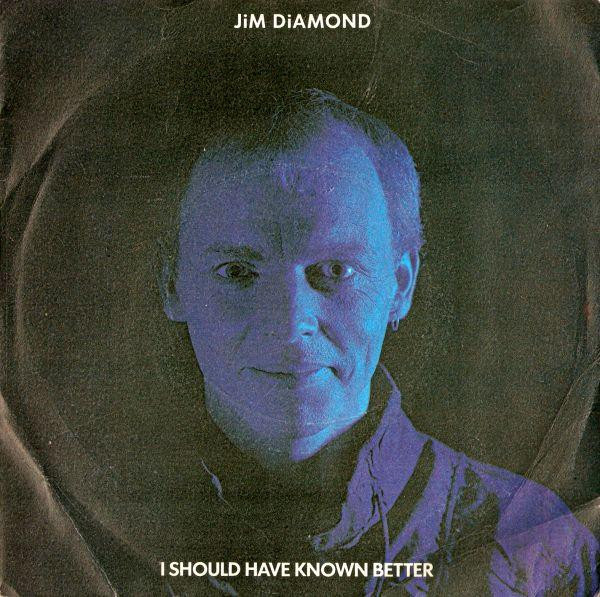
541. ‘I Should Have Known Better’, by Jim Diamond

On with the next thirty, and in 1984’s ongoing battle between ballads and bangers it’s another… ballad. I make that Bangers 6-5 Ballads.

I Should Have Known Better, by Jim Diamond (his 1st and only #1)

1 week, from 25th November – 2nd December 1984

I confess that the only thing I know about Jim Diamond is that he was Scottish. We Scots are brought up to know two things off by heart: our brave football defeats, and the singers that have represented our tiny country in charts around the world. There are actual compilation CDs with titles like ‘The Best Scottish Album… Ever!’, which stick The Bay City Rollers next to Jimmy Shand, but it’s not weird because they’re all SCOTTISH! (as if it was a musical genre to squeeze in between ‘samba’ and ‘ska…)

Anyway… All I knew about Jim Diamond is that he was Scottish and he had a surprise #1 in 1984, sandwiched among all the Wham! and Frankie Goes to Hollywood. A plucky #1. (Any Scottish successes, in sport, or music, or film, must be described as ‘plucky’. It’s a rule.) So it’s nice to finally put a song to the name. And it’s… not bad?

Diamond has a distinctive voice. It’s a good, white-soul voice, but the way he pronounces his vowels is odd… I shooda knohwn baytah… The song starts off nicely enough: standard mid-eighties balladry. I shoulda known better… To lie to one as beautiful as you… He regrets lying to his girlfriend mainly, it seems, because she was hot. Lying to ugly girls is, as we all know, okay. I can see what he’s going for, but it lacks depth. It’s a bit lightweight.

Then halfway through things get simultaneously better, and worse. Some huge drums come slamming in – this might be the first chart-topping example of those huge drums that just scream ‘1985!’ – and Diamond goes for it. Aiyayayayayayay… lo-ove yo-ou! Guitars soar. Fists are clenched. Chests are thumped. This common or garden ballad has become a power ballad.

But still it lacks something. Whether it’s in Diamond’s voice, which struggles the further this song moves from soul into rock, or in the production, which never goes as huge as, say, ‘Total Eclipse of the Heart’. That’s probably the reason why this record hasn’t taken its place in the pantheon of eighties ballads, and why this feels like a forgotten #1 in between 1984’s other enormous hits.

Still, I do quite like it, and am glad to have discovered it. It sounds like a great one to belt out after a few drinks (which, at the end of the day, may be the one unifying quality every Scottish song has). Jim Diamond’s career makes for interesting reading. He’d been active in the music industry since the late sixties, had been in a band with a future member of AC/DC, and had fronted a Japanese act (??) called BACCO, before finding fame as lead singer of new-wave band PhD. They had one big hit, and then Diamond went solo.

He’s not quite a one-hit wonder, as he would score a #5 a couple of years after his only number one. Diamond continued to record and perform up until his sudden death in 2015, aged just sixty-four. He will also feature, uncredited, on a couple of charity singles still to come. Sadly not, though, on the big one that’s on its way very soon…

Advertisements

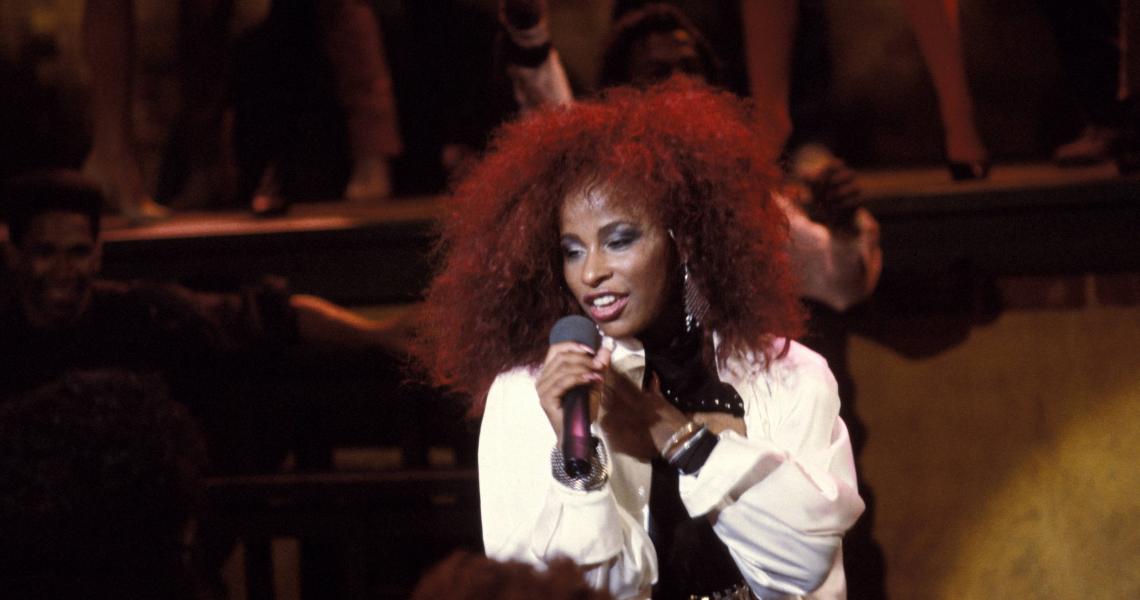
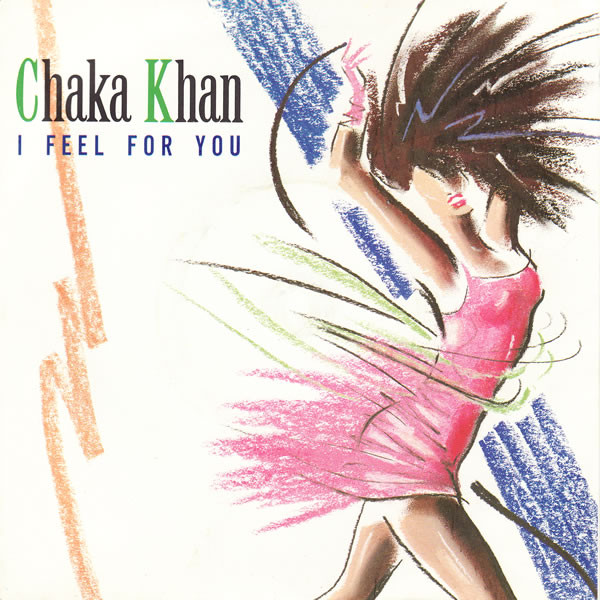
540. ‘I Feel for You’, by Chaka Khan

Chakakakakakaka-chakakhan… 1984 truly was the year of the in-your-face intro. ‘The Reflex’, ‘Wake Me Up Before You Go-Go’, now this. The most in your face of the lot?

I Feel for You, by Chaka Khan (her 1st and only #1)

3 weeks, from 4th – 25th November 1984

It probably stands out so much because of the rapping. Only the second example of rap at the top of the charts and, with all due respect to New Edition, this is the real stuff. The Lemme rock you Chaka Khan… lines are delivered at break-neck speed by one of hip-hop’s founding fathers, Melle Mel of Grandmaster Flash. It feels incredibly modern, a female singer being introduced at the start of a song, decades before Beyonce and Jay-Z, or Rihanna and Drake.

I did wonder if the rap might have been supplied by the writer of this song, one Prince Rogers Nelson. Prince is someone with a giant discrepancy between his fame and his UK chart-toppers (one, fairly lame, #1 a decade from now). But here at least is one of his songs, transformed from the slinky disco-soul original into a clattering beast of a record.

It seems that every song which topped the charts in 1984 was either a ballad or a banger, and ‘I Feel for You’ is very much the latter. Like Frankie and Duran Duran before, this record grinds and pounds, chops and changes, with that mid-eighties reimagining of Phil Spector’s Wall of Sound that’s become the vibe of the year. But while much of ‘84 has been Brit-dominated, this is a very American sounding disc, with its snatches of harmonica and horns, and its new jack swing energy.

Said harmonica was actually played by the last chart-topper but one, Stevie Wonder, while the song also features samples from his 1963 hit ‘Fingertips’, though you’d be hard-pressed to pick them out. It’s a bit of an all-star ensemble then: Chaka Khan, Melle Mel and Stevie Wonder, on a song by Prince. And it delivers: this is a great dance song, with a brilliantly funky bassline, a song that sounds like nothing we’ve heard at #1 before…

You can tell that this was written by Prince. Few people could throw out a line like I wouldn’t lie to you baby, I’m physically attracted to you… and make it work. Khan, in a brilliant move, delivers the lines like Prince, especially in the chorus: I fee-eel for you-oo… The one thing that I would change is that her voice is a little too far back in the mix.

The video ups the ‘80s Americana even further. Khan performs in an inner-city courtyard, with graffiti and wire fences, while a DJ scratches and spins, and break dancers throw shapes around her. It looks a bit funny now, but again must have looked very modern and very cool to suburban Britain in November 1984. In fact, ‘I Feel for You’ feels both new, in terms of its position in this countdown, and pretty dated, when you listen to it through your 2022 ears.

Maybe that’s why Khan’s only #1 isn’t as well remembered as her two other big hits: ‘I’m Every Woman’ and ‘Ain’t Nobody’, which would both chart twice, before ‘I Feel for You’ and then a few years later in remixes. It’s possibly the hip-hop element – of all the genres, rap ages the worst – but it’s a shame. It’s been great to discover this funky gem. Next up: a recap. Could ‘I Feel for You’ contend for the top prize…? Watch this space…

Advertisements

539. ‘Freedom’, by Wham!

Time for more effervescent pop from George and Andrew, as Wham! cement their place as the teen idols of the day…

Freedom, by Wham! (their 2nd of five #1s)

3 weeks, from 14th October – 4th November 1984

Like the duo’s first #1, ‘Wake Me Up Before You Go-Go’, it’s another backwards facing hit. And if that sounded like a subtle dig, then I didn’t mean it to. It’s wonderfully retro, a tribute to Motown and sixties vocal groups and the perfect follow-up to ‘Wake Me Up…’, which was pitched half a decade earlier, towards the days of doo-wop.

Every day I hear a different story, People say you’re no good for me… The chord progression in the verses sounds so familiar. I don’t know if it’s because ‘Freedom’ sounds like something, or if something released since has sounded like ‘Freedom’, or if it’s just such good pop that it sounds timeless. The verses, and the bridges – ending in that and you do-o-o… – are so strong that the chorus, when it comes, feels a little pedestrian. I don’t want your freedom… It follows the beat too much, and gets a little slowed down by it.

It’s not as instant as WMUBYG-G (what an ugly acronym) but then I did rather excitedly claim that as the catchiest song ever! It’s still a great slice of pop, though. Yes, Wham were teeny-boppers, but they proved that being a teeny-bop act needn’t mean being second rate. And the lyrics here are (slightly) darker than before. George’s girl is treating him properly bad, like a prisoner who has his own key, not just sneaking off to the dancing without him.

It is also a bit too long: five minutes even with an edit. The ‘solo’, where the boys adlib over that deliberate beat feels like they were killing time for some unknown reason. It’s not fair to compare – each song should be taken on its individual merits yadda yadda yadda – but WMUBYG-G was shorter, and even sweeter for it. (There are even seven-minute long mixes of ‘Freedom’, which is definite overkill.)

The video for this one is interesting, taking the form of a travelogue from the duo’s tour of China in 1985 (it must have been made several months after the song was a hit). They were the first Western act to play there since Mao’s rise to power, and they sold out stadiums despite nobody knowing who they were. One wonders if using the song for this video was intentional: I don’t want your freedom… sung over images of communist China?

So. Three of the past five chart-toppers have been written and performed by George Michael. (And Andrew. Let’s not forget Andrew!) Over half of the year so far has seen either Frankie Goes to Hollywood or George Michael at #1. Wham! won’t be back at the top in 1984, but under normal circumstances they would have been. They were about to release probably the world’s favourite Christmas hit (sorry Mariah…) only to see it kept off the top by… Well, we’ll save that for another time.

Advertisements

538. ‘I Just Called to Say I Love You’, Stevie Wonder

And so we reach the last of 1984’s colossal ballads. ‘Hello’, ‘Careless Whisper’, now this. Fifteen weeks at #1 shared between them. And can I admit, straight off the bat, that this is my favourite of the three…?

I Just Called to Say I Love You, by Stevie Wonder (his 2nd of two #1s)

6 weeks, from 2nd September – 14th October 1984

Yes, yes, yes. It is fashionable – and quite correct – to scoff at this silly little song for being THE Stevie Wonder’s only solo chart-topper. No ‘Superstition’ (a #11), no ‘Sir Duke’ or ‘Master Blaster’ (both #2s)… Only ‘I Just Called to Say I Love You’. And while it’s not anywhere near Wonder’s best work, there’s a charm to it.

It’s a lullaby of a song. And I don’t mean that it’s dull, like ‘Hello’; I mean there’s something in its strangely reggae-ish rhythm that just chills you out. Plus, it’s an easy song to remember, and to sing. It’s a song a mother might sing to their baby, or that a dorky boy might sing down the phone to his crush. It’s cute. It’s not Valentine’s Day, or New Year’s, or the 1st of spring (??)… Stevie’s just calling to say he loves you. (In fairness, some cynics have argued that if a man unexpectedly ‘just calls to say he loves you’, then he must just have done something fairly shitty…)

That’s not to say there isn’t quite a lot wrong with this song, though. The production is cheap and tacky – the drum machine is pure karaoke backing track. Then there are the key changes, which start early, on the second chorus, and just keep coming (to be fair, they are so cheesy I can help enjoying them). And then there are the three rinky-dink notes that it ends on, possibly the laziest ever ending to a number one single.

But I do like the ‘second’ melody – the higher, synth line that compliments the chorus. And if it were a little faster, and the production better, this could be a great song. Seriously. As it is, I like it a lot more than ‘Hello’ and, while I admire ‘Careless Whisper’, ‘I Just Called…’ is a simple love song, simply told. And that’s nice. At least it slightly redeems Stevie Wonder’s UK chart-topping career, after ‘Ebony and Ivory’

I’ve lived abroad for a lot of my life, in non-English speaking places, and I can confirm that this song is universal. ‘Top of the World’ by The Carpenters, ‘My Heart Will Go On’, this. And you can see why… Aside from the blatant sentimentality, which other cultures don’t seem to mind as much, the lyrics are slow and simple, and you can make them out clearly. As I’ve mentioned in posts before, that was a big bug-bear of my late Gran’s: pop singers you couldn’t make out. I never had time to ask, but I’ll bet she approved of this one.

Before we go, it’s worth noting how long songs are staying on top of the charts at the moment. In the last twelve months, we’ve had three 5-weekers, three 6-weekers, and a jumbo 9-weeker. There hasn’t been a one-week #1 for a year and a half. Not sure what this means, if anything, but it’s interesting. What’s also interesting (and slightly depressing) is that this is Motown’s biggest-selling record of all time in Britain. It’s a colossus and, yes, I do kind of love it…

Advertisements

537. ‘Careless Whisper’, by George Michael

We’ve had a famous chart-topper earlier this year that was obsessed with sex. Here, we have a number one that is all about sax.

Careless Whisper, by George Michael (his 1st of seven solo #1s)

3 weeks, from 12th August – 2nd September 1984

Can I just admit right now that ‘Careless Whisper’ has always left me feeling a little… icky? It’s the epitome of mid-eighties slickness: glossy, shimmering, and very heavy on the saxophone. But it’s an important record. Not only is it the first solo #1 for one of Britain’s biggest ever stars, but it set the template for boyband members looking to break away from their group, from Robbie Williams to Harry Styles.

I didn’t appreciate how early George Michael’s solo career began – just a few weeks ago Wham! were scoring their own first #1 – or how confidently he launched into it. This does not sound like the early fumblings of a boyband star going solo; this is a supremely well-made pop ballad. And, amazingly, he wasn’t even twenty when he and Andrew Ridgeley wrote it… His maturity and attention to detail can be found in the fact that he went through nine saxophonists before finding one who could play the famous riff to his liking.

I will not deny how well made this record is. And there are bits I can appreciate. The sax, for a start. This has to be the most famous use of the instrument on a pop single, alongside ‘Baker Street’, and the solo from ‘True’. And the chorus is timeless: I’m never gonna dance again, Guilty feet have got no rhythm… Both this and Wham’s earlier #1 have centred around dancing: on missing out on it, and now on being unable to do it through guilt…

Towards the end, as George is belting out that we could have been so good together… there is a real confidence on show. It’s a song that takes its time, that fills its five-minute runtime at a stately pace. It’s also an interesting lyric: Time can never mend, The careless whispers of a good friend… It’s a classic of late-night ‘love song’ hours on commercial radio, but it’s clearly a break up song… Now who’s gonna dance with me…? Is it also possible, knowing now what we do, that it’s about George hurting a girl thanks to him being gay…?

The video is everything you want from a mid-eighties ballad: soft-focus, gorgeous hair, pointless but moody ropes hanging from the ceiling, sexy yachts, a Princess Diana lookalike love-interest… But the fact that this record is so precisely of its time is what ultimately hurts it in my eyes. Give me the fun, retro stylings of ‘Wake Me Up Before You Go-Go’ over this.

I mentioned that this was the launch of George Michael’s solo career, when in actual fact it’s something of a false start. His next solo record will not be for another couple of years, when Wham! were indeed coming to an end. In fact, in the US ‘Careless Whisper’ reached #1 as a Wham! single. George Michael clearly wasn’t yet enough of a name to carry a record over there. That would change though, and quickly.

Advertisements

536. ‘Two Tribes’, by Frankie Goes to Hollywood

Slap bang in the middle of 1984 comes the year’s biggest hit, from the year’s biggest band.

Two Tribes, by Frankie Goes to Hollywood (their 2nd of three #1s)

9 weeks, from 10th June – 12th August 1984

Make that the decade’s biggest hit. No record will spend longer at #1 during the 1980s than this. Nine weeks, in which the best-selling song across the land was an ode to nuclear war. There are very few chart-toppers that have lines like: We’ve got the bomb, Yeah… Sock it to me biscuits now… But this is one. When two tribes go to war, A point is all that you can score…

On this, just their second release, Frankie (and producer Trevor Horn) were clearly sticking to the same formula as their first smash, ‘Relax’. Pounding, aggressive, disco-rock… check. A subject matter (and video) designed to raise eyebrows… check. Just the right mix of catchy and clever…?

Almost. The bass riff is thrilling, the splicing of Russian classical music with high-NRG dance is fun… But to my ears it’s all a bit of a mess, especially in the verses. It’s been a theme this year: hard-edged pop that’s bursting at the seams, constantly threatening to implode but just about keeping it together. ‘Relax’, ’99 Red Balloons’, ‘The Reflex’, now this… Maybe it was the impending threat of nuclear destruction (this is also already the 3rd chart-topper of the year to reference war and/or peace…), or maybe it was cocaine. But something was definitely in the air in 1984.

The video is another event in itself, with Ronald Reagan and Russian leader Konstantin Chernenko throwing one another around a sawdust ring. Chernenko only led the Soviet Union for a year or so – despite being nowhere near as famous as Stalin, Khrushchev, Gorbachev and co., he’s the one immortalised in this video… He grabs Reagan by the balls. Reagan bites his ear off. Holly Johnson drinks it all in as the ringside announcer. As the song reaches its final note, the planet explodes. If I had to choose, though, I think I’d spend my last moments on earth in the ‘Relax’ video, rather than this one.

I want to love this as much as I do ‘Relax’, but it falls short for me… I think it’s because ‘Relax’ is so simple, so gloriously filthy, and so universal. Songs about sex generally work. Songs about geopolitical tension can be hit or miss. Frankie try so hard to make it work – and it is still a banging, clanging, throbbing, pulsing wonder – but I think they overreach and, slightly, overcook it.

There were a million and one remixes of ‘Two Tribes’ – the ‘Annihilation Mix’, anyone? – but I like the classic single mix, with the air raid siren, and the public information announcer opening the song with: The air attack siren sounds like… By contrast, the album version is a little short, and missing the very Russian-sounding middle eight.

No doubt all those mixes helped this record to its giant stay at the top – the longest since 1977 – as well as similar promotion tactics to those that worked so well for ‘Relax’. But that’s not to suggest Frankie Goes to Hollywood weren’t genuinely massive in 1984. As ‘Two Tribes’ set up camp at #1 for the summer, their previous five-week chart-topper climbed back up to #2, making them only the fourth act to occupy both Top 2 positions after The Beatles, John Lennon and, um, John Travolta… They have one final number one coming up this year. And after two synth-rock thumpers, they’ll be changing tack, just in time for Christmas…

Advertisements