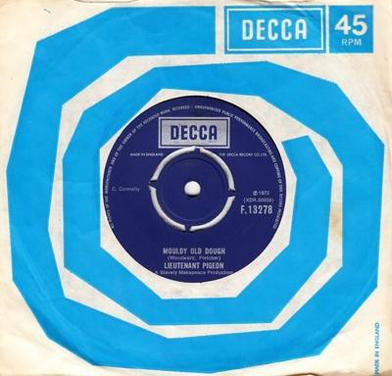
321. ‘Mouldy Old Dough’, by Lieutenant Pigeon

I’ve heard of this song before – for better or for worse – but don’t think I’d ever heard it, in full, until now. And boy, is it strange…

lieutenantpigeon000

Mouldy Old Dough, by Lieutenant Pigeon (their 1st and only #1)

4 weeks, from 8th October – 5th November 1972

It starts with a military drum beat, and for a second I’m worried that we’re getting 1972’s second pipes ‘n’ drums #1 single. Then we get a flute, and I’m picturing an orange march. Then we get a boozy, woozy, synthesised rock ‘n’ roll piano, and we’re in a crowded German beerhall.

Two immediate points of reference jump out at me. There’s Chicory Tip’s similarly stomping ‘Son of My Father’ from a few months back. And then there’s the work of Joe Meek a decade ago: The Tornados, and ‘Have I the Right?’ and so on. There’s a lot of similarities there, but they don’t fully explain what the hell is going on here.

‘Mouldy Old Dough’ is an instrumental, save for the title being growled by what sounds like a very old man with no teeth. Apparently the line Dirty old man… is also buried in there, deep within the soupy mix, but I can’t make it out. It is so rough and ready, this record. It sounds like an old demo that was burnt, buried in a shallow grave, then dug up years later, released and sent to the top of the charts…
download

Have you ever eaten durian? It’s a huge spiky fruit, really popular in south-east Asia, with a smell somewhere between sweaty socks and rotten onions. Apparently, though, if you can get past the stench the actual flesh of the fruit is quite nice. I’ve never been able to get past the stink but feel that ‘Mouldy Old Dough’ might be the durian fruit of #1 singles. Get past your initial doubts and reservations, your initial what the hell?, and by the third or fourth listen you start to find something charming buried deep within its relentless, plodding, churning beat.

The backstory of Lieutenant Pigeon only adds to the record’s charm. They were an experimental band from Coventry, fronted by Rob Woodward, and featuring his mum, Hilda, on piano. She’s basically the star of this record, as it’s her melancholy piano line that holds it all together. ‘Mouldy Old Dough’ was recorded in their living room (what I mistook for synths is just poor sound insulation!) When asked what it was all about, Rob admitted that he had no idea… Despite being the composer. Honest. I like it. The follow-up to this, ‘Desperate Dan’, made #17 and after that the charts were a Pigeon-free zone… The Woodwards are still the only mother and son combo to ever top the UK singles chart.

And isn’t that nice? Lieutenant Pigeon still record and release music to this day, mainly online, while Hilda died twenty years back. She was fifty-eight when this record hit the top of the charts, and she’s still in the Top 10 oldest people to feature on a number one single. By the end the marching beat has transformed into a glam-rock stomp as we fade out. As weird as this record sounds – and it does sounds pretty darn weird – it still somehow fits in with the styles of the time…
320. ‘How Can I Be Sure’, by David Cassidy

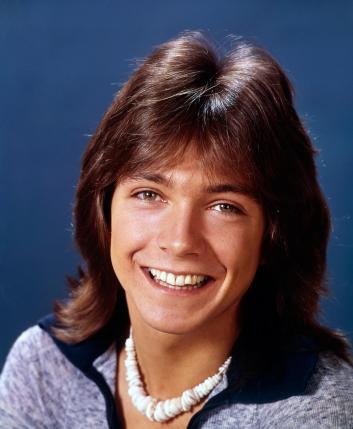
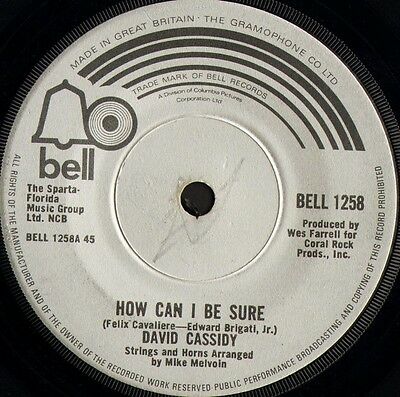
Unluckily for David Cassidy, I arrive at his first UK chart-topper – ‘How Can I Be Sure’ – and instantly think of Dusty Springfield’s version of the same song. It’s a version that I’ve known for years, and it puts young Cassidy at a bit of a disadvantage…

nintchdbpict000368494384

How Can I Be Sure, by David Cassidy (his 1st of two #1s)

2 weeks, from 24th September – 8th October 1972

…for which singer would want to be compared against Dusty? But hey. I’ll try to keep an open mind. This version opens a little gently: echoing guitars backed by an annoying ting – like a typewriter reaching the end of a line – before settling into a French accordion’s sway. Whenever I, Whenever I am away from you… I wanna die, Because you know I wanna stay with you…

Dramatic, right? Except this record never quite reaches the levels needed to sell the lyrics. How can I be sure? I really, really, really, really wanna know… He loves someone, but is overcome with self-doubt. Do they really love him back? How can he ever know? And that’s before you add in the ‘alibi’, who’s going around spreading nasty rumours about him… It’s just a shame that he sings it, for the most part, in a crooning style, never really letting loose. He sings it nicely, and enunciates his words wonderfully, but I’m not sold.

At least it’s not too sickly saccharine. I still have the aftertaste of ‘Puppy Love’ in the back of my throat… In my mind (and remember this all came a decade before I was born), Cassidy was the main rival of Donny Osmond, with the two pre-eminent teen-idols of the day competing to see who had the whitest smile and the most perfectly set hair. Both came from a showbiz family too, though Cassidy’s was the made-for-TV ‘Partridge Family’. In reality, Cassidy was a decade older than Osmond, so they would surely have been competing for different audiences, and by 1972 he had been photographed nude on the cover of ‘Rolling Stone’ by Annie Liebovitz and had been reported to have taken – shock horror – recreational drugs.

s-l400

So, David 1 Donny 0, if indeed it was a competition at all. You would, after all, have to go to some lengths to make a worse record than ‘Puppy Love’. At the same time, I’m struggling to have a strong opinion on this song. It’s fine. It’s nice enough. It’s no Dusty. It’s the perfect proof of a truly great singer, when they can take lyrics that sound a little trite in the voice of another, and give them meaning… But I do like the ending here, as the lines How can I, How can I, How can I… tumble and cascade over one another, like a wonky soundtrack in a circus big-top.

‘How Can I Be Sure’ had been around for a few years by the time David Cassidy recorded his version. It was originally a hit for The Young Rascals in 1967 – their version is meh – before Dusty in 1970 and David two years after that. And we’ll hold off on a full Cassidy bio, as he has another #1 to come in a year or so. Though, I have to admit that, until a few seconds ago, I had no idea that he passed away a few years ago…

318. ‘You Wear It Well’, by Rod Stewart

In which Rod Stewart scores his second number one single, by releasing a song that sounds suspiciously like his first. I mean, ‘Maggie May’ had been such a huge hit, his now-signature song, that you can’t blame him for trying to re-bottle lightning.

c1lq-28tuss-_sl1000_1

You Wear It Well, by Rod Stewart (his 2nd of six #1s)

1 week, from 27th August – 3rd September 1972

Not that it’s a rip-off (can you even rip-off your own song?), but it’s similar enough to sound like an off-cut from the same recording session. The intro meanders, as it did in ‘Maggie May’, before two drumbeats – dun dun – signify that we’re ready for the song proper to get underway.

I had nothing to do, On this hot afternoon, But to settle down and write you a line… Rod’s reminiscing about a woman he once loved. Who knows, maybe it’s Maggie…? He’s been meaning to call her, but thinks a handwritten letter would tug the old heartstrings a bit more effectively. You wear it well, A little old fashioned but that’s alright…

He reminisces about basement parties, her radical views, a birthday gown he bought her in town… Then he lays on the charm: Madame Onassis got nothing on you… It’s another wordy ballad, a little more electric than acoustic this time, while the fiddle from ‘Reason to Believe’ – the flip-side of his first #1 – makes another appearance to add some homespun charm. To be honest, I’m struggling to get into ‘You Wear It Well’. It’s a bit plodding, and the words sometimes get lost in the mix.

-688033

When you look the lyrics up, though, you see that there are some nice touches. The fact that he didn’t call because he’s in Minnesota and, y’know, that’d be a bit pricey, and the line: My coffee’s gone cold and I’m getting told, That I gotta go back to work… While at the end Rod hopes that she’s still at the same address. It’s not a record without charm; you just have to give it a few listens and dig a little deeper to find it.

But, you’d have to admit that if he had been trying to recapture the magic of his debut chart-topper then he’s not quite managed it. It’s strange to think that of all Rod Stewart’s big seventies hits which didn’t make the top of the charts – ‘You’re In My Heart’, ‘Tonight’s the Night’, ‘Hot Legs’ – ‘You Wear It Well’ did.

A short post, then. A nice enough song, and a nice enough addition to 1972’s parade of chart-toppers. It seems that to hit #1 in the summer of ’72 your record either had to be glammed up to the eyeballs, soppy teenybopper fluff, or an acoustic ballad. Let’s spin the tombola and see what pops up next…!

Follow my #1s playlist on Spotify:

317. ‘School’s Out’, by Alice Cooper

Aw, hell yeah! School heartthrob Donny Osmond finds himself elbowed out the way by school bad boy, and shock-rocker supreme, Alice Cooper. No more mister nice guy indeed!

D5rMk28WAAAr1nl

School’s Out, by Alice Cooper (their 1st and only #1)

3 weeks, from 6th – 27th August 1972

The charts of 1972 continue to swing wildly: acoustic ballad to glam to teeny bopper pap to this. Some anarchic hard rock. And it’s a great record, right from the start. The riff rings out, loud and clear, before the drums and the bass are added. (There are three songs that I cannot tell apart for the first five seconds or so: this, ‘Born to Be Wild’ by Steppenwolf, and Iggy Pop’s ‘The Passenger’. They don’t even sound that similar, so I’m not really sure why I have this problem…)

Vince Furnier said in an interview that in ‘School’s Out’ he was trying to capture the last three minutes of the school year which, along with Christmas morning, is the best moment of a child’s life: the nervous tension, the excitement, the sense that wonderful chaos is just around the corner. I’d say he managed it. Well we got no choice, All the girls and boys, Make all the noise, Cos they’ve found new toys…

There are famously no real punk-rock #1s… Is this, then, the first and only punk #1, several years before anyone knew what ‘punk’ was? It soon becomes clear that this isn’t just a song about two months of sun and no homework; it’s an anarchist’s manifesto. School’s out for summer… then it’s out for ever… then it’s been blown to pieces. The playground chants in between the verses move from No more pencils… To We might not come back at all…

R-15604226-1594390979-2958.jpeg

The best bit is the second verse, with its word-play: Well we got no class, And we principles… and the so dumb its actually pretty clever last line: We can’t even think of a word that rhymes! And then there’s the final verse – perhaps the heaviest moment in a #1 single so far – where the lead guitar squeals, and the drums beat out a pounding, tribal rhythm, as if the kids have rounded up all the teachers for a ritual sacrifice. Morality campaigner Mary Whitehouse managed to get it banned from featuring on ‘Top of the Pops’, an act for which Furnier sent her a bouquet of flowers in thanks for the free publicity.

‘School’s Out’ was the breakthrough hit for Alice Cooper, who had been seen as a bit of a novelty act until then with all their make-up and on stage pyrotechnics (they were friends of Arthur Brown). And actually, maybe ‘School’s Out’ still suffers from being seen as a novelty song, when in actual fact it’s a great hard rock track. The band would score a few more Top 10s off the back of this, before ‘Alice Cooper’ became Vince Furnier’s solo act. His biggest hit will arrive many years later: ‘Poison’ coming oh so close to the top in 1989.

In the end the bell rings, everybody cheers and then we all get sucked into a blackhole, a cool effect that caps off a startlingly fresh sounding #1 single. OK, in the end it might not quite be ‘punk’, but I’ll bet it felt amazing blasting this record out on the final day of 1972’s summer term. And speaking as a teacher, I have to say that this song speaks more to me now than it ever did as a kid…

Remembering Cilla Black

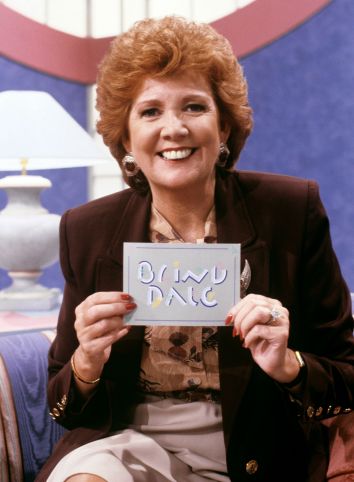
Growing up, the two things that I knew about Cilla Black was that she presented ‘Blind Date’ on a Saturday night (a program I wasn’t allowed to watch as a child, due to my mother’s long-held distrust of ITV) and that her real name was Cilla White.

1486481447-cilla-black-blind-date-1990s

As I got older, and all teenage, it would have been harder to think of anyone less cool than Cilla Black. She hung out with Cliff Richard, campaigned for the Tories, and had her hair set in a perfect early-nineties bouffant. Years ago I stumbled across a forum in which BA cabin crew posted horror stories about serving Ms. Black (always ‘Ms. Black’), how she would only sit in seat 1A, only drank a particular champagne, and would make her demands known only through her PA… (although, are you even a real celebrity if cabin crew don’t have a few bad things to say about you…?)

The one thing I didn’t know Cilla Black for, really, was the thing that started her off on her career of matchmaking and terrorising cabin crew: her singing.

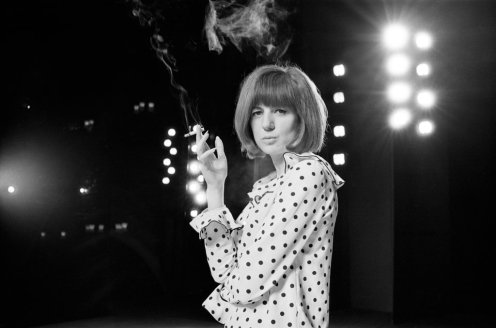
While her hit-making career didn’t last too long, the two chart-toppers she had in 1964 are both excellent ballads interpreted very well, by a very young woman. The first – ‘Anyone Who Had a Heart’ – a Bacharach & David number that stands as the highest-selling single of the 1960s by a British woman.

I love the way, in that performance, how she starts off simply, quite unspectacularly, before dropping an octave and letting loose. Then a few months later came ‘You’re My World’, an Italian melody with English lyrics. Both these hits stood out, when I wrote about them for this blog, because they stood out so much from Cilla’s contemporaries, the Merseybeat bands, and in particular her Cavern Club mates, The Beatles (who are in the audience for the performance below).

She would continue to have hits as the sixties went on, though no further number ones. I can’t claim to be the biggest expert on the later musical career of Cilla Black (and I will happily take recommendations from those who know better), but if I can choose one more video to embed, it would be her final UK Top 10, a #3 from 1971: ‘Something Tells Me (Something’s Gonna Happen Tonight)’.

Following this the hits dried up, although she kept on recording music even after reinventing herself as the 1980s/1990s go to woman for Saturday night ‘trash’ TV. (My mother’s words, not mine…) On this, the fifth anniversary of her death then, it is worth remembering that Cilla Black was, first and foremost, a lady who could hold a tune, and whose musical achievements have been slightly overshadowed by what came next.

00849490_1024x1024

Cilla Black, 27th May 1943 – 1st August 2015

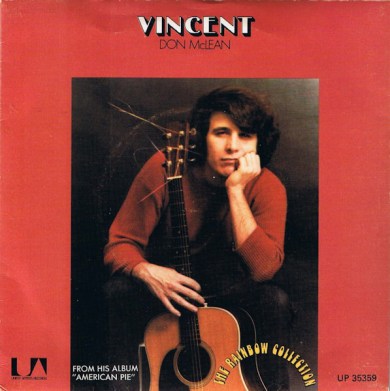
314. ‘Vincent’, by Don McLean

From the glorious, life-affirming swagger of ‘Metal Guru’… to one of the saddest #1 singles ever recorded.

mclean-american-pie-getty--735x413

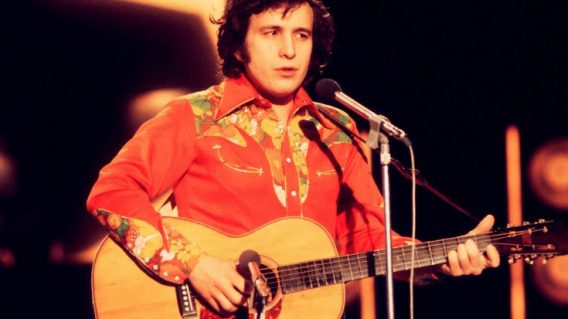
Vincent, by Don McLean (his 1st of two #1s)

2 weeks, from 11th – 25th June 1972

The ‘Vincent’ in question is the Dutch artist Vincent Van Gogh, who lived and painted in the late 19th century, to little recognition and with failing mental health until severe poverty and depression led to him shooting himself. Not the cheeriest of topics to start with, even before we get to the song itself, and certainly not the usual territory of pop singles.

It’s also one of the most articulate and descriptive chart-topping singles yet. Don McLean takes Van Gogh’s most famous works and turns them into lyrics: Starry, starry night, Paint your palette blue and grey, Look out on a summer’s day, With eyes that know the darkness in my soul…

It’s just a voice, an acoustic guitar, and some light, light backing touches. The gist of the song is that the singer sympathises with Vincent, that he recognises something of himself in the artist’s struggle (this was written before McLean hit the big time with ‘American Pie’), and that perhaps Vincent was the sane one after all. If people know one thing about Vincent Van Gogh, it’s that he cut off his ear and sent it to his brother. But that’s not all that he was. Now I understand, What you tried to say to me, And how you suffered for your sanity… It works also in the voice of Van Gogh’s brother, Theo, who was entwined in Vincent’s life, and who suffered equally under his brother’s illness. It’s strong stuff.

I love the idea that Van Gogh was too pure, too good for this ordinary world. It comes to a height midway through, as McLean describes the day Van Gogh committed suicide: For they could not love you, But still your love was true, And when no hope was left inside on that starry, starry night, You took your life as lovers often do… Some artistic license there, as he shot himself in a wheat field during the day, but it’s a powerful image – that he could have died on a night like the one in his most famous painting. But I could have told you Vincent, That this world was never built for one as beautiful as you… There’s also an urban legend that ‘Vincent’ was played to rapper Tupac on his death-bed, after he had suffered the same fate as Van Gogh. It was, apparently, his favourite song.

R-1456931-1342348675-5628.jpeg

It ends on a gut-punch. Each previous verse has ended on the hope that: They did not listen, They did not know how… Perhaps they’ll listen now…. On the final note, however, this changes to: They were not listening, They’re not listening still, Perhaps they never will… The idiots will always outnumber us. We’re all doomed…

Acoustic singer-songwriter type music is far from being my favourite genre. It’s all too easy to sound clever and profound as long as you sing softly enough and don’t plug your guitar in. Especially in the past few years, every male solo artist to hit the charts seems to have a beard, a beanie hat and observations to make. (I blame Ed Sheeran, personally, but then I’d happily blame all the world’s problems on Sheeran.) However, when a song is written and performed as beautifully as this, with a genuine message and genuine emotion, it’s very powerful. Don McLean had made his name just a few months before with ‘American Pie’, another song built around the death of a cultural icon. You have to wonder if ‘Vincent’ would have been such a big hit had ‘American Pie’ not come along first (it had reached #2 in the UK), especially as this sounds so out of place in a chart dominated by glam and bubblegum, though you’d hope it would have.

Last winter, in those final, blissful pre-coronavirus days, I visited the Van Gogh Museum in Amsterdam. If you have the chance to go one day, do! It displays his pictures in chronological order, and gives the background to his circumstances and mental state at the time of painting. When you get to the end, and see his very last works, it’s genuinely affecting. Maybe this song wouldn’t be hitting me so hard, had I not been there? Who knows. Under the museum is buried a time-capsule containing Vincent’s paintbrushes, and the sheet music to this song. Tens of thousands walk above it every year, to see the work of a once-ignored painter. People did listen, eventually.

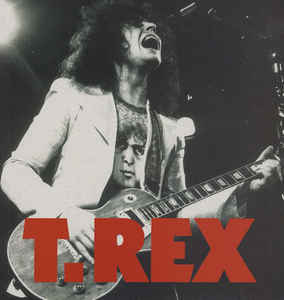
309. ‘Telegram Sam’, by T. Rex

Oh yes. Thrusting The New Seekers out of the way, thank God, with one flick of his corkscrew hair… Marc Bolan, ladies and gentlemen.

R-3472462-1331733929.jpeg

Telegram Sam, by T. Rex (their 3rd of four #1s)

2 weeks, from 30th January – 13th February 1972

With a chunky, crunchy riff that is part-electric guitar and part-sax, and some wonderful nonsense lyrics, T. Rex score their 3rd chart-topper in well under a year. This is a single that swaggers in to the room oozing arrogance and attitude – a band at the peak of their powers and popularity ever so slightly phoning it in. (OK, ‘Telegramming’ it in.)

Telegram Sam, Telegram Sam, You-ooh, Are my main man… The song is a list of characters, introduced one after the other. Golden Nose Slim, Golden Nose Slim, I-I-I, Knows where you’ve been… Who are these people? Are they people? Are they a band? Are they cocaine-fuelled imaginings? Who knows, who cares, when you can join Purple-Pie Pete, whose lips are like lightning making girls melt in the heat…

I did read that the line Bobby’s alright, Bobby’s alright, He’s a natural born poet, He’s just outta sight… is a reference to Bob Dylan, while the other references are people close to Bolan. His ‘main man’ was his manager, for example. And then there’s ‘Jungle-face Jake’, about whom one must make no mistake… That would be his managers assistant. Who was black. Yeah… Not the kind of lyric you would get away with writing these days. Moving swiftly on…

T-REX__TYRANNOSAURUS_REX_TELEGRAM+SAM-558429

Because this is a song written by Marc Bolan, there is of course a verse dedicated solely to himself. And isn’t the line: Me I funk, But I don’t care, I ain’t no square with my corkscrew hair… just perfect? There’s always a gem in amongst the nonsense with T. Rex. For the mini solo we get the same electric violin from Slade’s ‘Coz I Luv You’, and there’s lots of squealing and breathing from Bolan throughout.

Maybe it’s because it’s coming hot on the heels of Benny Hill and bloody ‘I’d Like to Teach the World to Sing’, but this record sounds super-thrilling and fresh – a blast from the future. Of all the bands that have ever existed, T. Rex are the one that I wish I’d been around for in real time. Of course it would have been great to have been a teenager at the birth of rock ‘n’ roll, or to have been around to hear ‘She Loves You’ for the first time in 1963, but I know that if I had been a fourteen-year-old in 1972, then I would have been sending my parents into a tizzy with my love of mascaraed Marc and his boys.

But I have to admit that, of T. Rex’s four number ones, ‘Telegram Sam’ is my least favourite. It’s a solid eight out of ten – that’s how good a band they were – but it doesn’t quite hit the heights of their other chart-toppers. Like I said at the start, it sounds like it’s been written to order. Still, as Marc Bolan can be heard breathing orgasmically just before the chorus: Sounds like the good stuff… Yes Marc, it certainly does.

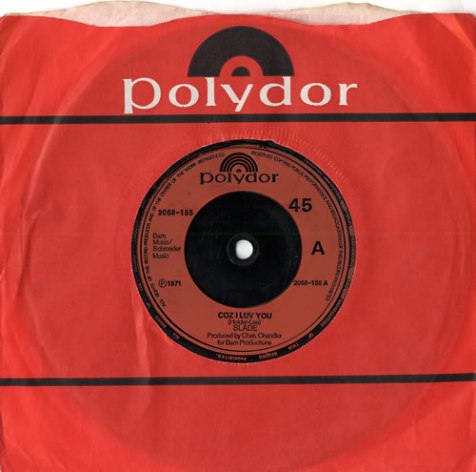
306. ‘Coz I Luv You’, by Slade

Without wanting to repeat myself… Having covered over three hundred #1s now, and I’ve come to realise the importance of a song’s intro. Sometimes, as a casual listener, they pass you by. But when you’re here to write about the song, when you’re poised to commit your first impressions to paper, the intro is everything.

image

Coz I Luv You, by Slade (their 1st of six #1s)

4 weeks, from 7th November – 5th December 1971

All of which is me building up to the fact that ‘Coz I Luv You’ has a great intro. In stereo, it sounds like someone in chunky boots, stomping down a corridor. Then the music, which can only be described as ‘menacing’. It’s Slade, Britain’s most successful glam-rock act, but this isn’t a very ‘glam’ record. Noddy Holder’s vocals start off light, and sneering: I won’t laugh at you, When you boo-hoo-hoo, Cause I love you…

Then a big beefy bass comes in, as Holder’s voice grows fuller: I just like the things you do, Don’t you change the things you do… You can draw a couple of similarities between this and the previous number one, Rod Stewart’s ‘Maggie May’ / ‘Reason to Believe’. Both songs are concerned with the singer being in love with a pretty terrible sounding woman. In ‘Coz I Luv You’: You make me out a clown, And you put me down… I still love you…

The other is the violin – though the country version from ‘Reason…’ has been distorted into an electric monster here, making the solo sound like an Irish jig from the bowels of hell. Apparently, Jim Lea – who played the violin on it – thinks the song sounds ‘soft’ and ‘namby-pamby’… Which begs the question: what the hell would he classify as ‘hard’? As the song fades out with the stomping and the violin, and some added shouting for good measure, it sounds like a gang of hooligans striding home from the pub, ready for their next punch-up.

SLADE_COZ+I+LUV+YOU+-+INJ-564322

I like this song, and I love Slade, but it stands out because it doesn’t really sound like the ‘Slade’ everyone knows. By their next number one they will, though. Like T. Rex, Slade had been around long before glam. Unlike T. Rex, they’d spent the final years of the sixties playing soul and Motown covers and sporting skinheads. Maybe ‘Coz I Luv You’ represents the last gasp of the ‘old’ Slade (Ambrose Slade, as they were called), before they sold their souls to glam. Though even at their peak, when they were wearing sparkly hats, platform shoes and cravats, I think don’t think they could ever quite mascara-out being four bruisers from Wolverhampton.

By the end, Holder’s voice has transformed completely, as he bellows out the closing lines. There’s another similarity to Rod Stewart – two of rock’s throatiest voices topping the charts in a row. One thing that is very Slade, and that’s already here in all its glory, is their shortened song titles. I used to think they looked crazily modern, using text-speak in the early seventies, when mobile phones were the stuff of science-fiction, but apparently it was an attempt to mimic the Birmingham/Black County dialect.

So, there we have it. This is already the second-last #1 of 1971 – it feels like we’ve raced through the year – welcoming some huge names: T. Rex, Rod, Slade… Middle of the Road… Like I said, and as I’m not sure came through from the write-up, I really like this song. It just sounds so belligerent, so menacing, so not #1-on-the-pop-charts material at all…

304. ‘Hey Girl Don’t Bother Me’, by The Tams

Our last number one was a glossy, highly polished number from one of the world’s biggest female stars – Ms. Diana Ross. Which contrasts completely with this rough-and-ready next chart topper.

9EcPD9eRbZXQzczmypYkeZKHPW4@383x305

Hey Girl Don’t Bother Me, by The Tams (their 1st and only #1)

3 weeks, from 12th September – 3rd October 1971

It starts with a simple drums and guitar intro. Then a refrain: Hey girl, don’t bother me… Hey girl, don’t bother me… Standard male vocal group stuff – think the Four Tops or the Miracles – but on a budget. Someone’s going for the Motown sound but without the backing of a major record label.

The lead singers voice is raspy and endearing: I heard about you from my friends… (I love the way he drags ‘friends’ out in a very ‘Murican way) The word really gets around… They say you broke the heart, Of every boy in town… He begs this floozy to stay away: Stay outta my arms, Don’t try to use your charms… Don’t bother me…

It’s a sweet song, despite the subject matter, and one that’s likeable from the start. When the handclaps start it seals this disc’s lo-fi charm. In the second verse, the singer admits that the girl is tempting, despite her reputation: But I really gotta say, You look so fine… He stands firm, though, determined not to be added to her list.

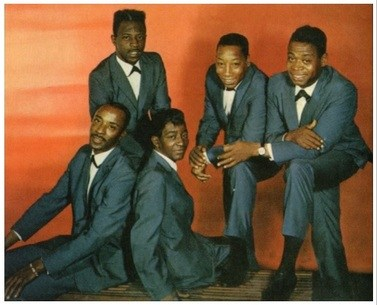
‘Hey Girl Don’t Bother Me’ stands right out in this countdown. We’re in the autumn of 1971, but this song sounds like a complete throwback. And that makes sense, seeing as it was recorded in 1964. To my ears it could have been even earlier. The Tams were a vocal group from Atlanta, who had had minor chart successes in the sixties but whose records were picked up by northern soul clubs in the UK. I can’t claim to be an expert on the northern soul scene in the seventies, but it was an offshoot of Mod culture, mainly in clubs in the north of England: Manchester, Wigan, Blackpool, down to Birmingham. They pushed lots of old soul discs back into the charts, and this one by The Tams made it all the way to the top.

611KpmwaVEL._AC_SL1280_

You can see why ‘Hey Girl…’ took off like it did. It’s a throwback, but it has enough of a guitar line and a stomp for it to fit in with the early seventies’ sound. You can imagine Mud doing a soft-glam cover version. Though I’m sure The Tams weren’t complaining, or inquiring as to the reasons for their sudden career resurgence in the UK. They will enjoy another mini-comeback fifteen years later, when their hit ‘There Ain’t Nothing Like Shagging’ makes #21 in 1987. (Stop giggling there at the back!) The ‘Shag’ is a dance, you see, (the official state dance of South Carolina!) and according to the song: There ain’t nothing like shagging, When you’re shagging with the one you love… There was a follow-up too – ‘My Baby Sure Can Shag!’ (Stop it!) Unfortunately, both were banned by a humourless BBC because ‘shagging’ means, erm, something else in Britain…

Anyway, back to ‘Hey Girl…’ It’s worth nothing that this is the third re-release to make #1 in the space of a year, following ‘The Tears of a Clown’ and ‘Voodoo Chile’. Not sure what to make of that… Were people already missing the sixties? Was it just a coincidence? It’s certainly adding to the already very eclectic feel of the charts in the early seventies!

Follow the #1s Blog playlist here.

303. ‘I’m Still Waiting’, by Diana Ross

For the second time this year, a former member of one of the sixties biggest groups scores a solo #1 single. From George Harrison, to Diana Ross. From The Supremes, to Diana Ross & The Supremes, to Diana. Just Diana.

90d2da18d8344f797cac2af08c389eef

I’m Still Waiting, by Diana Ross (her 1st of two #1s)

4 weeks, from 15th August – 12th September 1971

The first word that comes to mind when this record intros is ‘polished’: polished strings, glossy production, not a dollar spared. Ross’s vocals, when they come in, are breathy and crystal clear. I remember when, I was five and you were ten, boy… Diana Ross, as always, has a voice you could swim in.

She’s loved this lad since they were kids, thought they were destined to be together, only to one day be told: Little girl, Please don’t wait for me, Wait patiently for love, Someday it will surely come… But Diana can’t take this advice, can’t give up on her first love. She’s still waiting.

It’s a record that I’m struggling to get into. I can see that it’s good – well-structured and beautifully recorded. It’s pop, but for grown-ups. Sophisticated soul. By the seventies, the people who had grown up buying pop music were getting older, and that starts to show in the number of AOR/MOR (not sure if these terms existed in 1971, but still) tracks that will become huge hits in this decade. Pop was no longer just for teenagers.

71wIjfmoBJL._SL1280_

And as I play it again, ‘I’m Still Waiting’ is slowly growing on me. I don’t love it, yet, but it’s gradually imprinting on my brain. It’s not short of hooks – the Little girl chorus is catchy, as is the And I’m still waiting… that hangs at the end of each of chorus. And there’s the I’m just a fool…! from the backing singers. And then, Diana speaks. Love has never shown his face, Since the day you walked out that door… Come back, Can’t you see it’s you I’m waiting for…

Will he ever come back? We’ll never know. The song shimmers to a fade-out. I can’t say I knew much about this record before writing this: it’s not one of Ms. Ross’s many hits that I could have named, that didn’t top the charts. Apparently it was one Tony Blackburn who plugged this album track so much on his radio show that Motown gave permission for it to be released in the UK. And it’s a sign of Ross’s longevity and sheer star quality that this #1 comes seven years after her first chart-topper with The Supremes (‘Baby Love’) and fifteen (!) years before her next chart-topper. She was a huge musical presence for the best part of five decades, and it’s been nice to discover this forgotten gem.

Listen to every number one single so far, here.