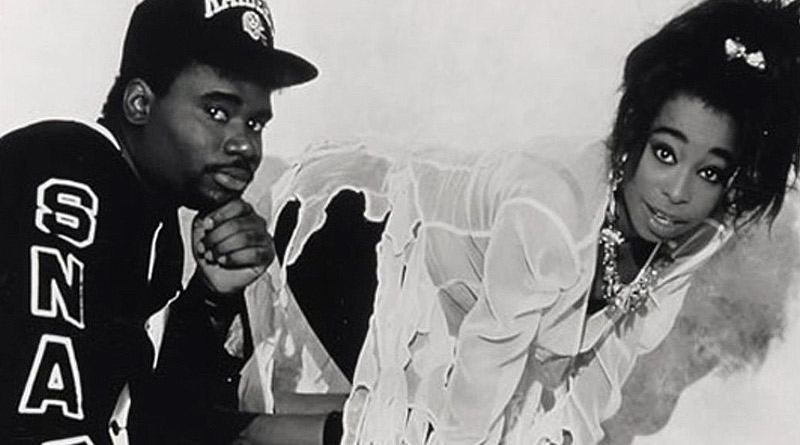
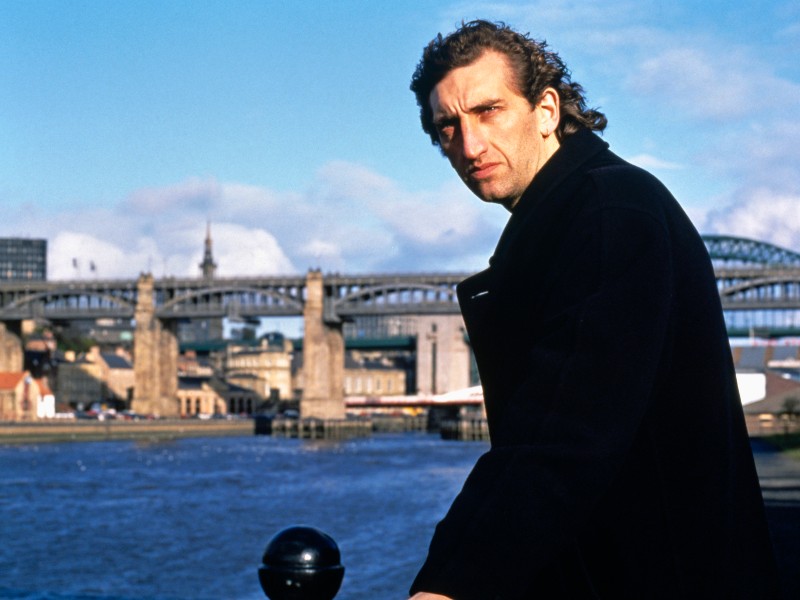
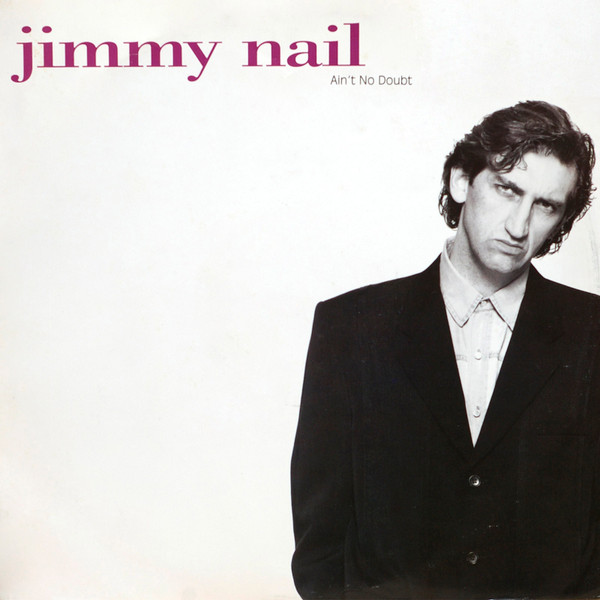
This next number one arrives shrouded in mystery… I was alive and kicking in the summer of 1992, all of six and a half years old, but the names Jimmy Nail and ‘Ain’t No Doubt’ don’t really chime with me at all…
Ain’t No Doubt, by Jimmy Nail (his 1st and only #1)
3 weeks, from 12th July – 2nd August 1992
I know he’s an actor, but for some reason I had Jimmy Nail down as the guy who played Crocodile Dundee. (He clearly wasn’t – he’s from Newcastle-upon-Tyne; not Newcastle, New South Wales – and my mistake comes from the fact that one of his later hits was ‘Crocodile Shoes’.) And when you see the terms ‘actor’ and ‘number one single’ together, knowing what we’ve heard from Telly Savalas, David Soul, Nick Berry and the like, the blood does tend to run cold…
But, in fairness, this quite a sophisticated, adult-orientated pop song. There’s a very early-nineties beat, with horns and heavy piano chords, alongside nods to seventies soul and disco. Nail talks his way through the verses, Geordie accent and all, describing a relationship gone sour: Oh yeah, I know a goodbye when I hear it… Which leads me to wonder if he can actually sing. Then the chorus comes along and blows my doubts away – Jimmy’s got a set of pipes on him.
Said chorus is slightly bizarre though, as the Ain’t no doubt it’s plain to see, A woman like you is no good for me line follows the call-and-response rhythms used by marching soldiers. ‘I don’t know what I’ve been told…’ followed by something saucy about Eskimos, etc. etc. Nail admitted that he wrote the song shortly after watching ‘Full Metal Jacket’. It gives the song a clear hook, but it comes off as a little gimmicky to my ears.
Pre-listening, I did wonder if this might be a novelty record, a comedy cash-in on an actor’s fame. It isn’t, but the marching beat chorus, along with the bridge where a female singer trills sweet nothings (I don’t want nobody else, I love you… while Nail replies with a deadpan: She’s lying…) add a comedy element to it, intentionally or not. Still, it’s a very listenable record, far above some of the earlier chart-toppers sung by actors, one that’s improving with each listen I give it.
Jimmy Nail was no stranger to chart success, having scored a #3 hit in 1985 with a cover of Rose Royce’s ‘Love Don’t Live Here No More’, after he’d found fame in the comedy ‘Auf Wiedersehen, Pet’ (which, to be honest, I should have known him from, as my parents were big fans). He resurrected his music career with this single, after starring in police drama ‘Spender’, while his last big hit would come in 1994, from the aforementioned ‘Crocodile Shoes’ (not, sadly, ‘Crocodile Dundee’). I’m sure the reason why I’m so foggy on Jimmy Nail is the fact that he retired sometime in the ‘00s, and rarely appears on TV or film these days.
The 1990s will keep up the tradition of actors becoming singers, which has been with us since the earliest days of the charts, with mixed results. We have of course recently seen Kylie and Jason become mega stars, while we will probably look back very fondly on Jimmy Nail after dealing with the likes of Robson and Jerome, and Martine McCutcheon…
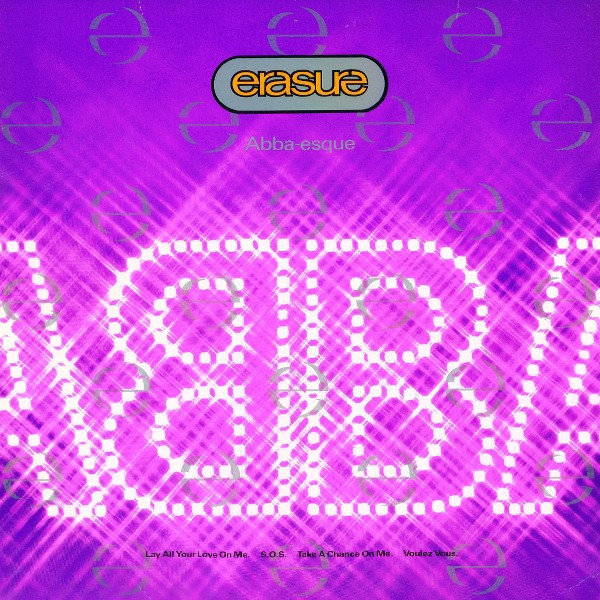
Can there be anything camper than Erasure covering ABBA? How about Erasure recording an entire E.P. of ABBA covers, and called it ‘ABBA-esque’?
ABBA-Esque (E.P.), by Erasure (their 1st and only #1)
5 weeks, from 7th June – 12th July 1992
ABBA scored nine #1s between 1974 and 1980, making them at this point in time the fifth most successful chart-topping act (behind Elvis, the Beatles, Cliff, and The Shadows). But luckily, three of the four tunes Erasure chose to cover didn’t make top spot originally. Starting with, perhaps, ABBA’s greatest non-number one single…
I’m not sure which was the ‘lead’ single from the E.P. – I get the feeling it was track three, but they made videos for all of them – so I’ll go through them in order. We kick off with ‘Lay All Your Love on Me’, which was only ever released by ABBA as a 12” single. It’s the most faithful cover of the four, with the mood and tempo kept, and just the instrumentation updated to a post-SAW, Hi-NRG style. I love that they don’t change the pronouns in the lyrics, as most acts do when covering a song originally sung by a different gender, and we’re treated to Andy Bell asking how a grown up woman can ever fall so easily…
Of the four, I don’t think I’d ever heard their take on ‘S.O.S.’ before. And, of the four, it’s my least favourite. ‘S.O.S.’ is an important song in the ABBA canon: the song that extended ABBA’s career beyond simply being Eurovision winners; a genuine rock classic beloved of Ray Davies, Pete Townshend and The Sex Pistols. This over-processed take, though, fails to capture the soaring joy that can be found in the when you’re gone, how can I even try to go on… line in the original.
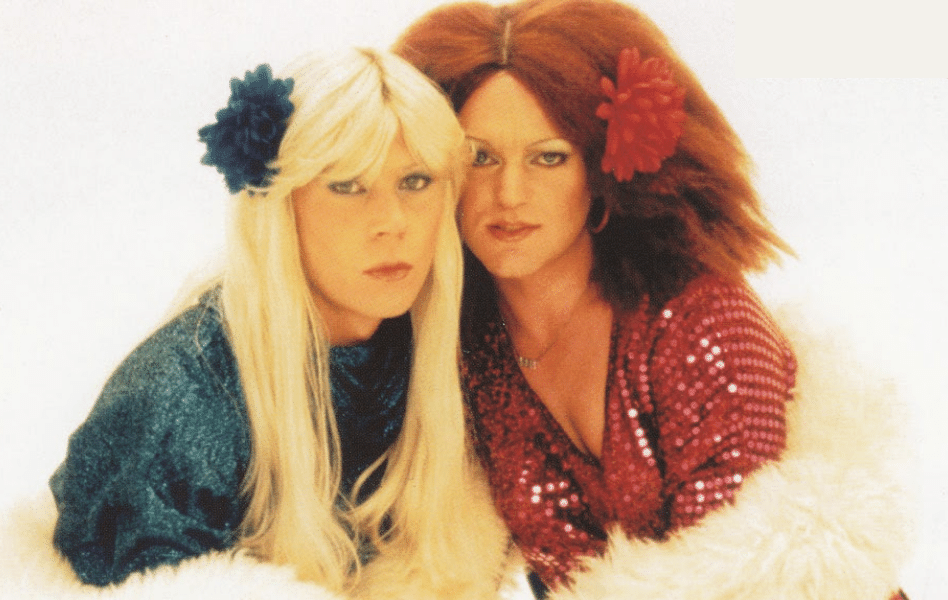
Track three then, and the one that represented this E.P. as a whole. ‘Take a Chance on Me’was an ABBA chart-topper, back in February 1978. It’s an improvement on ‘S.O.S.’, but they’ve gone moodier than the original. They’ve also gone very early-nineties and added a ragga-style rap, or toast, by one MC Kinky. It’s a bold move, but then by this point in the E.P. maybe they were thinking it might have started to feel a bit by-the-numbers. It certainly shakes things up. The video for ‘Take a Chance…’ is the highlight of the entire project: Vince and Andy pout, gurn and flirt with one another, both as themselves and in drag as Agnetha and Frida. I’m sure it was done lovingly, but I do wonder what the ladies thought…
We end on what is probably my favourite of the four: a pounding, throbbing, techno-take on ‘Voulez Vous’. The intro, in fact, isn’t a million miles from something you’d hear at a hardcore rave. Here Erasure succeed in completely updating disco-era ABBA to a 1992 sound, which is testament either to the strength of their interpretation, of Benny and Björn’s songwriting, or maybe both. (‘Voulez Vous’ also includes some of my personal favourite ABBA lyrics: I know what you think, The girl means business so I’ll offer her a drink… and We’ve done it all before, And now we’re back to get some more, You know what I mean…)Years later, a fifth cover – ‘Gimme! Gimme! Gimme!’ – was added to the E.P., but as it wasn’t around when this topped the charts I won’t bring it up.
Are any of the four covers better than the originals? No, of course not. But that doesn’t mean that this wasn’t a worthwhile exercise. For a start it got Erasure an overdue #1, after almost a decade of releases and twelve previous Top 10 hits. But even better than that, it started The ABBA Revival.
It seems strange to say in 2023, but even I can remember a time when ABBA weren’t the world’s most beloved band. By the late-eighties they were a punchline, an embarrassment, records to be hidden under the bed rather than publicly displayed. Erasure unashamedly covering four of their hits, allowing kids to discover them and adults to remember just how good ABBA had been, started us down the road to ‘ABBA Gold’ (which was released later in 1992) becoming one of the biggest-selling albums of all time, to ‘Muriel’s Wedding’, to the ‘Mamma Mia’ stage show and films, to the band’s holographic comeback. As a ‘thank you’, ABBA tribute act Björn Again (who in 1992, believe it or not, opened for Nirvana – Kurt Cobain being another factor in the ABBA-naissance) released ‘Erasure-ish’, with covers of ‘A Little Respect’ and ‘Stop!’
Do my ears deceive me, or are we entering yet another new phase in dance? As someone who isn’t that into dance music, the way in which I’ve been noticing new trends in the genre has surprised me… From house in the mid-80s, to sampling, to the rave influenced early nineties hits… And now we enter the ‘golden age of dance’.
Please Don’t Go / Game Boy, by KWS (their 1st and only #1)
5 weeks, from 3rd May – 7th June 1992
I don’t think people actually call it that. But between 1992 and 1997, even though Britpop is what the 1990s are remembered for, it was dance music that ruled the charts. And I’d say it starts here, with what is a fairly lacklustre remake of a KC & The Sunshine Band hit from a decade or so earlier…
Even as someone who doesn’t love dance music, I’m excited at the prospect of covering some of the dance number ones on the horizon: the Prodigy, Chemical Brothers… 2 Unlimited. But for every fun and fresh electronic #1, there are lazy remakes like this. It’s got a fairly low beats-per-minute – though not slow enough to be ‘chillout’ – it’s got elements of house, a hint of trance… It dabbles in different styles, but doesn’t commit to any, and ends up quite dull. (To be fair, the original is also fairly pedestrian, compared to KC’s more famous hits. It made #3 in 1980, and was also the first Billboard chart-topper of the ‘80s.)
And yet, this fairly forgettable tune was number one for five weeks… Perhaps now is as good a time as any to address the elephant in the room. We’re almost halfway through 1992, and we’ve only had four number ones. As I mentioned in an earlier post, 1992’s turnover is the slowest for thirty years, and it’s down to two things. We’re in one of those slumps that come along every decade or so: think the early sixties, between rock ‘n’ roll and the Beatles, or the mid-seventies, between glam and new wave. Currently we’re puttering around lost between the SAW-led late-‘80s and Britpop.
In addition, the way people were buying music was changing. After decades as the main format, vinyl ‘45s were slowly being phased out in favour of CD singles. At the peak of vinyl’s popularity, in the late 1970s, an act had to sell an average of 150k copies to make number one; in 1992 it was taking only 60-70k. By the end of this decade, the CD will be at its peak, and the turnover of #1s will be at record-breaking levels (1992 has twelve #1s, 2000 has forty-two!) There will be a similar slow-down in the mid-00s, as CDs die and downloads take over, and then again in the late 2010s as streaming becomes the default for how we consume music.
Anyway, after that detour into chart logistics, we mustn’t forget that this was a double-‘A’ side, and we have another song to write about. A song that is bloody hard to track down. Nothing on Spotify, and one trippy YouTube video, which leads me to assume that ‘Game Boy’ didn’t get much airtime when ‘Please Don’t Go’ was riding high in the charts. And when I listen to it, my doubts are confirmed. It’s probably the closest we’ll ever come to a happy hardcore #1. It’s an instrumental – been a while since we featured one of those – and it feels almost retro in the way it appears to be a bunch of samples strung together to make a hot mess of a tune.
I like it, more than its flip-side, for about a minute. Then it outstays its welcome. Who decides when a ‘B’-side becomes a double-‘A’? Record companies? The band? The charts themselves? Because I’d file this with ‘Girls’ School’ and ‘Anitina’ as an ‘A’-side that is much less well-known than many ‘B’-sides. But it’s there, in the record books, and we have to cover it. And it is, like I said, an aggressive style of dance that wouldn’t have otherwise featured at #1. Plus, it references the classic game console of the age in its title, which is nice.
KWS were a trio from Nottingham, named in ABBA-style as an acronym of the members’ surnames, and this was their first ever chart hit. They owed their chart fortunes to the fact that an Italian group called Double You had covered ‘Please Don’t Go’, but their record company had failed to secure UK distribution. KWS stepped in to record a remarkably similar sounding version, resulting in three years of legal action. By the time the record labels had settled up, KWS had long since ceased to be a chart concern. Their only other Top 10 hit was another remake of a much older dance tune, George McCrae’s early disco hit ‘Rock Your Baby’.
I play the intro to our next number one, and am convinced that I am actually listening to The Proclaimers’ ‘I’m Gonna Be (500 Miles)’. Listen to the two of them back to back, and you won’t be able to un-hear it. But this is not the brothers Reid (their time will eventually come), but the brothers Fairbrass…
Deeply Dippy, by Right Said Fred (their 1st and only #1)
3 weeks, from 12th April – 3rd May 1992
It’s also slightly discombobulating to hear Right Said Fred singing a song that isn’t ‘I’m Too Sexy’, their monster hit from a few months before, which had spent six weeks at #2, prevented from featuring on this blog by the dreaded Bryan Adams. But yes, they had other songs. One of which did make number one. And, in all honesty, it might be the better tune.
I’m finding it hard to write about this record without using horrible words like ‘jaunty’, or ‘ditty’. For this is undeniably a jaunty ditty. From the alliterative title, to the springy acoustic rhythm, to the brass section that comes blasting in mid-way through. And then there’s the nonsense lyrics: Deeply dippy ‘bout the curves you got…
It’s actually just as sex-obsessed as ‘I’m Too Sexy’ – love as a ‘contact sport’ (let the neighbours talk) – but also has a swing at being romantic. Oh my love, Let’s set sail for seas of passion… It’s a song, like Vic Reeve’s ‘Dizzy’ not so long before, that just about manages the balance of being a novelty, and remaining listenable. In fact, if you were in the right mood, the moment where the horns come in could be downright jubilant.
It’s also an odd number one for this moment in time, wedged in among the dance tracks and ballads, one that might have been a hit in any era, that is as likely to get your granny dancing as it is your five-year-old nephew. But there’s little doubt that this wouldn’t have been anywhere near as big a hit without ‘I’m Too Sexy’ laying the groundwork. We can add Right Said Fred to acts like Don McLean, Alvin Stardust, and a-Ha, whose ‘big’ hit isn’t actually their biggest.
Right Said Fred were Richard and Fred Fairbrass, plus guitarist Rob Manzoli, and were named not for that Fred, but after a Bernard Cribbins song from 1962. Richard had already had a fifteen year career as a bassist for Boy George, Mick Jagger and David Bowie, while Fred had played guitar for Bob Dylan. In the late seventies, the pair toured with Joy Division. So, quite the musical chops for a duo often written off as one-hit wonders.
‘Deeply Dippy’ was the third of four Top 10 hits for Right Said Fred, but they continue to record. Fairbrass the elder has had quite the career since his chart-topping days, hosting ‘GayTime TV’ (the first BBC programme to be aimed at an LGBT audience), being targeted and beaten up by Russian ultra-nationalists, and in later years turning into something of a Twitter conspiracy theorist, as well as most recently accusing Beyonce of ripping him off. Deeply dippy, indeed.
Our next number one follows nicely on from the first chart-topper of the year, Wet Wet Wet’s ‘Goodnight Girl’. At least at first…
Stay, by Shakespears Sister (their 1st and only #1)
8 weeks, from 16th February – 12th April 1992
The opening two minutes are paired-back, moody, and again almost a cappella. If this world is wearing thin, And you’re thinking of escape… The voice is memorably kooky, a slightly higher-pitched Cyndi Lauper, to my ears. It lulls you, draws you in, takes you a moment to realise that the lyrics are pretty dark: When your pride is on the floor, I’ll make you beg for more…
It’s not ‘Stay’ as in ‘please stay, baby’. It’s ‘Stay’ as in ‘stay… or else!’ So, darker than first anticipated. And then things get very dark indeed, when one-third of Bananarama comes crashing through the doors, and the song flips to grungy, industrial rock. You better hope and pray, That you make it safe back to your own world…she crows, relishing her pantomime villain role.
The two contrasts – the soft, gospel opening half against the heavy final two minutes – are complemented by the two very different voices. What could have been a nice but fairly run-of-the-mill ballad (like, say, ‘Goodnight Girl’) becomes something else altogether. Towards the end the first voice takes over again, much more frantic now, begging their lover to stay.
‘Stay’ really has to be listened to in conjunction with its bizarre, award-winning video. One Shakespears Sister – Marcella Detroit, very pale and panda-eyed – sits by a dying man’s bedside while the other, Siobhan Fahey, barges into their hospital room looking like a slimmed-down Ursula from ‘The Little Mermaid’. The two women wrestle over the man, before he finally comes back to life in Detroit’s arms, and Fahey shuffles off with a roll of the eyes. It’s every bit as melodramatic as the song, and very camp.
By the end, this has turned into one of the stranger chart-toppers of recent years. It’s very hard to pin down, and whoever described it as ‘a weird sci-fi ballad of gothic-gospel electronica’ for PopMatters is pretty spot on. It was written by both women (managing to chart higher than Bananarama ever did), alongside Dave Stewart of the Eurythmics, who was then Fahey’s husband.
Shakespears Sister was Fahey’s post-Bananarama solo project, with Detroit joining a bit later. (This was one of the only songs on which Detroit sang lead, and its success apparently annoyed Fahey.) The duo’s name was a misspelling that stuck, inspired by the Smith’s song of the same name, which had in turn been inspired by Virginia Woolf’s ‘A Room of One’s Own’, which eventually leads us all the way back to William himself. A fittingly literary heritage for a song that packs an epic story into less than four minutes. They’d had one Top 10 hit before this, and would have one more after, but it is for ‘Stay’ that they are to this day best remembered.
Into 1992 we go, then. A year that it won’t take us long to get through, as it only has twelve #1s – the lowest turnover of chart-toppers for thirty years. Why the charts slowed down so much as we move towards the mid-‘90s is something we might chat about in the coming posts…
Goodnight Girl, by Wet Wet Wet (their 2nd of three #1s)
4 weeks, from 19th January – 16th February 1992
We kick off with Clydebank lads Wet Wet Wet, last heard four years ago singing a peppy cover of ‘With a Little Help from My Friends’ for charity. Since then they’ve grown up: the hair is longer, the mood much more serious… Was this the original boy-band to man-band transition, a path since followed by Take That, Westlife and more…?
It’s a nice enough ballad. Lots of strings, a bit of piano, and an almost a cappella feel to the vocals. Marti Pellow takes the lead of course, but the three others whose names I don’t know weave themselves around him. It could have crumpled into bland, MOR mush; but the chorus is an earworm, with real purpose to it: Caught up in your wishing well, Your hopes inside it…
The video is very 1992, and not nearly as clever as it thinks it is. Why is there a priest swinging on a pendulum? Why indeed? The same applies to the lyrics, really, but if you allow them to just wash over you then the melodies, and Pellow’s voice, are enough to make this an enjoyable, if low-key, start to the year. It seems that Wet Wet Wet had managed to grow old(er) gracefully. It was also my 6th birthday #1, and perhaps that means I give it extra fondness points.
‘Goodnight Girl’ is a bit of an anomaly in the Wet Wet Wet discography. As well as being their only self-penned number one, it was the only Top 10 hit the band managed between 1989 and 1994. It’s pleasant enough, but I’m not sure I can explain why it so spectacularly broke their slump. Was it as simple as it being released in January, traditionally the quietest time for new singles? Anyway, they’ll come back properly in a couple of years, with an (almost) record-breaking mega-hit that will set them up for the rest of the decade, and beyond.
We’ve left them far behind, but before we draw a line under the decade of synths and hairspray, lets rundown the Top 10 records of that era (according to my very scientific ‘Recap’ posts).
I’ve already done a Top 10 for the 1950s, 1960s and 1970s. Follow the links to see how they panned out.
For the eighties, there are six ‘Very Best’ records, and then four records that came so very close. Oh, and an honorary ‘best’ number one, for reasons that will become evident below. Just to be clear, I’m not retroactively ranking these tunes: these are the ones I picked as we meandered through the decade, even if some I look at now and wonder quite what I was thinking… And I’m restricted to one #1 per artist (the only act who could have had two are… I’ll reveal that later!)
‘Atomic’, by Blondie – #1 for 2 weeks in February-March 1980
We kick off with only the 4th chart-topper of the decade, and a punk-disco-new-wave-funk masterpiece. ‘Atomic’ came in the midst of Blondie’s run of five chart-toppers in just under two years – one of the best runs of number ones the charts has ever seen. Debbie Harry’s vocals (plus her rocking a bin-bag in the video), Clem Burke’s drumming, and Nigel Harrison’s bass playing combine to make something truly explosive (you can read my original post here.) And yet, I didn’t name it as a Very Best Chart-Topper, because Blondie already have one, and this record came along a few months later…
‘The Winner Takes it All’, by ABBA – #1 for 2 weeks in August 1980
What more needs to be written about one of the greatest pop songs of all time? Not much, to be honest, and I already wrote a lot about it here. Usually my ‘Very Best’ Awards are dished out in the heat of the moment (see the next song in this list as proof), but I knew ‘The Winner Takes It All’ would be one of them as soon as I started writing this blog.
‘My Camera Never Lies’, by Bucks Fizz – #1 for 1 week in April 1982
From two all-time classics, to Bucks Fizz’s forgotten final number one. I can still justify picking it, as this is very sophisticated pop, from a band most people only remember as one of Eurovision’s cheesiest winners (a category for which the competition is unimaginably fierce…) Read my reasons for doing so here. And yet, seriously, this is one of the ten best number ones of the eighties?? No Michael Jackson, no Madonna… but Bucks Fizz? To which I say, yes! Why the hell not?? (Though perhaps I should have chosen ‘The Land of Make Believe’ instead…)
‘Total Eclipse of the Heart’, by Bonnie Tyler – #1 for 2 weeks in March 1983
Turn around… The ’80s was very much the decade of ‘bigger is better’, and you don’t get much bigger or better than this power ballad. The first of the great eighties power ballads? That’s up for debate, but it’s certainly one of the very best. Tyler gives a performance of total commitment, unwilling to be eclipsed by the ridiculousness of the song, and yet she seems fully aware that she’s helming something quite ludicrous (other over-earnest balladeers, take note). I named this as runner-up, ahead of ‘Billie Jean’ no less, to the record below… Read my original post here.
‘Relax’, by Frankie Goes to Hollywood – #1 for 5 weeks in January-February 1984
The winner of my 3rd ’80s recap, Frankie and the boys tell us just what to do when we want to… you know what. Chaos ensues: controversy, bans, Mike Read in a tizz… Read all about it here. Meanwhile, in the video, Holly Johnson turns up straight from work to his local leather-bondage-piss bar for a night of wholesome fun. In a twist nobody could have predicted, banning the record turned it into one of the biggest-selling hits of the decade. Though the fact it’s a throbbing, pounding synth-pop banger probably also helped. At the time I asked whether it was a triumph of style of substance, and there may be some truth to that. But substance be damned: it’s just too iconic to have been left out!
‘You Spin Me Round’ Like a Record, by Dead or Alive – #1 for 2 weeks in March 1985
Another synth-pop banger was named as my 4th ‘Very Best’ eighties #1. Frankie Goes to Hollywood, alongside Boy George, and all the New Romantics (there was a lot of make-up around at the time), opened the door for gender-bending oddballs like Pete Burns to score hits. It’s not deep, or very thoughtful, but boy does it get you racing for the dancefloor. It was a sign of the Hi-NRG to come, and was the first hit record produced by Stock Aitken and Waterman (and it wouldn’t be an eighties rundown without them!) Read my original post here.
‘The Power of Love’, by Jennifer Rush – #1 for 5 weeks in October-November 1985
I’m a bit surprised that this makes the cut, but then again there probably is room for one more blockbuster power ballad. Runner-up to Dead or Alive above, ‘The Power of Love’ is a slow-building beast of a love song. (Read my original post here.) And the moody video makes no sense, but provides ample opportunity for Jennifer Rush to wander the streets of New York, showing off her spectacular earrings.
‘It’s a Sin’, by Pet Shop Boys – #1 for 3 weeks in June-July 1987
The final three songs hit a much dancier groove, as the beats per minute rose in the final years of the decade. First up is ‘It’s a Sin’, one of the best pop groups of the decade’s best songs. And yes, you can dance to it, but it’s also a scathing look back at Neil Tennant’s closeted childhood. Never has Catholic guilt sounded so catchy… Original post here. PSBs were the only act that could have featured twice on this list, with their cover of ‘Always on My Mind’ a runner-up in my next recap, which was won by…
‘Theme from S-Express’, by S’Express – #1 for 2 weeks in April-May 1988
Enjoy this trip… The final Very Best Chart-Topper of the 1980s… Uno, dos, tres, quatro…! From the first house #1, ‘Jack Your Body’ in early ’87, sample-heavy dance music had started to break through into the upper reaches of the charts. At first, I felt the random samples stitched together seemingly for novelty value rather than sonic pleasure sounded dated. But S’Express were the first act to really get it right, to prove that effective sampling could create something wonderful. Original post here.
‘Ride on Time’, by Black Box – #1 for 6 weeks in September-October 1989
Runner-up in my last ’80s recap, and sneaking in just a couple of months before the deadline, the last song in our countdown is what I called the first modern dance record in my original post. It’s still all samples, and not all of them obtained legally, but you’d be forgiven if you mistook it for an original club banger. Plus, it contains one of the great mondegreens (the lyrics are clearly ‘right on time’) that confused even Black Box themselves when it came to naming their biggest hit.
Honorary Inclusion
‘Stand by Me’, by Ben E. King – #1 for 3 weeks in February-March 1987
I couldn’t not find a place for one of the best pop songs ever recorded. Back in my 86-87 recap, I was torn between naming this outlier as the ‘Very Best’, and giving it to the much more contemporary ‘It’s a Sin’. The Pet Shop Boys won out, but I invented an honorary award so that Ben E. King could take his rightful place at top table. It didn’t even make the Top 20 on its original release in 1961, but was taken to the top of the charts through a combination of the classic movie and a Levi’s advert (Levi’s adverts being one of the less-likely providers of #1s at the time – this was the first of three…)
And so we can finally bid the 1980s adieu. Next up, I head on into 1992…
On November 23rd 1991, Queen frontman Freddie Mercury released a statement announcing that he was HIV positive, and had developed AIDS, confirming years of speculation about his ailing health. Barely one day later another announcement followed: Mercury was dead, aged just forty-five.
Bohemian Rhapsody / These Are the Days of Our Lives, by Queen (their 4th of six #1s)
5 weeks, from 15th December 1991 – 19th January 1992
Which brings us to the final #1 of the year – the Christmas Number One – and the first time a song has re-topped the charts. How to deal with this? Write about ‘Bohemian Rhapsody’ all over again? I’d rather not… Or just provide a link to my original post on the song, back when it was a nine-week chart-topper (and another Xmas #1) back in 1975-76? Neither seems the perfect solution… ‘Bo Rap’ may well be one of the best-loved, most innovative, outré pop songs of all time; but it has been played to death. We all know what it sounds like. Luckily, Queen twinned it with a song from ‘Innuendo’, their latest album, and gave us something else to talk about!
‘These Are the Days of Our Lives’ couldn’t be more different from its re-released partner. A lounging, glossy soft-rock tune, with a gentle Bossa nova beat. It’s not classic Queen – it sounds more like a Freddie Mercury solo record – until Brian May’s trademark guitar come chiming in towards the end. Lyrically, though, it’s the perfect swansong.
It was written by Roger Taylor, but lines like You can’t turn back the clock, You can’t turn back the tide, Ain’t that a shame… are sung ruefully by Mercury, in what many have claimed were the final vocals he ever recorded. It’s unashamedly sentimental, and usually that would have me running a mile, but when lyrics like Those days are all gone now, But one thing is true, When I look, And I find, I still love you… are sung by a dying man then they hit much harder.
The video – filmed in black and white to hide just how gaunt Mercury was – is certainly the last thing he filmed, six months before his death. Ever the showman – behold the cat waistcoat! – he asked for the closing shot to be re-filmed, in which he chuckles to himself, looks down, then whispers I still love you… Not a dry eye left in the house.
The lyrics shift from ‘those were’ the days of our lives to ‘these are…’, in a positive message, a sign that even in the shadow of death each day is a gift. Again, this is something I might balk at if it weren’t for the fact that a dying man is singing it. If he believes it then who am I to judge? Personally, I’d have liked ‘The Show Must Go On’ as the posthumous single – much more dramatic, much more Queen – but that had been released a couple of months earlier, making #16.
For sure ‘These Are the Days of Our Lives’ wouldn’t have made number one on its own, without either Mercury’s death or ‘Bo Rap’s re-release. A certain run-of-the-mill Elton John song will suffer a similar fate a few years later, caught up in another famous death, becoming one half of the highest-selling single ever in the process. ‘Bohemian Rhapsody’ meanwhile added five more weeks in top spot to its original nine, becoming the third longest-running #1 ever. And this isn’t the end of the chart-topping story for either Queen or Freddie. But it is the end for 1991, one of the more interesting years for chart-topping singles, with Gregorian chants, rapping cartoon characters, sixteen-weekers, Bono in character as ‘The Fly’, Vic Reeves (because why not?), and it all ending on a farewell to the greatest frontman who ever strutted the stage.
It’s been a while since we’ve had a live number one. And here’s one featuring two of Britain’s best-loved pop stars…
Don’t Let the Sun Go Down on Me, by George Michael (his 4th of seven #1s) & Elton John (his 3rd of ten #1s)
2 weeks, from 1st December – 15th December 1991
It starts off as George Michael doing a cover of a 1974 Elton John hit. It’s nice enough – Michael is an excellent singer, especially considering that it’s a live recording – but I’m not sure if live recordings are ever better than studio versions. They’re great at capturing the essence of an artist, and sound fine as long as you’re a singer as competent as George Michael. But unless you were there, in the crowd at Wembley Arena in March 1991, is this as enjoyable as it would have been in the studio?
What happens at the end of the first chorus, though, elevates it above most other live singles. The crowd noise rises… something’s happening… and George utters the immortal line: Ladies and gentlemen, Mr Elton John! The crowd’s reaction suggests it was a surprise, arranged for the closing night of Michael’s tour. From then on, this record becomes a moment in pop history. They had already performed the song together at Live Aid in 1985, while at Elton’s recent Glastonbury headline show he touchingly dedicated the song to his late partner in this duet.
What I will say in its favour is that, despite being almost six minutes in length, this cover doesn’t drag. The slow build of the intro and first verse, the revelation, and then the duet are all propelled along by the crowd’s reaction. There’s real drama there. Were this a studio recording then it may well have dragged (which the original does, a bit, despite it eventually reaching a pretty rousing climax, and despite having two out of the five Beach Boys on backing vocals…)
Like the artist they knocked from top spot, Michael Jackson, the 1990s would be among Elton and George’s ‘best’ periods for #1s, despite them being synonymous with earlier decades. It’s only Elton’s second chart-topper of the decade, and that’s already better than his ‘70s and ‘80s returns combined. Meanwhile, apart from his duet with Aretha Franklin, none of Michael’s ‘Faith’ era smashes made number one in the UK.
Aside from the fact that it featured two of the nation’s biggest pop stars, another reason for this record’s instant success (it entered at the top) was that all money raised went to AIDS charities. And our very next chart-topper might explain why, sadly, the disease was at the forefront of the public’s consciousness in late 1991.
This next number one carries a lot of baggage: involving the singer, the video, the theme of the song… So much that it’s easy to forget that it’s actually quite a breezy pop tune, built around an actually quite cool riff. Compared to Michael Jackson’s big ‘80s hits – ‘Billie Jean’, ‘Bad’, ‘Smooth Criminal’ – it’s a lot more ‘pop’.
Black or White, by Michael Jackson (his 4th of seven #1s)
2 weeks, from 17th November – 1st December 1991
It’s also a very modern sounding song, moving from said pop, to rock, to rap, with a tribal drumbeat laid underneath, with effortless ease. By the middle of the decade it will be common for pop songs to incorporate a rapped verse, but this is one of the first chart-topping examples I can think of. The huge change in tone for the middle-eight sticks out like a sore thumb, but also somehow works too, and is our first glimpse into how this is more than just a nice pop song.
I ain’t scared of no sheets, I ain’t scared of nobody… Jackson spits (‘sheets’ referring to the white cloths of the KKK), and the rest of the song’s lyrics are similarly hard-hitting. Don’t tell me you agree with me, When I saw you kicking dirt in my eye… he sings, as the main riff kicks back in again. But the true classic line is kept for the rap: I’ve seen the bright getting duller, I’m not gonna spend my life bein’ a colour…
This being Michael Jackson, though, the message that it don’t matter if you’re black or white comes with a little extra baggage. Compared to the MJ that we saw in the video to his last UK #1 – 1987’s ‘I Just Can’t Stop Loving You’ – he looks a lot less… black. His nose, too, has changed beyond recognition. It would turn out to be a combination of plastic surgery, vitiligo and skin bleaching. In releasing a song called ‘Black or White’, you have to either marvel at Jackson’s confidence, knowing that he was going to invite comment and criticism, or suspect that he was becoming divorced from reality.
Still, he was the biggest pop star on the planet, and the music video premiered to the biggest audience ever. Like many of Jackson’s videos, it’s an eleven-minute piece of cinema. It opens in a suburban kid’s bedroom (the kid being child star du jour Macauley Culkin), before taking us on a tour of the world, as MJ dances with African tribesmen, Native Americans, Thai dancers and Cossacks before ending up on top of the Statue of Liberty. Nowadays you might label it as well-intentioned but clumsy. The most affecting part of the video is the simplest: the face shifting sequence, in which white men morph into black women into Asian men into white women.
The song ends, but the video continues with a five minute long scene where Jackson morphs into a panther, then embarks on a vandalism rampage, smashing shop windows and car windscreens. He got criticism for this, and cut it from later screenings of the video. (Personally, I’d criticise it for being self-indulgent and pointless, rather than encouraging violence…) Years later he edited this section of the video so that he was smashing windows that had been spray painted with racist slogans to better explain his actions. Oh, yeah, and then the video actually ends by cutting to an episode of ‘The Simpsons’, in which Bart has just watched the video to Homer’s annoyance (handily harking back to Jackson’s alleged other #1 from earlier in the year).
It’s a complex beast, then, this single. On the one hand a breezy tune with a positive message, on the other a sign that the King of Pop might have been living up to the ‘Wacko’ nicknames. It was the lead single from ‘Dangerous’, his last truly great album (though one that still probably couldn’t quite live up to its 1980s predecessors). Despite that, the 1990s would end up being Jackson’s most successful decade of all for number one singles, with three more to come… And I’m going to spoil things by saying that ‘Black or White’ is probably the best.