874. ‘Lady (Hear Me Tonight)’, by Modjo

After a record-breaking twelve single-week number ones in a row, when neither Kylie, Eminem, Robbie Williams, nor Madonna herself, could hold on for more than seven days, we have a multi-week chart-topper.
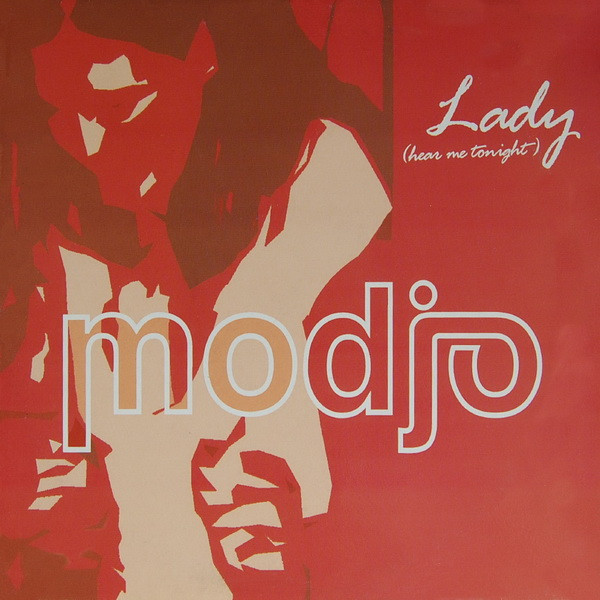
Lady (Hear Me Tonight), by Modjo (their 1st and only #1)

2 weeks, from 10th – 24th September 2000

And of course the act to finally hold firm at the top are one that nobody had ever heard of before, that didn’t have pent-up demand and huge first day sales which quickly petered out. Modjo were a French house duo and, with no previous hits become, I think, at least the sixth Random Dance act of the year to make #1.

And it also makes sense that this song was the one to spend more than a week on top – actually increasing in sales in its second week, which was practically unheard of in 2000 – because it is a mash up of all the era’s hot sounds. There’s a Chic sample, fitting in perfectly with the nu-disco hits that we’ve heard recently, but presented through a chilled Balearic filter, more suited for the poolside bar than the club. The BPMs are low, but the blissed out vibes are high…

We’ve had plenty of hard-hitting Italian, German and Dutch dance tracks over the years, but very few from France. In fact, Modjo’s success made them only the fourth French act ever to have a UK number one, after Serge Gainsbourg, Charles Aznavour, and Mr. Oizo. And not that I want to fall into the trap of national stereotyping, but there’s something very effortlessly cool about this song. A certain… Well, if only there was a French term for a quality that can’t be described or named easily.
Maybe it’s because only the five minute long album version is available on Spotify, but I’m beginning to think that effortless cool can only get you so far. Eventually things become repetitive, which is my eternal problem with dance music. I will give a shout out, though, to the jazz hands flourish that comes along every so often, a camp little nod to the Moulin Rouge among all the modernity, which also feels very French. And to the lyrics, which in the best Europop tradition feel quite ‘second language learner’: Lady, Hear me tonight, ‘Cause this feeling, Is just so right… But they work, and are very easy to remember.

The Year 2000 is really trying its best to make me re-evaluate my feelings on dance music. On the one hand each recent dance #1 has been interesting, fun and, most importantly, not Westlife. But at the same time, the best I can say for the majority of them is that they are diverting. Most of them don’t land hard enough between my ears for me to truly love them (I’d say ‘Groovejet’ is the one dance song from this year that I really, really like). Oh, and speaking of Westlife…

872. ‘Music’, by Madonna

Maybe it’s just my age, and the fact that I was in prime ‘coming of age’ territory during the summer of 2000, but it feels like every chart-topper at the moment has a line, or a moment, that resonates to this day.

Music, by Madonna (her 10th of thirteen #1s)

1 week, from 27th August – 3rd September 2000

We’ve had Craig David’s seven days of wooing. Robbie’s ‘Rock DJ’. Will the real Slim Shady please stand up and If it ain’t love, Then why does it feel so good… To the list we can add Madonna’s command: Hey Mr DJ, Put a record on, I wanna dance with my baby…

When I claimed that her version of ‘American Pie’ wasn’t as bad as people said, but that it was also a bit too safe, I was looking ahead to this record. Imagine if she had bent and twisted that hallowed classic of rock ‘n’ roll using the grinding, whirring, blurping production that she employs on ‘Music’. It may have turned out terrible, but it would have been every bit as fun and provocative as her other most controversial moments.

As it is, we are left with ‘Music’, and for a woman in her forties, almost two decades into her chart career, it is a remarkably modern record. The video and the lyrics may reference disco balls and boogying, but musically this is forward-facing electro-funk. Again, Madonna shows herself to be bang on-trend, as this sounds both like Daft Punk circa 1997, and Hot Chip circa 2006. It also leaves room for a bit of cheese amongst the cool, in the heavily distorted Do you like to boogie-woogie refrain.

Lyrically this is standard sort of ‘music brings the world together’ stuff. Although she does try to reach for a higher plane of thought with the line: Music, Mix the bourgeoisie, And the rebel… Apparently Madonna was inspired to write this at a Sting concert, noting the euphoric reaction of the crowd when he started to play the old Police hits. The video isn’t one of her most thought-provoking either, featuring Sacha Baron-Cohen in character as Ali G (how very Y2K) driving her around in a pimped-out limo.

No, here Madonna isn’t trying to outrage or annoy, she just wants us up on our feet. And I, for one, will always head to the dancefloor when this one comes on. This record took her into double-figures in the total number ones count, the first woman in British chart history to manage it. She joined Elvis, The Beatles, and Cliff Richard in managing ten or more chart-toppers. Meanwhile ‘Music’ itself made history by becoming the first song ever to be played on an iPod.

I may have overstated it in the intro, or allowed nostalgia’s rose-tinted specs to influence my take. Perhaps the chart-topping lyrics of the day were no more memorable than any other era’s. Perhaps I was just of an age to remember them. But I do think the #1s of the summer of 2000 were an integral part of turn-of-the-century popular culture, one of those periods when the charts reflected more than just musical taste. And that’s something, in this fragmented, online age, that I don’t think we’ll ever see again.

871. ‘Groovejet (If This Ain’t Love)’, by Spiller ft. Sophie Ellis-Bextor

The chart week beginning Sunday 20th August 2000 was supposed to be a Spice one-two. Victoria Beckham was to replace Mel C at the top of the charts with her (and Dane Bowers, and True Steppers) garage-influenced single ‘Out of Your Mind’. But as we all know by now, the path of true chart success never does run smooth…

Groovejet (If This Ain’t Love), by Spiller ft. Sophie Ellis-Bextor (their 1st and only #1s)

1 week, from 20th – 27th August 2000

For along came this incredibly catchy piece of nu-disco, from an Italian DJ and the lead singer of a little known indie band, to throw a groovy spanner in the works. Spiller, the DJ, had created the track in 1999, and named it after the Miami nightclub where he had first given it a spin, Groovejet. The backbone of the track is a sample of Carol William’s 1976 track ‘Love Is You’, and the vocals/lyrics were added by Sophie Ellis-Bextor, lead singer of Theaudience, and – once again involved in the unlikeliest of number ones – Mud’s Rob Davis.

The reasons why this unlikely dance track got caught up in one of the most famous chart races of all time with Posh Spice are various (and I might explore them in a future post). But I’d suggest that the most important reason is very simple: ‘Groovejet’ is the much better song.

It’s an effortlessly chic track, one that blends perfectly the need to be cool with the need to be accessible. It balances an authentic disco beat, some very ‘Year 2000’ production chops and swishes, and Ellis-Bextor’s beautifully detached vocals. It works as a chillout, by-the-pool track as much as it works as a floor-filler. It is retro, it is modern. It is disco, it is house. (Wikipedia lists it as ‘handbag house’, which is now my new favourite genre of all time…) It is, and this may be pure recency bias but who cares, the year’s best chart-topper.

My biggest problem with dance music is that it can sometimes get repetitive. Spiller avoids this by filling his track with lots of little touches to keep things busy, such as the strings in the old school middle-eight, and the hand drums at the end, not to mention the just silly enough aeroplane sound effect.

Back to release-week, then, where Victoria Beckham (and Dane Bowers and True Steppers) were announced to be leading the race midweek. Both women did promo, with the battle billed as ‘Posh Vs Posher’. In the end, Spiller and Sophie won out by 20,000 copies, and secured the highest weekly sales of the year so far. That was as good as it got for Spiller, who bookended his biggest smash with two #40 hits. But it set Sophie Ellis-Bextor up for much more solo success, including six Top 10 hits across the noughties (seven, if we count the two times that classic ‘Murder on the Dancefloor’ has peaked, agonisingly, in the runners-up position…) Meanwhile, this was as close as Victoria Beckham got to a solo #1, and she remains the only Spice Girl not to manage one.

863. ‘Spinning Around’, by Kylie Minogue

And she’s back. Forget Billie Piper, this is the pop comeback of the year 2000. Surely one of the biggest pop comebacks of all time?

Spinning Around, by Kylie Minogue (her 5th of seven #1s)

1 week, from 25th June – 2nd July 2000

Amazingly, it has been over a decade since Kylie’s last number one (‘Tears on My Pillow’ in January 1990), and almost six years six since her last Top 10 hit (1994’s ‘Confide in Me’). Since her debut in 1988, we’ve had ‘Neighbours’ Kylie, Pop Puppet Kylie, Creative Control Kylie, Indie Kylie… and then a couple of years of silence. Was that, everyone wondered, that?

As an unashamed Kylie fan, I’m glad about what ‘Spinning Around’ did for the Princess of Pop. It brought her back, set her up for a glorious, and so far never-ending, second act. She was still only in her early-thirties here, but quite often early-thirties might as well be early-eighties for a female pop star. It was truly impressive the way she returned, with an updated yet familiar, utterly-commercial-but-critically-respected sound, as if she’d never been away. But…

As far as ‘Spinning Around’ is concerned, I’ve always found it a bit basic. A bit Radio 2. A bit hen-night in a provincial town. It’s catchy, for sure, and it’s funky bassline and sparkly synths are more proof that we’re in the midst of a disco revival. I like the middle-eight – the Baby, baby, baby… bit – but the rest of the lyrics are a whole lot of nothing, vaguely themed around this song as a comeback. I’m spinning around, Move out of my way, I know you’re feelin’ me cause you like it like this…

And let’s be honest, as reluctant as I am to reduce Queen Kylie to a mere sexual object, the one thing everyone remembers about this record are the gold hotpants she wore while writhing around on a bar top in the video. (Hotpants that were allegedly bought for fifty pence in a market, and which have since been displayed at the V&A museum.)

So the best I’ll say for ‘Spinning Around’ is that it’s a perfectly serviceable pop song which did what it had to do. Kylie was back, back, back, and free to release better songs in the coming years. Of course there’s the colossal lead single from her next album, but even the Latin-tinged ‘Please Stay’ was a better track from later in 2000, while there’s also the industrial camp of ‘Your Disco Needs You’, which really should have been a single. Still, maybe it’s just me. ‘Spinning Around’ seems to be remembered fondly, and was the first in a run of sixteen straight Top 10 hits for Australia’s highest-selling act, lasting right through until 2008. It also earned Kylie enty to a very exclusive club – the #1s in three decades club, which at the time consisted only of Elvis, Cliff, the Bee Gees, Queen, Blondie and Madonna.

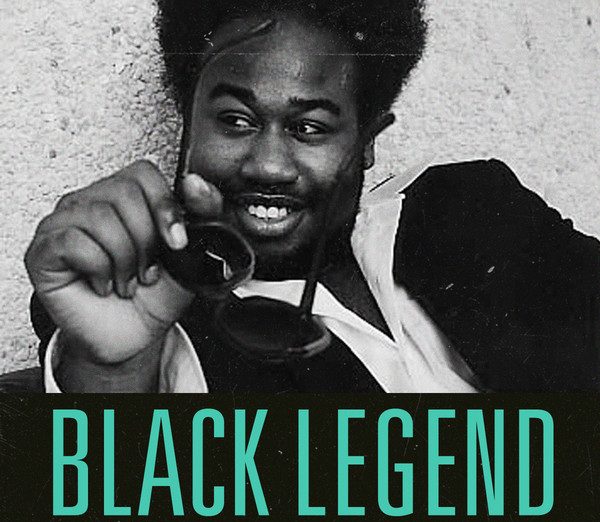
862. ‘You See the Trouble With Me’, by Black Legend

Our slow meander around the year 2000’s many, many chart-toppers continues, and we find another interesting stop along the road: the lost Barry White number one.

You See the Trouble With Me, by Black Legend (their 1st and only #1)

1 week, from 18th – 25th June 2000

First, we do have to state that it is not Barry White’s voice on this record, though vocalist Elroy ‘Spoonface’ Powell does a mighty fine impersonation. He even manages to make this sound like a live sample, introducing it with a spoken In 1975, we brought you an album, With a song… backed with lots of crowd noise.

Is it too early to suggest a mini disco revival, after Geri, Madison Avenue, and now this? (I’m also sneaking a peek at the record which replaced Black Legend at the top.) Though what dominates this record is not so much disco strings, but a naggingly insistent, thoroughly modern, house beat. On the radio edit the producers toy with us for the opening two minutes, teasing snatches of ‘You See the Trouble With Me’ (a #2 hit in 1976) that cut in and out, before finally letting ‘Barry White’ loose. For a bit. When the house beat kicks back in for the third or fourth time, it officially becomes annoying.

Barry White had refused the use of his original vocals for this remix, as he felt it ‘was cheap and had no soul’. I can understand his point, as the song uses the sample as bait, almost, to lure you to the dancefloor. The choppy nature of this song, the insistence on falling back on that irritating beat, means that there’s no release, no climax. You’re left with blue (disco) balls…

Black Legend were a very short-lived Italian production duo, with the aforementioned Powell on singing duties. They were together for three singles, and their only other appearance on the UK singles chart is with the #37 peaking ‘Somebody’. They fall agonisingly short of verified one-hit wonder status.

While I don’t much care for this remix, I am being won over by the year 2000’s fast turnover, which allowed curios like this to make number one, records that may not have made the top at any other period in chart history. Speaking of which, Black Legend are the first chart-toppers in a run of twelve one-weekers, from mid-June to mid-September 2000: a record-breaking stretch. Let the frantic fun begin!

859. ‘Don’t Call Me Baby’, by Madison Avenue

Though it may have been a chaotic year of one-week wonders, of number ones with the lifespan of butterflies, there’s something joyous about the chart-toppers of the year 2000.

Don’t Call Me Baby, by Madison Avenue (their 1st and only #1)

1 week, from 14th – 21st May 2000

This is the fifteenth number one of the year (we’re only in May, and there have been years in which the entire twelve months saw fewer than fifteen #1s). Of that fifteen, I’d count eleven as being in some way upbeat, uptempo, uplifting… It’s as if the record buying public had bounded into the new millennium full of optimism, ready to fill their CD players with fun records. Such as this slice of disco-funk.

Other than the chorus, the one thing that stands out about ‘Don’t Call Me Baby’ is the catchy bass riff that propels the song along. And it’s surprising how much of the record is left ‘blank’, with just that bass riff and the disco beat to fill the spaces between the verses and chorus. I suspected that it might have been a sample, so timeless does it sound, and so it is: from a 1980 Italian hit called ‘Ma Quale Idea’, by Pino D’Angiò, which in turn had been based on disco classic ‘Ain’t No Stoppin’ Us Now’, by McFadden & Whitehead.

The lyrics tell a story of female empowerment via the dancefloor: Behind my smile is my IQ, I must admit this does not sit with the likes of you… You’re really sweet, You’re really nice, But didn’t mama ever tell you not to play with fire…? I like the modern sass and the bite of the lyrics against the retro beat. Don’t underestimate me boy, I’ll make you sorry you were born… In fact, this brings us to another emerging theme of the year: Girl Power actually kicking in, half a decade late. I’ve already mentioned that the 21st century would see female pop stars dominate, but I hadn’t quite noticed how spunky many of the songs would be. This, straight after ‘Oops!… I Did It Again’, and ‘Bag It Up’, for example. (We’ll ignore ‘Born to Make You Happy’…)

Madison Avenue were an Australian duo, producer Andy Van Dorsselaer and singer Cheyne Coates. This record’s success made them the first Australian group to top the British charts since Men at Work back in 1983. ‘Don’t Call Me Baby’ had actually made #30 the year before, but hung around in clubs and the lower reaches of the charts, prompting this successful re-release.

They may not quite qualify as one-hit wonders, having one further Top 10 (the similarly fun ‘Who the Hell Are You’), and one more Top 40, hit. But I’d say Madison Avenue definitely qualify as the latest member of our rapidly growing ‘random dance’ sub-folder, with more to come very soon.

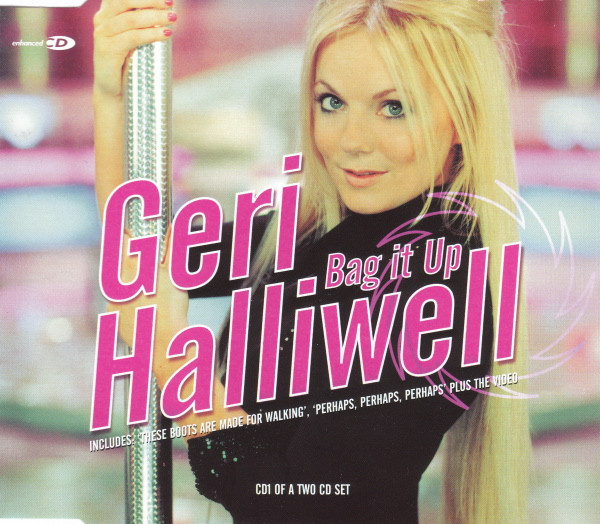
852. ‘Bag It Up’, by Geri Halliwell

Fresh from not giving up, we’re now bagging it up…

Bag It Up, by Geri Halliwell (her 3rd of four solo #1s)

1 week, from 19th – 26th March 2000

I overused the c-word in my post on Geri’s previous number one ‘Lift Me Up’, so I will endeavour to describe this record as anything but ‘camp’. Problem is, ‘Bag It Up’ opens with what may be the gayest line ever recorded: I like chocolate and controversy… Don’t we all, Geri.

What is this silly slice of disco-cheese about? Why is she treating her man ‘like a lady’? What the hell does I don’t take sugar on my colour TV mean?? It’s clearly some extension of the ‘Girl Power’ message, about how women don’t have to take crap from men. But like ‘Girl Power’ it falls apart under close inspection, and turns into the aural equivalent of a rowdy hen party entering a pub, even if the line Just a bad case of opposite sex… is wonderful.

Not that this record was ever meant to be closely inspected. It’s complete fluff. The video is even gayer, if such a thing was possible, as Geri advertises ‘Girl Powder’, which she uses to spike her boyfriend’s drink and turn him into a topless servant. She then dances around her factory with lots of pink-haired, six-packed oompah loompahs. Meanwhile, at that year’s Brit Awards, she performed the song after emerging from between a giant pair of legs.

Musically it sounds much like the Spice Girls’ ‘Who Do You Think You Are?’, in its poppy, nu-disco beats. In fairness, all three #1s from Geri’s debut solo album have brought something a bit different to the party, while remaining utterly disposable pop. I don’t mean that to be rude, either: I love Geri, and I love disposable pop.

What I might have questioned, had I been a bit older in 2000, was Geri’s relentless pursuit of gay icon status. It’s fun and all, but if anything it’s a little too much. She’d secured it anyway, what with being a literal Spice Girl, and so didn’t have to try so hard. I wonder if in the end it cost her some longevity. (As I write this I’m just remembering that her final chart-topper will be a cover of ‘It’s Raining Men’…)

Still, ‘Bag It Up’ is fun, and Geri was admirably serious about not taking herself seriously. Compared to self-obsessed modern pop, it’s been very refreshing to revisit the time when she was the biggest female pop star in the land.

738. ‘Fastlove’, by George Michael

George Michael bows out from chart-topping duty, after eleven #1s – both solo and with Wham! – in just under twelve years. And dare we say he bows out with his best…?

Fastlove, by George Michael (his 7th and final solo #1)

3 weeks, from 28th April – 19th May 1996

I doubt many other people would name ‘Fastlove’ as Michael’s best chart-topper, but it’s my favourite. As worthy, and lyrically beautiful, as ‘Jesus to a Child’ was; I’m glad that he wraps up with this banger. Gotta get up to get down… And if his number one from earlier in the year was an ode to a lost love, then this is an ode to getting over a lost love. An ode to anonymous and fleeting satisfaction, as Cher once memorably put it.

I ain’t mister right, But if you’re looking for fast love… he purrs, over a funky bassline and some contemporary disco beats. All that bullshit conversation, Baby can’t you read the signs… I also love the line about all his friends having babies, while he’s just wanting to have fun, which is something every gay man in their thirties can relate to. In the background we can hear ‘interpolated’ – as we must always refer to sampling from hereon in – the hook from 1982 hit ‘Forget Me Nots’ by Patrice Rushen (which Will Smith will soon ‘interpolate’ even more blatantly).

I called this a ‘banger’, but it’s actually quite smooth and slinky. The melody and the groove wrap themselves around you like a particularly sexy snake, and don’t let go. There are still some of the over-indulgences that, for me, always mark George Michael’s work down a notch: the muzaky saxophones, and the fact that it goes on for over five minutes. A three-minute quicky would have been more appropriate here, especially given the subject matter. But the funky break in the middle is a thing of beauty.

Like all great pop songs, though, there is more going on under the surface. The lyrics aren’t just celebratory, they reveal a pain behind all the sex. George needs affirmation, needs someone to ease his mind. In the absence of security, I made my way into the night… Which sounds quite dark, until a few lines later he proposes a quick shag in his BMW. But there’s enough here to suggest that his need for ‘fastlove’ isn’t an entirely healthy thing, and may be linked to the loss in ‘Jesus to a Child’. The most telling line is surely I miss my baby… It’s admirable that he made a very catchy pop song out of such personal issues.

Post-‘Fastlove’, George Michael would remain a fairly regular presence in the UK charts, including four more #2s. One of which is the truly glorious, and definitely worthy of the term ‘banger’, ‘Outside’ – a brilliant middle-finger to all the fuss over his sexuality. He died in 2016, aged just fifty-three, and took his place in the highest-echelons of dead pop superstars. I have my opinions on his current standing among the greats, but it seems churlish to drone on about them here.

And, of course, he isn’t actually done with chart-topping, as the streaming era has given ‘Last Christmas’ – for years the highest-selling #2 hit of all time – a new lease of life. But that’s something that we’ll get to, again, and again, and again, in due course…

696. ‘Relight My Fire’, by Take That ft. Lulu

In their early years, in amongst the Hi-NRG pop and the ballads, Take That had made a habit of popping out covers of 1970s golden-oldies. A version of Tavares’s ‘It Only Takes a Minute’ had brought them to the Top 10 for the first time, while a pumped up take on Barry Manilow’s ‘Could It Be Magic’ gave them their first Top 5 hit.

Relight My Fire, by Take That (their 2nd of twelve #1s) ft. Lulu (her 1st and only #1)

2 weeks, from 3rd – 17th October 1993

‘Relight My Fire’, their second number one, was the pinnacle of their cover version days, and the final one before their ascent to superstardom. And it’s a perfectly fine piece of pop: complete cheese – though a nice camembert rather than plastic cheddar – and completely undeniable. It’s the ultimate soundtrack to Saturday evening family TV, to a kid’s birthday party at a Charlie Chalk’s, to a Butlin’s disco…

They don’t do anything clever with it, updating the disco beat and percussion for something more post-SAW, but otherwise keeping sensibly close to the Dan Hartman original. An original which hadn’t been a very big hit in the UK. I assumed it must have been a hit of some sort, as it just sounds so very ‘peak’ disco, but no. In the US, it had topped the Billboard Dance Chart for six weeks in late 1979; but in Britain people may not have been aware of it. (The female vocalist on the original was Loleatta Holloway, who we last heard being similarly uncredited on Black Box’s ‘Ride on Time’, while Hartman sadly died just a few months after this cover became a hit.)

I say Take That don’t do anything clever with their version of the tune, but actually… Roping in none other than Scottish pocket-rocket Lulu to belt out the Loleatta verse provided a clever bit of cross-generational appeal. And belt it out she does, as her rasping You gotta be strong enough to walk on through the night… is a clear highlight. She grasps with both hands this gold-plated chance at a chart comeback, also making sure she isn’t overshadowed by these young whippersnappers (though, amazingly, she was only forty-five when this made #1…)

It gave Lulu her first chart-topper a full twenty-nine years after her chart debut with ‘Shout’ – a record at the time. She had recently released her first album in eleven years, and this was her first Top 10 in almost twenty (not counting a re-release of ‘Shout’ in the ‘80s). But just as importantly as relaunching Lulu’s career, it announced to the world that Take That weren’t just teeny boppers aimed at twelve-year-olds. They were looking to become Britain’s foremost pop group, one that appealed to your mum, your granny, and your gay uncle (note Mark Owen’s crop top in the video, as well as Jason/Howard’s – who can tell them apart? – leather chaps…)

Come the end of the decade, all the boyband imitators that Take That had spawned would be trying the same thing. Off the top of my head, I can remember seventies covers from Boyzone, Westlife and 911 all doing very well in the charts, and I’m sure there were more. It’s songs like this which mean Take That are still filling stadiums across the country, thirty years on, with people of all ages looking for nothing more than a good night out. It’s easy to sniff (and sniff I do), but few do it better.

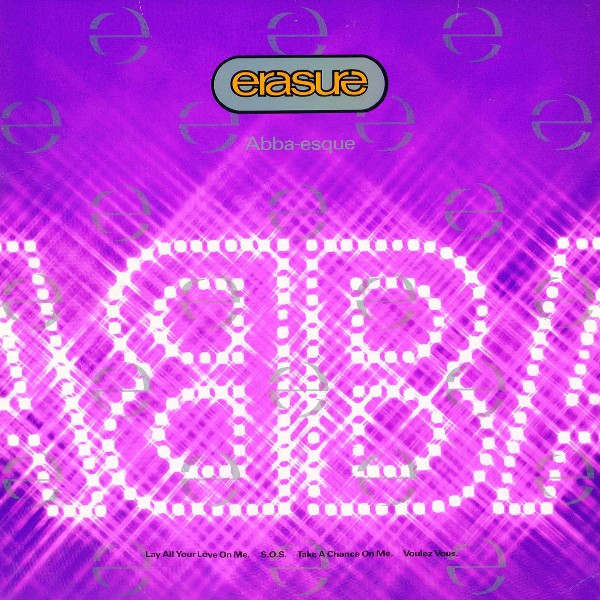
677. ‘ABBA-esque E.P.’, by Erasure

Can there be anything camper than Erasure covering ABBA? How about Erasure recording an entire E.P. of ABBA covers, and called it ‘ABBA-esque’?

ABBA-Esque (E.P.), by Erasure (their 1st and only #1)

5 weeks, from 7th June – 12th July 1992

ABBA scored nine #1s between 1974 and 1980, making them at this point in time the fifth most successful chart-topping act (behind Elvis, the Beatles, Cliff, and The Shadows). But luckily, three of the four tunes Erasure chose to cover didn’t make top spot originally. Starting with, perhaps, ABBA’s greatest non-number one single…

I’m not sure which was the ‘lead’ single from the E.P. – I get the feeling it was track three, but they made videos for all of them – so I’ll go through them in order. We kick off with ‘Lay All Your Love on Me’, which was only ever released by ABBA as a 12” single. It’s the most faithful cover of the four, with the mood and tempo kept, and just the instrumentation updated to a post-SAW, Hi-NRG style. I love that they don’t change the pronouns in the lyrics, as most acts do when covering a song originally sung by a different gender, and we’re treated to Andy Bell asking how a grown up woman can ever fall so easily…

Of the four, I don’t think I’d ever heard their take on ‘S.O.S.’ before. And, of the four, it’s my least favourite. ‘S.O.S.’ is an important song in the ABBA canon: the song that extended ABBA’s career beyond simply being Eurovision winners; a genuine rock classic beloved of Ray Davies, Pete Townshend and The Sex Pistols. This over-processed take, though, fails to capture the soaring joy that can be found in the when you’re gone, how can I even try to go on… line in the original.

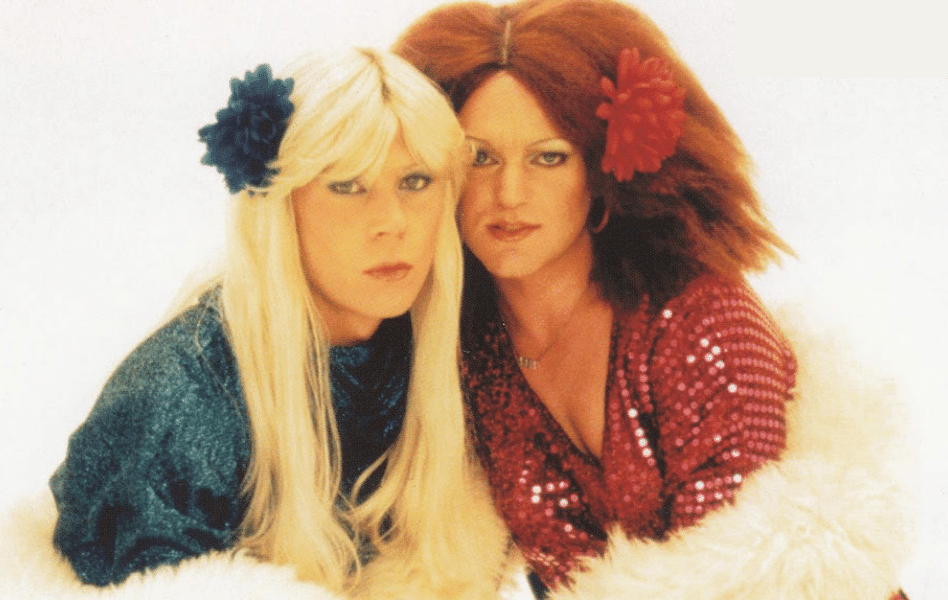
Track three then, and the one that represented this E.P. as a whole. ‘Take a Chance on Me’ was an ABBA chart-topper, back in February 1978. It’s an improvement on ‘S.O.S.’, but they’ve gone moodier than the original. They’ve also gone very early-nineties and added a ragga-style rap, or toast, by one MC Kinky. It’s a bold move, but then by this point in the E.P. maybe they were thinking it might have started to feel a bit by-the-numbers. It certainly shakes things up. The video for ‘Take a Chance…’ is the highlight of the entire project: Vince and Andy pout, gurn and flirt with one another, both as themselves and in drag as Agnetha and Frida. I’m sure it was done lovingly, but I do wonder what the ladies thought…

We end on what is probably my favourite of the four: a pounding, throbbing, techno-take on ‘Voulez Vous’. The intro, in fact, isn’t a million miles from something you’d hear at a hardcore rave. Here Erasure succeed in completely updating disco-era ABBA to a 1992 sound, which is testament either to the strength of their interpretation, of Benny and Björn’s songwriting, or maybe both. (‘Voulez Vous’ also includes some of my personal favourite ABBA lyrics: I know what you think, The girl means business so I’ll offer her a drink… and We’ve done it all before, And now we’re back to get some more, You know what I mean…)Years later, a fifth cover – ‘Gimme! Gimme! Gimme!’ – was added to the E.P., but as it wasn’t around when this topped the charts I won’t bring it up.

Are any of the four covers better than the originals? No, of course not. But that doesn’t mean that this wasn’t a worthwhile exercise. For a start it got Erasure an overdue #1, after almost a decade of releases and twelve previous Top 10 hits. But even better than that, it started The ABBA Revival.

It seems strange to say in 2023, but even I can remember a time when ABBA weren’t the world’s most beloved band. By the late-eighties they were a punchline, an embarrassment, records to be hidden under the bed rather than publicly displayed. Erasure unashamedly covering four of their hits, allowing kids to discover them and adults to remember just how good ABBA had been, started us down the road to ‘ABBA Gold’ (which was released later in 1992) becoming one of the biggest-selling albums of all time, to ‘Muriel’s Wedding’, to the ‘Mamma Mia’ stage show and films, to the band’s holographic comeback. As a ‘thank you’, ABBA tribute act Björn Again (who in 1992, believe it or not, opened for Nirvana – Kurt Cobain being another factor in the ABBA-naissance) released ‘Erasure-ish’, with covers of ‘A Little Respect’ and ‘Stop!’