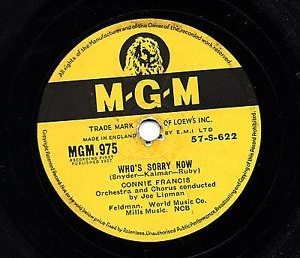
71. ‘Who’s Sorry Now’, by Connie Francis

s-l300

Who’s Sorry Now, by Connie Francis (her 1st of two #1s)

6 weeks, from 16th May – 27th June 1958

I really didn’t mean to set it up like that at the end of the previous post, truly I didn’t. It simply occurred to me that we hadn’t had a female singer at the top of the charts for a long old time and then, lo and behold, here we are…

Not since the 19th October 1956 – just shy of seventeen months ago – have we had a feminine voice on a #1 record. Since then sixteen different male singers, or male groups, have come and gone with twenty different number one singles.

And the differences between ‘Who’s Sorry Now’, and the last female-led chart-topper – Anne Shelton’s ‘Lay Down Your Arms’ – paint a very telling picture of how the landscape of popular music has changed in recent months. Because, basically, rock ‘n’ roll has happened. Anne Shelton hit the top around the same time as ‘Que Sera Sera’ and Frankie Laine’s big-band show tune ‘A Woman in Love’. ‘Lay Down Your Arms’ was a bizarre, military marching fruit-loop of a song that harked back to World War II, Vera Lynn and all that. Since then we’ve had Elvis, and Lonnie Donegan, and Buddy and Jerry Lee. And now Connie Francis takes all that rock ‘n’ roll attitude, and gives it her own, feminine twist.

Who’s sorry now? Who’s sorry now? Whose heart is achin’ for breakin’ each vow…? Miss Francis had her heartbroken, but the man who hurt her now has his own romantic troubles… Who’s sad and blue? Who’s cryin’ too? Just like I cried, Over you… There’s a twang in her voice, a sassy hiccup, and it gives the distinct impression that she’s struggling to dredge up much sympathy for her ex.

Is this a rock ‘n’ roll ballad? The slower tempo and the backing singers suggest that it is. If so, I make it only the second one ever to top the charts – the first being The Dream Weavers’ ever-so-dreary ‘It’s Almost Tomorrow’ from two years back. (I thought about including ‘Young Love’ as a ballad; but that was just a soppy little pop song – ballads need a little bit of emosh about them).

And ‘Who’s Sorry Now’ certainly gives us emotion. It’s a song of two halves. During the first, Francis’s voice lilts and coos. For the second, she whips it up a notch or five. Right till the end! Just like a friend! I tried to warn you somehow… The drums start whippin’, cymbals crash, and her voice almost snaps… You had your way, Now you must pay… Then she delivers the final, crushing blow… I’m glad that you’re sorry now… It is a moment!

Connie_Francis_1961

This is part torch-song, part clap-back. If I were a sassy black drag-queen, I would have clicked my fingers and shouted ‘Preach’ as this track shuddered to a halt. Alas, I am not; but I love this song all the same. This is a big stepping stone in music, make no doubt about it: this is paving the way for Madonna, The Spice Girls, and any other female act with even a smidgen of attitude. This is Beyoncé’s ‘Lemonade’ repackaged for the late fifties. A lot of the female artists we’ve met previously on this countdown have been cute, and flirty, and fun to listen to – Kitty Kallen, Kay Starr, Winifred Atwell, I’m looking at you. But no girl has brought this level of spunk to the table. Alma Cogan and Rosemary Clooney were having a great time on records like ‘Dreamboat’ and ‘Mambo Italiano’ but they were, ultimately, throwaway pop discs, with nothing like the bite of ‘Who’s Sorry Now’.

I love this song, and I love Connie Francis, and have done for a while. You can’t truly be into rock ‘n’ roll without having discovered Connie, Brenda Lee and the other female stars of the time. She was just twenty-one when this hit the top-spot, and in her pictures she sports a perfectly ‘fifties’ look: short curls an’ smokey eyes. But, on doing a little further research, I was surprised – nay, shocked! – to learn two things. One: that ‘Who’s Sorry Now’ was actually first recorded in 1923! And two: that Connie Francis was initially resistant to recording it. Luckily for all of us she did, and this version is completely different to the reedy-sounding 1923 version (which was an instrumental, for a start).

I shan’t wax too lyrical on Ms Francis just yet – we’ll be meeting her again before the year’s out, with an equally brilliant but completely different record. For now, I shall ask one more time… ‘Who’s Sorry Now? Not Connie. No sir… Preach!’

46. ‘No Other Love’, by Ronnie Hilton

271927944821

No Other Love, by Ronnie Hilton (his 1st and only #1)

6 weeks, from 4th May to 15th June 1956

Through writing these blog posts, I’m becoming a strong believer in nominative determinism. I.e. through looking at the name of the recording artist one can anticipate what the song will sound like. Not that anyone’s been called Sax Jazzington, or anything silly like that. More like how Kay Starr sounds fun and flirty, Slim Whitman sounds grizzled and lonesome, Jimmy Young sounds… normal, and a little dull. I feel that Ronnie Hilton should fall into the latter category.

And, lo and behold, he does. It starts dramatically enough, though: a burst of cymbals, then another, then another… Then it feels like a step back in time, to the dark days of *shudder* David Whitfield. It’s semi-operatic, its over the top, it’s not a particularly easy listen. Hilton’s voice is overwrought. It’s a powerful voice, a technically very good voice, the sort of voice that your gran would have approved of; but it’s too much. It’s probably no worse than the Whitfield, Laine days of a couple years back, but it already sounds very dated coming so soon after more progressive-sounding records by Bill Haley, Alma Cogan and even Dean Martin.

Lyrically too, this is a song that’s been done before. No other love have I… Into your arms I’ll fly… Waiting to hear you say… ‘No other love have I’. He’s a little lovelorn, is Mr Hilton. I’ve mentioned it before, but why is it the girls that have all the fun in these early chart toppers? With a few exceptions (Vera Lynn, cough cough) they get to be perky and flirty while the men stay at home and stoically wait for their love to be fulfilled.

One thing I was certain of, without doing any kind of research, is that Ronnie Hilton was British. His voice has that properness, that stoicism, void of any kind of vulgar, American swagger. One other thing that I was pretty certain of, again before delving into Wikipedia and around, is that ‘No Other Love’ must have been from a soundtrack, such is its unnervingly bombastic approach to what is an otherwise very basic love song. And yes, it’s a Rogers & Hammerstein number, from their 1953 show ‘Me and Juliet’.

A-439529-1148657608.jpeg

Actually, the most surprising thing I could uncover about Ronnie Hilton – this is his only appearance at the top so let’s give him a moment in the sun – is that ‘Ronnie Hilton’ was his stage name. He was born Adrian Hill. Let that sink in for a second: he, or somebody advising him, thought Adrian Hill was a little too boring, a little too staid, and that ‘Ronnie Hilton’ would get the girls swooning. I think that just sums him, this song, and this whole pre-rock era up… If you’re going to change your name in an attempt to gain fame and glory for God’s sake try to come up with something slightly sexy. No?

And – perhaps just as interestingly – Hilton recorded a fairly successful (in the UK at least) version of ‘The Wonder of You’, eleven years before Elvis Presley made it a standard. But… listen to Hilton’s version, then Presley’s version, and it becomes clear why the latter was one of the most famous voices, and personalities, of the 20th Century and the former wasn’t.

I’m being a little down on Ronnie Hilton, really, so let’s give him a break and end with something completely unrelated. Something that just occurred to me as I wrote the intro to this post. The only reason that my nominative determinism theory works is because I have heard so few of these early number one hits. I write the title down, search them out on Spotify, and take a step into the unknown. But, looking down the list of UK #1s through the remainder of 1956, through ’57 and ’58, this is going to become less and less of a thing. I know several of the next twenty or thirty records. Soon I’ll know the majority of them. Of course, every so often, even as we get to the eighties and nineties, there will be songs I simply have never heard before (I have no idea how ‘Doop’, by Doop, goes for example – and it had 3 weeks at the top in 1994) but, on the whole, we are slowly stepping out of the mist and onto firmer, better known ground.

43. ‘It’s Almost Tomorrow’, by The Dream Weavers

R-4052394-1471122223-8022.jpeg

It’s Almost Tomorrow, by The Dream Weavers (their 1st and only #1)

2 weeks, from 16th – 30th March / 1 week, from 6th – 13th April 1956 (3 weeks total)

Perhaps it’s time to christen a brand new era in popular music. I’ll call it: the ‘post-pre-rock age’! We’ve had the first wave of the rock ‘n’ roll explosion – the very first rock ‘n’ roll number one – but the waves have receded and we are stood on soggy sand waiting for them to return. And they will, they will… Just not yet.

What I mean is that, to all intents and purposes, we are still in the pre-rock age but that the rules have changed ever so slightly. Of course, the very top of the charts is never where you look for music’s cutting edge. You get to the top of the pop charts by being, well, popular, and by appealing to the largest number of people. But… even if you look at the Top 20 from the week in March ’56 that this latest song hit #1, there are very few records that stand out as being rock songs: Bill Haley is at #7 with ‘See You Later Alligator’, Lonnie Donegan is at #9 with ‘Rock Island Line’ (a skiffle track, admittedly, but still) and there’s a song called ‘Pickin’ a Chicken’ by Eve Boswell which sounds like a rock song involving a funky dance move (a la ‘The Twist’) but is actually just a pretty dull song about having a picnic. The rest is Sinatra, Jimmy Young, Slim Whitman

And, as with ‘Memories Are Made of This’ which preceded it, ‘It’s Almost Tomorrow’ has elements of rock ‘n’ roll in it – enough, perhaps, to attract the youngsters but not enough to put off the old folks. Thus the gap between the worlds of Eddie Fisher and Elvis is deftly bridged.

Anyway, to the song. And after that big build-up, all that stuff about it being a brand new era in popular music, ‘It’s Almost Tomorrow’ is a bit dull. The idea behind it is that the singer’s sweetheart is falling out of love with him, and that she will leave him ‘tomorrow’. And yet he hopes it will be otherwise… My dearest, my darling, tomorrow is near, The clouds will bring showers of sadness, I fear… ‘Emotions As Weather’ – the first chapter in ‘Cheesy Love Songs 101’. It’s almost tomorrow, but what can I do? Your kisses all tell me that, your love is untrue…

It’s a bit cloying, what with its backing singers and plinky-plonky pianos. A bit of a nursery rhyme, too – I can’t decide if it sounds more like ‘Puff the Magic Dragon’ or ‘Away in a Manger’. And again, it’s another very simple #1. The production is very rich – the piano and backing singers turned up to 11 – but there isn’t much there. And, unfortunately, there’s a bit of a THIS IS THE END OF THE SONG ending: You’ll always be miiiiiiiiiiiine!

0c35382efac3ea5f3d8299d3381300a1

But, in the ‘pros’ column there is a rather wonderful key-change – a very rock ‘n’ roll touch. I’m a big fan of a well constructed key-change. I can’t resist them. Who can? Its inbuilt in most people, I think. A Pavlovian reaction. And this is not just a key change, but a mid-note key change… Your love is untruuuu *key change* uuuueeeee. I’m not going to lie – it did give me a mild covering of goose bumps the first time I heard it. But that’s far and away the best thing about this song. A song which we could brand the very first rock ballad to hit the top of the UK Singles Chart, if it didn’t feel a bit of a waste to use up such an honorific title on such an average record.

This is The Dream Weavers only appearance in this countdown, and in the charts. They were big ol’ one hit wonders, you see. Though we should give them a shout out for being one of the few acts so far to have hit the top with an original composition. The Dream Weavers consisted of two high school friends – Gene Adkinson and Wade Buff (great name!) – and a rotating cast of back-up singers. Adkinson and Buff wrote ‘It’s Almost Tomorrow’ themselves, and so are pretty unique among the forty-two songs that we’ve written about previously.

And we’ll leave it there for now. A simple love song – all key changes and not an orchestra in sight – but with familiarly mopey lyrics about rain and heartache, as well as a silly, bombastic ending. One leg in the new world; one leg stuck firmly in the past.

36. ‘Rose Marie’, by Slim Whitman

Slim+Whitman+Rose+Marie+-+VG-569464

Rose Marie, by Slim Whitman (his 1st and only #1)

11 weeks, from 29th July to 14th October 1955

Yee-Hah! I hoped, back when Tennessee Ernie Ford was topping the charts with ‘Give Me Your Word’, that we might be seeing our first Country and Western #1. Well, Ernie didn’t quite live up to his name but we didn’t have to wait long. This is country with a capital C O U N T R and Y.

Slim Whitman stands alone on the prairie. The setting sun casts an orange glow across this horizon. Cacti spread their long shadows over the dirty ground. A tumbleweed bounces lazily by. Slim picks up his spittoon, clears his throat, and begins… Oh Rose, my Rose Marie… I love you… I’m always dreaming of you…

It’s an atmospheric record, I’ll grant you that. Just a piano, a simple rhythm and that weird noise which is the epitome of old, Nashville C&W: strange and echoing, made either by guitars submerged in water or sped up recordings of whale noises. You’ll know it as soon as you hear it.

Anyway, Slim can’t forget Rose Marie, and even wishes he’d never met her. Then he hums as he thinks of her. It’s quite effective. You really can picture him wandering plaintively past hail bays and broken barn doors, as the light finally fades.

There are definitely some pros to this 36th UK chart topper: it is quite an understated ballad, lacking the OTT grandstanding of some of its predecessors, while there are definitely some ‘rockier’ elements to the song too in the twangy guitars and the piano riff. But there are definitely some cons too: Whitman’s voice comes far too close to yodelling for my liking (My Ro-OOse Marie), for example. Some nice touches; some things jar.

I was planning to write something indignant about this record spending 11 (Eleven!) consecutive weeks at the top – setting a record that would last for thirty-six years. But the more I listen to it, the more ‘Rose Marie’ is getting under my skin. It’s simple, it’s heartfelt, it’s kinda cute. There’s another fade, rather than a bombastic finale: a long drawn out note and a piano refrain.

3288955

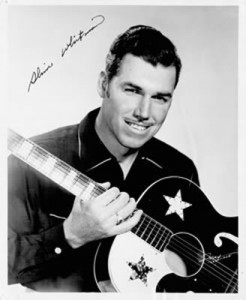
It’s not a bad way to claim your sole chart-topper – double figures then out – though Slim Whitman did have a handful of other hits. Pictures of him show a very dapper looking pseudo-cowboy with a natty little moustache. It almost goes without saying, by now, that he lived to a ripe old age: dying at ninety in 2013. ‘Rose Marie’ itself (herself?) dates from far earlier than 1955 – from a 1924 opera of the same name, written by none other than Oscar Hammerstein II. And that, fact fans, is that.

34. ‘Unchained Melody’, by Jimmy Young

s-l300

Unchained Melody, by Jimmy Young (his 1st of two #1s)

3 weeks, from 24th June to 15th July 1955

Forget ‘I Believe’, discard ‘How Much is that Doggie’, don’t mention ‘Mambo Italiano’… For the first time in this countdown, we have a song that everyone knows.

We’ve flirted with legend so far. Sinatra and Doris Day have hit the top, but not with any of their most famous recordings. Frankie Laine has set an unbeatable chart record with a song that will be unmistakeable to people of a certain age. And there have been other chart toppers that people might be able to sing a couple of lines from. But everyone, and I repeat everyone, knows ‘Unchained Melody’.

But not everyone will know this version. 4 (Four!) versions of ‘Unchained Melody’ have hit top spot in the UK charts – take a bow The Righteous Brothers, Robson & Jerome, and Gareth Gates, we shall hear from you anon. With these versions – the former especially – ingrained in popular culture, Jimmy Young’s version is a strange listen.

The tempo is faster, for a start. Then there are the Spanish guitars, when we are used to it being a piano led song. And then there is the clipped, British delivery. No glossy, American vocals here. Young’s voice is deep, sonorous even. It’s technically a good voice. But there is more than a whiff of David Whitfield about it, especially when he belts out the line Are you still MIIIIIIINE?

He still needs your love, and would like God to speed your love to him. It is the same song, but it’s not. I think that were this a more forgotten hit – a ‘Give Me Your Word’ for example -it might simply file in amongst all the other stiff, slightly overwrought, pre-rock ballads that we have sat through so far. But, unfortunately for Jimmy Young, people took this song and turned it into one of the most instantly recognisable pieces of popular music ever recorded. And his version, while still not the original (there were, inevitably, four other versions in the chart during the summer of ’55), now sounds very dated next to the more modern interpretations.

Interestingly, though, as we study the evolution of the number one record through time, we have a first here. At least, I think it’s a first (I can’t be bothered going back and listening to all the previous thirty-three). So many of these hits have favoured a bombastic THIS IS THE END OF THE SONG approach to the final chorus (to be referred to from now on as a TITEOES ending). And what song would have better suited this kind of OTT climax than ‘Unchained Melody’? But no. What we have here is Young singing the last line – God speed your love to me – the final note being held, the guitars strumming and a fade. A fade! And it works pretty well. It is, ironically – considering the time in which it was recorded – the most understated ending out of the four chart topping versions.

Why, though, is it called ‘Unchained Melody’ when the lyrics make no reference to being ‘unchained’? Is it because the singer is unchaining his heart, and pouring out his feelings to the one he loves? That would be a sensible guess, but no. We might as well address this here, though I am aware that I will have sod all to write about by the time we stumble across the Gareth Gates version. The song is from a film called ‘Unchained’, and is therefore the melody from ‘Unchained’. Kind of like Mantovani’s ‘Song from Moulin Rouge’. Simple. The film has been forgotten, but it lingers on in the title of a world-famous love song. And, it keeps up our run of film soundtrack #1s – four in a row, and counting. Of course, ‘Unchained Melody’ is also very well known for being in an ultra famous scene from another movie: ‘Ghost’. Which is turning this all very meta – kind of like the play within a play. Or not. I think I should stop writing soon.

jimmy-young-musical-career_1478869423

But I can’t finish without mentioning the man who has played barely a supporting role in this post so far: Jimmy Young himself. I’ve not so far been able to relate many of these early chart toppers to life events, experiences, or memories… But I do have a special place in my heart for Jimmy Young.

He was known by most as a Radio 2 DJ, rather than a singer. My parents love a bit of Radio 2 – as parents tend to do – and while I did put in some half-hearted protests for Radio 1, or even a commercial station (Shock! Horror!), I didn’t actually mind long car journeys with Steve Wright or Wogan or whoever. But I hated the two hours over lunch when Jimmy Young came on to talk about, ugh, politics, the world, society and the issues of the day. Then I would really protest, and my parents would usually concede to putting ‘ABBA Gold’ on for a bit.

Young just came across as a crusty old man, who thought youngsters didn’t know how easy they had it, who was definitely in favour of bringing back National Service, maybe even hanging… This is obviously all complete speculation on my part (though I see now that he had a column in the Daily Express – draw your own conclusions there…) and he’s dead so I shouldn’t be too rude. He did talk an awful lot, though. And yet I look back on those days fondly now, sitting in a car on our way to a fortnight in, I don’t know, Devon, listening to an old man chuntering on – an old man I had no idea had been a chart-topping singer.

30. ‘Give Me Your Word’, by Tennessee Ernie Ford

tennessee-ernie-river-of-no-return-capitol

Give Me Your Word, by Tennessee Ernie Ford (his 1st of two #1s)

7 weeks, from 11th Mar to 29th Apr 1955

Before we get down to analysing this next chart-topper, let’s just take a second to appreciate the name of the artist that recorded it. Tennessee Ernie Ford… I wonder what kind of music he might make? (*cough* country and western *cough*)

But, no. While he has the voice for a C&W hit, this isn’t the song. He drawls ‘all’ into ‘aawl’ and ‘wants’ into ‘waaonts’, yet from this second this record cracks into gear, with soaring strings and a dramatic piano, we know we ain’t gettin’ a country lament – no tumbleweeds nor howlin’ coyotes. This is a song that means business.

It’s basically a marriage proposal – a lot of talk of vows, of being beside him, of words being given for ever and always. And, to be fair, you probably wouldn’t say ‘no’ to Tennessee: he has a deep sonorous voice, the voice of a man who can chop trees and wrestle cattle. Rough hands but a warm heart, that kind of thing. The only time the voice lets him down is at the very end, when a song of this gravitas needs a slightly more powerful, and slightly less Pingu sounding finish.

And is it just me, or are these chart toppers starting to get sexier? Ruby Murray was all about softly, breathlessly, touching lips and now Mr. Ford carries on the theme. Give me your lips, he drawls, and let your lips remain. Remain where, you might ask? It’s hardly Prince at his raunchiest; but it certainly isn’t something Eddie Fisher would have sung about either.

ErnieFord

Looking at pictures of Tennessee Ernie, he looks somewhat like you would expect. Perhaps not as rugged as his voice makes him sound, but he has a natty little moustache, and clearly liked to play up his cowboy credentials, with plenty of Stetson ‘n’ rodeo-tassels popping up on a Google image search. He was really born in Tennessee, too.

But, for a song that starts of with grand intent, this is actually pretty dull. Or at least average. File it along with ‘Answer Me’ and ‘Cara Mia’ – songs that were huge, and clearly got people all weepy in their day, but whose melodramatic lyrics and OTT melodies have lost their resonance over time.

20. ‘Cara Mia’, by David Whitfield with Mantovani & His Orchestra

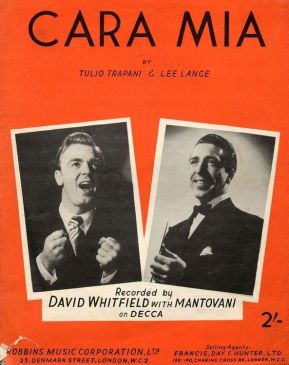
david-whitfield-with-mantovani-cara-mia-decca

Cara Mia, by David Whitfield with Mantovani & His Orchestra (both Whitfield and Mantovani’s 2nd of two #1s)

10 weeks, from 2nd July to 10th Sept 1954

The last time I wrote about David Whitfield, when his first number one followed on from Frankie Laine’s rockabilly number ‘Hey Joe’, I might have mentioned something about it being one step forward and two steps back…

But for this to follow on from rock ‘n’ roll pioneer Johnnie Ray, and the gloriously suggestive ‘Such a Night’ (OK, yes, Doris Day did return to the top for a big old spell in between but let’s not allow that to get in the way of my indignation!) – it’s more a case of one step forward, ten steps back! One step for every week this record spent at the top! The difference between this and ‘Such a Night’ is massive. This is pre-rock. If such a thing ever existed, if it could be captured and bottled or defined in a dictionary, then this would be it. The Sex Pistols were punk, Oasis were Britpop, David Whitfield was pre-rock.

Shrill backing singers? Check. Overwrought vocals? Got it. Proper enunciation? Yep. Big bastard of an ending? Oh boy. Seriously, check out this ending. It has three stages. Whitfield comes in for the final verse like he means it, an octave up on previous lines: All I want is you, for ever more… Then comes the final line for which he amps it up even more: TILL THE END OF… And the note that he hits for the final TIIIIIMMMMMMEEEEE!!! cannot be natural. Its impressive, yet horrifying.

I have nothing new to write about David Whitfield. He’s of his time, and who am I to judge? People at the time clearly enjoyed it: very, very few records have ever reached double figures in terms of weeks at #1. ‘Such a Night’ only got one week. And he died young, unlike so few of his contemporaries, aged just fifty-four in 1980. We should also drop a mention for Mantovani, of violin and rhyming-slang fame, from whom we won’t be hearing again in this countdown. The violins in this song sound identical to those in his first chart topper. Mantovani’s signature strings.

cara-mia-song-featuring-david-whitfield-mantovani-englebert

Though the sharp-eyed among you will currently no doubt be thinking ‘Now just wait a minute here!’ Because back a few posts ago I mentioned that every record thus far had been conducted by someone and their orchestra, and that these conductors – Paul Weston, Hugo Winterhalter et al, never seemed to get credited and were deleted from any chart statistics. So why is Mantovani getting a credit here? To be brutally honest… I dunno. Maybe it’s because this, more than any, is a super operatic, orchestral record and they feel that that should be recognised. Maybe it’s because Mantovani already sneaked a week at the top with his own song, ‘Moulin Rouge’, and so was slightly more renowned than your run-of-the-mill conductors. Maybe Mantovani was just really concerned about his legacy and so paid someone to stick him in the records. Who know? But if I were Paul Weston, I’d be pretty pissed off.

Before finishing, I want to mention a thought that struck me a few posts ago. It seems that in the mid-1950s there were very few ways for people to hear the music that was in the charts without buying it. No MTV (duh!), no Top of the Pops, no YouTube, no nothing. Radio consisted of a handful of stations, very few of which played pop music. Pirate Radio hadn’t got going yet. Perhaps you could have listened to ‘Pick of the Pops’, on the BBC Light Programme, but even that wasn’t first broadcast until 1955. It just seems so alien to me, to us, that you might only know of a record as a listing in a magazine and have no idea how it sounded until you went out and bought it.

Although, this might explain how certain songs managed to top the charts in the first place…

18. ‘Secret Love’, by Doris Day

doris-day-secret-love-1954-78-s

Secret Love, by Doris Day (her 1st of two #1s)

1 week, from 16th to 23rd April / 8 weeks from 7th May to 2nd July 1954 (9 weeks total)

A dreamy intro… Is that a harp…? And is that running water, or just the quality of the recording? It’s very soft start to the 18th chart-topping record, and it’s not immediately obvious why this song straddled the very top of the charts for three whole months.

There are some mushy lyrics about the titular ‘secret love’, about being a dreamer, about only being able to tell the stars about how deeply in love you are… So far, so 50s.

But then. Boom. The chorus. I know this song. People know this song. NOOOOOWWWW I shout it from the highest hills, even told the golden daffodils, at last my heart’s an open door, and my secret love’s not secret, anymore…

GACCALAMITYJANE

Day has a wonderful voice: with elocution as crisp and clear as any we’ve heard before, but without the stiffness and formality that has made some of the previous number ones sound old-fashioned. There’s a great warmth to it, and the way she jumps from softly purring the verse to walloping out the chorus is impressive. It’s effortless. You could say it’s star quality.

And surely she is the biggest star to have topped the charts thus far. Frankie Laine, and Guy Mitchell, were huge in their day but have largely been forgotten. People know Doris Day. Even today people will have heard of her, though they might not be able to pinpoint why. I, for example, knew this song without realising it. And everyone knows her next chart-topper, which contains some of the most famous lines in the history of popular music. But more on that later…

Probably the first time I ever heard of her was through ‘Grease’, and Rizzo’s mocking line ‘Hey, I’m Doris Day. I was not brought up that way…’ Day is held up by the Pink Ladies as straight-laced and old-fashioned – a girl who most certainly would not go to bed till she was legally wed. That, in a way, sums up this ‘pre-rock’ age and its stars who would, long before the turn of the next decade, seem painfully uncool next to Elvis and his kind.

Speaking of movies… Something about this recording gave me an inkling that it was from a movie soundtrack. Perhaps it was the orchestra, or the way the song doesn’t so much end as fade away to grey. Anyway, for each of these posts I make sure I listen to each song three or four times before doing any research on it (honest). But, lo and behold, ‘Secret Love’ is from a movie: ‘Calamity Jane’. Again: a film I’ve heard of – most people probably have – but have never seen. This is a sign of star quality, of true fame, no? When you are woven so deep into popular culture that people stop realising you’re there.

Two other little things to muse upon before we move onwards… At 3 minutes 40 seconds, this is a pretty long record. That’s pretty much the length of the average 21st century pop hit. Actually, these super-early chart toppers have routinely been hitting the three-minute mark. When I started listening to music I – no doubt influenced by the 2.5 minute wonders on my parents ‘Sounds of the ’60s’ cassettes in the car – assumed that songs started out really short and got longer and longer (at least until the 70s, when prog-rock came along and simply took the piss). But it appears that the average length of pop songs (as we know them, post-war, at least) actually started out at three minutes or longer and shrunk in the late fifties/ early sixties.

And the last thing (which is much more important than the average length of chart topping singles): you know how I keep referencing just how long these early pop stars seemed to have lived for? Well, Miss Day has only gone and topped them all. By still being alive! Ninety-five and still going strong (at the time of writing…) Well done her!

15. ‘Answer Me’, by Frankie Laine

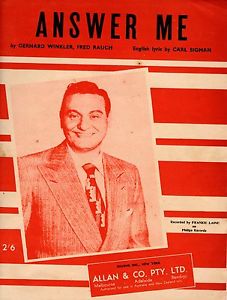
frankie-laine-answer-me-philips-78-s

Answer Me, by Frankie Laine (his 3rd of four #1s)

8 weeks, from 13th November 1953 to 8th January 1954 (including 1 week joint with David Whitfield, from 11th to 18th December 1953)

There’s something rather familiar about this record…

Having read the previous post, you know what this song is all about: heartbroken guy, on his knees, turning to the Lord as a last resort… all very melodramatic. This sticks very close to the structure of the David Whitfield version – it’s exactly the same length – but I must admit I like this version better. There’s just something about Laine’s voice: warm, beckoning, a voice I want to listen to, a voice I trust. Unlike Whitfield’s plummy whining.

Musically, this version is also a little less overwrought than its predecessor. The guitar strums that play us in are very reminiscent of ‘I Believe’, and the violins have been replaced by an organ and backing singers. It’s still pretty dull, don’t get me wrong, but it’s just that little bit more listenable. It’s got an American gloss, all glittery lapels and perfect teeth, that David Whitfield’s reserved, BBC World Service delivery was lacking. And the ending is still a bit much, though Laine holds it back until the final line rather than belting out the whole last chorus.

s-l300 (2)

We’re now a year into this countdown, believe it or not, and out of the past 37 weeks, Mr. Frankie Laine has been at number one for 28 of them. In many ways it is impossible to compare the charts of today with those of the early ’50s – in terms of how the data is collected, in terms of what data is included, in terms of how wide-ranging the chart data is – but if anyone does think that today’s streaming dominated charts are dull, slow-moving and dominated by the same handful of artists, I would suggest you tell them to thank their lucky stars they weren’t around in the autumn of 1953. Not only are the same artists dominating here; the same songs are, too.

In lieu of mentioning having anything new to say about the song, I thought I might give a little shout out here to the conductors. The ‘what’, you say? The conductors! Almost every chart-topping record by a solo act, as you may have noticed from the pictures I post at the start of every entry, has been conducted by someone and their orchestra.

So far, Monty Kelly has conducted the orchestra for ‘Here in My Heart’, Harold Mooney for ‘Comes A-Long A-Love’, Hugo Winterhalter did both Eddie Fisher’s chart-toppers, Mitch Miller was Guy Mitchell’s go-to guy for both of his, Johnny Douglas did the ‘accompaniment’ for ‘That Doggie in the Window’ (apparently it didn’t warrant a full-blown orchestra) while Stanley Black guided David Whitfield through ‘Answer Me’. Mr. Paul Weston, though, has been the most prolific so far: Jo Stafford’s ‘You Belong to Me’, as well as the Frankie Laine trio of ‘I Believe’, ‘Hey Joe’ and now ‘Answer Me’ coming under his baton. Only the Stargazers (presumably because they played their own instruments) and Perry Como haven’t had orchestral accompaniment. Mantovani got the credit as conductor for ‘Moulin Rouge’ because it was an instrumental.

If haven’t included these conductors in the titles of my blog posts it’s because, well, they aren’t included anywhere else. Most listings of UK Singles Chart #1s – Wikipedia and the Official Chart Company included – don’t mention them. And so I won’t either. I understand it from the point of view that the conductor is neither playing an instrument nor singing the song, and that if the conductor gets a credit then so should the violinist, the trombonist, the harpist etc. etc. But, at the same time, Paul Weston has been heavily involved in four number one singles so far – with more to come, presumably – totalling 30 weeks at the top. That would already be enough to make him joint 7th (with Justin Bieber) for most combined weeks at number one! It seems a little harsh that he is forever banished from the chart history books…

14. ‘Answer Me’, by David Whitfield

05bcd67666dbe25f75de8dae9ccd1bba

Answer Me, by David Whitfield (his 1st of two #1s)

1 week, from 6th to 13th November/ 1 week joint with Frankie Laine, from 11th to 18th December 1953 (2 weeks total)

This period, the immediate post-war years, 1945-55, is known musically as the ‘pre-rock era’. The time right before ‘Rock Around the Clock’, and Elvis, and teddy boys and pink ladies, created what we know as modern popular music.

Except I have a history degree, and one of the first things you learn in history class is that any labels that have been applied to certain periods of time, and the images that are conjured up when you think of, say, the ‘Tudors’ or the ‘fin de siècle’, are at best gross stereotypes and at worst just plain wrong.

And, having listened to thirteen of the biggest selling hits from this period, it’s clear that there’s no such thing as the ‘pre-rock’ sound. Rock was already here, in the playful hiccups of Kay Starr’s voice and the twangy guitar solo of ‘Hey Joe’. Plus, twenty years previously we had been right in the middle of the ‘Jazz Age’, and that was a pretty raucous time. No, rock was here. It had always been here, at least in spirit if not in sound. It just hadn’t broken through quite yet as ‘rock’. It was having what we might now call a soft landing. Every musical genre has one – nobody woke up one morning and invented heavy metal, or garage, or grime. They can all be traced back to something earlier.

But – big but – that’s not to say you’re going to find any traces of the nascent rock ‘n’ roll movement here, in the 14th UK #1. Because for every hit that was flirting with rockier elements, there was a hit like this. One step forwards, two steps back. This is pre-pre-pre rock. This is partying like it’s 1910.

David Whitfield’s ‘Answer Me’ is a proper record. And I don’t mean ‘proper’ as in substantial and fulfilling; I mean ‘proper’ as in how you should behave when the vicar comes for tea. It’s semi-operatic, it’s painfully earnest, and it’s incredibly old-fashioned.

It’s a song about heartbreak, first and foremost. The singer is asking the Lord for an answer: does his love still love him back? Answer me, Lord above, just what sin have I been guilty of?… She was mine yesterday… I believed love was here to stay… And so on. Whitfield’s voice is so clear, so technically correct, that it sounds slightly ridiculous. Here is a man at the end of his tether, laying himself at the mercy of God, begging for one more chance with the love of his life, and all the while enunciating like the Queen. Every ‘t’ pings off his teeth, every ‘r’ is rolled. It’s as if the lyrics were written down in the phonetic alphabet – If she thinks aT awll abowT me, please leT heR heaR my praiR – and that it was recorded for the benefit of foreign students.

david

And, I know I’ve mocked the dramatic endings of some of the previous records, but this one really takes the biscuit. Whitfield’s voice completely changes with thirty seconds to go, growing fuller and throatier, but losing none of his cut-glass diction, as he steels himself for the big finish. Please answer me…. Oh….. Lord…..! It’s as if he’s responding to the American singers that have gone before, the Guy Mitchells and the Frankie Laines, with all their sloppy vowels and swallowed endings: “Sir, my heart may indeed be breaking, but that’s no reason to speak like a slob.”

If anything, the chart run of ‘Answer Me’ is much more interesting than the song itself. It had a week at the top, then dropped down for a whole month before returning. That’s a pretty long gap between stints at number one. When it did eventually climb back up, it did so in a manner that has only occurred a handful of times in chart history: it tied with another record for number one. And, for added intrigue, the song that it had this little tussle with was… a different version of ‘Answer Me’. This is all very 1950s. But more on all that in the next post…

To finish, I’d like to return to the idea of the ‘pre-rock era.’ I dug up this old article from ‘The Guardian’, which name checks some of the hits covered here. And it posits an interesting idea about why this time in music was dominated by very MOR, very laid-back, very jaunty hits about prayers being answered, and girls in red feathers and huly-huly skirts. Namely, that Britain had just seen the worst conflict in history, had lost loved ones, had survived the nightly threat of the Blitz, had suffered through ten years of rationing and rubble only to emerge at the other side into a world on the verge of nuclear Armageddon… and they just wanted some bloody escapism. It’s pretty obvious when you think about it.

Then, come 1955 or thereabouts, youngsters for whom the war was a distant, childhood dream, who wanted to escape the drab post-war depression, looked across the Atlantic… and the rest is history.

But not quite yet.