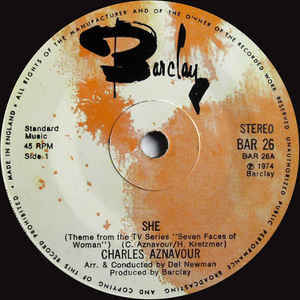
352. ‘She’, by Charles Aznavour

Un chanson, en anglais…

She, by Charles Aznavour (his 1st and only #1)

4 weeks, from 23rd June – 21st July 1974

It’s a simple ballad – a piano, a voice, not much else to start with – about an unnamed woman. She. A bit of a femme fatale, it sounds like. She may be the beauty or the beast, May be the famine or the feast… Not the most flattering lyrics for a love song, you might argue.

The words are crammed into each line, running on slightly, spilling over onto the next, in that way that French chansons do, a la Jacques Brel and Edith Piaf. She who always seems so happy in a crowd, Whose eyes can be so private and so proud… Meanwhile, when the drums come in, it starts to sound like a late Beatles ballad, a ‘Something’, or a ‘Long and Winding Road’.

Charles Aznavour was French-Armenian, and he sings this in heavily-accented English. I’m not sure it would work so well were it sung in straight-forward British or American tones. The Frenchness of it adds glamour, mystery, and romance – all the things that we pasty, repressed Anglo-Saxons associate, rightly or wrongly, with the other side of the channel. I knew this song through Elvis Costello’s late-nineties version and, looking back, it’s not as good simply because he isn’t French.

Not only was Aznavour French, he was also pretty old – he’d just turned fifty when ‘She’ hit the top of the charts, making him… I think… the second oldest male chart-topper, so far, behind Louis Armstrong. He sounds older, even, when he sings, and again this adds to the mystique, to the idea that his life has been plagued-slash-brightened by this alluring lady. It was recorded as the theme to a TV series: ‘Seven Faces of a Woman’ (which can’t have been very memorable, as it doesn’t have a Wiki page) and soared to the top of the charts as a result. Amazingly, this was Aznavour’s second and final chart hit in the UK. Mais, en France…

I would need another article to do his biography justice. A seventy year career taking in 1,200 songs… France’s Sinatra… ‘Entertainer of the Century’ ahead of Elvis… Seller of 200 million records… Performing until a few weeks before his death aged ninety-four! And that’s before you get to the non-musical portion of his life: he sheltered Jews during WWII, he was a National Hero of Armenia, as well as Armenian ambassador to Switzerland, an opposer of far-right politicians, a supporter of LGBT rights before that was the done thing… He sounds like quite the guy. And it just goes to show how insular our Anglo-centric world can be, given that I knew nothing of his life before writing this post!

Follow along with my playlist:

347. ‘Seasons in the Sun’, by Terry Jacks

From one mawkishly sentimental #1, to another…

Seasons in the Sun, by Terry Jacks (his 1st and only #1)

4 weeks, from 31st March – 28th April 1974

Let’s not pull any punches: this record is seen by many as one of the worst songs, ever. And I can understand why. From the opening riff, both ominous and irritating, to the nursery rhyme lyrics that don’t quite scan: Goodbye to you, My trusted friend, We’ve known each other since we were nine or ten…

It’s the swan-song of a dying man, a man who has lived quite a life: drinking, carousing, chasing girls… The self-confessed black sheep of the family. He lies upon his deathbed, smelling spring in the air, hearing children playing outside. There’s a verse for his friend, his father, and his daughter Michelle.

Jacks’ voice is perhaps the biggest problem here. It’s reedy, and at times sounds like bad impression of Kermit the frog. But it’s far from being the only problem… There’s an early key-change, and then another, and another, and another, until you’re left wondering if the song might continue until it’s reached a key that only dogs can hear. And then there are lines like: we skinned our hearts and skinned our knees… and like: but the stars we could reach were just starfish on the beach…

‘Seasons in the Sun’ is in many ways a terrible song. Saccharine, cloying, cheesy, simplistic… throw all these adjectives at it and they stick in the sentimental gloop. But I’ve never been able to hate it. I quite like this record. In reflective moments I picture myself singing it on my own deathbed… I find the Goodbye papa, It’s hard to die, When the birds are singing in the sky… line very moving, and a reminder of our own great insignificance in the grand scheme of things. The birds don’t give a shit if you live or die – they’ll go on singing regardless. And Jacks was inspired to write his version of the lyrics when one of his friends was diagnosed with terminal leukaemia, so that’s very sad.

In the right hands this could be a powerful song. Unfortunately the only other version I can think of is Westlife’s – a version we will meet atop the charts one day – and they are certainly not ‘the right hands’. The very first version had come in the early sixties as ‘Le Moribund’, in French, sung by Jacques Brel. In it the singer is ‘dying’ from a broken heart, and he sarcastically dedicates the final verse to the girlfriend that cheated on him. It sounds so unlike ‘Seasons in the Sun’ that you wouldn’t instantly connect them.

The first English version was recorded by folk act The Kingston Trio. It’s just as strident as Brel’s. Meanwhile, the Beach Boys were working on a version at the same time as Terry Jacks and his wife. Sadly it never saw the light of day. But what’s this I’ve found…? A demo version? By Nirvana? With Kurt Cobain mumbling, and making up half the lyrics, including a line about ‘foggy turds’…? Still not convinced they’re the right hands, but I like it…

Terry Jacks doesn’t quite make it as a one-hit wonder – his follow up to this chart-topper made #8. He lives in his native Canada, where he semi-retired from the music industry in the eighties, enjoying many a season in the sun, and where he has won several awards for his environmental campaigning.

336. ‘Young Love’, by Donny Osmond

We’ve heard this one before, haven’t we…?

Young Love, by Donny Osmond (his 3rd and final #1)

4 weeks, from 19th August – 16th September 1973

Cast your mind all the way back to early 1957, when blue-eyed, all-American heartthrob Tab Hunter was crooning his way into the hearts of many with his own version of ‘Young Love’. I wasn’t keen on it then – and I quote: “I’ve listened to ‘Young Love’ several times now, trying to find something to like about it, but I can’t do it. It’s insipid. And that’s it” – and I ain’t much keener on it now.

It’s a pretty faithful cover – the same lullaby guitar and lyrics, with a few strings thrown in for that trademark Osmond schmaltz. Donny sounds like… Donny. It’s not as teeth-grindingly terrible as ‘The Twelfth of Never’, but it’s no ‘Puppy Love’. Who’d have thought, when I gave ‘Puppy Love’ it’s glowing review, that it would wind up being the best of Donny Osmond’s three chart-toppers!

No, I’m going to play nice. Yes, this is complete tripe, but as I say every time: I am not the target audience for it. Same way that I will not be the target audience for New Kids on the Block, Boyzone, Westlife or 1 Direction, when their times come. Plus, it’s a song by a fifteen year old kid. No way would I want any of the stupid things I did, said, wore, or released on 7” vinyl around the world, aged fifteen, held against me. I’ll let him be…

But then, oh Jesus, he starts talking. Even Tab Hunter didn’t go this far… Just one kiss, From your sweet lips, Will tell me that our love is real… Donny, son, you’re making it really hard for me to not write terrible things about you… You just know that this was the exact moment in the song where girls across the country leant in to give their Donny posters a good hard snogging.

It’s short, at least, two and a half minutes and we’re through. That’s it as far as this young man’s solo chart-toppers are concerned, though he does have one more #1 coming up soon with his brothers in tow. I feel we need write no more.

Except, I guess it’s interesting that back in the fifties, at the same time as Tab Hunter took this to the top first time around, right on the verge of the rock ‘n’ roll revolution, that it was common for artists to cover songs from the twenties and thirties. Connie Francis took ‘Carolina Moon’ to the top, Bobby Darin did the same with ‘Mack the Knife’, while Tommy Edwards used an old melody in ‘It’s All in the Game’. This disc marks the first time, of many, that a former #1 will return to the top as a cover version. And, scarily, the 1950s are to the 1970s what the 1930s were to the ‘50s…

334. ‘Welcome Home’, by Peters and Lee

I know from the second I press play on our next number one that it is a song I’m going to enjoy. The intro alone is an example of such lavish, seventies, horns ‘n’ strings cheese that, despite knowing much, much better, I like it before the voices have even come in.

Welcome Home, by Peters & Lee (their 1st and only #1)

1 week, from 15th – 22nd July 1973

I’m so alone, My love, Without you… You’re part of everything I do… There’s a gentle, country and western twang in there too, adding to the sentimentality of it all. And then comes the chorus, and I’ve heard this song before. I know it, of course I do, because it’s the sort of chorus you’d know even if you’d never listened to music before. Welcome home, Wel-come… Come on in, And close the door…

‘Welcome Home’ makes the work of Tony Orlando – ‘Knock Three Times’, ‘Tie a Yellow Ribbon…’ and all that – seem subtle and understated. It is that cheesy. Listening to it, I immediately picture Elvis giving it the glitzy, jump-suited Vegas treatment. (Though to be honest, I can’t find any evidence of him ever singing it. Shame…)

Peters and Lee were a duo, obviously, but hearing this single it sounds more like a singer and his backing vocalist. The woman’s voice is much softer, and much further back in the mix. Lennie Peters had been a pianist and singer, travelling round pubs for gigs throughout the sixties. He was blind, having lost sight in one eye in a car crash aged five, and in the other aged sixteen, when a brick was thrown at him! He met Dianne Lee on the same pubs and clubs circuit. She was nearly twenty years younger, and dreamt of being a ballet dancer…

And if you were expecting a seedy story of exploitation and creepy age-gaps… You’ll have to wait (at least until our next #1…) For it seems that Peters and Lee were two people who simply enjoyed singing with one another. They entered a TV talent show called ‘Opportunity Knocks’, and the rest, as they say, is history. Two people for whom life might not have turned out quite as they’d hoped, but who suddenly found themselves at number one on the pop charts. Yes it’s sentimental, yes its ridiculously uncool, but it’s kind of lovely. As your nan would have said: “They don’t make ‘em like that anymore!”

I’m not quite sure what’s just happened. I should have approached this song much more cynically, but the more I listen to it the more I sway along. I better stop before I start claiming this is some kind of all-time classic. Peters & Lee had a few more hits, and kept intermittently recording and touring through to Peter’s death in 1992.

They also spent a good chunk of their time, in the later years, recording crappy karaoke-backing-track versions of their biggest hit. These are the only versions of ‘Welcome Home’ on Spotify; you have to go to YouTube, or your nearest record store, if you want it in all its original, schmaltzy glory. 1973 has truly been the year to ruin my #1s Blog Spotify playlist, and the situation probably won’t be helped by our next chart-topper…

327. ‘The Twelfth of Never’, by Donny Osmond

I press play on this, the second part of Donny Osmond’s chart-topping trilogy, and the first word that comes to mind is ‘syrupy’. Listening to this record’s intro is like being dropped head first into a vat of treacle, and trying to swim to safety…

R-13845213-1562429675-6559.jpeg

The Twelfth of Never, by Donny Osmond (his 2nd of three #1s)

1 week, from 25th March – 1st April 1973

Second thing I notice is that lil’ Donny’s voice has broken. He’s become a man, or at least a proper teenager, and so, we wonder, will his music have grown up along with him? We last heard him chirping about his ‘Puppy Love’; is there any sign that Donny is pushing boundaries, experimenting on the lead single from his fifth (his fifth!) album?

No. If anything – and I have considered this statement very carefully – ‘The Twelfth of Never’ is worse than ‘Puppy Love’. (Meanwhile it makes his little brother Jimmy’s chart-topper sound genuinely enjoyable by comparison.) You ask how much I need you… Must I explain… I need you oh my darlin’, Like roses need rain… You really don’t need to hear any more of the lyrics to get the picture.

But, just in case you were enjoying it, he will love his girl until the roses don’t bloom, until the clover has lost its perfume, and until the poets have run out of rhyme… Until the twelfth of never, And that’s a long, long time… I’ll give this song one thing: it’s powerful. Certain songs make you sad, certain songs make you happy, certain songs make you nauseous. You can guess what category this one falls under…

I dunno. I feel a bit bad. He was only fifteen, and picking on this record feels a bit like taking candy from, well, a kid. I’m sure he was a nice young man, and your nan would certainly have approved (though she might have suggested a haircut), but Donny Osmond did release some utter shite. But then again, as I wrote in my post on ‘Puppy Love’, I am not and never have been a thirteen-year-old girl, and so am far, far away from being this song’s target audience.

‘The Twelfth of Never’, like ‘Puppy Love’, was a cover of an older hit. Johnny Mathis had released his version way back in 1956, and it is much less syrupy, almost gospel-ish. (Mathis, though, disliked the song and kept it as a ‘B’-side.) In the UK, Cliff Richard had had a #8 hit in 1964 with his own version

Donny will have one last UK #1, coming up pretty soon, so brace yourselves. That one is interesting as it is not just a cover of an oldie, but a cover of an oldie that has already topped the charts! Until then, I need a glass of water and a ‘Rennies’…

Follow along with my #1s playlist…

318. ‘You Wear It Well’, by Rod Stewart

In which Rod Stewart scores his second number one single, by releasing a song that sounds suspiciously like his first. I mean, ‘Maggie May’ had been such a huge hit, his now-signature song, that you can’t blame him for trying to re-bottle lightning.

c1lq-28tuss-_sl1000_1

You Wear It Well, by Rod Stewart (his 2nd of six #1s)

1 week, from 27th August – 3rd September 1972

Not that it’s a rip-off (can you even rip-off your own song?), but it’s similar enough to sound like an off-cut from the same recording session. The intro meanders, as it did in ‘Maggie May’, before two drumbeats – dun dun – signify that we’re ready for the song proper to get underway.

I had nothing to do, On this hot afternoon, But to settle down and write you a line… Rod’s reminiscing about a woman he once loved. Who knows, maybe it’s Maggie…? He’s been meaning to call her, but thinks a handwritten letter would tug the old heartstrings a bit more effectively. You wear it well, A little old fashioned but that’s alright…

He reminisces about basement parties, her radical views, a birthday gown he bought her in town… Then he lays on the charm: Madame Onassis got nothing on you… It’s another wordy ballad, a little more electric than acoustic this time, while the fiddle from ‘Reason to Believe’ – the flip-side of his first #1 – makes another appearance to add some homespun charm. To be honest, I’m struggling to get into ‘You Wear It Well’. It’s a bit plodding, and the words sometimes get lost in the mix.

-688033

When you look the lyrics up, though, you see that there are some nice touches. The fact that he didn’t call because he’s in Minnesota and, y’know, that’d be a bit pricey, and the line: My coffee’s gone cold and I’m getting told, That I gotta go back to work… While at the end Rod hopes that she’s still at the same address. It’s not a record without charm; you just have to give it a few listens and dig a little deeper to find it.

But, you’d have to admit that if he had been trying to recapture the magic of his debut chart-topper then he’s not quite managed it. It’s strange to think that of all Rod Stewart’s big seventies hits which didn’t make the top of the charts – ‘You’re In My Heart’, ‘Tonight’s the Night’, ‘Hot Legs’ – ‘You Wear It Well’ did.

A short post, then. A nice enough song, and a nice enough addition to 1972’s parade of chart-toppers. It seems that to hit #1 in the summer of ’72 your record either had to be glammed up to the eyeballs, soppy teenybopper fluff, or an acoustic ballad. Let’s spin the tombola and see what pops up next…!

Follow my #1s playlist on Spotify:

314. ‘Vincent’, by Don McLean

From the glorious, life-affirming swagger of ‘Metal Guru’… to one of the saddest #1 singles ever recorded.

mclean-american-pie-getty--735x413

Vincent, by Don McLean (his 1st of two #1s)

2 weeks, from 11th – 25th June 1972

The ‘Vincent’ in question is the Dutch artist Vincent Van Gogh, who lived and painted in the late 19th century, to little recognition and with failing mental health until severe poverty and depression led to him shooting himself. Not the cheeriest of topics to start with, even before we get to the song itself, and certainly not the usual territory of pop singles.

It’s also one of the most articulate and descriptive chart-topping singles yet. Don McLean takes Van Gogh’s most famous works and turns them into lyrics: Starry, starry night, Paint your palette blue and grey, Look out on a summer’s day, With eyes that know the darkness in my soul…

It’s just a voice, an acoustic guitar, and some light, light backing touches. The gist of the song is that the singer sympathises with Vincent, that he recognises something of himself in the artist’s struggle (this was written before McLean hit the big time with ‘American Pie’), and that perhaps Vincent was the sane one after all. If people know one thing about Vincent Van Gogh, it’s that he cut off his ear and sent it to his brother. But that’s not all that he was. Now I understand, What you tried to say to me, And how you suffered for your sanity… It works also in the voice of Van Gogh’s brother, Theo, who was entwined in Vincent’s life, and who suffered equally under his brother’s illness. It’s strong stuff.

I love the idea that Van Gogh was too pure, too good for this ordinary world. It comes to a height midway through, as McLean describes the day Van Gogh committed suicide: For they could not love you, But still your love was true, And when no hope was left inside on that starry, starry night, You took your life as lovers often do… Some artistic license there, as he shot himself in a wheat field during the day, but it’s a powerful image – that he could have died on a night like the one in his most famous painting. But I could have told you Vincent, That this world was never built for one as beautiful as you… There’s also an urban legend that ‘Vincent’ was played to rapper Tupac on his death-bed, after he had suffered the same fate as Van Gogh. It was, apparently, his favourite song.

R-1456931-1342348675-5628.jpeg

It ends on a gut-punch. Each previous verse has ended on the hope that: They did not listen, They did not know how… Perhaps they’ll listen now…. On the final note, however, this changes to: They were not listening, They’re not listening still, Perhaps they never will… The idiots will always outnumber us. We’re all doomed…

Acoustic singer-songwriter type music is far from being my favourite genre. It’s all too easy to sound clever and profound as long as you sing softly enough and don’t plug your guitar in. Especially in the past few years, every male solo artist to hit the charts seems to have a beard, a beanie hat and observations to make. (I blame Ed Sheeran, personally, but then I’d happily blame all the world’s problems on Sheeran.) However, when a song is written and performed as beautifully as this, with a genuine message and genuine emotion, it’s very powerful. Don McLean had made his name just a few months before with ‘American Pie’, another song built around the death of a cultural icon. You have to wonder if ‘Vincent’ would have been such a big hit had ‘American Pie’ not come along first (it had reached #2 in the UK), especially as this sounds so out of place in a chart dominated by glam and bubblegum, though you’d hope it would have.

Last winter, in those final, blissful pre-coronavirus days, I visited the Van Gogh Museum in Amsterdam. If you have the chance to go one day, do! It displays his pictures in chronological order, and gives the background to his circumstances and mental state at the time of painting. When you get to the end, and see his very last works, it’s genuinely affecting. Maybe this song wouldn’t be hitting me so hard, had I not been there? Who knows. Under the museum is buried a time-capsule containing Vincent’s paintbrushes, and the sheet music to this song. Tens of thousands walk above it every year, to see the work of a once-ignored painter. People did listen, eventually.

311. ‘Without You’, by Nilsson

If anyone’s feeling a little fragile, a little unlucky in love, then they may want to skip this next #1. Things are about to get emotional

unnamed

Without You, by Nilsson (his 1st and only #1)

5 weeks, from 5th March – 9th April 1972

In our previous post – ‘Son of My Father’ – we had the first uber-electronic chart-topper. This time out, another new genre gets its turn to debut – the power ballad. Plus there’s the small matter of one of the best ever vocal performances on a #1 record.

It starts off with a piano. Just a piano, jabbing and stabbing like audible heartache. Well I can’t forget this evening, Your face as you were leaving, I guess that’s just the way the story goes… Harry Nilsson’s voice is slightly on edge, pitched slightly higher than you might expect. Strings are added in, as is a bass guitar for the second verse… No I can’t forget tomorrow, When I think of all my sorrow… We’re building steadily towards a chorus that everyone knows.

I can’t live, If living is without you… Can’t live, I can’t give anymore… It’s soft, gentle to start with, but not for long. He’s been holding it in, and now he just has to let her know what she should know. He tries again. Can’t live, If living is without you…! This time there’s a growl in his voice. Anger, along with the pain.

Power ballads are a much, much-maligned genre. And that’s because people automatically think of the late-eighties, early-nineties monstrosities from the likes Bryan Adams and Celine Dion (I do enjoy that type of power-ballad, in a completely ironic way, honest…) But when they’re done right, when they build subtly to a heart-wrenching climax, like this bad boy. Ooft. It gets you. The chorus comes around a second time, and Nilsson’s not hanging around anymore. A rush of drums, and then he slams into it: Can’t liiiiiivvvvvveeeeee….. His voice up an octave, sweat on his brow. This is the line that everyone thinks of, when they think of ‘Without You.’

HARRY_NILSSON_WITHOUT+YOU+-+SOLID+CENTRE-386106

Cliched as it may be: this is a song for belting out by yourself, an empty bottle (or two) of wine on the floor. And all this time I’ve been thinking that she left him high and dry, unannounced. But of course, there’s the When I had you there but then I let you go… line. He did something to drive her away. It only adds to the heartbreak. The song slowly fades, and you can imagine a camera panning out, leaving the singer alone on his sofa. Cut to black.

Actually, it’s striking that, in a song that’s all about the vocals, Nilsson stops singing thirty seconds before the end of the song. We’re used to bloated power ballads dragging on for at least five minutes, with multiple chorus repetitions and plenty of chest-beating. ‘Without You’ keeps it to a minimum, clocking in at just over three minutes. Short, sweet and effective.

There’s no point trying to place this in context. It’s a classic, one that would work in any era. But it’s also one of those songs that few people realise is a cover. The band Badfinger had written it and released it as an album track in 1970. Their version is slower, slightly less intense, but still really good. (The band sadly didn’t receive any royalties from the song, but that’s a story for a different post…) And, of course, the song will be exhumed, and returned to the top of the charts, as one of those aforementioned OTT early nineties power-ballads, by none other than Queen of the OTT early-nineties power-ballad: Mariah Carey. We’ll cover that one when the time comes but, just to give you a sneak preview of my write-up… It’s nowhere near as good.

Nilsson really was a bit of a one-hit wonder in the UK (OK, a two-hit wonder). ‘Everybody’s Talkin’’ made a modest #23, and that was pretty much that. Considering his body of work and the esteem with which he’s held, that seems pretty surprising. He passed away in January 1994, just as Mariah’s cover of ‘Without You’ was climbing the charts. We can only hope that the two were not related…

All 310 previous #1 singles, in one handy playlist:

305. ‘Maggie May’ / ‘Reason to Believe’, by Rod Stewart

And so we welcome to the stage a true rock icon, a man who sells albums and fills stadiums to this day. Sir Rod Stewart. (I’m assuming he’s a ‘Sir’. Sort it out, Queenie, if he isn’t.)

image

Maggie May / Reason to Believe, by Rod Stewart (his 1st of six #1s)

5 weeks, from 3rd October – 7th November 1971

This was his very first solo single release to make the charts. Straight to the top with a bullet, with what is his most famous song? I don’t think I’ve ever heard the ‘single’ version of ‘Maggie May’, which is a full two minutes shorter than the extended version I grew up with. It’s the same intro, albeit condensed, a confident acoustic riff, then two emphatic drumbeats announcing that the story is ready to begin. Wake up Maggie, I think I got something to say to you…

Young Rod has been seduced by an older woman, spent a summer with her, and is now starting to wake up to the harsh realities of their relationship. It’s late September and I really should be back at school… ‘Maggie May’ is famously based on Stewart’s encounter with a real woman, at a Jazz festival when he was sixteen. Getting away from the slightly predatory story – imagine if the genders were reversed – the lyrics capture perfectly the voice of a callous teen, coupled with some corny rhymes: I laughed at all your jokes, My love you didn’t need to coax… And then the classic: The morning sun when it’s in your face really shows your age… Harsh!

He loves her, but wishes he’d never seen her face. We’ve all been there. Young Rod sounds like a bit of a tearaway – his options post-Maggie are either becoming a roadie or making a living out of playing pool… I’m sure he’ll be fine, and get over the heartbreak. Anyway, the whole song is basically him rehearsing what he’s going to say to Maggie. He hasn’t broke it off just yet! It hinges on the opening and closing lines: I think I’ve got something to say to you… and I’ll get on back home, One of these days…

Unfortunately, the single version cuts the best verse, the one with the: You turned into a lover and mother what a lover you wore me out! line. Maybe that would have been too ripe for daytime radio. Then comes the solo, and the mandolin outro, one of the Celtic-sounding elements that often pop up in Rod Stewart’s music. It’s an undeniable classic, one that – cliched but true – still sounds fresh today. One that no amount of terrible pub karaoke versions can ruin. And while the woman may have been real, her name wasn’t ‘Maggie May’ – she was a famous Liverpudlian prostitute. I’m sure the actual ‘Maggie’ was delighted by the comparison…

ROD_STEWART_REASON+TO+BELIEVE+-+SOLID-689258

It’s been a long old while since we had a double-‘A’ hit the top of the charts – not since Louis Armstrong in 1968. On the flip we have Rod’s cover of ‘Reason to Believe’, a song I’m certain I’ve never heard before. It opens with a lonesome piano, before the vocals come in. Both these songs are very much focused on Stewart’s voice. Which is fair enough, as he does have one of the best.

If I listen, Long enough, To you… I’d find a way, To believe, That it’s all true… In ‘Maggie May’, he was trying to convince himself to leave someone. In this song, he’s trying to talk himself into staying, despite knowing that his lover lied: straight faced, while I cried… He needs a reason to believe in her. The two songs work well together, both in terms of the sound and the lyrical theme.

A fiddle gives this record the country feel that the mandolin gave ‘Maggie May’. Then midway through, we’re left with just the voice. Someone like you, Makes it hard to live, Without, Somebody else… It’s a nice song, that slowly grows on the listener; but it’s no ‘Maggie May’. Technically, ‘Reason to Believe’ was the song first pushed to radio when the disc was released, but the song on the other side quickly won through. Maybe it was because The Carpenters had released a version of the song the year before – a classic Carpentersy-country version – while the folky original had been recorded in 1965, by Tim Hardin, that the label thought ‘Reason…’ might have caught people’s attention quicker.

For, while this was Rod Stewart’s first charting single, it wasn’t his first attempt at a solo career. He’d been releasing singles since 1964, and had spent the sixties busking, playing session gigs and jumping between bands. Then came The Jeff Beck Group, in which he met Ronnie Wood, and then The Faces (basically The Small Faces minus lead singer Steve Marriott), with whom he was having hits alongside his solo work in the early seventies. After this huge five-week #1 smash there will be no looking back for Rod – he’ll go on to become one of the decades’ biggest stars, on either side of the Atlantic, and we’ll be meeting him plenty more times in the months to come.

289. ‘The Wonder of You’, by Elvis Presley

Well, look who’s back! Over five years on from his last #1, Elvis is back in the building. What version of Elvis are we on now? We’ve had the ‘Sun’ Records Elvis, Elvis the Pelvis, Army Elvis, Post-Army-Chart-Dominator Elvis, Terrible Movie Soundtrack Elvis…

ce30a99eda621f97208bdefcb6d247e9

The Wonder of You, by Elvis Presley (his 16th of twenty-one #1s)

6 weeks, from 26th July – 6th September 1970

’68 Comeback Special Elvis has been and gone – he didn’t make the top of the charts, though ‘Suspicious Minds’, ‘In the Ghetto’ and ‘If I Can Dream’ were all decent-sized hits. Now we’ve arrived at Vegas Elvis. The jumpsuits, the rhinestones… It’s one of his most distinctive looks, the favoured outfit of the modern Elvis impersonator.

‘The Wonder of You’ sweeps in, the instruments sounding brassy and confident, as if the very fact that they are being played on an Elvis record is giving them an extra decibel. And the man himself can’t wait to get singing, joining in with the intro: Woah-woah-woah-woah… His voice sounds deeper, thicker than when we last heard him, crooning on ‘Crying In the Chapel’.

When no-one else can understand me, When everything I do is wrong… I’m not going to lie, this record is a big bucket of schmaltz… You give me hope and consolation, You give me strength to carry on… But I love it. I especially love giving it a good old belt out in the shower. Elvis has plenty of excellent shower-songs, but this is the ultimate. I guess I’ll never know, The reason why, You love me as you do… That’s the wonder, The wonder of you… Who is the ‘you’ in the title? Priscilla? God? The listener? It works, because any old schmuck can sing it to their loved-one and come away looking cute.

R-1023324-1227378003.jpeg

Completing the ‘Elvis at the MGM’ feel are the crowd noises. Yes, we have our first ‘live’ number one since, I think, Lonnie Donegan a decade ago. They applaud at the start, when The King begins to sing, and they cheer at the end when the song rises to its finale. He never actually recorded ‘The Wonder of You’ in a studio, amazingly. At the very end, as the final note appears over the horizon, Elvis’s voice is faded right back into the mix. It’s a disappointingly muted end, a sign perhaps that his voice was beginning to fade. Of course, the next Elvis (Elvis MK VIII?) will be prescription drugs ‘n’ burgers Elvis.

And, sadly, the next Elvis we’ll meet on this countdown will be The Late Elvis. Yep, this is the last UK chart-topper of his lifetime. ‘The Wonder of You’ had been around for a while, though. It was written in 1959 by one Ray Peterson, and recorded by Ronnie Hilton (remember him, from way back in 1956?) and The Platters. Their versions are fine, though a lot stiffer than this one. Apparently Elvis had asked Peterson’s permission to record the song, and Peterson had replied with an ‘Um, you don’t really need to ask, cause you’re, you know, Elvis…’

Very few acts who scored number ones in the sixties managed to keep their runs going in the sixties. There was a sudden and sharp cut off: The Beatles (to be fair, they split up in 1970), The Stones, The Beach Boys, all the Beat bands… The door slammed down on New Year’s Eve 1969. Except, obviously, these rules didn’t apply to The King. In fact, with his 16th #1 he creates a whole new club: artists who have scored chart-toppers in three different decades. Even now it’s a select club, reserved for big names: Madonna, Michael Jackson (if you count The Jacksons), Eminem, Kylie… and Cliff Richard, who has hit #1 in an outrageous five different decades. Yep, plenty more Cliff to look forward to, coming up right here…

Follow along with the UK #1s Blog Spotify playlist here.