401. ‘When I Need You’, by Leo Sayer

Oh boy. More soft-rock…

When I Need You, by Leo Sayer (his 1st of two #1s)

3 weeks, from 13th February – 6th March 1977

We’re really hitting a slow and slushy moment in chart history. It must have been great at school discos, I suppose, with no shortage of last-dance tunes in which to snag your latest crush. But it doesn’t make for a very exciting listen forty odd years later.

It’s got all the instruments we’ve come to expect: gentle guitars, tinkly percussion, a glossy echo to everything. (Plus, this record has a secret weapon – more on that in a moment.) When I need you, I just close my eyes and I’m with you… Leo Sayer’s missing his girl while he works away from home… For some reason that I can’t quite place, I’m enjoying this more than the last-but-one chart topper, David Soul’s equally smoochy ‘Don’t Give Up On Us’. I think it’s the slightly funkier rhythm. If this one was sped up – a lot – it could be a disco classic.

I also like the emphatic It’s cold out, Just hold out… line. Plus, Leo Sayer’s voice has got a lot more oomph to it than Soul’s. He lets loose, in a fashion, for the fade-out. But, before that, we come to the secret weapon… the sax solo! Unleashed from out of the blue! They’re something we’ll have to get used to as the ’80s loom, but they’ve never sat well with me. Done well they’re fine; done badly they sound like the soundtrack to a bad date, or a porno.

It is sometimes hard to focus on the lyrics in songs like this, as they’re usually of the don’t leave me baby hold me baby variety. But, on closer inspection, on listen three or four, as Leo talks about closing his eyes and touching love while on the phone to his girl, and beseeching her to ‘do as he does’… I begin to wonder… Is this record actually about phone sex??

Or am I grasping to make it more interesting than it is? ‘When I Need You’ was the follow-up to the dorky but super catchy ‘You Make Me Feel Like Dancing’, which I would have much preferred as a #1. As it stands, this makes it four slow and soft #1s in a row, and five out of the last six. It’s not something that you say every day, but thank God for Showaddywaddy! Looking to the next chart-topper on my list, a record I have never heard before, I offer a silent prayer that it might be up-tempo.

Leo Sayer had been scoring hits since 1973, and had peaked at #2 three times before this one took him all the way. He will be back on top, but not for twenty-nine years, when he’ll feature on a remix of one of his seventies hits. That’s one of the longest gaps between number ones, ever. Meanwhile, ‘When I Need You’ has been covered by the great and the good of easy listening: Cliff, Julio Iglesias, Luther Vandross, Celine Dion… Leonard Cohen wasn’t as impressed by it, though – he sued Sayer for plagiarising his song ‘Famous Blue Raincoat”.

400. ‘Don’t Cry for Me Argentina’, by Julie Covington

Time for a proper show tune! The first, unless I am mistaken, since Shirley Bassey way back in 1961?

Don’t Cry For Me Argentina, by Julie Covington (her 1st and only #1)

1 week, from 6th – 13th February 1977

It’s a long one, too. Five and a half minutes, with nearly a whole minute of portentous introing before Julie Covington actually sings. It won’t be easy, You’ll think it strange… Gosh she sings it proper. When I try to explain how I feel… Musical theatre really stands out against pop songs, belted out as they are with cut-glass diction, aiming for the back row.

We’re approaching two and a half minutes, and still no appearance of the chorus. I have never seen ‘Evita’, neither on stage nor on screen, but I can sing this chorus. (I’ll show my age by saying I’m more familiar with Madonna’s version, which made #3 in 1996.) Come on Julie, love… Don’t cry for me Argentina, The truth is I never left you… It’s a love song, with all the usual trimmings, but about a country!

Show tunes also sound a bit strange divorced from their play, plonked into the singles chart. Who is she, and why is she singing about Argentina? Amazingly, this record was released well before ‘Evita’ debuted on the West End. Nobody had seen the show… and yet there was enough interest in this record to get it to the top of the charts!

To be honest, that first chorus was a bit underwhelming. I’m waiting for her to go around again, to really belt it out for the finale. While we wait – cause this is a record that isn’t afraid to take its time – a little bit of history. ‘Evita’, the musical by Andrew Lloyd-Webber, tells the story of Eva Perón, First Lady of Argentina between 1946 and ’52 and, since her death, official ‘Spiritual Leader of the Argentine Nation’ (with a fair few allegations of fascism thrown in from those who were against her).

Finally, a full four minutes in, and were back at the chorus. I’m ready for Ms. Covington’s big finale. But it never materialises… The orchestra does the soaring, we could be back in the charts of 1954, and I’m left a little bored. What a strange #1 hit… Bring back Dame Shirley. She’d have belted the life out of this.

Julie Covington never actually played Eva Perón on stage – she turned the role down – and when the show finally opened Elaine Paige took the part. Covington was a fixture on the West End stage throughout the seventies and eighties, but doesn’t seem to have done much in recent decades. Andrew Lloyd-Webber’s show tunes will be back, though – off the top of my head I can think of at least two more chart-toppers penned by him.

As this is the 400th (!) number one, I had planned to take stock, to see where we stood in the musical landscape. Except, this is a completely random one-week wonder that has no bearing on the real sound of the mid-seventies. In an ideal world, we could tell the story of British popular music tastes through every hundredth chart-topper. Number 100 would have been Elvis… (It wasn’t, it was Anthony Newley’s clipped and clicky ‘Do You Mind’), 200 would have been The Beatles… (It was! ‘Help’.) 300 would have been something glam… (Instead it was Tony Orlando’s sex-pest anthem ‘Knock Three Times’.) And 400 would have been a disco classic… Instead we aren’t crying for Argentina. Funny old things aren’t they, music charts…?

399. ‘Don’t Give Up On Us’, by David Soul

And it is onwards into 1977. Officially the late seventies! Bring it on!

Don’t Give Up On Us, by David Soul (his 1st of two #1s)

4 weeks, from 9th January – 6th February 1977

Actually… I’m tempted to write the entire year off after thirty seconds of this next number one. It’s been creeping up on us, slowly but surely, with Demis Roussos, Chicago, Johnny Mathis… I fear the soft-rock years may officially be upon us.

In fact, I think this record has the exact same gloopy, doopy backing track from Johnny Mathis’s Christmas #1. They sure sound similar. Though David Soul’s voice has nowhere near the gravitas that Mathis had. Don’t give up on us baby, Don’t make the wrong, Seem right… It’s a decent voice, but a very soppy one.

I want to get a foothold on this song, a way in to appreciating it, but I can’t. It’s a puff of smoke. There’s nothing actually there. It’s a ‘check your watch’ kind of song, in that you start to wonder how long it’s going to go on for… Pulses are raised slightly come the middle-eight: I really lost my head last night… though you struggle to imagine the singer of this song being capable of any strong emotions… and then we get the blandest solo you could ever imagine, featuring a mish mash of guitars, strings and a French horn.

And then there’s a key change! Of course. Is there a more divisive trick in the songwriters’ handbook than the key change? Some make you punch the air and shout ‘YES!’; others make you wish the song would just end right there and then. No prizes for guessing which camp this record falls into…

Before coming to this record, I knew David Soul as being famous for his role in ‘Starsky and Hutch’, though I needed to check which one he was (Hutch). Soul’s record career came slap bang in the middle of the show’s four series run. So, he had the exposure and was perhaps always going to score a huge hit. But ‘Starsky and Hutch’ was a cop show, in which the two main characters used their wits and traded blows to catch the bad guys. They were cool, bad-ass. Yet, it is hard to think of another song that is as far away from being cool, or bad-ass, as ‘Don’t Give Up on Us’ is.

I just wish it had a bit more – a lot more! – life about it, is all. And glancing down the list of up and coming #1s for the year – including one more from Hutch – I worry that this might become a recurring wish. Not that there aren’t plenty of classics to come, though. So come on – think positive! I won’t give up on 1977 yet… (see what I did there?)

398. ‘When a Child Is Born (Soleado)’, by Johnny Mathis

For the third time this decade, and for the fifth time in all, the Christmas number one is an actual Christmas song. The previous two, from Slade and Mud, were very seventies, very glam. This one, though, could have been #1 at any point in chart history.

When a Child Is Born (Soleado), by Johnny Mathis (his 1st and only #1)

3 weeks, from 19th December 1976 – 9th January 1977

Let’s split this record in two, and start with the good half. It’s got that ‘classic standard’ feel to it, a sweeping melody of the kind that you think you must have always known. When the backing singers come in with the ah-ah-ah-aaahhs it’s quite sweet. Plus, Johnny Mathis sings it like the professional crooner that he is. A ray of hope, Flickers in the sky…

On to the bad bits… And let’s start with those lyrics. It’s all winds of change, silent wishes, brand new morns and rosy hews. It feels churlish to complain about soppy lyrics in a religious, Christmas-themed song. What kind of lyrics is it supposed to have? Except, I’m not religious, and it’s April. So there.

Plus, the production is very floaty, glossy, mid-seventies MOR goop. And there’s a stinker of a spoken section: The world is waiting, Waiting for one child… Black, white… yellow? No-one knows… It is what it is. I’m not going to knock it any more. Mathis means well, and I have fond memories of my late grandmother singing this by the tree after a sherry or three.

I had assumed that ‘When a Child Is Born’ would have been an old, old tune from the mists of time. But the melody, ‘Soleado’, was written for an Italian singer in 1972, while the English lyrics followed a few years later. It’s a skill, I guess, to write a song that sounds so timeless. Johnny Mathis had been around for a lot longer, releasing his first singles in the mid-fifties. He followed this up with ‘Too Much, Too Little, Too Late’, his first US #1 for almost twenty years. Some impressive longevity there. He’s still with us, aged eighty-five, having released his most recent album in 2017.

You will all be thrilled to hear that the 1970s, the decade of the Christmas #1, is not done with the festive tunes just yet. But that is some way off. Up next, we launch head-first into 1977, which marks the singles chart’s quarter century!

Listen to all the #1s from 1976, and from every year before, with this playlist:

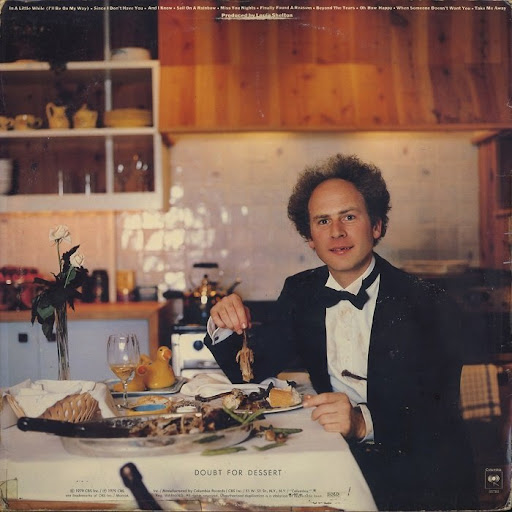
379. ‘I Only Have Eyes For You’, by Art Garfunkel

Amazingly, and despite this being the first solo chart-topper for either Simon and/or Garfunkel, I have never heard this record before…

I Only Have Eyes for You, by Art Garfunkel (his 1st of two #1s)

2 weeks, from 19th October – 2nd November 1975

Quick question: has anyone listened to this song in the past thirty years? The big S & G hits still get airplay, as does a lot of Paul Simon’s stuff, and some of Art’s… But this? The only place this is still getting a spin is on those late-night local radio request shows, where people request sexy music for their loved ones. (Do they still exist? The one I listened to growing up was called ‘Pillow Talk’.)

And yes, ‘sexy’ is the right word for this disc. Sexy, sultry, slinky, slow, sophisticated, and any other adjective you can think of beginning with ‘s’ … Are the stars out tonight…? I don’t know if it’s cloudy or bright… Art Garfunkel croons in that smooth, high-pitched way of his. I only have eyes… For you… Dear… It sounds nothing like the folky, acoustic classics he recorded in Simon & Garfunkel.

I’m picturing a fancy apartment in the Hollywood Hills, candlelight reflected in a private pool, Art flicking the fire on and slipping a bottle of champagne from the cooler, before answering the door to his date for the night… It’s an image. This is purest of pure seventies soft rock. So glossy and smooth that you can’t find anything to grab onto, and so you slide down into the sickly syrup. It is… I’ll just come out and say it… pretty dull.

Nothing about this jumps out as #1 hit material. It is last-song-on-the-album filler, to me. And it’s not as if its success can solely be explained by Garfunkel’s star name. This was the 2nd single, from his 2nd solo album, and it took a leisurely six weeks to make it to the top. But whatever the reason, there it is. Top of the pops. I’m going to proclaim this as the most-forgotten #1 since ‘Baby Jump’.

Things pick up a bit when we get to the Beach Boys sounding bridge – Art Garfunkel is one of the few singers who can make his voice sound like five people. I don’t know if we are in a garden… Or on a crowded avenue… The doo-wop feel becomes clearer when you remember that ‘I Only Have Eyes for You’ has been around since the 1930s, while the version that most people know was by The Flamingos, in 1959. The ethereal do-bub-she-bubs that make that version a classic are notably missing from Garfunkel’s version, drowned in the gloop, and that’s a shame.

It has also been recorded by names as legendary as Billie Holiday, Rod Stewart, Louis Armstrong and, um, Michael Bublé. Meanwhile at the start of this post, when I named this as the first solo #1 for either Simon or Garfunkel, I was being slightly misleading. Paul Simon has never (to date, we should add, because who knows!) topped the UK charts. Art Garfunkel will again, in a few years, with a song I have heard before! Hurray.

377. ‘Sailing’, by Rod Stewart

It’s been three years since we had Rod Stewart at the top of the singles chart. Back then, he was a folky troubadour, spinning yarns about older women and long-lost lovers. The songs were acoustic, and lyrically driven, lots of mandolins and fiddles…

Sailing, by Rod Stewart (his 3rd of six #1s)

4 weeks, from 31st August – 28th September 1975

‘Sailing’, while still unmistakably a Rod Stewart song (the voice is there, for a start), is a different proposition. The lyrics now are very simple, borderline nursery rhyme: I am sailing, I am sailing, Home again, ‘Cross the sea… He’s sailing, he’s flying, he’s on his way… To be with you, To be free… It builds, it grows, until organs and a full-blown choir have been added. It’s still got those little Celtic touches that litter classic Rod Stewart songs; but it’s overblown, and more than a little ridiculous.

It’s tempting to argue that in the past three years, as Rod has become possibly the biggest pop star on the planet, he may have disappeared, somewhat, up his own behind… I’d bet that drugs were present in the recording studio when they cut this disc. ‘Sailing’ had originally been written and recorded by The Sutherland Brothers, a Scottish folk duo, and their version is much more earthy.

What saves ‘Sailing’ is the moment when, after the guitar solo, it changes to We are sailing… Suddenly it isn’t a song for a self-indulgent rock star; it’s a football crowd singalong, a last song at karaoke night, a song to bellow out as you stumble home from the pub. It definitely moves something in you, deep down, and I am right this moment crowning it the ultimate drunk singalong tune, above even ‘Delilah’ and ‘My Way’. Change my mind!

The ending came as a bit of a surprise, I have to say. I thought it just continued with the We are sailings… ad infinitum. But no, for the last thirty seconds the vocals drop away, and the strings take it home. Which means that there’s a good chance I have never actually heard this record the whole way through. It’s a sign of a song’s ubiquity, of its classic status, when you think you know it simply through cultural osmosis.

‘Sailing’ is Rod Stewart’s best-selling single in the UK, and was a huge hit around the world. Everyone knows it. I have met people from many different countries: when they find out you are Scottish, and after mentioning whisky, of course, they will wrack their brains to think of another Scottish thing. This will invariably be Rod Stewart – even though he was born in London, and never lived in Scotland – and the song they sing will invariably be ‘Sailing’. (Still, at least it’s not The Bay City Rollers.)

Just a couple of weeks ago, ‘Sailing’ featured in a French movie that I stumbled across, ‘Ete 85’, in which the climax of the film involves a boy dancing on his dead lover’s grave while listening to the song on a Walkman, having promised to do so when said lover was alive. Which is a completely melodramatic and ridiculous storyline; but then this is a ridiculous, melodramatic song, and so, in the end, pretty appropriate.

357. ‘Annie’s Song’, by John Denver

Finally, we get a respite from all the disco, by lurching as far away from the dance hall as possible.

Annie’s Song, by John Denver (his 1st and only #1)

1 week, from 6th – 13th October 1974

I didn’t think I knew this one… Until after ten seconds, when the vocals begin: You fill up my senses, Like a night in a forest… Of course I know this. It’s an easy listening classic. Like the mountains in spring time, Like a walk in the rain… A girl – Annie, we might presume – stimulates John Denver in ways that normally only nature does. You fill up my senses, Come fill me again…

I have to admit, I remain unconvinced by that line. It just sounds… odd. (Yes, I am well aware that my mind is in the gutter.) And I have to admit, I remain unconvinced by this song. By this entire genre of acoustic, singer-songwriter balladry on the whole. It is just not my cup of tea. Whenever one of these #1s comes along, as they will do from time to time, I will endeavour to put my prejudices aside and judge fairly.

It might not be disco, but it is still a very American sounding record. The Billboard charts of the mid-seventies were choc-a-bloc with soft, countryish rock like this. For whatever reason, ‘Annie’s Song’ was one of the few that managed to break through to the top across the Atlantic. (I had my suspicions that this was a posthumous chart-topper, which would maybe have explained why it made it to the top, because I knew that John Denver died in a plane crash. Except that was in 1997…)

As the song progresses, the production becomes more and more overblown. In come strings, and mandolins, and melodic hums from the backing vocalists. The lyrics also become a little OTT: Let me drown in your laughter, Let me die in your arms… Maybe I’m giving myself away as completely unromantic, but he is laying it on a little bit thick.

‘Annie’ was Denver’s wife at the time, and he was inspired to write the song while on a ski-lift in Aspen, Colorado. He claimed he skied back down the mountain and wrote it in an hour. Colorado was the inspiration for much of his music – he used the capital as his stage name, and was named the state’s poet laureate. When he did indeed die in a plane crash, his ashes were scattered across the Rocky Mountains.

What amazes me is that this was John Denver’s one and only hit record in the UK. He was a huge chart star in the States – four number ones to his name – but a bona-fide one-hit wonder in Britain! His most famous songs that aren’t ‘Annie’s Song’ – ‘Take Me Home, Country Roads’ and ‘Leaving on a Jet Plane’ – were hits, though, for Olivia Newton-John and Peter, Paul and Mary. A chart quirk, then; and probably the most prolific one-hit wonder in UK chart history!

352. ‘She’, by Charles Aznavour

Un chanson, en anglais…

She, by Charles Aznavour (his 1st and only #1)

4 weeks, from 23rd June – 21st July 1974

It’s a simple ballad – a piano, a voice, not much else to start with – about an unnamed woman. She. A bit of a femme fatale, it sounds like. She may be the beauty or the beast, May be the famine or the feast… Not the most flattering lyrics for a love song, you might argue.

The words are crammed into each line, running on slightly, spilling over onto the next, in that way that French chansons do, a la Jacques Brel and Edith Piaf. She who always seems so happy in a crowd, Whose eyes can be so private and so proud… Meanwhile, when the drums come in, it starts to sound like a late Beatles ballad, a ‘Something’, or a ‘Long and Winding Road’.

Charles Aznavour was French-Armenian, and he sings this in heavily-accented English. I’m not sure it would work so well were it sung in straight-forward British or American tones. The Frenchness of it adds glamour, mystery, and romance – all the things that we pasty, repressed Anglo-Saxons associate, rightly or wrongly, with the other side of the channel. I knew this song through Elvis Costello’s late-nineties version and, looking back, it’s not as good simply because he isn’t French.

Not only was Aznavour French, he was also pretty old – he’d just turned fifty when ‘She’ hit the top of the charts, making him… I think… the second oldest male chart-topper, so far, behind Louis Armstrong. He sounds older, even, when he sings, and again this adds to the mystique, to the idea that his life has been plagued-slash-brightened by this alluring lady. It was recorded as the theme to a TV series: ‘Seven Faces of a Woman’ (which can’t have been very memorable, as it doesn’t have a Wiki page) and soared to the top of the charts as a result. Amazingly, this was Aznavour’s second and final chart hit in the UK. Mais, en France…

I would need another article to do his biography justice. A seventy year career taking in 1,200 songs… France’s Sinatra… ‘Entertainer of the Century’ ahead of Elvis… Seller of 200 million records… Performing until a few weeks before his death aged ninety-four! And that’s before you get to the non-musical portion of his life: he sheltered Jews during WWII, he was a National Hero of Armenia, as well as Armenian ambassador to Switzerland, an opposer of far-right politicians, a supporter of LGBT rights before that was the done thing… He sounds like quite the guy. And it just goes to show how insular our Anglo-centric world can be, given that I knew nothing of his life before writing this post!

Follow along with my playlist:

347. ‘Seasons in the Sun’, by Terry Jacks

From one mawkishly sentimental #1, to another…

Seasons in the Sun, by Terry Jacks (his 1st and only #1)

4 weeks, from 31st March – 28th April 1974

Let’s not pull any punches: this record is seen by many as one of the worst songs, ever. And I can understand why. From the opening riff, both ominous and irritating, to the nursery rhyme lyrics that don’t quite scan: Goodbye to you, My trusted friend, We’ve known each other since we were nine or ten…

It’s the swan-song of a dying man, a man who has lived quite a life: drinking, carousing, chasing girls… The self-confessed black sheep of the family. He lies upon his deathbed, smelling spring in the air, hearing children playing outside. There’s a verse for his friend, his father, and his daughter Michelle.

Jacks’ voice is perhaps the biggest problem here. It’s reedy, and at times sounds like bad impression of Kermit the frog. But it’s far from being the only problem… There’s an early key-change, and then another, and another, and another, until you’re left wondering if the song might continue until it’s reached a key that only dogs can hear. And then there are lines like: we skinned our hearts and skinned our knees… and like: but the stars we could reach were just starfish on the beach…

‘Seasons in the Sun’ is in many ways a terrible song. Saccharine, cloying, cheesy, simplistic… throw all these adjectives at it and they stick in the sentimental gloop. But I’ve never been able to hate it. I quite like this record. In reflective moments I picture myself singing it on my own deathbed… I find the Goodbye papa, It’s hard to die, When the birds are singing in the sky… line very moving, and a reminder of our own great insignificance in the grand scheme of things. The birds don’t give a shit if you live or die – they’ll go on singing regardless. And Jacks was inspired to write his version of the lyrics when one of his friends was diagnosed with terminal leukaemia, so that’s very sad.

In the right hands this could be a powerful song. Unfortunately the only other version I can think of is Westlife’s – a version we will meet atop the charts one day – and they are certainly not ‘the right hands’. The very first version had come in the early sixties as ‘Le Moribund’, in French, sung by Jacques Brel. In it the singer is ‘dying’ from a broken heart, and he sarcastically dedicates the final verse to the girlfriend that cheated on him. It sounds so unlike ‘Seasons in the Sun’ that you wouldn’t instantly connect them.

The first English version was recorded by folk act The Kingston Trio. It’s just as strident as Brel’s. Meanwhile, the Beach Boys were working on a version at the same time as Terry Jacks and his wife. Sadly it never saw the light of day. But what’s this I’ve found…? A demo version? By Nirvana? With Kurt Cobain mumbling, and making up half the lyrics, including a line about ‘foggy turds’…? Still not convinced they’re the right hands, but I like it…

Terry Jacks doesn’t quite make it as a one-hit wonder – his follow up to this chart-topper made #8. He lives in his native Canada, where he semi-retired from the music industry in the eighties, enjoying many a season in the sun, and where he has won several awards for his environmental campaigning.

336. ‘Young Love’, by Donny Osmond

We’ve heard this one before, haven’t we…?

Young Love, by Donny Osmond (his 3rd and final #1)

4 weeks, from 19th August – 16th September 1973

Cast your mind all the way back to early 1957, when blue-eyed, all-American heartthrob Tab Hunter was crooning his way into the hearts of many with his own version of ‘Young Love’. I wasn’t keen on it then – and I quote: “I’ve listened to ‘Young Love’ several times now, trying to find something to like about it, but I can’t do it. It’s insipid. And that’s it” – and I ain’t much keener on it now.

It’s a pretty faithful cover – the same lullaby guitar and lyrics, with a few strings thrown in for that trademark Osmond schmaltz. Donny sounds like… Donny. It’s not as teeth-grindingly terrible as ‘The Twelfth of Never’, but it’s no ‘Puppy Love’. Who’d have thought, when I gave ‘Puppy Love’ it’s glowing review, that it would wind up being the best of Donny Osmond’s three chart-toppers!

No, I’m going to play nice. Yes, this is complete tripe, but as I say every time: I am not the target audience for it. Same way that I will not be the target audience for New Kids on the Block, Boyzone, Westlife or 1 Direction, when their times come. Plus, it’s a song by a fifteen year old kid. No way would I want any of the stupid things I did, said, wore, or released on 7” vinyl around the world, aged fifteen, held against me. I’ll let him be…

But then, oh Jesus, he starts talking. Even Tab Hunter didn’t go this far… Just one kiss, From your sweet lips, Will tell me that our love is real… Donny, son, you’re making it really hard for me to not write terrible things about you… You just know that this was the exact moment in the song where girls across the country leant in to give their Donny posters a good hard snogging.

It’s short, at least, two and a half minutes and we’re through. That’s it as far as this young man’s solo chart-toppers are concerned, though he does have one more #1 coming up soon with his brothers in tow. I feel we need write no more.

Except, I guess it’s interesting that back in the fifties, at the same time as Tab Hunter took this to the top first time around, right on the verge of the rock ‘n’ roll revolution, that it was common for artists to cover songs from the twenties and thirties. Connie Francis took ‘Carolina Moon’ to the top, Bobby Darin did the same with ‘Mack the Knife’, while Tommy Edwards used an old melody in ‘It’s All in the Game’. This disc marks the first time, of many, that a former #1 will return to the top as a cover version. And, scarily, the 1950s are to the 1970s what the 1930s were to the ‘50s…