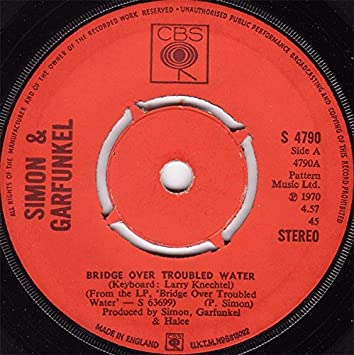
283. ‘Bridge Over Troubled Water’, by Simon & Garfunkel

A couple of times already, I’ve written about pop music as hymn. ‘Hey Jude’ was one. Here’s another. The one, and only, British chart-topping single for America’s foremost pop duo. (Sorry Don and Phil, Hall and Oates…)

mainSIMGARF-800x445

Bridge Over Troubled Water, by Simon & Garfunkel (their 1st and only #1)

3 weeks, from 22nd March – 12th April 1970

I’m only going to write good things about ‘Bridge Over Troubled Water’, but I have to get off my chest first and foremost that I didn’t always like this song. It was a big presence in my childhood – my parents are big fans – but for a long time I thought it was a bit proper, a bit overwrought, a bit… too much like a hymn! Art Garfunkel certainly does enunciate his lines properly (the cut-glass ‘t’ in when tears are in your eyes…) and, if you were being cruel, he does sound a little like a choir-boy.

But you’re allowed to make dubious musical choices when you’re young (*cough* Kid Rock *cough*). I have since come to see the error of my ways. This is an undeniable classic, from the understated confidence of the opening piano, to the giant crescendo of an ending.

And, fittingly for a song that sounds angelic, the lyrics are apparently sung by an angel. Someone looking out for you, someone who’s on your side. Like a bridge over troubled water, I will lay me down… They will follow you even at your lowest ebb, down and out on the streets, as darkness comes. Theories abound that the voice singing is that of heroin, the drug, and that the listener is an addict, which would be a spectacular twist in such a Christian sounding song. Simon and Garfunkel have always denied it.

After two verses of just voice and piano, in come the drums, like gunshots in the distance. And we start to build… I think the moment that this goes from being a great song and becomes one of the greatest is when Art’s voice dips: Oh, If you need a friend… Then the chorus comes in, and what was a simple ballad has grown into something massive without you even really noticing. Suddenly it’s ending with strings, and cymbals, and what sounds like fireworks. Suddenly it’s midnight on New Year’s Eve.

61BAj+jfwTL._SY355_

It’s superb. It’s timeless. It’s a classic. To think I used to prefer ‘Cecilia’. Seriously, though, I think ‘Bridge Over Troubled Water’ does sometimes lose something in its ubiquity. Twice in the past few years – decades after it originally hit #1 – the song has reached the top of the UK charts in the form of well-intentioned but fairly dreadful charity singles. It’s kind of easy to lump this record in with other easy-listening, uplifting MOR hits, but that would be a mistake.

And, like many of the best pop songs, there’s a friction working under the surface of ‘Bridge Over Troubled Water’. Simon and Garfunkel weren’t the best of friends by this point, and would split up later in the year. Simon apparently resents the fact that he wrote their biggest hit but Garfunkel gets remembered for singing it. When he performed it on his farewell tour, in fact, he introduced the song by saying “I’m going to reclaim my lost child.”

Actually, I have to confess that I’ve been slow to realise the merits of not just this song, but of Paul Simon and Art Garfunkel’s entire back-catalogue. I was force-fed them on childhood car journeys and, while I’ve come to recognise that ‘The Sound of Silence’, ‘Mrs. Robinson’ and ‘Homeward Bound’ are great, and ‘The Boxer’ a work of art, I still find the likes of ‘I Am a Rock’, ‘America’ and ‘Wednesday Morning, 3 A.M.’ a bit twee. I can’t stand their version of ‘El Condor Pasa’. And part of me is still seven-years-old, and still loves the outright catchiness of ‘At the Zoo’ and ‘Cecilia’. In fact, there probably is no other act about which I am so undecided. I genuinely have no idea whether or not I like Simon and Garfunkel! I do definitely like ‘Bridge Over Troubled Water’, though, and definitely think you should press play below and enjoy it one more time…

282. ‘Wand’rin’ Star’, by Lee Marvin

The seventies’ second number one… is not what I was expecting. Not by a long stretch.

5b18b0aba7b32184792db93d93f58a7a

Wand’rin’ Star, by Lee Marvin (his 1st and only #1)

3 weeks, from 1st – 22nd March 1970

For a start, it’s got one of the longest intros to a number one single, surely, ever. A gentle, countryish rhythm, some horse hooves clip-clopping, and lots of humming. For a full minute and fifteen seconds. They hum through an entire chorus and verse! Apparently the radio-edit was shorter, but it seems that the single version was the full four and a half minutes, with the added humming. I can’t find a shorter version anywhere.

Finally the vocals come in. And my, what a voice. Chiselled straight from granite, like a statue come to life. A series of deep vibrations, rather than actual words. I… Was born… Under a wand’rin’… Star… The singer is a traveller, one born to roam. Wheels are made for rollin’, Mules are made to pack, I’ve never seen a sight that didn’t look better lookin’ back… Harmonicas trill in the background, while the slight rhythm carries, and on. The wagon keeps headin’ west…

‘Wand’rin’ Star’ is a showtune, that much is clear from the first listen (it’s the backing singers that give it away) and Lee Marvin an Oscar-winning actor. He sung (whispered, grunted, grumbled… I can think of so many better verbs for his performance than plain old ‘sung’) this in the character of Ben Rumson, a gold prospector, in the movie version of ‘Paint Your Wagon’.

To be fair to Marvin, he perks up a little in the verses. I especially like the third, in which he appeals to anti-social people everywhere: Do I know where hell is? Hell is in ‘Hello’… Heaven is ‘Goodbye’ forever, It’s time for me to go… He’s happiest alone, heading somewhere new. Home is a place best dreamt of. There’s something quite romantic in the song’s cynicism.

In the following chorus, he lets the final ‘star’ flop out of his mouth, as if he’d like to go back to sleep, and you presume that’s that. But no, the song keeps plodding along, Marvin keeps chewing his tabaccy. It’s almost a lullaby – parents of the time could have used this record, and Marvin’s spectacularly sonorous voice, to get their babies to sleep.

Lee+Marvin+Wandrin+Star+-+Solid-585856

‘Wand’rin’ Star’ could have been a hit in the early-fifties, for someone like Frankie Laine. That’s the kind of territory we’ve temporarily slipped back into. The musical version of ‘Paint Your Wagon’ did debut in 1951, in fact, though the movie version had been released just the year before this single hit #1. It is apparently a ‘not very good film’, though one I’ve never seen, which didn’t make a lot of money. The soundtrack, though, made up for it. If you’ve ever wondered what Clint Eastwood would sound like singing a song called ‘I Talk to the Trees’ then check it out (he’s got a surprisingly light voice!)

Lee Marvin stuck to the acting after this, never releasing another single. Which means we’ve had two one-hit wonders in a row! He passed away in 1987, with full military honours thanks to his service in WWII. To be fair: an Oscar, a #1 single, several military medals… a life well-lived. ‘Wand’rin’ Star’ has an equally interesting postscript, including a cover version by Julian Clary (if you don’t know who he is then please, please follow this link) and being played at Joe Strummer’s funeral.

277. ‘Je T’Aime… Moi Non Plus’, by Jane Birkin & Serge Gainsbourg

We end our run of apocalyptic #1s at two, and turn to another of human kind’s most primal concerns. From death and survival, to sex… Though if the end of the world were nigh, you could probably do a lot worse than closing the curtains, dimming the lights, and slipping this disc onto the turntable…

4641

Je T’Aime… Moi Non Plus, by Jane Birkin and Serge Gainsbourg (their 1st and only #1)

1 week, from 5th – 12th October 1969

I mentioned Peter Sarstedt’s ‘Where Do You Go To…’ as a French #1. (Well, it was set in France, and the melody sounded French.) But this is the French #1. For a song to sound any more French, Edith Piaf would need to be singing ‘Frere Jacques’ on top of the Arc De Triomphe.

‘Je T’Aime…’ is a record that you picture in soft focus. All pinks and whites, scattered glasses of champagne with raspberries in them. The organ drones, the drums woozily keep time, and the strings flutter around the edges. I particularly love the filthy growl in the bass just before the main riff. Meanwhile Jane Birkin and Serge Gainsbourg breath, whine, mutter, whisper, and moan… Do everything but actually sing.

The lyrics are all en Francais: Je t’aime, Je t’aime, Oui je t’aime… sings Jane. I love you, Yes I love you! Moi non plus… mutters Serge. Me neither. Jane: Oh, mon amour… It’s been written off as nonsense – ‘I Love You, Me Neither’ – but I think it shows that the singers only have lust on their minds. From now on I’ll write the lyrics in English, even though they sound much better in French…

Like a vacillating wave, I go, I come and go, Inside of you… Ooh la la! Potent stuff. Even worse if you translate the Inside of you line literally. Entre te reins = Between your kidneys. Kind of gross. By the end, Birkin is faking a pretty convincing orgasm. At least, we think she’s faking… At the time there were rumours, or some well-contrived publicity, that ‘Je T’Aime…’ was a chart-topping single with live sex (!) on it.

R-1687183-1236951812.jpeg

Even today, in our cynical world, a record like this would raise eyebrows. In 1969, there was a fair amount of controversy. The record was banned, obviously, from radio, except in France, where it could be played after 11pm. The Vatican excommunicated the Italian label exec. who released it. Gainsbourg was unrepentant, claiming that it wasn’t about sex, but about the impossibility of true love. Others have argued that it is a feminist song, thanks to the line at the end when Birkin breathes: Non! Maintenant! Viens! (No! Come! Now!) She is in control of the love-making.

At the same time, while ‘Je T’Aime…’ is still a fairly attention-grabbing record, it also comes across as very camp and kitschy. I’m sure most people were buying it for a laugh, rather than as a soundtrack to romantic nights in. It’s also suffered the same fate as, say, ‘The Good, The Bad and The Ugly’, in that it’s become a cliché – a piece of music to play over a certain scene: in this case one involving a comical seduction. I’m not sure if or why anyone would want to sit down today and listen to it. Plus, at four and a half minutes it goes on for much longer than it needs to. But… In 1969 people lapped it up. ‘Je T’Aime…’ had already reached #2, been banned, then re-leased to make #1!

Birkin and Gainsbourg were a real-life couple when they recorded their sole chart-topper. She was twenty-three, he was forty-one. Their daughter is the actress Charlotte Gainsbourg. Serge had originally recorded it with Brigitte Bardot, but her husband had stopped them from releasing it. I know very little about their other recordings. Birkin still sings and acts to this day; Gainsbourg meanwhile is a legendary figure in France – provocative and boundary-pushing. It’s sad that most English speakers know him solely for this record, his chain-smoking and for the famous TV interview in which he told a young Whitney Houston that he wanted to ‘fuck her’ (his words.) He died in 1991 after years of alcoholism.

A notable #1 then – the first in a foreign language, the first to feature simulated sex, the first to get somebody excommunicated. And suddenly we’re three chart-toppers away from the 1970s!

267. ‘Where Do You Go To (My Lovely)’, by Peter Sarstedt

I complained about our last #1 – Amen Corner’s ‘(If Paradise Is) Half As Nice’ – having nothing for the listener to get their teeth into. It just floated along, pleasantly enough… This next #1 though, has enough meat in it for several courses.

xxl

Where Do You Go To (My Lovely), by Peter Sarstedt (his 1st and only #1)

4 weeks, from 26th February – 26th March 1969

It’s a ballad, in the very traditional sense. An epic song – nearly five minutes in length – that tells a story. I love a song that tells a story. A story that’s introduced by some accordions, as you picture the singer strolling alongside the Seine in winter, hands thrust deep in his pockets, a cigarette dangling from the side of his mouth. Mais oui.

He’s rueful, thinking about a girl, as Frenchmen are wont to do. Where do you go to, My lovely, When you’re alone in your bed… Tell me the thoughts that surround you, I want to look inside your head… (Yes I do…) I love those little run-ons at the end of each verse. They add to the idea that this song is being made up on the spot, that it exists only in the singer’s head, as he walks the river banks.

He paints quite the picture of this girl. Beautiful, glamorous, diamonds and pearls in her hair, famous friends and a fancy apartment off the Boulevard St. Michel… She went to the Sorbonne, of course, and talks like Marlene Dietrich. She has Picassos, and a racehorse from the Aga Khan, and sips only the finest brandy… I’m paraphrasing, obviously. All this unfolds over several verses, accompanied only by an acoustic guitar. This song really is all about the lyrics, and the voice that delivers them: full of regret but still defiant.

It’s funny too. The verse about her carefully designed topless swimsuit, for example that gives her: an even suntan, On your back, And on your legs… And then suddenly it’s menacing, when he mocks her fake laugh: a-ha-ha-ha! There’s anger too: They don’t realise where you came from, And I wonder if they really care, Or give a damn… (Note the mild swear word! The worst one so far? Two hundred and sixty seven chart-toppers in.)

peter-sarstedt-where-do-you-go-to

Who is she, then? Who is this deceptive femme fatale? Don’t keep us in suspense any longer, Peter! We know we’re getting to the denouement when the violins come in. Turns out, the singer knew the girl as a child in Naples, when they were both begging in rags. Her name’s Marie-Clair… So look into my face, Marie-Clair, And remember just who you are, Then go and forget me forever, But I know you still bear the scar, Deep inside… (Yes, I do…) As with all the best stories, it leaves things open to interpretation. Were they childhood friends? Young lovers? Brother and sister? Did she betray him to escape their life of poverty…?

The final line, I think, gives it away. I know the thoughts that surround you, ‘Cause I can look inside your head… They are twins! And she did do something terrible to him! Maybe… The same accordions from the intro play us out, as we contemplate this bombshell. Apparently, the title character might have been inspired by the fashion magazine ‘Marie Claire’, or by the actress Sophia Lauren (who was from Naples), or by Sarstedt’s girlfriend… ‘Where Do You Go To (My Lovely)’ both won an Ivor Novello award, and was one of John Peel’s least favourite songs. I can see why you might either love or hate this record. It’s smug, and pretentious, and wordy. Myself, I’m leaning more to the ‘love’ side.

Peter Sarstedt was, disappointingly, not French. He just wrote a very French-sounding chart topper. Don’t worry, though – there will be a genuine French #1 before the year’s out. He was British, though born and raised in India, and was the younger brother of Eden Kane, whom we met back in 1961, when he hit top spot with ‘Well I Ask You’. Which, I think, makes them the first siblings to hit #1, following on from father and daughter Frank and Nancy. The follow-up to ‘Where Do You Go…’ made #10, and that that was that for Sarstedt’s chart career. Knowing he was on to a good thing, he wrote two further instalments of the Marie-Clair story – ‘The Last of the Breed’ and ‘Farewell Marie-Clair’ before he died in 2017.

259. ‘Those Were the Days’, by Mary Hopkin

From the longest number one yet… To the second longest. Five minutes plus! Picture yourself in a tavern in Leningrad, back when it still was Leningrad. Big furry hats, sturdy men, even sturdier women…

stream_img

Those Were the Days, by Mary Hopkin (her 1st and only #1)

6 weeks, from 25th September – 6th November 1968

It reminds me of Petula Clark’s ‘This Is My Song’, an old-fashioned ballad with a sweeping intro. Instruments that I couldn’t begin to name jingle-jangle before the violins come in… Once upon a time there was a tavern, Where we used to raise a glass or two… It’s a song of longing and regret. The singer is reminiscing about happier times, dancing and singing down the pub. Those were the days, my friend, We thought they’d never end… If ‘bittersweet’ was a sound, then that sound would sound a lot like ‘Those Were the Days.’

I wasn’t just making up all that stuff about Leningrad – this really is based on an old Russian folk-tune. A Georgian folk-tune, actually, which had been around since the turn of the century. And you really can picture some Cossacks high-kicking in time to the steady beat, especially when we get to the dadadadas. That’s another thing that this record has in common with its predecessor ‘Hey Jude’: a chanted refrain. Except this one doesn’t drag on for four and a half minutes…

By the third verse, time has moved on. The singer stands outside the same tavern: In the glass I saw strange reflections, Was that lonely woman really me…? In the fourth verse she timidly enters the bar… Oh my friend we’re older but no wiser, For in our hearts the dreams are still the same… Do they get back together? Have one last fling for old time’s sake? Or do they just leave it at a smile? I guess we’ll never know…

unnamed

As a melody, it’s pretty irresistible, coming as it does from a time before ‘pop music’ existed. It sounds nostalgic, like you’ve heard it before, somewhere, sometime… It feels as if it should be from a musical. It was also produced by one Paul McCartney, who may have popped up once or twice already on this countdown. He’d known the tune for years, and finally chanced upon Mary Hopkin as a singer. She was barely eighteen, and looks every bit the sixties flower-power girl. Long hair, bare feet, that kind of thing. ‘Those Were the Days’ was her first, and by far her biggest hit. She would go on to have four more Top 10 singles in the next couple of years, and still records to this day.

In one way, this song stands out as odd. It’s sentimental, old-fashioned, a bit cheesy… But in another way it is very late sixties: there are folk-rock touches (the ‘B’-side was even a cover of The Byrds’ ‘Turn! Turn! Turn!’) and some very Beatlesy flourishes (the horns that come in midway through, for example). Plus, this is 1968, and anything goes at the top of the charts this year. There have been some weird chart-toppers, and some weird ones are still to come…

258. ‘Hey Jude’, by The Beatles

Buckle up and make yourselves comfortable, cause we’ve hit our longest number one single yet. One of the longest ever. Seven minutes and ten seconds of Beatlesy goodness.

0007362_900

Hey Jude, by The Beatles (their 15th of seventeen #1s)

2 weeks, from 11th – 25th September 1968

It starts off in beautiful simplicity. Just Paul and a piano. Hey Jude, Don’t make it bad… Take a sad song, And make it better… You’re there, in the studio. You can picture his face as he sings. Remember, To let her into your heart, Then you can start, To make it better…

I love the way the instruments are slowly added into the mix. Before you know it there’s a tambourine, a guitar, then backing vocals and Ringo’s drums. Hey Jude, Don’t be afraid, You were made to, Go out and get her… It sounds like an encouragement to a friend, to go and get the girl he loves, but it was inspired by John’s separation from his first wife Cynthia. Paul wrote it to comfort their son Julian (Julian – Jules – Jude). John, however, claimed that it was about him, and that the song’s lyrics were Paul’s blessing to him and Yoko Ono. Others still – mainly McCartney’s exes – have claimed that it was written about them. Who knows? A great song means something different to everyone.

And this is a great song. I’ve always liked the bridge best: And anytime you feel the pain, Hey Jude, Refrain…  It’s almost, without wanting to sound hopelessly pretentious, spiritual. Pop music as hymn. If I were religious, I’d go to churches where they sang ‘Hey Jude.’ I gave Paul McCartney a hard time in my post on ‘Hello, Goodbye’, and I stand by that, but here… His voice grows ever more soulful. It’s something else – it’s undeniable.

Just over three minutes in we reach the bit that means this record will live on for ever more. When the waves finally lap over the last bit of unsubmerged land left on earth, the final sound man hears will probably be the coda of ‘Hey Jude’. Na-na-na… Nananana! Nananana… Hey Jude! It lives on at karaoke nights, in pubs, outside pubs, in football stadiums… And you can see why. It isn’t hard to remember some ‘nananana’s. Whatever language you speak. Nananana.

271312379723

(‘Hey Jude’ was the 1st single released on The Beatles’ own Apple Label)

I had forgotten – having not actually listened to ‘Hey Jude’ properly for years, how crazy Paul goes over the coda. He riffs, he scats, he howls and yells. By the end he sounds as if he’s properly lost it. This was recorded at a particularly difficult time in The Beatles’ history: John spending all his time with Yoko, Ringo temporarily leaving the band… Maybe he was just letting some frustrations out.

The song starts to fade a full minute and a half before it actually ends. Does it really need to be over seven minutes long? Probably not. But at the same time: why the hell not? By this point in their careers, The Beatles could do whatever they wanted. ‘Hey Jude’ is a full two minutes forty seconds longer than the previous ‘Longest #1 Single’ title-holder, The Animal’s ‘The House of the Rising Sun’. You could play the shortest #1 – Adam Faith’s ‘What Do You Want’ – almost five times before ‘Hey Jude’ plays once. As far as I’m aware, it is still the 4th longest #1 single ever, and won’t be displaced as the longest until 1998, when Oasis will release their cover version… sorry, their completely different song… ‘All Around the World.’

And so we reach the end, finally, as the nananas fade and we are left to return to everyday life. ‘Hey Jude’ is a song that has entered the fabric of British life, of our national identity even… Paul McCartney plays it at most of his concerts, as a tribute to his long-dead song writing partner. It’s only right that it hit number one, but it seems wrong that it stayed at the top for just a fortnight. In the US it tied for the longest-ever run, at nine-weeks. That seems more appropriate. A long old run in pole position, for a long old song… Na-na-na-na!

Listen to all the previous, much shorter, #1 singles here:

253. ‘I Pretend’, by Des O’Connor

Oh dear. I thought we were past this… I thought we had waded through the easy-listening swamp and made it out alive… I was wrong. Des O’Connor sticks out an arm and drags us back in…

DES_OCONNOR_CARELESS+HANDS+-+1ST-443540

I Pretend, by Des O’Connor (his 1st and only #1)

1 week, from 24th – 31st July 1968

If I’ve learned one thing from the two hundred fifty three songs I’ve covered so far it’s that no matter the leading sounds of the day – be they rock ‘n’ roll, Beat, baroque, or folk – you are never more than seven feet away from an easy-listening #1. It is the genre that never dies, mainly because it isn’t a genre at all. It can adapt, morph, mimic and ultimately survive, like the cockroaches that will rule following the apocalypse.

And I have nothing against easy-listening. Nothing at all. I am here for every single one of these chart-topping hits. I approach each one with an open-mind. I loved Petula Clark’s ‘This Is My Song’, and enjoyed Engelbert’s ‘The Last Waltz’, but this… This does nothing for me. This is bland. Where’s the hook? I’m trying to find something to grab hold of, something to appreciate, but find myself clutching at thin air.

It’s a velvety, cutesy, saccharine fart of a record. Something about how the the lady he loves is cheating on him, so till then I’ll just pretend… Blah, blah, blah who cares? One day our love must end, Till then I’ll just pretend… He’s literally sitting alone, pretending that his wife is still in love with him, simpering over an empty chair, while she’s out gallivanting. God’s sake man, have some self-respect…

Des-OConnor-I-Pretend-UK-7-vinyl-single

I have never heard this record before. I truly wonder if anyone has listened to this song in the past twenty years. Is this the most forgotten #1 ever? Maybe that’s because it’s surrounded by monster hits by The Beatles, Stones, Cliff and more. Maybe. But, tellingly, ‘I Pretend’ sneaked a week at the top after an eleven-week climb – a disc that slipped in to pole position when nobody was looking. (It did also spend a full year on the chart, though, so there clearly was an audience for it…)

To be fair, Des O’Connor was – even years later when I was a kid – a household name in the UK. He had a fanbase. He hosted chat shows and game shows throughout the sixties, seventies, eighties and nineties. He was warm, family-friendly, slightly too tanned… A kind of male Cilla Black, though her music was much more credible. I was amazed to just find out that he’s still alive… I could have sworn he’d died years ago.

Apparently he’s in pretty poor health, though, so let’s wish him the very best. His one and only number one single may be terrible, and completely out of place in mid-1968, but it’s one more number single than most of us will manage. Next up, I believe, normal service will be resumed.

240. ‘Let the Heartaches Begin’, by Long John Baldry

I start to fear the worst when I press play on this latest #1, and find that it begins with a soft and swaying intro… The type of intro that we’ve heard at least five times too often in recent posts. The type of intro that Engelbert Humperdinck would have licked his lips at…

Dzna6QlWkAEahw1

Let the Heartaches Begin, by Long John Baldry (his 1st and only #1)

2 weeks, from 22nd November – 6th December 1967

But no, this record is a cut above the run-of-the-mill, middle-of-the-road, so-so-ness that has made up so much of the past year’s chart-topping material. That becomes clear the second that Long John Baldry’s voice comes in, all smoky and croaky. It reminds me of Chris Farlowe – another British singer that you would think was American.

I can hear the guitars start to play… The first verse is innocuous enough. Boy’s lost girl etc. etc. It does nothing to prepare you for the soaring beauty of the chorus… So let the heartbreaks begin, I can’t help it, I can’t win… It’s a sad song – the title makes that pretty obvious – but it’s also kind of uplifting.

It’s the sort of chorus that makes you wish it wouldn’t finish, and that makes you count the seconds through the next verse until it returns. And Baldry’s voice… When he pauses for the Anymore… at the end of the final chorus you can actually picture him crying. (Apparently he was quite drunk when he recorded the song…)

As with Chris Farlowe, it’s really hard to imagine that voice coming out of the man in the picture above. But it did. And ‘Long John’ Baldry is a brilliant stage name, isn’t it? Anything combining rock stars and pirates is bound to be pretty badass. It was an appropriate name, too, as he measured six foot seven in height!

XD7_1026

I’m getting lots of different notes from this record. It’s got a strong 1967, easy-listening vibe, but it’s also yet another British soul hit in the tradition of Farlowe and Fame, and following hot on the heels of the The Foundations. It’s also forward-facing – this could easily be an early-seventies Rod Stewart record, especially when the acoustic guitar comes in on the second verse. Which makes sense, as both Stewart and Elton John played with Baldry before they hit the big time. Long John would never reach similar heights, but his #1 does feel like a bit of a marking post…

It’s also a perfect winter hit, and it makes perfect sense that it hit the top spot as the nights drew in and folks huddled around their fireplaces. And it’s perfect that I’m publishing this just before Christmas. Grab your loved one – even though it’s a song about heartbreak, literally, but hey – a mug of something mulled, and enjoy. Long John enjoyed quite the life beyond ‘Let the Heartbreaks Begin’, including time in a mental health institution and saving Elton John from suicide (he’s who ‘Someone Saved My Life Tonight’ is about.) And, apparently, he had a brief romantic relationship with Dave Davies from The Kinks. A biography worth reading! He passed away in 2005.

Before we go, I’d like to wish a very merry Christmas to every one of you UK #1s Blog readers. I hope that it is both merry and bright! Next up, before the New Year… a recap!

237. ‘The Last Waltz’, by Engelbert Humperdinck

The Summer of Love is over. The VWs are rolling back home. People are sobering up and cutting their hair. Squeezing back into starchy old suits rather than baggy tie-dye. And the top of the UK singles charts reflects this. Engelbert is back; and he has no time for hippies.

Engelbert Humperdinck

The Last Waltz, by Engelbert Humperdinck (his 2nd and final #1)

5 weeks, from 6th September – 11th October 1967

‘The Last Waltz’ is indeed a waltz. Any hope that it might just be a misleading title is crushed in the opening bars. I wonder should I go, Or should I stay, The band had only one more song to play… We’re in a dancehall, and it’s time for the final song of the night. Engelbert’s out on the pull, but hasn’t had any luck. Until… I saw you out of the corner of my eye, A little girl alone and so shy…

Immediately I like this more than his earlier #1, the dreary ‘Release Me’. It’s just got a little more of a swagger, more of a wink in its eye, a certain je ne sais quoi… It also sounds a lot more contemporary, with a touch of the swinging sixties buried in amongst all the schmaltz. It’s the la-lalalalala-lalas, I think, that shimmer in an oh so sixties way. They remind me of Jackie Trent’s ‘Where Are You Now (My Love)’ from a couple of years back.

And then comes the chorus, and it is undeniable. I had the last waltz with you, Two lonely people together… Engelbert croons like the fate of the world depends on it. And the way he powers through the I fell in love with you… line is spectacular. The last waltz should last forever… Classy.

ENGELBERT_HUMPERDINCK_(SINGER)_THE+LAST+WALTZ-511473

In the end, however, it hasn’t lasted. They’ve split up (though the tense keeps switching between past and present in a way that doesn’t make it immediately obvious.) And so they have truly had their last waltz. I know it’s pure and utter cheese but – keep this secret, will you? – I kind of like it. And I really like the way he doesn’t go for the all-out big finish. He just allows it to slide away with some more lalalas.

So. Just what should 1967 be remembered for? For the Summer of Love? Or for blockbuster easy-listening hits like this? Or an uncomfortable mix of both? Engelbert Humperdinck’s two chart-toppers – one in the spring, one in the autumn – straddle the year like pillow-lipped bookends. After this the hits kept coming for a while, before he settled into a life of Vegas-residencies and TV specials. In 1996 he recorded the song ‘Lesbian Seagull’ for the soundtrack of ‘Beavis and Butthead Do America’. In 2012 he represented the UK at the Eurovision Song Contest. Clearly, despite his multi-decade success, he isn’t a man that takes himself too seriously. Let’s leave him here. Engelbert Humperdinck. The ultimate housewives’ choice. The man, the myth, the name…

231. ‘Somethin’ Stupid’, by Nancy Sinatra & Frank Sinatra

We are still stuck in the seventh circle of easy-listening hell, it seems. In calendar terms, it’s now getting on for a good half-year of dullness…

R-1373325-1414604339-5769.jpeg

Somethin’ Stupid, by Nancy Sinatra (her 2nd and final #1) & Frank Sinatra (his 3rd and final #1)

2 weeks, from 13th – 27th April 1967

And I have to admit that I thought this latest chart-topper would be better. It’s a song I know, one that’s ingrained in popular culture, and one which had a second wind thanks to a certain ex-Take That singer and an Australian actress when I was at high-school, but one that I’d never really paid much attention to.

The main problem with it, I think, is that Frank and Nancy both sound pretty bored. I know I stand in line until you think you have the time to spend an evening with me… Strings swirl and Latin guitars strum, much like they did in Petula Clark’s ‘This Is My Song’. And if we go someplace to dance I know that there’s a chance you won’t be leaving with me… It’s a wordy song, and the lines are well constructed – the alliteration in the see it in your eyes you still despise the same old lies… one is great, to give credit where it’s due. And the hook of ‘I love you’ being a stupid thing to say is cute.

But beyond that I’m left feeling a bit underwhelmed. Especially remembering how fierce Nancy sounded on ‘These Boots…’, and knowing the swagger that Frank was capable of. Both recorded far, far better songs in their careers. Perhaps they felt they had to meet in the middle, cancelling one another out. It certainly sounds like they’re holding back.

Or maybe they’re just feeling uncomfortable singing, as father and daughter, a duet clearly written for a pair of lovers… I mean, it could, maybe, be seen as song in which the father is lamenting how little time his kid spends with him… I practise every day to find some clever lines to say to make the meaning come true… That could speak of a strained inter-generational relationship, right? Of course, lines like The time is right, Your perfume fills my head… would be more difficult to sell in that way… Nancy has, apparently, gone on record to say she thinks it’s sweet that people refer to this as ‘The Incest Song.’

FRANK_SINATRA_SOMETHING+STUPID-560726

By the end we have some very-sixties horns thrown into the mix, and the pair are mumbling I love you… over the fade-out. It doesn’t end with a bang. It’s not the worst disc from our half-year of easy-listening (hello, Engelbert), but it’s not the best either (hello, Petula). It’s a shame that both Nancy and Frank are bowing out of their chart-topping careers with this slice of meh.

Perhaps the big problem with this duet – and this has just come to me – is that it’s not a duet. They sing each and every line together. A duet should have a bit more give and take, call and response, you know? Nancy especially is relegated to little more than breathy backing vocalist here. Anyway, she was about to go on to make some of the best recordings of her career, with a more suitable partner: Lee Hazlewood. Here’s a link to their version of ‘Jackson’, proving that boy could she pull off a duet, under the right circumstances.

And what of her dad? A star since the late 1930s, now into his fifties. One of the legendary figures of 20th Century popular music. He isn’t very well-represented by his three UK chart-toppers, to be honest. The bland and now forgotten ‘Three Coins in the Fountain’, the much more famous, but hated by Frank himself, ‘Strangers in the Night’, and now this limp duet with his daughter. But he wasn’t done yet. In a couple of years he will record the biggest hit of his whole career, ‘My Way’, and he’ll go on scoring Top 10s through to his version of ‘New York, New York’ in 1979, aged sixty-four. If only that could have been his final chart-topper… They were still playing that as the ‘lights-up’ song in nightclubs when I was a kid!