The fifties had rock and roll, the sixties had beat bands and psychedelia. The seventies had glam, disco, and punk, while the eighties had new wave and new romantics. The nineties had hip-hop and Britpop, not to mention dance. The 2000s have… What do the 2000s have? In fact, what musical movements of any sort does the 21st century have…?
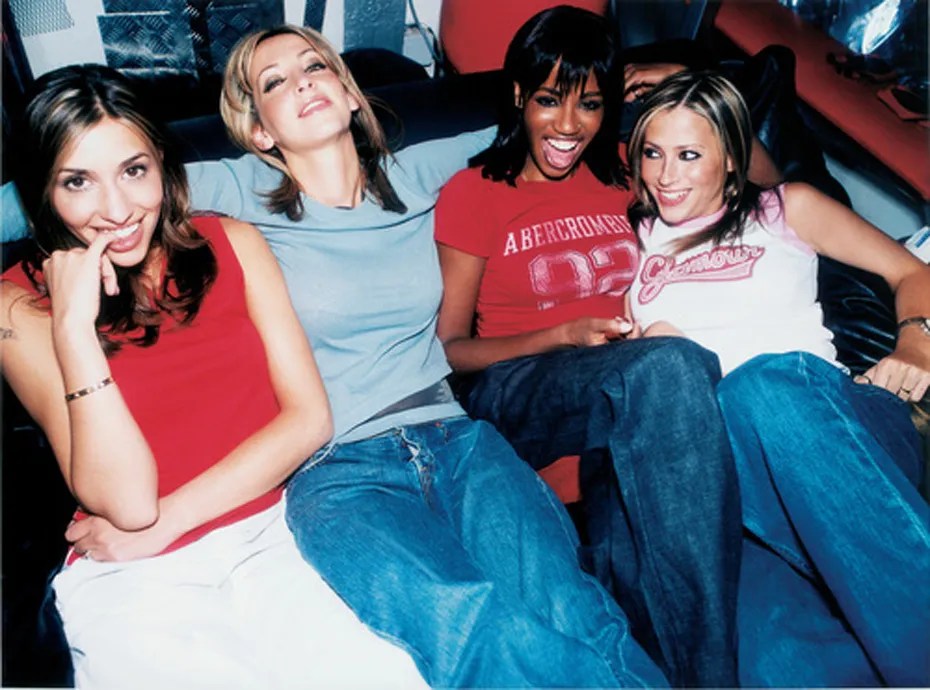
Pure Shores, by All Saints (their 4th of five #1s)
2 weeks, from 20th February – 5th March 2000
The new millennium provides an interesting dividing line, after which the Pop River reaches its delta, loses momentum, and splits into lots of little tributaries. It’s all to do with something called ‘the internet’, I think, taking power away from record companies and radio stations, and letting people discover all the music they could ever have dreamed of at the whir of a dial-up modem and the click of a mouse. The death of the monoculture, and all that. (Which isn’t to suggest that pop music’s journey had been relentlessly forward-moving over the first fifty years of the singles chart. Glam owed a debt to rock ‘n’ roll, Britpop owed a debt to the sixties, and so on …)
Anyway. That’s my long-winded way of getting around to saying that if the 21st century has a musical movement, I’d argue that it’s not so much a sound as a gender. Women. Female pop stars. Britney, Beyoncé, Gaga and Swift, to scratch but the tip of the iceberg. (And again, this is not to suggest that Connie Francis, Dusty Springfield, Diana Ross and Madonna were all figments of the 20th century imagination. Just indulge me…)
The dominance of the female pop star also meant – especially in the case of Britain in the 2000s – girl groups. In a few years I’ll be going wild for the cutting-edge pop of Sugababes and Girls Aloud, who even the likes of the NME will be rushing to anoint as the new avant-garde. All of which starts here, with the return of All Saints.
Phew. Having almost used up my regular wordcount with that intro, I’d better crack right into the song. ‘Pure Shores’ is described as ‘dream pop’, and it is definitely a step away from the group’s R&B-focused 1998 hits. The verses are laid-back, ambient, with a thrumming bass and lots of shimmering effects. We take detours between the verses for some whale calls and echoey backing vocals. It’s a pop song with the confidence to take its time, and to take us to some odd places. It was produced by electronic pioneer William Orbit, who is most famous perhaps for his work with Madonna around the same time, and who also worked with Blur, Prince, and U2.
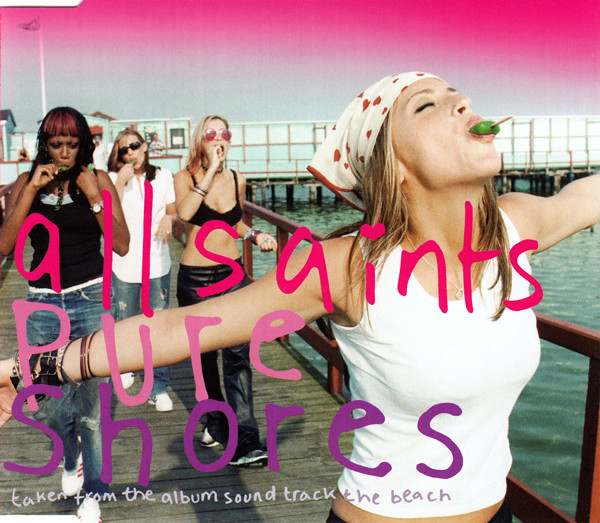
But it is still a pop song, and the success of such things hinge on choruses. ‘Pure Shores’, for all its unusual soundscaping, remembers to click things into gear for a memorable I’m movin’, I’m comin’, Can you hear what I hear… Perhaps I’m of just the right age, but there are few choruses that transport me to a particular place and time like this one. It’s calling you my dear, Out of reach… The best bit of the song, though, is the hard-edged middle-eight, all industrial synths, and the following key change to take us home.
‘Pure Shores’ was written to order for the Leonardo Di Caprio movie ‘The Beach’, hence the Take me to my beach… line (the title doesn’t appear in the lyrics but certainly fits in with the film’s theme). Shaznay Lewis wrote most of the lyrics on a transatlantic flight, which is impressive, and not something many girl group members would be capable of doing, adding another layer of respectability to this tune.
Having said all that, and as good as ‘Pure Shores’ is, I think All Saints’ final chart-topper is even better. Both tracks, bookending the year 2000, set the tone for what pop music, specifically pop music fronted by women, could achieve in the years to come…
 The UK Number Ones Blog
I’m glad you had a positive review of this song. I absolutely love this song. It came out when I was in college and I wasn’t following music at all, but it really spoke to me. I think it’s haunting, shimmering, ethereal, and all those other words. It reminds me of the atmosphere of Shakespeare’s “Tempest”. In fact, I happened to be thinking about this song about ten or fifteen minutes before I got the email notification of this blog post! And I love all the evocative aquatic sound effects.
I looked for other “dream pop” songs hoping I would like them as much, but they didn’t really do anything for me.
Maolsheachlann, Dublin.
I do really like this song, and I loved All Saints both then and now. I hadn’t really heard of Dream Pop as a genre, but as a term I think it sums this song up very well!
In all honesty, I couldn’t hear much commonality in the songs that were labelled Dream Pop. Perhaps Dream Pop is like Western Civilization, according to Gandhi. A good idea!
Maolsheachlann
As an older person who loves throwing a spanner in the works, I’d say that, with the possible exception of Beyoncé, not one of the women you’ve mentioned in this post, either individuals or groups, has the vocal talent of Dusty, Diana, Cher, Whitney etc. Whilst you ( in some cases justifiably) malign 80’s, early 90’s music for “overproduction’ , over use of synths etc, at least Paul Young, Midge Ure and co weren’t being auto tuned to death. If the majority of the 21st century’s stars (male or female) had to stand on a stage and sing with minimal accompaniment like Dusty Springfield or Shirley Bassey did fifty years earlier they’d be lucky to sound like an average pub singer
I think you’ve misunderstood my argument. It’s not that I think 21st century female singers are better than their predecessors, it’s that women dominate in a way that they never did in the 60s and 70s. In 1960, literally zero female voices were heard on chart-topping single. Every #1 was by a male act. Things started to change in mid-late 80s, and the 90s, but I think the charts properly tipped in women’s favour in the 2000s.
I just checked the current top 10, and there are six female acts. Only two male acts have topped the charts since last summer, and one of them was Wham at Christmas. I love Dusty Springfield, I’m not a fan of Taylor Swift… And ps. Lady Gaga can hold a tune with the best of them! : )
Point taken, and I’m with you on Gaga, saw her live and she’s brilliant. Taylor Swift is awful, I really don’t understand how she’s so huge
You are correct you know… it’s hard to distinguish decade to decade anymore in anything. I’ve talked to friends about that. Even clothes now are the same…do we even have a pop culture anymore?
It’s the internet, simply put. Until the early 2000s, once a song was out of record shops, or a show had been on TV, then that was that. OK, old music wasn’t impossible to find, but it wasn’t at your fingertips like it is now. It wasn’t as accessible, so it felt like pop culture was generally moving forwards… That’s my take, anyway.
Yes that makes sense. Everything is disposable now. Everything pretty much.
Brilliant record, Shaznay at her best, Orbit at his best – been a fan at this time since Bass-o-matic’s retread of Tommy Roe’s Dizzy sample (the first record I ever bought) on the fabulous Fascinating Rhythm. One of the great records of the decade. On the 21st century trends, yes pop music and dance music largely became the domination of female vocals, and that was all down to Madonna – she was clearly the basis and inspiration behind going global in control of your own business and material, a template which – and respect to female singer-songwriters who went before – no female had done before in that way, bar the more cult-appeal of a Kate Bush here and there.
Music of this century to me seems to be more of an ongoing development of existing genres, the rock revivak of the mid-2000’s, followed by the end of it as a pop music force (give or take Coldplay, The Killers and a couple of others able to mash into other genres), the ongoing fragmentation of dance into endless sub-genres which come and go in fashion, the current new one is afro-beats (which is also not new, 80’s Mory Kante did that first albeit more uptempo and epic as compared to low-key and grooving), and of course the move of rap into an unstoppable chart domination with it’s own sub-genres, Trap, Grime, and more. Those song though, by and large, are unbroadcastable without bleeps and use words that are not mainstream, so they might stream globally but tend not to be known outside their huge fanbases. That leaves Country, which also has a global presence now, and like rap, dance, rock, everything has morphed and merged – and I’d give that to Taylor Swift as the one that kick-started the Country to Pop to folk to morphing mainstream.
And of course Streaming. The music world has gone global with a lot of global overlap, and global releases, and old-fashioned physical and downloads being more of a niche thing to fanbases than the public in general. And records hang around for years in the charts. Sorry I mean decades. Mr Brightside, Iris, Dreams, the same Christmas songs year after year, they never go away and keep new acts from breaking out. Streaming companies rule.