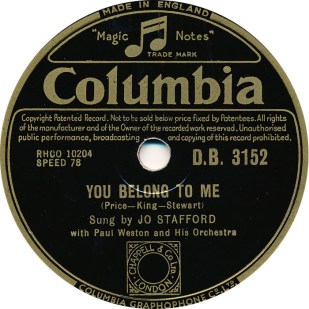
2. ‘You Belong to Me’, by Jo Stafford

jo-stafford-you-belong-to-me-1952-78
You Belong to Me, by Jo Stafford (her 1st and only #1)

1 week, from 16th to 23rd January 1953

On first listen, this sounds like the music that used to play between scenes in Dad’s Army. January 1953 was less than eight years after the end of World War II, I suppose, but this song just sounds so old. On the other side of the coin – this was less than fifteen years before Sgt Peppers! It’s genuinely amazing to think of how much popular music changed in such a short time.

However, without wanting to go off down that road just yet – this is a fairly nice, sedate little after-hours number. In complete contrast to the first chart topper, this is a track that holds back. A guitar strums, and some saxophones (trumpets?) flutter between the lines. Imagine a smoky club, little tables, couples whispering sweet nothings, gangsters and their molls quaffing champagne in the booths that line the walls. Though a quick image search of Jo Stafford brings up some fairly prim and proper pictures of her in buttoned-up blouses. None of her draped across a piano for the benefit of rowdy mobsters, unfortunately.

The premise of the song is that, no matter where her lover travels – the pyramids along the Nile, the market place in old Algiers, the jungle wet with rain – he should remember that he belongs to her and that, naturally, she will be alone and pining until his return. This being 1953, I’m guessing that he’s travelling the world as part of the military, rather than simply on a jolly, and that might explain the song’s popularity in the day’s of National Service, and the Korean War.

Jo_Stafford_color_photo_1948

Despite the song’s understated quality and the jazz-bar feel, though, Stafford is still enunciating the lyrics like she’s being graded on her diction. That’s what is immediately standing out as I listen to these early number ones. Sure they sound dated, and they have a simplistic take on romance (think about it, how many modern pop songs are about simply being in love, requited or otherwise?) but what comes across most is how clear the lyrics are. Rock and roll must’ve ruined the way folks sang!

While this was a one-week number one, the song actually hung in doggedly at number two for the whole of Al Martino’s run at the top. It could have all been so different! But at least Jo can hold claim to being the first ever female singer to top the UK charts, though she never did so again.

1. ‘Here In My Heart’, by Al Martino

Picture the scene. It’s November 1952. It’s cold. Smoggy. A real pea-souper. You’ve just popped down to Smiths and bought a copy of New Musical Express, the hot music magazine that’s been hitting newsstands these past few months.

What’s this? A chart? Of the top selling singles in the country? There’s Nat King Cole, and Rosemary Clooney. Bing Crosby’s at number four. Vera Lynn has three songs in the top ten! (And people say the charts these days are dominated by a few big names…)

You think it’d be a cracking idea to pass by the record store on your way home and pick up the number one record on this chart, which you’ve never heard before, but by golly you’ll have to watch your step. How you wish they’d hurry up and sort out all the piles of rubble in the street, it’s been seven blinking years since VE day!

Back home, you pull the record from it’s sleeve. ‘Here in my Heart’, by Al Martino. Some new crooner from the States. His first disc, apparently. The needle crackles and pops.

al-martino-here-in-my-heart-capitol-78-s

Here in My Heart, by Al Martino (his 1st and only #1)

9 weeks, from 14th November 1952 to 16th January 1953

Al Martino had no idea, I presume, that his debut single was going to be the first ever UK Number One. I assume that the NME hadn’t been advertising it for weeks: 12 records wanted for the first ever record retailers chart! Can you be the Top-Seller!? Can anyone stop Vera Lynn??

But ‘Here in my Heart’ is the perfect song to have topped the first ever chart. From the minute the intro kicks in, it’s clear that this is a song not ready to settle for second place. A ten second crescendo peaks with Al belting out the title… Here in his heart, he’s lonely…

It’s old-fashioned, sure, but that doesn’t make it unlistenable. The strings (or, rather, the full-blown orchestra) aren’t that far removed from an Adele or a Sam Smith record. The strangest thing about it is actually Martino’s voice. He enunciates every syllable in a way that you just don’t hear anymore, outside musical theatre. Surely, you know, I need your love, so badly… And the way in which, at the start of the song at least, he delivers the second half of each line in a much subtler way, compared to the bombastic first halves, is quite effective. I can imagine my Gran (God rest her) praising the record as one in which you can actually make out the words. Unlike any record released post 1967. Incidentally, my Gran would have been nineteen when this record hit number one. We are talking here about a seriously long time ago.

A-266267-1129103707.jpeg

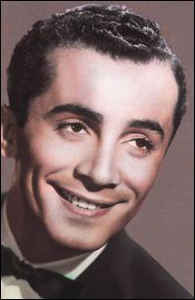
Looking at pictures of Al Martino in the 1950s, he looks like a standard Italian-American, rat-pack crooner. Louche, grinning, eyes that suggest he’s done a bit of living… But whereas Sinatra, Davis, et al delivered their lines with the minimum of fuss, Martino is going for it here. Nothing is left on the bench. If he belted out the closing line – Please be mine, and stay here… in… my…………… heart ‘neath his lover’s window, she would have no choice but to shout ‘Oh yes, Al. Yes!’

I’d never really heard of Al Martino, beyond it being the name of the guy who had the first ever UK Number One. But, to give him his due, ‘Here in My Heart’ still holds record for the joint-seventh longest stay at the top of the UK charts. Plus, he starred in both The Godfather and The Godfather Part III (singing the theme for the former), and had a huge hit in the mid-70s with ‘Spanish Eyes’ – one of those songs that you think you’ve never heard until you hear it. And one which holds a special place in my heart as the second ever song I mastered on the keyboard (and by ‘mastered’, I mean I made it sound vaguely recognisable), aged eleven. The first ever song I mastered was Rock Around the Clock, the guitars and drums of which sound a world away from this, the first ever UK chart topper.