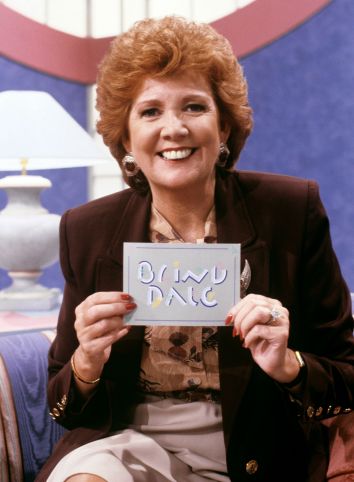
Growing up, the two things that I knew about Cilla Black was that she presented ‘Blind Date’ on a Saturday night (a program I wasn’t allowed to watch as a child, due to my mother’s long-held distrust of ITV) and that her real name was Cilla White.
As I got older, and all teenage, it would have been harder to think of anyone less cool than Cilla Black. She hung out with Cliff Richard, campaigned for the Tories, and had her hair set in a perfect early-nineties bouffant. Years ago I stumbled across a forum in which BA cabin crew posted horror stories about serving Ms. Black (always ‘Ms. Black’), how she would only sit in seat 1A, only drank a particular champagne, and would make her demands known only through her PA… (although, are you even a real celebrity if cabin crew don’t have a few bad things to say about you…?)
The one thing I didn’t know Cilla Black for, really, was the thing that started her off on her career of matchmaking and terrorising cabin crew: her singing.
While her hit-making career didn’t last too long, the two chart-toppers she had in 1964 are both excellent ballads interpreted very well, by a very young woman. The first – ‘Anyone Who Had a Heart’ – a Bacharach & David number that stands as the highest-selling single of the 1960s by a British woman.
I love the way, in that performance, how she starts off simply, quite unspectacularly, before dropping an octave and letting loose. Then a few months later came ‘You’re My World’, an Italian melody with English lyrics. Both these hits stood out, when I wrote about them for this blog, because they stood out so much from Cilla’s contemporaries, the Merseybeat bands, and in particular her Cavern Club mates, The Beatles (who are in the audience for the performance below).
She would continue to have hits as the sixties went on, though no further number ones. I can’t claim to be the biggest expert on the later musical career of Cilla Black (and I will happily take recommendations from those who know better), but if I can choose one more video to embed, it would be her final UK Top 10, a #3 from 1971: ‘Something Tells Me (Something’s Gonna Happen Tonight)’.
Following this the hits dried up, although she kept on recording music even after reinventing herself as the 1980s/1990s go to woman for Saturday night ‘trash’ TV. (My mother’s words, not mine…) On this, the fifth anniversary of her death then, it is worth remembering that Cilla Black was, first and foremost, a lady who could hold a tune, and whose musical achievements have been slightly overshadowed by what came next.
Time for a Top 10. A month or so ago I ranked my Top 10 #1 singles of the 1950s. Now that I’ve officially drawn the sixties to a close with my most recent recap, here’s the Official 100% Undisputed Top 10 #1 singles of the 1960s!
The sixties. The decade that brought, many would say, the finest pop music known to man. Malt Shop pop, to Merseybeat, to R & B, Folk, Psychedelic, Hippies and Motown. It had it all.
By ‘My Top 10’, I mean the records that came out on top in my recaps. This isn’t me looking back and choosing; this is me recounting how I felt in the moment, as I encountered these great records in their natural environment, like seeing a pack of majestic lions while on safari… Or something. I only have one rule, and it is simple: one record per artist.
Here then, in chronological order, are my Top 10 #1 singles of the swinging sixties… (with a bonus or two thrown in for good measure…)
1. ‘Cathy’s Clown’, by The Everly Brothers – #1 for 7 weeks in May/June 1960
Winner in my first sixties recap… Don and Phil relaunch with a mature new sound. They had scored their 1st chart-topper two years earlier with the nice but soppy ‘All I Have to Do Is Dream’. Since then they had changed labels and toughened up, kicking off a run at the top of the UK charts with some of the best harmonising ever heard. The above video doesn’t quite do the recording justice – listen to and read about that here – but apparently the backing group there is none other than The Crickets, and I couldn’t resist…
2. ‘Shakin’ All Over’, by Johnny Kidd & The Pirates – #1 for 1 week in August 1960
For the most part, American rock ‘n’ roll was far superior to the British version. Had it been a boxing match, it would have been a 1st round knockout. In response to Elvis, Chuck, Buddy, Little Richard, Jerry Lee Lewis, Carl Perkins, Fats and Eddie Cochran we had Cliff and, um, Tommy Steele. (OK, OK, simplifying things a bit, but still…) But ‘Shakin’ All Over’ was the moment in which UK rockers truly competed with their counterparts from across the Atlantic, with its timeless riff and racy lyrics. A runner-up in my 1st recap, you can read my original post here.
3. ‘Telstar’, by The Tornadoes – #1 for 5 weeks in October/November 1962
Of course, by the middle of the decade, the Brits were the ones showing the Yanks how to do it. The first sign that the tide was changing, and the first UK band to hit #1 in the US, were The Tornadoes. Masterminded by slightly unhinged genius Joe Meek, this instrumental tells the story of an alien spacecraft that comes to earth for a look around, before shooting back off to whatever galaxy it came from. Except, ‘Telstar’ is an instrumental, so I’ve made up that story entirely. More simply put: a brilliant, brilliant record that blows you away when you hear it in context (the #1s on either side of it were Elvis’s ‘She’s Not You’ and Frank Ifield’s ‘Lovesick Blues’). I named it best chart-topper in my 2nd sixties recap – read my original post here.
4. ‘She Loves You’, by The Beatles – #1 for six weeks in September, October, November & December (!!) 1963
Without my ‘one chart-topper per artist’ rule I’d probably have had 4 Beatles discs in this Top 10. But ‘She Loves You’ is the one that makes it. Yes, yes, yes – in the years following this the band would go way beyond She loves you, And you know you should be glad… both sonically and lyrically. But, to me, this is the moment the 60s really begins. Hell, it’s the moment Britain finally put the war, the rationing and all the misery of the past half-century behind them for good. Imagine being thirteen years old in 1963, and hearing this beauty for the first time…. I named it best chart-topper, and you can read my original post here.
5. ‘Needles and Pins’, by The Searchers – #1 for 3 weeks in January/February 1964
A low-key, under-appreciated, melancholy #1 from one of the biggest bands in the country during the first wave of Merseybeat. I called it a runner-up to ‘She Loves You’ in my 3rd recap, and it’s one of my earliest musical memories. Plus, I love the way they bow at the end of the video above. A well brought-up bunch of lads! The original post is here.
6. ‘You’ve Lost That Lovin’ Feelin”, by The Righteous Brothers – #1 for 2 weeks in February 1965
The first five in this rundown are all of a similar pop/rock ‘n’ roll feel… The latter five shoot all over the place, starting with this slice of blue-eyed soul. Now pop music was for grown-ups again, and this glossy hit led the way. The call and response section, with one voice growling and one voice hitting the highest notes a man has ever sung, are simply stunning. I really struggled, long and hard, in choosing between this and the next song for a ‘Best Chart-Topper’ award. Ultimately, I named this as runner-up. Do I regret my decision…? Maybe… If I read my original post again I might change my mind…
7. ‘(I Can’t Get No) Satisfaction’, by The Rolling Stones – #1 for 2 weeks in September 1965
The song that pipped The Righteous Brothers to the post… Suddenly rock ‘n’ roll was just ROCK, and the riffs were sledgehammers through your brain. And the lyrics weren’t about meeting your girl at the juke-joint; they were world-weary swipes at phoney advertising campaigns and girls who wouldn’t sleep with you, even though you were a world-famous rock star… It just had to be in this Top 10, plain and simple. Original post here.
8. ‘Good Vibrations’, by The Beach Boys – #1 for 2 weeks in November 1966
A song that needs no further introduction, and one that I struggle to really, really, really love. One that needs respected as a work of art; but not one I listen to all that often. Still, I did name it as runner-up in my 5th sixties recap, so it gets its place in the Top 10. Read my original musings here.
9. ‘A Whiter Shade of Pale’, by Procol Harum – #1 for 6 weeks in June/July 1967
At the start of the Summer of Love, one song redefined what a pop song should sound like, how a pop song should be constructed, what lyrical content huge a #1 hit could cover… Who knows how the hell ‘to skip the light fandango’? Who the hell cares when it sounds as good as this. Winner of my 5th ’60s recap – read my original post here.
10. ‘I Heard It Through the Grapevine’, by Marvin Gaye – #1 for 3 weeks in March/April 1969
Winner of my last sixties recap, when I opted for it at the last minute over ‘Hey Jude’. Motown’s finest moment? Again, a song that I can write nothing new about, so I’ve attached this video of a live version. I love the way that Marvin and one of his band act out the phone call at the start… ‘Somethin’ funky goin’ down’ indeed… Read my original post here.
Bonus 1 – ‘Voodoo Chile’, by The Jimi Hendrix Experience – #1 for 1 week in November 1970
I called this one runner-up in the recap I just posted a couple of days ago, it having reached top-spot a year too late following Hendrix’s death. Had it hit number one at the right place and time, I may well have named it a winner. So, as a consolation, here it is…
Bonus 2 – ‘These Boots Are Made For Walkin”, by Nancy Sinatra – #1 for 4 weeks in February/March 1966
Looking back at this list, one thing struck me: it’s a sausage fest. And then I had a closer look, and was amazed to count that, out of the 185 records that made #1 in the UK between January 1960 and December 1969, only 23 (!!) featured a female artist. If we don’t count duets with men, or male bands with female lead-singers, then there were only 16 (!!!!) #1s by females. Here then, is the record-by-a-girl that came closest to a prize in my recaps… Officially the best female-recorded #1 of the decade : Are you ready boots? Start walkin’!
Usually one of our recaps is summed up by the ‘sound’ of the previous thirty chart-toppers. This recap, though, really doesn’t have an all-encompassing sound. We’ve been pinging around all over the place for the past couple of years. What sums up this thirty is the world outside the charts – the end of the sixties, the death of the hippy dream, Vietnam and Nixon, the Beatles’ split… All of which has fed into what we’ve been hearing at #1.
Perhaps this is best summed up by the three number ones during the summer of ’69. Two years previous it had been ‘All You Need is Love’, and ‘San Francisco’; now we got the final call towards a hippy utopia (‘Something in the Air’) before being dragged back down to earth by Zager & Evans’ terrifying visions of the year 2525. And in between those two we had The Rolling Stones doing what the The Rolling Stones do best, some low-down sleazy rock ‘n’ roll, consoling us with the knowledge that the world might be going to shit but we still have the Stones. (Hell, that still applies in 2020.)
Actually, ‘Honky Tonk Women’ was their final #1 – we had to bid them farewell. As we did The Beatles, who bowed out with ‘The Ballad of John and Yoko’. It feels strange to think that this recap still includes The Fab Four, such is the distance we’ve travelled since then. In fact, this recap also includes the first solo chart-topper by a Beatle: George Harrison’s ‘My Sweet Lord’. Plus, we had an Elvis record at #1 again! And with the soaringly cheesy ‘The Wonder of You’ he became the first act to score chart-toppers in three different decades.
There have been plenty of outliers too, to keep things interesting. Which means awarding the latest WTAF Award will be a decision to ponder. There was alleged live, recorded sex (!) from Jane Birkin & Serge Gainsbourg, Rolf Harris riding the war-theme with ‘Two Little Boys’, a letter ‘Back Home’ from the England World Cup Squad, and Clive Dunn sitting all alone in his rocking chair, thinking… Plus the aforementioned Lee Marvin (with Clint Eastwood on the ‘B’-side!), Zager & Evans, and the bizarre-but-brilliant ‘Double Barrel’. But, for the terrifying imagery and the genuine feeling of impending doom… I’m awarding it to ‘In the Year 2525 (Exordium and Terminus)’.
It’s much harder to name a ‘Meh’ Award winner, for the record that struggled to make much of an impact because, to be honest, most of the past thirty songs have made an impression, for better or worse… I could give it to our most recent #1, Dawn’s ultra-cheesy ‘Knock Three Times’ but, I can’t lie: I was humming that in the kitchen this morning… No. One record stands out for me not being able to really remember it: Matthews’ Southern Comfort, with their cover of ‘Woodstock’. Pleasant, but completely unmemorable.
Although, ‘Woodstock’ does tie into what I was saying at the start about the charts beginning to reflect the wider world. That last Beatles’ #1 literally documented the end of the Beatles (it was quite meta, if you think about it), while I count two #1s about the end of the world, two about war, two related to Woodstock, one to the World Cup, two with fairly overtly religious themes, and one in which an old man contemplated his own mortality (see, even the novelties were thought-provoking this time out…)
However, in the early months of 1971, a new ‘sound’ finally emerged, one of the seventies own making. ‘Spirit in the Sky’ had hints of it, as did ‘I Hear You Knocking’. But with Mungo Jerry’s outrageous ‘Baby Jump’ and then T. Rex’s ‘Hot Love’ hitting the top – Glam Rock has arrived! It’ll dominate the next thirty number ones, and I can’t wait…
UNSPECIFIED – JANUARY 01: (AUSTRALIA OUT) Photo of Norman GREENBAUM; Posed portrait of Norman Greenbaum with acoustic guitar (Photo by GAB Archive/Redferns)
To the big two awards, then. What was the worst chart-topper of the past couple of years? I could do the big build-up, teasing a few sub-standard number-ones before WHAM! announcing a left-field winner. But, to be honest, this time it wasn’t much of a contest. Dana, my dear, step forward and accept your award for ‘All Kinds of Everything’. A toe-curlingly bad song about seagulls and lollipops and lots of other stuff I don’t care to remember. It’s our latest Very Worst Chart-Topper.
And the best? Thankfully, there’s a whole load of competition this time. One song that I have to get out the way first is ‘Band of Gold’… I had no idea how highly-regarded that song is. It’s on all kinds of ‘Best Songs Ever’ lists. I mean, it’s a great Motown-sounding song, but it’s not going to be my Very Best Chart-Topper. There’s also T. Rex’s ‘Hot Love’. I love T. Rex, but I can’t do any more than really, really like ‘Hot Love’, and would be awarding it for reasons beyond the song. Plus, they’ve got three more #1s to come so there’s every chance that they’ll be winners in my next recap.
I’ve got it down to three. And I’m smiling as I write this, like King Joffrey at a beheading, because I know deep down what I’m about to do. In the blue corner, Simon and Garfunkel’s ‘Bridge Over Troubled Water’. In the red corner, the Jimi Hendrix Experience with ‘Voodoo Chile’. And in the green corner (this is a triangular wrestling ring)… ‘Baby Jump’, by Mungo Jerry. Simon and Garfunkel are there because I feel obliged to have them. They are the dweeby kids my mum has forced me to invite to my birthday party. ‘Bridge Over Troubled Water’ is an amazing, epic piece of music… But I just can’t love it like I should. It’s out.
‘Voodoo Chile’, in terms of sound, is one of the most forward facing, exciting, swaggering records to have ever topped the UK singles chart. It is a better song than ‘Baby Jump’, I am under no illusion (as is ‘Bridge…’) BUT. ‘Voodoo Chile’ was a song from 1968, re-released because Hendrix had died. I’m eternally grateful that it did get a week at #1, but it did so in the wrong decade, under special circumstances… Which means, in all its belligerent, crunching, leering, drunken beauty, Mungo Jerry’s house party from hell ‘Baby Jump’ is the winner! Hurrah!
(Hey, I spent the entire last decade very sensibly naming all the classics, your ‘Satisfactions’ and your ‘Whiter Shades of Pales’, as my Very Best Chart-Toppers. Allow me a moment of indulgence!)
To recap the recaps:
The ‘Meh’ Award for Forgettability:
‘Hold My Hand’, by Don Cornell.
‘It’s Almost Tomorrow’, by The Dream Weavers.
‘On the Street Where You Live’, by Vic Damone.
‘Why’, by Anthony Newley.
‘The Next Time’ / ‘Bachelor Boy’, by Cliff Richard & The Shadows.
‘Juliet’, by The Four Pennies.
‘The Carnival Is Over’, by The Seekers.
‘Silence Is Golden’, by The Tremeloes.
‘I Pretend’, by Des O’Connor.
‘Woodstock’, by Matthews’ Southern Comfort
The ‘WTAF’ Award for Being Interesting if Nothing Else:
‘I See the Moon’, by The Stargazers.
‘Lay Down Your Arms’, by Anne Shelton.
‘Hoots Mon’, by Lord Rockingham’s XI.
‘You’re Driving Me Crazy’, by The Temperance Seven.
‘Nut Rocker’, by B. Bumble & The Stingers.
‘You’ll Never Walk Alone’, by Gerry & The Pacemakers.
‘Little Red Rooster’, by The Rolling Stones.
‘Puppet on a String’, by Sandie Shaw.
‘Fire’, by The Crazy World of Arthur Brown.
‘In the Year 2525 (Exordium and Terminus)’, by Zager & Evans.
The Very Worst Chart-Toppers:
‘Cara Mia’, by David Whitfield with Mantovani & His Orchestra.
‘The Man From Laramie’, by Jimmy Young.
‘Roulette’, by Russ Conway.
‘Wooden Heart’, by Elvis Presley.
‘Lovesick Blues’, by Frank Ifield.
‘Diane’, by The Bachelors.
‘The Minute You’re Gone’, by Cliff Richard.
‘Release Me’, by Engelbert Humperdinck.
‘Lily the Pink’, by The Scaffold.
‘All Kinds of Everything’, by Dana.
The Very Best Chart-Toppers:
‘Such a Night’, by Johnnie Ray.
‘Cherry Pink and Apple Blossom White’, by Perez ‘Prez’ Prado & His Orchestra.
‘Great Balls of Fire’, by Jerry Lee Lewis.
‘Cathy’s Clown’, by The Everly Brothers.
‘Telstar’, by The Tornadoes.
‘She Loves You’ by The Beatles.
‘(I Can’t Get No) Satisfaction’, by The Rolling Stones.
‘A Whiter Shade of Pale’, by Procol Harum.
‘I Heard It Through the Grapevine’, by Marvin Gaye.
I’m taking a quick break from the usual rundown to give a mention to the bands and artists that we will never meet at the top of the UK singles chart. If you were following along, wondering when (*insert name of your favourite act*) were going to finally appear in this countdown, then I got some bad news for you…
(I’ll do this in chronological order, with acts whom we would have met by now – i.e. in the fifties, sixties and early seventies.)
Up today… One of the sixties’ most iconic bands…
I dunno about The Doors, really. Do I like them? Were they as good, or as bad, as people say? They’re a band that seem to inspire extreme reactions, based around whether you think Jim Morrison was a lizard-leather-sex-God, or a bit of an arse.
Plus, most of the Doors’ songs that I enjoy never made it to the British charts – ‘Touch Me’, ‘Love Her Madly, ‘Love Me Two Times’, ‘People Are Strange’… In fact, for such an iconic, influential band, they only ever had four charting singles in the UK Top 75! Which shocked me, I have to admit. Here they are:
‘Light My Fire’, #7 in 1967
A US #1, and their only Top 10 hit in Britain. A sixties classic, and a pretty simple song really. It’s either about sex, or drugs, or both, with a snazzy Louis XIV riff to start and end. I like that the backdrop to this performance in the video is lots and lots of doors hanging on the wall. (Meanwhile, ‘Light My Fire’ will top the charts, much later, and in a very different version.)
‘Hello, I Love You’, #15 in 1967
Another US #1 – part of the reason why I chose The Doors for this feature is the difference between their success in the two countries – with a cool riff and some trippy sound-effects. There was only three years between ‘Oh, Pretty Woman’ and this and, while they cover the same topic, the difference in sound is quite something.
‘Riders on the Storm’, #22 in 1971
A seven-minute-long bit of self-indulgence, if you ask me… But the band’s 3rd highest charting single in the UK!
‘Break On Through (To the Other Side)’, #64 when re-released in 1991
This is more like it. Quiet, then loud – loud, then quiet. Morrison sounds raw and ferocious, before the drugs took their toll. And that was it. Four hits (if you can call reaching #64 in the charts, twenty years later, a ‘hit’.) They’re a band that managed to go a long way – and become pretty legendary – without much of a back catalogue. Style and looks over substance?
One more chart-topper-less artist, coming up tomorrow…. And we’re going back a little further to find him. A rock ‘n’ roll idol, dead now, (and he didn’t die recently, if that’s who you’re thinking of…)
I’m taking a quick break from the usual rundown to give a mention to the bands and artists that we will never meet at the top of the UK singles chart. If you were following along, wondering when (*insert name of your favourite act*) were going to finally appear in this countdown, then I got some bad news for you…
(I’ll do this in chronological order, with acts whom we would have met by now – i.e. in the fifties, sixties and early seventies.)
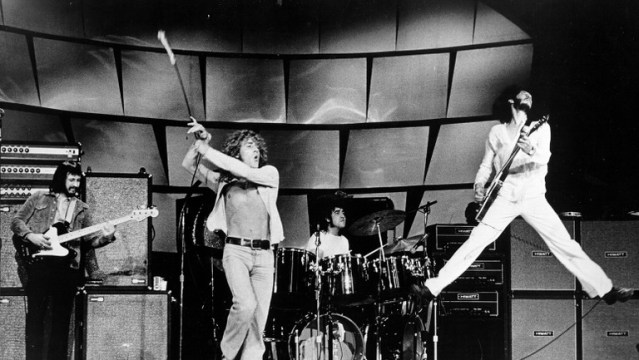
First up, probably just the biggest and most famous act never to have had a number one single… The Who!
Yup, they’ve come close on plenty of occasions. 14 Top 10 hits between 1965 and 1981. Here are the five that came closest:
‘My Generation’, #2 in 1965
Part of the sixties canon, but a world away from both the optimistic pop of the Merseybeat days and the Summer of Love; The Who were angry young men. Banned by the Beeb because they thought Roger Daltrey’s delivery might offend stutterers, not, as I always thought, because it sounds like he’s about to drop an F-bomb. I’ve attached this live version for some brilliantly pointless guitar and drum smashing at the end. ‘My Generation’ was scandalously kept off the top spot by The Seekers snooze-inducing ‘The Carnival Is Over‘!
‘I’m a Boy’, #2 in 1966
My name is Bill and I’m a head-case… Just as anarchic as ‘My Generation’, though gentler sounding. Bill has four sisters and his ma is hell-bent on having five. He wants to ride his bike, climb trees, come home covered in blood – you know, regular 1960s boy stuff… But mum’s not having any of it. I’m a boy, I’m a boy, But if I say I am I get it! Power pop brilliance.
‘Happy Jack’, #3 in 1966
Happy Jack is a man who lives in the sand on the Isle of Man. Apparently, a real person from Pete Townshend’s childhood, kids bully him, laugh at him, chuck things at him… But nothing stops Jack from being happy. Not my favourite Who song in any way, but a worthy inclusion just for Keith Moon’s drumming.
‘Pictures of Lily’, #4 in 1967
I think people’s impression of The Who leans more nowadays to the hard rocking, stadium band that they became in the 1970s. But as this run-through is showing, their biggest hits came earlier, and were much quirkier. ‘Pictures of Lily’ tells the tale of a young lad who can’t sleep, until one day his dad gives him an old picture of a lady named Lily. Suddenly the boy can sleep the whole night through… Pictures of Lily, Solved my childhood problem… ‘Tis “merely a ditty about masturbation, and its importance to a young man” (Pete Townshend’s words, not mine). When the boy asks his dad if he can meet Lily, he is crushed to find out that she died in 1929…
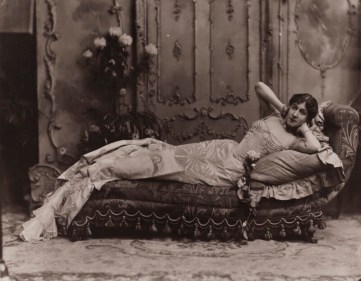
(Actress Lily Langtry, who died in 1929… This could well be the actual ‘Picture of Lily’.)
‘Pinball Wizard’, #4 in 1969
Last but not least… a song about a deaf, dumb and blind kid who sure plays a mean pinball. From the rock-opera ‘Tommy’ this, along with ‘My Generation’ and ‘Won’t Get Fooled Again’, has to be The Who’s signature song, and still a feature of their live shows to this day.
My personal favourite Who single, ‘Substitute’, only made #5, while their big seventies hits like ‘Won’t Get Fooled Again’ and ‘Who Are You’, made #9 and #18 respectively. But, no number one! And that’s why I wrote this post.
Up tomorrow, another hard-rocking, hard-living band, with a member who died too young, this time from the other side of the pond.
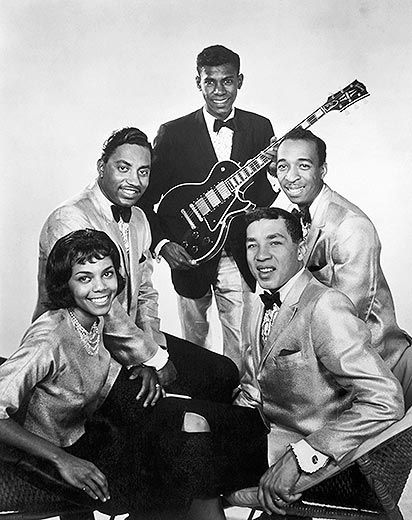
A perky riff kicks off this next number one, one that sounds like something The Pied Piper would play while leading the kids out of Hamelin. A jester’s riff, one that might play as a clown enters a room… It’s a riff, a motif, that repeats and holds the song together, while the rest is pure Motown.
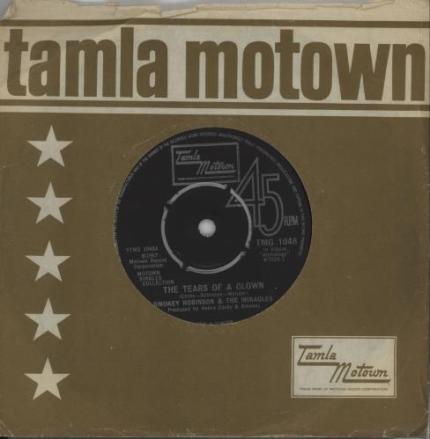
The Tears of a Clown, by Smokey Robinson (his 1st of two #1s) & The Miracles
1 week, from 6th – 13th September 1970
Yes, Motown’s 4th #1 single in the UK, from one of its biggest acts, one that had been scoring Top 10 hits throughout the sixties in the States. And it’s another sad-lyrics-with-upbeat-accompaniment number… Really I’m sad, Oh, sadder than sad, You’re gone and I’m hurting so bad, Like a clown I’ll pretend to be glad…
It’s a song about putting a brave face on things, about not letting on when you’re heart is breaking. And it’s very wordy record… Sample lyric: Now if I appear to be carefree, It’s only to camouflage my sadness… There aren’t many #1 singles throwing words like ‘camouflage’ around. By the end Smokey’s referring to the famous clown opera ‘Pagliacci’… All very highbrow.
But it’s catchy, too. This is Motown after all. I have to admit that, for all this is a very highly regarded record, I’m struggling to really love it… Though I do love the bubblegum hook in the chorus: Now there’s some sad things known to man, But ain’t too much sadder than… The tears of a clown… 1970 really is jumping around all over the place, evading all attempts to define the ‘sound’ of the year. Some of its chart-topping singles have been true classics, others just truly dreadful. ‘The Tears of a Clown’ I’d place right in the middle, one of the purest ‘pop’ moments of the year.
It had actually been recorded back in 1967, and was only released due to Robinson’s reluctance to record new music with the band. It hit #1 on both sides of the Atlantic, and Smokey was convinced to spend another couple of years with them. He did eventually go solo, and he’ll go it alone at the top of the charts in a decade or so. The Miracles continued too, and had their own successes through the seventies. Also of note is the fact that ‘The Tears of a Clown’ was co-written by Stevie Wonder, who we have yet to meet in this countdown. I think it’s not giving too much away for me to say that this, his first writing credit at #1, is far better than either of the chart-toppers he’ll get under his own name…
And so the 1960s, the decade that’s given us so much fine, fine pop music, so much invention, so much sonic expansion, comes to an end. With Rolf effing Harris.
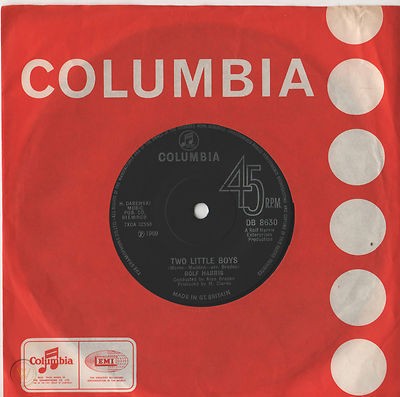
Two Little Boys, by Rolf Harris (his 1st and only #1)
6 weeks, from 14th December 1969 – 25th January 1970
Though in some ways, having a convicted sex-offender at #1 is actually a very appropriate introduction to the 1970s… Yes, let’s get this out the way at the start. Rolf Harris is currently serving a lengthy jail sentence for indecently assaulting several underage girls. (Of course, he’s not the last sex-offender that we’ll meet on our journey through the charts.) I won’t make light of it, because it’s not something to make light of.
To the song, then. Is it a novelty? Is it a ballad? Is it traditional pop? Music hall? All of these things? It’s a tale, as the title suggests, of two little boys. We open on a summer’s day, a back garden somewhere in suburban Australia. (Harris sounds extremely Australian here, especially given that he doesn’t really sing the song as much as he talks us through it.) Two little boys had two little toys, Each had a wooden horse… One boy, Jack, breaks his toy, and starts crying, upon which his little buddy, Joe, offers him a go of his own horse. When we grow up we’ll both be soldiers, And our horses will not be toys… If this were a movie we’d be rolling our eyes at some pretty heavy-handed signposting…
Fast-forward many years. The boys are now soldiers, at war. Cannon roared loud, And in the mad crowd, Wounded and dying lay… One of the little boys. But what’s that? From the fray dashes a horse. Yep, little boy number two… Did you think I would leave you dying, When there’s room on my horse for two…? The roles are reversed: Joe is now in peril, and Jack comes to his rescue.
It’s utter sentimental crap, perfect for the grannies at Christmas. But at the same time, goddamit, it tugs at something. It hits you right in the feels, for want of a better expression, when the marching drums and trumpets fall away, and Harris near-whispers: Can you feel Joe, I’m all a tremble… Perhaps it’s the battle’s noise? But I think it’s because I remember, When we were two little boys… Then we end with what sounds like ‘The Last Post’. It’s a celebration of male friendship, of non-romantic love, even if it does play to the very outdated idea that men can only express affection to one another on the battle, or sports, field.
‘Two Little Boys’ was written many years before, way way back in 1902. The lyrics about ranks so blue make me think it’s set in the US Civil War. Which automatically puts it high up the table of the ‘oldest’ chart-toppers. You’ve got ‘It’s All in the Game’, originally from the 1910s, ‘Lily the Pink’ from the 1870s, ‘Cumberland Gap’ from the mid-eighteen hundreds, and ‘I See the Moon’, parts of which date from the 1780s.
It’s a song that brings about conflicting feelings. Cheesy; but somehow touching. Familiar, but also not a song you can play in public these days… In fact, it’s odd to look back at Rolf Harris’s career from a 2020 vantage point. Growing up in the nineties he was still a constant figure on TV – he sketched, he sang, he cracked jokes, he did his weird wobble board and played his didgeridoo. He was as Australian as Lamingtons (his biggest hit in the UK prior to his sole chart-topper was the Top Ten ‘Tie Me Kangaroo Down, Sport.’) And then he was disgraced and, to be honest, erased from history…
I was half-expecting to not find ‘Two Little Boys’ on Spotify, remembering the furore that R Kelly’s music caused when they reinstated it, as if he was the first pop star with a seedy past. But it’s there; and that’s only right. Harris is a convicted child molester, but his music was, and in some circles probably still is, popular. If people feel uncomfortable listening to it – completely understandable – they can choose not to. But the decision not to listen should be ours, not Spotify’s or HMV’s. That’s my tuppence-worth, anyway…
But enough of that, we should be focusing on the positives! We’re about to jump into the 1970s, the decade of glam, of disco, of punk and new-wave. I’m excited. You should be excited. Hey! Ho! Let’s go!
Listen to every number one from the 1960s (and the 1950s) here!
The second last #1 of the 1960s brings up one of its biggest hits. Eight whole weeks at the top, tying with Elvis’s ‘It’s Now or Never’ (1960) and The Shadows’ ‘Wonderful Land’(1962) for the honour of longest-running chart-topper of the decade. And when you hear the chorus, you begin to understand why…
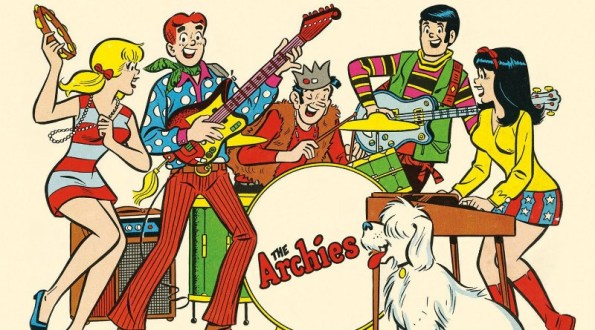
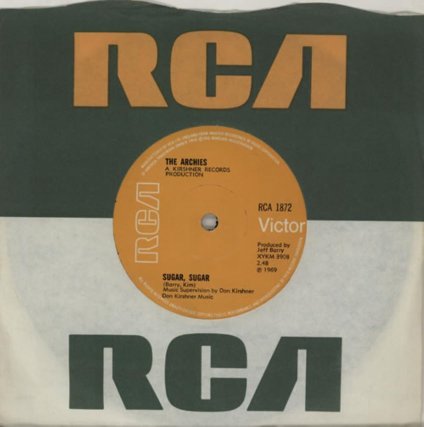
Sugar, Sugar, by The Archies (their 1st and only #1)
8 weeks, from 19th October – 14th December 1969
Sugar – do-do-do-do-do-do… Awww honey, honey – do-do-do-do-do-do… You are my candy girl… And you got me wanting you… It’s a chorus that everyone can sing, imprinted on our collective consciousness. In fact, to call it a ‘chorus’ isn’t very accurate – it is pretty much the entire song. As a record, it is undeniably catchy…
But then so are crabs. To be honest – ‘Sugar, Sugar’ is annoying, it’s simplistic, it’s basic… It’s bubble gum, and then some. Candy floss, sherbet and a huge dose of saccharine for good measure. I just can’t believe the loveliness of loving you… I just can’t believe the wonder of this feeling too… After a couple of listens you start to get a sugar-headache.
It’s one of pop music’s great clichés – love as candy. We’ve already had ‘Sweets for My Sweet’ at #1, and there will be more to come. ‘Candy Girl’, ‘Sweet Like Chocolate’, ‘Sugar Baby Love’… You can make quite the list… ‘Pour Some Sugar On Me’ (a classic, I won’t deny), ‘Brown Sugar’ (a filthy Stones’ take on the theme.) You catch my drift…
There are glimmers of hope here: the low-key verses contrast nicely with the all-out bubble gum of the chorus. And the ‘ad-libs’ towards the end are fun. Pour a little sugar on me honey… Aw yeah… (maybe a young Def Leppard were listening.) All in all though, and I say this as someone who loves pop music, ‘Sugar, Sugar’ is a bit much. I’m glad when it’s over.
Adding to the sickly effect is the fact that The Archies were a cartoon band, plus a dog, that featured in their own TV variety show, ‘The Archie Show’. To me, they look like the ‘cast’ of ‘Scooby-Doo’ went and formed a band. Their records were recorded by session musicians, several of whom quit when they didn’t get any royalties from their hits. Despite the fact that just two weeks ago we had simulated orgasms at #1, I’d have to say that ‘Sugar, Sugar’ is the more offensive record.
In fact, this is perhaps the icing on the cake for the cynical second half of 1969. We’ve had horrifying visions of an apocalyptic future, and now an equally pessimistic vision of the future of pop music. We’ve had a pre-manufactured band from a TV show at #1 already, but it feels very unfair to compare The Monkees to this… They were real musicians who quickly broke away from their confines. Here you can’t help picturing a cynical record executive laughing and chucking wads of dollar bills in the air… “Who needs real people? Who needs real instruments? It’s mine! All mine!”
Or maybe that’s too much. We’ve had so much amazing music hit number one over the past decade, so perhaps we can cut this record some slack. It what it is, and what it is is fine in small doses. Assembly-line bubblegum is here to stay, and we’ll have to get used to it as we delve into the 1970s…
After all the in-your-face sex and apocalyptic predictions of the past few #1s, it’s nice to hear the gentle piano and bass intro of ‘I’ll Never Fall in Love Again’. The musical equivalent of closing your eyes and taking a deep breath.
I’ll Never Fall in Love Again, by Bobbie Gentry (her 1st and only #1)
1 week, from 12th – 19th October 1969
Not that this record is all sweetness and light, though. The title kind of gives that away. What do you get when you fall in love…? A guy with the pin to burst your bubble… Bobbie is convinced that she’s done with love. That’s what you get for all your trouble…
I love her voice – all tired and husky. It lends a perfect edge to possibly the best rhyming couplet ever to feature in a #1 single: What do you get when you kiss a guy…? You get enough germs to catch pneumonia, After you do he’ll never phone ya… Bacharach and David – racking up another UK chart-topper here – added the line after Burt had been hospitalised with the flu. It does make sense when you realise that this is a B&D number, with its gently soaring melody. They had written it for a musical called ‘Promises, Promises’, and Dionne Warwick had had the hit version of this song in the States.
You could add ‘I’ll Never Love Again’ to our run of recent cynical number ones – crushing the closing months of the swinging sixties – but for one line: So for at least, Until tomorrow… Who knows? She might just meet the man of her dreams tomorrow morning… And I’d argue that there’s something very late-sixties-positive about a young female artist singing about her love life in a matter-of-fact way: I’ve been there and glad I’m out… Women’s Lib reaching the top of the charts right here.
The fact that Bobbie Gentry is a woman is worth noting in itself. She’s the sole female chart-topper of 1969. In fact, in the past three years, only Bobbie, Mary Hopkin, Sandie Shaw and Petula Clark have topped the singles charts as solo females (Esther Obarim, Nancy Sinatra and Jane Birkin did so by duetting with men.) It really is surprising how few women topped the charts throughout the sixties, compared to later decades… I would work out the percentage, if I had any kind of mathematical ability.
Bobbie Gentry is also another artist whom I racially-profiled as a kid… Add her to the list along with Chris Farlowe and Georgie Fame. She isn’t black, she’s another white singer with a bit of soul in her voice, an American Dusty. My first exposure to her was through the superb ‘Ode to Billie Joe’, which was her biggest US hit – a gothic novel in a four-minute pop song – which shockingly only reached #13 in the UK… As nice as ‘I’ll Never Fall in Love Again’ is, it’s no ‘Ode to Billie Joe’.
But it is nice. Better than nice. It’s a great, late-sixties pop song with a hint of country. Bobbie Gentry has become very reclusive in her later years, not recording, performing or giving interviews since 1982. She lives to this day, people believe, in Memphis. And with that, we reach the penultimate number one single of the 1960s…
We end our run of apocalyptic #1s at two, and turn to another of human kind’s most primal concerns. From death and survival, to sex… Though if the end of the world were nigh, you could probably do a lot worse than closing the curtains, dimming the lights, and slipping this disc onto the turntable…
Je T’Aime… Moi Non Plus, by Jane Birkin and Serge Gainsbourg (their 1st and only #1)
1 week, from 5th – 12th October 1969
I mentioned Peter Sarstedt’s ‘Where Do You Go To…’ as a French #1. (Well, it was set in France, and the melody sounded French.) But this is the French #1. For a song to sound any more French, Edith Piaf would need to be singing ‘Frere Jacques’ on top of the Arc De Triomphe.
‘Je T’Aime…’ is a record that you picture in soft focus. All pinks and whites, scattered glasses of champagne with raspberries in them. The organ drones, the drums woozily keep time, and the strings flutter around the edges. I particularly love the filthy growl in the bass just before the main riff. Meanwhile Jane Birkin and Serge Gainsbourg breath, whine, mutter, whisper, and moan… Do everything but actually sing.
The lyrics are all en Francais: Je t’aime, Je t’aime, Oui je t’aime… sings Jane. I love you, Yes I love you! Moi non plus… mutters Serge. Me neither. Jane: Oh, mon amour… It’s been written off as nonsense – ‘I Love You, Me Neither’ – but I think it shows that the singers only have lust on their minds. From now on I’ll write the lyrics in English, even though they sound much better in French…
Like a vacillating wave, I go, I come and go, Inside of you… Ooh la la! Potent stuff. Even worse if you translate the Inside of you line literally. Entre te reins = Between your kidneys. Kind of gross. By the end, Birkin is faking a pretty convincing orgasm. At least, we think she’s faking… At the time there were rumours, or some well-contrived publicity, that ‘Je T’Aime…’ was a chart-topping single with live sex (!) on it.
Even today, in our cynical world, a record like this would raise eyebrows. In 1969, there was a fair amount of controversy. The record was banned, obviously, from radio, except in France, where it could be played after 11pm. The Vatican excommunicated the Italian label exec. who released it. Gainsbourg was unrepentant, claiming that it wasn’t about sex, but about the impossibility of true love. Others have argued that it is a feminist song, thanks to the line at the end when Birkin breathes: Non! Maintenant! Viens! (No! Come! Now!) She is in control of the love-making.
At the same time, while ‘Je T’Aime…’ is still a fairly attention-grabbing record, it also comes across as very camp and kitschy. I’m sure most people were buying it for a laugh, rather than as a soundtrack to romantic nights in. It’s also suffered the same fate as, say, ‘The Good, The Bad and The Ugly’, in that it’s become a cliché – a piece of music to play over a certain scene: in this case one involving a comical seduction. I’m not sure if or why anyone would want to sit down today and listen to it. Plus, at four and a half minutes it goes on for much longer than it needs to. But… In 1969 people lapped it up. ‘Je T’Aime…’ had already reached #2, been banned, then re-leased to make #1!
Birkin and Gainsbourg were a real-life couple when they recorded their sole chart-topper. She was twenty-three, he was forty-one. Their daughter is the actress Charlotte Gainsbourg. Serge had originally recorded it with Brigitte Bardot, but her husband had stopped them from releasing it. I know very little about their other recordings. Birkin still sings and acts to this day; Gainsbourg meanwhile is a legendary figure in France – provocative and boundary-pushing. It’s sad that most English speakers know him solely for this record, his chain-smoking and for the famous TV interview in which he told a young Whitney Houston that he wanted to ‘fuck her’ (his words.) He died in 1991 after years of alcoholism.
A notable #1 then – the first in a foreign language, the first to feature simulated sex, the first to get somebody excommunicated. And suddenly we’re three chart-toppers away from the 1970s!







 The UK Number Ones Blog