Remembering Connie Francis

Earlier this week the sad news of Connie Francis’ death was announced, aged eighty-seven, closing the door on yet another chapter from the earliest chart years. There can’t be many, if any, older chart-toppers than Francis still around… And there were precious few women, either, who were scoring rock ‘n’ roll hits and competing with the big male stars of the late fifties.

Francis scored two huge, six-weeks-apiece #1s in 1958, the sassy ‘Who’s Sorry Now’ and the whipcracking ‘Stupid Cupid’ (twinned with ‘Carolina Moon’). I also covered her 1960 hits ‘Mama’ and ‘Robot Man’ as a Random Runner-Up. Follow those links to hear those tunes, and to read my original posts. But since writing those posts – and this has been one of the best things about doing this blog, discovering artists’ non-chart topping back catalogues – I’ve fallen in love with many of Connie’s other hits. So let’s share some here, in her memory.

‘Lipstick on Your Collar’ – #3 in 1959

I love the camp melodrama of this bop, about a cheating boy given away by lipstick smudges. How does Connie know the lipstick isn’t hers? Well, eagle-eyed, she notices his is red, while hers is baby pink. Coleen Rooney eat your heart out. Turns out that floozy Mary Jane had been smooching her man right outside the juke joint. But, as with so many of her early records, Connie does not wallow in heartbreak. In fact, she seems almost thrilled to have rumbled him…

‘Plenty Good Lovin” – #18 in 1959

A similarly uptempo, more swinging, hit from the same year. And this one is positively raunchy by 1959 standards. In fact, I’m not sure Connie isn’t simulating orgasm during the break in the middle… She sings the praises of a man who doesn’t have a nice car, can’t play guitar, is neither intelligent nor particularly good-looking, but who’s got somethin’ that’s better by far… I mean, gurrrrlllll… Plenty of things that he don’t know, But this boy shines when the lights are low…

‘Everybody’s Somebody’s Fool’ – #3 in 1960

Her first US #1, and in fact the first Billboard Hot 100 number one by a female singer (the chart having launched well over a year earlier). Which just goes to prove how impressive Francis’s hit making was, stacked against the likes of Elvis, Pat Boone, Ricky Nelson and co. I love the honky-tonk feel to this, with the rolling organ and the rickety, country beat, and her voice drenched in echo.

‘Where the Boys Are’ – #5 in 1961

Francis made her acting debut in 1961, in the movie ‘Where the Boys Are’. And the title track gave her another big hit, proving that she could sing something a little more traditional to go along with all the rock ‘n’ roll. In 1978, as she was attempting a career comeback, Connie recorded a disco version. If that doesn’t grab you, how about a Japanese version? Today’s female stars could only dream of such versatility.

‘Vacation’ – #10 in 1962

Despite not having an original bone in its body, and already sounding dated in 1962, I love this throwaway tune. ‘Vacation’ was Francis’s last Top 10 hit in both the US and the UK, as the Merseybeat acts prepared to render so many stars obsolete. But it’s hard not to get carried along with this record’s exuberance. Maybe because I’m an English teacher in my day job, I’m instinctively drawn to songs that spell words out in the lyrics. Similarly, it’s probably why I’m drawn to songs about the summer holidays. So this one works for me on many levels.

‘Pretty Little Baby’

It would be wrong to finish without mentioning her final ‘hit’. ‘Pretty Little Baby’ was a B-side back in 1962, but in recent months you’ll surely have heard it if you’ve spent any amount of time scrolling on Instagram or TikTok. In one of her final interviews, Francis claimed to have forgotten of the song’s existence, but that she was touched by its resurgence, and how even kindergartners now know her music. Back to teaching for a moment, I can attest to this as I have a student who has been singing this to himself for several months now… Musically this is cute, and I love whatever early electronic device the solo was recorded on.

From the mid-sixties onwards the hits dried up, and Connie Francis’s personal life took several dark turns. The Guardian published a good article on her many highs and lows yesterday, and she became an advocate for mental health following various traumatic experiences. Having read that, it feels impressive that she lived such a long life and fulfilled life. She returned to music, and only officially retired a few years ago.

Connie Francis, December 12th 1937 – July 16th 2025

897. ‘It’s Raining Men’, by Geri Halliwell

Providing the meat in an S Club sandwich, Geri Halliwell returns for her fourth and final solo chart-topper. It is also, sadly, our very last Solo Spice number one.

It’s Raining Men, by Geri Halliwell (her 4th and final solo #1)

2 weeks, from 6th – 20th May

But… Is this a case of saving the worst for last? I’ve found something to enjoy in all seven of the Spice Girl’s previous solo #1s, which have spanned a variety of genres, from hip-hop to trance. But I find Geri covering ‘It’s Raining Men’ to be a step too far.

It’s not just that it’s yet another inferior cover of an eighties classic, after similar recent efforts from Westlife, A1, and Boyzone. It’s also not just that it’s another classic #2 being belatedly taken to the top, after 911, Madonna, and Westlife (again). These things don’t help, but this cover feels even more tired than many of those earlier refits.

I think it’s more of what I complained about in Geri’s previous #1, ‘Bag It Up’, in which she was so blatantly chasing the pink pound that it was becoming a bit embarrassing. And what could be more gay-baiting than covering ‘It’s Raining Men’? Like I wrote in that post, she already had gay icon status. She was a Spice Girl, for God’s sake! She didn’t need to try so hard.

Anyway. She decided (or was asked) to cover this camp classic. Very well. But it’s so half-arsed. It’s missing the original’s sassy ad-libs (how low, girl? and the like). It’s missing the thunderclaps. And she gives the song’s best line – I’m gonna go out, I’m gonna let myself get, Absolutely soaking wet – neither the gravitas nor the commitment it deserves. I don’t believe for one second that Geri is excited about this extreme weather event. Whereas, in the original, I fully believe that the Weather Girls were two thirsty bitches ready to rip off their roofs and stay in bed. The lowest point comes when Ginger finally does try her own smutty ad-lib, and it’s genuinely cringey. Go get yourself wet girl, I know you want to… No, Geri. We don’t.

Other than that, it’s a fine record… Joking aside, it was the lead from her second solo album, as well as being from the soundtrack to the second ‘Bridget Jones’ film (from memory, it soundtracks Hugh Grant and Colin Firth beating each other up in a fountain). It was probably always destined to be a huge hit, and was the only one of her four #1s to spend more than a week at the top. But it was the beginning of the end, as none of the album’s subsequent singles got higher than #7.

I feel I’ve been a bit harsh of ol’ Gezza here. She remains my favourite Spice Girl. She remains an icon. And in fact, her best record was yet to come. She had one final LP, 2005’s ‘Passion’, from which the lead single was ‘Ride It’: her truest, campest classic. She always had it in her, she just didn’t have to try so hard…

If anyone’s interested, my solo Spice Girls singles ranking goes (from worst to best): ‘It’s Raining Men’ > ‘Never Be the Same Again’ > ‘Lift Me Up’ > ‘Bag It Up’ > ‘I Want You Back’ > ‘What Took You So Long?’ > ‘Mi Chico Latino’ > ‘I Turn to You’.

The ‘Fame’ referencing video, over which a lot of fuss was made at the time about Geri’s eye-catching, yoga-based weight loss. Just the song below:

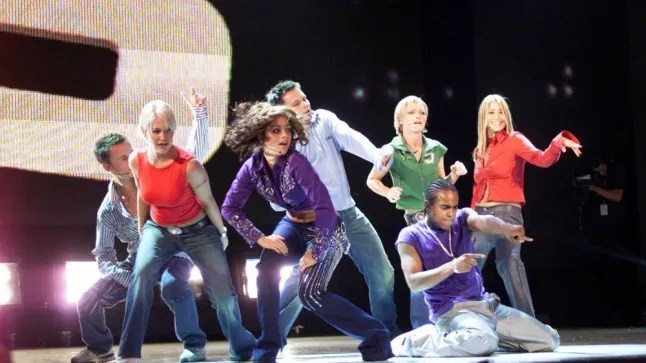
896. ‘Don’t Stop Movin”, by S Club 7

So far, S Club 7 have teased us with their two number one singles: a cheesy TV show theme, and a festive ballad. Okay records, but no real proof of why they were the turn of the century’s finest tween-pop bubblegummers.

Don’t Stop Movin’, by S Club 7 (their 3rd of four #1s)

1 week, from 29th April – 6th May / 1 week, from 20th – 27th May 2001 (2 weeks total)

Until now. Because here is their undisputed (by me) best song: an unapologetic disco-pop banger. Uncontrollably catchy, unarguably wholesome, utterly lacking in edge. But who needs edge? Not S Club. Not anyone, really, when they have such a complete and utter floor filler. I can genuinely not imagine a party where ‘Don’t Stop Movin’’ would not get people dancing (and if there is then I don’t want invited).

Musically, this smooshes the past twenty-five years of pop music into a blender and comes up with a balance that works. The strings are disco, the beat is a ‘Billie Jean’ rip off (not a sample, as some claim), and the chorus is pure nineties bubblegum. For 2001, you could claim that it sounds old-fashioned. I’d rather go with ‘timeless’. There’s even a vocoder, for the fabulously naff Don’t stop movin’ to the S Club beat… coda, giving things that Daft Punk chic.

Bradley McIntosh is on lead vocals here, for the verses. (I have seen Bradley perform this live, and to this date he remains the only chart-topping artist whom I have touched/got an autograph off). Then regular lead Jo takes over for the bridge, which is the part of the song that seals its classic status. And which, listening to it now, owes a big debt to Madonna’s ‘Vogue’. Right here on the dance floor is where you got to let it go… Her vocals ahead of the final chorus are actually fairly spectacular.

I often claim that British pop songs lagged behind their US cousins at this time, which they did. But ‘Don’t Stop Movin’’, while completely British in its production and tone, can compete in terms of quality with almost anything that Britney was putting out at this time. And if I had to choose between this and the overly earnest Destiny’s Child record it knocked off top spot then there’s no contest.

There will be those that argue for ‘Reach’ as S Club 7’s best song, and it is a debate that causes deep divisions. ‘Reach’ is a great pop song, if a little too goody two shoes for my liking. But the real reason why ‘Don’t Stop Movin’’ is S Club’s greatest song, and not ‘Reach’, is that while both could happily be played at a primary school disco, only one could be played in a respectable nightclub. This one.

893. ‘Pure and Simple’, by Hear’Say

There is an argument to be made that this next number one is the single most important pop song of the twenty first century. Had the debut single from the winners of ‘Popstars’, a docu-competition in which a brand new group was formed in front of the viewing public’s very eyes, not been a huge, million-selling success, then think what we might have been spared…

Pure and Simple, by Hear’Say (their 1st of two #1s)

3 weeks, from 18th March – 8th April 2001

It would be easy to claim that this is the moment in which pop music was irredeemably ruined, all credibility stripped from the process of making pop, and that from here on the charts were off to hell in a handcart… In fact, that would be too easy. Pop music has always been reliant on photogenic puppets singing other people’s songs. What reality TV did was to bring the tawdry process out into the open, and to give the public a say (not always a good idea…)

Though I didn’t realise, or had forgotten, that Hear’Say were not chosen by a public vote. No, the five winning ‘Popstars’ were chosen by a judging panel, and the series filmed more as a documentary than a competition. The final episode aired on the day that ‘Pure and Simple’ entered at number one, the fastest selling debut of all time, with the Radio One announcement seen as the culmination of their journey.

What of the song, then, that kicks off this brave new world? It’s… alright. I remember actually liking it at the time, aged fifteen; but it hasn’t quite stood the test of time for me. It’s got some nice touches, some soulful vocals, and an ear-catching chord progression. But it can’t escape the fact that it already sounds dated, more 1998 than 2001, and that it is in debt to at least three other recent songs.

It has the cheapness of Atomic Kitten’s ‘Whole Again’, while it is also reaching for (and missing) the sassiness of All Saints’ ‘Never Ever’. And it is a clear melodic rip-off of Oasis’ ‘All Around the World’ – a fact noted by Noel Gallagher, who wisely let it slide given the liberal amount of melody borrowing he had done in his time. It had originally been recorded, but not released, by short-lived girl group Girl Thing a couple of years earlier.

Having said all that, and with these shortcomings fully in mind, ‘Pure and Simple’ stands head and shoulders above pretty much every Pop Idol/Fame Academy/X Factor/you name it winner’s single that came after. It is a decent, upbeat pop song, with lyrics that allow it to exist beyond its talent show context, and not a maudlin ballad about overcoming obstacles, making your dreams come true, and earning Simon Cowell millions of pounds…

I was about to launch into a (short) potted history of Hear’Say’s post-‘Pure and Simple’ career before remembering that they bucked the odds and actually managed a second number one. Fair play to them. We’ll save the bio for next time. And we’ll have plenty of time to reflect on the reality TV era – perhaps the biggest pop ‘genre’ of the 21st century – over the course of the fifty-plus number ones it has generated. Not all of which are terrible (though many of course are), and a handful of which are pretty damn good!

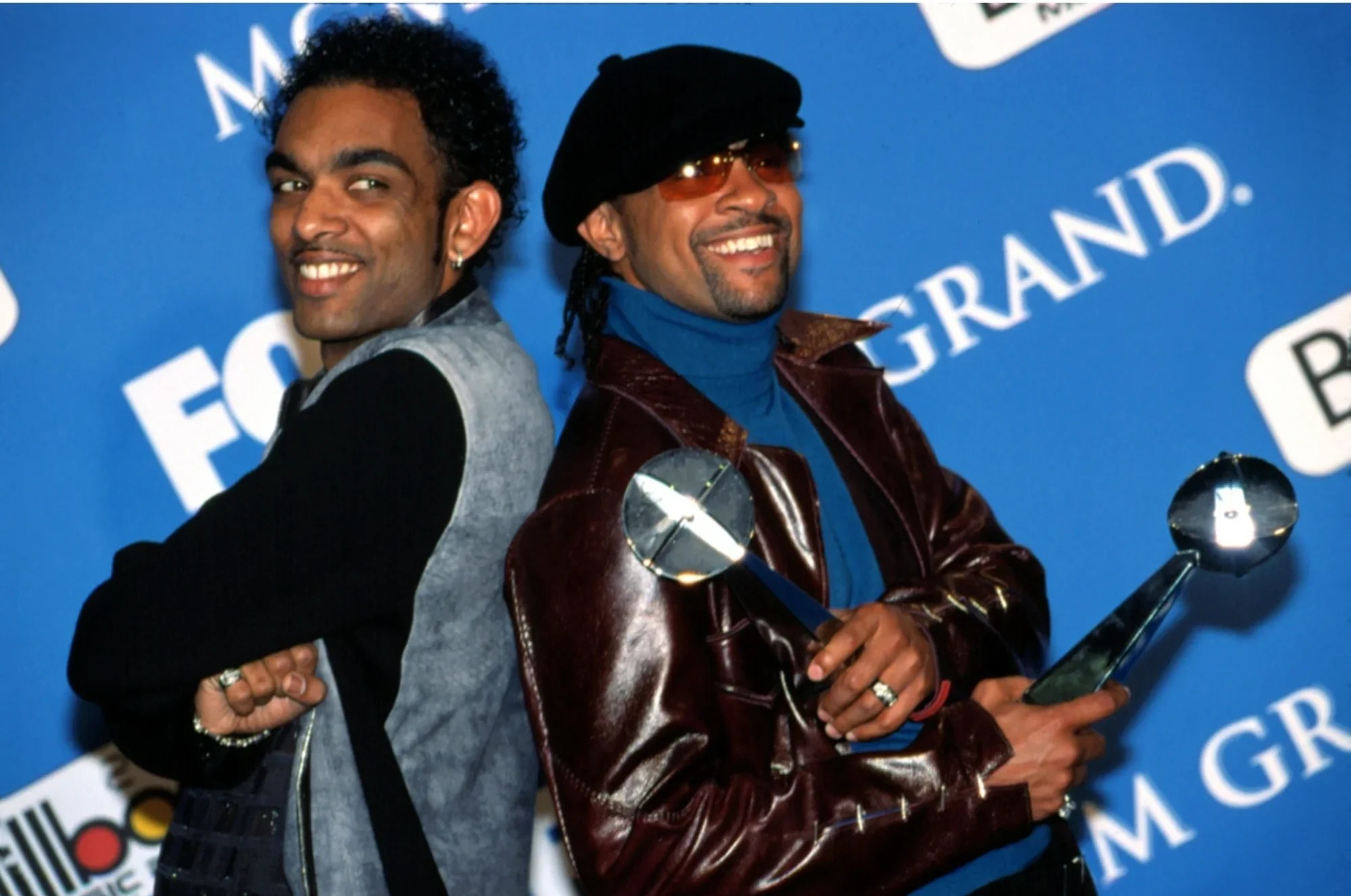
891. ‘It Wasn’t Me’, by Shaggy ft. RikRok

In today’s instalment of Ask Shaggy, we have a letter from RikRok, in Jamaica… “Dear Shaggy: I was recently caught red-handed by my wife, creeping with the girl next door. Picture this, we were both butt-naked, banging on the bathroom floor…”

It Wasn’t Me, by Shaggy (his 3rd of four #1s) ft. RikRok

1 week, from 4th – 11th March 2001

Ricardo ‘RikRok’ Ducent is in a bit of a pickle alright. How could I forget that I had given her an extra key? he asks, hand to forehead. Shaggy is not in the mood for sympathy however, offering blunt advice: deny everything. To be a true player you have to know how to play, If she say a-night, Convince her say a-day…

Caught on camera? Heard the screams of passion? Marks on your shoulder? The evidence of her very own eyes…? It wasn’t me. It’s not hard, nearly a quarter of a century on, to read a sinister subtext to this well-remembered chart-topper. It’s pure gaslighting, and not something you’d be allowed to get away with in the year of our Lord twenty twenty five.

But. At the same time, this is such a silly song, the situation so preposterous, Shaggy at his most cartoonishly alpha (especially in the video), that you cannot take it seriously. The idea that his advice will work is never supposed to enter the listener’s head. And at the end of the day, morality wins out, with RikRok deciding to ignore the advice and apologise: Gonna tell her that I’m sorry for the pain that I’ve caused, I’ve been listening to your reason, It makes no sense at all…

Compared to his two earlier hits, this is a much more pop-infused reggae than in ‘Oh Carolina’ or ‘Boombastic’. And in comparison to those hits, Shaggy is not the main attraction. Most of the story is carried by RikRok, with Shaggy delivering his two verses as the devil on his shoulder (in his trademark deliciously thick patois). But the move into pop paid off, as this was Shaggy’s first big hit in over half a decade, and the year’s biggest seller. (As well as becoming the decade’s highest-selling song not connected to a TV talent show!)

It wasn’t even supposed to be released as a single, but Shaggy and his record label were convinced after a radio DJ obtained an illegal copy of the song from Napster – nice period detail, there – and it became his most requested song. The single had a full four-month build up period before being released, and smashed in at number one with sales well over a quarter of a million.

And you have to admire Shaggy’s limpet-like ability to weather changes in style, to go for years between hits, and to still re-appear at the top of the charts every so often. In fact, 2001 will go down as his most successful year by far, with one further massive number one hit to come soon. Maybe this just proves, once and for all, that reggae is the one genre which will never truly die.

888. ‘Love Don’t Cost a Thing’, by Jennifer Lopez

A few weeks ago we welcomed Beyoncé to the top of the charts, and now we welcome another twenty first century icon…

Love Don’t Cost a Thing, by Jennifer Lopez (her 1st of three #1s)

1 week, from 14th – 21st January 2001

It does seem a bit laughable to compare Jennifer Lopez with Beyoncé now, in 2025, but in the early years of the millennium there were few bigger pop stars than J Lo. And for her first number one, the Beyoncé comparison is very fitting, as I hadn’t realised how much ‘Love Don’t Cost a Thing’ owed a debt to Destiny’s Child and their fluttery style of R&B.

It’s also similar to ‘Independent Women (Pt 1)’, though Lopez compares love, rather than independence, to wealth in the lyrics: Baby credit cards, Aren’t romance, Still you’re tryna buy, What’s already yours… Call me a cynic, but I’m not totally sold on the idea that J Lo would be happy dating a pauper, but at least it gives us a treasure trove of early ‘00s slang: Think you gotta keep me iced, You don’t… If I wanna floss I got my own… Rumours at the time suggested it was a dig at her then-boyfriend, P Diddy, who apparently had the cash but not the class. Looking back, if the worst he did was buy her a few Mercedes then she probably got off quite lightly…

Musically it’s fine. It rattles along at a fair clip, not giving you a chance to pick holes with some of the now pretty dated production touches. I do like the synthy drum fills, and the break where squelchy horns take over the beat. Like most US pop songs at the time its slick and polished, though it comes nowhere close to the heights of a Britney or a Christina record from the same time.

In fact, without giving too much away, I find all three of J Lo’s number ones slightly underwhelming. She had some great tunes fall short, such as her other classic of false modesty ‘Jenny From the Block’, and the banging ‘Play’, which made #3 a few months after this chart-topper. This is decent enough pop, very much of its time – a time capsule record – but perhaps not the sort of record that would have topped the charts at any time other than January.

887. ‘Touch Me’, by Rui da Silva ft. Cassandra

Into 2001 we go… Picture the scene: it’s January, the Christmas decorations are down, the weather’s shit… Time for some Random Dance.

Touch Me, by Rui da Silva ft. Cassandra (their 1st and only #1s)

1 week, from 7th – 14th January 2001

I mean, why not? Now’s as good a time as any, and ‘Touch Me’ does have a cold, wintry feel to it. This is moody dance, made for mixing deep into a set at around two thirty in the morning. It’s not a grab-your-handbags floor-filler. I remembered the hook – Touch me in the morning, And last thing at night… – but little else about it.

What this reminds me of is that around the time this charted I was preparing for my Standard Grades (GCSEs to the rest of Britain), and in our art class we were allowed to have the radio on as we worked on our final projects. I can’t say for sure if ‘Touch Me’ was played often, but it’s the sort of thing that would have done. (We were also allowed to bring in snacks, which was even more of a treat than the radio).

I’m taking detours down memory lane not only because it’s fun, but because I can’t think of much to write about this record. It’s alright for what it is, which is not my type of thing. There’s not much to get your teeth into, really (unlike the fruit pastilles I was launching down my gullet in art class). It’s more of a vibe, a mood, than a melody and a hook. It’s technically ‘progressive house’, the first record of its kind to be a number one single, and I can see that. It’s more layered, more cerebral perhaps, than most dance records.

It’s also the first ever UK chart-topper by a Portuguese act, DJ Rui da Silva hailing from Lisbon. Vocalist Cassandra Fox, meanwhile, wrote the lyrics and became the third youngest woman to debut at #1, after Billie Piper and Britney Spears. Her voice has a nice throaty rasp well beyond her eighteen years. And actually, if we’re being pernickety, it this song, and not ‘The Masses Against the Classes’, which is technically the first number one of the new millennium.

So there are some stories here, just not necessarily within the song itself. Still, ‘Touch Me’ still seems to be well-respected in dance music circles. Meanwhile, the Guardian has claimed it to be both the ‘most forgotten number one of the decade’, and the 70th greatest UK number one single of all time.

Either an official video was never made, or has never been uploaded to YouTube.

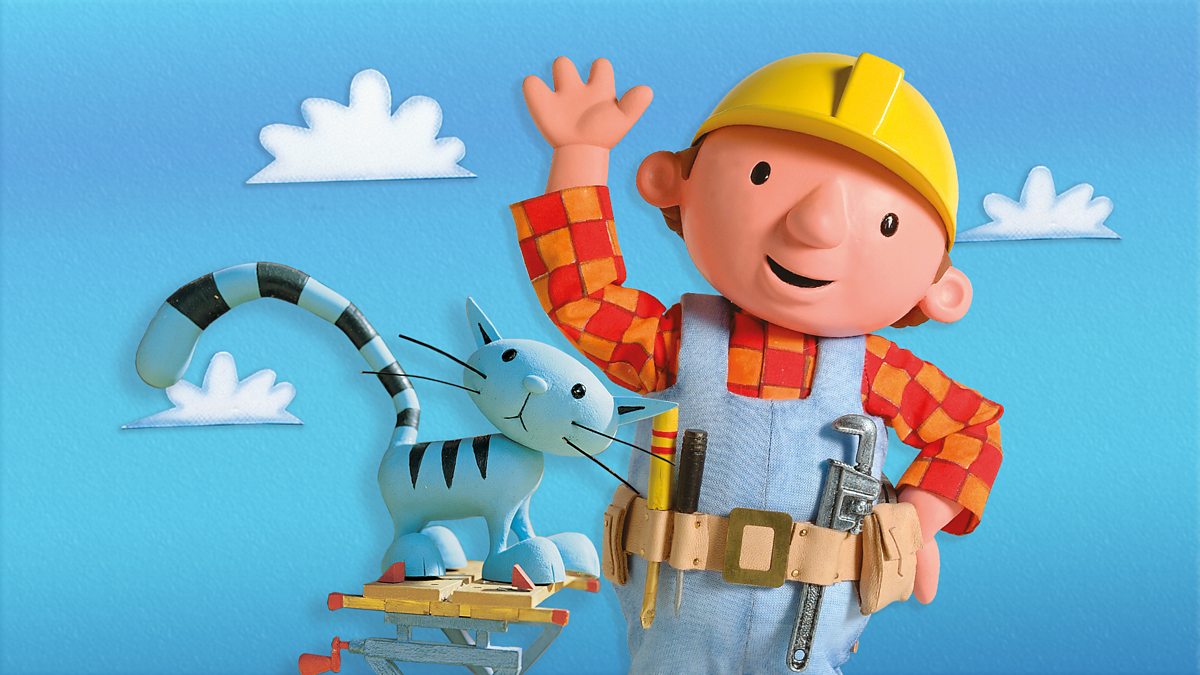
886. ‘Can We Fix It?’, by Bob the Builder

Ah, the classic British Christmas. Pigs in blankets, a half-pissed Granny, more rain than snow outside, and some novelty tripe at number one in the charts…

Can We Fix It?, by Bob the Builder (his 1st of two #1s)

3 weeks, from 17th December 2000 – 7th January 2001

Bob the Builder joins Mr Blobby, Benny Hill, the kids of St. Winifred’s, Little Jimmy Osmond, and several more, in the festive hall of shame. But I will say that, while ‘Can We Fix It?’ is not a song I’m desperate to ever revisit after this; it’s far from the most heinous example of festive excess.

It’s an expansion on the theme to the popular kids’ TV show, with lots of fun musical references. It opens with a version of the escalating ‘Twist and Shout’ intro, also heard in more respectable chart-toppers from David Bowie and the Manic Street Preachers (which means that the year 2000’s first and last #1s are connected in the most unlikely way). Elsewhere there’s a pretty current 2-step garage beat, and lots of record scratches. For a song based on a children’s TV show theme it actually sounds like it could, in a not too distant parallel universe, be a real pop song.

In the video, by which novelties like this often live and die, Bob the Builder puts on various pop star guises, the most memorable of which is Liam Gallagher, complete with a parka and a sneering microphone stance. It also helps that Neil Morrissey, AKA Bob, has a Jarvis Cocker-esque drawl to his voice, sounding almost like a real rock star, but also like he’s very much not taking this seriously at all.

So, like I said, far worse musical crimes have been committed in the name of a Christmas number one. (And that’s before we mention the many God-awful, non-festive novelty chart-toppers…) But quite how this managed to become 2000’s best-selling single – in a year not short of generational classics – and the entire decade’s 10th best seller (!), I’m not quite sure. But hey, at least it kept Westlife’s ‘What Makes a Man’ off top spot, denying them a second Christmas #1 in a row.

Interestingly too, it was the only one of the year 2000’s forty-two chart-toppers that climbed to the top, entering at #2 behind ‘Stan’ the week before. It then peaked in sales in its third week, taking the coveted Christmas prize.

We finally, then, reach the end of 2000: the longest year we’ll ever cover. I published the first number one of this year on 23rd January, real-time, and we’re now well into June. I’m not sure I can sum up a year with so many different number one singles, but I’ve enjoyed more of them than I expected to (while it’s also been a self-indulgent trawl through my fifteenth year on this planet). Back then I was frustrated at the high turnover, feeling that it devalued the charts (which it does), but I’m coming round to the feeling that variety is indeed the spice of life. Meanwhile, at the time of writing in 2025, the current UK #1 has just entered its twelfth week on top…

885. ‘Stan’, by Eminem

The end of the longest year in chart-topping history is in sight: here we are at the forty-first and penultimate number one of 2000. And of all the zeitgeist grabbing #1s we’ve met along the way – Craig David’s seven days, Robbie’s rocking DJ, Destiny’s Child and their independent women – we’ve reached the ultimate pop culture reference. For none of those other records’ titles have entered the OED, as both a noun and a verb…

Stan, by Eminem (his 2nd of eleven #1s)

1 week, from 10th – 17th December 2000

With ‘The Real Slim Shady’, Eminem announced himself, for better or worse, as a foul-mouthed, parent-baiting, attention-demanding cartoon character. With ‘Stan’ he announces himself as something else entirely. It’s a study of fame, of fandom, of what we would now call toxic masculinity, much of which is even more pressing today than it was a quarter of a decade ago. And it was almost a Christmas number one.

I don’t love Eminem, and I’m not the biggest fan of hip-hop. But I am a writer, and the way he constructs a character, a backstory, and a narrative with not one but two twists, in four verses is one of pop music’s great feats. One little detail stood out to me on this re-listen: in verse one Stan mentions how sloppy his handwriting is, while in the third he calls back to it and claims he wrote the address on his letters perfectly. That’s some proper plotting.

The tension builds as the letters from Stan pile up, unanswered. (The fact that Eminem manages to make some weirdo writing letters this gripping is another great feat.) The start of the third verse (the best of the four) is my favourite moment: Dear mister I’m too good to call or write my fans…! Stan then launches into a rambling rant about how he’s like the character in Phil Collins’ ‘In the Air Tonight’, with Eminem capturing perfectly how someone on a fistful of downers and a fifth of vodka would sound.

Then there’s the twists. First that Eminem hasn’t been ignoring Stan’s letters, he’s just not had the time to reply. And then Eminem remembering in the final lines that he’d heard about some guy on the news who’d driven off a bridge, killing his pregnant girlfriend. Come to think about it, His name was… It was you… Damn. Thunderclap. It’s an almost theatrically, dare I say camply, abrupt ending. But it works, ending a near seven-minute record in a flash.

The fact that Stan references Eminem having written songs about killing his ex-wife Kim, inspiring him to do the same, is worth mentioning. Eminem knows the controversy he causes, knows the monsters he might create. But he doesn’t apologise, doesn’t judge, doesn’t celebrate. He offers us a glimpse of a life lived, and ended. And it’s art, quite high art, of a level that not many #1s can achieve.

The only thing that feels forced is the P.S. line about Stan wanting ‘to be together’ with Eminem. I covered the homophobic side of Eminem in my last post, and again maybe this is just the repressed fears of fourteen-year-old me, but I don’t think the song needs a gay element to it. Stan is already unhinged enough without wanting to literally fuck his idol. It just feels like an excuse to allow Eminem to reject him in the final verse – That type of shit makes me not want us meet each other… – a chance for him to prove, yet again, that Marshall Mathers is definitely not homosexual.

Beyond Stan’s story, what makes this record stand out is one of the great uses of a sample. Dido’s ‘Thank You’ had existed since 1998, and had been used in the soundtrack to the film ‘Sliding Doors’ (which gave us an earlier chart-topper in Aqua’s ‘Turn Back Time’) A DJ put the chorus to a hip-hop beat, and the demo found its way to Eminem who was inspired by the line got your picture on my wall to write about a deranged fan. In the wake of ‘Stan’s success, both ‘Thank You’ and Dido’s debut album raced up the charts, establishing her as one of the biggest British stars of the new millennium.

But as great as ‘Stan’ is, I am glad it didn’t hold on to become Christmas number one. No, after this tragic tale we all needed some light relief…

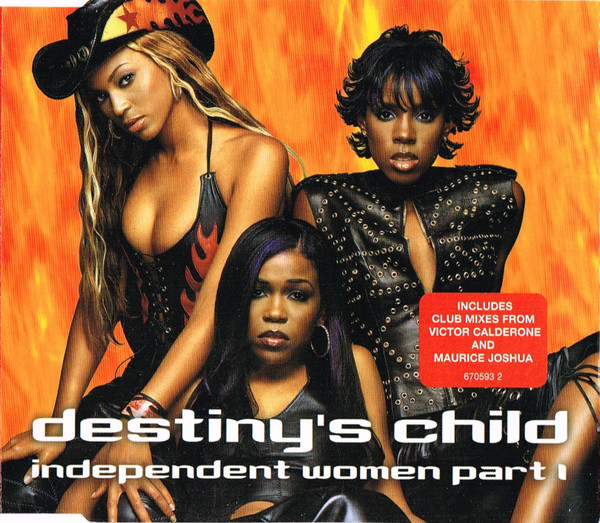
883. ‘Independent Women (Pt. 1)’, by Destiny’s Child

Question…

Independent Women (Pt. 1), by Destiny’s Child (their 1st of two #1s)

1 week, from 26th November – 3rd December 2000

Towards the end of a year jam-packed with zeitgeist grabbing choruses, where does All the women, Who independent, Throw your hands up at me… rank?

That’s before we get to the I bought it bridge, or indeed the repeatedly deadpanned question line. It’s slick turn-of-the-century R&B, minimalist in its instrumentation, with plenty of space for Beyoncé and co.’s tight harmonies, especially in the nearly a cappella break. This was the first Destiny’s Child track to feature Michelle Williams, and the only one to feature Farrah Franklin (who was only in the group for a couple of months).

‘Independent Women’ comes from the soundtrack to a movie reboot of ‘Charlie’s Angels’, and we are given no chance to forget it. From the spoken intro introducing the actresses, to the Charlie how your angels get down like that… refrain, few other movie soundtrack chart-toppers have had such strong product placement. It could have backfired, or at least left the song stranded in a very particular place in time, but it hasn’t. In fact, lines like Cameron D, Invest in me have perhaps added to its nostalgic allure.

I earlier drew comparisons between the Spice Girls’ recent ‘Holler’ and US girl-groups like Destiny’s Child, but really it’s no contest. This is so polished, so confident; another example of how American acts were setting the tempo at this time. Britain could still produce good pop (Steps!), but whenever we tried to ape this sort of hip-hop/R&B uber-pop we just couldn’t pull it off.

What I’m noticing now, after repeated listens, is the irony of a song about women’s independence promoting a film about three (admittedly kickass) women controlled by an unseen older man. Plus, as others have pointed out before me, the independence of the women in the song seems to be measured by the fact that they can buy their own clothes, shoes, cars and jewellery.

I mentioned her in passing, but we should make more of this being our introduction to Beyoncé, who will go on to be one of the new millennium’s biggest stars, with a near twenty-five year span between this and her most recent chart-topper. And while this track is well-remembered, I’d argue that the two following Destiny’s Child singles have become even more embedded in popular culture (one of which will be shortly turning up at #1).

Before we finish, I have one final question. If this is ‘Independent Women (Pt I)’, then what of part two? Well, it’s an album track, much harder-edged, nowhere near as catchy. Case closed, Charlie.