Top 10s – Buddy Holly

February made me shiver, With every paper I delivered, Bad news on the doorstep, I couldn’t take one more step…

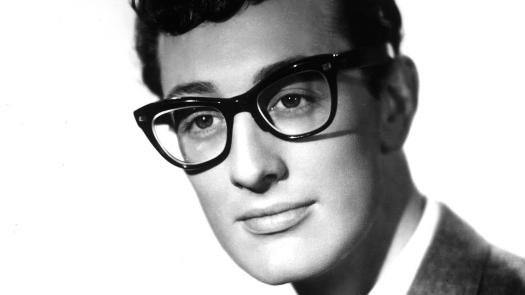
Sixty-one years ago today, a light aircraft slammed into a field in Iowa during a snow-storm, killing everyone on board. The four passengers were Ritchie Valens (a seventeen-year-old up and coming rock ‘n’ roller), J.P. Richardson (AKA The Big Bopper, of ‘Chantilly Lace’ fame), pilot Roger Peterson, and Charles Hardin Holley. Buddy Holly.

The Day the Music Died has passed into folklore. I’m not going to write about that today. Rather, for my 2nd artist’s Top 10 post – check out the first one I did here – I’m going to list my favourite UK hit singles from a man whose legacy stretches far. The Beatles, The Stones, punk rock and power pop – they all owe a big debt to Buddy.
investigators-may-reopen-buddy-holly-plane-crash-fdrmx

As before, I’m restricting myself to ‘A’-sides of singles that charted in the UK. So no ‘Everyday’, no ‘I’m Gonna Love You Too’, no ‘Not Fade Away’, and no ‘You’re So Square… Baby I Don’t Care’. Don’t blame me… Blame the people that didn’t buy those singles, or the record labels that never released them…

10. ‘Think It Over’, with The Crickets, 1958 – peaked at #11

People sometimes forget that Buddy Holly recorded some down and dirty rock ‘n’ roll. Maybe it’s the thick-rimmed glasses that make him seem a little more, how to say, cerebral, than Elvis or Little Richard… But while he was able to add more subtlety than most of his contemporaries, ‘Think It Over’ has swagger and attitude to spare. Is she sure she doesn’t want him? Really sure? Maybe she should think it over… Great piano solo, too.

9. ‘It Doesn’t Matter Anymore’, 1959 – reached #1

Holly’s only solo #1, three months after he died. More strings than you’d expect from a rock ‘n’ roll single, and a very memorable vocal performance. Lots of trademark hiccups and southern drawl. The video above starts with a snippet of ‘Heartbeat’… not sure why. Read my original post on ‘It Doesn’t Matter…’ here.

8. ‘Reminiscing’, 1962 – reached #17

Some sexy sax, and a quality chugging riff. And Buddy’s voice. I’ve always loved the way he has fun with the line You’re a mean mistrea-ea-ea-ter… This peaked in the early sixties, along with several other gems from his back catalogue.

7. ‘What To Do’, 1965 – reached #34

Since this was never a big hit in Holly’s lifetime, you can hear it in all manner of overdubbed and re-imagined versions. I’ve gone for this stripped-back one, though. Just Buddy Holly and a guitar, so close to the mic that you can hear his breathing. It was a minor hit a full six years after his death. I love the lines about ‘soda pops’ and ‘walks to school’, that by the mid-sixties must have sounded very old-hat.

6. ‘Early in the Morning’, 1958 – reached #17

Some more swagger from Mr. Holly. We-e-e-e-el, he crows at the start, You gonna miss me… To be honest he doesn’t sound very heartbroken. In fact he might just be enjoying the break-up. I love his vocals here, one second yelping, the next growling…

The Top 5 were all Top 10 hits in the UK, all priceless slices of rock ‘n’ roll goodness:

5. ‘Maybe Baby’, with The Crickets, 1958 – reached #4

Every Buddy Holly song has a little detail – beyond the lyrics and melody – that makes it stand out. In ‘Maybe Baby’ it’s the reverb on the guitar. A near perfect pop song.

4. ‘Peggy Sue’, 1957 – reached #6


Buddy’s first ‘solo’ single – even thought The Crickets are clearly accompanying him in videos around online… It was written for the drummer, Jerry Allison’s, girlfriend after they had temporarily split up. Probably more groundbreaking than the 3 songs I’ve chosen above it… That drumbeat for a start is like nothing heard in a rock ‘n’ roll single before. Just my personal preference. The moment when the electric guitar comes in. My, my, my…

3. ‘That’ll Be the Day’, with The Crickets, 1957 – reached #1

If the plane crash was The Day the Music Died, then this is the moment it all began. The jingle-jangle intro, the hiccuping voice, the John Wayne inspired hook… My favourite bit has always been the start of the second verse – the country twang on the: well-a, when Cupid shot his dart… Read my original post on this number one record here.

2. ‘Oh Boy!’, with The Crickets, 1957 – reached #3

Teenage angst – you can here my heart a-callin’ –  and lust – a little bit of lovin’ makes the everythin’ alright – in The Crickets 2nd big hit. Holly’s vocals rasp, yelp and strain against the conservatism of 1950s America, and it just pips ‘That’ll Be the Day’ into the runners-up slot…

1. ‘Rave On’, 1958 – reached #5

We-a-he-a-he-al… The opening second of this record already seals its place as an all-time great. The way he stretches out the opening syllable is sublime, and then it morphs into a proto-punk number with its relentless riff surfing along in the background. One minute fifty seconds of rock ‘n’ roll brilliance, the well from which so much modern pop music springs…

Charles Hardin ‘Buddy’ Holley

September 7th 1936 – February 3rd 1959.

Remembering Bobby Darin

Named after a faulty sign outside a Chinese restaurant (the letters M-A-N were blacked out, leaving only D-A-R-I-N), today we remember perhaps the most underrated of the big fifties stars…

MI0002749454

Underrated, perhaps, because nobody knew where to fit him in. He didn’t look much like a teen-idol. He could sing rock ‘n’ roll, as well as more old-fashioned swing and jazz. His hit singles include both self-penned songs, like his debut ‘Splish Splash’, and modern interpretations of standards, such as his 1961 Top 10, ‘You Must Have Been a Beautiful Baby’.

Born in Harlem, New York, in 1936, into a family of low-level mobsters and vaudeville singers, his mother was actually his grandma and his sister his biological mother  – a fact he didn’t find out until he was in his thirties. He was a sickly child, with recurring bouts of rheumatic fever, and always knew that he was not expected to live to an old age.

ss

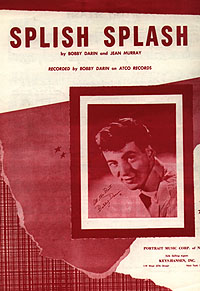
(The sheet music for Darin’s first big hit.)

Which perhaps explains why he crammed so much into his short life. Songwriter, singer, actor, presenter, political campaigner, chess player… His two UK chart toppers perhaps best sum up his approach to life and music. In the space of four months in 1959 he hit #1 with the swaying rock ‘n’ roll ballad ‘Dream Lover’

And then with a cover of ‘Mack the Knife’, a German musical number from the 1920s, about a murdering, thieving, raping ‘shark’ called MacHeath…

Two number ones of the highest quality. ‘Mack the Knife’ stands out in particular – it doesn’t sound much like any of the other hits of the time, and the lyrics are pretty niche. It’s simply a record that got to #1 because it’s really, really good. Darin continued to have hits through the early sixties, including karaoke standard ‘Beyond the Sea’ and one of my personal faves, ‘Things’.

1960-photo-ed-sullivan-tv-bobby-darin-connie_1_1a60acb097042d853882e5eb19a09d46

(Bobby Darin with Connie Francis – whom he wrote songs for and had a relationship with – and Ed Sullivan in 1960.)

As the sixties progressed he moved into films, then TV and political campaigning. Darin was heavily involved in Robert F. Kennedy’s career, and he went into a deep depression when Kennedy was assassinated, having been present when it happened.

He continued to perform right up until his death, and by the end was on oxygen before and after each performance. Bobby Darin passed away during an operation on his heart, aged just thirty seven.

Bobby-Darin

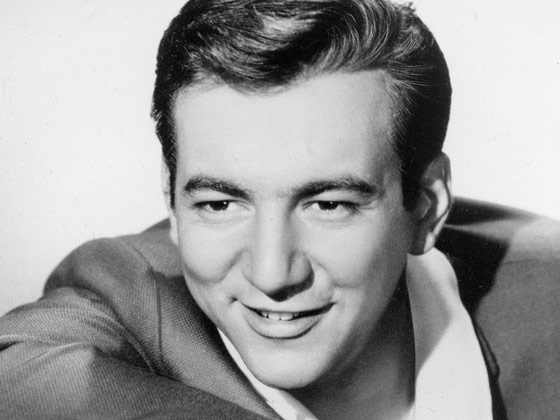
Bobby Darin, May 14th 1936 – December 20th 1973


Remembering Kay Starr

On this day three years ago, one of our earliest chart-toppers passed away: Kay Starr, smoky voiced pre-rock chanteuse.

kay-starr-cropped

Born in 1922, on a Native-American Reservation, Katherine Laverne Starks parents were a sprinkler fitter and a chicken raiser, and she was singing with bands in Texas from the age of ten, to earn a few extra dollars for her family. (Sounds like the sort of story you might invent, were you challenged to invent a story from Depression-era America…) She sang with big bands through the thirties and forties, before going solo and recording two of my favourite pre-rock n roll #1 singles.

Back when I was working my way through the first fifty or so UK chart-toppers, before Elvis, Buddy, Jerry Lee et al came along, I did find it a bit of a slog at times. Painfully earnest crooners (Eddie Fisher, David Whitfield), irritating novelties (‘That Doggie in the Window’, ‘I See the Moon’) and staid instrumentals (Eddie Calvert, Mantovani) plodded by, one after the other. It was the hidden gems, such as Kay Starr, that made the journey more bearable.

She popped up as early as chart-topper number three, in January 1953, with the sprightly, sassy ‘Comes A-Long A-Love’ – a record that was a whole lot of fun, and one that proved a lot of my preconceptions about the pre-rock era wrong.

And then we had to wait a while for her second, and final, #1. A record that Starr was, apparently not too keen on, but that gave her a hugely unexpected hit: ‘Rock and Roll Waltz’. The story of a teenager (though Starr was thirty-two when she recorded it) who comes home to find her parents trying to waltz to one of those new-fangled rock ‘n’ roll discs. It hit the top in the spring of 1956, just before Elvis went stratospheric with ‘Heartbreak Hotel’, and can perhaps be counted as one of the first rock ‘n’ roll chart-toppers, even if it is poking slight fun at the genre…

(I’ve linked to an 1980s TV performance, as it’s a lot of fun and shows Ms Starr still swinging in her sixties. Follow the link above to hear the original.)

And that was that for Kay Starr on the UK charts. She only ever charted five singles here, though she would have presumably had more had the charts begun before November 1952. In the US she was much more prolific, with fifteen Top 10 hits between 1949 and 1957. ‘Wheel of Fortune’ was the biggest, but she also had big duets with fellow UK chart-topper Tennessee Ernie Ford. In later years she toured with Pat Boone, and Tony Bennett.

I think the reason that Kay Starr stood out amongst the other pre-rock stars is that there is such a sparkle in her voice – it flirts, flitters and then suddenly goes all husky-sexy. Billie Holiday apparently claimed that Starr was the only ‘white woman who could sing the blues’. It’s a great voice, but not ‘proper’ like her cut-glass contemporaries. She could have succeeded as a rock ‘n’ roll singer like Connie Francis or Brenda Lee, had she been born a decade later.

Kay-starr-729243

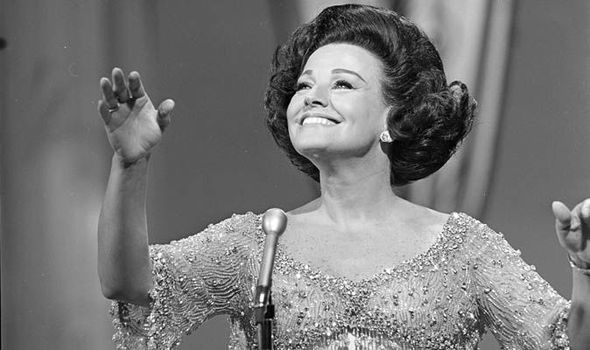
Kay Starr, July 21st 1922 – November 3rd 2016

Behind the #1s – Norrie Paramor

We’ve covered 210 chart-toppers so far in this countdown, going from the very first chart through to Nancy Sinatra and her boots in early 1966. And it’s only fair that we turn our attention to the man that, up to now, has been involved in more of these #1 singles than anybody else, more than Lennon and McCartney, Jagger and Richards, Bacharach and David…! Norrie Paramor.

A-389780-1239185483.jpeg

Born in 1913, Paramor had worked as a pianist and arranger through the thirties and forties, before being appointed recording director at EMI in 1952 – the very year that the singles chart he was to help shape began. Having developed his sound during the light-programme, easy listening days, Paramor was perfectly positioned to help the pre-rock stars sway (albeit gently). He was responsible for trumpeter Eddie Calvert’s hits, and the Northern-Irish warbler Ruby Murray’s ‘Softly, Softly’. Then there was Michael Holliday. Already a pretty impressive body of chart-topping work… And it was about to become all the more impressive, because along came Cliff.

Cliff Richard has had eight number ones so far in our countdown, all of which have been produced by Norrie Paramor. And each time I’ve complained that ‘rock ‘n’ roll Cliff’ was nowhere to be seen… Britain’s answer to Elvis etc. etc. Yeah right. He had a handful of truly rocking singles in ’58, but by the time he’d gotten down to the business of topping the charts the rock had become more of a gentle toe-tap. And a lot of that was probably down to Paramor. He wasn’t a rock ‘n’ roll producer; he was a light-entertainment, easy listening kind of guy. I get the feeling he wasn’t convinced by rock and roll, probably saw it as a fad, and was willing to allow it as long as it was successful. Still, he moulded Cliff’s sound. One wonders how Cliff would have turned out had he had someone else’s hands on the tiller…

1129e96d0f0a1b4230ce73143899964e

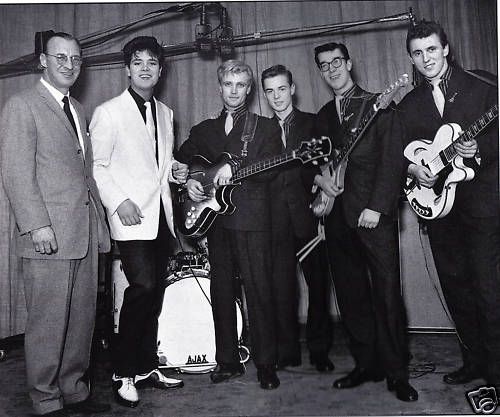
(An early pic of Paramor, Cliff and The Shadows)

Of course, wherever Cliff went The Shadows weren’t far off. Paramor produced all of their chart-toppers too. Which makes for a more interesting comparison of styles, as discs like ‘Kon-Tiki’ and ‘Dance On!’ were actually pretty rocking little numbers. Perhaps it’s unfair, then, to write Paramor off as a dinosaur. Add to this the fact that he also oversaw Helen Shapiro’s wonderful 1961 chart-topping double – the bubbly ‘Walkin’ Back to Happiness’ and the melodramatic ‘You Don’t Know’ – and it’s clear that he wasn’t all bad…

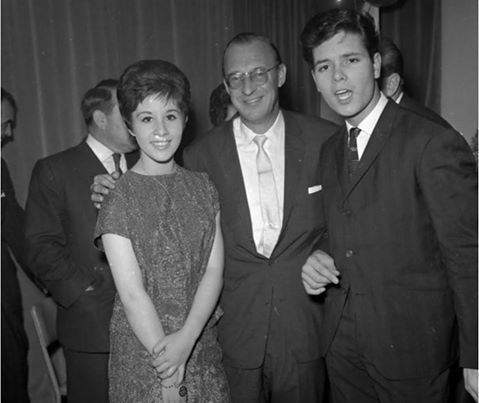
ed1197fc5e386c79ec58aef7e2fda6c8

(Paramor with Cliff, again, and Helen Shapiro in the early sixties)

Wait, though… On the flip side of this particular coin lies one Frank Ifield. Yep, Norrie Paramor produced all four #1s from ‘The Year of Ifield’, pre-rock’s final hurrah before The Beatles and The Pacemakers saved us all… The yodelling horror that is ‘Lovesick Blues’ remains, for me, far worse than anything that Cliff has inflicted.

A mixed bag, then, from Norrie Paramor, prolific producer of the chart’s early years. In total (I think, it’s hard to keep track) he put his name to around twenty five chart-topping singles before the seventies arrived. He also acted as musical director for the Eurovision Song Contest, and wrote multiple film scores, before passing away in 1979. And, in a sentimental twist, the artist that was sitting at #1 in the UK as Paramor drew his final breath, with his first chart-topper in over a decade, was… Cliff!

Behind the #1s – Paul Weston

Taking a break from the usual proceedings, I’m going to use this week to take a look at the folks behind some of the 210 #1s we’ve heard so far. The writers, the producers and, in the case of our first post, the conductors…

In the early days of the charts, when big productions and even bigger voices were all the rage, any self-respecting chart-topper needed an orchestra to back up them up. On the 45s of the time, nearly every #1 is assigned to both a lead artist and an orchestra. ‘Here in My Heart’, by Al Martino, with Orchestra under the direction of Monty Kelly… ‘Outside of Heaven’, by Eddie Fisher with Hugo Winterhalter’s Orchestra and Chorus…

al-martino-here-in-my-heart-capitol-78-s

Perhaps for reasons of convenience, the Official Singles Chart don’t list the orchestra, or it’s conductor, for any of the early chart-toppers. Which is strange, I suppose, as in modern times we have no problem with crediting ‘featured’ artists on a dance or rap track. Maybe it’s because we don’t actually hear their voices… Whatever the reason, several men have missed out on their moment in the record books. Winterhalter and Kelly, Frank Cordell, Stanley Black, Harold Mooney, Mitch Miller…

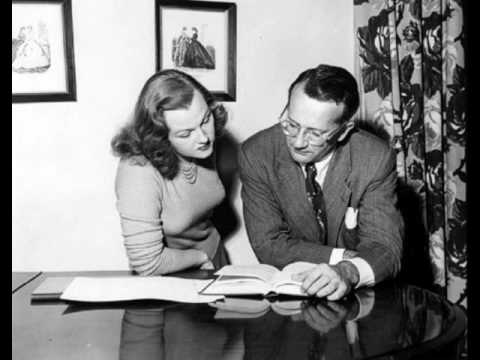
paul_weston

I’ve chosen Paul Weston as the frontman for this piece, though, thanks largely to his work with Frankie Laine. Weston was a Massachusetts born musician, who had been a pianist in a dance band, before becoming a song-writer and music director at Capital, and then Colombia Records. He conducted and arranged all three of Laine’s 1953 hits: ‘I Believe’ (still the song with the most weeks at #1 in the UK, sixty-five years on), ‘Hey Joe!’ and ‘Answer Me’. He also conducted on Jo Stafford’s ‘You Belong to Me’, Britain’s 2nd  ever chart-topper. Stafford and Weston had married not long before recording the song.

hqdefault

Paul Weston with his wife, Jo Stafford

If Paul Weston were actually credited with his work on #1 singles, he would sit at joint 10th place in the all-time weeks at the top of the UK singles chart list with 29 weeks’ worth of chart-toppers, tied with ABBA and Take That, and one week behind Drake. Later in the 1950s he went on to do TV work, helped to start up the Grammy Awards, and worked for Disney. He passed away in the mid-nineties.

One conductor who did get credited on his hit records was the Italian, Annunzio Paulo Mantovani who, like all the best pop stars, went by just the one name: Mantovani. He was popular enough to score a solo, instrumental number one single in 1953: The Song from ‘The Moulin Rouge’, which had been a big hit in the cinemas that year. This success, and his subsequent fame is, I’m guessing, why he is the only conductor to be credited by the Official Charts Company, for his orchestral accompaniment on David Whitfield’s overwrought ‘Cara Mia’ in 1954.

mantovani-663032

Mantovani, doing his thing

Conductors and their orchestras became less essential once rock ‘n’ roll arrived, but they still occasionally popped up on the more bombastic number ones. The last one I can think of was Shirley Bassey’s ‘Climb Ev’ry Mountain’ / ‘Reach for the Stars’ double-‘A’ side from 1961, which was credited, on the vinyl at least, to Geoff Love and His Orchestra.

To the conductors, then, and their batons, which shaped the sound of the singles chart’s earliest years.

Remembering Eddie Fisher

I’m starting out a new feature today, remembering some of the biggest stars that we have met so far. The only requirements needed to feature here are that we have already covered your chart-topping careers on this countdown, and that you are dead…

On this day, then, nine years ago, Eddie Fisher – the King of pre-rock ‘n’ roll – passed away, aged 82. The first artist to score multiple #1 singles in the UK. An artist whose two chart-toppers came in the blink of an eye, in the first eight months of the singles chart’s existence. Numbers 4 and 10.

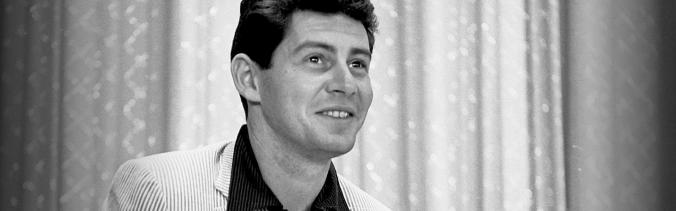
eddie-fisher-getty-hero-improvedcrop

First came the sombre ‘Outside of Heaven’, in which he stood outside the house of the girl he once loved. You can read my original post here. It’s sedate, proper… traditional.

Then came the equally sombre ‘I’m Walking Behind You’ – a duet with Sally Sweetland – in which he followed his ex to church on her wedding day. Again it’s sedate, proper, traditional… and pretty darn creepy when you listen carefully.

I struggled to really get his chart-topping singles when I originally wrote about them, and still do. He had a good voice, they were well-constructed songs… They were just so old-fashioned. Old-fashioned sounding even among their contemporaries, and incredibly old-fashioned when compared to where we are now in the countdown – slap bang in the middle of the swinging sixties (amazingly, given the way pop music has changed, we’re only actually thirteen years down the line in real time…)

What the songs do offer is an interesting glimpse into how music sounded before rock ‘n’ roll came along, and Fisher – along with Frankie Laine, Guy Mitchell, Johnnie Ray – was one of the biggest male stars of the late forties / early fifties. Only one of his singles failed to make the UK Top 10, while he enjoyed 25 (!) US Top 10s, including 4 #1s.

fa8866f2820f2b82a295d63679695579

He had quite the life outside of the recording studio, too. That is, yes, him with Elizabeth Taylor, his second wife (he was number four of eight for her). He left his first wife, Debbie Reynolds – Taylor’s best friend! – for her. It was quite the scandal, and proof that misbehaving pop stars weren’t a rock ‘n’ roll invention. He was married five times in total, and had four children over the course of them. The oldest of whom was the late, Star Wars great, Carrie Fisher.

So, if you can, take a moment out of your day, click on the links, and transport yourself back to 1953, when Eddie Fisher was crooning his way to the top of the charts and was, for a short time, the man with the most UK #1 singles in history.

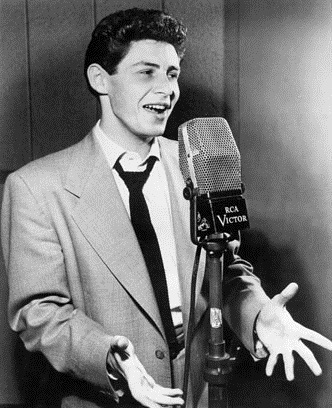
Photo of Eddie Fisher

Eddie Fisher, August 10th 1928 – September 22nd 2010

Songs That Should Have Been #1… ‘Heartbreak Hotel’, by Elvis Presley

The Stargazers, Don Cornell, The Johnston Brothers, The Dream Weavers, Jerry Keller…? Nope, me neither. But they’ve all had the honour of topping the UK singles chart.

How well a single performs in the charts can be influenced by various things… promotion, star power, tastes and trends, time of year… pure luck. And that most fickle, unpredictable of  factors: the general public. Do enough of them like your song to make it a smash? Or will they ignore it, and let it fall by the wayside?

I’m taking a short break from the regular countdown to feature five discs that really should have topped the charts. Be it for their long-reaching influence, their enduring popularity or for the simple fact that, had they peaked a week earlier or later, they might have made it. (I’ll only be covering songs released before 1964, as that’s where I’m up to on the usual countdown.)

Next up…

Well since my baby left me…

mainELVISPRESL-800x445

Heartbreak Hotel, by Elvis Presley

 reached #2 in June 1956

OK, OK, I know. Elvis doesn’t need any more number one singles. He’s had plenty. Back on my regular countdown, of actual #1s, we’re in 1964 and The King of Rock ‘n’ Roll is on fourteen (14!)

But… His dominance of the charts in the early 1960s is why I wish that this disc could have made the top. He had some brilliant, classic #1s – don’t get me wrong – but he also dragged a lot of crap to the top just through the power of his name. If only we could swap ‘Good Luck Charm’, or ‘Rock-A-Hula Baby’, or ‘Wooden Heart’, for this burst of primal energy.

This was Elvis the hip-swiveller, Elvis as Moral Panic, Elvis the Pelvis edited from the waist down… And it’s a really clever song, too. A broken heart imagined as a real place – a hotel where broken-hearted lovers cry in the gloom, and the desk-clerks are all dressed in black. It was inspired by a real-life suicide, which is some heavy shit for a pop song in 1956 (for comparison, it was kept off the top-spot in Britain by the banal, saccharine stylings of Pat Boone, with ‘I’ll Be Home’.) And when that guitar solo kicks in… Oh boy. The King was most definitely in the building.

Remembering Doris Day

GACCALAMITYJANE

With the sad news that Doris Day has passed away, at the grand old age of ninety-seven, I thought it would be fitting to remember her two UK chart-toppers. I covered them in my countdown last year, but they are always worth a re-listen (follow the links below to read the original posts…)

Her first was one of the longest running #1 hits in British chart history – ‘Secret Love’, from the soundtrack to her hit movie ‘Calamity Jane’, which spent a whole 9 weeks on top in the spring/summer of 1954.

She followed this up two years later, with possibly one of the best-known songs to ever  have topped the charts, ‘Whatever Will Be, Will Be (Que Sera, Sera)’

Of course, Day’s musical success went far beyond her two chart-toppers. She scored hits throughout the fifties, and she would have had several more had the charts begun before 1952. My favourite of hers, though, is her final UK Top 10, from 1964… ‘Move Over Darling’.

And it wouldn’t be right if I didn’t mention the fact that she got one of the most famous name-checks in one of the most successful movies ever… ‘Grease’ (which is probably where I first heard of her!) She most certainly was not brought up that way… Which was a big part of her charm, and her longevity. In 2011, for example, she became the oldest artist to score a UK Top 10 album featuring new material, aged eighty-nine.

RIP.


‘Hoots Mon’, by Lord Rockingham’s XI – The UK Number 1s Blog Anniversary Special

This week marks the 1st anniversary of The UK Number 1s Blog (** Trumpet Fanfare**)! In the past year we’ve covered the period from Nov. ’52 to Nov’ 61, with 129 chart-topping songs featured. We’ve survived pre-rock, rode the rock ‘n’ roll revolution, and are now well on our way towards the swinging sixties… Thanks to everyone who has read, followed, commented and enjoyed.

To celebrate this milestone, I’m going to take a short break from the usual countdown to repost seven songs that I have really enjoyed discovering over the past year. These aren’t necessarily the best songs to have topped the charts – there’ll be no Buddy Holly, Johnnie Ray, Connie Francis, Elvis or The Everly Brothers (follow the links if you want to read about them) – as I’ve been listening to, and loving, those artists for years. This week will be all about the forgotten gems, the hits I’d never heard before, the songs that have slipped through the cracks…

My penultimate choice is one that pays homage to my homeland – Bonnie Escocia. It’s a song that, at the time of writing, I suggested should become our new national anthem. With the advantage of hindsight… I still think that’s a great idea. This is a record that sounds like it was recorded on a cocktail of Irn-Bru, soor-plooms, the Best Of ‘Oor Wullie’ and just a splash of Buckfast Tonic Wine. It’s a wild and zany chart-topper, that makes no sense and yet complete sense. One more time then… Och Aye!

Lord-Rockingham_s-XI-Hoots-Mon-1958-7”

And so on we roll towards the United Kingdom’s seventy-seventh chart topping single. And it’s a song that I’ve never… No, wait… Ah! I know this… We all know this…

Hoots Mon, by Lord Rockingham’s XI (their 1st and only #1)

3 weeks, from 28th November – 19th December 1958

Dooooo-doo-doo-do-do… Dooooo-doo-doo-do-do… It’s an intro that smacks of slightly misplaced grandeur, like an aged diva swishing onto the stage before slipping on a banana. We know what follows is going to be absurd. And, oh boy, it is…

Na-nana-na-nana, Na-nana-na-nana, Nana-nanananana… Na-nana-na-nana, Na-nana-na-nana, Nananananananana… Apologies for my woeful attempts to render this riff using the medium of ‘na’s. The minute this starts playing you will know it.

It’s an instrumental, and it’s been a while since we featured an instrumental. I make Winny Atwell’s ‘The Poor People of Paris’ our most recent lyric-less number one, and that was two and a half years back. And it is undeniably catchy. It bores its way in on the first listen and will, I’m sorry, remain for days. And days. And days. There are key-changes, oh yes! And the bass! One of my main complaints about the rock ‘n’ roll numbers we’ve heard so far is that, while there have been some undeniable classics – your ‘Great Balls of Fire’s, your ‘That’ll Be the Day’s and your ‘Rock Around the Clock’s – they’ve all sounded a bit light to modern ears. Listen to this, though, especially through headphones. It fills your ears, in a way that makes it sound like a modern record. Every instrument – the throbbing bass, the slapdash drums, the natty organs – are, if you’ll forgive the cliché, turned up to eleven. And a half.

Actually, I called this an instrumental; but it’s not quite. There are a few words, shouted out above the clatter, foremost among them being: There’s a moose loose aboot this hoose… and It’s a braw, bricht, moonlicht nicht… Then there are the Och Ayes! thrown in towards the end and the big Hoots Mon! upon which the record ends. Yes, this is, as they say in theatre circles, The Scottish Number One. All we’re missing is a ‘Help ma Boab!’

large

The ringleader of Lord Rockingham’s XI was a man named Harry Robinson, a Scot if ever there was one. But, being from Scotland myself, I’m not sure how I feel about this record, and the manner in which it reduces the culture, language and heritage of my homeland to a handful of trite, drunken catchphrases…

Actually, screw it. It’s as catchy as crabs and a hell of a lot more fun than some of the more ‘official’ Scottish songs – ‘500 miles’ (Jings!), ‘Scotland The Brave’ (Crivvens!), ‘Caledonia’ (Shudder… and boak!) In fact, I think that this song I hadn’t ever properly listened to until twenty minutes ago should become our new national anthem, in place of the dirge that is ‘Flower of Scotland’. And when I fulfil my manifest destiny in replacing wee Nicky Sturgeon as First Minister, that’ll be the first act I sign into law.

Anyway, file this record under ‘complete and utter novelty’. It’s no coincidence that it hit the top spot in the weeks leading up to Christmas and New Year. Lord Rockingham’s XI wouldn’t go on to much more success and so for the first time, I think, we have two (semi) one-hit wonders replacing one another at the top of the charts. File this also under ‘British Rock ‘n’ Roll’. It’s something that I’ve long been noting – the gradual handing over of the rock ‘n’ roll baton from the US to the UK – and with this anarchic British track following soppy efforts from The Everly Brothers and The Kalin Twins the transition may be complete.

I’ll finish by reminiscing on how this song stirred in me a long-discarded, foggy memory of a commercial for something or other, way back in the late eighties or early nineties… I knew I knew this song, but I didn’t know how I knew it – if you catch my drift. I suppose whatever it was will be forever lost in the mists of time… Actually, no it won’t. The advert was for Maynard’s Wine Gums, back in 1993. Thanks, internet.

94. ‘What Do You Want to Make Those Eyes at Me For?’, by Emile Ford & The Checkmates

What’s that I hear? Tick, tick, tick, tick… Is it a clock racing to the turn of a decade? From the Fabulous Fifties to the Swinging Sixties? Tick, tick, tick, tick… Or is it just the intro to this next chart-topper?

s-l640

What Do You Want to Make Those Eyes at Me For?, by Emile Ford and The Checkmates (their 1st and only #1)

6 weeks, from 18th December 1959 – 29th January 1960 (including 1 week joint with Adam Faith from 18th – 25th December 1959)

It begins with some ticks, and then the vocals swoop in. This is a Doo-Wop record in the truest sense: in that much of it consists of the backing singers – The Checkmates, presumably – going a-doo-wop bee doo be doo be doo-wop…

I love this song, I do. What with all the doo-wops, the key changes and the brilliant false ending I can’t see how anyone could fail to enjoy it. I first heard it on a compilation called ‘Don’t Stop – Doo Wop’, which must have been released in the early ‘90s and which I picked up in a second hand CD shop years ago. I think I mentioned it in my post on The Teenagers’ ‘Why Do Fools Fall in Love’, which also featured on it.

The lyrics, though, to ‘What Do You Want to Make Those Eyes at Me For?’ (abbreviated forever more into WDYWTMTEAMF because that is a hell of a title to type out in full)… Hmmm. Questionable. What do you wanna make those eyes at me for, If they don’t mean what they say… That sounds like the justifications of a sex pest: “She was askin’ for it, guv! Those eyes!” You’re foolin’ around with me now, We-ell you lead me on and then you run away… She does sound like a tease… Of course, during these enlightened #MeToo times, we know that no means no. In 1959 it was perhaps a different story. We-ell that’s alright, I’ll get you alone tonight… Ok… And baby you’ll find, You’re messing with dynamite… Oo-er. Sexual dynamite? Or is he just going to give the disobedient hussy a black eye?

I jest, I jest… I’m willing to give Emile Ford the benefit of the doubt, as he keeps this song the right side of jaunty throughout and, to be honest, you can listen to it several times – as I did – without ever noticing the slightly sinister lyrical undertones. And, in defence of the 1950s as a whole – a decade, don’t forget, in which certain professions were closed to women, in which hotels could stick ‘No Blacks, No Irish’ in their windows, in which gay men were being slung in jail, in which people could still be sentenced to hanging – there have been very few #1 singles that stand out as troublesome for the modern listener. Very few lyrics have veered away from the catchy or the bland. I’d perhaps nominate WDYWTMTEAMF  and Guy Mitchell’s ‘She Wears Red Feathers’, from way back when (i.e. 1953) as being the most ‘of their time.’

A-347098-1418674966-5971.jpeg

As I mentioned in my last post, this disc was one of the last two records ever to share the top-spot in the UK charts. I suggested earlier that the death of the joint number one was due to a wider range of sales figures coming in but now I’ve just realised another theory: there will never be two such similarly titled #1 singles sitting at the top of the charts. Think about it: people go in to HMV looking to buy ‘What Do You Want?’ by Adam Faith, take a quick glance at the shelves, and come away with ‘What Do You Want to Make Those Eyes at Me For?’ by Emile Ford! Or vice-versa. Must have happened loads! Mystery solved.

WDYWTMTEAMF (that might actually be more of a pain to type than just writing it out in full) has quite the story, beyond this most famous of versions. It was written in 1916 (!) as a duet – in which the woman actually got to defend her wanton ways – and has been recorded by acts as varied as Shakin’ Stevens and former England, Barcelona and Tottenham manager Terry Venables. (Yes. Seriously.)

And so. We come to the end of the 1950s. And the start of the 1960s. Is this the last #1 record of the ‘50s, or the first of the ‘60s? Philosophical questions best left for another day. We are about to delve into a decade that will bring the most innovative pop ever recorded, the birth of modern rock, Merseybeat, Flower Power, psychedelica etc. and so on. So, I thought it might be interesting to gaze forward to the record that will be atop the charts on 31st December 1969, and to wonder at the advancements to come over the next ten years. Except. The final #1 of the sixties will be… ahem… ‘Two Little Boys’ by Rolf Harris. So… From a record with sex-offender lyrics to a record by an actual, convicted sex-offender. Ladies and Gentlemen, I give you the 1960s!

Let’s linger a while yet in the more innocent air of 1959, and end this post as Emile Ford (the first, and presumably only, St. Lucian to hit #1 in the UK – correct me if I’m wrong)  ended his sole chart-topping hit. Possibly the best ending we’ve heard yet. One more time, then: adoo-wop bee doo be doo be doo-wop be doo be doo be doo-wop be doo be doo be doo… Yeah!