227. ‘The Green, Green Grass of Home’, by Tom Jones

It’s become a bit of theme recently – every so often we take a pause from pop music’s race into the future to enjoy a good, old-fashioned ballad. First with Ken Dodd, then Jim Reeves, and now Tom from the Valleys.

tom-jones8

Green, Green Grass of Home, by Tom Jones (his 2nd of three #1s)

7 weeks, from 1st December 1966 – 19th January 1967

A soft, swaying intro precedes a tale of a man returning home, from a long time away. The old home town looks the same, As I step down from the train… And doesn’t Tom sing it well? There’s something in the Welsh waters… Why are they such good singers? Why is it Welsh Male Voice choirs, and not Geordie Male Voice choirs?

He runs towards his long-lost love, Mary: Hair of gold, And lips like cherries… And then he heads home: There’s that old oak tree, That I used to play on… It’s a heart-warming song for Christmas. One for all the family. Yes, it’s good to touch, The green green grass of home… Like most Tom Jones songs, it helps if you’re a bit drunk. I love the saloon-bar piano, that really adds a ‘last-call’ vibe. And, also like most Tom Jones songs, it’s a karaoke classic. Not quite ‘Delilah’, but getting there.

I love a song that tells a story, verse by verse. Just where has this man been all this time…? And ‘Green, Green Grass of Home’, like all good stories, has one hell of a twist. We break for a spoken-word interlude, in which the singer reveals that it was all a dream. And, who’s that? Why it’s the guard… And there’s a sad, old padre, On and on we’ll walk at daybreak, Again I’ll touch, The green green grass of home… Yep, plot twist: he’s getting executed.

TOM_JONES_GREEN,+GREEN+GRASS+OF+HOME-303646

I love it. Either he’s been wrongfully convicted, which only increases the power of the earlier verses, or you’ve spent the last two minutes sympathising with a murderer. The little piano riff to end is this song’s version of a ‘badoom-tish.’ And I’m similarly in two minds about this record as a whole. On the one hand, it’s mawkish, sentimental mush. On the other, it’s a great one for belting out in the shower.

And to be fair, this was a mega-hit. Seven weeks at #1 is longer than any record in the past three and a half-years, since The Beatles’ ‘From Me to You’. And, as I mentioned earlier, I doubt that this disc being released over the festive season hurt its chances. The idea of a ‘Christmas Number One’ wasn’t really a thing this early in the charts, but I do wonder if the success of ‘Green, Green Grass of Home’ set the tone for later, similarly saccharine, festive hits.

As for Sir Tom, similar to his first #1, ‘It’s Not Unusual, I think we have to look at him as existing separately from his chart contemporaries. His other big sixties hits included ‘What’s New Pussycat?’ and ‘Help Yourself’ – nothing baroquey or folky, or Beat-poppy about them. But… If you’re never in fashion you’ll never be out of fashion. Maybe it’s this refusal to follow trends that’s allowed him all his comebacks: his Prince covers in the eighties, and his huge resurgence when I was in high-school. Looking back, how on earth did a near sixty-year old man singing ‘Sex Bomb’ become such a thing…? And he will hit the top-spot once more, briefly, in forty-two years’ time. Which, unsurprisingly, is by far the biggest gap between #1 singles, ever.

224. ‘Distant Drums’, by Jim Reeves

What to make of this, then…? Just as we were getting into a groove at the top of the charts – a rocking, modish, soulful groove with cool and forward-facing #1s following similarly cool and forward-facing #1s – The Kinks, The Blue Flames, Chris Farlowe and ‘Eleanor Rigby’, a curveball is thrown our way.

C1sLy+PlIFS._SL1000_

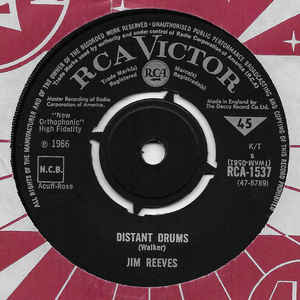
Distant Drums, by Jim Reeves (his 1st and only #1)

5 weeks, from 22nd September – 27th October 1966

Gentle drums, a swaying rhythm, a crooner’s voice… I hear the sound, Of distant drums, Far away, Far away… It’s the sort of country-ish ballad that was ten-a-penny in the late fifties and early sixties. (I’d perhaps call this one country-calypso, if that’s at all possible…) But it’s a sign of how far popular music has come in a very short time that ‘Distant Drums’ sticks out like a sore thumb in late 1966.

It’s a sentimental song, about a man who hears the distant drums of war… Then I must go, And you must stay… And so he begs his beloved to marry him before he gets shipped off: Let’s share all the time we can before it’s too late… If you love me Mary, Marry me… (Gettit? ‘Mary’ – ‘Marry’?) It’s sweet. Old-fashioned. Your gran would love it. I am certain, even without checking, that Daniel O’Donnell has covered this.

Why on earth it spent over a month at the top of the charts I do not know. But there’s no need to make a big fuss about it. Yes, it’s nothing like the brilliant hits that went right before, but I’m not a snob. There’s room for all in this parish. Jim Reeves sings it beautifully, in a very understated way. And it’s worth noting that exactly one year ago, Ken Dodd was at the top of the charts – for five weeks as well, no less – with the similarly saccharine ‘Tears’. And as with Doddy, ‘Distant Drums’ was, despite the strong competition, the biggest-selling single of the year! Maybe there was something in the autumn air…

R-7280842-1437917201-5702.jpeg

Or maybe it was because, as I’ve just discovered, Jim Reeves was dead. We have our third ever posthumous #1! But, unlike Buddy Holly and Eddie Cochran’s swansongs, Reeves had been dead for a while… A light aircraft crash, in a storm, in July 1964. Well over two years before this record hit the top spot… A bit late for a tribute, then. One other explanation is timing: that the song’s theme suddenly became prescient with escalation of the Vietnam War. Jim Reeves – ‘Gentleman Jim’ as he was known – had had plenty of chart hits before this one, both alive and dead, and so perhaps it isn’t a huge shock that one would catch the public’s imagination like this.

Whatever the reason, it means we get a little interlude in our rundown of the nation’s biggest selling songs. I’m not going to pretend that hearing this song has been a highlight of my day. If it had come in, say, 1962, in a version by Frank Ifield, I would have probably had far less patience with it… Moving on, then, without any further ado…

194. ‘King of the Road’, by Roger Miller

And now for something completely different… A hobo anthem. A paean to all the drifters, all the homeless floaters who sneak rides on dusty freight trains – no ties, no families, picking up a couple cents as they go… Sounds depressing? Well…

Roger-Miller-billboard-bw-1548

King of the Road, by Roger Miller (his 1st and only #1)

1 week, from 13th – 20th May 1965

It’s not. Perhaps it should be; but it’s not. A groovy bass rhythm slinks in, fingers click… Trailer for sale or rent, Rooms to let fifty cents, No phone, no pool, no pets, I ain’t got no cigarettes… Add a lightly strummed guitar, and a saloon bar piano, and you pretty much have it. A simple song. A ditty.

The singer is a wanderer – one that’s happy with his lot. He finds jobs as he goes – two hours of pushing broom – and travels in the third box-car on the midnight train, where he’s friends with all the engineers. The references are very American: Bangor, Maine – union dues – old stogies… I think I know what they all mean… Why on earth this song hit #1, across the Atlantic, in the middle of the swinging sixties, is a mystery. The closest reference point I can think of for ‘King of the Road’ is Tennessee Ernie Ford’s similarly finger-clickin’ ‘Sixteen Tons’, from way back in January 1956.

But then again, why not? It’s a song that’s hard not to love. A song you know you must have heard somewhere before, with a hook that most people can sing from scratch: I’m a man of means by no means… King of the Road. I’ve listened to it several times now, and read the lyrics, and I still can’t work out if he means he’s king of the road despite having nothing, or if having nothing makes him king of the road… And it’s been a long day, so I’m not up to thinking that much more about it. It is what it is. Whatever it is.

ROGER-MILLER-7-KING-OF-THE-ROAD-b-w

I can remember precisely how I heard ‘King of the Road’ – or a version of it – for the first time. There was a road safety ad they used to show during children’s TV in the nineties featuring two hedgehogs who crossed roads slowly and safely, looking both ways, thereby becoming – you guessed it – kings of the road. Happy memories. But… in doing a little more Roger Miller related research for this post I discovered that he impacted on my childhood in a much bigger way, without me ever realising. You see, Miller wrote and performed several of the songs for the 1973 Disney version of ‘Robin Hood’ (AKA Disney’s Most Underrated Animation) – a film I must have watched around a hundred and fifty six times between the ages of seven and ten, after taping it off the TV on a grainy old VHS. The second I read that, I could hear the same deep, gravelly voice from this record coming from a cartoon rooster, singing ‘Oo-De-Lally’, ‘Not in Nottingham’, and other early-Medieval classics.

Anyway, back in 1965, all that was still to come. For now, we’ll leave Mr. Miller at the fade-out –one of the longest fade-outs we’ve heard so far. The full final thirty seconds of this record is him repeating the first verse, mumbling as he wanders off, back on the road again. There he goes, a black silhouette against an orange setting sun, the dusty highway stretching out in front, a tumbleweed spinning slowly by… The King of the Road.

(The version of ‘King of the Road’ in this video may be a re-recording. It seems to be the only version available on YouTube. Spotify has both.)

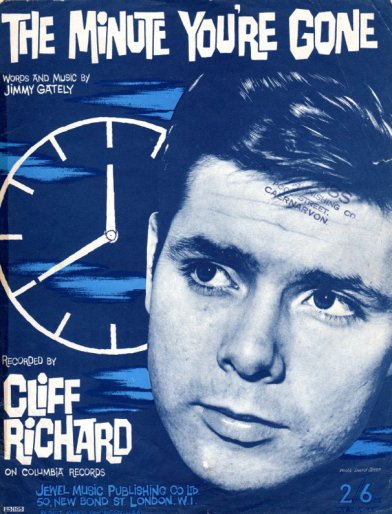
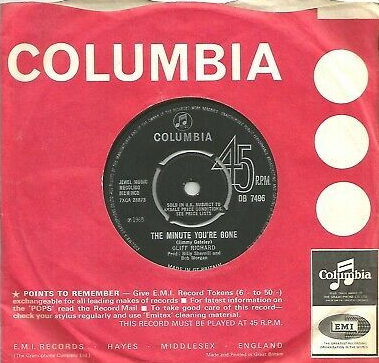
192. ‘The Minute You’re Gone’, by Cliff Richard

A fraction over two years since we last heard from him, Cliff’s back. What’s changed in his absence? Well… There’s been Merseybeat, for a start. The Beatles, The Pacemakers, The Searchers reinvented pop music, then The Animals and the Stones brought the blues and The Kinks brought the rock, and recently we’ve started going all jazzy, folky and a touch Baroque…

cliff-richard-7744-mm

The Minute You’re Gone, by Cliff Richard (his 8th of fourteen #1s)

1 week, from 15th – 22nd April 1965

So, has Cliff emerged from the most fertile and fast-moving period in popular music history, and taken anything from it? Has he borrowed a funky new sound from all those new kids on the block? Has he bollocks.

If anything he’s regressed. He sounded old-fashioned before; now he sounds positively pre-historic. For this latest chart-topper, Cliff’s gone… brace yourselves… country. Lilting guitars, a tinkling saloon-bar piano, backing singers last heard on a Frankie Laine record. That weird, uber-C & W whale-noise guitar in the background, last heard in ‘Rose Marie’. In 1955. ‘The Minute You’re Gone’ was recorded in Nashville, and it’s clear that Cliff dived whole-heartedly into the scene over there. I can imagine him buying his own Stetson and spurs just for the occasion, and throwing the odd ‘Howdy’ into conversation.

The minute you’re gone I cry, The minute you’re gone I die… To be honest, it took me several listens before I actually paid attention to the words… Before you walk out of sight, I’m like a child all alone at night… And I’m not sure it was worth bothering… I stare into emptiness… So on and so forth.

It’s not a terrible song. The chords are in the right place, there are verses, a bridge, a chorus… In the hands of a different singer I might have enjoyed this much more. The original singer, Sonny James, put a bit more OTT emotion into it. The very first UK chart-topper – the one and only Al Martino – lent it some of his customary gravitas. The only thing that stops Cliff’s version from finishing bottom of the ‘The Minute You’re Gone’ league table, is a sub-karaoke version by Irish grannies’ favourite Daniel O’Donnell.

Cliff-Richard-The-Minute-Youre-Gone

Back in 1963, I described the Mersybeat invasion as a comet that slammed into the musical landscape. A comet that killed off all the musical dinosaurs that had clogged up the charts of the early sixties. Only the very strongest would survive its sudden impact – Elvis, Roy Orbison, and Sir Cliff. Britain’s very own musical cockroach…

Harsh? A bit, maybe. It was an exaggeration to claim in my intro that Cliff had been ‘absent’ in recent years. He may not have scored a #1 since ‘Summer Holiday’, but every one of his singles, both with The Shadows and, like this one, without them, had gone Top 10. Don’t look at this record as a comeback; Cliff hadn’t been anywhere.

Who was buying his records, though? Surely not the same kids that were going wild for The Beatles and The Stones? Their mums, maybe? Their grans? I always complained about how seldom Cliff, Britain’s first rock ‘n’ roll star, actually rocked. Even as far back as his first chart-topper: the cheesy and insipid ‘Living Doll’. But maybe that was a masterstroke of foresight by him and his management. You can’t lose something you never had. Sell out from the very start…

Since starting this countdown, I’ve changed my opinion on many things. I now know that pre-rock music was far from boring, that Elvis didn’t actually invent sex, that ‘Rock Around the Clock’ didn’t open the floodgates, that instrumentals can actually be great… And yet I can’t say I’ve heard anything to convince me that Sir Clifford of Richard isn’t one of the blandest, squarest, middle-of-the-roadest artists in history…

Next!

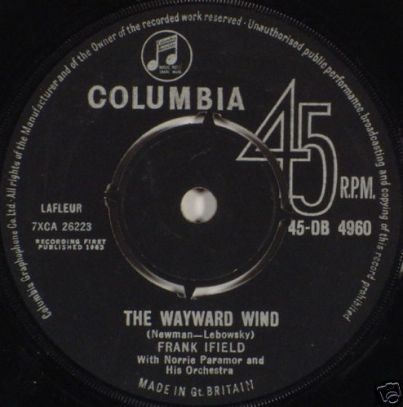
147. ‘The Wayward Wind’, by Frank Ifield

I have to admit – I’m struggling to ‘get’ Frank Ifield, Britain’s pop-idol du jour in 1962-3. We’ve arrived at Pt. III of his chart-topping quadrilogy (that’s a word, right?) and still the key to his success is eluding me.

FRANK-IFIELD-88-600x417

The Wayward Wind, by Frank Ifield (his 3rd of four #1s)

3 weeks, from 21st February – 14th March 1963

At the very least ‘The Wayward Wind’ is an improvement on Ifield’s last #1, the demented ‘Lovesick Blues’. Largely because the yodelling (Oh God, the yodelling…) is kept to a minimum. Instead we get a harmonica riff (that sounds suspiciously like it’s from an early-Beatles B-side…) and the story of a wanderer:

Oh the wayward wind, Is a restless wind, A restless wind, That yearns to wander… And I was born, The next of kin, Ah, the next of kin, To the wayward wind… It was originally, you may have guessed from those lyrics, a Country & Western song from the fifties – the rest of the lyrics are all about ‘railroad tracks’ and ‘border towns’. Which means it’s the third hit running in which Frank Ifield and his producers have taken an old song and tarted it up to fit in with the sound of the time – i.e. the soon-to-explode ‘beat movement’.

It’s probably the best of Ifield’s three chart-toppers; though that is very, very faint praise indeed. I like the way that strings and cymbals come in on the verses as the ‘wayward wind’ – it’s a nice effect. And we make it almost a minute into the song before the first yodel: made me a sl-a-a-a-eeee-ave…! Frank clearly couldn’t help himself. Maybe it was an actual affliction – yodelling Tourettes? – and he did it even when talking…? He saves it for that line and that line only, though, for which we can all be grateful.

690a_12

Like all of Ifield’s hits, ‘The Wayward Wind’ isn’t a song I’d ever heard before. The one good thing about his year in the sun is that all these tunes are completely new to me. There is at least a novelty value to his work. It was quite the popular tune, however, especially in the mid-to-late fifties. Our old friend Jimmy Young did a version (which makes complete sense, thinking about it – this could be ‘The Man from Laramie’ Pt. II) along with Patsy Cline, Sam Cooke and The Everly Brothers. The Beatles included it in their early live shows (I knew it – that harmonica!)

Let’s look at this as a throwback. In fact, let’s view the entire career of Frank Ifield as a throwback. He sings nicely, properly (your gran would have liked him, no doubt) with good enunciation. He was the final Pre-Rock star, the successor to the likes of Jimmy Young, Guy Mitchell and Frankie Laine, and his sudden popularity was the final twitch of a corpse that had been trampled over by rock ‘n’ roll and that was about to be completely buried by beat groups.

But, at the end of the day, this isn’t a very good record. Solid at best. Competent. Maybe his final chart-topper will unlock the mystery of Frank Ifield’s success? Maybe… Anyway, to finish… I’ve really held off mentioning this, but hey… ‘The Wayward Wind’ sounds, to me, like a euphemism for a fart.

On that note…

142. ‘Lovesick Blues’, by Frank Ifield

It had been a while since I arrived at a record about which I know nothing. Zilch. Nada. Until Frank Ifield came along. I should relish these moments of blissful ignorance. They are becoming rarer and rarer the further we move into the rock age…

frank-ifield-lovesick-blues-1962-19

Lovesick Blues, by Frank Ifield (his 2nd of four #1s)

5 weeks, from 8th November – 13th December 1962

Upon pressing play, however, and unleashing this next #1, I find myself wishing for a quick return to those halcyon times, just two minutes back, when I had never heard this song.

‘Lovesick Blues’ could be a decent song. It’s fun, it’s up-tempo. It’s got a strong hook and a funky trumpet. It’s a record with an old-world, showtune charm (it was originally written in 1922) and a super-sixties rhythm section. It’s cheesy, sure, but that’s OK. I can imagine it as the theme to a silly sitcom, or an Austin Powers movie. I could live very easily with this as a huge chart-topping record; if it weren’t for one very big problem…

The yodelling. Oh God, the yodelling. In my post on Ifield’s first number one – ‘I Remember You’ – I was surprised to find him labelled as a ‘yodeller’. He doesn’t yodel that much, I thought. One listen of ‘Lovesick Blues’, however, and my doubts are dispelled. Frank Ifield = Yodeller.

A Brief History of Yodelling. Originally used by Alpine herders calling to their cattle, or to send messages from one village to another, yodelling was gradually incorporated into traditional songs and stage shows. And then, for some reason, it crossed the Atlantic and made it into country music. We’ve had yodelling before in this countdown – without me even noticing it! – thanks to Slim Whitman in 1955. Once you start looking, the breadth and depth of yodelling around the world is quite terrifying. Switzerland is where it started, obviously, but it can also be found in the folk music of Romania, Scandinavia, Georgia, Central Africa and Hawaii… Hank Williams was a good yodeller. As was, believe it or not, Bill Haley (he gave it up when he jumped on the rock ‘n’ roll bandwagon.) The mind boggles.

I want, as I usually do in these posts, to quote some lyrics from this song, to explore some of the themes that are present etc. and so on. But to be honest, I can’t really focus on the words. Ifield rattles through the song at breakneck speed, adding twelve notes to a word when just one would do. It’s a song, I believe, about feeling blue when lovesick.

FRANK_IFIELD_LOVESICK+BLUES+-+1ST-294596

He’s a good singer, is Frank Ifield. He’s an excellent yodeller, if that’s your kinda thing. But when he hits that drawn-out final note… Oh boy. In the interests of fairness, I gave the Hank Williams version of ‘Lovesick Blues’ a go. But nope, I wasn’t feeling it. Little Richard recorded a version, and I love me some Little Richard, but, again, it ain’t doing nothing for me. Maybe the song’s just cursed… Plus, the ‘B’-side to ‘Lovesick Blues’ was a ditty titled ‘She Taught Me How to Yodel.’ I’ve put in a link, but I would urge you to only click on it if you are in a sound-proofed room with hard liquor to hand.

There’s clearly a reason why this is a very forgotten chart-topper; why this was the first #1 in a long time that I’d never heard before. I bet nobody’s listened to this for years… And for it to follow on from the sublime ‘Telstar’!? Talk about coming back to earth with a bump. You can still see the crater…

‘Lovesick Blues’ does, though, mark an important milestone in British chart history. Its second week at the top coincided with the chart’s 10 year anniversary. From ‘Here in My Heart’ to now. One decade; 142 chart-topping discs. That’s an average of one #1 every twenty-six days. From pre-rock, to rock ‘n’ roll, to post rock ‘n’ roll, to yodelling… If I continue at this rate I’ll reach the 1970s by next summer, the 1980s by 2022, the 1990s hopefully before the 2030s… Still with me…?

139. ‘I Remember You’, by Frank Ifield

For the 3rd post in a row, we have somebody new at the top of the charts. Mr. Frank Ifield is going to burn very brightly, and very briefly, across British pop in 1962-63 and he kicks things off here with a big ol’ seven-week stay at #1.

p021yt5y

I Remember You, by Frank Ifield (his 1st of four #1s)

7 weeks, from 26th July – 13th September 1962

Let’s get down to business, then. What is this new and rather sudden singing phenomenon all about? On first listen… I’m not sure. There’s a nice, rolling C&W rhythm, and a lot of harmonica. This is a record that is harmonica-heavy. I remember you-oooh… You’re the one who made my dreams come true, A few, Kisses ago…

He’s got a distinctive voice, does Frank Ifield. It’s a good voice; but not what I’d call a particularly enjoyable voice. He has a tendency to launch into extremely high notes at the end of each line, for a start. Then there’s the way he takes the phrase out of the blue, and adds about eight extra syllables onto the end. Wiki describes Ifield as a ‘singer and guitarist who often incorporated yodelling’, but I wouldn’t describe what he’s doing here as ‘yodelling’ exactly. It’s more that he’s just fannying about when he should be getting on with singing the song.

Singing style aside, I’m not terribly sure what this song is about, either. He ‘remembers’ a girl, but that’s because he just kissed her. When my life is through, And the angels ask me, To recall, The thrill of them all… That’s a strange thing to think, as you kiss the love of your life – that you’ll remember it on your deathbed. Or is it extremely romantic? Kind of? Contrast these very lightweight lyrics with those of Ray Charles in the previous chart-topper. Big difference.

FRANK_IFIELD_I+REMEMBER+YOU+-+2ND-571711

If you’re getting the feeling that I’m not terribly into this record, then you’d be right. This is the first time I’ve ever heard it and, to be honest, it’s average. Even the music is a weird kind of Americana: a British interpretation of Country & Western (Ifield was British-Australian). You can imagine him on a music-hall stage, perched on a wooden fence, chewing a bit of straw. Howdy pardner…! But – and this might just be me – I’m also getting slight Merseybeat vibes. Maybe it’s the way his sentences run on – You’re the one who said I love you too, Yes I do, Didn’t you know…. – or maybe it’s the chord progression. The harmonica ‘riff’ which I complained about at the start kind of reminds me of ‘Please Please Me’ by The Beatles. The Merseybeat explosion is less than a year off, and the bands that would lead it were already around and making music, and so perhaps it’s not so far-fetched to be hearing the sounds already creeping through.

The end of ‘I Remember You’ sounds pretty cheesy and cheap, and I, personally, was glad that we got there in just over two minutes. If ‘I Can’t Stop Loving You’ was a Champions League kind of record; then this is solidly League One. The Scunthorpe United of chart-topping singles. It’s a cover of an old forties standard – which means that the blame can’t be heaped wholly at Frank Ifield’s door and that the people of 1962 would perhaps have already known the song, giving it a head start in its bid for the top. Yet, I remain unconvinced that this is what the charts needed. And why on earth it stayed at #1 for seven weeks, selling over a million copies in the process, is a real mystery. Maybe it shouldn’t be, though: bland and accessible sells – always has, always will.

I’ll hold off on any Frank Ifield biography for now – this is just the beginning of a big twelve months for him, and we’ll be hearing a lot more from him very, very soon. For now, let’s leave the bio at him being (half) Australian, and thus the first in a very long line of Aussie chart-toppers. To be at the head of a list that contains Kylie, The Seekers, Olivia Newton-John and Peter Andre is a proud achievement indeed…

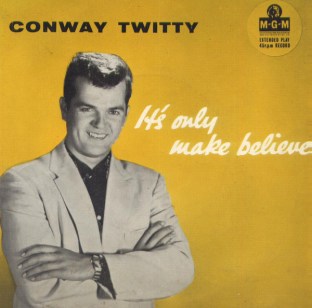
78. ‘It’s Only Make Believe’, by Conway Twitty

Before we begin writing anything about this record, let’s take a minute to appreciate the name of the man who recorded it… Mr. Conway Twitty. It’s a strange name – ‘Conway’ being quite rugged and windswept, and ‘Twitty’ being somewhat less so. It’s a name you don’t forget in a hurry; which I suppose is a good thing in show-business.

R-7902310-1451306561-6539.jpeg

It’s Only Make Believe, by Conway Twitty (his 1st and only #1)

5 weeks, from 19th December 1958 – 23rd January 1959

And note! I’ve finally – seventy-eight number ones in! – managed to locate some genuine cover art to stick at the top of my post. This, I am strongly led to believe, was the genuine cover that people would have seen in British record stores when they went to pick up their copies of ‘It’s Only Make Believe’.

To the song. A guitar strums… People see us everywhere… Another strum… They think you really care… Strum… But myself I can’t deceive… I know it’s only… Make… Believe… Conway loves a gal, but she ain’t lovin’ him back. Bizarrely enough, it sounds quite like the intro to ‘Runaround Sue’ – but that’s a story for another day.

My only prayer will be, Some day you’ll care for me, But it’s only Make… Believe… Is she using him to get back at an ex? Is she leading him on? Is she just a tease…? The reasons as to why they are leading this pretend-life remain tantalisingly out of reach. But Conway’s got it bad. His heart is a-achin’.

This is a rock ‘n’ roll ballad. We’ve toyed with the concept up to now. Was ‘It’s Almost Tomorrow’ the first? Or was it ‘Young Love’? Or was it neither? Because this is heart on your sleeve balladry. This is the real deal, and the starting point for all manner of Bon Jovi / Aerosmith-type fist clenching, air-punching soft-RAWK. Not that it actually sounds anything like a late ’80s power ballad; but mark my words – the seeds are being sown. The lyrics are super-overwrought: lots of my all, my everything, I’d give my life for you etc. etc. But Twitty sells it, just about, with some top-notch wailing. You really believe that his heart is cracking in twain as he sings.

This is also, I’m pretty confident in saying, our first slice of country rock at the top of the UK charts. We’ve had country before – a bit of Frankie Laine here, a little Slim Whitman there – but this is rock ‘n’ roll with a country twang. The Eagles, Dolly and Shania, even Tay-Tay before she went basic, stem from this kind of thing.

I know, I know… That’s a very bold statement. But it’s useful, as we reach the end of 1958, to take a step back and admire the bigger picture. We’re over two years into the ‘rock’ age and, as I’ve commented on several recent chart-toppers, there is more and more of a fusion going on. Songs like ‘The Story of My Life’, ‘All I Have to Do Is Dream’ and ‘It’s All in the Game’ topped the charts this year, and were all pop songs – hummable, easy listening numbers – with a distinct whiff of rock ‘n’ roll. The year started out with two utter classics – tracks one and two on Now That’s What I Call Rock N Roll: ‘Great Balls of Fire’ and ‘Jailhouse Rock’. Since then, though, the overriding theme of 1958 has been one of much ‘blander’ rock ‘n’ roll. And so ‘It’s Only Make Believe’, is in many ways the perfect track to round the year off – a rock song much more likely to appeal to mum, and gran, than the kids.

twitty2

The worst thing about this whole record is that Conway Twitty was not the singer’s real name. Boo! He was actually one Harold Jenkins, and apparently got his stage name after blindly opening a map and finding a town named Conway in Arkansas and one called Twitty in Texas. So far, so C&W. ‘It’s Only Make Believe’ was his only big success on the UK charts, so I make it three-in-a-row in the one-hit wonders stakes. He stumbled through the 1960s before becoming an absolute demon on the US Country Charts in the ’70s and ’80s, with hits like ‘Tight Fittin’ Jeans’ and ‘Red Neckin’ Love Makin’ Night’. Yee-haw! Best of all, he lived in a self-built multi-million dollar ‘country music entertainment complex’ called, wait for it… ‘Twitty City’. He died in 1993, aged but fifty-nine.

We’ll leave him here, caterwaulin’ us into 1959, the final year of the decade that gave us rock ‘n’ roll, Elvis, Buddy and Jerry Lee. Beyond that lie the 1960s, and nothing much of musical interest happened then. Did it?

36. ‘Rose Marie’, by Slim Whitman

Slim+Whitman+Rose+Marie+-+VG-569464

Rose Marie, by Slim Whitman (his 1st and only #1)

11 weeks, from 29th July to 14th October 1955

Yee-Hah! I hoped, back when Tennessee Ernie Ford was topping the charts with ‘Give Me Your Word’, that we might be seeing our first Country and Western #1. Well, Ernie didn’t quite live up to his name but we didn’t have to wait long. This is country with a capital C O U N T R and Y.

Slim Whitman stands alone on the prairie. The setting sun casts an orange glow across this horizon. Cacti spread their long shadows over the dirty ground. A tumbleweed bounces lazily by. Slim picks up his spittoon, clears his throat, and begins… Oh Rose, my Rose Marie… I love you… I’m always dreaming of you…

It’s an atmospheric record, I’ll grant you that. Just a piano, a simple rhythm and that weird noise which is the epitome of old, Nashville C&W: strange and echoing, made either by guitars submerged in water or sped up recordings of whale noises. You’ll know it as soon as you hear it.

Anyway, Slim can’t forget Rose Marie, and even wishes he’d never met her. Then he hums as he thinks of her. It’s quite effective. You really can picture him wandering plaintively past hail bays and broken barn doors, as the light finally fades.

There are definitely some pros to this 36th UK chart topper: it is quite an understated ballad, lacking the OTT grandstanding of some of its predecessors, while there are definitely some ‘rockier’ elements to the song too in the twangy guitars and the piano riff. But there are definitely some cons too: Whitman’s voice comes far too close to yodelling for my liking (My Ro-OOse Marie), for example. Some nice touches; some things jar.

I was planning to write something indignant about this record spending 11 (Eleven!) consecutive weeks at the top – setting a record that would last for thirty-six years. But the more I listen to it, the more ‘Rose Marie’ is getting under my skin. It’s simple, it’s heartfelt, it’s kinda cute. There’s another fade, rather than a bombastic finale: a long drawn out note and a piano refrain.

3288955

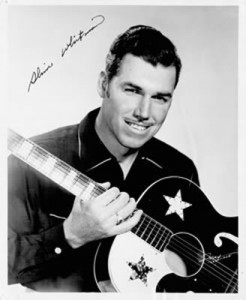
It’s not a bad way to claim your sole chart-topper – double figures then out – though Slim Whitman did have a handful of other hits. Pictures of him show a very dapper looking pseudo-cowboy with a natty little moustache. It almost goes without saying, by now, that he lived to a ripe old age: dying at ninety in 2013. ‘Rose Marie’ itself (herself?) dates from far earlier than 1955 – from a 1924 opera of the same name, written by none other than Oscar Hammerstein II. And that, fact fans, is that.