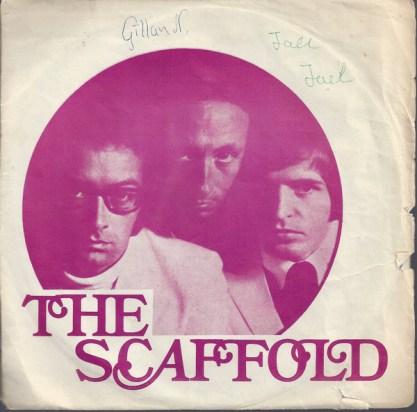
262. ‘Lily the Pink’, by The Scaffold

The final number one single of 1968! Over the course of the twenty-one records that have topped the charts this year, we’ve met a wide range of characters: Bonnie & Clyde, Quinn the Eskimo, Cinderella Rockefella, Lady Madonna… Now please welcome, last but by no means least, Lily the Pink!

Scaffold-1010482

Lily the Pink, by The Scaffold (their 1st and only #1)

3 weeks, from 11th December 1968 – 1st January 1969 / 1 week, from 8th – 15th January 1969 (4 weeks total)

We’ll drink a drink a drink, To Lily the Pink, The saviour of, The human race… The pace is frenetic, the song charges along on an oompah-band beat. For she invented, Medicinal compound, Most efficacious, In every case… And it’s not just Lily the Pink that we meet either, but the cast of poor souls that her medicinal compound has helped.

There’s Mr Frears, with his sticky-out ears… The notably bony Brother Tony… Old Ebeneezer, who thought he was Julius Caesar… Jennifer Eccles, with her terrible freckles… You get the idea. It’s a novelty song. Perfect for a Christmas party, last-orders down the pub sing-along when everybody’s a bit pissed. Pure music-hall.

It reminds me of two, very different songs. First, there’s ‘Oom-pah-pah’, from the musical ‘Oliver!’ Another rowdy bar-room tune, in which the drinkers raise their glasses to the life-giving properties of the mythical ‘oom-pah-pah’. It’s a classic. Secondly, this also reminds me, with its boing-boing rhythm, of another (in)famous Christmas #1… ‘Mr Blobby’. (Which very much isn’t a classic.)

‘Lily the Pink’ falls somewhere in between these two songs. It’s fun, for a verse or two, and then it gets pretty old pretty quick. There’s an unfortunate stuttering verse – Johnny Hammer, Had a terrible s-s-s-s-stammer… – and it’s very hammy by the end, when the medicinal compound proves too strong even for Lily the Pink, and she snuffs it. It’s definitely a song that would improve the more you drink…

R-8669325-1546580204-5379.jpeg

Speaking of which, it is based on a much older, American drinking song – ‘The Ballad of Lydia Pinkham’ – which in turn was inspired by an actual drug – Lydia E. Pinkham’s Vegetable Compound, from the 1870s, which relieved menstrual cramps. The fact that it was 40 proof alcohol meant that plenty of people not suffering from period-pains drank it anyway… And apparently the original verses were saucier even than The Scaffold’s end-of-the-pier version.

Just as interesting as the song’s origins are the musicians involved in its recording. The Scaffold were a comedy trio from Liverpool – one of whom was Peter McCartney (brother of Paul.) Musicians they were not, and so to help them on ‘Lily the Pink’ you can hear Graham Nash of The Hollies (the line about ‘Jennifer Eccles’ is a reference to a Hollies’ hit), Tim Rice and an unknown singer by the name of Reginald Dwight, who may or may not have gone on to bigger things under a different name.

What’s that? You thought that 1968 was going to finish off with some bland, run-of-the-mill pop song? Well you haven’t been paying attention, have you? This year has brought us the most eclectic bunch of #1s so far. We’ve veered from silly novelties, to bizarro fantasy epics, from spaghetti western soundtracks to the birth of shock-rock. All with healthy doses of jazz, crooning, rock ‘n’ roll, and Cliff, in between. Next up, we tick on over into the final year of the swinging sixties, and hope that it can be half as interesting as the year just gone…

Enjoy all the number ones from 1968, and earlier, here:

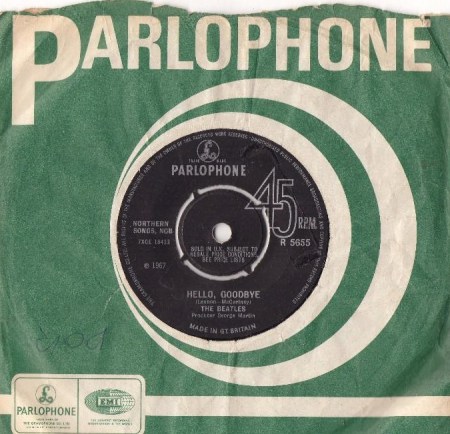
241. ‘Hello, Goodbye’, by The Beatles

We round off 2019 with the final number one from 1967. Top of the charts fifty-two years ago today was…

SgtPepper1_700

Hello, Goodbye, by The Beatles (their 13th of seventeen #1s)

7 weeks, from 6th December 1967 – 24th January 1968

… of course it was. Who else? (As a kid, listening to ‘Pick Of The Pops’ on Radio 2, we’d always have a contest in the car to guess who would be number one. And if it was a chart from the sixties I’d always guess The Beatles because, well, the odds were with you.) And, speaking of being a kid, ‘Hello, Goodbye’ was one of my first favourite Beatles hits. But, to be honest, it’s appeal has faded as the years have gone on, and as I’ve gotten older and more cynical.

You say yes, I say no, You say stop, And I say go, go, go… Oh no… It’s a song that explodes into life – no waiting around. You say goodbye, And I say hello… A song about an argument, about two people that are deliberately disagreeing with one another. One says ‘high’, the other says ‘low’. So on and so forth. It’s tempting to read into it – is it a seemingly nonsensical, childish pop song documenting the start of the slow break-up of the world’s biggest band…? Or a glimpse into the marriage of Paul McCartney and Linda… Actually no, that theory is dead in the water – they didn’t marry until 1969.

McCartney did write this one, which I think is probably quite obvious. It’s got that slightly irritating chipper-ness to it that shows up more often in his solo work, once John wasn’t around to check his worst impulses. Lennon reportedly didn’t care much for ‘Hello, Goodbye’, and pushed for ‘I Am the Walrus’ to be released instead. If only… (‘Walrus’ was the B-side.)

169602920

But, but, but… I’m making it sound as if I hate this record, when I don’t. Beatles’ ‘average’ is still pretty good. I like the backing vocals, which remind me of ‘Help!’ in the way that they sing different lines to the lead, and the reverb on the Why-why-why-why do you say goodbye-bye-bye-bye… And Ringo’s drumming is great on this. The outro, though… The Hare Krishna-ish Hey-la-hey-bah-hello-ah… Nah. Not for me.

Perhaps this is the Beatles playing it safe, worrying that they had spooked people too much with their much more avant-garde stuff: ‘Eleanor Rigby’, ‘Penny Lane’, ‘Strawberry Fields’ and ‘All You Need is Love’. Playing it safe with a huge Christmas hit – their 4th Xmas #1 in five years. It’s just that, for the first time in ages, a Beatles song doesn’t feel like a step forward.

But, what do I know? ‘Hello, Goodbye’ gave The Fab Four their joint-longest run at the top of the charts, tied with their debut #1 ‘From Me to You’. (It has to be mentioned, though, that charts were often repeated for a week over the Christmas and New Year holidays in those days.) It’s also fitting that 1967 ends with a blockbuster number one. It’s been a quick year to get through, with lots of long runs at the top from Tom Jones, Engelbert, Procol Harum and now The Beatles. It’s one of the very few years in chart history where every single #1 stays there for longer than one week.

It’s also fitting that I end 2019 by thanking everyone who has read, liked and commented on this blog over the past twelve months, and wish you all a very happy new year. See you all on the other side… 1968 awaits!

My #1s playlist:

227. ‘The Green, Green Grass of Home’, by Tom Jones

It’s become a bit of theme recently – every so often we take a pause from pop music’s race into the future to enjoy a good, old-fashioned ballad. First with Ken Dodd, then Jim Reeves, and now Tom from the Valleys.

tom-jones8

Green, Green Grass of Home, by Tom Jones (his 2nd of three #1s)

7 weeks, from 1st December 1966 – 19th January 1967

A soft, swaying intro precedes a tale of a man returning home, from a long time away. The old home town looks the same, As I step down from the train… And doesn’t Tom sing it well? There’s something in the Welsh waters… Why are they such good singers? Why is it Welsh Male Voice choirs, and not Geordie Male Voice choirs?

He runs towards his long-lost love, Mary: Hair of gold, And lips like cherries… And then he heads home: There’s that old oak tree, That I used to play on… It’s a heart-warming song for Christmas. One for all the family. Yes, it’s good to touch, The green green grass of home… Like most Tom Jones songs, it helps if you’re a bit drunk. I love the saloon-bar piano, that really adds a ‘last-call’ vibe. And, also like most Tom Jones songs, it’s a karaoke classic. Not quite ‘Delilah’, but getting there.

I love a song that tells a story, verse by verse. Just where has this man been all this time…? And ‘Green, Green Grass of Home’, like all good stories, has one hell of a twist. We break for a spoken-word interlude, in which the singer reveals that it was all a dream. And, who’s that? Why it’s the guard… And there’s a sad, old padre, On and on we’ll walk at daybreak, Again I’ll touch, The green green grass of home… Yep, plot twist: he’s getting executed.

TOM_JONES_GREEN,+GREEN+GRASS+OF+HOME-303646

I love it. Either he’s been wrongfully convicted, which only increases the power of the earlier verses, or you’ve spent the last two minutes sympathising with a murderer. The little piano riff to end is this song’s version of a ‘badoom-tish.’ And I’m similarly in two minds about this record as a whole. On the one hand, it’s mawkish, sentimental mush. On the other, it’s a great one for belting out in the shower.

And to be fair, this was a mega-hit. Seven weeks at #1 is longer than any record in the past three and a half-years, since The Beatles’ ‘From Me to You’. And, as I mentioned earlier, I doubt that this disc being released over the festive season hurt its chances. The idea of a ‘Christmas Number One’ wasn’t really a thing this early in the charts, but I do wonder if the success of ‘Green, Green Grass of Home’ set the tone for later, similarly saccharine, festive hits.

As for Sir Tom, similar to his first #1, ‘It’s Not Unusual, I think we have to look at him as existing separately from his chart contemporaries. His other big sixties hits included ‘What’s New Pussycat?’ and ‘Help Yourself’ – nothing baroquey or folky, or Beat-poppy about them. But… If you’re never in fashion you’ll never be out of fashion. Maybe it’s this refusal to follow trends that’s allowed him all his comebacks: his Prince covers in the eighties, and his huge resurgence when I was in high-school. Looking back, how on earth did a near sixty-year old man singing ‘Sex Bomb’ become such a thing…? And he will hit the top-spot once more, briefly, in forty-two years’ time. Which, unsurprisingly, is by far the biggest gap between #1 singles, ever.

207. ‘Day Tripper’ / ‘We Can Work It Out’, by The Beatles

The Fab Four claim their third straight Christmas number one (before Christmas number ones were a thing, but still), and they do so with their most straight-up rock record yet.

beatles

Day Tripper / We Can Work It Out, by The Beatles (their 9th of seventeen #1s)

5 weeks, from 16th December 1965 – 20th January 1966

There’s a riff – a riff we all know – dun-duh-duh-duh-duh-dun-dada-da-dada – (riffs never really work when written out…) which keeps on going till the end. It’s a riff record – maybe, just maybe, they’d been listening to The Stones –a great, straight-up rock song.

I like the way the intro builds: guitar, then bass, then drums, and the way that the solo is basically the riff, beefed-up. It’s a simple song – there’s no reinventing the wheel here. I guess it’s experimental, in the sense that they’re experimenting with a heavier sound, but that’s stretching it a bit. It’s a John Lennon number, and one of the things I like most about him is that he never lost his rock ‘n’ roll roots, never stopped being a fan of Chuck and Buddy, no matter how avant-garde he and his bandmates seemed to get.

Of course, like any great rock song, there’s a fair amount of raunch here too. She’s a big teaser, She took me half the way there now… Not much imagination needed. Especially after Lennon admitted that he would have made it ‘prick teaser’, had he been allowed. Tried to please her, She only played one night stands… So on and so forth. Another layer of innuendo comes when you consider the ‘trip’ aspect of the lyrics. A ‘day tripper’ would be someone who only drops acids on special occasions. A weekend hippy, a ‘Sunday driver’.

Whether it’s about drugs or sex, or both, doesn’t really matter, though. This is a cracking rock number – one that I’ve enjoyed reacquainting myself with for this post. It’s one of those Beatles songs that kind of gets lost among the mega-hits. But, actually, listen to the soooooo long growl, and the way that the solo ascends to a climax with a hint of ‘Twist and Shout’, and try telling me that this isn’t one of their best. And, come to think of it, I can think of two other songs off the top of my head in which the ‘Day Tripper’ riff makes an appearance: ‘Hair of the Dog’, which gleefully rips it off to the extent that when Guns N’ Roses covered it they gave up the pretence and by the end were just playing the Beatles’ riff, and The Wildhearts’ ‘My Baby Is a Headfuck’. So maybe I’m underestimating it…

the-beatles-day-tripper-uk-solid-centre-7-vinyl-sold-in-uk-parlo-gramo-vg_44624215

What of the flip-side? We’ve not had a double-‘A’ side #1 for a while (nearly three years to be precise) and ‘We Can Work It Out’ is the perfect companion for ‘Day Tripper’, in that it sounds pretty much the opposite. I’ve always thought that double-‘A’s should contrast, one should be the yin to the other’s yang, and so gone is the electric guitar and the bravado, replaced by acoustics and recriminating.

It’s a folk-rock waltz of a record, in which Paul McCartney muses on a failing relationship: Try to see it my way, Do I have to keep on talking till I can’t go on?… Think of what you’re saying, You can get it wrong and still you think that it’s all right… He remains positive – the title is ‘We Can Work It Out’ after all – but if you listen closely to the lyrics it becomes clear that any compromise will be on his terms: While you see it your way, There’s a chance that we might fall apart before too long… Very passive-aggressive… Actually, the more I listen, the more I realise how the singer of this song is being a bit of a dick. Life is very short, And there’s no time, For fussing and fighting my friend… (So hurry up and just admit I’m right!)

The accordion-slash-harpsichord sounding instrument which characterises this disc – the one that creates the woozy, trippy feel at the end of the bridge, and that closes the song with a little riff – is a harmonium, apparently. This is where pop music has been heading throughout 1965, with the baroque-folk stylings of The Byrds, Sonny and Cher and The Walker Brothers, and it’s nice to close out the year in this way. A sign of where The Beatles were heading. ‘Rubber Soul’ was released while this disc sat at #1, and ‘Revolver’ would be coming up very shortly after.

This was The Beatles first double-‘A’ side as they couldn’t agree on which record was the more commercial sounding. Lennon was the one who forced ‘Day Tripper’ to get equal-billing, but in terms of airplay at the time ‘We Can Work It Out’ was the winner. In the US they were released separately, with ‘We Can Work It Out’ hitting the top of the Billboard 100 and ‘Day Tripper’ only making #5. But for me rock always wins. ‘Day Tripper’ all the way…

And so we cross the midway point of The Beatles’ chart-topping run. Nine down, seven to go. To celebrate, I thought I’d do a quick rank of the hits that have gone so far. Based solely on personal preference not artistic merit. Let me know if you agree or are scandalised by my ignorance. In ascending order (worst – best), then:

We Can Work It Out > Can’t Buy Me Love > From Me To You > I Feel Fine > A Hard Day’s Night > Ticket to Ride > I Want to Hold Your Hand > Day Tripper > Help! > She Loves You

Actually, that was really hard and kind of pointless. I don’t dislike any of those songs. A ‘bad’ Beatles disc is another act’s signature song. But it’ll be interesting to add the next seven to the list, and to see where they fit in. Anyway, look! Suddenly it’s 1966. Onwards!

Listen to every number one so far – by The Fab Four or otherwise – with this playlist:

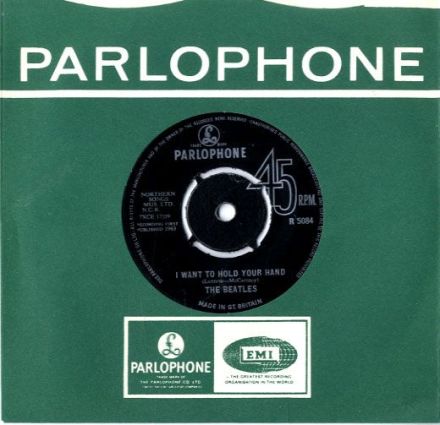
160. ‘I Want To Hold Your Hand’, by The Beatles

Oh yeah I’ll, Tell you somethin’, I think you’ll understand… Well, what you need to understand is that we end 1963 with the biggest band of the year. Three #1s spread out over a staggering eighteen weeks! The band that would go on to become the biggest band of the decade and then the biggest band of all time.

the beatles john lennon george harrison ringo starr paul mccartney 1280x1024 wallpaper_www.wallpapername.com_64

I Want to Hold Your Hand, by The Beatles (their 3rd of seventeen #1s)

5 weeks, from 12th December 1963 – 16th January 1964

And what a cheesy wonder this song is. When I wrote about ‘She Loves You’, I mentioned that it was quite a sophisticated pop song, with a pseudo-3rd person narrative and melancholy chord progressions. Well, all that sophistication was dumped at the studio door when the lads turned up to record ‘I Want to Hold Your Hand.’

Oh please, Say to me, You’ll let me be your man, And please, Say to me, You’ll let me hold your hand… It’s so twee, so innocent. Can I be your boyfriend? I just really, really, really want to… hold your hand. I’ve listened to it several times now, scouring the lyrics for a hint of double-entendre, but no. And when I touch you… promising… I feel happy inside… Oh. It’s as chaste and vanilla a record as you’ll find.

This is not to suggest that I don’t like it. Who doesn’t like this record? It’s probably been proven, by a team of crack scientists, that it’s impossible for a fully-functioning human being to dislike this record. You’ve got that intro, for a start. Dun-dan-ding, Dun-dan-ding… And some quality drum fills from Ringo. And that twangy guitar – George Harrison’s, I’m guessing. And some clapping (Yes, clapping!) My personal highlight, though, is the Everly Brothers’ harmonising on the ‘Ha-a-a-a-a-nd’.

beatles-the-i-want-to-hold-your-hand-this-boy-r-5084-decca-pressing-77189-p

Nope, we’re pretty close to pop-perfection here. It’s not quite in the same league as ‘She Loves You’, but it’s pretty, pretty, pre-tty good. The greatest threat to songs like ‘I Want to Hold Your Hand’ is ubiquity – the fact that most people have heard them three hundred times already. You have to remind yourself that The Beatles were re-inventing pop music as they went here, have to imagine yourself as a sixteen-year-old in the winter of 1963, hearing this for the first time…

I think this might become a theme whenever a Beatles disc crops up on this countdown but, hey: some statistics. The band replaced themselves at #1 with this disc (‘She Loves You’ having returned to #1 after seven weeks, remember) becoming only the second ever act to do this. (Plus, The Shadows replaced themselves with records on which they were the featured, not the lead, artists, so…) ‘I Want to Hold Your Hand’ is their biggest selling record worldwide, having sold 12 million copies.

It also holds an important place in pop-music folklore. Bob Dylan famously thought that they were singing I get high… when they were actually singing I can’t hide… and was shocked to find out that they had never smoked weed. And it was so good that it made Brian Wilson and Mike Love convene a special Beach Boys meeting to discuss the threat The Beatles posed to their position as America’s #1 band. (I love that – pop music meets military strategy.)

In the end, even Sgts Wilson and Love couldn’t hold back the British Invasion. ‘I Want to Hold Your Hand’ was their 1st US #1 a few weeks after it hit the top back home. It was part of the all-Beatles Billboard Top 5 in April ’64. Suddenly they were HUGE. Bigger even – some might have said – than Jesus himself…

Follow along with my Spotify playlist:

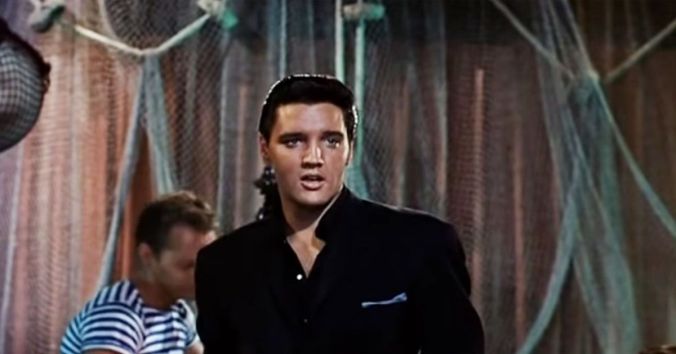
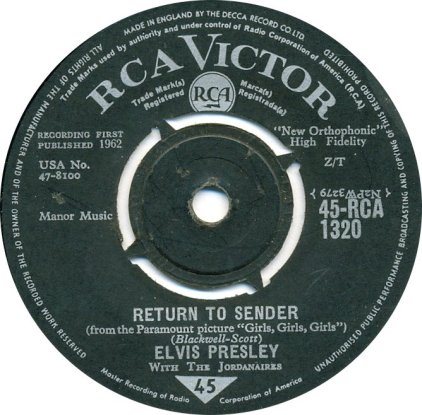
143. ‘Return to Sender’ by Elvis Presley

In which Elvis does something unprecedented and – to this very day – unmatched. Two years, eight number ones singles. Four in 1961. Four in 1962. Of the 110 chart-weeks that have passed since he returned from his army-enforced hiatus, Elvis has been at #1 for forty-one of them… The record with which The King sealed this feat…?

767443674e89abb4f5a207ea43f83b12

Return to Sender, by Elvis Presley (his 13th of twenty-one #1s)

3 weeks, from 13th December 1962 – 3rd January 1963

…is utter, utter cheese. Elvis wrote a letter to a girl; it came back. Return to sender, Address unknown, No such number, No such zone… They had a quarrel – a lover’s spat – and no matter how much he apologises his girl ain’t having it. That’s about it.

It’s Elvis at his most unimaginative: an early to mid-sixties movie soundtrack that got to the top of the chart by default just because it had the name ‘Elvis Presley’ on the cover. But… I love this song. Have done for years. Back when I first got my much-mentioned Elvis ‘Best Of’ as a teenager this was one of the songs I would skip to first. At the time I even went so far as to list it as my favourite Elvis song… ever. I know, I know, I was young and have since seen the error of my youthful ways. It’s not my favourite Elvis song, honest. And it’s nowhere near being his best song. But it has a charm to it, a swing and a swagger to it, that is hard to deny.

For example, I love it when the backing singers – the Jordanaires – pop up with their baritone The writing on it… before every chorus. I love it when Elvis launches into the final verse, as if impatient for it to begin: This time I’m gonna take it myself, And put it right in her ha-and… And I love the line I write I’m sorry but my letter keeps coming back… for the rasp in Elvis’s voice that went missing circa-1959, and for the fact that to someone from Scotland it sounds like he’s saying ‘Aye right, I’m sorry…’ (And therefore isn’t sorry in the slightest.)

elvis-presley-return-to-sender-1962-5

At the very least, Elvis sounds more alive during this than he did in his last two chart toppers – the dull ‘Good Luck Charm’ and the slightly better ‘She’s Not You’. There’s a hiccup in his voice and a wink in his eye that suggest he might even be enjoying himself here. It’s a solid pop song – very jaunty without being irritating. It sounds a bit like a mellower version of a Neil Sedaka hit. ‘Calendar Girl’, maybe.

However, this doesn’t mean that ‘Return to Sender’ is signalling an upturn in Elvis’s career. As I mentioned, this was yet another movie soundtrack tie-in – this time from ‘Girls! Girls! Girls!’, which currently holds a 40% rating on Rotten Tomatoes. (Sample lyric from the title track: Big and brassy, Small and sassy, Just give me one of each kind…) In fact, you could say that this hit marks the end of Elvis’s ‘Imperial Phase’. People were getting tired of the same sub-standard pop, and a star name can only get you so far – even when that star name is The One-And-Only Elvis Presley. Amazingly, after this, Elvis will score just three more UK number one singles in his lifetime!

There we have it, then. It’s weird to think that from now on every fifth number-one I write about won’t be by The King. But I’ll cope. While it’s undeniably impressive to have had four chart-toppers a year, two years in a row; when that run includes tracks like ‘Wooden Heart’, ‘Rock-a-Hula Baby’ and ‘Good Luck Charm’ then some of the shine is inevitably lost…

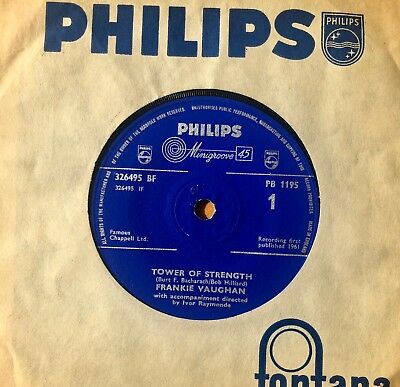
130. ‘Tower of Strength’, by Frankie Vaughan

And so we resume normal service. Since I first listened to this next Number One single, in preparation for writing this post, I’ve been trying to place it. Trying to put my finger on what exactly is happening here… What box does this fit into? Why did it prove such a popular song in December of 1961…?

xo4c63c9oxj66j96

Tower of Strength, by Frankie Vaughan (his 2nd and final #1)

3 weeks, from 7th – 28th December 1961

What’s happening here is simple: Frankie Vaughan is singing a song – and having the time of his life doing so. This is an irresistible song – it barrels in the front door and wallops you over the head with a rollicking sax riff (you can have a saxophone riff, right?)… baaa da da-na da-na… And then in comes Frankie.

If I were a tower of strength, I’d walk away, I’d look in your eyes, And here’s what I say… If he were a tower of strength, a man of action, someone with a bit of backbone, he’d tell his wayward lover: I don’t want you, I don’t need you, I don’t love you anymore… Said woman would , cry, plead and beg him to stay. Simple. Except, plot twist… A tower of strength is something, I’ll never be…

That’s pretty much it as far as the lyrics are concerned. The main attraction here is the absolute gusto with which Frankie Vaughan belts his way through this song. He yelps, he growls, he hits some scandalously high notes, and he gives us the biggest finish we’ve had a number of years: I’ll… Ne-ver… BEEEE-EEEEEE! It’s the sort of ending that was done to death in the mid-fifties – the THIS IS THE END OF THE SONG! kind of finale – but in the right hands it can still sound superb. For some reason I’m imagining this scenario where the sound engineer and the producer are goading Vaughan, suggesting that he might not be up to singing this particular song, not able to hit all the notes, and Frankie just looks at them and says: “Press the red button, punks…”

FRANKIE-VAUGHAN-Tower-Of-Strength-Rachel-7

I first came across this song a few years ago when it appeared on my Spotify feed, and it lifts me every time it pops up on a shuffle. It’s the sort of tune you should throw on when you’re in a mid-afternoon slump, or nursing a mild hangover – an aural espresso. When it finishes, you draw breath, half-expecting to look around the room and see the lampshade swinging, pieces of paper floating to the ground, pictures on the wall knocked squint…

What I didn’t realise until now is that Vaughan’s version of ‘Tower of Strength’ was a cover. The original was released by one Gene McDaniels – an American soul singer. It’s a fine version, a slightly slicker, Sam Cooke-ish version, that was a big hit in the US – though it could only creep to #49 in the UK. But… There’s something so relentlessly likeable about this version, something so fabulously uncool about Vaughan’s dad-at-a-wedding vocals, that I’d say his is definitive.

Of course, we have heard from Mr. Vaughan before in this countdown. Way, way back in January 1957 – nigh on five years ago – with ‘The Garden of Eden’. A song which was, in its own way, every bit as weird as this. While a five year gap between #1s isn’t that odd; he has basically straddled the rock ‘n’ roll era – bookending it with his two chart-toppers. Very few of the chart stars from 1957 – Tommy Steele, Guy Mitchell and Tab Hunter were his contemporaries at the top the first time around – were still managing it in the early sixties, and so credit where it’s due. In total, Vaughan’s recording career lasted from 1950 through to 1987 and, again, that ain’t to be sniffed at. He was an old-fashioned type – the sort of Butlins holiday-camp performer turned everyman pop star that seems to be a constant trope in British music, no matter the era – think Dickie Valentine through to Olly Murs.

We’ll leave him here, belting out ‘Tower of Strength’ to his heart’s content. And while we won’t be hearing from Frankie again, our ears will still be ringing for some time to come…

94. ‘What Do You Want to Make Those Eyes at Me For?’, by Emile Ford & The Checkmates

What’s that I hear? Tick, tick, tick, tick… Is it a clock racing to the turn of a decade? From the Fabulous Fifties to the Swinging Sixties? Tick, tick, tick, tick… Or is it just the intro to this next chart-topper?

s-l640

What Do You Want to Make Those Eyes at Me For?, by Emile Ford and The Checkmates (their 1st and only #1)

6 weeks, from 18th December 1959 – 29th January 1960 (including 1 week joint with Adam Faith from 18th – 25th December 1959)

It begins with some ticks, and then the vocals swoop in. This is a Doo-Wop record in the truest sense: in that much of it consists of the backing singers – The Checkmates, presumably – going a-doo-wop bee doo be doo be doo-wop…

I love this song, I do. What with all the doo-wops, the key changes and the brilliant false ending I can’t see how anyone could fail to enjoy it. I first heard it on a compilation called ‘Don’t Stop – Doo Wop’, which must have been released in the early ‘90s and which I picked up in a second hand CD shop years ago. I think I mentioned it in my post on The Teenagers’ ‘Why Do Fools Fall in Love’, which also featured on it.

The lyrics, though, to ‘What Do You Want to Make Those Eyes at Me For?’ (abbreviated forever more into WDYWTMTEAMF because that is a hell of a title to type out in full)… Hmmm. Questionable. What do you wanna make those eyes at me for, If they don’t mean what they say… That sounds like the justifications of a sex pest: “She was askin’ for it, guv! Those eyes!” You’re foolin’ around with me now, We-ell you lead me on and then you run away… She does sound like a tease… Of course, during these enlightened #MeToo times, we know that no means no. In 1959 it was perhaps a different story. We-ell that’s alright, I’ll get you alone tonight… Ok… And baby you’ll find, You’re messing with dynamite… Oo-er. Sexual dynamite? Or is he just going to give the disobedient hussy a black eye?

I jest, I jest… I’m willing to give Emile Ford the benefit of the doubt, as he keeps this song the right side of jaunty throughout and, to be honest, you can listen to it several times – as I did – without ever noticing the slightly sinister lyrical undertones. And, in defence of the 1950s as a whole – a decade, don’t forget, in which certain professions were closed to women, in which hotels could stick ‘No Blacks, No Irish’ in their windows, in which gay men were being slung in jail, in which people could still be sentenced to hanging – there have been very few #1 singles that stand out as troublesome for the modern listener. Very few lyrics have veered away from the catchy or the bland. I’d perhaps nominate WDYWTMTEAMF  and Guy Mitchell’s ‘She Wears Red Feathers’, from way back when (i.e. 1953) as being the most ‘of their time.’

A-347098-1418674966-5971.jpeg

As I mentioned in my last post, this disc was one of the last two records ever to share the top-spot in the UK charts. I suggested earlier that the death of the joint number one was due to a wider range of sales figures coming in but now I’ve just realised another theory: there will never be two such similarly titled #1 singles sitting at the top of the charts. Think about it: people go in to HMV looking to buy ‘What Do You Want?’ by Adam Faith, take a quick glance at the shelves, and come away with ‘What Do You Want to Make Those Eyes at Me For?’ by Emile Ford! Or vice-versa. Must have happened loads! Mystery solved.

WDYWTMTEAMF (that might actually be more of a pain to type than just writing it out in full) has quite the story, beyond this most famous of versions. It was written in 1916 (!) as a duet – in which the woman actually got to defend her wanton ways – and has been recorded by acts as varied as Shakin’ Stevens and former England, Barcelona and Tottenham manager Terry Venables. (Yes. Seriously.)

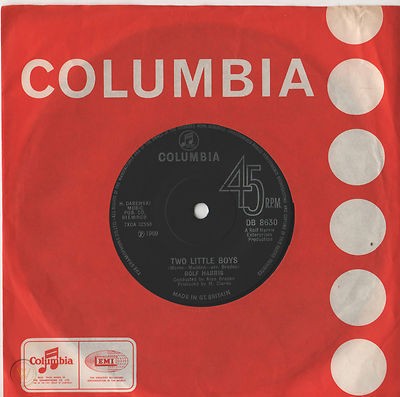
And so. We come to the end of the 1950s. And the start of the 1960s. Is this the last #1 record of the ‘50s, or the first of the ‘60s? Philosophical questions best left for another day. We are about to delve into a decade that will bring the most innovative pop ever recorded, the birth of modern rock, Merseybeat, Flower Power, psychedelica etc. and so on. So, I thought it might be interesting to gaze forward to the record that will be atop the charts on 31st December 1969, and to wonder at the advancements to come over the next ten years. Except. The final #1 of the sixties will be… ahem… ‘Two Little Boys’ by Rolf Harris. So… From a record with sex-offender lyrics to a record by an actual, convicted sex-offender. Ladies and Gentlemen, I give you the 1960s!

Let’s linger a while yet in the more innocent air of 1959, and end this post as Emile Ford (the first, and presumably only, St. Lucian to hit #1 in the UK – correct me if I’m wrong)  ended his sole chart-topping hit. Possibly the best ending we’ve heard yet. One more time, then: adoo-wop bee doo be doo be doo-wop be doo be doo be doo-wop be doo be doo be doo… Yeah!

78. ‘It’s Only Make Believe’, by Conway Twitty

Before we begin writing anything about this record, let’s take a minute to appreciate the name of the man who recorded it… Mr. Conway Twitty. It’s a strange name – ‘Conway’ being quite rugged and windswept, and ‘Twitty’ being somewhat less so. It’s a name you don’t forget in a hurry; which I suppose is a good thing in show-business.

R-7902310-1451306561-6539.jpeg

It’s Only Make Believe, by Conway Twitty (his 1st and only #1)

5 weeks, from 19th December 1958 – 23rd January 1959

And note! I’ve finally – seventy-eight number ones in! – managed to locate some genuine cover art to stick at the top of my post. This, I am strongly led to believe, was the genuine cover that people would have seen in British record stores when they went to pick up their copies of ‘It’s Only Make Believe’.

To the song. A guitar strums… People see us everywhere… Another strum… They think you really care… Strum… But myself I can’t deceive… I know it’s only… Make… Believe… Conway loves a gal, but she ain’t lovin’ him back. Bizarrely enough, it sounds quite like the intro to ‘Runaround Sue’ – but that’s a story for another day.

My only prayer will be, Some day you’ll care for me, But it’s only Make… Believe… Is she using him to get back at an ex? Is she leading him on? Is she just a tease…? The reasons as to why they are leading this pretend-life remain tantalisingly out of reach. But Conway’s got it bad. His heart is a-achin’.

This is a rock ‘n’ roll ballad. We’ve toyed with the concept up to now. Was ‘It’s Almost Tomorrow’ the first? Or was it ‘Young Love’? Or was it neither? Because this is heart on your sleeve balladry. This is the real deal, and the starting point for all manner of Bon Jovi / Aerosmith-type fist clenching, air-punching soft-RAWK. Not that it actually sounds anything like a late ’80s power ballad; but mark my words – the seeds are being sown. The lyrics are super-overwrought: lots of my all, my everything, I’d give my life for you etc. etc. But Twitty sells it, just about, with some top-notch wailing. You really believe that his heart is cracking in twain as he sings.

This is also, I’m pretty confident in saying, our first slice of country rock at the top of the UK charts. We’ve had country before – a bit of Frankie Laine here, a little Slim Whitman there – but this is rock ‘n’ roll with a country twang. The Eagles, Dolly and Shania, even Tay-Tay before she went basic, stem from this kind of thing.

I know, I know… That’s a very bold statement. But it’s useful, as we reach the end of 1958, to take a step back and admire the bigger picture. We’re over two years into the ‘rock’ age and, as I’ve commented on several recent chart-toppers, there is more and more of a fusion going on. Songs like ‘The Story of My Life’, ‘All I Have to Do Is Dream’ and ‘It’s All in the Game’ topped the charts this year, and were all pop songs – hummable, easy listening numbers – with a distinct whiff of rock ‘n’ roll. The year started out with two utter classics – tracks one and two on Now That’s What I Call Rock N Roll: ‘Great Balls of Fire’ and ‘Jailhouse Rock’. Since then, though, the overriding theme of 1958 has been one of much ‘blander’ rock ‘n’ roll. And so ‘It’s Only Make Believe’, is in many ways the perfect track to round the year off – a rock song much more likely to appeal to mum, and gran, than the kids.

twitty2

The worst thing about this whole record is that Conway Twitty was not the singer’s real name. Boo! He was actually one Harold Jenkins, and apparently got his stage name after blindly opening a map and finding a town named Conway in Arkansas and one called Twitty in Texas. So far, so C&W. ‘It’s Only Make Believe’ was his only big success on the UK charts, so I make it three-in-a-row in the one-hit wonders stakes. He stumbled through the 1960s before becoming an absolute demon on the US Country Charts in the ’70s and ’80s, with hits like ‘Tight Fittin’ Jeans’ and ‘Red Neckin’ Love Makin’ Night’. Yee-haw! Best of all, he lived in a self-built multi-million dollar ‘country music entertainment complex’ called, wait for it… ‘Twitty City’. He died in 1993, aged but fifty-nine.

We’ll leave him here, caterwaulin’ us into 1959, the final year of the decade that gave us rock ‘n’ roll, Elvis, Buddy and Jerry Lee. Beyond that lie the 1960s, and nothing much of musical interest happened then. Did it?

65. ‘Mary’s Boy Child’, by Harry Belafonte

HARRY_BELAFONTE_MARYS+BOY+CHILD+-+1ST-572716

Mary’s Boy Child, by Harry Belafonte (his 1st and only #1)

7 weeks, from 22nd November 1957 – 10th January 1958

Must we?

Maybe it’s because we are approaching mid-summer as I sit down to this, but I am really not in the mood to write a post about a Christmas song… Especially a song as dull as this one.

You surely all know it: Long time ago, In Bethlehem, So the Holy Bible says… Mary had a baby – one Jesus H. Christ – and the herald angels sang. The shepherds saw a star. Man will live for ever more… So on and so forth…

I am potentially the most-irreligious person going and so, to avoid offending any sensibilities, I will refrain from any cynical interpretations of these lyrics. Plus, Harry Belafonte is a titan, both of pop music and of the Civil Rights Movement, and to belittle this song (his only appearance at the top of the UK charts) would be to belittle the seventy-year career of a ninety-one-year-old man, who has achieved more in life than most of us could ever hope to.

Actually, talking of the Civil Rights Movement, the most notable thing about this record is how black it is. And how Harry Belafonte becomes, five years after its inception, the first man of colour to top the UK singles chart. And considering the sheer number of black male artists who have topped the charts – some of the biggest names in popular music history – that’s a pretty cool trail to blaze. He’s of course not the very first black artist to reach the top… So far we’ve had Winifred Atwell playing old-fashioned, white, music hall tunes on her piano, and The Teenagers with Frankie Lymon giving us a good dollop of Doo-Wop. And that’s been it. The charts are still very white. But here, Belafonte sings in a Jamaican patois (a heavily diluted patois, but still). And lines like: While shepherds watch their flock by night, Them see a shining star… are almost subversive in their flaunting of proper grammar! This is technically a Calypso record, but I struggle to hear anything particularly Calypso-ish about the strings and violins that swirl around Belafonte’s voice.

432466bq

Let’s treat this is an interlude, then – a moment’s respite from the advancing march of rock ‘n’ roll. The songs that top the charts at Christmas time are rarely reflective of current tastes (cough Cliff Richard cough cough Bob the Builder). Normal service will be resumed presently. Though to call this record’s stint at the top a ‘moment’ is a slight under-exaggeration (what is the opposite of an exaggeration?) It stayed there for seven weeks – hitting the top spot as early as the second last week in November! People clearly loved it.

Searching out the right version of this song has been a bit tough. Belafonte recorded various live versions, and an extended version in the early-60s, though the link below should be the song that topped the charts for Christmas ’57. But if you asked me what the best version of ‘Mary’s Boy Child’ is, I’d have to say Boney M’s!

https://www.youtube.com/watch?v=p9CLVLdr63w