512. ‘Save Your Love’, by Renée & Renato

Festive chart-toppers tend to come in three varieties: actual Christmas songs (Slade, Mud, Boney M…), bona-fide classics (Bo Rap, Pink Floyd, ‘Don’t You Want Me’…) and novelty dross (Little Jimmy Osmond, ‘Lily the Pink’, and St. Winifred’s School Choir…) Take a guess, then: what variety of hit 1982’s Christmas number one was…?

Save Your Love, by Renée & Renato (their 1st and only #1)

4 weeks, 12th December 1982 – 9th January 1983

Yes, the British public’s capacity for sending crap to #1 for Christmas knows no bounds. Of the three varieties, ‘novelty dross’ reigns supreme. A middle-aged Italian, and a pretty blonde (though the Renée in the video below and the Renée whose voice you hear were apparently not the same person…) Save your love, My darleeeeng… Strings and trembling guitars complete the ‘Valentine’s in a Bella Italia’ vibe.

Songs like this are never worth the effort of holding up to any sort of examination. You can see what they were going for: Christmas, romance, one for the oldies… Except, it’s so cheap and tacky it’s almost unbearable. Back a decade ago, people put some love into their novelty hits. There was a charm, for me at least, to ‘My Ding-A-Ling’ and ‘Ernie’. But ‘Shaddap You Face’ and the St. Winny’s kids, and now this, are almost aggressive in their cheapness. They know they’re shit, and they’re going to batter you into submission.

Sample rhyming couplet: I can’t wait to hold and kiss you, Don’t you know how much I’ve missed you… If they’d gone for a slightly higher-quality production, and spent more than three minutes on the lyrics, I might actually enjoy this. Maybe. Slightly… It’s got a ‘This Is My Song’, or ‘It’s Now or Never’, Venetian gondolier vibes to it, .

Actually, I can half-imagine Elvis belting this out in Vegas, if he’d still been around in 1982. Renato is, sadly, not Elvis. Technically, he can sing. He sounds like a constipated boar, but he the notes are all in the right place. Renée can hold a tune, in a bland kind of way. Who were they? I did hope that this was some kind of ‘Allo Allo!’ spin-off… Except, Rene was a man in that show. (Although, in a spooky coincidence, ‘Allo Allo!’s pilot aired while ‘Save Your Love’ was on top of the charts…)

This record’s ‘cheapness’ can perhaps be excused by the fact that it was written, produced and released all by a man and wife duo (Johnny and Sue Edwards, not Renée and Renato). It is therefore the first truly ‘indie’ chart-topper which, as someone who lived through the height of indie-snobbery in the ‘90s and ‘00s, I find hilarious. Like I said, I want to enjoy this one, want to embrace the ridiculousness of it… but I can’t. It’s just too much.

Renato Pagliari was genuinely Italian, and had waited tables in a Birmingham trattoria before fame came calling. I say ‘fame’, the follow-up to this made #48 and that was that. Rumour, has it that he was the singer of the famous ‘Just One Cornetto’ jingle, though his son denies it. He was also a big Aston Villa fan, and was invited to perform ‘Nessun Dorma’ to the team at half-time, following a poor first-half showing. Sources are quiet on whether the team played any better afterwards… He passed away in 2009.

Meanwhile, Renée (not her real name) had quit the duo before this record even became a hit. She came back for a few years, but retired from the business before the decade was out. One last thing before I go: the grandiose ending to this song is so familiar, but I just can’t place it. It’s driving me mad trying to think what song it copies… Do let me know if you hear it. Anyway, just like that, we make 1983…

491. ‘Don’t You Want Me’, by The Human League

1981 has had its fair share of iconic chart-topping moments: Bucks Fizz’s skirt-ripping moves, The Specials’ call to arms, Soft Cell’s re-imagining of a soul classic, Mercury and Bowie going toe-to-toe… And it ends with perhaps its most iconic tune.

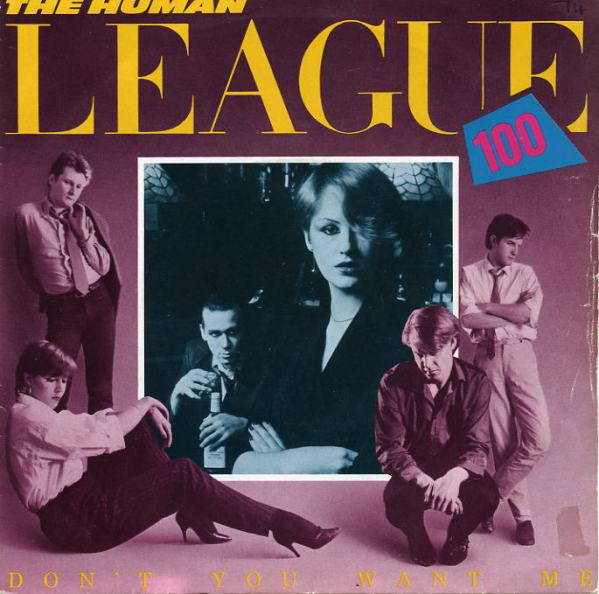
Don’t You Want Me, by The Human League (their 1st and only #1)

5 weeks, 6th December 1981 – 10th January 1982

For this is one of the most recognisable riffs ever, I’d say. Up there with ‘Satisfaction’ and ‘You Really Got Me’ for chart-topping riffs. It’s dramatic and ominous, yet catchy and danceable. It’s a synth riff here, but play it on a piano, a guitar, a bloody harp, and people would know it was the intro to ‘Don’t You Want Me’.

The opening lyrics are equally iconic: You were working as a waitress in a cocktail bar… a male voice intones… When I met you… It’s sung by an overbearing – ok, creepy – bloke. A Svengali figure. He found this girl, made her a star, and now she’s outgrown him. Don’t forget it was me who put you where you are now, And I can put you back down too…

In the second verse, the starlet has her say. Yes, she was working in a cocktail bar… That much is true… She tells him politely that it’s time for her to make it on her own. The male ‘character’ is so well-formed, such a nasty sounding piece of work, that you wish his female counterpart had a little more bite. Who is she? Did she really just use him? Or maybe her niceness is the ultimate insult…?

Aside from the riff, the next best bits are the lines that accelerate up to the chorus: You better change it back or we will both be sorry! This is a high-quality pop song, well worthy of being the year’s biggest-seller and a Christmas number one. But – there’s always a ‘but’ – I’m not sure if there isn’t a hint of ‘fur coat and no knickers’ about it. ‘Don’t You Want Me’ has a great riff and great hook, but on repeated listen it goes from all-time classic to simply great pop. Two years ago, Gary Numan was doing things with a synth that genuinely stood out. Now, in late-1981, synths alone are not enough to wow.

Phil Oakey, The Human League’s founder, didn’t want this released as a single, and has said in subsequent interviews that he sees the music video as a big factor in its success. And you can see why: it’s moody, noirish… dare I say, once more for luck, iconic? It’s certainly slicker and more expensive than many of the homemade looking MVs from the last couple of years, and it looks forward to a New Romantic future in the make-up, earrings and fringes. ‘Rolling Stone’ has claimed ‘Don’t You Want Me’ as the starting point for the 2nd British Invasion in the US (it hit #1 on Billboard six months after topping the charts here).

The Human League had only the one UK chart-topper, but were scoring hits well into the nineties. They still tour to this day. After I’m done writing this post, I’m going to listen to the album that birthed this hit, ‘Dare!’ to see what all the fuss us about. Maybe I’m being harsh in saying that this record lacks much substance beyond its killer riff. It’s still a great tune, but when songs come along with as much baggage and reputation as this one then I can’t help expecting great great things…

Should Have Been a #1…? ‘Happy Xmas (War is Over)’, by John & Yoko with The Plastic Ono Band

So this is Christmas… And what have you done?

‘Happy Xmas (War Is Over)’, by John & Yoko with The Plastic Ono Band & The Harlem Community Choir

reached #4 in December 1972 / #2 in January 1981

Not many festive hits start in such an accusatory tone. Not many festive hits sound like this classic, though. Yes, there are jingling bells and a choir. But there’s no talk of Santa, or snow, or stockings stuffed with presents. This record has it sights set higher: peace on earth.

In my post on ‘Imagine’, which hit #1 shortly after Lennon’s murder, I said that nowadays it could feel a little too idealistic, and a little preachy. Why, then, can I tolerate this song year after year? Is it just because I’m more receptive to songs about war being over, if I want it, when I’m stuffed full of mulled wine and mince pies? Maybe…

I think actually that it’s Phil Spector’s production: taking Lennon’s song and giving them his full Christmas treatment. Strings, chiming bells, beefy drums… It may not have worked on ‘Let It Be’, but it really does here. Despite not actually being much about Christmas, this song sounds like Christmas should.

I’m not posting this song just because I really like it, though. I do, but I also think there’s a chance that it genuinely should have been #1. In its first chart-run, in 1972, it made #4 fair and square, behind the likes of T. Rex and Little Jimmy Osmond. But in 1980, re-released in the wake of Lennon’s death, it also made #4 for Christmas, while the delights of St. Winifred’s School Choir wafted down from top-spot.

Back in those pre-computer days, when everyone at the chart-keeping company was on Christmas holiday, the post-Xmas chart was usually a copy-paste of the previous week’s. St. Winifred’s remained top, John and Yoko at #4. The week after, though, it rose to #2, behind the also re-released ‘Imagine’. I wonder… If the sales of the ‘Happy Xmas’ – which was presumably selling very well in the days leading up to Christmas – were counted, and the chart hadn’t simply been repeated… Could it have been a number one? I guess we’ll never know.

Though it never made #1, ‘Happy Xmas (War Is Over)’ makes the chart every year now thanks to festive streaming. It’s currently perched at #34 in the charts, and will presumably rise even higher next week. With that, I’d like to wish all my readers a very merry Christmas, and a happy new year… Let’s hope it’s a good one… wherever this holiday season finds you. (I’d also like to wish for war to be over, but I think I may be overreaching…)

472. ‘There’s No One Quite Like Grandma’, by St. Winifred’s School Choir

There has been a lot of talk in recent years that 1984 was ‘The Best Year’ for pop music, ever. I would disagree and, from the chart-toppers POV that this blog takes, 1984 is in truth a far from vintage year which we’ll hear all about soon enough. No, my vote for best year of the ‘80s, in terms of #1s, would be 1980 itself. Blondie, ABBA, The Jam, The Pretenders, The Specials, Bowie, Lennon and ELO. Yes, yes, yes. A done deal. Except…

There’s No One Quite Like Grandma, by St. Winifred’s School Choir (their 1st and only #1)

2 weeks, 21st December 1980 – 4th January 1981

1980 had to go and ruin things with its final #1. For, ladies and gentlemen, I present this year’s Christmas Number One, and the record that kept the late John Lennon from scoring an unprecedented three consecutive chart-topping singles: the sweet, sweet tones of St. Winifred’s School Choir.

Whichever way you try to approach this record – as a novelty, as a camp curio, as a nursery rhyme, as a cynical attempt to cash-in at Christmas – one thing’s for sure. It’s a God-awful piece of music. The budget kiddies-TV backing track, the choir, the little girl who sings the lead… Grandma we love you, Grandma we do…  The key-change! (Oh Christ, the key-change…) The stench only intensifies when you find out that this was originally written as a tribute to the Queen Mother for her eightieth birthday!

It’s so bad that it’s almost not worth elaborating. The bit where the lead girl sings about ‘potty time’ (I presume it’s actually ‘party time’) and the bit where grandma is killed off towards the end… We’ll look back and say, There’s no one quite like grandma, She has helped us on our way… It’s all terrible, and you don’t need me to tell you why. Just listen, shudder, then go about your day as best you can (after liking and commenting, ta…) It would also be whacking some very low-hanging fruit to make fun of these seven and eight-year-olds, singing their little hearts out for their dear old grannies.

This song storms instantly into my Top 3 worst chart-toppers so far (alongside ‘All Kinds of Everything’ and ‘No Charge’, in case you’re wondering). But I’ve never bothered properly ranking them because I don’t want to really remember that they exist. It has also caused me to reassess this song’s obvious counterpart, Clive Dunn’s ‘Grandad’, the (almost) Xmas #1 from 1970. Compared to this, ‘Grandad’ is quite the sharp-eyed satire.

This isn’t actually the first time we’ve heard from St. Winifred’s School Choir – the school is in Stockport, Greater Manchester, and they provided uncredited backing vocals on Brian & Michael’s Mancunian anthem ‘Matchstalk Men and Matchstalk Cats and Dogs’. It is though, thankfully, the last time we’ll hear from them. The choir has released eight (8!) albums, and if you’d like to hear their takes on ‘Dancing Queen’, ‘Bright Eyes’ and ‘Rivers of Babylon’ then you’ll have to search for them yourself cause I ain’t linking!

So there we are. The first year of the 1980s finally draws to a close. Though its final chart-topper was a complete and utter howler, I am still ranking it among the very best years for the quality of its number ones. I fear I may not be so generous about what remains of this decade…

(I’m breaking my rule on not posting ‘live’ versions here but, to be honest, each one’s as bad as the next…)

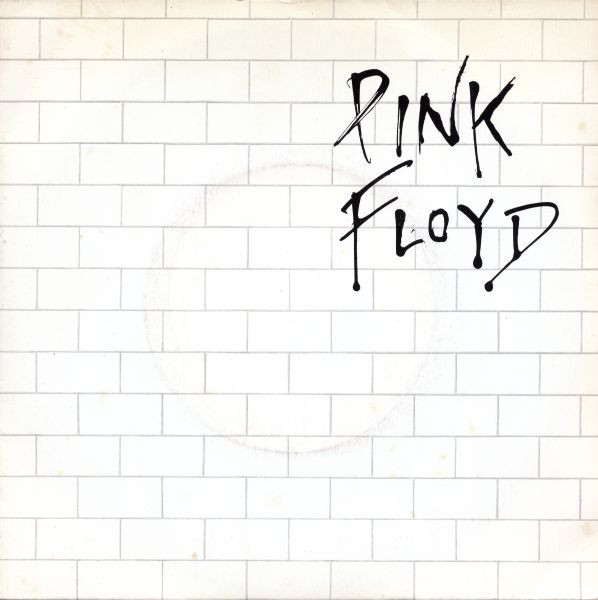
448. ‘Another Brick in the Wall Pt. II’, by Pink Floyd

Here we are then. The final #1 of the seventies, or the first of the eighties. Or both! And, well, at least we’re not ending with a whimper…

Another Brick in the Wall Pt II, by Pink Floyd (their 1st and only #1)

5 weeks, from 9th December 1979 – 13th January 1980

‘Another Brick in the Wall Pt II’ was of course, the Xmas #1 for 1979, and a couple of Christmas ‘must haves’ are present: a novelty element, and a children’s choir (of sorts)… It also acts as a bit of a ‘Best Of the Late-Seventies’, as musically it’s a blend of MOR rock, and disco. (The riff really puts me in mind of The Eagles’ ‘One of These Nights’… there are purists out there who’ll hate that comparison!)

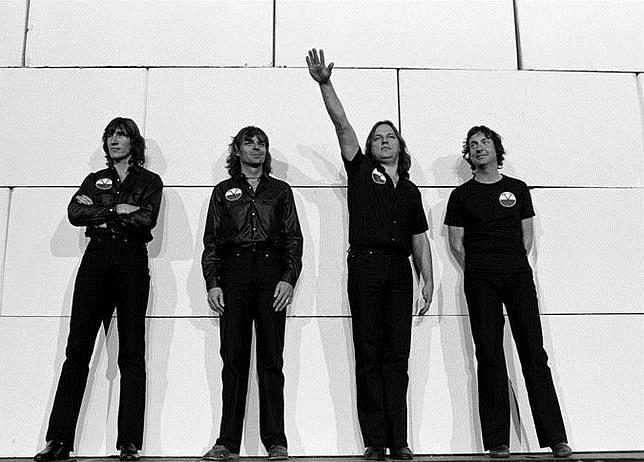
And then there’s the band that put all this together, Pink Floyd: one of decade’s biggest, most successful, influential acts… scoring their first British hit since 1967. Like Led Zep, singles were beneath Pink Floyd, and they had to undergo some real persuasion to make this record. The disco beat, the children, releasing it as a single: all brainwaves from the song’s producer, Bob Ezrin.

We don’t need no education, We don’t need no thought control… Roger Waters wrote this record as a satire of his experiences at boarding school. The video features a giant cartoon teacher feeding hundreds of children into a meat grinder. The point is then literally ‘hammered’ home when the teacher turns into an, um, hammer… No dark sarcasm in the classroom…!

The best bit is when the kids take over for the second verse. Their Hey! Teacher! Leave us kids alone! is genuinely spine-tingling. We then exit with a long solo – again, I’m getting Eagles… – and you’re left kind of scratching your head. OK. That was… something. My uncertainty maybe comes from the fact that this is Pt II of III. The album version starts abruptly with a train screeching, and ends weirdly, with a telephone ringing, after some voice actors have yelled trippy lines like: How can have any pudding, If you don’t eat your meat…???

For those to potentially be the last words spoken on the final #1 of the 1970s is bizarre. I say ‘potentially’, for I don’t know if they were actually on the single edit. If you listen to all three ‘parts’ of ‘Another Brick In the Wall’ it does start to make a little more sense – Parts I and III are variations on the same riff – but, just to make things even more complicated, the tracks don’t even run concurrently on the album…

Another thing that the 168th #1 of the seventies brings back to the top, just in time, is prog rock. Or, at least, a prog band. It was one of the biggest genres of the decade, albums wise, but we haven’t seen much if it in the singles, for obvious reasons (like prog bands not bothering to release them!) You could make the case for 10cc’s ‘I’m Not in Love’, and ‘Bohemian Rhapsody’ being prog #1s, but I’m struggling to think of others. Way, way back in my post on The Moody Blues’ ‘Go Now!’ I argued my ‘Problems with Prog’, and the same applies to Pink Floyd. As is pretty much the law, I bought a copy of ‘Dark Side of the Moon’ aged seventeen, and listened to it… twice, maybe. I just didn’t get it; and didn’t have much inclination to try to get it.

Not that this isn’t an interesting song, though, and a fitting end to a rich and diverse year of chart-toppers. I’ve said it before: 1979 is the ‘best’ year of the ‘70s in terms of chart-topper quality (though 1973 would probably be my favourite year of the decade, just for all the glam stompers…) And it was a controversial Xmas #1, too. The London Education Authority labelled it a ‘scandalous’ slander on the teaching profession. Apparently the new Prime Minister, one Margaret Thatcher, wasn’t too keen on it either… Which is fitting, as quite a few of the biggest acts from this new and upcoming decade had plenty to say about her…

Listen to (almost) every #1 single from the 1970s here:

430. ‘Mary’s Boy Child / Oh My Lord’, by Boney M

One of this blog’s main drawbacks rears its head once again: Christmas songs in July. Oh well… Boney M’s 2nd discalypso hymn of the year. Ready?

Mary’s Boy Child / Oh My Lord, by Boney M (their 2nd of two #1s)

4 weeks, from 3rd – 31st December 1978

It’s a wonder why more acts don’t do this: rush out a Christmas single while at the peak of their popularity. Maybe, just maybe, it’s because the results might sound a bit like this… The steel drums are back, the insistent, steady pace of ‘Rivers of Babylon’ remains. It could be the same, karaoke-ish backing track.

But we do get off to a positive start when I realise that ‘Mary’s Boy Child’ / ‘Oh My Lord’ is not the double ‘A’-side I’d first feared; but a medley. Our first (official) chart-topping medley! (*Edit* Since Winnie Atwell.) And thank goodness because, for my money, the ‘Oh My Lord’ section – newly written by Boney M’s founder Frank Farian – is the best thing about this song. Oh my Lord, When in the crib they found him, Oh my Lord, A golden halo around him… as a backing singer harmonises. It’s nice.

We’ve heard the main bit of song atop the charts before, of course, way back in 1957. Harry Belafonte’s treatment of it was a bit more hushed and reverential. Not that Boney M sound sacrilegious or anything – they do sound genuinely Christian – but it’s hard to sound too pious with that rinky-dink Eurodisco backing. One thing that does work is the way that the band’s Caribbean accents add a slight gospel flavour to the vocals.

One thing that seems to be a very late-seventies phenomenon is the length of our chart-topping singles. This must be the era of the longest average #1. The 7” of this ditty runs to close on six minutes, while the 12” keeps things running for another minute or so. Why, oh why? Pop songs rarely need to run over 3.5 minutes, I’d say, yet disco seemed to encourage indulgence.

Again, as the song plods on and the minutes pass, my mind turns to wondering why this, and ‘Rivers of Babylon’, gave Boney M their pair of chart-toppers, and not ‘Rasputin’, ‘Daddy Cool’, ‘Sunny’, even ‘Ma Baker’… Rare is it, I suppose, for an artist to be properly represented by their chart positions. Anyway, this was the fourth festive themed Christmas #1 of the 1970s – after Slade, Mud and Johnny Mathis – making it officially the Christmassiest decade ever. It’ll be six years until the next one. But, on the plus side, we are about to enter 1979, and are on the cusp of some all-time great chart-topping singles. Bring it on!

416. ‘Mull of Kintyre’ / ‘Girls’ School’, by Wings

It is amazing to think that, almost eight years on from their split, this is only the second time an ex-Beatle has appeared at the top of the charts. You’d have got long odds on it taking this length of time. George Harrison got in there quickly, and then there was a big old wait… Until our latest Christmas #1.

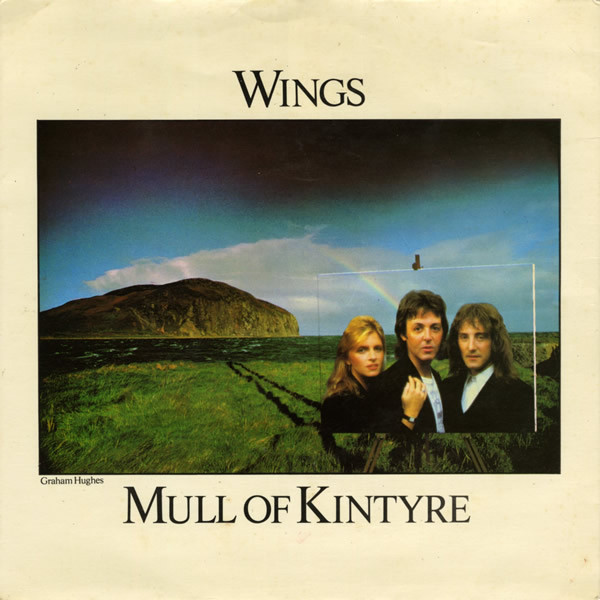
Mull of Kintyre / Girls’ School, by Wings (their 1st and only #1)

9 weeks, from 27th November 1977 – 29th January 1978

And it’s strangely comforting to hear Macca’s voice again, like a long lost friend… Mull of Kintyre, Oh mist rolling in from the sea, My desire, Is always to meet you… It’s just him, and a couple of guitars. Simplicity itself. Until ninety seconds in, when the bagpipes arrive (I always assumed they were saved for the finale. Alas, no.) They enter with that unmistakeable, ominous drone, and by the three minute mark they are the stars of the show. It is amazing to think that, in the 1970s, as many #1 singles featured bagpipes as featured a Beatle.

‘Mull of Kintyre’ is not an old folk song, though it sounds for all the world as if it should be. It is further evidence of McCartney’s ability to conjure timeless pop from a few chords (and a cheeky slice of ‘Auld Lang Syne’). It is not ‘Yesterday’, nor is it ‘Eleanor Rigby’, but it is a huge moment in his legacy. And yet…

As a Scot, part of me bristles at this act of cultural appropriation… (You may roll your eyes, but hear me out.) It’s a nice song, a sweet melody, a love-letter by Paul to his adopted home (he really was living, while he wrote this, on the Mull of Kintyre). But the lines about mist rolling in from the sea and sweeping through the heather like deer in the glen… It’s the aural equivalent of a souvenir shortbread box. It’s Scotland as imagined by American, or Japanese, (or Liverpudlian) tourists. It’s #notmyscotland. You can also imagine John Lennon hearing this for the first time, on the radio one morning, and ruefully shaking his head…

Still, come the drum-roll and the key change, ‘Mull of Kintyre’ has wormed its way into your brain. You can see why this is was a ginormous hit – a song that appeals to five-year-olds, ninety-five-year olds, and anyone who’s had enough whisky. Its nine weeks at the top makes it the joint longest running #1 of the decade, alongside ‘Bohemian Rhapsody’ and an upcoming movie soundtrack hit. It became the biggest selling single ever in the UK, usurping ‘She Loves You’, and it remains the biggest selling non-charity single ever released.

I did wonder if, by hitting #1 in late November, this was the earliest an Xmas #1 had made it to the top. But it’s not even close. Al Martino got there two weeks earlier in 1952, as did Clean Bandit in 2016, while Elvis’s ‘It’s Now or Never’ holds the record by holding on from November 3rd. However, this record also stayed top for over a month after Christmas thanks, it seems, to the flip-side…

‘Girls’ School’ is a rocker, all scuzzy slide guitars and heavy drums, as far removed from the faux-folk of ‘Mull of Kintyre’ as can be. SongFacts describes it as ‘semi-pornographic’, and that’s putting it mildly. While your grandma would have enjoyed singing along to ‘Mull…’, she may have choked on her sherry when she heard this one. Sleepy head kid sister, Lying on the floor, Eighteen years and younger boy, Well she knows what she’s waitin’ for…

It seems the nuns have lost control of the convent school… Yuki, the resident mistress and oriental princess, is showing porn in the classroom. The Spanish nurse is running a full-body massage parlour, while the matron is drugging the kids in their beds at night, and then… Well that much is left to the imagination… Ah, what can the sisters do…?

I’m loving-yet-appalled-by this post-‘Mull…’ palate cleanser. It is pure rock ‘n’ roll, both in terms of its sound and its lyrical content (which would come under, shall we say… ‘scrutiny’ were it released in 2021). I think someone was having a good old chuckle to themselves when they stuck this alongside such a shamelessly sentimental ‘A’-side. It does seem, too, that McCartney may have swept it under the carpet in recent years. It’s not on Spotify, for a start.

Although this is his first #1 since The Beatles, it’s not as if Paul had been hiding under a rock since ‘Let It Be’. Wings were a huge chart force throughout the seventies, featuring Paul, his wife Linda, Denny Laine (whom we have heard from before as a member of The Moody Blues) and a rotating cast of supporters. This was their 10th Top 10 hit, but the only one to go all the way. Macca will be back, though, in the 80s, with a couple of chart-toppers to make ‘Mull of Kintyre’ sound like the epitome of cool, cutting edge pop.

398. ‘When a Child Is Born (Soleado)’, by Johnny Mathis

For the third time this decade, and for the fifth time in all, the Christmas number one is an actual Christmas song. The previous two, from Slade and Mud, were very seventies, very glam. This one, though, could have been #1 at any point in chart history.

When a Child Is Born (Soleado), by Johnny Mathis (his 1st and only #1)

3 weeks, from 19th December 1976 – 9th January 1977

Let’s split this record in two, and start with the good half. It’s got that ‘classic standard’ feel to it, a sweeping melody of the kind that you think you must have always known. When the backing singers come in with the ah-ah-ah-aaahhs it’s quite sweet. Plus, Johnny Mathis sings it like the professional crooner that he is. A ray of hope, Flickers in the sky…

On to the bad bits… And let’s start with those lyrics. It’s all winds of change, silent wishes, brand new morns and rosy hews. It feels churlish to complain about soppy lyrics in a religious, Christmas-themed song. What kind of lyrics is it supposed to have? Except, I’m not religious, and it’s April. So there.

Plus, the production is very floaty, glossy, mid-seventies MOR goop. And there’s a stinker of a spoken section: The world is waiting, Waiting for one child… Black, white… yellow? No-one knows… It is what it is. I’m not going to knock it any more. Mathis means well, and I have fond memories of my late grandmother singing this by the tree after a sherry or three.

I had assumed that ‘When a Child Is Born’ would have been an old, old tune from the mists of time. But the melody, ‘Soleado’, was written for an Italian singer in 1972, while the English lyrics followed a few years later. It’s a skill, I guess, to write a song that sounds so timeless. Johnny Mathis had been around for a lot longer, releasing his first singles in the mid-fifties. He followed this up with ‘Too Much, Too Little, Too Late’, his first US #1 for almost twenty years. Some impressive longevity there. He’s still with us, aged eighty-five, having released his most recent album in 2017.

You will all be thrilled to hear that the 1970s, the decade of the Christmas #1, is not done with the festive tunes just yet. But that is some way off. Up next, we launch head-first into 1977, which marks the singles chart’s quarter century!

Listen to all the #1s from 1976, and from every year before, with this playlist:

382. ‘Bohemian Rhapsody’, by Queen

I have to admit, I’ve been putting off writing this entry. I mean, A) How do you say anything about ‘Bohemian Rhapsody’ that hasn’t been said before? And B) When are you ever in the mood to sit and listen to it on repeat? (Though actually, I could probably play this one from beginning to end, in my head, from memory…)

Bohemian Rhapsody, by Queen (their 1st of six #1s)

9 weeks, from 23rd November 1975 – 25th January 1976

I can remember hearing this record for the first time. That must mean something, right? That must be proof of this song’s place in our lives? I was at the kitchen table, aged seven or so, playing with some Lego, and my dad was playing this, loud. And singing. My dad does not normally play music loud, or sing. So seven-year-old me sat up and took notice. What was this record that had turned my father into a headbanger?

Is this the real life, Is this just fantasy…? If I had to rate the three parts (or is it four?) of ‘Bohemian Rhapsody’, the first would be my favourite. Freddie’s voice… Mama, Just killed a man… and his luxuriant piano. The singer is haunted by his past, his crimes, and is setting out alone. Mama, Ooh-ooooh-ooh… If that was it, if this were a three-minute ballad, it’d still be great. But, of course, that is not it. ‘Tis but the amuse-bouche.

In comes Brian May, with the most outrageous piece of guitaristry in a #1 single since ‘Voodoo Chile’, and then… You know what comes next. This is the bit I remember hearing as a kid. You do have to step back and applaud the fact that the band managed to sandwich this bit into a pop single. In terms of the story, it represents, I think, the singer’s inner torment at what he’s done. Beelzebub, Has a devil put aside, For ME!

Then comes the head-banging section, the Wayne’s World bit, my second favourite part. It’s proper hard rock, almost heavy metal – a sound that we have very rarely heard in any of the previous 381 chart-toppers. ‘Bohemian Rhapsody’ really is a deeply strange strong, and a bizarre #1. But it is also so much a part of the furniture that people no longer stop to wonder what the hell it’s about. Is it a tale of a Faustian pact? Is it Mercury coming to terms with his sexuality? Or is it, as the band maintain, all nonsense?

And, for then the coda, it’s back to Freddie and his piano. The clincher. Any way the wind blows… Done, and exhale. The stories around the song’s recording and release are well-known: the record execs’ reluctance, Kenny Everett playing it on repeat… I enjoyed the scene in the recent movie – a movie that wasn’t as bad as everyone made out – where the band wonder if Freddie’s lost his mind while recording the Galileo! Galileo! part.

People always name ‘Bohemian Rhapsody’ as one of the longest songs ever, and certainly one of the longest #1s. But it’s barely six minutes long, and feels even shorter, ranking it pretty far down the ‘long number ones’ list. Even ‘I’m Not In Love’, from earlier in 1975, went on for ten seconds more. What was long was its stay at the top of the charts. No record has spent nine weeks at #1 since ‘Rose Marie’ managed eleven, twenty years back. Add to that the fact that it will be back on top shortly after Freddie Mercury’s death, and we’re looking at one of the longest-running #1s, ever.

In my post on ‘Space Oddity’ – isn’t it amazing to think that these two classic records so nearly met one another atop the charts! – I named David Bowie as an artist woefully represented by his chart-toppers. Well, to that short list add Queen, who will only have two more before they lose their frontman, and then descend into some highly questionable duets by the turn of the century. All that to come…

Anyway, after I wrap this up I will go back to never choosing to listening to ‘Bohemian Rhapsody’, just hearing it by osmosis (and when forced to join in with it at karaoke nights…) I don’t hate it – it is an amazing piece of music – and yet I think it works best as a memory, of me aged seven, staring open-mouthed at my dad moshing around the living-room.

Should’ve Been a #1… ‘I Wish It Could Be Christmas Everyday’, by Wizzard

Are you ready children…? (*Fart noise*)… Ladies and gentlemen, I give you a Christmas classic.

‘I Wish It Could Be Christmas Everyday’, by Wizzard – #4 in December 1973

People complain that few good Christmas pop hits are written these days – though I would argue that The Darkness, Kelly Clarkson, Gwen Stefani (and even Miss Britney Spears) have all added their own classics to the canon this century – and then they look wistfully back to 1973, when two of the most enduring Christmas songs of all time raced up the singles chart.

Slade made #1 – and you can read all about that here – while an even better record got stuck at number four. (I always knew that they came out at the same time, but for years I assumed that Wizzard were runners-up.) Roy Wood’s band had already scored two superlative chart-toppers in ’73 – ‘See My Baby Jive’ and ‘Angel Fingers’ – when they turned on the snow machine and went even heavier on the French horns.

While Slade went quite tongue in cheek – with talk of drunken Santas and dancing grandmas – Wizzard lay the traditional Christmas tropes on thick: When the snowman brings the snow, Well he might just like to know, He’s put a great big smile on somebody’s face… And while Slade toned down the glam, for a Beatlesy ode to the season, Wood chucks everything at this one. It’s every bit as OTT, if not more, than their earlier #1s. And why not? When has Christmas ever been a time for subtlety?

By the end, if the two drummers and multiple brass instruments weren’t enough, the sweet, sweet voices of the Stockland Green School choir are added into the mix. Ok, you lot… Take it! (The full credit for the single is: ‘Wizzard ft. vocal backing from the Suedettes plus the Stockland Green Bilateral School First Year Choir with additional noises by Miss Snob and 3C’, which is every bit as extra as the song itself.) And for the last line, Roy earnestly implores us: Why don’t you give, Your love, For Christmas…?

See, it’s not as wild and anarchic as it sounds. Except, when you actually stop to imagine it being Christmas every single day, when the kids start singing and the band begins to play, and it quickly becomes a dystopian nightmare vision of never ending lights, noise, gift giving and turkey…. Still, I can forgive them, for this is a classic. A song that has been played every December since, but that somehow doesn’t ever inspire in me the feelings of irritation that, say, Slade, the Pogues and Mariah Carey do. As I write this, ‘I Wish It Could Be Christmas Everyday’ sits at #16 in the UK Singles charts, and will probably climb even higher next week.

All that’s left for me to do is to wish everyone who reads and follows the UK Number 1s Blog, a very merry Christmas. It doesn’t come everyday – and this year might be different than most – but, still, make it a good one!