Part three in this series of posts on artists with an abundance of Top 10 hits, but for whom the very top of the charts has proven elusive. Up next…
Janet Jackson – 16 Top 10 hits between 1986 and 2002
Given that she is one of the most succesful female pop stars of all time, I can’t say I’m very familiar with Janet Jackson’s discography. There’s ‘Together’ Again’, which during my first year of high school you couldn’t turn on the radio for more than five minutes without hearing, and ‘Scream’, the duet with her brother Michael, and the most expensive music video ever (at the time). Neither of these make this list…
In my head I put it down to her simply being bigger in the US than in Britain. Which is true; but which is also completely disbunked by the fact she’s featuring here as the second most succesful non-number-one-getter of all time. Why isn’t she mentioned in the same breath as Madonna, or Whitney Houston? Has her music dated more than theirs? Has she been dwarfed by her brother’s fame (and infamy)? Or is it because her right breast slipped out at a Superbowl half-time show? I’m not attempting to choose a reason here (though, sadly, it’s probably the latter), yet it is worth pondering as we count down her three biggest UK hits.
‘What Have You Done for Me Lately’ – reached #3 in 1986
Miss Jacko has several #3 hits to choose from, but I’ll go for her breakthrough smash. From the wonderfully over-acted intro, to the pounding synths and drums, it is so mid-eighties it hurts. But it also has an energy, and an aggressive beat, that pretty much drags you to the dancefloor. Not a relaxing listen, but one that ‘slaps’, as the kids might say. Interestingly, given her famous family, it took three albums and four years of flops for Janet to establish herself as a solo star with this sassy tune.
‘The Best Things in Life Are Free’ (with Luther Vandross) – reached #2 in 1992
Janet Jackson’s joint-biggest UK hit is this perfectly pleasant, if fairly forgettable, slice of mid-tempo nineties pop, with a hint of R&B. It was from the soundtrack for the movie ‘Mo’ Money’, and neither Janet nor Luther feature in the video. Instead the film’s stars Damon Wayans and Stacey Dash lip-synch along gamely.
‘That’s the Way Love Goes’ – reached #2 in 1993
From the sounds of this, Janet went down the same ultra-slick route as her big brother in the ’90s. At least she is singing, rather than clicking and squeaking her way through the song, but still. I’m trying to find something to grab on to here, but it’s all just too polished and bland. Apparently it was a shockingly sexy change of pace for her, and this record ended up with 8 (eight!) weeks at #1 in the US. I can’t see it, myself.
Much more interesting is the video, with the ginormous home sound system (I pity her neighbours) and actual J-Lo (!), back when she was plain old Jennifer Lopez. Anyway this ended up as Jackson’s (joint) biggest UK hit, but it hasn’t given me much of an urge to do a deep-dive into her discography.
Tomorrow, we’ll wrap this series up by featuring the biggest band never to make number one. Yes, we are significantly more than halfway there…
This week, in a break from our regular schedule, I’m going to be celebrating some acts with plenty of Top 10 hits to their name. Household names, the lot of them. But acts that, for whatever reason, have never made it to pole position.
In fact, the acts I’m going to cover – two bands, two soloists; three whose careers began in the ’80s and stretch to the present day, one who was present on the very first chart way back in 1952 – are perhaps the unluckiest pop stars around. They are the bands and artists who have managed the most Top 10 hits without ever making number one. As recompense for their bad luck, I’ll present to you the three records from each band/artist that came closest…
First up… Well, I kind of gave that away in the title:
Depeche Mode – 14 Top 10 hits between 1981 and 2005
‘People Are People’ – #4 in 1984
None of Depeche Mode’s biggest hits are the tunes you’d expect. No ‘Enjoy the Silence’, no ‘Just Can’t Get Enough’ or ‘Personal Jesus’. ‘People Are People’ was the lead single from their fourth album, and their joint biggest hit (they’ve never risen above #4). The clanking irons and booming cannons that intro this record are almost too ‘eighties’ for me, but they are certainly striking. Interestingly, I’d have thought that this was from a few years later, when the synths in the charts got harsher and tinnier. This record, then, was a trendsetter, a nod towards a Pet Shop Boys, SAW future. The lyrics are the sort that are sadly always going to be prescient: I can’t understand, What makes a man, Hate another man, Help me understand…
‘Barrel of a Gun’ – #4 in 1997
Deep in the midst of the Britpop years, Depeche Mode were on their 9th album, and the lead single was this moody, churning, paranoid beast. It takes a chorus that could have been by Oasis, mixes it with Nine Inch Nails, and some grungy leftovers, and a hip-hop beat for good measure, to create an very unlikely hit single.
‘Precious’ – #4 in 2005
The Mode’s final Top 10 single (to date… who knows?) is also their joint highest charting. By the mid-00s, synth-pop was making a comeback thanks to acts like the Killers, Goldfrapp, the Bravery and more, and Depeche Mode were the granddaddies. Perhaps that’s why they managed such a late career flourish (or perhaps it was the fact that singles sales were in the toilet in 2005). It’s a low-key, melancholy track, written by Martin Gore to his children as an apology for his impending divorce.
Another unlucky artist is up tomorrow, and we’re going right back to the dawn of the British singles chart…
The past thirty #1 singles have thrown the charts into a state of flux. We last recapped in July 1989, and the song that kicked off this latest section was Sonia’s ‘You’ll Never Stop Me Loving You’. Back then, Stock Aitken Waterman were responsible for what felt like one in every two chart-toppers, their brassy synths and predictable melodies the sound of the late 1980s…
And then, suddenly, they weren’t. After Sonia, SAW had just two number ones left in the tank – Band Aid II, and Kylie’s cute cover of ‘Tears on My Pillow’ – and neither of those were classics of their kind. No, it seemed that as dance music took over, people realised that there was a world beyond SAW. Black Box’s ‘Ride on Time’, for example, that autumn’s monster hit, and the record I claimed as the first modern dance #1.
From then on, we slipped into a dance groove as we began the final decade of the 20th century. Beats International, Snap!, Adamski, even New Order with the finest football song of all, and Madonna with another of her famous shapeshifts. It was dance music of a different sort: not one hundred manic samples all smashed together; but cool, confident music that, to be honest, wasn’t always that easy to dance to.
Yet to claim that this recap is solely about the dance hits is to airbrush a lot of what makes this period in chart history so interesting. For while the dance hits were trying to hold everything together, the rest of popular music was going ever so slightly mental. We caught glimpses of the decade to come, with the first modern boyband (NKOTB), some lilting indie from The Beautiful South, and the first movie-soundtrack monster ballad of the ‘90s in ‘Show Me Heaven’. It won’t be the last.
Then there were the continued random releases of golden oldies that have been a feature of the charts since 1986, thanks to Levi’s adverts (‘The Joker’) and movies about ghosts with a fetish for pottery wheels (‘Unchained Melody’). And then there was the long-awaited arrival of hip-hop as a genuine chart force, with the genre scoring three out of the past thirty number ones. (Though, as those raps were either about animated turtles, or delivered by cartoon children, or Liverpool midfielders, or… oh yeah… Vanilla Ice, it’s safe to say that it’s a genre still finding its feet. Its time will come soon enough.)
And then it’s almost too easy to pass over the fact that Elton John scored his first ever solo #1, and that Cliff Richard went all Christian-contemporary to ensure he managed a chart-topper in each of the singles chart’s five decades, and his 3rd Xmas #1 appearance in a row! Because all that pales into insignificance when we hit the run of number one singles that came in the deep midwinter of 1990-91. Iron Maiden brought the heavy metal. Enigma brought the Gregorian chanting. Queen brought the Spanish guitars (not to mention the end of the world). And the KLF brought the house down with their industrial dance banger ‘3AM Eternal’, complete with machine guns.
Anything else…? Oh, but I’d almost forgotten. At least, I’d tried to forget. Jive Bunny. J-J-J-Jive Bunny. He was a thing that happened. And he didn’t just ‘happen’. Three #1s, ten weeks at the top, in barely four months. For a brief moment it was the Bunny’s world and we were just living in it (and I’ve only just realised quite how much these past few months have been dominated by cartoon characters…) To tell the truth, I quite enjoyed his first two hits, with their perky mash-ups of rock ‘n’ roll classics. By the 3rd, Christmas-themed, hit however the joke had run out of steam…
Which brings us on to the awards. The ‘Meh’ Award is hard to decide, as so many of the past thirty records have been anything but dull. I could give it to Lisa Stansfield’s ‘All Around the World’, but that was a bit too classy. I could give it to NKOTB’s ‘Hangin’ Tough’, but that was entertainingly lame. So, I’ll have to give it to Band Aid II, for their completely faithful, but nowhere near as iconic, attempt to recapture the magic of ‘Do They Know It’s Christmas?’ At least it raised some money for a worthy cause.
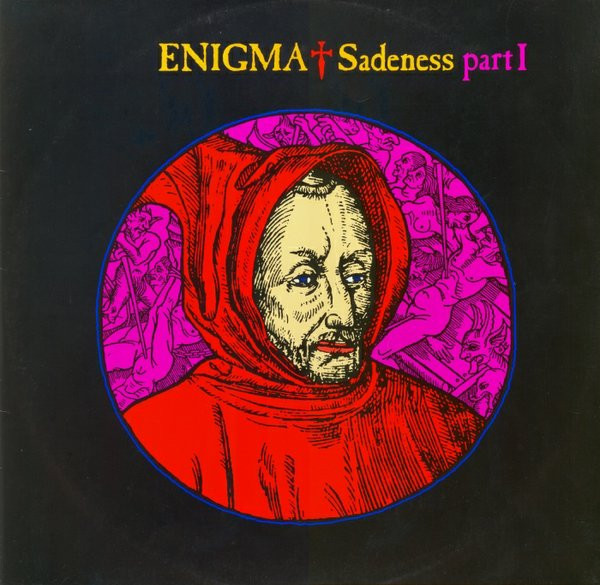
There have rarely been as many rich pickings for our next award, the The WTAF Awardfor being interesting if nothing else. Where in God’s name do we start? Partners in Kryme? Timmy Mallet and his scantily clad young ladies? The Simpsons? Iron Maiden? Vanilla Ice?? J-J-J-Jive Bunny?? No, I think it’s between two back to back #1s from January 1991. ‘Innuendo’, and ‘Sadeness Part 1’. And as much as I grew to enjoy Queen’s 3rd chart-topper (or perhaps because I now like it so much…) I’ll have to give it to the one with the chanting monks, and the lyrics in French about a perverted literary genius.
Finally, then, to the main events. The Best and, before that, our 22ndVery Worst Chart-Topper. I listed so many weird and wonderful hits above, but I’d be loath to give it to any of them. No, this one’s cut and dried. I’m giving it to the record which confirmed that the Jive Bunny joke had ceased to be funny: ‘Let’s Party’. Cheap covers of Slade, Wizzard and Gary Glitter, stitched together with the subtlety of a charging elephant, do not a classic record make.
Much more tricky to decide is this recap’s Very Best Chart-Topper. I started off with a longlist but, as much as I enjoyed ‘Vogue’, Beats International and the KLF, I pretty quickly refined things down into a shortlist. Black Box’s ‘Ride on Time’, and a song I haven’t even found time to mention yet… Sinéad O’Connor’s ‘Nothing Compares 2 U’. Two very different records, two worthy winners. Black Box set the sound for the decade to come, whereas O’Connor’s take on Prince’s original would sound, yes, iconic in any decade. ‘Nothing Compares 2 U’ for the win.
To recap the recaps:
The ‘Meh’ Award for Forgettability
‘Hold My Hand’, by Don Cornell.
‘It’s Almost Tomorrow’, by The Dream Weavers.
‘On the Street Where You Live’, by Vic Damone.
‘Why’, by Anthony Newley.
‘The Next Time’ / ‘Bachelor Boy’, by Cliff Richard & The Shadows.
‘Juliet’, by The Four Pennies.
‘The Carnival Is Over’, by The Seekers.
‘Silence Is Golden’, by The Tremeloes.
‘I Pretend’, by Des O’Connor.
‘Woodstock’, by Matthews’ Southern Comfort.
‘How Can I Be Sure’, by David Cassidy.
‘Annie’s Song’, by John Denver.
‘I Only Have Eyes For You’, by Art Garfunkel.
‘I Don’t Want to Talk About It’ / ‘The First Cut Is the Deepest’, by Rod Stewart.
‘Three Times a Lady’, by The Commodores.
‘What’s Another Year’, by Johnny Logan.
‘A Little Peace’, by Nicole.
‘Every Breath You Take’, by The Police.
‘I Got You Babe’, by UB40 with Chrissie Hynde.
‘Who’s That Girl’, by Madonna.
‘A Groovy Kind of Love’, by Phil Collins.
‘Do They Know It’s Christmas?’, by Band Aid II.
The WTAF Award for being interesting if nothing else
‘I See the Moon’, by The Stargazers.
‘Lay Down Your Arms’, by Anne Shelton.
‘Hoots Mon’, by Lord Rockingham’s XI.
‘You’re Driving Me Crazy’, by The Temperance Seven.
‘Nut Rocker’, by B. Bumble & The Stingers.
‘You’ll Never Walk Alone’, by Gerry & The Pacemakers.
‘Little Red Rooster’, by The Rolling Stones.
‘Puppet on a String’, by Sandie Shaw.
‘Fire’, by The Crazy World of Arthur Brown.
‘In the Year 2525 (Exordium and Terminus)’, by Zager & Evans.
‘Amazing Grace’, The Pipes & Drums & Military Band of the Royal Scots Dragoon Guard.
‘Kung Fu Fighting’, by Carl Douglas.
‘If’, by Telly Savalas.
‘Wuthering Heights’, by Kate Bush.
‘Hit Me With Your Rhythm Stick’, by Ian Dury & The Blockheads.
‘Shaddap You Face’, by Joe Dolce Music Theatre.
‘It’s My Party’, by Dave Stewart & Barbara Gaskin.
‘Save Your Love’ by Renée & Renato.
‘Rock Me Amadeus’, by Falco.
‘Pump Up the Volume’ / ‘Anitina (The First Time I See She Dance)’, by M/A/R/R/S
‘Doctorin’ the Tardis’, by The Timelords
‘Sadeness Part 1’, by Enigma
The Very Worst Chart-Toppers
‘Cara Mia’, by David Whitfield with Mantovani & His Orchestra.
‘The Man From Laramie’, by Jimmy Young.
‘Roulette’, by Russ Conway.
‘Wooden Heart’, by Elvis Presley.
‘Lovesick Blues’, by Frank Ifield.
‘Diane’, by The Bachelors.
‘The Minute You’re Gone’, by Cliff Richard.
‘Release Me’, by Engelbert Humperdinck.
‘Lily the Pink’, by The Scaffold.
‘All Kinds of Everything’, by Dana.
‘The Twelfth of Never’, by Donny Osmond.
‘The Streak’, by Ray Stevens.
‘No Charge’, by J. J. Barrie
‘Don’t Give Up On Us’, by David Soul
‘One Day at a Time’, by Lena Martell.
‘There’s No One Quite Like Grandma’, by St. Winifred’s School Choir.
‘I’ve Never Been to Me’, by Charlene.
‘Hello’, by Lionel Richie.
‘I Want to Know What Love Is’, by Foreigner.
‘Star Trekkin’’, by The Firm.
‘Nothing’s Gonna Change My Love for You’, by Glenn Medeiros.
‘Let’s Party’, by Jive Bunny & The Mastermixers.
The Very Best Chart-Toppers
‘Such a Night’, by Johnnie Ray.
‘Cherry Pink and Apple Blossom White’, by Perez ‘Prez’ Prado & His Orchestra.
‘Great Balls of Fire’, by Jerry Lee Lewis.
‘Cathy’s Clown’, by The Everly Brothers.
‘Telstar’, by The Tornadoes.
‘She Loves You’ by The Beatles.
‘(I Can’t Get No) Satisfaction’, by The Rolling Stones.
‘A Whiter Shade of Pale’, by Procol Harum.
‘I Heard It Through the Grapevine’, by Marvin Gaye.
‘Baby Jump’, by Mungo Jerry.
‘Metal Guru’, by T. Rex.
‘Tiger Feet’, by Mud.
‘Space Oddity’, by David Bowie.
‘I Feel Love’, by Donna Summer.
‘Heart of Glass’, by Blondie.
‘The Winner Takes It All’, by ABBA.
‘My Camera Never Lies’, by Bucks Fizz.
‘Relax’ by Frankie Goes to Hollywood.
‘You Spin Me Round (Like a Record)’, by Dead or Alive
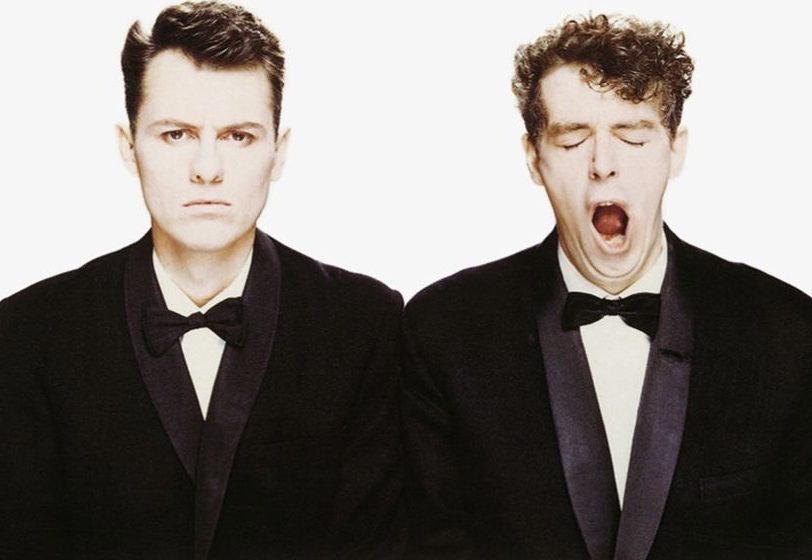
Time for a ‘Best of the Rest’ rundown for one of the most consistent hitmakers of the eighties and nineties. In fact, Pet Shop Boys’ run of Top 10 hits spans exactly twenty years, from their first #1 ‘West End Girls’ in 1986, to 2006’s ‘I’m With Stupid’.
Neil and Chris were a bit short-changed, for my money, in terms of their chart-toppers. Far worse acts have had far more than just four number ones… But, I’ve said it before and may as well say it again, the chart gods are fickle. Here then are PSB’s ten biggest non-number one hits. Unlike similar posts I’ve published in the past, I’m not ranking them – this is all based on cold hard chart-positions. It’s just ‘Highest Charting of the Rest’ as a title doesn’t have quite the same ring to it…
‘Before’ – #7 in 1996
Perhaps not the most instant PSBs track, ‘Before’ was the lead single from their sixth studio album, ‘Bilingual’. There’s a hook there, in the cooing synth line, and a chilled mix of disco and nineties dance. The brief for the video, meanwhile, was clearly to aim for ‘peak 1996’, years before people had though of ‘peak’ anything.
Can You Forgive Her? – #7 in 1993
It’s very Pet Shop Boys to make love sound like a panic attack. You’re short of breath, Is it a heart attack…? It’s both compulsive and threatening, with nice brassy synths. It’s not hard to read a subtext in the lyrics about a woman making fun of a man who prefers disco to rock, and who claims that’s she’s off to find a real man instead… Another striking video, that I imagine looked very impressive at the time.
‘Domino Dancing’ – #7 in 1988
As we’ve seen from our regular rundown, the mid-to-late eighties saw a mini burst of Latin-tinged pop. PSBs got in on the act for the lead single from their third album. I think the guitar and Spanish rhythms mixed with with their regular synths works well, but Neil Tennant sees it as the end of their imperial phase (as well as failing to break the Top 5 in the UK, ‘Domino Dancing’ was their last Top 20 hit in the US). The video features two ridiculously handsome (and permanently topless) twinks competing for the attentions of the same girl, before giving up and wrestling one another on a beach. Rolling Stone described it as ‘probably the most homo-erotic pop video ever made’, and it’s hard to disagree…
‘Absolutely Fabulous’ – #6 in 1994
La-La-Lacroix, darling… A charity single next, for Comic Relief. Lines from the sitcom of the same name are stitched around a thumping techno beat, as Neil Tennant does very little apart from intone Abso-lutely fa-bulous… over it all. It’s an pastiche of the big eighties and nineties dance hits – ‘Pump up the Jam’, ‘Ride on Time’, ‘Rhythm of the Night’ to name a few. Techno, Techno, Bloody techno darling… Few charity singles manage to be this catchy and remain (relatively) funny, so it’s a shame that this has been all but forgotten, even if the duo don’t recognise it as an official single and have never featured it on a Greatest Hits. Strange fact: this was PSB’s highest-charting single in Australia.
‘It’s Alright’ – #5 in 1989
A thirty-five year old song about dictators in Afghanistan, and forest falling at a desperate pace… Glad we’ve made progress since then, huh! To me this sounds like Pet Shop Boys-by-numbers. Nothing wrong with it, but not a patch on their greatest singles.
‘How Can You Expect to Be Taken Seriously?’ / ‘Where the Streets Have No Name (Can’t Take My Eyes of You)’ – reached #4 in 1991
This bitchy number – with lines like: You live within the headlines, so everyone can see, You’re supporting every new cause and meeting royalty – is about the pomposity of pop stars in general. Or is it about someone in particular…? Neil Tennant claimed later that it was about a ‘female pop star from 1989’. Make of that what you will… It features guitars, which is rare for a PSBs single.
It was paired with two covers – U2 and Frankie Valli – melded into one soaring disco anthem. An early form of the mash-up, both songs work well with a churning dance beat and Tennant’s ethereal vocals.
‘So Hard’ – reached #4 in 1990
Another atypical love song, about a toxic relationship in which both parties make it so hard for ourselves… Tennant’s vocals rarely break a sweat, there are some wonderfully dated ‘barking dog’ synths, and a low-key gem of a chorus. ‘So Hard’ was the lead single from their fourth album, and the video is set in the wonderful city of Newcastle. It apparently features Paul Gascoigne’s sister Anna, as well candid clips of Geordies out for a night on the toon.
‘Left to My Own Devices’ – #4 in 1988
Everything great about the PSBs in a just under five-minute edit: a dramatic string intro giving way to a pulsing disco beat, NT’s trademark deadpan delivery, lyrics that are as camp (I could love you, If I tried, I could, And left to my own devices, I propably would) as they are pretentious (Che Guevara and Debussy to a disco beat). Oh and, of course, you can dance to it.
‘Go West’ – #2 in 1993
The mark of a good cover is that you no longer imagine it being performed by the original artist. The Village People took their version, inspired by an old rallying cry used to spur pioneers to head out into the great unclaimed (apart from by, you know, the natives…) American West. PSBs kept most of the original, including the chord progression based on Pachelbel’s Canon, but added lots of glorious other things: horns, a male voice choir, a big female diva (posing as the Statue of Liberty) taking it home at the end. They originally covered it for an AIDS charity concert, then decided to release it, scoring their biggest hit in five years. We can assume the video was inspired by the breakdown of the Soviet Union, with lots of sturdy Russian-looking men heading towards a ‘promised land’. The CGI is so dated that it now looks like a brilliantly judged attempt to be retro.
‘What Have I Done to Deserve This?’ (with Dusty Springfield) – #2 in 1987
I’m not ranking these, but it just so happens that the best is saved for last. For not only do we have Pet Shop Boys in their imperial, huge hits without even trying, phase… (Coincidentally, Neil Tennant is credited with first using the phrase ‘imperial phase’ to describe an artist at the peak of their powers.) Anyway, I digress… We also have Ms Dusty Springfield! Almost two decades into a career slump, filled with alcohol and drug abuse, as well as abusive relationships. Despite this, the sixties diva remained a star, initially turning the duet down because she hadn’t heard of the PSBs. A couple of years later, after hearing ‘West End Girls’ on the radio, she agreed. Neil Tennant was a huge fan, and pushed for her inclusion, despite their label wanting someone less ‘washed up’.
Dusty also took twenty or so takes before she was happy with her vocals. But when she was happy, her voice became an integral part of an ’80s classic. When she comes in for the chorus, slightly raspier but still Dusty, after Tennant has dead-panned the first verse, it’s a goosebumps moment. The song itself is perhaps of its time, a comment on society in the Thatcher-Reagan years: You always wanted a lover, I only wanted a job… It’s also a very subversive number, every bit as gay as ‘Relax’, just less in-your-face, with the lesbian Springfield and the gay Tennant playing a very odd couple.
This record came agonisingly close to the top, peaking at #2 in both the UK and the US. It also sparked a late-career renaissance for Dusty. Tennant and Lowe would go on to produce her comeback album ‘Reputation’ in 1990. She died from cancer in 1999. Pet Shop Boys continue to record and perform to great acclaim, almost forty years later.
And so we reach the end of the 1980s. And, in some ways, the decade’s final number one single is quite perfect.
Do They Know It’s Christmas?, by Band Aid II
3 weeks, from 17th December 1989 – 7th January 1990
It’s a charity single, for a start, a ‘genre’ that has dominated the charts since the middle of the eighties. It’s a cover, of course, of the charity single, the one that kicked the whole trend off. Plus, it was produced by Stock, Aitken and Waterman, giving the trio their seventh #1 of the year. But beyond the good cause, and the production team, the tag ‘perfect’ quickly wears thin.
There’s a reason why none of the three subsequent Band Aids have ever been much played after their original chart runs; while the first is seen as a classic, a perennial returnee to the charts every Christmas. There’s a novelty factor each time, and the urge for people to be seen to be doing something for charity, that means a new Band Aid single will always chart highly. But beyond that initial burst of enthusiasm, there’s always the slow realisation that the new versions simply aren’t as good.
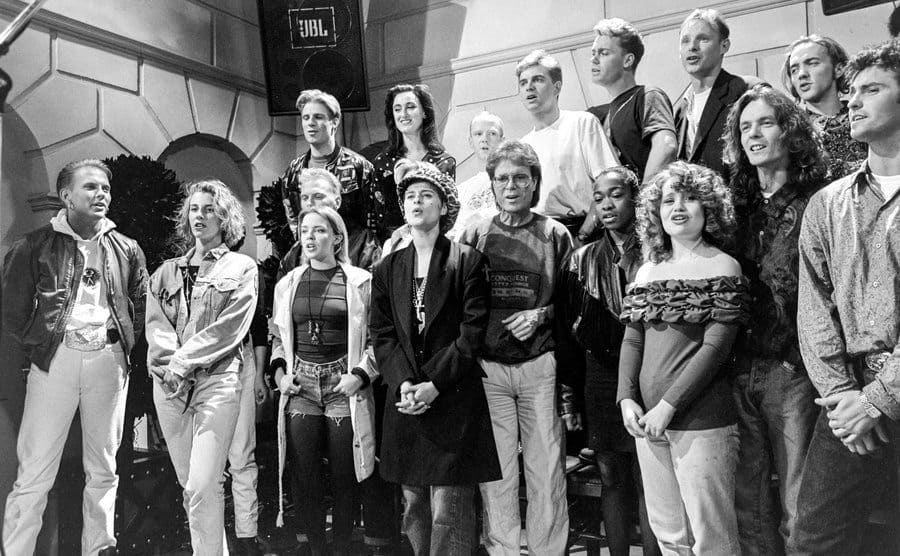
Here, we swap Bono, Boy George, Sting and Paul Young for a considerably younger crowd. Kylie is on opening line duties, followed by Chris Rea and Jimmy Somerville. We meet Jason Donovan, Sonia, Lisa Stansfield, Bros and Wet Wet Wet again, after their recent chart-topping successes. The only singers to reprise their roles from 1984 are two-thirds of Bananarama (Siobhan Fahey having left the year before). To be honest, I struggled to recognise many voices without watching the video, which isn’t a problem you have with the original. One voice stands out above the rest, though: Sir Cliff, who makes it two Xmas #1s in a row (and who will, without wanting to give too much away, soon be making it three).
The production is muted and respectful by SAW’s usual standards, which was probably to be expected. The video is standard: Michael Buerk reporting from Ethiopia, horrifying images of malnutritional babies spliced with footage of Marti Pellow and Matt Goss goofing about. We’ll leave Band Aid II to play out here, bringing the 1980s to a close, and instead muse on the final year of the decade.
1989 has been, I’m going to stick my neck out here, a game-changing year. It’s set the template for modern pop music, in various ways. Firstly, on a purely technical level, songs have started to enter regularly at #1. They’ll continue to do so throughout the 1990s, speeding up the turnover of chart-toppers. As well as that, we’ve had the first ‘modern’ dance #1 from Black Box, from which almost every subsequent dance smash can be traced. We’ve met the first ‘modern’ boy band too, in New Kids on the Block.
Meanwhile, rock music is no longer the force that it has been since the late ‘50s. Rock groups will still make #1, as U2 and Simple Minds have recently done, but often for one week only, thanks to fanbase support rather than genuine cultural heft. And finally, Madonna has defined the ‘modern’ female pop star, and the pop comeback (and comeback video) as a massive event that every pop star since 1989 has tried to mimic.
Next up, we’ll be embarking on the 1990s – the decade in which I came of age, among Britpop, dance, the Spice Girls and boy-bands. I’m looking forward to reliving it. But, you could argue that the nineties began a year earlier, in the final year of the decade that taste forgot…
Let’s Party, by Jive Bunny & The Mastermixers (their 3rd and final #1)
1 week, from 10th – 17th December 1989
Blunderbusses at the ready, for surely you knew it was coming. With a chart-topper in the summer, and one in the autumn, Jive Bunny and his Mastermixers set their sights on the Christmas number one.
And after two rock ‘n’ roll medleys, he’s skipped forward a decade or so, to the glam Christmas classics of the seventies and early eighties. A Noddy Holder soundalike is on C’mon everybody! duties, as well as his classic It’s Chriiiisstmaaaass… line from ‘Merry Xmas Everybody’. This version sounds muted by comparison to Slade’s raucous original, but it only lasts for a verse and a chorus, before Wizzard take over.
Yes, ‘I Wish It Could Be Christmas Everyday’ finally assumes its rightful position atop the charts. It’s just a shame that it took this crap to get it there. Unlike Slade, Roy Wood endorsed this sampling, and even re-recorded his vocals for the occasion. That done, the 3rd song is announced: Ok Gazza, take it away…
And it’s ‘Another Rock and Roll Christmas’, Gary Glitter’s 1984 comeback hit. Given that he was also involved in last year’s ‘Doctorin’ the Tardis’, it’s easy to forget just how big a part of British popular culture he was before his trip to PC World. Presents hanging from the trees, You’ll never guess what you’ve got from me… (We’d rather not find out, Gary.) Apparently he’s been replaced with Mariah Carey in more recent versions of ‘Let’s Party’, though who exactly has listened to this song at any point in the last thirty years is beyond me.
The thumping beat that holds this whole mess together is called ‘March of the Mods’, which I don’t think has anything to do with Christmas. Why didn’t they try something from ‘The Nutcracker’, at least? And while I complained about some of the mixing on JB’s earlier #1s, at least attempts were made to stitch those songs together. Here the three Christmas songs and the filler beat slam together like dodgems. I found some cheesy, madcap charm in the previous chart-toppers, but here my patience runs out fast. (The sleeve above lists the record as a double-‘A’, alongside a version of ‘Auld Lang Syne’. Thankfully the Official Charts Company only lists ‘Let’s Party’, so I’ll follow their lead and pretend the Bunny’s desecration of Rabbie Burns never happened…)
What in the hell is going on…? a voice demands towards the end, a sentiment I wholeheartedly echo. J-J-Jive Bunny! someone else replies. Meanwhile the fake Noddy Holder aggressively bellows Let’s Party! It’s a mess, and not a hot one. Yet it entered the chart at #1, and meant that Jive Bunny joined Gerry & The Pacemakers and Frankie Goes to Hollywood in making top spot with their first three releases (the fact that Jive Bunny did it quickest is another feather in his cap).
He and the Mastermixers still had two Top 10 hits to come, and would continue releasing singles until well into 1991. But, thankfully, they won’t be troubling this blog again. And, despite the clear demand for this single, it was never going to be 1989’s Christmas Number One. We have Bob Geldof to thank for that.
(This is the original video, but with the Gary Glitter verse edited out and replaced with the second verse of ‘I Wish It Could Be Christmas Everyday’.)
(This sounds to me like a re-recording – with slightly more modern production values – but with he-who-shall-not-be-named left in…)
The 1990s, the decade that we are on the verge of entering, will mean many musical delights. Grunge, Britpop, blockbuster movie soundtracks, Girl Power, the Vengaboys… But you could argue that, ahead of everything, it will be the decade of the Boy Band ™
You Got It (The Right Stuff), by New Kids on the Block (their 1st of two #1s)
3 weeks, from 19th November – 10th December 1989
From beginning to end – literally, as the first and last #1s of the decade will be by a boyband – groups of three to five handsome young men in baggy jeans and backward-facing caps will dominate. Boyz II Men, Take That, Boyzone, Hanson, 5ive to name but a few. And all kicked off by five boys from Dorchester, Massachusetts.
Let’s take a moment, before we start dissecting this record properly, to thank the stars that it’s not a ballad. Wherever boybands go, a drippy love song is never far behind. But no, ‘You Got It (The Right Stuff)’ is a classic serving of late-80s R&B fused with hints of new jack swing. The drums ratatat, the synths swoosh, the bassline is actually pretty cool… It all sounds wonderfully dated. And, in true boyband fashion, the lyrics amount to some pretty nothings and some half-hearted innuendo. First kiss was a sweet was a kiss, Second kiss had a twist… What the ‘twist’ is, or indeed the ‘right stuff’ of the title, is never specified. It’s all dates and kisses, with one mildly risqué mention of being ‘turned on’.
The bridge is the most modern part of the record, a soaring template to be followed by every boyband to come. All that I needed was you, Oh girl, You’re so right… You can just picture the clenched fists as the Kids meet that line. And then there’s the hook in the chorus, the oh-oh-ohohohs that’s as catchy as it is annoying. The video – again, as was traditional for ‘90s boybands – sees them dressed like idiots, dancing like idiots, having a great time in a deserted bar. They then chase some girls around a graveyard, for reasons best left mysterious…
To suggest that New Kids on the Block (NKOTB if you’re in the know) were the first boyband is wrong. At the same time, defining a ‘boyband’ is like catching mist in a jar. If you go by the literal definition – boys in a band – then we’re going to go back to the Crickets, at least. If you insist on the manufactured aspect of it, then we start at the Monkees. But what of the Jacksons and the Osmonds? What of New Edition? Bros? (And I was only mentioning acts we’ve met earlier in this blog.)
Let’s say NKOTB are the first ‘modern’ boyband, then. They were managed by Maurice Starr (also the mastermind behind New Edition) and composed of four school friends led by Donnie Wahlberg (brother of actor Mark) and a younger boy, Joey McIntyre. Unlike some boybands, the path to success hadn’t been smooth for NKOTB: they’d been together since 1984 and were on the verge of being dropped by their label before ‘Please Don’t Go Girl’ made #10 in the US. ‘You Got It’ was the second single from their second album, and their first chart hit in the UK. They’d go on to have nine more Top 10 singles between 1989 and 1992, including one further #1 coming up very soon.
And so we enter the era of the (modern) boyband. And for a taster, ‘You Got It (The Right Stuff)’ is neither a classic of the genre, nor terrible. There are much better boyband chart-toppers to come, and much worse.
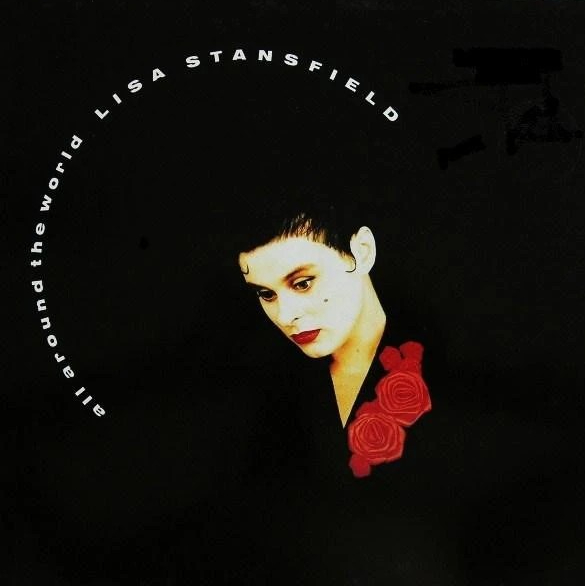
An under-represented genre at the top of the British charts, in the late 1980s, was the neo-soul of Seal, Sade, and Terence Trent D-Arby… Even Prince went without a UK #1 for a long time. Perhaps Lisa Stansfield’s first chart-topper is as close as we’re going to get…
All Around the World, by Lisa Stansfield (her 1st of two #1s)
2 weeks, from 5th – 19th November 1989
If you’re being harsh you might call this sort of smooth and glossy R&B ‘dinner-party soul’ – soft background music you’d hear while munching asparagus tips in an Islington townhouse. And it would be especially harsh on this record, as it’s a lot more lively than some of its contemporaries. I don’t know where my baby is… Lisa Stansfield purrs in the spoken intro… But I’ll find him… She is famously northern, from Manchester, but she does a passable American accent (which was probably wise, as it might not have made #3 in the US if she’d sounded like someone from ‘Coronation Street’).
The verses are a little too tidy, a little too glossy. Bland, even. This is what the late ‘80s would have sounded like without Stock Aitken Waterman to liven them up (I’ve resigned myself to missing SAW when their hits dry up…) But the chorus picks things up, and it comes with a great hook: Been around the world and aye-aye-aye, I can’t find my baby…
There’s drama too, in the strings and the middle-eight: I did too much lyin’, Wasted too much time… and through the length of the record Stansfield shows off the full-range of her vocal talents. She trills, growls, and hits some impressive high-notes. If you didn’t know what she looked like, you might imagine a black soul diva rather than a skinny Manc lass. By the end, as she starts harmonising with herself, it’s a little OTT; but you can forgive the exuberance.
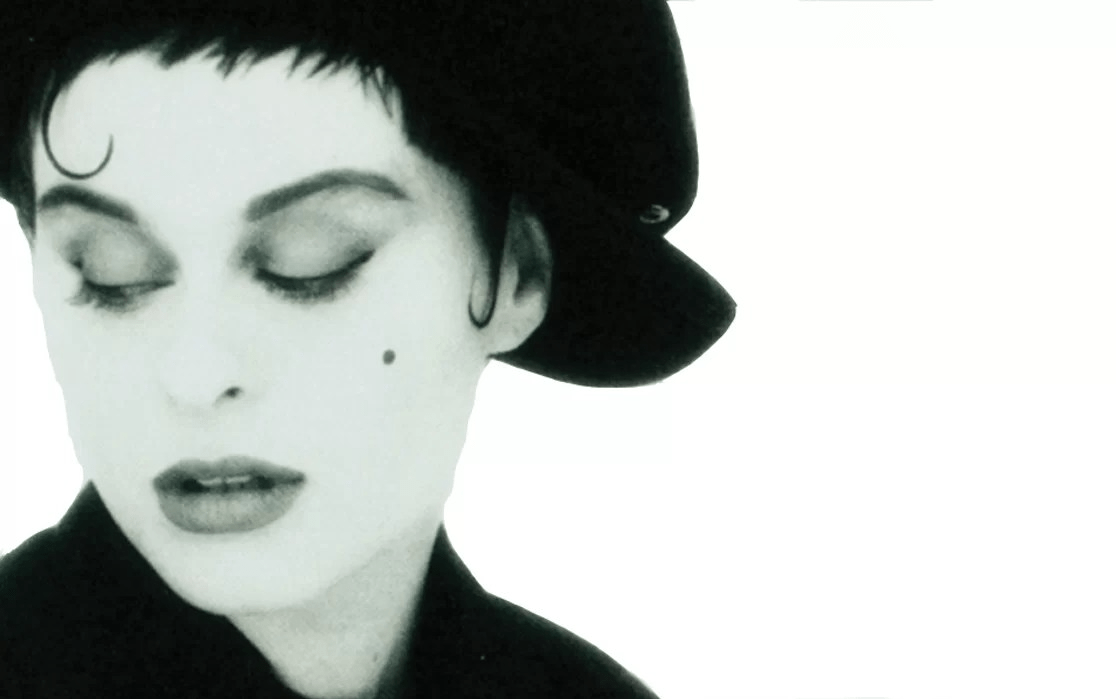
Lisa Stansfield had been releasing music since 1981 – both solo and as part of the band Blue Zone – but to little fanfare until she teamed up with production duo Coldcut. Earlier in ’89 they had released the house classic ‘People Hold On’, establishing her as a vocalist. ‘All Around the World’ was her second solo hit, helped by her distinctive look in the video, the short hair with Betty Boop kiss-curls.
Stansfield would continue scoring Top 10 hits throughout the nineties, including one further chart-topper to come. Meanwhile, we find ourselves with just three #1s left in this decade! Time flies… And if ‘All Around the World’ gives us a perfect mash-up of late-80s/early-90s sounds, our next chart-topper is an ear-popping vision of the decade to come.
He’s back! The biggest chart star of 1989, the hottest medley-maker of the decade, the most successful rabbit in pop history, returns!
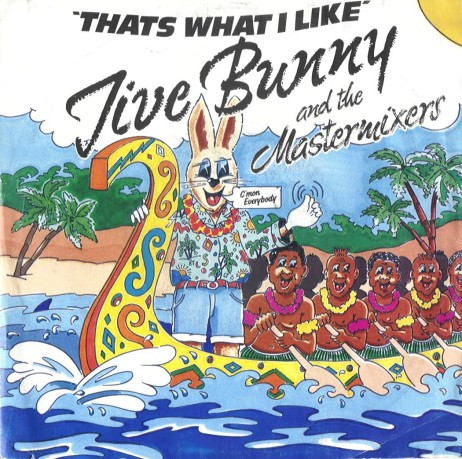
That’s What I Like, by Jive Bunny & The Mastermixers (their 2nd of three #1s)
3 weeks, from 15th October – 5th November 1989
C’mon everybody… Jason Derulo, DJ Khaled, Pitbull: all the biggest morons have their own call-signs by which to announce themselves at the start of a new record, and Jive Bunny is no exception… C-C-C’mon everybody! After that, we’re off on another double-speed tour around some golden oldies: ‘Let’s Dance’, ‘Great Balls of Fire’, ‘Runaround Sue’ and more… Bill Haley, Eddie Cochran and Little Richard have the honour of appearing on their second straight Mastermixers’ release. (I’ve just realised something truly upsetting – these are as close as Little Richard ever came to a #1 single…) Though, as in the first Jive Bunny record, a lot of the vocals are clearly performed by impersonators. The theme to ‘Hawaii 5-0’ does the job of ‘In the Mood’ here, and bookends the entire party.
As before, the whole thing is completely incongruous, and wholly ridiculous. And yet, I still can’t hate it. In fact, it gives you a new-found respect for what are already classic songs, that they can be dropped from a great height into this hot mess and still shine through. In the Mastermixers’ defence, the transitions between the songs are slightly smoother here than in ‘Swing the Mood’. They were clearly honing their craft.
And let’s be clear: the fact that this topped the charts just six weeks after their first #1 confirms that Jive Bunny fever was clearly sweeping the country in the autumn of 1989. They were just giving the public what they so craved – what they liked, as it were. (The title comes from the Big Bopper’s lascivious Oooh baby that’s what I like… in ‘Chantilly Lace’.)
As with ‘Swing the Mood’, ‘That’s What I Like’ was a huge hit throughout Europe (though returns were slowly diminishing, and the UK was the only territory in which it made #1). Even the US wasn’t immune to the rabbit’s charms, with this making #69 on the back of a very impressive #11 peak for ‘Swing…’ Twas, for a short time, Jive Bunny’s world, and we were just living in it.
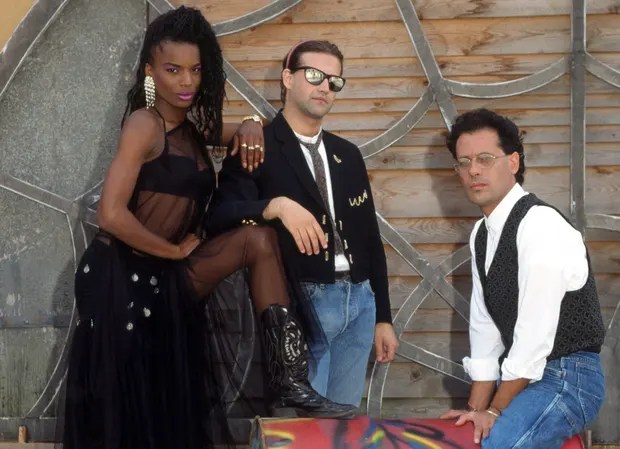
Ride on Time, by Black Box (their 1st and only #1)
6 weeks, from 3rd September – 15th October 1989
I’m a child of the nineties, the decade in which the music we recognise today as ‘dance’ really came into being. There have been dance #1s popping up regularly throughout the second half of the 1980s but, as good as many of them have been (‘Theme from S-Express’ says ‘hello’), they have sounded quite dated – often chaotic mish-mashes of samples and sound effects.
‘Ride on Time’, however, is much less cluttered – just a beat, a few synth hooks, a classic piano riff – but all the more weighty for it. One of the song’s creators mentioned wanting to create a dance track with the power of a rock song. And then there are the vocals. Though I think describing them as just ‘vocals’ isn’t quite doing them justice. They are colossal, momentous… add whatever synonym for ‘very big’ you want. There aren’t many lines, and half of them are just woah-wa-wa-wa-oh, but not for nothing is this record classed under the sub-heading ‘diva house’. The singer does a great job. I hesitate in naming this ‘singer’, as there was a lot of controversy over who they actually were. The record originally used the vocals of a 1980 hit by Loleatta Holloway, called ‘Love Sensation’, which Black Box didn’t have the rights to. They then re-recorded the track with Heather Small, soon to become a star in her own right with M People.
To confuse matters further, the woman in the video and the record sleeve below is model Katrin Quinol, who had been brought in to mime on TV performances and the like. I’m not 100% sure which version I’ve been listening to – a search for ‘Ride on Time Heather Small’ on YouTube throws up nothing – but since Black Box finally bought the rights to ‘Love Sensation’ in 2018 I assume it’s Loleatta Holloway’s big lungs that are blasting my cobwebs away. Sadly she died in 2011, though she did eventually receive enough royalties from the song to, as she put it, buy herself a fur coat.
Every time an electronic dance number one comes along, I feel contractually obliged to mention that it isn’t my favourite genre. I’m guitars and drums all day long. But good dance, just like good rap and good reggae, can transcend my fussy tastes. Good is good, and ‘Ride on Time’ is pretty darn good. (I said a lot of the same stuff about Soul II Soul’s ‘Back to Life’ and, although the two songs have very different vibes, they are two sides of the same futuristic dance coin.) I’d go as far as to say that, in the right nightclub, in the right mood, ‘Ride on Time’ could be euphoric. And it also feels like a direct riposte to the cheap ‘n’ cheesy tat that it replaced at #1…
And as I said above, ‘Ride on Time’ feels much more streamlined and precise after previous years’ big dance hits. But that’s not the only reason, I don’t think, for it being a huge, game-changing hit. It also, cleverly, harks back to disco, with its big-voiced diva on lead vocals, giving a timeless sheen to its very modern sound. And also, we have to nod our heads to acts like Pet Shop Boys, and even Stock Aitken Waterman, for making pop music much more dance-oriented over the past couple of years. In the ‘60s and ‘70s ‘pop’ usually equalled ‘rock’ (think Merseybeat, and glam), while in the 80s ‘pop’ has shifted in a dancier direction. The 90s will see pop shift back to guitars, and then towards an R&B/hip-hop future.
Black Box were an Italian act, kicking off a trend for European DJs and dance acts scoring big hits across the Channel, often in the autumn after Brits had spent the summer on Mediterranean beaches. The Euro-house influences are clear, and very different from the American house we’ve met up to now. Clearer, classier… dare we give into stereotypes and say ‘chic’? My favourite aspect of the song is that the lyrics are clearly Because you’re right on time… But the Italian DJs’ English wasn’t great, and they misheard it as ‘Ride’. Which I think is cute (and much more memorable than the correct phrase).
And yet, for all my talk of game-changing modernity, the charts will do what they always do and completely disprove all my blethering with the next number one. Yes, that damn rabbit is back, next.