I knew the chorus of this song, as everyone does, what with it having firmly imbedded itself in our popular culture. And so, I was fully expecting a cheesy, sing-along record…
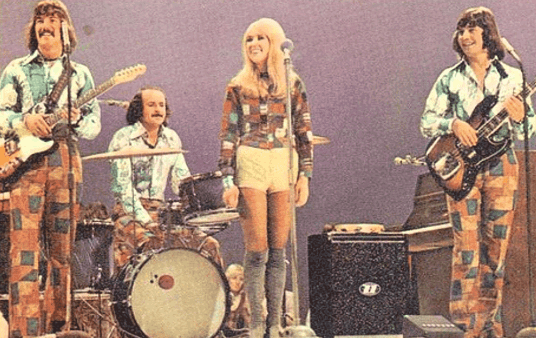
I’d Like to Teach the World to Sing (In Perfect Harmony), by The New Seekers (their 1st of two #1s)
4 weeks, from 2nd – 30th January 1972
…but was not prepared for just how sickly saccharine this song truly is. Do not play this record on a full stomach! The melody is jaunty, the vocals are twee: I’d like to build the world a home, And furnish it with love… Grow apple trees, And honey bees, And snow-white turtle doves… I mean, eeesh. (*Insert vomiting emoji*)
The singers, with their gentle acoustic guitars, sound like earnest church youth-camp leaders around a campfire. Or the bouncy volunteers that confront you on the street, asking for your signature in some worthy cause. I’d like to teach the world to sing, In perfect harmony, And I’d like to hold it in my arms, And keep it company… They sound utterly insufferable – in case I wasn’t making that clear – though I wouldn’t bet against at least two of them having a crippling drug addiction, because nobody is naturally this perky. I do like the bass-line, though.
The message is one of peace and love, obviously, which is nice and all. But the lyrics never get above ‘primary school assembly’ level. We’d all like everyone to get along better and love another, obviously, but the Summer of Love has been and gone – with far better music than this – while a couple of years ago it was all doom and gloom at the top of the charts: ‘Bad Moon Rising’ and ‘In the Year 2525’. This record is the sound of people giving up on the hippy dream and/or a cynical counter-culture, and settling for meaningless crap. And listening to this today, given the absolute shitshow that 2020 has been so far, well it’s almost unbearable.
Plus. Plus, plus, plus. The one other thing that everyone knows about ‘I’d Like to Teach the World to Sing’, other than the sugary chorus, is that it originated from a jingle in a Coca-Cola advert. I’d like to buy the world a coke… etc. etc. For this ‘anthem’ of world-peace to have stemmed from one of the world’s mega-corporations, a company that floods every corner of the globe with its spectacularly unhealthy soft drinks and subsequent litter, is the piece de resistance. It’s actually quite funny.
I’ll get down from my high-horse now. This record wasn’t meant to be taken so seriously. It’s just a cute little pop song aimed at the kids. But, at the same time – back on the high horse for a second – I can’t help feeling that, for people in 1972, spending a few pounds on this shite was the same as people nowadays changing their Facebook profile to reflect whatever the week’s worthy cause is. Making the doer feel better about their privilege, while making no difference whatsoever to the world’s problems.
In fact, I’ve grown to detest this record so much in the past half an hour that I’m going to make a bold, bold claim. That it is worse than ‘Chirpy Chirpy Cheep Cheep’. Yes. ‘CCCC’ was inane and annoying. ‘ILTTTWTS(IPH)’ – that’s one hell of an abbreviation – is inane, annoying, and has ideas way above its station.
Finally, one question needs answering. What relation did The New Seekers have to The (old) Seekers, the Australian folk-pop act who scored two #1s in 1965 with the average ‘I’ll Never Find Another You’ and the dirgey ‘The Carnival Is Over’. Well, both bands share one member: Keith Potger, guitarist, who founded The New Seekers in 1969. They had scored a #2 the year before with ‘Never Ending Song of Love’ and will, I’m sure you’ll be thrilled to discover, top the charts one more time before leaving us in peace forever. Till then…
Follow along through the first (almost) 20 years of the charts, with this playlist:
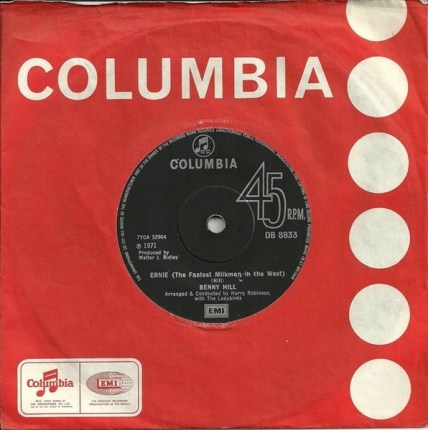
Oh God. You know we must have reached the festive season, when a song like this comes along. Join us then, for the story of Ernie, driver of the fastest milk-cart in the west, and his sworn rival, Two-Tonne Ted, the baker…
Ernie (The Fastest Milkman in the West), by Benny Hill (his 1st and only #1)
4 weeks, from 5th December 1971 – 2nd January 1972
It’s set to a faux-Spaghetti Western theme, but narrated (‘sung’ would be too generous a verb) in a west-country accent by comedian Benny Hill. And did someone say ‘innuendo’? Because this song is an innuendo smorgasbord, a triple-shot of double-entendres…
Ernie comes galloping into Market Street, to meet his lady-love, a widow called Sue. They said she was too good for him, She was haughty, proud and chic, But Ernie got his cocoa there, Three times every week… Oo-er, matron, and so forth. On we go – this is a story told at breakneck speed.
Ernie can’t compete with Ted’s wide range of pastries: He tempted her with his treacle tarts, And his tasty wholemeal breads, And when she saw the size, Of his hot-meat pies, It very near turned her head… I’m smiling as I listen, even though I should really know better… He knew once she’d sampled his layer-cake, He’d have his wicked way… Meanwhile, Ernie can but offer milk, and not much else.
So Ernie and Ted have a shoot-out, as must happen in all the best Westerns. As he leapt down from his van, Hot-blood through his veins did course, And he went across to Ernie’s cart, And he didn’t ‘alf kick his ‘orse… (Do you have to be British to get this ropey wordplay?) …whose name was Trigger… Two-Tonne Ted fights dirty, of course, throwing a stale pork-pie that kills Ernie. Sob. Now it’s a pastiche of the old early sixties death-discs, ‘Tell Laura I Love Her’, ‘Johnny Remember Me’ and the like. Two piss-takes for the price of one!
But. A woman’s needs are many-fold. Sue marries Ted regardless. And on their wedding night, as they lie in their bed, they are haunted by Ernie’s ghostly gold-tops a-rattling in their crate…They won’t forget Ernie! It’s actually a bit of a dud finish to what, compared to most novelty records, has been a pretty funny song. You know, for its time. It also has what must be one of the first music videos – see below. (I do enjoy the fact that Ted still has his hat on in bed.)
For the fourth year running, then, we have a novelty #1 single at Christmas. You can blame The Scaffold for starting it, with the irritating ‘Lily the Pink’, then it was ‘Two Little Boys’, ‘Grandad’ (which hit top-spot just after New Year), and now this. And, for what it’s worth, I like ‘Ernie’ the best of the four. It’s aiming squarely for silly. Not smart, not sentimental… Just plain old pantomime, music-hall, very British, ‘silly’. Not that I’m rushing to add it to my Spotify queue, either, but still.
Benny Hill actually was a milkman, before hitting the big-time, and had written this back in the fifties. He performed it on his show – which in 1971 was pulling in 21 million viewers! (there were only three channels, to be fair) – and then released it as a single. For me, Hill is a slightly vague figure from a time before I was born. He wasn’t on TV growing up, having been pushed aside by the new wave of comedy acts in the eighties. He’s reduced, in my mind, to his famous theme tune playing as he gets chased by an irate crowd.
At the same time, though, I just watched a few of clips on YouTube, and they raised a smile. They’re old-fashioned, and ‘of their time’, but they’re funny, in the worthy tradition of Charlie Chaplin (a huge fan of Hill’s) and Mr. Bean. Plus, you’ll just have to get used to silly novelty songs cropping up every December… and not many will be as tolerable as this!
Without wanting to repeat myself… Having covered over three hundred #1s now, and I’ve come to realise the importance of a song’s intro. Sometimes, as a casual listener, they pass you by. But when you’re here to write about the song, when you’re poised to commit your first impressions to paper, the intro is everything.
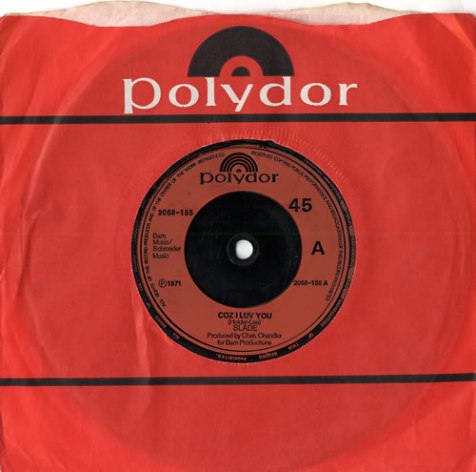
Coz I Luv You, by Slade (their 1st of six #1s)
4 weeks, from 7th November – 5th December 1971
All of which is me building up to the fact that ‘Coz I Luv You’ has a great intro. In stereo, it sounds like someone in chunky boots, stomping down a corridor. Then the music, which can only be described as ‘menacing’. It’s Slade, Britain’s most successful glam-rock act, but this isn’t a very ‘glam’ record. Noddy Holder’s vocals start off light, and sneering: I won’t laugh at you, When you boo-hoo-hoo, Cause I love you…
Then a big beefy bass comes in, as Holder’s voice grows fuller: I just like the things you do, Don’t you change the things you do… You can draw a couple of similarities between this and the previous number one, Rod Stewart’s ‘Maggie May’ / ‘Reason to Believe’. Both songs are concerned with the singer being in love with a pretty terrible sounding woman. In ‘Coz I Luv You’: You make me out a clown, And you put me down… I still love you…
The other is the violin – though the country version from ‘Reason…’ has been distorted into an electric monster here, making the solo sound like an Irish jig from the bowels of hell. Apparently, Jim Lea – who played the violin on it – thinks the song sounds ‘soft’ and ‘namby-pamby’… Which begs the question: what the hell would he classify as ‘hard’? As the song fades out with the stomping and the violin, and some added shouting for good measure, it sounds like a gang of hooligans striding home from the pub, ready for their next punch-up.
I like this song, and I love Slade, but it stands out because it doesn’t really sound like the ‘Slade’ everyone knows. By their next number one they will, though. Like T. Rex, Slade had been around long before glam. Unlike T. Rex, they’d spent the final years of the sixties playing soul and Motown covers and sporting skinheads. Maybe ‘Coz I Luv You’ represents the last gasp of the ‘old’ Slade (Ambrose Slade, as they were called), before they sold their souls to glam. Though even at their peak, when they were wearing sparkly hats, platform shoes and cravats, I think don’t think they could ever quite mascara-out being four bruisers from Wolverhampton.
By the end, Holder’s voice has transformed completely, as he bellows out the closing lines. There’s another similarity to Rod Stewart – two of rock’s throatiest voices topping the charts in a row. One thing that is very Slade, and that’s already here in all its glory, is their shortened song titles. I used to think they looked crazily modern, using text-speak in the early seventies, when mobile phones were the stuff of science-fiction, but apparently it was an attempt to mimic the Birmingham/Black County dialect.
So, there we have it. This is already the second-last #1 of 1971 – it feels like we’ve raced through the year – welcoming some huge names: T. Rex, Rod, Slade… Middle of the Road… Like I said, and as I’m not sure came through from the write-up, I really like this song. It just sounds so belligerent, so menacing, so not #1-on-the-pop-charts material at all…
And so we welcome to the stage a true rock icon, a man who sells albums and fills stadiums to this day. Sir Rod Stewart. (I’m assuming he’s a ‘Sir’. Sort it out, Queenie, if he isn’t.)
Maggie May / Reason to Believe, by Rod Stewart (his 1st of six #1s)
5 weeks, from 3rd October – 7th November 1971
This was his very first solo single release to make the charts. Straight to the top with a bullet, with what is his most famous song? I don’t think I’ve ever heard the ‘single’ version of ‘Maggie May’, which is a full two minutes shorter than the extended version I grew up with. It’s the same intro, albeit condensed, a confident acoustic riff, then two emphatic drumbeats announcing that the story is ready to begin. Wake up Maggie, I think I got something to say to you…
Young Rod has been seduced by an older woman, spent a summer with her, and is now starting to wake up to the harsh realities of their relationship. It’s late September and I really should be back at school… ‘Maggie May’ is famously based on Stewart’s encounter with a real woman, at a Jazz festival when he was sixteen. Getting away from the slightly predatory story – imagine if the genders were reversed – the lyrics capture perfectly the voice of a callous teen, coupled with some corny rhymes: I laughed at all your jokes, My love you didn’t need to coax… And then the classic: The morning sun when it’s in your face really shows your age… Harsh!
He loves her, but wishes he’d never seen her face. We’ve all been there. Young Rod sounds like a bit of a tearaway – his options post-Maggie are either becoming a roadie or making a living out of playing pool… I’m sure he’ll be fine, and get over the heartbreak. Anyway, the whole song is basically him rehearsing what he’s going to say to Maggie. He hasn’t broke it off just yet! It hinges on the opening and closing lines: I think I’ve got something to say to you… and I’ll get on back home, One of these days…
Unfortunately, the single version cuts the best verse, the one with the: You turned into a lover and mother what a lover you wore me out! line. Maybe that would have been too ripe for daytime radio. Then comes the solo, and the mandolin outro, one of the Celtic-sounding elements that often pop up in Rod Stewart’s music. It’s an undeniable classic, one that – cliched but true – still sounds fresh today. One that no amount of terrible pub karaoke versions can ruin. And while the woman may have been real, her name wasn’t ‘Maggie May’ – she was a famous Liverpudlian prostitute. I’m sure the actual ‘Maggie’ was delighted by the comparison…
It’s been a long old while since we had a double-‘A’ hit the top of the charts – not since Louis Armstrong in 1968. On the flip we have Rod’s cover of ‘Reason to Believe’, a song I’m certain I’ve never heard before. It opens with a lonesome piano, before the vocals come in. Both these songs are very much focused on Stewart’s voice. Which is fair enough, as he does have one of the best.
If I listen, Long enough, To you… I’d find a way, To believe, That it’s all true… In ‘Maggie May’, he was trying to convince himself to leave someone. In this song, he’s trying to talk himself into staying, despite knowing that his lover lied: straight faced, while I cried… He needs a reason to believe in her. The two songs work well together, both in terms of the sound and the lyrical theme.
A fiddle gives this record the country feel that the mandolin gave ‘Maggie May’. Then midway through, we’re left with just the voice. Someone like you, Makes it hard to live, Without, Somebody else… It’s a nice song, that slowly grows on the listener; but it’s no ‘Maggie May’. Technically, ‘Reason to Believe’ was the song first pushed to radio when the disc was released, but the song on the other side quickly won through. Maybe it was because The Carpenters had released a version of the song the year before – a classic Carpentersy-country version – while the folky original had been recorded in 1965, by Tim Hardin, that the label thought ‘Reason…’ might have caught people’s attention quicker.
For, while this was Rod Stewart’s first charting single, it wasn’t his first attempt at a solo career. He’d been releasing singles since 1964, and had spent the sixties busking, playing session gigs and jumping between bands. Then came The Jeff Beck Group, in which he met Ronnie Wood, and then The Faces (basically The Small Faces minus lead singer Steve Marriott), with whom he was having hits alongside his solo work in the early seventies. After this huge five-week #1 smash there will be no looking back for Rod – he’ll go on to become one of the decades’ biggest stars, on either side of the Atlantic, and we’ll be meeting him plenty more times in the months to come.
Our last number one was a glossy, highly polished number from one of the world’s biggest female stars – Ms. Diana Ross. Which contrasts completely with this rough-and-ready next chart topper.
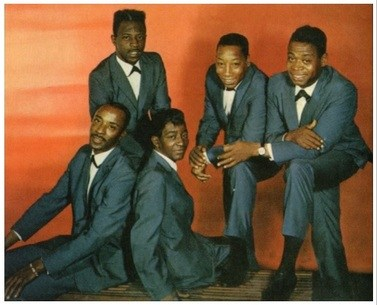
Hey Girl Don’t Bother Me, by The Tams (their 1st and only #1)
3 weeks, from 12th September – 3rd October 1971
It starts with a simple drums and guitar intro. Then a refrain: Hey girl, don’t bother me… Hey girl, don’t bother me… Standard male vocal group stuff – think the Four Tops or the Miracles – but on a budget. Someone’s going for the Motown sound but without the backing of a major record label.
The lead singers voice is raspy and endearing: I heard about you from my friends… (I love the way he drags ‘friends’ out in a very ‘Murican way) The word really gets around… They say you broke the heart, Of every boy in town… He begs this floozy to stay away: Stay outta my arms, Don’t try to use your charms… Don’t bother me…
It’s a sweet song, despite the subject matter, and one that’s likeable from the start. When the handclaps start it seals this disc’s lo-fi charm. In the second verse, the singer admits that the girl is tempting, despite her reputation: But I really gotta say, You look so fine… He stands firm, though, determined not to be added to her list.
‘Hey Girl Don’t Bother Me’ stands right out in this countdown. We’re in the autumn of 1971, but this song sounds like a complete throwback. And that makes sense, seeing as it was recorded in 1964. To my ears it could have been even earlier. The Tams were a vocal group from Atlanta, who had had minor chart successes in the sixties but whose records were picked up by northern soul clubs in the UK. I can’t claim to be an expert on the northern soul scene in the seventies, but it was an offshoot of Mod culture, mainly in clubs in the north of England: Manchester, Wigan, Blackpool, down to Birmingham. They pushed lots of old soul discs back into the charts, and this one by The Tams made it all the way to the top.
You can see why ‘Hey Girl…’ took off like it did. It’s a throwback, but it has enough of a guitar line and a stomp for it to fit in with the early seventies’ sound. You can imagine Mud doing a soft-glam cover version. Though I’m sure The Tams weren’t complaining, or inquiring as to the reasons for their sudden career resurgence in the UK. They will enjoy another mini-comeback fifteen years later, when their hit ‘There Ain’t Nothing Like Shagging’ makes #21 in 1987. (Stop giggling there at the back!) The ‘Shag’ is a dance, you see, (the official state dance of South Carolina!) and according to the song: There ain’t nothing like shagging, When you’re shagging with the one you love… There was a follow-up too – ‘My Baby Sure Can Shag!’ (Stop it!) Unfortunately, both were banned by a humourless BBC because ‘shagging’ means, erm, something else in Britain…
Anyway, back to ‘Hey Girl…’ It’s worth nothing that this is the third re-release to make #1 in the space of a year, following ‘The Tears of a Clown’ and ‘Voodoo Chile’. Not sure what to make of that… Were people already missing the sixties? Was it just a coincidence? It’s certainly adding to the already very eclectic feel of the charts in the early seventies!
For the second time this year, a former member of one of the sixties biggest groups scores a solo #1 single. From George Harrison, to Diana Ross. From The Supremes, to Diana Ross & The Supremes, to Diana. Just Diana.
I’m Still Waiting, by Diana Ross (her 1st of two #1s)
4 weeks, from 15th August – 12th September 1971
The first word that comes to mind when this record intros is ‘polished’: polished strings, glossy production, not a dollar spared. Ross’s vocals, when they come in, are breathy and crystal clear. I remember when, I was five and you were ten, boy… Diana Ross, as always, has a voice you could swim in.
She’s loved this lad since they were kids, thought they were destined to be together, only to one day be told: Little girl, Please don’t wait for me, Wait patiently for love, Someday it will surely come… But Diana can’t take this advice, can’t give up on her first love. She’s still waiting.
It’s a record that I’m struggling to get into. I can see that it’s good – well-structured and beautifully recorded. It’s pop, but for grown-ups. Sophisticated soul. By the seventies, the people who had grown up buying pop music were getting older, and that starts to show in the number of AOR/MOR (not sure if these terms existed in 1971, but still) tracks that will become huge hits in this decade. Pop was no longer just for teenagers.
And as I play it again, ‘I’m Still Waiting’ is slowly growing on me. I don’t love it, yet, but it’s gradually imprinting on my brain. It’s not short of hooks – the Little girl chorus is catchy, as is the AndI’m still waiting… that hangs at the end of each of chorus. And there’s the I’m just a fool…! from the backing singers. And then, Diana speaks. Love has never shown his face, Since the day you walked out that door… Come back, Can’t you see it’s you I’m waiting for…
Will he ever come back? We’ll never know. The song shimmers to a fade-out. I can’t say I knew much about this record before writing this: it’s not one of Ms. Ross’s many hits that I could have named, that didn’t top the charts. Apparently it was one Tony Blackburn who plugged this album track so much on his radio show that Motown gave permission for it to be released in the UK. And it’s a sign of Ross’s longevity and sheer star quality that this #1 comes seven years after her first chart-topper with The Supremes (‘Baby Love’) and fifteen (!) years before her next chart-topper. She was a huge musical presence for the best part of five decades, and it’s been nice to discover this forgotten gem.
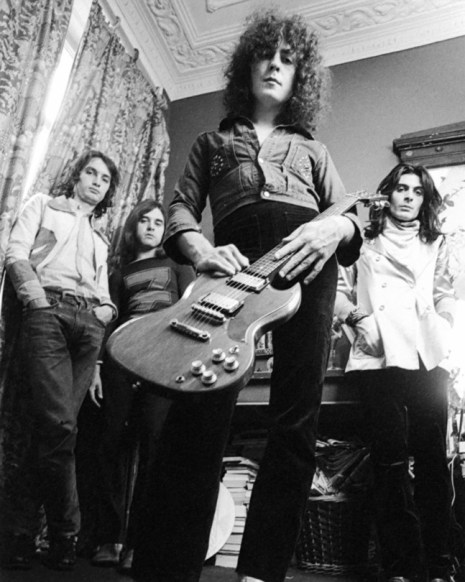
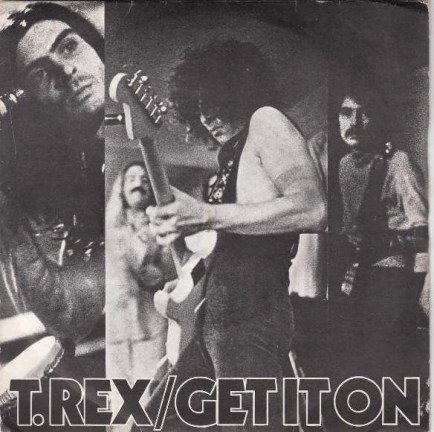
Aw yeah! T. Rex score their second number in less than three months. There are riffs, and there are riffs. This, baby, is a riff.
Get It On, by T. Rex (their 2nd of four #1s)
4 weeks, from 18th July – 15th August 1971
It’s a riff that growls and purrs, like a cat ready to pounce on its prey. Like a sports car purring at the start line, fuzzy and scuzzy. Then someone’s fingers slide down a set of piano keys – a glissando, if you want to be technical about it – and we’re off. Head first into the glam rock era.
Well you’re dirty sweet, Clad in black, Don’t look back, And I love you… Bolan’s in love with a vamp. You’re slim and you’re weak, With the teeth of a hydra upon you… She sounds like quite the woman. Get it on, Bang a gong, Get it on! Just what might he be singing about?
Sex. The answer is sex. Very few chart-toppers so far have been quite so up-front about the that fact they’re concerned with shagging, and nothing else. The only one that springs to mind, from a couple of years earlier, was ‘Je T’Aime’, and that was more funny than sexy. ‘Get It On’, though… Well, it’s all in the title. They might as well have called it ‘Let’s Fuck.’
Most of the time you’re not quite sure what Marc Bolan’s singing, and most of the time it simply does not matter. This is a record that sounds brilliant, that sounds like an idea come to life, and the lyrics are merely there to make up the runtime. And having looked them up, I’m not sure Bolan put more than two seconds thought into them: Well you’re an untamed youth, That’s the truth with your cloak full of eagles… and You’ve got the blues in your shoes and your stockings…. Dumb, and yet perfect. You just know that a girl with the blues in her shoes and stocking is going to be a handful.
There’s one line that’s always stood out to me – and I’ve loved this song a long time – and that’s: You’re built like a car, You got a hubcap diamond star halo… I have never met a woman who would take ‘You’re built like a car’ as a compliment. But, to be fair, if that line was going to work for anyone, it would be Marc Bolan.
Even when he’s not singing, the brazen, filthy horns keep up the raunchy atmosphere. Then towards the end he simply starts breathing, and hiccupping, and it still sounds X-rated. The moment, before the final chorus, when he breathes in then out, with a little tremor, is the probably the sexiest moment in a #1 single so far, bar none. Bear in mind, T. Rex’s audience were teenagers. T. Rexstasy was here and, for the briefest of moments, they were the biggest band since The Beatles.
Then he shouts Take me! as he gives himself over completely to this woman, and we slide to a finish that includes a snippet of Chuck Berry: Meanwhile, I’m still thinking… A line from ‘Little Queenie’, the song that inspired ‘Get It On’. And while the similarity is not immediate, if you listen to it, buried beneath the vocals and the trademark Berry licks, the riff is there. Bolan brought it out and set it centre stage.
Such is the power of this riff that in the 1990s, Prince and Oasis took it in completely different directions and still made two superb singles. Prince dialled the smut up even further for ‘Cream’, changing ‘dirty sweet’ to ‘filthy cute’, while Noel Gallagher did what he does best on ‘Cigarettes and Alcohol’: shamelessly plundering, turning the guitars up to five-hundred, and making his band the biggest in the land. Shove those two song into a playlist, alongside ‘Little Queenie’ and ‘Get It On’, and you’re got yourself a brilliant fifteen minutes.
As for T. Rex, if ‘Hot Love’ was the start, then this was the push that sent them flying. They would dominate the British charts for the next two years, and we’ll be meeting them twice yet. ‘Get It On’ was also the band’s only US hit, reaching the giddy heights of #12. Like, seriously, America…?
On with the next three-hundred! And our 301st #1 gets going with a promising glam rock stomp. Seriously, this is a great record… for the first three or four seconds.
Chirpy Chirpy Cheep Cheep, by Middle of the Road (their 1st and only #1)
5 weeks, from 13th June – 18th July 1971
Then the handclaps come in, and a voice that sounds like a knock-off Lulu. Where’s your mama gone? (Where’s your mama gone?)… Little baby bird… Far, far away… Mummy bird’s gone, flown the coop. Where’s your papa gone? (Where’s your papa gone?)… Daddy bird too. That’s half the song.
Then: Last night I heard my mama singin’ a song, Woke up this morning and my mama was gone… Oo-wee, Chirpy chirpy cheep cheep! That’s the second half of the song. It gets annoying, quickly. Did anyone say ‘bubblegum’?
No, that’s harsh. ‘Bubblegum’ needn’t be a dirty word. ‘Dizzy’, for example was a fine slice of bubblegum pop. I should have asked: did anyone say ‘cloyingly irritating novelty’? This is a record that shouldn’t appeal to anyone over the age of five. And yet, we all know it. I don’t think I’ve ever heard ‘Chirpy Chirpy Cheep Cheep’ in its entirety until now, but I sure as hell knew that chorus.
The lyrics – the four lines that make up this entire song – are actually quite sad. The singer is either a bird, abandoned in her nest. Or the singer is a child, abandoned by her parents, who sees an abandoned bird and feels a sense of kinship. To her credit, though, she’s not wallowing in despair. Oh no. She sounds as if she’s determined to make something of her life regardless of the tough start. Chirpy chirpy cheep cheep chirp!
I don’t mind a novelty, but this song makes very little sense, and midway through the chorus starts repeating over and over, and over. Let’s go now! You frantically check that this record isn’t actually six minutes long. All together now! No, just forty seconds left, thank God. One more time now! Phew.
Middle of the Road were (‘are’ actually, they’re still going) a Scottish band, who had a brief burst of fame in the UK in the early seventies, with this and other hits such as ‘Tweedle Dee, Tweedle Dum’ – which I listened to and found to be not as bad as their only #1. They were huge across Europe – I guess the simple lyrics and sugary tunes translated well – and I’ve seen some sources label them as a predecessor to ABBA. (Which is like saying the first ever wheel carved from a hunk of rock by a hairy caveman is a predecessor to a Ferrari.)
Anyway, that’s that. Had Middle of the Road arrived at the top of the charts just a few weeks earlier, then Dana would have had some stiff competition for ‘Worst Chart-Topper’ last time out. But they’re safe, for now…
Enjoy all the previous 300 number ones with this playlist (I promise most of them are better than this.)
Time for a Top 10. A month or so ago I ranked my Top 10 #1 singles of the 1950s. Now that I’ve officially drawn the sixties to a close with my most recent recap, here’s the Official 100% Undisputed Top 10 #1 singles of the 1960s!
The sixties. The decade that brought, many would say, the finest pop music known to man. Malt Shop pop, to Merseybeat, to R & B, Folk, Psychedelic, Hippies and Motown. It had it all.
By ‘My Top 10’, I mean the records that came out on top in my recaps. This isn’t me looking back and choosing; this is me recounting how I felt in the moment, as I encountered these great records in their natural environment, like seeing a pack of majestic lions while on safari… Or something. I only have one rule, and it is simple: one record per artist.
Here then, in chronological order, are my Top 10 #1 singles of the swinging sixties… (with a bonus or two thrown in for good measure…)
1. ‘Cathy’s Clown’, by The Everly Brothers – #1 for 7 weeks in May/June 1960
Winner in my first sixties recap… Don and Phil relaunch with a mature new sound. They had scored their 1st chart-topper two years earlier with the nice but soppy ‘All I Have to Do Is Dream’. Since then they had changed labels and toughened up, kicking off a run at the top of the UK charts with some of the best harmonising ever heard. The above video doesn’t quite do the recording justice – listen to and read about that here – but apparently the backing group there is none other than The Crickets, and I couldn’t resist…
2. ‘Shakin’ All Over’, by Johnny Kidd & The Pirates – #1 for 1 week in August 1960
For the most part, American rock ‘n’ roll was far superior to the British version. Had it been a boxing match, it would have been a 1st round knockout. In response to Elvis, Chuck, Buddy, Little Richard, Jerry Lee Lewis, Carl Perkins, Fats and Eddie Cochran we had Cliff and, um, Tommy Steele. (OK, OK, simplifying things a bit, but still…) But ‘Shakin’ All Over’ was the moment in which UK rockers truly competed with their counterparts from across the Atlantic, with its timeless riff and racy lyrics. A runner-up in my 1st recap, you can read my original post here.
3. ‘Telstar’, by The Tornadoes – #1 for 5 weeks in October/November 1962
Of course, by the middle of the decade, the Brits were the ones showing the Yanks how to do it. The first sign that the tide was changing, and the first UK band to hit #1 in the US, were The Tornadoes. Masterminded by slightly unhinged genius Joe Meek, this instrumental tells the story of an alien spacecraft that comes to earth for a look around, before shooting back off to whatever galaxy it came from. Except, ‘Telstar’ is an instrumental, so I’ve made up that story entirely. More simply put: a brilliant, brilliant record that blows you away when you hear it in context (the #1s on either side of it were Elvis’s ‘She’s Not You’ and Frank Ifield’s ‘Lovesick Blues’). I named it best chart-topper in my 2nd sixties recap – read my original post here.
4. ‘She Loves You’, by The Beatles – #1 for six weeks in September, October, November & December (!!) 1963
Without my ‘one chart-topper per artist’ rule I’d probably have had 4 Beatles discs in this Top 10. But ‘She Loves You’ is the one that makes it. Yes, yes, yes – in the years following this the band would go way beyond She loves you, And you know you should be glad… both sonically and lyrically. But, to me, this is the moment the 60s really begins. Hell, it’s the moment Britain finally put the war, the rationing and all the misery of the past half-century behind them for good. Imagine being thirteen years old in 1963, and hearing this beauty for the first time…. I named it best chart-topper, and you can read my original post here.
5. ‘Needles and Pins’, by The Searchers – #1 for 3 weeks in January/February 1964
A low-key, under-appreciated, melancholy #1 from one of the biggest bands in the country during the first wave of Merseybeat. I called it a runner-up to ‘She Loves You’ in my 3rd recap, and it’s one of my earliest musical memories. Plus, I love the way they bow at the end of the video above. A well brought-up bunch of lads! The original post is here.
6. ‘You’ve Lost That Lovin’ Feelin”, by The Righteous Brothers – #1 for 2 weeks in February 1965
The first five in this rundown are all of a similar pop/rock ‘n’ roll feel… The latter five shoot all over the place, starting with this slice of blue-eyed soul. Now pop music was for grown-ups again, and this glossy hit led the way. The call and response section, with one voice growling and one voice hitting the highest notes a man has ever sung, are simply stunning. I really struggled, long and hard, in choosing between this and the next song for a ‘Best Chart-Topper’ award. Ultimately, I named this as runner-up. Do I regret my decision…? Maybe… If I read my original post again I might change my mind…
7. ‘(I Can’t Get No) Satisfaction’, by The Rolling Stones – #1 for 2 weeks in September 1965
The song that pipped The Righteous Brothers to the post… Suddenly rock ‘n’ roll was just ROCK, and the riffs were sledgehammers through your brain. And the lyrics weren’t about meeting your girl at the juke-joint; they were world-weary swipes at phoney advertising campaigns and girls who wouldn’t sleep with you, even though you were a world-famous rock star… It just had to be in this Top 10, plain and simple. Original post here.
8. ‘Good Vibrations’, by The Beach Boys – #1 for 2 weeks in November 1966
A song that needs no further introduction, and one that I struggle to really, really, really love. One that needs respected as a work of art; but not one I listen to all that often. Still, I did name it as runner-up in my 5th sixties recap, so it gets its place in the Top 10. Read my original musings here.
9. ‘A Whiter Shade of Pale’, by Procol Harum – #1 for 6 weeks in June/July 1967
At the start of the Summer of Love, one song redefined what a pop song should sound like, how a pop song should be constructed, what lyrical content huge a #1 hit could cover… Who knows how the hell ‘to skip the light fandango’? Who the hell cares when it sounds as good as this. Winner of my 5th ’60s recap – read my original post here.
10. ‘I Heard It Through the Grapevine’, by Marvin Gaye – #1 for 3 weeks in March/April 1969
Winner of my last sixties recap, when I opted for it at the last minute over ‘Hey Jude’. Motown’s finest moment? Again, a song that I can write nothing new about, so I’ve attached this video of a live version. I love the way that Marvin and one of his band act out the phone call at the start… ‘Somethin’ funky goin’ down’ indeed… Read my original post here.
Bonus 1 – ‘Voodoo Chile’, by The Jimi Hendrix Experience – #1 for 1 week in November 1970
I called this one runner-up in the recap I just posted a couple of days ago, it having reached top-spot a year too late following Hendrix’s death. Had it hit number one at the right place and time, I may well have named it a winner. So, as a consolation, here it is…
Bonus 2 – ‘These Boots Are Made For Walkin”, by Nancy Sinatra – #1 for 4 weeks in February/March 1966
Looking back at this list, one thing struck me: it’s a sausage fest. And then I had a closer look, and was amazed to count that, out of the 185 records that made #1 in the UK between January 1960 and December 1969, only 23 (!!) featured a female artist. If we don’t count duets with men, or male bands with female lead-singers, then there were only 16 (!!!!) #1s by females. Here then, is the record-by-a-girl that came closest to a prize in my recaps… Officially the best female-recorded #1 of the decade : Are you ready boots? Start walkin’!
Usually one of our recaps is summed up by the ‘sound’ of the previous thirty chart-toppers. This recap, though, really doesn’t have an all-encompassing sound. We’ve been pinging around all over the place for the past couple of years. What sums up this thirty is the world outside the charts – the end of the sixties, the death of the hippy dream, Vietnam and Nixon, the Beatles’ split… All of which has fed into what we’ve been hearing at #1.
Perhaps this is best summed up by the three number ones during the summer of ’69. Two years previous it had been ‘All You Need is Love’, and ‘San Francisco’; now we got the final call towards a hippy utopia (‘Something in the Air’) before being dragged back down to earth by Zager & Evans’ terrifying visions of the year 2525. And in between those two we had The Rolling Stones doing what the The Rolling Stones do best, some low-down sleazy rock ‘n’ roll, consoling us with the knowledge that the world might be going to shit but we still have the Stones. (Hell, that still applies in 2020.)
Actually, ‘Honky Tonk Women’ was their final #1 – we had to bid them farewell. As we did The Beatles, who bowed out with ‘The Ballad of John and Yoko’. It feels strange to think that this recap still includes The Fab Four, such is the distance we’ve travelled since then. In fact, this recap also includes the first solo chart-topper by a Beatle: George Harrison’s ‘My Sweet Lord’. Plus, we had an Elvis record at #1 again! And with the soaringly cheesy ‘The Wonder of You’ he became the first act to score chart-toppers in three different decades.
There have been plenty of outliers too, to keep things interesting. Which means awarding the latest WTAF Award will be a decision to ponder. There was alleged live, recorded sex (!) from Jane Birkin & Serge Gainsbourg, Rolf Harris riding the war-theme with ‘Two Little Boys’, a letter ‘Back Home’ from the England World Cup Squad, and Clive Dunn sitting all alone in his rocking chair, thinking… Plus the aforementioned Lee Marvin (with Clint Eastwood on the ‘B’-side!), Zager & Evans, and the bizarre-but-brilliant ‘Double Barrel’. But, for the terrifying imagery and the genuine feeling of impending doom… I’m awarding it to ‘In the Year 2525 (Exordium and Terminus)’.
It’s much harder to name a ‘Meh’ Award winner, for the record that struggled to make much of an impact because, to be honest, most of the past thirty songs have made an impression, for better or worse… I could give it to our most recent #1, Dawn’s ultra-cheesy ‘Knock Three Times’ but, I can’t lie: I was humming that in the kitchen this morning… No. One record stands out for me not being able to really remember it: Matthews’ Southern Comfort, with their cover of ‘Woodstock’. Pleasant, but completely unmemorable.
Although, ‘Woodstock’ does tie into what I was saying at the start about the charts beginning to reflect the wider world. That last Beatles’ #1 literally documented the end of the Beatles (it was quite meta, if you think about it), while I count two #1s about the end of the world, two about war, two related to Woodstock, one to the World Cup, two with fairly overtly religious themes, and one in which an old man contemplated his own mortality (see, even the novelties were thought-provoking this time out…)
However, in the early months of 1971, a new ‘sound’ finally emerged, one of the seventies own making. ‘Spirit in the Sky’ had hints of it, as did ‘I Hear You Knocking’. But with Mungo Jerry’s outrageous ‘Baby Jump’ and then T. Rex’s ‘Hot Love’ hitting the top – Glam Rock has arrived! It’ll dominate the next thirty number ones, and I can’t wait…
UNSPECIFIED – JANUARY 01: (AUSTRALIA OUT) Photo of Norman GREENBAUM; Posed portrait of Norman Greenbaum with acoustic guitar (Photo by GAB Archive/Redferns)
To the big two awards, then. What was the worst chart-topper of the past couple of years? I could do the big build-up, teasing a few sub-standard number-ones before WHAM! announcing a left-field winner. But, to be honest, this time it wasn’t much of a contest. Dana, my dear, step forward and accept your award for ‘All Kinds of Everything’. A toe-curlingly bad song about seagulls and lollipops and lots of other stuff I don’t care to remember. It’s our latest Very Worst Chart-Topper.
And the best? Thankfully, there’s a whole load of competition this time. One song that I have to get out the way first is ‘Band of Gold’… I had no idea how highly-regarded that song is. It’s on all kinds of ‘Best Songs Ever’ lists. I mean, it’s a great Motown-sounding song, but it’s not going to be my Very Best Chart-Topper. There’s also T. Rex’s ‘Hot Love’. I love T. Rex, but I can’t do any more than really, really like ‘Hot Love’, and would be awarding it for reasons beyond the song. Plus, they’ve got three more #1s to come so there’s every chance that they’ll be winners in my next recap.
I’ve got it down to three. And I’m smiling as I write this, like King Joffrey at a beheading, because I know deep down what I’m about to do. In the blue corner, Simon and Garfunkel’s ‘Bridge Over Troubled Water’. In the red corner, the Jimi Hendrix Experience with ‘Voodoo Chile’. And in the green corner (this is a triangular wrestling ring)… ‘Baby Jump’, by Mungo Jerry. Simon and Garfunkel are there because I feel obliged to have them. They are the dweeby kids my mum has forced me to invite to my birthday party. ‘Bridge Over Troubled Water’ is an amazing, epic piece of music… But I just can’t love it like I should. It’s out.
‘Voodoo Chile’, in terms of sound, is one of the most forward facing, exciting, swaggering records to have ever topped the UK singles chart. It is a better song than ‘Baby Jump’, I am under no illusion (as is ‘Bridge…’) BUT. ‘Voodoo Chile’ was a song from 1968, re-released because Hendrix had died. I’m eternally grateful that it did get a week at #1, but it did so in the wrong decade, under special circumstances… Which means, in all its belligerent, crunching, leering, drunken beauty, Mungo Jerry’s house party from hell ‘Baby Jump’ is the winner! Hurrah!
(Hey, I spent the entire last decade very sensibly naming all the classics, your ‘Satisfactions’ and your ‘Whiter Shades of Pales’, as my Very Best Chart-Toppers. Allow me a moment of indulgence!)
To recap the recaps:
The ‘Meh’ Award for Forgettability:
‘Hold My Hand’, by Don Cornell.
‘It’s Almost Tomorrow’, by The Dream Weavers.
‘On the Street Where You Live’, by Vic Damone.
‘Why’, by Anthony Newley.
‘The Next Time’ / ‘Bachelor Boy’, by Cliff Richard & The Shadows.
‘Juliet’, by The Four Pennies.
‘The Carnival Is Over’, by The Seekers.
‘Silence Is Golden’, by The Tremeloes.
‘I Pretend’, by Des O’Connor.
‘Woodstock’, by Matthews’ Southern Comfort
The ‘WTAF’ Award for Being Interesting if Nothing Else:
‘I See the Moon’, by The Stargazers.
‘Lay Down Your Arms’, by Anne Shelton.
‘Hoots Mon’, by Lord Rockingham’s XI.
‘You’re Driving Me Crazy’, by The Temperance Seven.
‘Nut Rocker’, by B. Bumble & The Stingers.
‘You’ll Never Walk Alone’, by Gerry & The Pacemakers.
‘Little Red Rooster’, by The Rolling Stones.
‘Puppet on a String’, by Sandie Shaw.
‘Fire’, by The Crazy World of Arthur Brown.
‘In the Year 2525 (Exordium and Terminus)’, by Zager & Evans.
The Very Worst Chart-Toppers:
‘Cara Mia’, by David Whitfield with Mantovani & His Orchestra.
‘The Man From Laramie’, by Jimmy Young.
‘Roulette’, by Russ Conway.
‘Wooden Heart’, by Elvis Presley.
‘Lovesick Blues’, by Frank Ifield.
‘Diane’, by The Bachelors.
‘The Minute You’re Gone’, by Cliff Richard.
‘Release Me’, by Engelbert Humperdinck.
‘Lily the Pink’, by The Scaffold.
‘All Kinds of Everything’, by Dana.
The Very Best Chart-Toppers:
‘Such a Night’, by Johnnie Ray.
‘Cherry Pink and Apple Blossom White’, by Perez ‘Prez’ Prado & His Orchestra.
‘Great Balls of Fire’, by Jerry Lee Lewis.
‘Cathy’s Clown’, by The Everly Brothers.
‘Telstar’, by The Tornadoes.
‘She Loves You’ by The Beatles.
‘(I Can’t Get No) Satisfaction’, by The Rolling Stones.
‘A Whiter Shade of Pale’, by Procol Harum.
‘I Heard It Through the Grapevine’, by Marvin Gaye.









 The UK Number Ones Blog