97. ‘Poor Me’, by Adam Faith

Time for another quickie with Adam Faith? Oo-er, that came out wrong. What I mean to say is that, for the second time in three months, Adam Faith has come and gone in less than two minutes. (That didn’t sound much better…)
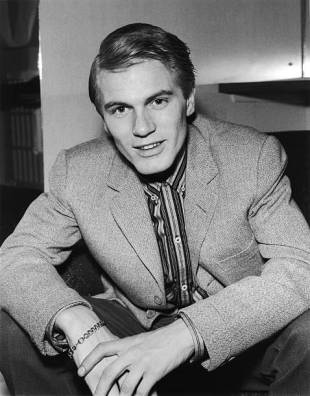
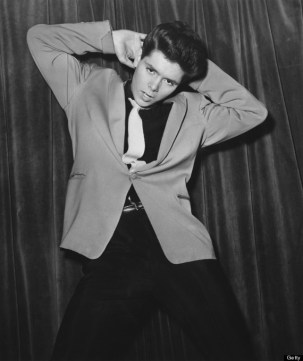
gettyimages-112058576-612x612

Poor Me, by Adam Faith (his 2nd of two #1s)

2 weeks, from 4th – 17th March 1960

His first chart-topper – ‘What Do You Want’ – clocked in at one minute thirty eight seconds; this one goes on for a much more leisurely one forty-six. Two #1s that take less time combined than many songs do on their own. And the similarities between the two don’t end there – ‘Poor Me’ rollicks along at the same tempo, and borrows the exact same lightly plucked strings (which were, lest we forget, nicked from Buddy Holly), as Faith’s first number one.

And yet… This is a different beast altogether. ‘What Do You Want’ was a standard pop song: a perky verse-verse-bridge kind of number. ‘Poor Me’ has a much darker edge to it. For a start there are the ghostly backing singers: AaaahAaaahAAAAAAhAaaaaah, their voices rising and falling like the soundtrack to a fairground’s haunted house. Then there are Faith’s vocals. He sounds grumpy, angry even, and he mumbles his way unwillingly through the opening lines. It’s a song about a lover cursing both his luck and his ex, a man wallowing in his misery. Sorry thoughts leaping around my head, It’s been heard and it’s been said that, You tried, To date another guy, Didn’t hide, Didn’t even try, Cheating me with lies again, Making me remember when… Brutal stuff, eh? No sugar-coating here! Poor me, indeed.

In fact, Faith is so pissed off that he may have been hitting the sauce in an effort to forget. I mentioned in my post on his previous #1 that his pronunciation was unique at the best of times; but here he’s also slurring his words like a man on day five of a three-day-bender. I had to check online to make sure I had the lyrics quoted above correctly (I did) and had to give in completely when it came to the bridge: I used to hold you baby, So tight, Each night, That’s right… Because that’s not what it sounds like on record (Try ‘I used to hold you by the, Soft hands…)

Come the end, Mr Faith has really given himself over to despair and is possibly reaching for the shotgun under the bed: Why oh why, Do voices say to me, Sit and cry, That this was meant to be, Love’s unkind and love’s untrue, Oh why did love pick out you, For me, For me, Wa-ha, Poor me, Poor me… Jeez. This is by far the mopiest, whiniest, most depressing record we have met on our countdown. We’ve had some heartbreak up to now; but nobody has wallowed quite as long or as deeply as Adam Faith here. The first Emo chart-topper, decades ahead of its time? Maybe I wouldn’t go that far; but it is a fascinating record. On first listen it sounds like a hastily knocked-together and derivative follow-up to a debut #1; but repeated listens reveal it to be a much more complex and, dare I say, challenging song than ‘What Do You Want’.
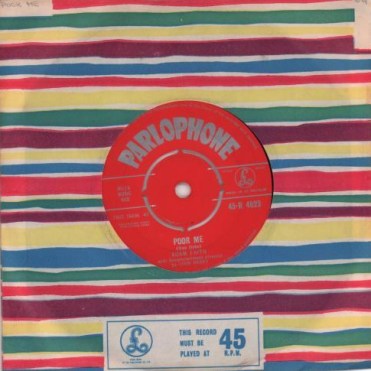
ADAM_FAITH_POOR+ME-407259

And that’s that as far as Adam Faith’s chart-topping career goes. By the mid-60s he had moved into television work and made a good career out of it – acting steadily until his death in 2003. According to Wiki – and God I really hope this is true – his final words, uttered on his deathbed following a heart-attack, were: “Channel 5 is shit, isn’t it? Christ, the crap they put on there. It’s a waste of space.” As final words go they are up there with the very best, alongside “Kiss me, Hardy” and Oscar Wilde’s quip about the wallpaper, and anyone who has spent any time watching British television will surely agree with the sentiment.

The very eagle-eyed among you will perhaps also have noticed that, while ‘Poor Me’ had a fortnight in the top-spot, if you add up the days between the 4th and the 17th March you get…thirteen. Unlucky for some. There’s a simple enough explanation: on 10th March the ‘official’ chart switched from the NME to Record Retailer, which was published one day earlier, and so Adam Faith lost twenty-four hours at the top. Poor him.

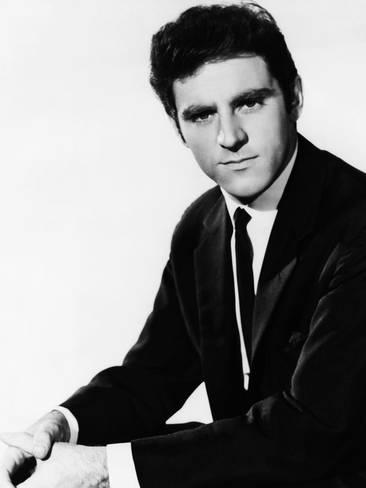
96. ‘Why’, by Anthony Newley

We’ve only just started with 1960, yet suddenly it’s March! Time flies! And it seems that if the early sixties is going to have an on-running theme at the top of the charts, then said theme will be ‘Whimsical’.

ANTHONY_NEWLEY_WHY-558515

Why, by Anthony Newley (his 1st of two #1s)

4 weeks, from 5th February – 4th March 1960

Because this is another gossamer light record, as ethereal and floaty as its predecessor: ‘Starry Eyed’. Here the chimes come from a xylophone, or maybe a glockenspiel, or any other instrument with bars that you might strike with a little furry ball on a stick. I’ll never let you go, Why? Because I love you… I’ll always love you so, Why? Because you love me… There are a lot of questions in this record, lots of ‘Why?’s, and the answer to every single one is that Newley loves his girl, or that she loves him. It’s a lovey-dovey song; a song to make you gag.

The lyrics to this #1 are, quite frankly, a cheesefest. And super simple. I think you’re awfully sweet, Why? Because I love you… You say I’m your special treat, Why? Because you love me… Anthony Newley’s voice is reedy, and clipped. Slightly camp. I’m picturing him as a bit of a dandy, nice mustard chinos and a tartan jacket, something eye-catching in the buttonhole, serenading his objet au desire from the lamppost outside her bedroom window. Yet somehow he just manages to keep the song from tipping over into silly territory. He is very earnest, with buckets of boyish innocence to spare, and this just about carries the day.

let-s-get-married-anthony-newley-1960_a-G-9917305-4985769

A couple of moments do threaten to ruin things completely. When the backing singers launch into their couple of lines like a tipsy Broadway chorus you can really picture, and are almost blinded by, the shine coming off their manic grins. And Newley’s final lines are particularly cloying: I love you, And you love me, We’ll love each other dear, Forever… You can imagine twelve-year-olds up and down the land theatrically retching, fingers in mouths, when their older sisters dropped this 7” on the gramophone. It’s amazing to think that three months back – just five chart-toppers ago – Bobby Darin was singing about a mass-murderer. And now this. Who says there’s no variety at the top of the pop charts, eh?

At best this #1 could be described as ‘cute’; and at worst as ‘positively vomit-inducing’. But I’m willing to give Newley the benefit of the doubt as he is so very earnest, so utterly proper throughout, that he simply must mean what he says. The pictures thrown up by a quick image search don’t really show him as a foppish man-about-town, more as a bank clerk with hair slightly longer than his manager might think appropriate. He did, though, manage four marriages, one of them to no less a glamazonian as Joan Collins, and so who knows? Maybe this simple little love-ditty helped in that regard. He’ll be back at the top before long, so we’ll save any further bio for then.

One final thing of note… I just noticed that we are in the middle of another long run of male-led number one hits. Shirley Bassey was the last woman to top the charts, a year ago now (though there was a female member of The Platters after that), and we’re going to have to wait another year to hear the next female voice on this countdown! 1960 will join 1957 as a lady-less year at the top of the UK Singles charts. An interesting quirk? Or a sign of a crushing patriarchy? If today’s ‘Guardian’ had been around in 1960 there would have been opinion pieces, that’s for sure…

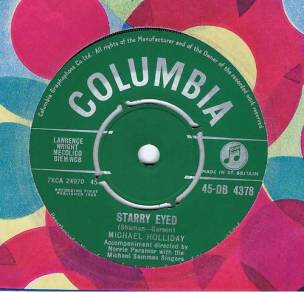
95. ‘Starry Eyed’, by Michael Holliday

Here we go then. One tentative foot in front of the other. A hop and a skip and… We’re into the 1960s! Hurrah! It’s one small step for man… as someone will quite famously say before this decade is through.

BtTnVMQBmkKGrHqEH-D8EvE9BvcOBL7ZdIM5g_12

Starry Eyed, by Michael Holliday (his 2nd of two #1s)

1 week, from 29th January – 5th February 1960

On first listen, however, the 1960s sounds suspiciously like the 1950s. Backing singers? Check. Basic rock ‘n’ roll guitar? Check. Croony male lead singer? Check. Where’s the innovation? Where are the groovy new sounds? Where are all the drugs and free love?

Bum-bam-bum-bam-bum… Why am I so starry-eyed, Starry-eyed and mystified, Every time I look at you, Fallin’ stars come into view… So far so standard. A song about being in love, and about seeing stars because you’re so in love, and to be honest it’s been done a million times before. When we touch I hear angels sing, When we kiss I hear wedding bells ring… Yeah yeah, blah blah blah.

But actually, to dismiss this song because of its unremarkable lyrics would be to do it a huge disservice. Because, on a second, third and fourth listen, this record has got a lot going for it. Firstly there are the backing singers and their Bum-bam-bums. They’re not just any old Bum-bam-bums – they sound echo-y and ethereal, like woozy church bells or a trippy version of the intro to ‘Mr. Sandman.’ It’s really cool.

Adding to this effect is the guitar, which is restricted to a few strums during the verses and chorus but which comes in nice and layered, fed through the same robotic distortions as the backing singers, during the solo. It gives the record a real dreamy quality, like the singer’s dazed after a blow to the… Wait, I get it! He’s starry-eyed. He has been whacked over the head. With love!

78964385

I could complain about Michael Holliday’s sonorous voice being a little too sombre, a little too straight-laced for this song but, after a few listens, it kind of works. His voice has an innocence to it, as he gazes into his lovers mystical eyes and his pupils morph into cartoon love-hearts. Underpinning it all there’s a groovy little rhythm – a bossanova? – that actually makes it quite a sexy record. A record to which there’s more than meets the ear and which improves with every listen. We’re not in the swinging sixties just yet; but this is a sniff of what’s to come…

‘Starry Eyed’ is certainly a lot better than the song which first brought Mr. Holliday to our attention a couple of years back – the fairly bland and saccharine ‘The Story of My Life’. I mentioned then that he only ever scored a handful of hits in his career – in fact he managed to squeeze two #1s from just three top ten hits. The story of his life – see what I did there! – is in truth quite a tragic one. Holliday suffered from crippling stage fright and, shortly after ‘Starry Eyed’ hit the top spot, he suffered a nervous breakdown. He took drugs to keep going and sadly died of an overdose in 1963, aged just thirty-eight. He joins the ‘Died Far Too Early’ club along with the likes of Dickie Valentine and Buddy Holly, perhaps proving that pop stars have always died young and in dubious circumstances, and that it didn’t just start with Jimi Hendrix. Remember him this way: by discovering – as I’ve just done – this forgotten gem of a UK Number One.

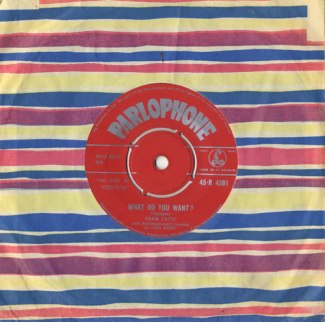
93. ‘What Do You Want?’, by Adam Faith

So. I finish writing that last post, search out the next chart-topping record on Spotify – ‘What Do You Want’ by Adam Faith – and settle down to take some notes. The song begins… And then the song finishes. I take precisely two notes, the second of which is ‘This song is short…’

ADAM_FAITH_WHAT+DO+YOU+WANT-407258

What Do You Want?, by Adam Faith (his 1st of two #1s)

3 weeks, from 4th – 25th December 1959 (including 1 week joint with Emile Ford & The Checkmates from 18th – 25th December)

It is, in fact, the shortest ever UK #1 single, clocking in at 1 minute and 38 seconds. That is seriously short. We’ve covered plenty of records thus far that have hovered around the two minute mark. This knocks a full twenty seconds off them. Adam Faith gets in and gets out, and gets his first chart-topper. (For the record, we’ll be meeting the longest UK #1 single – a nine-minutes-plus behemoth – in exactly thirty eight years’ and two months’ time. Bonus points for those who can name it.)

The first note I took upon listening to ‘What Do You Want’ was: ‘Strong whiff of ‘It Doesn’t Matter Anymore’. Now, I wouldn’t ever want to use a phrase liked ‘ripped off’… So let’s just say Mr. Faith and his song writing team were heavily influenced by Buddy Holly’s recent, posthumous hit. It’s sung at the same pace, with the same staccato strings, while Faith tries to replicate Holly’s famous hiccup.

What do you want if you don’t want money, What do you want if you don’t want gold… Say what you want and I’ll give it you darlin’, Wish you wanted my love baby… Adam loves a girl, but she isn’t feeling it. So Adam hurls all sorts of rubies and trinkets at her – ermines and pearls, amongst others – but to no avail. It’s not the best message to be sending out in a song… maybe she’s just not that into you Adam, yeah?

He even gets a little petty in the final verse: One of these days when you need my kissin’,  One of these days when you want me too, Don’t turn around ‘cos I’ll be missin’, Then you’ll want my love, baby… I get the feeling that this girl just thinks he’s a dick, no matter what he buys her.

T_What-Do-You-Want

I know, I know – I’m perhaps looking a little too hard into what is an extremely light and fluffy #1 single. It’s cute, it’s jaunty, and it certainly doesn’t outstay its welcome. Adam Faith’s voice is kind of endearing as well. He’s not a great singer; but he lends the song something distinctive (check out his ‘bay-buh’), and he’s a clear successor to the likes of Dickie Valentine and Tommy Steele in the British cheeky-chappy, teen idol stakes. I’ll delve deeper into his life and works when he scores his second chart-topper in a few months.

But for now I’m struggling to think of much more to write… Perhaps such a short song requires a short post. One final thing to note is that the penultimate #1 of the 1950s is also one of the last two songs ever to have tied for the top spot. It’s happened four times now: once each in 1953, 1957, 1958 and now ’59. It seems that the upcoming switch of the ‘official’ chart from the NME to Record Retailer will have something to do with killing off the tied number one (more record shops’ sales figures going towards the charts, perhaps?) I can confidently say that it will never happen again, such is the accuracy with which sales and streams are tracked nowadays. Apparently if it does, the song with the biggest increase in sales for that particular week will be given the #1 position – kind of like goal-difference in football. And part of me is slightly sad about that… Farewell, then, to the shared number one single. Well, after we’ve covered the record with which Adam Faith had to share, that is.

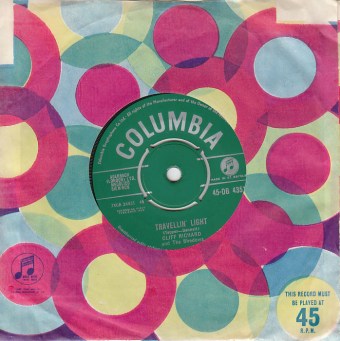
92. ‘Travellin’ Light’, by Cliff Richard & The Shadows

We waited a long time for Cliff to make his first appearance at the top of the UK singles chart; we didn’t have to wait long for him to return. Seven weeks, to be precise. You better get used to this…

cliff-richard-travellin-light-dynamite-db-4351-m--35093-p

Travellin’ Light, by Cliff Richard & The Shadows (Cliff’s 2nd of fourteen #1s / The Shadows 2nd of twelve #1s)

5 weeks, from 30th October – 4th December 1959

‘Travellin’ Light’ treads very much the same path as ‘Living Doll’ did. In fact I wouldn’t be surprised to discover that they were recorded during the same session, within minutes of one another. It’s jaunty, it’s stripped-back… It’s, again, surprisingly minimalist. It’s a cooler record than its forbear – it would be a tough struggle to be less cool, in all honesty – as seen through the missing ‘g’ at the end of ‘Travellin’. Cliff don’t need no proper pronunciation.

His voice is light and airy, with an eerie echo. Got no bags and baggage to slow me down, I’m travellin’ so fast my feet ain’t touchin’ the ground… You can imagine him strolling alongside a dusty highway, or riding with the hobos on an empty freight train carriage. It’s a very American sounding recorded, steeped in the atmosphere of the open prairie, from Britain’s foremost rock ‘n’ roller.

And there’s something quite endearing about this song, something that ‘Living Doll’ lacked. The lines: No comb an’ no toothbrush, I got nothin’ to haul… And: I’m a hoot and a holler, Away from paradise… give it a nice homely feel. Cliff sounds relaxed, as if he’s just jamming with his buddies. The one time it does veer into cheese-territory is at the end of the bridge: I’m carrying only, A pocket full of dreams, A heart full of love, An’ they weigh nothing at all… We get it, we get it – you’re racing home to the girl you love. Whatever…

32F708E500000578-0-image-a-11_1460113522164

Actually, the more I listen to this song, the more I can see an incongruity between the music and the lyrics. Music: laid-back, chilled, goin’ nowhere in a hurry. Lyrics: all about rushing to get back to ‘see my baby tonight’. The two don’t really go together. But, hey, I don’t think this type of pop song is ever designed to be put under very intense scrutiny. It is what it is; and I like it a lot better than I did ‘Living Doll.’

Still though, The Shadows (who are now properly ‘The Shadows’, having dropped ‘The Drifters’ due to legal reasons) get another chart-topping credit without having to do an awful lot. One acoustic guitar pins the whole song together. Someone shakes a tambourine. The same, dreamy surf guitar that gave us the solo in their first #1 is back, purring away in the background  with little ad-libbed guitar licks, improvised morsels of music more complex than they need to be, which suggests the guitarist – Hank Marvin, I’m guessing – may have been feeling a little restricted in his role.

To conclude, then. This is better, cooler even, than ‘Living Doll’. And yet… It’s still very safe. We are still to meet Cliff the Rock ‘n’ Roller and, by this point at the tail-end of the 1950s, looking ahead at his chart-toppers to come, I’m not sure if we will. Cliff the Rock ‘n’ Roller may already be dead and gone.

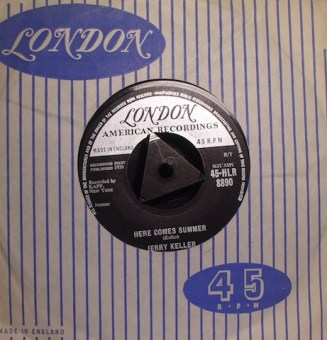
90. ‘Here Comes Summer’, by Jerry Keller

Number ninety! If this was Bingo we’d be top of the shop. And to celebrate this milestone – a record I’d never ever heard before.

OLYMPUS DIGITAL CAMERA

Here Comes Summer, by Jerry Keller (his 1st and only #1)

1 week, from 9th – 16th October 1959

I’ve mentioned this a couple of times now, but what was quite common back when I started this blog is now pretty rare. I know more and more of these songs as we push on through the first flushes of rock ‘n’ roll and into the canon of pop and rock. So it’s quite nice to come across a disc that I have truly never heard of. ‘Here Comes Summer’? Nope. Jerry Keller? Who’s he?

Well, I think he may be related to Cliff. Cliff’s long lost American cousin, perhaps? I take it all back – what I said in my last post, and before, about US singers being intrinsically cooler than their British counterparts. Because this is a twee little number.

First things first – I quite like the riff that underpins this song. Though I’m not sure it counts as a riff, more of a chug. It’s kind of a proto-Beach Boys, gentle surf-rock lilt. If that makes any sense. And towards the end an organ comes in for emphasis, which is pretty nice. The backing singers are very ‘pre-rock’, but Jerry Keller himself is very clean-cut rock ‘n’ roll. And beyond all that… we have the lyrics.

Here comes summer… do-do-do-do… School is out, Oh happy day… It’s the summer holidays, and Jerry couldn’t be happier. He’s got lots of plans: hanging out with his girl, hanging out with his buddies… We’ll go swimming every day, Oh let the sun shine bright, On my happy summer home…

What follows are lyrics about his flat-top (which I always thought was a type of open-top car – turns out it’s a short back and sides!), drive-in movies, (double features – more time to hold her tight!), sittin’ by the lake and meetin’ the gang at Joe’s Café. It is a song that drips images of milkshakes, preppy sweaters, ball-games and sock-hops on to the floor of the juke-joint until we are ready to drown in all the cuteness.

jerry-keller

I guess, like so many of the cheesy sounding US-recorded hits that have topped the charts before this (I’m looking at you ‘Diana’, ‘When’, and ‘All I Have to Do Is Dream’) it appealed because it sounded really exotic to British schoolkids in, say, Scunthorpe, whose dads still had an Anderson shelter in the garden and whose mums were still darning tights.

The song finishes on a romantic note. Jerry has high hopes for him and his girl: If she’s willing, We’ll go steady right away… (Aww..) And then, with a Here comes summer time at last… we reach an abrupt end. Summer is over. And summer was truly over when this reached the top of the UK charts. On the 9th of October. When the schools had been back for well over a month…

This is a perfectly harmless, kind of cute little song that zips along nicely for a couple of minutes. Beyond that I’m not sure it has much of a wider significance. There are strong notes of earlier, preppy-rock (a new genre I’ve just invented) #1s such as The Dream Weavers ‘It’s Almost Tomorrow’ and Tab Hunter’s ‘Young Love’. Looming largest of all, though, is good old Pat Boone who, if Wiki is to be believed, was Keller’s friend from church and introduced him to his manager.

Jerry Keller is a one-hit wonder in the purest sense, in that he had had zero previous chart hits – in either the US or the UK – and would go on to have zero more. A 100% strike-rate for him, then. Well done! He’s still alive – aged eighty-one – and was apparently the go-to guy for TV jingles in the ‘70s and ‘80s! Well there ya go. Next up – a recap!

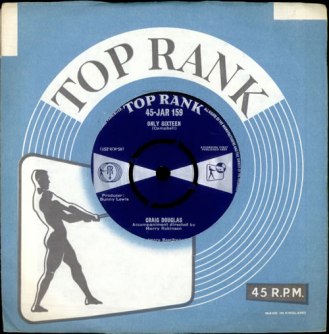
89. ‘Only Sixteen’, by Craig Douglas

Following on from Cliff, it’s another British rock ‘n’ roll disc taking up a considerable residency at the top of the UK Singles chart. Unlike Sir Cliff, the singer is completely unknown to me…

CRAIG_DOUGLAS_ONLY+SIXTEEN+-+4PR-511404

Only Sixteen, by Craig Douglas (his 1st and only #1)

4 weeks, from 11th September – 9th October 1959

But first, a question. Why, oh why, couldn’t British rock ‘n’ roll acts of the 1950s take themselves seriously? Why does every rock ‘n’ roll chart topper from a British artist have the whiff – nay, the stench – of the Victorian music hall, of Skegness pier about it? Why weren’t we cool?

I make Craig Douglas the 5th UK-born rock ‘n’ roll chart topper, and the four previous – Tommy Steele, Lonnie Donegan, Lord Rockingham’s XI and Cliff – have made the top by blending simple rock melodies with a lot of silliness. OK, ‘Hoots Mon’ was a novelty record so we can perhaps let Lord Rockingham’s XI off. Lonnie Donegan was a pioneer in terms of his sound but old-fashioned when coming out with lyrics like ‘two old ladies sitting in the sand, each on wishing that the other was a man’. Tommy Steele camped ‘Singing the Blues’ right up, while ‘Living Doll’ was barely more than a nursery rhyme. (A very creepy nursery rhyme, but still). And you can trace this theme – this current of candyfloss that runs through our British hit singles – way back into the pre-rock days. The US was giving us ‘I Believe’; while the UK was replying with ‘I See the Moon’.

I suppose the big question is… (and I’m deliberately excluding women like Ruby Murray and Shirley Bassey as, while British and while quite classy, they definitely weren’t rock) what will be the first truly cool, suave and sophisticated British recorded rock ‘n’ roll record? Well, I can reveal… It’s not ‘Only Sixteen.’

This is more jauntiness, more end-of-the-pier winking and gurning. There’s whistling, and a guitar plucked so precisely that I think it might be a banjo. She was only sixteen, Only sixteen, I loved her so… Douglas’s voice is slightly shrill, quite posh and, to be honest, fairly average. It doesn’t quite fit the song. It sounds a bit like the dreaded David Whitfield, but a David Whitfield who’s debasing himself in an attempt to sing rock ‘n’ roll…

We’d laugh and we’d sing, And do the little things, That made my heart glow… Craig had a fling with a lass; but it didn’t last. She was too young to fall in love, I was too young to know… So far, so ‘Jackie Magazine’. Then comes the punchline: Why did I give my heart so fast, It never will happen again, I was a mere lad of sixteen, I’ve aged a year since then… Oh! Hahaha – he thinks he’s all grown up. At seventeen! The folly of youth.

craig-douglas-only-sixteen-golden-girl-pretty-blue-eyes-buy-049-autographed-64148-p

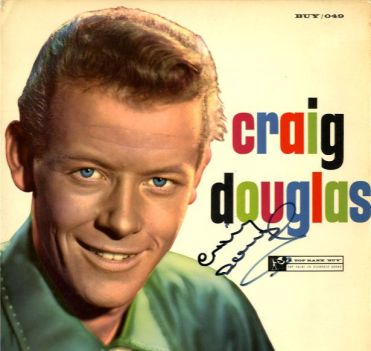
Yeah, it’s a cute line and all, but I don’t think it’s quite enough to build a whole song around. Plus, with that voice, I’m having trouble imagining that Craig Douglas was seventeen when he recorded this. *Plot twist* He was! But come on – look at that picture. That lad of sixteen must have had one hell of a paper round. And while we’re at it – Craig Douglas just isn’t the name of a chart-topping star. Craig Douglas lives next door to you, and is someone you avoid making conversation with on your way to the car in the morning.

I think we should just file this under ‘Of It’s Time’ and be done with it. ‘Only Sixteen’ isn’t a terrible record – it’s quite pleasant, really – but it won’t live with you long after hearing it. Craig Douglas is still with us, however – aged seventy-seven – and still tours, though his recording career didn’t last the Beatles-led cull of ’63.

To finish, and to illustrate my point about US singers being that much cooler than their British counterparts, just listen to Sam Cooke’s version of this song. It’s technically the original, though they were released around the same time, and has exactly the same melody and lyrics… But, you see what I mean? I think I may have finally put my finger on just what the difference is, though: the huge gulf in coolness between British and American stars. The Sam Cooke version, you see, doesn’t have Any. Bloody. Whistling!

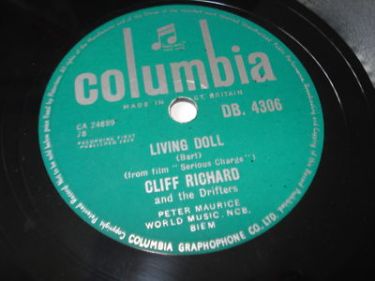
88. ‘Living Doll’, by Cliff Richard & The Drifters

In which we meet the pre-eminent British popular singer of the day. And the next day. And the next. Next. Next. Basically, there will be no escaping Cliff for the following forty years…

230674091186

Living Doll, by Cliff Richard & The Drifters (Cliff’s 1st of fourteen #1s / The Drifters – AKA The Shadows – 1st of twelve #1s)

6 weeks, from 31st July – 11th September 1959

In the intro to my post on Shirley Bassey’s debut #1 I gave it the big fanfare about living legends and national treasures and so on. And let’s be honest, the same applies ten times over for Sir Clifford of Richard. He will go on to utterly dominate UK pop music, remaining a genuine chart presence well into the 2000s, even if he is probably more famous today for singing during the rain at Wimbledon and for suing the BBC over the way they covered allegations of… (REDACTED).

Let’s get to the music shall we? ‘Living Doll’ begins with a natty little bass intro, and then… Well it’s rock ‘n’ roll; but not as we know it. I’ve mentioned many a time the idea of ‘US’ Vs ‘UK’ rock ‘n’ roll: British singers taking on the Yanks at their own game and slowly getting better at it. Let’s be honest, the odds were stacked against the Brits with Elvis, Buddy Holly, The Everly Brothers, Johnnie Ray et al against Lonnie Donegan and, um, Tommy Steele. And with the arrival of ‘The British Elvis’ AKA Cool Cliff, you might think that this is the moment for Britain to really grab the rock ‘n’ roll flag for herself!

Except, no. ‘Living Doll’ is an extremely lightweight record. A couple of acoustic guitars. Cliff’s simpering vocals. And that’s about it. Got myself a cryin’, walkin’, sleepin’, talkin’, living doll… Got to do my best to please her, Just cos she’s a living doll… This is a song that I could have sung a few lines from – most Brits could, no? – without ever having listened to it properly. And it’s a song that doesn’t do well under more intense scrutiny.

Yes it sounds cheesy and flimsy with a whiff of George Formby in the background. But beyond all that there’s the problem of the lyrics… In the previous chart-topper, Bobby Darin was giving us a ‘girl as dream’ narrative. Here Cliff is giving us ‘girl as doll’, and taking it very literally: Well take a look at her hair, It’s real and if you don’t believe what I say just feel… Pretty creepy… Gonna lock her up in a trunk, So no big hunk, Can steal her away from me… Eww. That’s taking a metaphor way too far and then some. She’s either literally a doll with which Cliff is romancing… Or an extremely submissive young lady over whom Cliff is aggressively over-protective. Either way…

The best bit of the song, by far, is the dreamy guitar solo which by the standards of the time is pretty long, loose and groovy. That, of course, is provided courtesy of Cliff’s long time backing band The Sha… No, wait. The Drifters. It’s actually quite simple: The Drifters were The Shadows until the US Vocal group of the same name (Ben E. King and co.) threatened legal action. They appeared as The Drifters on Cliff’s first five or so hit singles; this was their sole chart-topper before the name change.

Rocker Cliff

It’s pretty easy, almost a cliché, to get stuck into Cliff as an uncool, God-bothering, 2nd rate Elvis impersonator. And I’d try to avoid doing so at all costs… If his debut #1 record didn’t kind of prove all the accusations correct. He was clearly trying to sound like Elvis. He was clearly trying to look like Elvis (just look at that quiff!). And this record is him selling out just like Elvis did. Except Elvis got a good few years of genuine rocking ‘n’ rolling in before the movie studios, the army and the burgers came a-calling. Cliff got one album. (Do give ‘Rock on With Cliff Richard’ a listen, though – it’s got some decent tracks on it.)

Anyway, that’s one down for Cliff; just thirteen more UK #1 Singles to go…

87. ‘Dream Lover’, by Bobby Darin

Now this is more like it. This is a chart-topping single!

BOBBY_DARIN_DREAM+LOVER+-+1ST-547817

Dream Lover, by Bobby Darin (his 1st of two  #1s)

4 weeks, from 3rd – 31st July 1959

It’s been a while since I listened to this song, or to any Bobby Darin songs, but slipping the needle to hear ‘Dream Lover’ is like slipping into a silk dressing gown and settling down by the fire: Every night I hope and pray, A dream lover will come my way, A girl to hold in my arms, And know the magic of her charms…

We get not one but two groups of backing singers: girls for the ‘oohs’ and boys for the ‘wadda waddas’. We get strings and we get some oh-so-fifties staccato guitars. In fact, I’d put this up there with ‘Diana’ and ‘When’ as the most fifties, most rock ‘n’ rolly, doo-woppy #1 yet. But ‘Dream Lover’ is a much better song than either of those.

And that’s down to Bobby Darin. His voice is as crisp and as clear as a bell, and he lends the song a sort of… gravitas, that places it a cut above pure teeny-bopper fluff. He sounds older than his twenty-three years, and sounds suave where Paul Anka and the Kalin Twins sounded puppyish. Does this then represent the pinnacle of late fifties rock ‘n’ roll-as-pop? Maybe something to consider in our upcoming re-cap.

For all that, it’s a simple song. The singer wants a dream lover, so he doesn’t have to dream alone. Someday, I don’t know how, I hope she’ll hear my plea, Some way, I don’t know, She’ll bring her love to me… The listener knows where the song is going, but is more than happy to be taken along for the ride.

I don’t want to really write any more about this record. I want to leave it there. Minimalist. This is where easy-listening and pop collide to create a seriously classy song. And we’ll be hearing from Bobby D again very soon, so we can delve into his backstory then. For now, just sit back, relax, and enjoy.

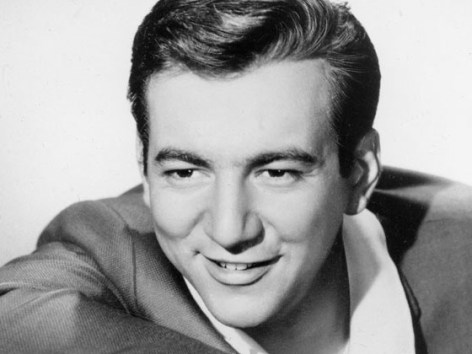
Bobby-Darin

There are two little things of note, though, that we should point out here. I mentioned in my post on ‘Hoots Mon’, back in November ’58, that the production on these chart-topping singles was getting more substantial, beefier. And I have to admit that on ‘Dream Lover’, and to a lesser extent on ‘When’, I’m getting a hint of the ‘Wall of Sound’ technique – Phil Spector and all that – which will be all the rage in three or four years. Listen to the crashing symbols that precede the final verse and chorus here, and you’ll see what I mean. Interestingly, this song was engineered by Tom Dowd, a pioneer of multi-track recording. So there could be something in that…

And finally, while this is a wonderful record more than worthy of a month atop the UK Singles Charts… something has been nagging at me for a while now. Are our #1 singles growing more and more lyrically banal? Let’s explore. Drag your minds back to the dark and smoggy days of pre-rock and yes, song lyrics were probably pondering weightier issues: I believe for every drop of rain that falls, A flower grows… Or Three coins in the fountain, Which one will the fountain bless…? Or I saw her face and ascended out of the common place, into the rare, somewhere in space… from ‘Brainiest #1 Yet’ ‘Stranger in Paradise’. Or they at least talked of love in slightly flowerier, more abstract terms. And there haven’t been any out-of-place, soundtrack songs like ‘Hernando’s Hideaway’ or ‘The Man from Laramie’ with lyrics about sharp-shooters and speakeasies hitting the stop spot recently.

In 1958-9, while there are anomalies like ‘Smoke Gets in Your Eyes’ and ‘The Day the Rains Came’, it’s mainly all Dream lover, where are you…? All I have to do is dream… And Goodness gracious great balls of fire…! Simple, immediate stuff. Is this a bad thing? Rock ‘n’ roll may have dumbed things down a bit, but its brought an immediacy to our chart-topping hits. Everyone can relate to someone sitting at home wishing for a dream lover. Not everyone can relate to She wears red feathers and a huly-huly skirt… I’m all for it really. And that’s probably a good thing, as our next #1 takes simple to the next level.

85. ‘A Fool Such As I’ / ‘I Need Your Love Tonight’, by Elvis Presley

The King is back in the building. Buddy Holly replaced at the top by Elvis himself. What halcyon days!

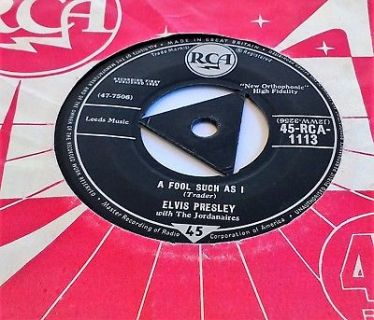
ELVIS-PRESLEY-A-FOOL-SUCH-AS-I-45-RCA-1113-1st-PRESS-7-VINYL

A Fool Such as I / I Need Your Love Tonight, by Elvis Presley (his 4th of twenty-one #1s)

5 weeks, from 15th May – 19th June 1959

One of these songs I’ve known for a very long time – since I got my first Elvis ‘Best Of’ way back when –so let’s start there. Now and then, There’s a fool, Such as I… I used to think that the scarily deep baritone that opens and closes this record was Elvis himself. It wasn’t, unfortunately. A chap called Ray Walker provided the voice, and it makes this whole track.

I really like this song. At least… I thought I did. I had it marked as one of my favourite ‘fifties-Elvis’ numbers, better than the silliness of ‘Teddy Bear’ or the mumbling verses of ‘King Creole’. Listening back to it now, though, I’m not so sure. The way Elvis sings it – he’s slightly restrained, slightly clipped… The vocals are weirdly ‘posh’, if you can imagine what I mean. There’s none of the growl he was giving us on ‘Jailhouse Rock’, and none of the saucy wink from ‘One Night’. It seems to me, listening to the song fresh after such a long absence, that Elvis might have been phoning it in here.

‘A Fool Such as I’ had been recorded before – back in the depths of the pre-rock era (AKA 1952), so perhaps Elvis had the original in the back of his mind as he enunciated, giving birth to the previously undiscovered Plummy Elvis. And while obviously everyone knows that Elvis phoned in pretty much everything he did between 1961 and ’68, it’s distressing to think that Elvis’s ‘phoning it in’ period might have started as early as 1959!

Still, the solo swings like I remember. And, to be fair, Elvis does let loose a little in the final verse. I’m a fool, But I love you dear, Until the day I die… And he just about redeems the whole thing by belting these lines out towards the end. He should, though, have been very grateful to Mr. Walker for his deep voice and to whoever was playing the guitar. They definitely helped paper over the cracks.

This record, and in fact all of Elvis’s early chart-toppers, are sometimes co-credited to The Jordanaires, AKA his backing singers. They also pick up some of the slack here (though I can’t remember even noticing them on songs like ‘All Shook Up’.) The Official Charts company don’t recognise them, however, so I won’t. But they’re there on the vinyl above, if you squint hard enough. I suppose it’s a case similar to the days when every record was ‘accompanied’ by an orchestra. I mentioned in a post a while back how the conductors of these orchestras had been airbrushed out of history, and it seems to be happening with backing groups now too.

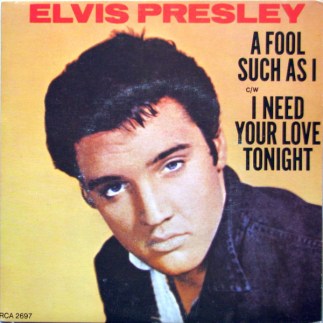
R-3000802-1311243588.jpeg

On then to the song I don’t know so well. Tell the truth I’d never heard this before and, when I saw that it was called ‘I Need Your Love Tonight’, I feared the worst. Maudlin ballad ahoy! But no…

The piano comes blasting in, rolling like a runaway train. And Elvis? Well, he needs your love tonight. And not in a mopey, crooning-in-the-window-at-the-moon kind of way (as we recently heard in Connie Francis’s flip-side ‘Carolina Moon’). No siree. I’ve been waiting just for tonight, To do some lovin’ and hold you tight, Don’t tell me baby you needa go, I got the Hi-Fi high and the lights down low…

This is fun stuff. This is rock ‘n’ roll. This possibly should have been the lead track. And Elvis does sound like he’s having a little more fun here. I count an ‘Oh-oh’, an ‘Uh-uh’, an ‘Ooh-ooh’, an ‘Oh Gee’, a ‘Wowee’, a ‘Wow’, and a ‘Pow-Pow’ among the lyrics. There’s even a bit of a rhumba during the bridge. But it really is the flip-side of ‘A Fool Such as I’ – they were well-placed together – as in the former he is lamenting the woman he loved while in this he’s pulled himself together and is promising her a night she won’t forget. G’wan yourself Elvis!

I still, though, get the faintest tang of him phoning it in here, even on this little rocker. I may be wrong – I may be listening for something that just isn’t there – but I can’t help but feel like I’m getting a whiff. He still isn’t quite going for it in the same way he did just a few months ago on ‘I Got Stung.’

As a little aside, ‘I Need Your Love Tonight’ is listed several times on Spotify as being ‘Live’, though there is nothing in the recording to suggest that it was performed in front of an audience. The link below is, to the very best of my knowledge, the version that topped the UK charts in the spring of ’59.

This #1 pulls Mr. Presley level with Guy Mitchell and Frankie Laine as the acts with the most UK chart-toppers. They all have four, though Frankie Laine is still well out in front in terms of weeks-at-number-one (Elvis has eighteen weeks from four #1s; Frankie Laine got that many just from ‘I Believe’). And if you think that this means Elvis will be boosting ahead any time soon you’d be wrong – we won’t be seeing him again for well over a year.

Thus, we bid farewell to rock ‘n’ roll Elvis. It’s been nice meeting him, or rather rediscovering him. He’s off into the army now; and when we hear from him next it will be with something rather different.