75. ‘Stupid Cupid’ / ‘Carolina Moon’, by Connie Francis

Connie-Francis-Stupid-Cupid-MGM-45

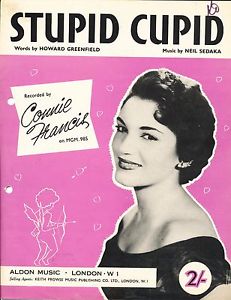
Stupid Cupid / Carolina Moon, by Connie Francis (her 2nd of two #1s)

6 weeks, from 26th September – 7th November 1958

A double ‘A’-side, which again means double the songs to write about. I’d better get cracking.

Connie Francis is back at the top. Three months on from ‘Who’s Sorry Now’s six-week reign at #1, ‘Stupid Cupid’ arrives to spend – you guessed it – six weeks at #1. She may only have had two chart-toppers, but twelve weeks in total at the top is nothing to be sniffed at. It reminds me of Rosemary Clooney’s chart run from a couple of years ago: two quick-fire chart toppers by a sparky female lead…

In ‘Who’s Sorry Now’, Connie was enjoying a bit of schadenfreude at her ex’s expense. Now, in ‘Stupid Cupid’, she’s back in love. Except she doesn’t want to be…

We start with a staccato sax, chugging drums, and then: Stupid Cupid, you’re a real mean guy, I’d like to clip your wings so you can’t fly, I’m in love and it’s a cryin’ shame, And I know that you’re the one to blame, Hey, hey, set me free, Stupid Cupid… Stop pickin’ on me! There’s a twang in her voice to match the twang in the guitar, and the song bounces along nicely. It’s a very sax-heavy track – with a chunky little solo in the middle – and it seems that we might be having a bit of a ‘sax phase’ at the top of the UK charts with this following on from ‘When’. It’s nice, considering that we’ve already had plenty of guitar and piano – the three main rock ‘n’ roll instruments taking their turn to dominate.

As with ‘Who’s Sorry…’, the best bit of this record is the bridge. It seems to be the point in her songs where Ms Francis really lets loose, belting the lines out while losing none of her sparkle: You mixed me up but good right from the very start, Hey! Go play Robin Hood with somebody else’s hea-a-a-art… Cue handclaps and a shimmy.

By the end of the song, however, it turns out that her reluctance in love has been a bit of front: Since I kissed his lovin’ lips of wine, The thing that bothers me is that I like it fine… The little minx! And the way she lingers over the final ‘I like it fine’ is perhaps the most playful, nudge-nudge, wink-wink moment of any chart-topper so far.

s-l300 (1)

Which makes the flip-side of this disc all the more disappointing… ‘Carolina Moon’, to be perfectly honest, is a bit dull. I get that you want to show off the different sides to a singer’s range – though in the previous double ‘A’ both Lonnie Donegan tracks were pretty similar. ‘Stupid Cupid’ is simply a really hard act to follow.

The sax is gone, replaced by a harmonica, a plinky piano and swaying guitars. Carolina moon, Keep shinin’, Shinin’ on the one who waits for me… Now Connie’s sitting at home pining for a guy. Make up your mind, love… How I’m hopin’ tonight, You’ll go, To the right, Window… Tell him that I’m blue and lonely… Dreamy Carolina moon…

I know Connie Francis’s music quite well, but somehow I’d never heard this before. And I wasn’t missing much. Lyrically, this pretty old-fashioned. There was a surfeit of songs back in 1953 / ’54 where people were waiting patiently for their distant loved ones. There was even one – ‘I See the Moon’ by The Stargazers – in which the singer implored the moon to ‘shine on the one they loved’. These days we’re used to something a bit more immediate, though, a bit less passive. Don’t just sit at home relying on the moon to tell the man of your dreams that you love him! Get out there and make him notice you!

Francis’s voice is still very nice on this record, but it lacks bite. She definitely sings better when there’s a bit of sass in the lyrics. This is just an average rock ‘n’ roll ballad… I had a sneaking suspicion that this might have been a pretty old song resurrected for the rock age, a la ‘Who’s Sorry Now’… And I was right. Wiki tells us that it was originally a hit way back in 1928.

And with this double whammy, Connie Francis’s short-lived time as a UK chart-topper comes to an end. Mopey songs about moons aside, her two lead singles have been highlights of the year so far. One a ballad with a spikey twist, the other a rollicking ride of a pop song. I’ll link here to some of her better non-chart toppers: songs such as ‘Where the Boys Are’, ‘Lipstick on Your Collar’, ‘Everybody’s Somebody’s Fool’, and hands-down the raunchiest song recorded in 1959: ‘Plenty Good Lovin’ (sample lyric: People say he’s not too smart, But he knows the way to a woman’s heart, Plenty of things that he don’t know, But this boy shines when the lights are low…) Oh, Connie. You are awful! I have a suspicion that we’ll be missing you before long.

74. ‘When’, by The Kalin Twins

THE_KALIN_TWINS_WHEN-552307

When, by The Kalin Twins (their 1st and only #1)

5 weeks, from 22nd August – 26th September 1958

We’re really getting further into the realm of ‘Songs That I Know’, now. Out of all our 1958 #1s up to this point there has only been one song that I truly hadn’t heard before: Michael Holliday’s ‘The Story of My Life’.

And ‘When’ by The Kalin Twins was all set to become the second 1958 chart topper I had never heard before. But then I pressed play… And I know this. I think. I’ve heard it before. I think…

It begins with perhaps the most fifties intro ever. Clickety-clack-clack… and then… Sax-Sax-Sax-Woah-Woah-Woah. I’m possibly not doing the best job of describing it; just listen and you’ll hear what I mean. Images of boys in leather jackets and girls in polka dot skirts, spinning each other around at the juke joint while their friends sip milkshakes leap into your head. Play this intro to anyone on the street and ask what decade it comes from and they will say ‘Why, THE 1950s!’ with utmost, unshakeable confidence.

It almost, though, sounds too fifties. It sounds so fifties that it possibly couldn’t actually be from the 1950s. It sounds like fifties-by-computer-algorithm. Like filler on the ‘Grease’ soundtrack, like the background music in a Frankie & Benny’s. It’s kind of the same problem I had with Paul Anka’s ‘Diana’. And it’s a real chicken vs egg scenario: does it sound cheesy because it sounds so ubiquitous; or has it become ubiquitous because it always sounded cheesy and inoffensive?

hqdefault

Anyway, enough of the philosophy. This truly has been the summer of the musical siblings, The Everlys followed by The Kalins. But whereas Don and Phil went on to become one of the most enduring and influential acts of the era; Herbie and Hal Kalin didn’t. They are complete and utter one hit wonders in the UK. And I love that. There’s nothing worse than a two hit wonder whose follow-up single limps to #38. Nope. Have your huge chart-topper, then leave it there. That way you can always claim that you could have been huge, had you been bothered… I’ve been less eagle-eyed when it comes to noticing UK chart firsts recently, but we have one here – the first ever twins to score a chart topping single. Bonus points if you can tell me the only other twins to do the same…

While I may have sounded slightly scathing when I described this record a moment ago; I am actually enjoying this track. It’s another sugar rush of a song – in the same vein as ‘Diana’ or ‘Rock-A-Billy’ – where you dive head first into a ball-pit filled with fruit pastilles, wine gums and the like, and come out buzzing but also feeling slightly grubby. Perhaps I should invent a new category of #1 for these posts: Songs It Is Impossible To Hate, No Matter How Much You’d Like To.

One thing does jar, however, and that is the high-pitched backing singers. They are super-shrill, tuned to almost dog-whistle levels. And I knew it reminded me of something, but it took me a minute to get there. EDDIE FISHER! Go back and listen to his 1953 #1 ‘I’m Walking Behind You’ and you’ll hear them. I don’t know what it is, but this is the 3rd post in a row in which I’ve mentioned Eddie Fisher – the man who put the ‘pre’ in pre-rock. He is a shadow that looms large, even after rock ‘n’ roll has long since blown those cobwebs away. If you have a spare minute, follow this link and remind yourself of just how bad it got during those dark, prehistoric days of 1953.

I realise that I am about to wrap this post up without having made any mention of ‘When’s lyrics. To be honest, I haven’t been paying attention, despite listening to it around six times in short order. Let me try once more… When, When you smile at me… When, When you kiss me right… I need you blah blah blah… I love you blah blah blah… I work with Japanese people, and these lyrics remind me of the sort of English banalities that get crowbarred into J-Pop songs. I’m thinking specifically of girl band extraordinaire AKB48, who regularly pepper their songs with trite English phrases: ‘I want you…’ ‘I love you…’ ‘Hold my hand…’

That is a truly bizarre comparison to end on: fifties one-hit wonders The Kalin Twins and 21st Century Japanese poppettes AKB48; but that’s where my mind took me. And it just goes to show that pop music is pop music, no matter the time or place…

73. ‘All I Have to Do Is Dream’, by The Everly Brothers

THE_EVERLY_BROTHERS_ALL+I+HAVE+TO+DO+IS+DREAM+-+1ST-504360

All I Have to Do Is Dream, by The Everly Brothers (their 1st of four #1s)

7 weeks, from 4th July – 22nd August 1958 (including 1 week joint with Vic Damone from 4th – 11th July)

We have an opening chord, then a pause… And then those voices. Those harmonious voices. The Everly Brothers certainly could harmonise.

Dre-e-e-eam, Dream, Dream, Dream, Dream…. Dre-e-e-eam, Dream, Dream, Dre-eam….

This is undeniably a classic, and most people will at least be familiar with the dream dream dream refrain. It’s also a very simple song. A song in which a lover, starved of attention from the object of his desires, turns to dreaming about her. All he has to do is dream. When I want you, In my arms, When I want you, And all your charms, Whenever I want you, All I have to do, Is dre-e-e-eam… You know what this song is going to be about just by glancing at the title. Simple. As.

I can make you mine, Taste your lips of wine, Anytime… Night or day… The Everlys sing (Is it Phil? Or Don? Or Both? Those harmonies are so damn tight they sound like the same voice) before delivering the classic line: Only trouble is, Gee Whizz, I’m dreamin’ my life away… Can we have a shout out for that ‘Gee Whizz’! So dorky; yet so appropriate. So ‘All-American-Boy-Next-Door’.

I’m going to go out on a limb here, and make a bold statement. That this record, ‘All I Have to Do Is Dream’, is the perfect fusion of rock and pre-rock. I’ve been continually mentioning that all through 1958 we’ve had a couple of rock ‘n’ roll #1s here, a couple of easy-listening, croony #1s there. Never before, though, have we had both styles melded together in the one record. This is it. This is where the previous seventy chart-topping records have been leading us. We’ve arrived. Bear with me…

everly-brothers-588fc7865f9b5874ee60dcf3

Musically, this is rock ‘n’ roll (very gentle, very country-tinged rock ‘n’ roll, but still) sung by a couple of fresh-faced young things. Don Everly was twenty-one when this hit the top spot, Phil was nineteen. But lyrically this is the same kind of schmaltz guys like Al Martino and Eddie Fisher were churning out back in 1952. Take the line: I need you so, That I could die, I love you so, And that is why… Melodramatic or what? I get that it’s trying to convey the helpless passion of a teenage crush; but I much prefer the cocksure swagger that The Crickets brought to ‘That’ll Be the Day’, or the cynical shrug of the shoulders offered by The Teenagers on ‘Why Do Fools Fall in Love’.

How long have I known this song? I’ve no idea. Forever? It’s always been there; though it isn’t a song I’d ever rush to listen to. It’s just a little too much on the cheesy side for me, thanks. Structurally, it is an AABA song which I believe, though I’m no songwriter, is code for ‘a bit basic’. It will, though, always remind me of karaoke sessions from my days teaching in Thailand. Along with Andy Williams and The Carpenters, ‘All I Have to Do Is Dream’ was one of the few English songs that my Thai colleagues knew. That’s quite a good barometer of a song’s fame, isn’t it? ‘It’s popular, but do they sing it at karaoke in Thailand?’

Personally, I see this record as Everly Brothers MK I. They’ve yet to hit their stride. They will be back at the top of the UK charts on three more occasions, each time with a song better than this one. They will return with a slightly harder edge, and with huskier voices. There will be no disputing that they are a rock ‘n’ roll act by then. In fact, the next time we hear from them they will be topping the charts with – hands down – one of the best pop songs ever recorded…

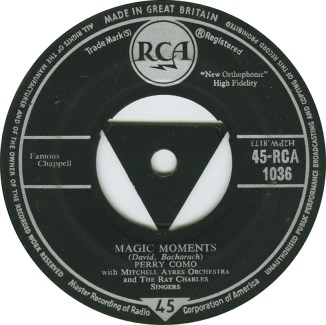
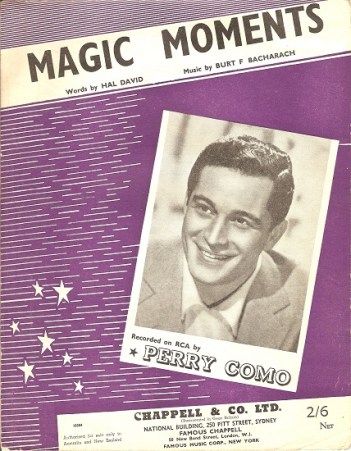
69. ‘Magic Moments’, by Perry Como

perry-como-magic-moments-1958-7

Magic Moments, by Perry Como (his 2nd of two #1s)

8 weeks, from 28th February – 25th April 1958

I’ve grown so used to describing this period in popular music history as the ‘rock ‘n’ roll revolution’ that I’m growing, quite frankly, bored of typing it (‘rock ‘n’ roll’ is actually a difficult phrase to type quickly – those two commas round the n, you see – and I will be relieved when I can start typing phrases like ‘New Wave’ and ‘Disco’).

And if I were to stop calling this the ‘rock ‘n’ roll era’, I’d be very tempted to re-christen it ‘The Age of Whistling’. Because I make this the sixth UK #1 in a little over a year to be very heavy on the whistling: ‘Just Walkin’ in the Rain’, both versions of ‘Singing the Blues’, ‘Butterfly’, ‘The Story of My Life’ and now ‘Magic Moments’ (and I’m sure I’ve forgotten about a few stray whistles elsewhere…) I suppose it’s cheap and easy to do. And I suppose it’s better than humming. But to me it creates an air of fake jollity around a song, a feeling of enforced fun – a sense that some red-faced, chain smoking record executive was yelling ‘Sound relaxed, dammit!’ just before they pressed record.

But, hey. At least the whistling is fairly sporadic here – after the first few bars Perry Como comes in with some very famous lines: Magic… Moments… When two hearts are carin’, Magic… Moments… Mem’ries we’ve been sharing… While this standard may have receded somewhat into the mists of time, surely everyone still knows the chorus. I can pinpoint the first time I became aware of this song – an advert for (I think) ‘Quality Street’ back when I was a lad – and it is one of those songs, along with, say, ‘Que Sera Sera’ or ‘I Believe’, that make up the background music of one’s life. It’s also another Bacharach and David number, hot on the heels of ‘The Story of My Life’, and while it’s a bit more memorable than Michael Holliday’s record it is still pretty bland in comparison to their later hits.

The best you can say about ‘Magic Moments’ is that it’s a very safe song: super laid-back and super-inoffensive. Como sounds like he recorded it from his bed, or at least from a very comfy armchair. Which kind of makes sense, as the singer of this song is supposed to be an older gentleman contentedly reflecting on happy times. The backing singers, meanwhile, are working overtime – taking on at least a third of the lines.

perry-como-magic-moments-1958

Away from the chorus, the verses flesh out just what the ‘magic moments’ were. Moments such as: The time that the floor fell outta my car when I put the clutch down… The way that we cheered whenever our team was scoring a touchdown… They are sweet little vignettes; lyrically quite modern in the way that they eschew grandiose statements about love for real life scenarios. There’s also a link here between this and Pat Boone’s ‘I’ll Be Home’ from a couple of years earlier, in the way that the song invokes cute images of small-town, suburban (super white and WASPy, obviously) America.

I’ve mentioned it before, but it bears repeating, how interesting it is to see the ebb and flow of the UK charts around this time; the old guard tussling with the new. You get a couple of very forward-looking, very cool, very new hits in ‘Great Balls of Fire’ and ‘Jailhouse Rock’ before the waves slowly recede and leave a saccharine blob like this beached at the top – for 8 (eight!) weeks. There are certain records that I can imagine having appealed to both young and old – ‘Diana’, for example – but I really struggle to imagine anyone under the age of forty buying this disc. Como himself was forty-five when this hit the top spot making him – and I’ve not checked this at all, but hey – the oldest chart-topper yet. Definitely one of the oldest. Probably.

Before we put the needle back into its holder for another post, let us bid farewell to the ‘King of Casual’. He has an impressive gap between his two #1s – ‘Don’t Let the Stars Get in Your Eyes’ (the 5th UK #1) and this (the 69th) – which is surely a sign of his enduring appeal. Though I do have to state that, personally, there is no contest as to which is the better song: the ever-so-jaunty ‘Don’t Let the Stars…’ all the way. Como will go on to have Top 10 hits as late as the mid-1970s – and would have had many more hits had the UK charts begun earlier than 1952 (his first US successes came in the early forties). A true titan of easy listening, he died, aged eighty-eight, in 2001.

68. ‘The Story of My Life’, by Michael Holliday

MICHAEL_HOLLIDAY_THE+STORY+OF+MY+LIFE-408385

The Story of My Life, by Michael Holliday (his 1st of two #1s)

2 weeks, from 14th – 28th February 1958

For the first time in a while, we pull up alongside a song I hadn’t ever heard before… Not since Lonnie Donegan’s ‘Gamblin’ Man / Puttin’ on the Style’ have I been able to approach a record with my ears fresh and untainted like this. What, then, do we have here…?

First things first – this is a big step back from the frenzied piano, and then snarling guitar, of the previous two #1s. It’s got the lilting acoustic guitar that sounds soooo 1957 (see ‘Just Walkin’ in the Rain’, ‘Singing the Blues’ and ‘Young Love’ for reference). It is a rock ‘n’ roll record; but super gentle rock ‘n’ roll – diluted and a little wishy-washy.

There are also some super cheesy touches – irritating whistles at the end of lines, some toodle-oohs and bum-bum-bums from the backing singers – which almost tip it over into pastiche territory. It’s very interesting, the fact that we have seen rock ‘n’ roll fragmenting before our very ears over the past few entries: Jerry-Lee Lewis and Lonnie Donegan have given us balls-out – dare I say real – RAWK. Elvis has given us superstar, super-polished rock. Paul Anka, and now Michael Holliday, are giving us what I’d call 2nd generation rock ‘n’ roll – pop music with rock touches, designed to appeal to the kids and their parents.

To the lyrics: Michael wants to write the story of his life: I’ll tell about, The night we met, And how my heart can’t forget, The way you smiled at me… Awwww. Basically his love is his life. But wait… They broke up! No wait… They made up! Safe, safe.

The story of his life isn’t quite over, though. It won’t be until – you guessed it – they get hitched. There’s one thing left to do, Before my story’s through, I’ve got to take you for my wife, So the story of my life can start… and end… with you… It’s nice. This is a perfectly nice, perfectly sweet and utterly forgettable record. I was actually shocked to discover, as I embarked on a little Wikipedia-ing, that ‘The Story of My Life’ was written by Burt Bacharach and Hal David, the first of this legendary duo’s songs to top the UK charts. A shock because, compared to the classics they wrote later in their careers, this is very, very meh. A big contender for the ‘Meh Award’ in my next recap, I’d say.

00000tmp

I’d hoped to pad this post out by delving a little into just who Michael Holliday was – as he’s someone I’d never heard – but I’ve just realised that we’ll meet him again, briefly, in a couple of years. Best hold something back for then. Suffice to say, he made the most of a short career – scoring two number ones out of only ten charting singles – before dying at the shockingly young age of thirty-eight. He has a nice, if unremarkable, voice on this nice, if unremarkable, record. Wiki sums it up best in their succinct entry on Holliday: ‘a British crooner popular in the late 1950s and early 1960s.’

Fin.

63. ‘Diana’, by Paul Anka

paul-anka-diana-columbia

Diana, by Paul Anka (his 1st and only #1)

9 weeks, from 30th August – 1st November 1957

In which we encounter the best opening line in pop music history. Or is it the worst? I can’t really tell…

Paul loves Diana, and has written a song for her. How does he begin said paean to his one true love? What is his grand opening declaration? It’s: I’m so young and you’re so old, This my darling I’ve been told…

Phew! I’ll bet there was no holding Diana back after she heard that. And the lyrics that follow aren’t much better. You and I will be as free, As the birds up in the trees… I love you with all my heart, And I hope that we will never part… Hold me darling, Hold me tight, Squeeze me darling with all your might… (If I could add a puking emoji right here, I would) This is pure pop-song-as-love-letter-written-by-fifteen-year-old. Elsewhere ‘me’ is rhymed with ‘see’, ‘my lover’ with ‘no other’ and ‘arms’ with ‘charms’… It’s by far the tritest, most banal, utterly cheesiest song we’ve met in this countdown.

But wait… It turns out that this song, which sounds like it was written by a randy fifteen-year-old, was written by… a randy fifteen-year-old! (OK, Paul Anka was sixteen when it was recorded and seventeen by the time it hit #1, but for the purposes of this next paragraph lets imagine he wrote it in his bedroom, aged fifteen). See, Paul had a crush on a girl at church, called Diana, and was thus inspired to write a song entitled ‘Diana’. Simple! Quite how old ‘so old’ is I can’t find any info on. She was probably only nineteen, but part of me really hopes Diana was a forty-five-year-old cougar.

paul-anka-diana-1957-3

Musically this record is super-diluted rock ‘n’ roll. It sounds like a pastiche of rock ‘n’ roll as recorded for the ‘Grease’ soundtrack. There’s a cheesy sax riff and some ‘doobeedoobees’ from the backing singers. Actually, to refer to this as a ‘rock’ song sounds ridiculous – I take back that last sentence. This is pure, bubblegum pop – a genre we haven’t seen too much of so far (strangely enough for the pop charts) – and I’d put it along with ‘Dreamboat’ and ‘Look at That Girl’, and perhaps ‘Butterfly’, as the purest ‘pop’ chart-toppers thus far.

Earlier I described Guy Mitchell’s ‘Rock-A-Billy’ as a sherbet dib-dab of a song – a song that you can’t resist despite knowing that it cannot be good for you. Well, if that was a sherbet dib-dab, then listening to ‘Diana’ is like drowning in a swimming pool filled with Coca-Cola. And, just as with ‘Rock-A-Billy’, as much as you want to dislike this utter cheese-fest it worms its way in and doesn’t let go. You’ll be belting it out in the shower after a couple of listens, trust me. Then again, I am a sucker for a catchy hook and a silly-but-simple lyric. It’s harder than you think to write a song like this, I’ve heard…

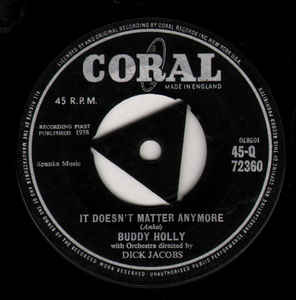
Anka’s voice is pretty strong too – it simultaneously sounds like the voice of a fifteen-year-old, and that of a middle-aged bloke. And by the time he belts out the champagne line: OOOOH, pleeeeeaaasseee stay-eee by me… Diana… you’re won over. Actually, the way he lowers his voice to sing her name does indeed sound like a kid trying to impress an older woman. It’s quite clever, in a way. Anka won’t have any more #1s, but when you’re debut single hits the top and stays there for nine weeks do you really need any more? He’s had a long chart career but is perhaps more famous as a songwriter, having written ‘It Doesn’t Matter Anymore’ for Buddy Holly and ‘She’s a Lady’ for Tom Jones. Oh, and ‘My Way.’ So he did alright for himself in the end.

To end, it’s perhaps worth noting how quickly rock ‘n’ roll has diversified since Bill Haley announced its arrival at the top of the charts. In quick succession we’ve had the raw, proto-punk of Lonnie Donegan, a low-key and slightly tropical sounding debut for Elvis Presley, and now this. After a run of very samey sounding #1s, we are getting a little more variety at the top. And I’m excited to hear what will come next!

62. ‘All Shook Up’, by Elvis Presley

elvis-presley-all-shook-up-that-s-when-your-heartaches-begin-hmv-pop-359--53154-p

All Shook Up, by Elvis Presley (his 1st of twenty-one #1s)

7 weeks, from 12th July – 30th August 1957

And so it begins…

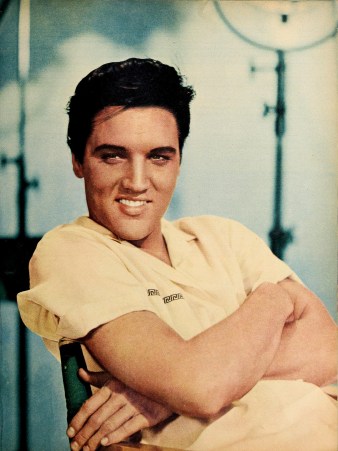
Between the 12th July 1957 and the 6th February 2005, Elvis Presley will score 21 UK #1 singles… (The most any artist we’ve met so far has managed is four). He will spend 80 weeks at #1, 386 weeks in the Top 10, 1062 weeks in the Top 40, 1304 weeks in the Top 75… And that’s before we get started on the albums chart… Elvis won’t just dominate the UK charts; he’ll hump their brains out.

I feel like whatever way I introduce the ultimate pop star (rock star, performer, King of Whatever) it won’t be enough. I’ve already struggled to set the scene for Sinatra, and I’m sure I’ll struggle similarly when it comes to The Beatles, Michael Jackson and co. Best thing is, I think, to just jump straight into the song.

‘All Shook Up’ is actually a fairly low key start for Elvis. There’s a roly-poly riff, a little Hawaiian guitar and someone slapping on a cardboard box (?). There’s no solo, no change of pace, and it’s over inside two minutes. Although I knew what to expect from this song, it does sound a little underwhelming as the record that announced ELVIS PRESLEY’S!! ARRIVAL at the top of the charts. (Of course, this was far from being his debut single – it was Presley’s 7th Top Ten appearance – and I can’t help feeling that some of the singles that went before, such as ‘Heartbreak Hotel’, ‘Hound Dog’ or ‘Blue Suede Shoes’, would have made much more of a statement as his first #1).

What the minimalist production does do, however, is show off Elvis’s voice to perfection. We’ve got the now iconic I’m all shook up – uh huh huh… which impersonators will be doing dodgy copies of until the end of time. We’ve also got the beautiful moment at the end of either verse (not that this song really has ‘verses’, but still) when the instruments pause and we are left with nothin’ but Elvis: My heart beats so an’ it scares a-me to death…

My favourite bit of the whole song, though, comes towards the end. And it’s not a lyric or a guitar lick or anything like that. For a song that’s about the feeling of being in love, and of being all shaken up from falling in love, the lyrics are quite tame. Lots of knees shakin’ and tongues gettin’ tied and so on. But just before the second last I’m all shook up, in a moment of silence, Elvis lets out a little grunt – a tiny little orgasmic sigh – and in that moment we catch the merest whiff of the scandalous Elvis: the Elvis that was causing a moral panic, ‘Elvis the Pelvis’ who couldn’t be shown from below the waist on TV.

article-2256834-16BE3173000005DC-708_634x834

I suppose I should state from the beginning that I know every one of Elvis’s chart-toppers very well. There will be no surprises as far as he’s concerned. I bought my first Greatest Hits when I was around sixteen and never looked back and, while I don’t listen to him as often as I used to, he’s been a pretty constant part of my life’s soundtrack for near twenty years. But it will be interesting to listen to these records in a more critical way, to dissect them as the little pieces of history that they are.

Of course, there’s the well-trodden argument that even by 1957 Elvis had sold-out. Purists will tell you that he recorded all his best, his rawest and most compelling singles, during the Sun years, before he signed to RCA. And there’s some truth to that. There’s also some (a lot?) of truth to the notion that he recorded some utter drivel in the 1960s. But it would be criminal to discount the late-50s singles – utter cornerstones of pop music the lot of them – many of which we will be encountering on this countdown erelong. And ‘All Shook Up’ – while it has never been one of my favourites – deserves its place amongst them…

Uh-huh-huh!

60. ‘Yes Tonight, Josephine’, by Johnnie Ray

s-l300 (3)

Yes Tonight, Josephine, by Johnnie Ray (his 3rd and final #1)

3 weeks, from 7th – 28th June 1957

We’re picking up pace again with the 60th #1, after an ever-so-slight respite under the poppier grooves of Andy William’s ‘Butterfly’, as Johnnie Ray takes us a-rockin’ and a-rollin’ on his final (sob!) chart topper.

Promise me your lips are mine, Josephine tonight’s the time, I will squeeze and hold you tight, Pack each kiss with dynamite…

This is pure rock ‘n’ roll territory – squeezing (!) holding (!), dynamite kisses (!). I noted way back when, during the post on Ray’s first #1, ‘Such a Night’, that the raunchy lyrics and suggestive groaning would have been outrageous, and shocking, for the time. That was only three years ago – in May 1954 – but it already seems a long way off. By the summer of ’57, rock ‘n’ roll was here to stay and lyrics about ‘tonight being the night’ were very much par for the course.

Everything, Josephine, will be alright… I’m gonna give my lips to you, Don’t ask me if I want you ‘cos you know I do… Yes tonight, Josephine! Yes, tonight! Little imagination is required to imagine what will be happening ‘tonight’. Not a quiet game of Canasta, that’s for sure.

The rest of the lyrics are rather throwaway: I’ll be Jack and you’ll be Jill, I have loved you from the start, Kiss me quick – knock me out… I used the term ‘basic’ for the previous number one and I’m reluctant to use it again here BUT, as much as I love Johnnie Ray, this isn’t his most innovative recording. It’s fun, perky and a very worthy attempt at jumping on the rock ‘n’ roll bandwagon, but it’s not in the same league as ‘Just Walkin’ in the Rain’, which in turn was a step down from the seminal ‘Such a Night.’

cb7c74a231dcd2dd49842e43981cd00f--josephine-musicians

Ray, too, sings it like he is aware of this. He doesn’t give it quite the same oomph as his earlier chart toppers. And while I know I mention it every time our Johnnie comes up… he was, after all, gay. And, if you are as gay as the day, then you aren’t going to put as much into a song about a ‘Josephine’ as you would into a song about a ‘Jonathan’, are you? Maybe that’s got something to do with Ray’s somewhat detached performance here? Or maybe he knew it just wasn’t as good a song…?

The best thing here, by far, is the backing singers. Backing singers have played a huge part in the history of the UK’s earliest chart topping singles; much more of a role than they play these days (does anyone have backing singers anymore?) Anyway, whereas most backing singers have been there for some oohs, aahs and the occasional bum-de-dum, Ray’s backers give us a – wait for it: Yip-yip-way-pa-de-boom-diddy-boom-diddy! At least, I think that’s what they’re giving us. There’s no way to be completely sure. But it’s utterly glorious.

If we include ‘Just Walkin’ in the Rain’ and ‘Yes Tonight, Josephine’, then we have now had nine consecutive chart-toppers which have all been variations on a rock ‘n’ roll theme. Never before have we seen such consistency in terms of the genre and style of our number one hits. Plus, they have all been recorded by male soloists and they have all been pretty much the same length: the trusty 2.5-minute pop single has suddenly appeared over the past few months. Plus, if we extend the reach to include Frankie Laine’s ‘A Woman in Love’ – which wasn’t a rock song – then I cannot think of ten chart-toppers I have enjoyed discovering and listening to as much these most recent discs. A Magic 10! I know I’ve called out the more recent ones for being a little basic, and Tab Hunter’s ‘Young Love’ was super-soppy; but when I think back to the depths of the pre-rock days I’d be lying if I said I’m not glad they’re long behind us! As this is the 60th #1, a recap will be up next, so I don’t want to go into much more detail than this – suffice to say that, glancing ahead, the run of rockers is set to continue for a while and – to be honest – long may it last!

I’ll end, then, by giving Johnnie Ray a big send-off. Out of all the artists we’ve covered on this countdown, he’s the one I knew the best and had already listened to extensively. He’s great, and it’s a crime that he never gets included in the list of the great early rock ‘n’ rollers. Beyond the three songs that made it to the top of the UK Charts I’d strongly suggest clicking on the links below and enjoying: his huge breakthrough hit ‘Cry’, ‘Let’s Walk That-a-Way’ – a sparkly duet with Doris Day, his cover of ‘Ain’t Misbehavin’, and ‘You Don’t Owe Me a Thing’ – a track released in between his final two chart-toppers, during this glorious spring of rock ‘n’ roll.

His popularity waned dramatically from 1959 onwards, especially in his native US and, while the same fate befell many stars of the forties and fifties once Elvis and then The Beatles had come along, it also had a lot to do with Ray’s homosexuality becoming more and more of an open secret-slash-scandal. He was also an alcoholic, and his addiction spiralled during the leaner years. He died in 1990. Our friend Kay Starr spoke at his funeral, while Tony Bennett described him as the ‘Father of Rock and Roll’. I couldn’t agree more.

59. ‘Butterfly’, by Andy Williams

R-803538-1160399892.jpeg

Butterfly, by Andy Williams (his 1st and only #1)

2 weeks, from 24th May – 7th June 1957

Our latest chart topping single has it all: handclaps, finger-clicks, whistling, lots of bum-bum-bums and doo-waas from the backing singers… the whole shebang! The perky guitars and drums that have accompanied us over the past half-dozen #1s also remain. It’s a little gentler than ‘Cumberland Gap’ and a little poppier than ‘Rock-A-Billy’, but ‘Butterfly’ is undeniably a rock ‘n’ roll record.

The lyrics compare a girl to a butterfly because, well, she likes ‘flying around’ – if you catch my drift… You tell me you love me, You say you’ll be true, Then you fly around, With somebody new, But I’m crazy about you, You butterfly…

We’ve had lots (and lots) of references to unrequited love in the previous fifty-eight number ones, but the girls in songs like ‘Answer Me’ were simply described as being hard to get, as untouchable angels, paragons of female virtue. This is the first time we’ve had a girl described as something of a floozy. And Andy Williams, try as he might, can’t get over her: I knew from the first time I kissed you, That you were the troublin’ kind, Cos the honey that drips, From your sweet lips, One taste and I’m outta my mind…

But, he doesn’t plan on waiting. Male singers stoically waiting around for their love to notice them hasn’t been in vogue since mid-’55. No, no, no – that ain’t cool no more! These days they either wallow – see ‘Just Walkin’ in the Rain’ – or they take action – see Mr. Williams here: I love you so much, I know what I’ll do, I’m clippin’ your wings, Your flyin’ is through… That’s a slightly sinister metaphor, isn’t it? ‘Clipping’ his girlfriend’s ‘wings’… But hey, you could get away with that sort of thing in 1957.

gty_andy_williams_dm_120926_wblog

Andy William’s has a slightly softer voice than some of the male singers we’ve been hearing from recently, and this softens the song’s impact a little. You can imagine a singer with a real rasp in his voice turning ‘Butterfly’ into a proper rocker. As it is, it’s a fine little track that doesn’t outstay its welcome, but it’s a little… basic? Six months into the rock ‘n’ roll revolution and songwriters/performers are perhaps already resting on their laurels, churning out production-line hits.

Or maybe that’s a bit harsh. Williams is much better known – to me at least – for more easy-listening, cocktail lounge records such as ‘Can’t Take My Eyes Off You’, ‘Music to Watch Girls By’ and ‘It’s the Most Wonderful Time of the Year’ (one of those songs that drives you a little bit mental in shopping centres every Christmas.) He didn’t stick with the rock ‘n’ roll for long, it seems, which was probably a wise decision as it prevented him from being tarred with that particular brush, and allowed his chart career to extend well into the 1970s.

But ‘Butterfly’ was his sole UK chart topper. Like Tony Bennett, Dean Martin, Bill Haley et al before him, he ticks ‘Get a UK Number One’ off his to-do list pretty early on in his career. And, as with those other luminaries, it seems only right that he had his moment at the top. He’s undeniably a legend of popular music, whose recordings remain admired today. Case in point: a decade ago I spent six months teaching in Thailand, and one of the most popular songs when my Thai colleagues dug the karaoke machine out – which was very, very often – was ‘Can’t Take My Eyes Off You’. I somehow doubt they’d heard of ‘Butterfly’, though. Which is a shame, I suppose.

58. ‘Rock-A-Billy’, by Guy Mitchell

s-l300 (2)

Rock-a-Billy, by Guy Mitchell (his 4th and final #1)

1 week, from 17th – 24th May 1957

Part 58, in which Guy Mitchell scores his latest UK #1 single with a rockabilly record entitled… ‘Rock-a-Billy.’ Imagine if Eminem were to release a song called ‘Rap’, or Ed Sheeran were to record one called ‘Bland Shite’ – that’s where we are right now. This is a record that does exactly what it says on the tin.

It’s another fast-paced chart topper – not quite as frantic as ‘Cumberland Gap’, but then what is? – that rolls along on jaunty guitars and a Winifred Atwell-esque piano. While lyrically it takes the term ‘generic’ to new levels. This is a song about a man and his love for rock ‘n’ roll music, to which the chorus goes:

Rockabilly, rockabilly, rockabilly, rock… Rockabilly, rockabilly, rock, rock, rock… Rockabilly, rockabilly, rockabilly, rock… Rockabilly, rockabilly… Rock! Rock!

Anyone who claims that modern pop is dumbed-down nonsense; point them in the direction of this record. The verses aren’t much more highbrow. There’s some silliness about the history of rockabilly music – it came from Tennessee, spread on out to the lone prairie – and then a lot of advice on how to dance to this crazy new music:

From the moment that you feel this crazy beat, You gotta lose control of your two left feet, Give me mountain juice, Turn me loose, Leave me wave my arms about…

It’s the latest song in a growing list where I’ve had to look the lyrics up online, rather than transcribe them by simply listening to them, as Guy Mitchell does a good bit of growling and slurring. (Actually, if you listen to his first chart-topper, back in 1953, and now this, Mitchell’s voice does have a harder edge – perhaps he was altering it to fit the style of the time? Or maybe he was just getting older?) Plus… is that reference to ‘mountain juice’ the first mention of alcohol, of drugs, of any kind of intoxicant in a UK Number One Single? I think it might just be… We truly are rockin’ and rollin’!

However, although I’m bandying terms like ‘generic’ and ‘silliness’ around, I wouldn’t want anyone to think for a second that I don’t like this song. It’s great. It’s dumb. It’s fun. I like it like how I like sherbet dib-dabs: I know there are ‘better’ foodstuffs to shove down my gullet, but I know I wouldn’t enjoy them half as much. It is a song that I dare anyone to dislike, a song that’s programmed to hit all the most primal happiness receptors in your brain. It’s got four key-changes, for God’s sake! The best bit of all is the bridge, which strangely comes right at the end, and which is positively life-affirming: You know what rockabilly’s all about, You know it’s gonna make you sing and shout, You know you’re gonna act like a crazy fool, Who cares? It’s cool! Yes, dance people! Dance like no one’s watching. Guy says so!

1100-86

We have to bid farewell to Mr. Mitchell here, following this short encore at the top of the charts. And I have to admit that I’ll miss searching for pictures of his handsome face to add to these posts. His first chart-topper was… interesting, but the subsequent three – ‘Look at That Girl’, ‘Singing the Blues’ and now this – can legitimately go down as classics of the early rock ‘n’ roll/pop crossover. Few, if any, artists can claim to have been as consistently popular throughout the 1950s as Guy Mitchell: he had his first US Top 10 single in 1950 and his last in 1959. And we leave him here as the man with the joint most UK #1s, a record which he’ll hold for a couple more years.

Anyway, I’m on my seventh listen of ‘Rock-a-Billy’ as I type this sentence, and with every listen I like it more. I’d better stop before I begin claiming that it’s the best song ever recorded. One final thought, though: it’s telling that the biggest stars of this fledgling ‘rock age’, at least in UK chart terms, were Guy Mitchell and Johnnie Ray – two already very established artists who jumped on the rockin’ bandwagon and started scoring huge hits once again. A case of mass-appeal, perhaps? The kids liked the cool new music, while mum and dad trusted good ol’ Guy to keep it respectable? More respectable than arrivistes like Elvis, Chuck and Little Richard at least? Not that this will last long, but still. An interesting mini-era in rock music: the oldies outselling the upstarts.