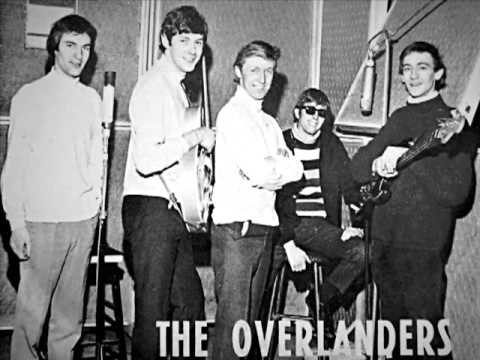
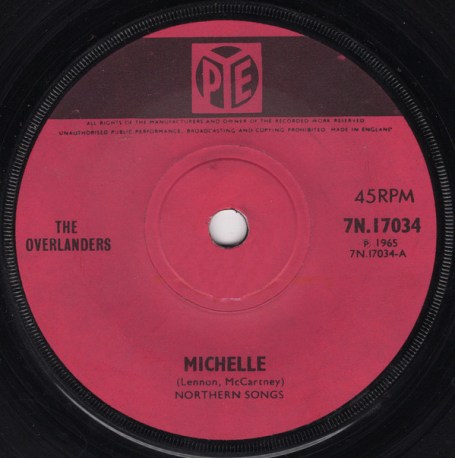
209. ‘Michelle’, by The Overlanders

For those counting, we arrive at the 3rd Beatles cover to top the UK charts. Which means that in a little under three years, Lennon & McCartney have been responsible for twelve chart-toppers! Not bad, not bad at all. A couple of posts ago I mentioned them in comparison with Bacharach and David, who recently wrote The Walker Brothers #1 ‘Make It Easy on Yourself’. But, having done some digging, it turns out that they were still way behind John and Paul with just 6 chart-topping compositions to their name, in well over double the time.

409261612b4d7aea6ffdc34e7c45d2b4

Michelle, by The Overlanders (their 1st and only #1)

3 weeks, from 27th January – 17th February 1966

Anyway, that’s all well and good; but this next chart-topper isn’t by The Beatles. Note the name at the start of this post: The Overlanders. You know, the British folk-rock-cum-pop combo? Nope? Well this was their one and only hit. And it’s a pretty faithful, note for note, cover of the original.

I’d like to write about this without comparing it to The Beatles’ version, but that would mean erasing a song that I’ve been listening to since I was a kid from my memory for the next half an hour. And I don’t have the technology to do that… Michelle, Ma belle, These are words that go together well, My Michelle… Alongside a jaunty, perky, French-salon tune. It’s slightly heavier, more deliberate version – the instruments and the vocals have a deeper finish and a gloss that the original doesn’t. The Beatles’ version is more subtle, lighter… (Oh fine, here’s a link. Compare them for yourself.)

Probably the most notable thing about this disc is that it has a full line of French in it, which is a first for a UK chart-topper. Michelle, Ma Belle, Son les mots qui vent très bien ensemble, Tres bien ensemble… Even if, like me, you have only the most basic of French abilities, you can work out that it’s just a direct translation of the preceding, English line. Still, aside from ‘Que Sera Sera’, which is actually gibberish, this is the first in a long line of ‘non-English’ #1s, or ‘not-completely-English #1s’, which will take us through ‘Je T’Aime…’ to ‘La Isla Bonita’, to, um, ‘Gangnam Style’…

R-5555535-1541595797-1010.jpeg

As a hit record, this is alright. It might as well have been done by a pub covers band for all the personality they bring to it, but it’s OK. It’s not as good as the original, you’d never choose to listen to this version over it, but the only bit I think that really lets The Overlanders down is the creaky I love you… before the solo.

What it kind of reminds me of is the electronic keyboard that I had as a kid, for the six months or so I attempted to learn, which had a bunch of famous songs pre-programmed into it. ‘Michelle’ wasn’t one of them; but if it had been I bet it would have sounded quite like this. Perhaps the problem is that, unlike the previous two Lennon & McCartney written chart-toppers, everyone thinks of ‘Michelle’ as a Beatles song. It’s a well- known track from one of their best-regarded albums, ‘Rubber Soul’, and features on several Greatest Hits compilations (which is where I first heard it all those years ago.) Whereas, Billy J. Kramer, and Peter and Gordon, could more easily pass ‘Bad to Me’ and ‘A World Without Love’ off as their own, with no ‘official’ version of those hits ever recorded by The Fab Four, The Overlanders wouldn’t be as lucky.

But then again, if you wanted a guaranteed hit in the mid-sixties, you couldn’t do any better than nabbing yourself a Beatles’ cast-off. They got their big smash; but very few people remember them for it. Like I wrote at the start, this was The Overlanders’ one and only hit record. It raises a philosophical question to finish on: What’s better, plugging away valiantly on your own with little recognition, or riding the coattails of the world’s biggest band for three weeks of reflected glory?

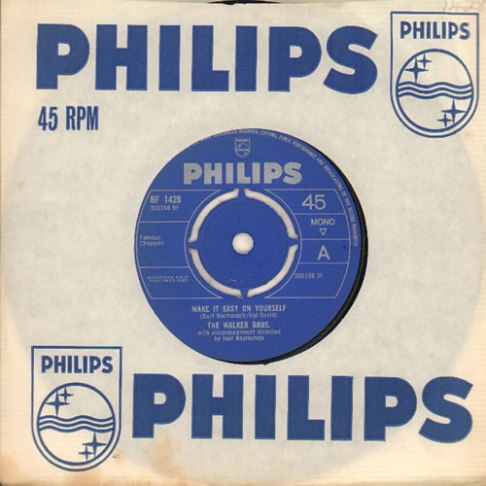
203. ‘Make It Easy on Yourself’, by The Walker Brothers

From an angst-ridden clarion call for disaffected youth, to this. We have strings! A full-blown orchestral section. The top of the charts lurch from one extreme to another, like a slightly edgier version of the Royal Variety Performance.

hqdefault

Make It Easy on Yourself, by The Walker Brothers (their 1st of two #1s)

1 week, from 23rd – 30th September 1965

We’re in a classy cabaret. All velvet drapes and green-shaded lamps on the tables. Where a melancholy, Spector-ish intro moves into a very melancholy opening line. Oh, breaking up, Is so, Very hard to do… A hook that we’ll keep returning to throughout the song.

If you really love him, And there’s nothing, I can do… Don’t try to spare my feelings, Just tell me that we’re through… It’s a novel twist on the break-up song – another sign that pop music is growing up – in that the singer spends the whole song encouraging his girlfriend to split up with him. And if the way I hold you, Can’t compare to his embrace… Get it over with, he says. Don’t hang around. Make it easy on yourself. He’ll feel terrible, but then breaking up is, after all, so very hard to do…

The voice is velvety, and very, very croony. Check out the O-o-o-h baby… before the final chorus. So croony that at times it sounds a little insincere. A little like he’s playing up to the cameras, like he might not really be that bothered if she goes. I like it; and I don’t like it. I’m on the fence with it. It perhaps doesn’t help that I can’t help hearing Jarvis Cocker, who has unashamedly copied Scott Walker’s singing style to great effect since the 1980s, in every line.

The Walker Brother, like the Righteous Brothers before them, weren’t really brothers. It’s a stage name, one that adds to the slightly camp, cabaret-ish feel that this record has, a feeling that this record can’t quite escape. Maybe I’m hearing it all wrong, but it’s a song that sounds as if it’s being delivered with an arched eyebrow and a knowing wink. Or maybe that’s the point. The beauty of art is in the interpretation, after all.

THE_WALKER_BROTHERS_MAKE+IT+EASY+ON+YOURSELF+-+4PR-639430

It’s another Bacharach & David number, originally written in 1962. I’ve not been keeping count, but this must put them at, or very near to, the top of the #1 record writing league. And, like so many of their compositions, it’s a song that just drips with that B & D class. It’s drenched in strings and portentous drums, and is another glowing example of Baroque pop, which is fast becoming the sound of 1965. It’s a record with a great pedigree, one of the first chart appearances by a man who has left a huge mark on popular music, from Bowie to Pulp to The Arctic Monkeys, and I just wish I could like it more…

The Walkers – Scott, Gary and John – were American but, in a sort of reverse British Invasion, enjoyed quicker and longer lasting success in the UK. They will appear one more time at the top of the charts here, with a song that – if I remember correctly – is even classier and glossier than this one, and that might just help me to ‘get’ them.

My first ever exposure to ‘Make It Easy on Yourself’, though, came long before I’d ever heard of Scott Walker, or Baroque Pop, or knew what a Wall of Sound was. In 2001, the opening strings from this #1 were sampled by Ash, on their #20 hit ‘Candy’. Ash are a great pop-rock band, who have never come anywhere near topping the charts, so I’d like to take this – my one and only chance to give them a shout-out. If you’ve never heard them, check them out.

Catch up with the previous 202 number-ones here:

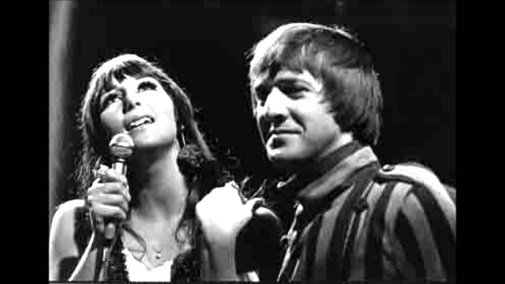
201. ‘I Got You Babe’, by Sonny & Cher

In which we meet a guy called Sonny and a gal called Cher. One of whom would go on to become a Republican politician; one of whom wouldn’t. I wonder which one it’ll be…?

maxresdefault (1)

I Got You Babe, by Sonny & Cher (her 1st of four #1s)

2 weeks, from 26th August – 9th September 1965

Before all of that, their debut single. And what a way to get your careers started – with an international chart-topper. A song that’s still well known to this day. Ubiquitous, even. They say we’re young, And we don’t know, Won’t find out until we grow… Y’all know the rest. But, having listened to it several times now, I’m realising that it’s a very difficult record to define. Is it pop? Is it folk? Is it country? Is there a whiff of Phil Spector-esque Wall of Sound in there?

It’s a dense, textured record – lots of bells and tambourines and other slightly unusual sounding instruments that you don’t normally get in a pop song, chiming in along with a slightly droney rhythm. It’s Baroque pop – pop that incorporates classical elements. The Beach Boys, The Walker Brothers and The Beatles were all beginning to experiment with harpsichords and strings. Neither of which feature on ‘I Got You Babe’, though I think you can hear a French horn or two.

It’s a grown-up sounding pop record. A feature of 1965 so far through chart-toppers from The Righteous Brothers, Georgie Fame and so on, a further step away from simple Beat-pop. Except… lyrically, ‘I’ve Got You Babe’ is ultra-simple. They say our love won’t pay the rent, Before it’s earned our money’s all been spent… etc. etc. Culminating in Sonny’s lines in the bridge: I’ve got flowers, In the spring, I’ve got you, To wear my ring… It’s cutesy cutesy and a little hippy dippy. And the ending, where they list all the things that they have one another for – I’ve got you, To hold me tight… and so on, is a bit much.

download

I have to admit, this has never been a song that I’ve loved. And writing this post hasn’t changed my mind. It’s too cute, too twee. Two teenagers in love, regardless of what the world thinks. Musically, yes, it’s another step forward but the lyrics are eighth-grade Valentine’s card level. And to call them teenagers isn’t strictly correct – Cher was nineteen when this hit the top, whereas Sonny was thirty…

What of Cher? There’s little going on here to suggest that she’s going to become one of the biggest female stars of the late twentieth century. She doesn’t even really sound like Cher yet. No autotune, maybe… The voice does come through in certain lines, though – rey-unt and spey-unt for example. She sounds a bit hesitant, a little shy, though she does deliver her lines in the bridge magnificently – You’re always aro-o-o-ound… and by the end she’s belting it out.

By the time we hear from her next, Cher will be stratospherically famous. But that won’t be for a while. A cover version of ‘I Got You Babe’, by UB40 and Chrissie Hynde, will top the charts before Cher appears there again. Meanwhile, Sonny Bono is the one who will go on to become the Republican politician (give yourself a round of applause if you guessed that right) before dying tragically in a skiing accident in 1998. They divorced as early as 1975, which kind of undermines the message of their only chart-topper together. ‘I Got You (Until We Split Up In a Decade) Babe’ doesn’t have quite the same ring to it.

198. ‘I’m Alive’, by The Hollies

Finally, after all the recent gospel, jazz and country, we’re back on track. This is more like it. This is what the sixties were meant to sound like…

125018732-origpic-9d7859.jpg

I’m Alive, by The Hollies (their 1st of two #1s)

1 week, from 24th June – 1st July / 2 weeks from 8th – 22nd July 1965 (3 weeks total)

This record is like a ‘Best of the Sixties’ compilation distilled down into a two and a half minute song. Let’s take it step by step… The intro is pure Merseybeat – light, chiming guitars – with a generous side order of Doo-Wop. Doo- doodoodoodoodoodoodoo… Then in comes in a husky, Lennon-ish voice: Did you ever see a man with no heart, Baby that was me… It’s all about a man who had never lived before, until his girl came along. It’s an upbeat and positive song. A song that puts you in a good mood. He’s alive!

The build-up to the chorus is very Beatles-y. Think a milder version of their ‘Twist and Shout’. Now I can breathe, I can see, I can touch, I can feel… Each line ascends ahead of the previous one, until the singer punches the chorus out: I never felt like this… I’m alive! I’m alive! I’m alive! End, and repeat.

Then the solo, which is a bit more hard hitting. Think tinny Kinks’ guitars with a bit of Stones swagger thrown in. And by the end, they’ve gone full on Who – with Keith Moon style drum fills and a frenetic rock-out to the end. Sprinkle the tiniest hint of psychedelica in the guitar reverb, and soupçon of Beach Boys in the backing vocals, and there you have it. I mentioned in recent posts that Jackie Trent and Sandie Shaw’s recent #1s were the most ‘sixties-sounding’ pop hits and now, well, I think we have the rock equivalent. We are slap-bang in the middle of the decade, and the sixties have never sounded sixtieser. It’s the perfect mix of old-style rock ‘n’ roll, Merseybeat and the newer, harder-edged rock. It’s a great little record.

THE-HOLLIES-Im-Alive-Parlophone-1965

The Hollies were also, like so many of the bands that they sound like, from the north-east of England, and went through the same Cavern Club circuit as all their peers. Founded by Allan Clarke and Graham Nash (later of Crosby, Stills and Nash), they started out as an Everly Brothers style duo before adding a few more members. Their name is – as you may have guessed – a tribute to Buddy Holly. ‘I’m Alive’ was far from being their first hit; nor was it their last. They would go on to have Top 10s well into the seventies, and were the 9th biggest chart-act of the sixties. Not bad, considering that they were up against Elvis, Cliff, The Beatles, The Stones, The Kinks and more in that list.

And I have to admit that they are the one big sixties rock group that have passed me by. I know ‘Just One Look’ – another mid-decade pop classic – and ‘Stop Stop Stop’, as well as their later, mellower hits ‘He Ain’t Heavy…’ and ‘The Air That I Breathe’. But I should know more, and will explore their back-catalogue as soon as I’ve finished writing this post. ‘I’m Alive’ was their only UK #1* and that, given their chart longevity, feels like a surprise.

But, before you give delve into their Greatest Hits, give this record one more spin. A song that sounds like the love-child of every prominent sixties rock ‘n’ roll band, a record that faces both forward and back, a record that did a weird mid-summer’s dance with Elvis’s ‘Crying in the Chapel’ (Elvis was #1, then The Hollies, then Elvis, then The Hollies again) at the top of the charts. A classic, that almost slipped through the gaps.

*(My first ever footnote!) Actually, The Hollies will have one further UK chart-topper, with a re-release in precisely twenty-three and a bit years, for Miller-Lite based reasons that we’ll go into when we get there.

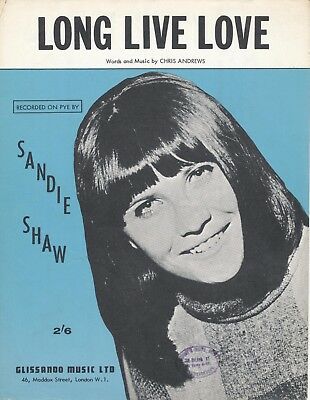
196. ‘Long Live Love’, by Sandie Shaw

**Cue fanfare** For the first time since September 1956 (!) one female artist replaces another at the top of the UK charts. Isn’t it amazing to think that, of the 150 or so chart-topping singles since then, so few have been recorded by women.

$_1

Long Live Love, by Sandie Shaw (her 2nd of three #1s)

3 weeks, from 27th May – 17th June 1965

Jackie Trent didn’t last long at the top – a solitary week is all she got – but our Sandie is back to stake a claim as the biggest female star of the decade. Her first #1 – ‘(There’s) Always Something There to Remind Me’ – was a slinky, sophisticated number. Her second is, well, more of the same.

Except ‘Long Live Love’ is perhaps a little more instant, a little catchier, a little jauntier… A swaying rhythm, a brass section, that ribbed instrument that you run a stick along, (you know the one you always got lumped with at Primary School when you couldn’t be trusted with a recorder, or a triangle…) It’s got a slight Copacabana Beach Bar vibe.

After the false start, that is. A guitar gently strums, Sandie’s voice comes through, as fun and flirty as ever: Venus must have heard my plea, She has sent someone, Along for me… And we’re off. Da-da-da-dada-dada-da-da… It’s an ode to the joys of simply being in love. Meeting each night at eight, not getting home till late… I say to myself each day, Baby oh long live love…

As with Jackie Trent before her, this is an uber sixties record. The sort of song you play over the opening credits of a TV show in order for the audience to instantly realise the time and place. And, also as with Jackie T, the lyrics – the overall meaning of the song – are pretty throwaway. She’s in love. She’s outrageously happy. The end.

sandie-shaw_long-live-love_2

And there’s nothing wrong with that. It’s a catchy little pop song that shimmies along, over and out in two and a half minutes. In fact, it ends pretty abruptly, as if someone’s just pulled the plug and called it a day. Like I said, ‘Long Live Love’ is a simpler song than ‘(There’s) Always Something…’, it doesn’t have that Bacharach and David gloss, but I think I might prefer it. Sandie Shaw certainly liked it – she turned down ‘It’s Not Unusual’ in favour of it and also recorded a successful version in French. She was riding high, and we’ll meet her again before the decade is out.

I like almost everything about this record, except the title. I get what they were going for – it’s got that carefree sixties wordplay to it. But it’s kind of annoying. Like the sort of cutesy slogan a certain type of person would nowadays have stencilled on their living room wall…

Title aside… There may not have been many female led #1s in the sixties, but when they do come along they feel like a bit of an event. Think Shirley Bassey, Helen Shapiro, Cilla and now Sandie. They’re always classy, and well-polished – records that it feels like a lot of time and effort went into. Maybe they just stand out because it’s a woman singing, but I think there’s more to it than that. And the good news is we won’t have to wait too long until the next feminine vocals pop up on a #1 single, and they will be some legendary vocals indeed…

(Shock, horror! There is no YouTube link for the full, original version of ‘Long Live Love’ – so this is the best I can do. Listen on Spotify for the real version.)

195. ‘Where Are You Now (My Love)’, by Jackie Trent

We are now slap bang in the middle of the 1960s, and we’ve arrived at perhaps the most sixties-sounding song yet. It shimmers, it glistens, it drips… It’s absolutely drenched in the sixties.

jackie-trent-on-tv-1968-billboard-650

Where Are You Now (My Love), by Jackie Trent (her 1st and only #1)

1 week, from 20th – 27th May 1965

La…la-la-la-la-la… la-la-la-la-la… a cute little Latin-tinged rhythm, and a voice that is rich and honeyed. I like her voice. I want to listen to it some more. I want it to sing me to sleep. When shadows of evening gently fall, The mem’ry of you I soon, Recall… She sings properly, with a mildly posh way of stressing her words – a slight pre-rock throwback. I imagine this disc playing in a luxury New York apartment, overlooking Central Park at sunset, as a man dressed like an extra from ‘Mad Men’ pours a cocktail for a woman in a daringly short skirt and a beehive…

Then the chorus soars – as the chorus of every mid-sixties, female-led ballad simply must – with swirling violins and portentous drums. Where are you now, My love…? Where are you now, My love…? To be honest, I’m struggling to pay much attention to the lyrics. They are stock-lyrics, lyrics that exist because, well, a song needs them. This record is much more about the sound. About being a gorgeously identifiable moment in time. Listen closely… It’s the sixties…

It’s yet another grown-up pop song. That’s the theme of the first half of 1965: the more we move away from the simple Beat-pop ditties of Herman’s Hermits, Peter and Gordon and the like, the more mature everything is getting. The Righteous Brothers, The Moody Blues, Jackie Trent. I’m no songwriter, but ‘Where Are You Now (My Love)’ sounds like a complex song. Upon closer listen, it’s still a verse-verse-chorus-repeat then middle-eight kind of number. But it sounds complex, the way one section leads softly into the other, fading then rising.

Jackie-Trent-Where-Are-You-Now-7-Single

(Note that pretty much everywhere lists the song title as ‘Where Are You Now (My Love)’, except for on the disc itself…)

You could be forgiven for thinking that this is another Bacharach and David number – it’s just got that feel about it – but it’s not. It was written by Trent herself, with her song-writing partner Tony Hatch. Apparently it featured in a popular TV series of the time, ‘It’s Dark Outside’, the exposure from which saw the song reach #1. The pair wrote several other sixties hits, primarily for Petula Clark, but also for Sinatra, Shirley Bassey, Scott Walker, and more. You can’t get much more ‘cool sixties’ than that list of names… Come the seventies, though, and the hits were drying up for Trent, both as a performer and as a writer. She was reduced to writing songs for Stoke City, to celebrate their appearance in the League Cup Final. And that seemed to have been that…

Until the ‘80s when Trent and Hatch, by this point married, moved to Australia. Where they only bloody went and wrote the theme to ‘Neighbours’. Yes, the theme. Neighbours, Everybody needs good neighbours – played on British TV, twice a day for the past thirty-odd years. Given that no TV show – outside of X Factor, Pop Idol etc. – has contributed more to the pop charts over the years than ‘Neighbours’, it’s amazing to think that (with a slight stretch of the imagination) you can claim ‘Where Are You Now (My Love)’ as the first ‘Neighbours’ hit… twenty years before the pilot aired!

Jackie Trent then, ladies and gentlemen, who sadly passed away in 2015. Sit back, press play and enjoy her one and only UK #1 hit – her most famous song-that-isn’t-the-theme-to-an-Australian-soap-opera…

Follow along with every song below:

193. ‘Ticket to Ride’, by The Beatles

In my post on the last Beatles’ chart-topper, ‘I Feel Fine’, I suggested that it announced the arrival of Beatles MK II. The cool Beatles. The detached Beatles. The stoner Beatles.

1965_beatles_01

Ticket to Ride, by The Beatles (their 7th of seventeen #1s)

3 weeks, from 22nd April – 13th May 1965

This, their seventh chart-topper in two years (!), is definitely mined from the same groove. It could even have been from the same recording session as ‘I Feel Fine’. The intro isn’t as scuzzy – the chiming guitars actually come across like a church bell on a Sunday morning – but that only lasts a second or two. Soon we lurch into a woozy, droney riff, with drums that roll, then thump, then disappear when you least expect. I’m no drummer, but am pretty sure that ‘Ticket to Ride’ should be produced as the first item of evidence when anyone claims Ringo couldn’t drum.

I think I’m gonna be sad, I think it’s today, Yeah…. The girl that’s drivin’ me mad, Is goin’ away, Yeah… Like most of the big Beatles hits, I grew up listening to this and could sing most of the words. But I’d never really noticed how desolate they were… She said that living with me, Was bringing her down… She would never be free, When I was around… Then how threatening they become: Before she gets to sayin’ goodbye, She oughta think twice, She oughta do right by me…  We’re a long way from ‘I Want to Hold Your Hand’, Toto.

Going by those lines, it seems as if Lennon & McCartney had been taking notes from the Rolling Stone’s book of romance. It’s the same sort of bruised bravado that we’ve heard in ‘The Last Time’ and ‘It’s All Over Now’. And that’s not the only thing they’d noticed – the clanging, ominous guitars here sound very Stonesy. Except… the lead guitar is also very US folk-rock. Very Byrds-y. And the guitar lick that connects the bridge back to the verses is… a mini-metal solo. Like, seriously.

THE-BEATLES-TICKET-TO-RIDE-UK-7-Single

‘Ticket to Ride’ is all about the details. Those drum-fills. That guitar lick. The chiming intro and the falsetto outro – My baby don’t care… – reminiscent of the way that they completely changed track for the last five seconds of ‘A Hard Day’s Night’. The Awww before the final She’s got a ticket to ride… It’s all about the details, because it’s an impossible record to categorise as a whole. It’s a beat-pop song at heart, but it’s also folksy, it’s heavy, it’s got bloody Indian sitar-sounding riffs thrown in…

I’m aware that this is going to be a very short post for a song of this stature. But we are seven songs into The Fab Four’s chart-topping run – there’s no need for an intro. And with ten more #1s to come from them we don’t need much of a postscript. I’ll leave you with a realisation that struck me midway through my sixth listen of ‘Ticket to Ride’… The Beatles were really, really good, weren’t they?

A playlist with all the #1s so far….

191. ‘Concrete and Clay’, by Unit 4 plus 2

I look at the title of this next chart-topper – a little one-week wonder from the spring of 1965 – and think ‘Nope’. I do not know this song. Which is good! I like a nice step into the unknown.

Unit 4 Plus Two

Concrete and Clay, by Unit 4 plus 2 (their 1st and only #1)

1 week, from 8th – 15th April 1965

Then I press play, catching a whiff of snazzy Latin guitar and some cowbells? And, what’s that…? The ting of a cymbal? And I start to wonder if perhaps I haven’t, somewhere, at some point in time, heard this before…

It sounds like the music used between scenes in a cutesy rom-com – the sort with slightly older leads (Alec Baldwin, perhaps?), set in a Californian wine-valley… But with added lyrics: You to me, Are sweet as roses in the morning, You to me, Are soft as summer rain at dawn… The suspicion that I may have heard it before grows…

Then we arrive at the hook: The concrete and the clay, Beneath my feet, Begins to crumble, But love will never die… And, yes, I do know this… We’ll see the mountains tumble, Before we say goodbye… Somewhere, deep in my subconscious, this tune must have lain dormant for years, decades perhaps. Until today. The mysteries of the human mind…

It’s a pleasant enough song. Cute, up-tempo, doesn’t outstay its welcome. It’s got a kind of timeless sound, a world away from most mid-sixties rock, in keeping with the way that 1965 in general has seen pop music splintering away from the Beat movement. But if I had one complaint about the song it would be that it’s slightly basic. ‘The world may end, but my love will live on…’ is the message, and ‘Yeah, whatever’ is my response. For a record intriguingly titled ‘Concrete and Clay’, it is a little disappointing to discover that it’s just a standard love song.

unit_4_and_2-concrete_and_clay_s_2

And I’m struggling to write much else … Perhaps the fact that I thought I’d never heard of it is telling. Ask a stranger in the street to sing a line from ‘Concrete and Clay’, by Unit 4 + 2 and I’m betting they’d struggle. This is a fairly well forgotten #1 from a fairly well-forgotten band. Not that they were quite one-hit wonders, as their follow up to this managed to reach #14 later in the year.

I like the name, though. The use of numbers looks quite modern, especially when placed next to ‘The Beatles’, ‘Herman’s Hermits’ and the like. Unit 4 + 2 sounds to me like a German Eurodance duo from the mid-nineties. The origin of the name is pretty prosaic though: a band named Unit 4 added two new members, and changed their name accordingly…

And that’s all (he) wrote (about this song.) We’ve not had much Spanish guitar at the top of the charts before now, so for that reason alone I have no problem with this grabbing a week at the top. A cute little interlude on our journey through pop music history… Onwards…

189. ‘It’s Not Unusual’, by Tom Jones

Some songs take a while to build to a climax; others wallop straight in from the get-go. ‘It’s Not Unusual’, the debut hit from voice-of-the-valleys and now Knight of the Realm, Sir Tom Jones, falls into the latter camp. There is no climax here. Or rather, the song is the climax.

Music - Tom Jones - 1965

It’s Not Unusual, by Tom Jones (his 1st of three #1s)

1 week, from 11th – 18th March 1965

Stabbing jazz-bar brass, and hand-claps. Pah-papa-Pah-papa… Your feet instantly start tapping. Then in blasts Tom… It’s not unusual, To be loved by anyone, It’s not unusual, To have fun with anyone… By God could Tom Jones sing. (And still can – let’s not kill him off before his time.) But when I see you hanging about with anyone, It’s not unusual, To see me cry… I wanna die…

Never has a song about a jealous and possessive ex-lover sounded so cheerful. Tom sees his girl around town – flirting, galivanting, generally having a good time – and it kills him. Why did they split up? Who knows? This isn’t a song for reflecting. Why can’t this crazy love be miiiiiiinnnnneeeeee…. he wails as we head into the break. I don’t know, Tom, maybe if you stopped snooping around on her like a creep…?

But it bears repeating: this cat can sing. Jones’s voice is not one you’d ever describe as subtle; but it’s super-soulful and packs a brilliant, throaty rasp. That miiiiiinnnnnneeee above is powerful, as is the way he lets loose at the end. It stands out for miles around compared to his contemporaries, and it is hard to imagine that he was only twenty-four when he recorded this record. Apparently the song was offered initially to Sandie Shaw, but once she heard Jones’s recording she felt it would be impossible to make a better one…

This disc races to an end in precisely two minutes, and it feels even shorter such is the galloping pace that it maintains. Over the past few months I had noticed that our #1s were getting longer. The Animals scored the longest by some distance – ‘The House of the Rising Sun’ reaching four and a half minutes – but ‘You’ve Lost That Lovin’ Feeling’ and ‘Yeh Yeh’ also pushed well beyond the magic three-minute mark. Tom Jones doesn’t hang about, though. He takes us back several years – to the days when a couple of minutes per song was the norm.

TOM_JONES_ITS+NOT+UNUSUAL-558172

Despite this being the very first hit for a fresh-faced young Welsh lad, it’s hard to imagine that Tom Jones was ever cool. Even when ‘It’s Not Unusual’ was sitting at number one in the charts, I’ll bet it was being bought more by mums than by their daughters. (Apparently, though, the BBC refused to play ‘It’s Not Unusual’ at the time, as Tom Jones’s image was too sexy…) Later hits like ‘Delilah’, ‘What’s New Pussycat?’ and ‘She’s a Lady’ did nothing to help his image. He’s remained steadfastly uncool throughout the decades, too. He was uncool when covering Prince in the eighties, and he was uncool when he scored a big comeback in the early 2000s with (shudder) ‘Sex Bomb’. There was a good reason he was Carlton’s favourite singer in ‘The Fresh Prince of Bel Air.’

But who cares? Who cares if he’s recorded some absolute cheese over the years? Who cares if he looks like someone you wouldn’t leave your wife alone with for a minute? Who cares if, by this point, he’s gone beyond parody? It’s worked for him, and given him career-longevity that few can even dream of. Maybe that’s the key: start of uncool and you’ll never have to worry about losing it… Plus, whenever Tom Jones sings, he sounds like he’s having the time of his life. Love what you do, folks, love what you do. Tom’s got it sussed…

188. ‘I’ll Never Find Another You’, by The Seekers

For the first time in a good nine months – since The Four Pennies’ bland ode to ‘Juliet’ – do we arrive at a #1 single that I have never heard before. This is how it used to be, of course, in the pre-rock days – before rock ‘n’ roll came along, with all those famous songs in tow. Almost every post was a step into the unknown…

152374

I’ll Never Find Another You, by The Seekers (their 1st of two #1s)

2 weeks, from 25th February – 11th March 1965

Speaking of rock ‘n’ roll, and the fifties and all that… The opening chords of this latest chart-topper sound a lot like ‘La Bamba’. A mellower, more folksy version of the Ritchie Valens hit to be sure, but they’re there. It’s a promising opening… that lasts until the singers open their mouths…

There’s a new world somewhere, They call the promised land, And I’ll be there someday, If you could hold my hand… Several earnest, fresh-faced voices chime together. I’m getting strong Christians-round-a-campfire vibes… I still need you there beside me, No matter what I do, For I know I’ll never find another you… Or maybe proto-hippies, the first feelers of a movement that will go full-on mainstream in a couple of years? The lyrics sure do sound like they could be about joining a commune (‘The promised land’?)

Not quite. This record is, though, our first slice of sixties folk-rock. The gentle guitars, the clear vocals, the tambourine that gets a good shaking in the background… It’s a genre that I don’t think was ever quite as popular in the UK as in America, where Peter, Paul and Mary, The Byrds, The Mamas and the Papas, Simon & Garfunkel and, of course, Bob Dylan were big, big stars. But we’d had fair warning of it – remember back in 1961, when the collegiate folk band The Highwaymen scored a surprise #1 with their version of ‘Michael’ (Row Your Boat etc. etc.)? They were from across the pond, too.

731107311054_1

I’m not convinced by this song, to be honest… There’s something a bit cloying about it, a bit happy-clappy. And the lead singer – Judith Durham – sounds kind of like a Sunday school teacher gone rogue. Plus the lyrics don’t really go anywhere – it’s just a long list of what she can do with her man by her side… When I walk through the storm you’ll be my guide… and I could lose it all tomorrow, And never mind at all… etcetera and so on. It’s not terrible; but it’s the worst number one for a while. Probably since ‘Juliet’, the last chart-topper that I’d never heard of… And in its defence, we’ve just enjoyed the highest-quality run of #1 singles in British chart-history, and it would be unfair to completely write a record off just because it doesn’t hit the heights of ‘A Hard Day’s Night’ or ‘You’ve Lost That Lovin’ Feelin’.

I am, for example, a sucker for those yearning chords that pop up time and time again in folk-rock. See lines like You’ll be my someone, Forever and a day… Or If I should lose your love dear, I don’t know what I’ll do… The first song I ever loved – I’m reliably informed, as I was too young to remember – was ‘Puff the Magic Dragon’, which I would sing anywhere and everywhere as a toddler, driving everyone around me to the edge of insanity. And ‘Puff’’s got plenty of those yearning, minor-key chords in it. Who knows – maybe I’m a folky at heart?

Of course, all that stuff I just spouted about ‘I’ll Never Find Another You’ being an all-American slice of hippyish folk is undone by the fact that The Seekers were Australian, and that the song was composed by British songwriter Tom Springfield (brother of Dusty – who keeps cropping up via other people’s songs – when will she appear on her own merits?) But hey. It sounds American, and was definitely influenced by American folk-rock artists of the day, so we’re claiming it for the Yanks.

To finish, I’ll return to the pre-rock days that I mentioned at the start of the post. Back then, as Vera Lynn, Dickie Valentine, Winifred Atwell et al were jostling for attention at the top of the charts, the word I reached for more often than most was ‘twee’. And that’s what this is: the twee-est number one single we’ve had in a long time. Altogether then, grab the marshmallows and back round the campfire for another singalong!

Catch up with this handily compiled playlist!