729. ‘Gangsta’s Paradise’, by Coolio ft. LV

Although 1995 is turning out to be a fairly – let’s be blunt – crap year for number one singles, it’s also turning out to be a year of firsts at the top of the charts.

Gangsta’s Paradise, by Coolio ft. LV (their 1st and only #1s)

2 weeks, from 22nd October – 5th November 1995

We’ve had our first Britpop #1s, as well as our first ‘Explicit Warning’ chart-toppers. You could also argue that Robson & Jerome, with Simon Cowell as mastermind, heralded the start of the ‘TV personality as pop star’ age, which will dominate the next twenty years of British pop music. And as we draw towards the year’s end, here comes our first proper rap #1.

We’ve had plenty of hip-hop at #1 before this: Vanilla Ice, Partners in Kryme, Jazzy Jeff & The Fresh Prince… Throw in the Simpsons, and John Barnes, and it’s clear that rap has struggled to be seen as much more than a novelty. Until now, for this is uncompromising hip-hop: undiluted, comfortable in its own skin, not softening its edges in looking for widespread appeal.

Coolio weaves a tale of life on the streets, a life of drugs and violence that often leads to death: You better watch how you talkin’, And where you walkin’, Or you and your homies might be lined in chalk… In it, the singer both recognises his situation: Why are we, So blind to see, That the ones we hurt, Are you and me…? and sees no way out: They say I gotta learn, But nobody’s here to teach me, If they can’t understand it, How can they reach me?

Heavy stuff, but it’s lifted to classic status by one of the all-time great samples. Stevie Wonder’s ‘Pastime Paradise’ provides a compelling, propulsive melody around which Coolio tells the story. LV, who sings the chorus, changes ‘Pastime’ to ‘Gangsta’, while a gospel choir provides the finishing touch.

The record’s authenticity must have struck a chord, as it became the UK’s highest-selling hip-hop record in fairly short order (today it sits well inside the Top 50 highest-selling singles in British chart history). It featured on the soundtrack to the Michelle Pfeiffer film ‘Dangerous Minds’ – Pfeiffer also appears in the video – which may have helped in its success. But probably not to the extent that the song wouldn’t have been a hit without it.

I’ve called this the first ‘proper’, ‘modern’ rap #1, but I’ve been reluctant to call it the first ‘gangsta’ rap number one. Mainly because the word is literally there, in the song’s title, and it feels slightly lazy. Plus, while the song’s themes may be pretty gangsta, the lyrics are all quite PG. They weren’t originally, however – Coolio had written a much more explicit version, but Stevie Wonder refused to sanction the sample until he cleaned it up.

Swears or no swears, this is a brilliant song, one of the best that 1995, if not the entire decade, has to offer. I also realised, while writing this post, how many of the lyrics I could remember. I certainly wasn’t rapping along at the time, so they must have entered my brain through cultural osmosis over the years – always a sign of a song’s classic status. Coolio went on to have three more Top 10 hits, including ‘C U When U Get There’, which has an equally famous ‘sample’. And of course, just as importantly for people of my vintage, he recorded the ‘Keenan & Kel’ theme song. He died following an overdose two years ago, aged just fifty-nine.

723. ‘Boom Boom Boom’, by The Outhere Brothers

In my last post, I asked who were the worse duo: the Outhere Brothers, or Robson & Jerome? Well here they stand, in direct comparison…

Boom Boom Boom, by The Outhere Brothers (their 2nd and final #1)

4 weeks, from 2nd – 30th July 1995

It’s more obnoxious rap-cum-dance from the Outheres, though I have to admit that this is significantly better than ‘Don’t Stop (Wiggle Wiggle)’. It has a less irritating beat, and something resembling a verse-chorus structure. It hangs together like an actual song, rather than a bunch of samples around which filthy lyrics are shouted.

That’s not to say the lyrics aren’t dirty here; they just don’t reach the same levels of obnoxious vulgarity as their earlier #1. There’s an excellent use of the term ‘nani’, (as in put your nani on my tongue…), as well as various mentions of the brothers’ pet obsession: the booty. And I will confess I smiled at the line: Slip my Peter, Into your folder… I’m no prude, and if rudeness can be both silly and inventive, then I’m all for it.

The vast majority of the song though, is a sledgehammer Eurodance beat, and the call-and-response hook of Boom, boom, boom, Now let me hear you say Way-Oh! That’s what I remember from the school playgrounds of the time, and presumably the reason why this was such a hit. There’s nary a millennial alive who can’t complete the second half of the title line, though back in 1995 innocent little me had no idea that there was an explicit original.

Like ‘Don’t Stop’, it looks like ‘Boom Boom Boom’ had a wide variety of mixes and edits: some radio-friendly, some not. I don’t know if these were a factor in making this record a hit, or whether the British public were just mad for the Outhere Brothers in the summer of ’95. It still does feel very incongruous that slap bang in the middle of the year of Britpop, we had a month of this after seven weeks of Robson & Jerome’s golden-oldies.

This, thankfully, is the last we’ll hear from The Outhere Brothers. They would manage a couple of further Top 10 hits, before fading away. I call this the ‘significantly better’ of their two chart-toppers, but that still doesn’t mean it’s particularly good. The Brothers’ charms remain difficult to place. At least they didn’t outstay their welcome – a quick-fire double and now we can forget they ever existed. Unlike the year’s other duo…

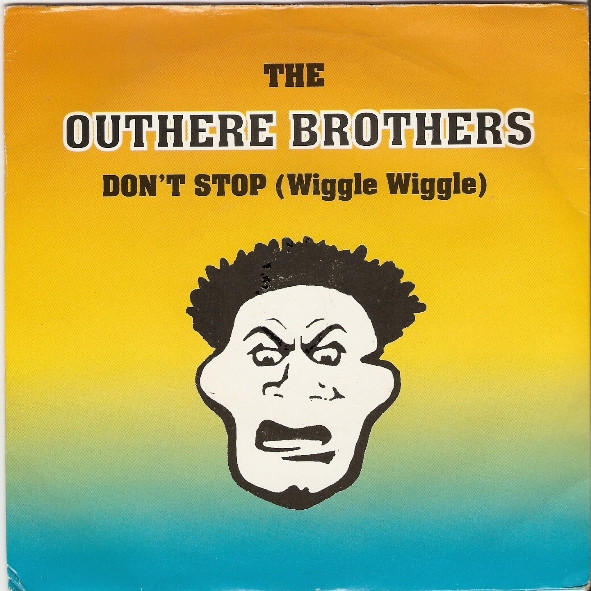
718. ‘Don’t Stop (Wiggle Wiggle)’, by The Outhere Brothers

Is 1995 the year with the biggest disparity between what it is remembered for, and what actually made #1? 1977 might have a case, the year punk exploded yet in which David Soul was the breakthrough star. 1995, though…?

Don’t Stop (Wiggle Wiggle), by The Outhere Brothers (their 1st of two #1s)

1 week, from 26th March – 2nd April 1995

I mention this because this next number one has left me in a state of shock. Shock at how I don’t really remember it. Shock at some of the lyrics. And shock at just how bloody awful it is… Biiiyyaaatch!

I thought that Rednex had my upcoming ‘Worst #1 Award’ in the bag. But as horrible as ‘Cotton Eye Joe’ is, at least it is identifiable as a ‘song’. This is an absolute racket. The pitch of the singer’s voice as he repeats the title line: Don’t stop movin’ baby oh that booty drive me crazy…, the one-note beat and the bubble-popping sound effect, the way that that one line is chopped up over and over again, ad nauseum… Some mixes are better than others – and the video attached at the foot of this post is the most palatable version, with a Hi-NRG beat – but most are dire.

I’m torn between wrapping this post up as soon as possible, trying to forget that this record ever existed, and delving a bit deeper. The radio edit of ‘Don’t Stop (Wiggle Wiggle)’ is repetitively, mind-numbingly, boring. But that wasn’t the reason this made number one. For the other, non-edited mixes reveal this to be the filthiest number one single we’ve heard so far on this countdown.

No, make that one of the filthiest number ones, ever. Period. Even in this post-‘WAP’ world, the lyrics here still raise an eyebrow. There’s that opening Biiiyyaaatch! for a start. Then there’s: Put your ass on my face… I love the way your… No I can’t type the rest. Girl you’ve got to suck my… Nope, still can’t. I’m not a prude, but this isn’t something I’ve never had to consider in my seven hundred and seventeen previous posts. The worst word we’ve encountered so far has been, I think, ‘bullshit’. And that’s a word I heard on Radio 4 the other day… I knew the 1990s would see morals and standards loosen (God, I sound like Mary Whitehouse), but I though it would be gradual. A ‘bitch’ here and a ‘fuck’ there. But no, it all arrived at once, right here: a smorgasbord of vulgarity. Which means that ‘Don’t Stop (Wiggle Wiggle)’ is actually a hugely important chart-topper…

But nah, I don’t want to give it that sort of weight. It happened. Swearing in #1 singles is fine now. Let’s move on. (And anyway, luckily for all of us, The Outhere Brothers have an even bigger hit coming up very soon…) They were a duo from Chicago – yet another pair of fake chart-topping siblings – and this was their breakthrough hit, after previous releases such as ‘Pass the Toilet Paper’ had failed to chart. Thirteen-year-old boys around the world then kept the pair in hits for the next couple of years, though their subsequent album ‘1 Polish, 2 Biscuits and a Fish Sandwich’ wasn’t as successful (and you can look up the meaning of that title, if you dare…)

Back to what I mentioned in the intro, about 1995 being a strange year, in which most of the acts and songs we remember the year for didn’t make the top of the charts. It’s a theme I’ll return to, especially when a different gruesome twosome dominate later in the year. Up next, though, I’m sort of instantly proven wrong, for it’s the decade’s biggest boyband, with one of the nation’s best-loved songs…

(The ‘best’ version of the song…)

(The explicit version, if you must…)

695. ‘Boom! Shake the Room’, by Jazzy Jeff & The Fresh Prince

Yo back up now and give a brother room, The fuse is lit and I’m about to go boom…! The first thing that becomes immediately apparent when I press play on our next number one is that I know almost all the words. When and how this happened I don’t know, but here we are…

Boom! Shake the Room, by Jazzy Jeff & The Fresh Prince (their 1st and only #1)

2 weeks, from 19th September – 3rd October 1993

It’s the most rap-heavy #1 so far. No sung chorus, a bit of chanting, just Big Will spitting rhymes. Or should that be ‘The Fresh Prince’. It’s easy to assume that this was a tie-in with his role in the hit sitcom, but in reality the sitcom was a tie-in for a rap career which had been going since the mid-eighties.

And while it may be the purest hip-hop chart topper thus far, I’ll make the same comment that I’ve made about almost all rap songs we’ve featured: it’s hard now not to see this as a novelty. The call and response, the lines about ‘scoring like Jordan’, the stuttering verse… All very cute, all very tame. A kids party DJ could throw this on and fear no repercussions. The closest we get to something gangsta is when Will promises to find a girl, flip her around and then work that booty

But, it’s a lot of fun. Like I said, I know nearly all the words. I grew up with rap a lot more explicit than this (with lots of words that a person of my complexion can’t go around saying…) I’m reminded of the classic Eminem line: Will Smith doesn’t have to cuss to sell records, Well I do, So fuck him, And fuck you too… That’s funny, but it also shows where Will Smith stood in the early 2000s: commercially very successful, but an outlier in the eyes of other rappers. Back in 1993, we’re on the verge of rap becoming a dominant sound in the charts, and I really don’t know if ‘Boom! Shake the Room’ was seen as cool, or already a relic of an earlier time.

Speaking of Eminem, we’re only seven years away from him scoring a huge #1 single about having his girlfriend gagged and bound in the boot of his car. That’s a huge shift, considering that the rap songs to have made #1 have been this, one about the Teenage Mutant Ninja Turtles, and Vanilla Ice. While the worst swearword that’s been uttered in a number one single has been, I think, ‘bullshit’. It’ll be interesting to watch how quickly tastes and standards change in the remaining years of the 1990s.

And while you could say that Will Smith became a figure of fun, spare a thought for the guy behind the decks on this record. Initially, Jazzy Jeff was the star of the duo, with first billing here and on their early hits, with wonderful titles like ‘Parents Just Don’t Understand’ and the ‘I Dream of Jeannie’ sampling ‘Girls Ain’t Nothing But Trouble’. At the very start of their relationship, Smith was Jazzy Jeff’s stand-in hype-man. Come the TV series, though, Jeff had become a punchline, spending most of his time getting launched out the door by Uncle Phil. ‘Boom! Shake the Room’ was the duo’s biggest hit, in the UK at least, but it was one of their last. Will Smith went solo in 1997 (more on that soon) with Jeff producing some his songs. He’s remained very active though, performing with Smith from time to time, while one of his biggest legacies is popularising the ‘transformer scratch’, a version of which opens this record.

665. ‘I Wanna Sex You Up’, by Color Me Badd

I arrive at this next chart-topper, and a question immediately springs to mind: what’s worse – the name of the song, or the name of the group?

I Wanna Sex You Up, by Color Me Badd (their 1st and only #1)

3 weeks, from 2nd – 23rd June 1991

I mean, both could win the pop music equivalent of the Razzies. But for me it’s the song title that is a smidge more excruciating. And that’s because it lends its name to four minutes of cringe-inducing boyband R&B. Come inside take off your coat, I’ll make you feel at home… squeaks a Poundshop Prince. The lyrics start of icky – all lighting candles and pouring wine – and only get ickier…

For example: Disconnect the phone so nobody knows… Personally, I don’t see disconnecting the phone as a sexy move; more a creepy, ‘there’s no escape’ kind of move. And then there’s the piece de resistance: making love until we drown… dig… Drown in what, dare I ask? (Vomit, probably, given the way these lyrics are making me feel.)

There’s a spoken-word section, of course, though it’s more of a whispered-word section: Just lay back, Enjoy the ride… The only redeeming moments in the song are the two hooks – the ooh-ooh-eeh-ooh and the tick tock ya don’t stop – that run on a loop. In fact, if you can block out the lyrics, the song itself sounds very modern. If I hadn’t known, then I’d have placed it in the mid-to-late nineties, rather than 1991. The song featured on the soundtrack (another soundtrack #1!) to ‘New Jack City’, an action-crime movie featuring the likes of Chris Rock, Wesley Snipes and Ice-T.

Was this controversial at the time? Few #1s have been this upfront about sex, save for Serge and Jane, and Frankie saying ‘Relax’. (Off the top of my head, I believe this might be the first chart-topper to feature the word ‘sex’ in its title.) Or did people just write it off as simply too ridiculous to be a threat to young and impressionable minds? The video is nowhere near as saucy as it might have been, mainly featuring the four Badds sauntering along railway tracks, like NKOTB’s moody older brothers. And, of course, it seems very PG-13 compared to some of the songs that have made number one between then and now, from ‘Freak Me’ to Megan and Cardi B’s wet-ass you-know-whats…

Color Me Badd were four high school friends from Oklahoma, who were helped on their way to brief stardom by Robert Bell of Kool & The Gang, who found them a manager, and Bon Jovi, who let the boys open for them at a concert in New York. They were a racially diverse group, too: one white, one black, one Mexican, and one part Native-American.

They had two further #1s in the US (where ‘I Wanna Sex You Up’ stalled at #2), including the actually pretty great ‘All 4 Love’, which was their only other UK Top 10. They split up in 1998. They’ve left behind a complicated legacy: some sources list this as one of the ‘50 Worst Songs Ever’, while others have it as one of the ‘100 Greatest Songs of the ‘90s’. Personally I’d lean towards the former, though it is so silly in places that it almost becomes quite fun.

660. ‘Do the Bartman’, by The Simpsons

As with all novelty singles, I approach this next number one with trepidation, my finger hovering reluctantly over the play button. But the intro actually sounds quite cool: a new jack swing beat and a squelchy bassline. Something by Janet Jackson perhaps, or a Prince ‘B’-side…

Do the Bartman, by The Simpsons (their 1st and only #1)

3 weeks, from 10th February – 3rd March 1991

The only version available on Spotify is the five minute (!) album version – from ‘The Simpsons Sing the Blues’ LP – so I don’t know for how long this intro did its funky thing on the single-edit. Eventually Homer comes in, yelling at Bart for some unspecified misdemeanour. Nobody saw me… I didn’t do it…

From here on things follow a fairly formulaic hip-hop single format: i.e. rapper tells us how great he is. Except here the rapper is a yellow cartoon boy, voiced by a thirty-five year woman (kudos to Nancy Cartwright here, as it can’t be easy rapping while putting on such a voice). There are some fun lines: I’m the kid that made delinquency an art, Last name Simpson, First name Bart… but the song ends up caught between not being funny enough to work as a novelty, yet still being gimmicky enough to annoy. The ‘joke’ wears especially thin on the, it bears repeating, five minutes long extended album version.

The fact that this does almost work as a pop song is probably down to the alleged involvement of Michael Jackson. He’s not credited – his label insisted he couldn’t be – and there are differing accounts of what he actually contributed towards the song, but it seems he wrote some of the lyrics and contributed backing vocals, as well as giving the song its title. He also apparently insisted that he be name-checked (If you can do the Bart, You’re bad like Michael Jackson…) Jackson would also feature in an episode of The Simpsons a few months after this had been a hit single. The video too is a six-minute long MJ-esque epic, in which Bart takes over a school talent show with his new dance routine (or was it all a dream…?)

It’s credited to ‘The Simpsons’, but it’s largely just Bart. Lisa gets a saxophone solo, and Homer gets to yell throughout. Marge and Maggie are conspicuous by their absence. I wonder if, to many British listeners, ‘Do the Bartman’ was their first exposure to ‘The Simpsons’. At the time this was released, the show was just halfway through its second season in the US, and was only broadcast on satellite TV in the UK (I remember it coming to terrestrial TV, on Channel 4, much later in the mid-nineties). If so, the song’s success is quite remarkable, as I’m not sure it holds much enjoyment for someone who’s never seen the show.

Anyway, in this moment ‘The Simpsons’ was on the verge of becoming the biggest TV programme in the world. Between series three and ten it was untouchable, and a fixture in my own house every dinner time. They even managed a second Top 10 single, another hip-hop track (and actually much better than this) ‘Deep, Deep Trouble’. After that, the show came to a natural conclusion in the early 2000s, and is remembered as one of the best series ever, and as a lesson in how to go out on top. Right? No…?

654. ‘Ice Ice Baby’, by Vanilla Ice

Alright stop. Collaborate and listen… It’s time for one of the most maligned number one singles of all time.

Ice Ice Baby, by Vanilla Ice (his 1st and only #1)

4 weeks, from 25th November – 23rd December 1990

And I get the hate. Yes, it’s ridiculous. Yes, it sounds very dated. Yes, Vanilla Ice comes across as a weapons-grade moron. But, let me play devil’s advocate. A) Being ridiculous isn’t necessarily a disadvantage for a record that wants to be a hit. This is far from the first ridiculous chart-topper. B) Early hip hop records do sound dated, very focused on rhyme and meter. And C) As for Vanilla Ice looking like a moron… Well, show me any rapper that you wouldn’t look at in the street and think seemed a bit eccentric.

Yet at the same time, Vanilla Ice is the worst thing about this record. Away from his look at me lyrics (If my rhyme was a drug, I’d sell it by the gram…) I’d say the moody synths and the riff that sounds suspiciously like a #1 from ten years earlier could easily form the basis of a hit single in 2023. And I say that it sounds ‘like’ ‘Under Pressure’, because Vanilla Ice claimed that it wasn’t a sample, and that he’d added an extra note. Queen and David Bowie weren’t terribly convinced – they settled out of court and were given co-writing credits.

Nowadays, for sure, ‘Ice Ice Baby’ is a punchline, bound to feature on a ‘Worst Moments of the ‘90s’ clipshow on Channel 5. But, at the time, was it taken seriously? It seems that it was, getting good reviews in Billboard, the NME, and Entertainment Weekly. When exactly the tide turned, I’m not sure. Perhaps it was a victim of its own success, or perhaps the controversy over the ‘sample’ took the gloss off it? Vanilla Ice – whose real name is the gloriously un-gangsta Robert Van Winkle – seems simultaneously annoyed by this albatross around his neck, and unwilling to let it die. He’s released live versions and anniversary remixes, as well as a nu-metal version (which is better than it has any right to be…)

Van Winkle never matched the heights of his debut single. The follow-up, a cover of ‘Play That Funky Music’, made #10 and since then he’s never bothered the Top 20. He’s had a troubled time of it, with firearms charges, burglary, domestic abuse and illegal drag-racing on his rap sheet. And yet, here he stands, with only the 2nd hip-hop #1 in British chart history (and certainly the most credible of the two so far, after ‘Turtle Power’.)

I’m still not sure how to finish and move on from ‘Ice Ice Baby’. On the one hand, it seems to have set hip-hop back by a good few years. At the same time, it’s a very modern rap track: the lyrics are all about how bad-ass, how dangerous, and how popular with the ladies Ice is. And there isn’t a rapper around who hasn’t recorded at least one self-aggrandising track. But I’m not sure it’s very good. It might even be terrible. Let’s leave the final word to Mr Van Winkle: Let’s get out of here, Word to yo’ mother… And speaking of bad-ass mofos; Cliff Richard’s up next!

648. ‘Turtle Power’, by Partners in Kryme

Cowabunga! God, I used to love the Teenage Mutant Hero Turtles. (Not, note, the Ninja Turtles, as the word ‘ninja’ apparently had too many violent connotations for UK audiences). Strangely, though, I was completely unaware of this song. Maybe because it was from the soundtrack to the Turtle’s first live-action movie, which I’ve never seen, rather than the far superior animated TV series.

Turtle Power, by Partners in Kryme (their 1st and only #1)

4 weeks, from 22nd July – 19th August 1990

Still, I was expecting this to be a remake of the classic theme tune (Heroes in a half-shell, Turtle Power!) I was also fully expecting it to be terrible. But… It’s neither of those things. It’s an actually quite funky rap track, with a new jack swing beat and creepy organs. It sounds a little, bear with me, like Dr Dre covering ‘The Monster Mash’.

The verses tell the story of the Turtles, and how they came to be. Splinter’s the teacher, Shredder the bad guy, while April O’Neil’s the reporter. (Partners in Kryme were clearly given a remit to mention every character at least once.) It also has to set up the movie: The crime wave is high with mugging mysterious, All police and detectives are furious, ‘Cause they can’t find the source, Of this lethally evil force… Plus one stanza is given over to ‘believe in yourself kids’ motivation: So when you’re in trouble don’t give in and turn sour, Try to rely on your, Turtle Power…

According to some sources, this is the very first hip-hop track to make #1 in the UK. I’m not sure that New Edition would agree with that, or Snap!, or Soul II Soul, or John Barnes. But I get the point: those acts had elements of it in their hit singles; this is pure hip-hop. Which means that when rap properly debuts atop the British charts, it arrives spitting rhymes like: Pizza’s the food that’s sure to please, These ninjas are into pepperoni and cheese…

I genuinely expected to hate this. But I don’t. The kid in me enjoys the heavily vocodered chorus: T-U-R-T-L-E power…, and then there’s also the nostalgia factor of it being from one of my favourite childhood cartoons. Lyrics aside, I think this might genuinely hold up, in a way that not all early rap does. Partners in Kryme were a duo from New York, made up of DJ Keymaster Snow and MC Golden Voice. I’m not sure if they were formed for this record; but they had no other hits, before or after, making them a classic one-hit wonder. (The ‘Kryme’ in their name stands for Keep Rhythm Your Motivating Element. Which is catchy.)

Whether or not this really was the first hip-hop chart-topper, 1990 was certainly the year it went mainstream. Snap!, John Barnes’ rap, as already mentioned, plus this, and a skinny, Queen-sampling white guy coming up very soon. It’s certainly going mainstream, but it’s still largely seen as a novelty. We’ll have to wait a while for a ‘serious’ rap #1, but when the time does come there’ll be no looking back for hip-hop as chart-topping force.

643. ‘The Power’, by Snap!

The spring of 1990 truly was an age of interesting intros. Well, I don’t know if two songs quite make an ‘age’, but following on from Beats International’s famous rap, our next #1 kicks off with a burst of Russian LW radio. Something something transceptor technology…

The Power, by Snap! (their 1st of two #1s)

2 weeks, from 25th March – 8th April 1990

Then boom: a riff that sounds like an electric shock, and (another) dance diva with big lungs bellowing about having the power. So far so famous, a hook that pretty much everyone of a certain age knows. Unfortunately, the less-remembered remainder of the song struggles to match the energy of the title line.

It’s much lower-tempo than you’d think: I’d mis-remembered it as a madcap ride, akin to S-Express, but it’s nowhere near as fun. There’s a rapper – in fact this might be the most rap-heavy chart-topper so far, at the start of the decade in which hip-hop will finally go mainstream. Turbo B has a couple of good lines: Maniac, Brainiac, Winnin’ the game, I’m the lyrical Jessie James… and a real clunker: So peace, Stay off my back, Or I will attack, And you don’t want that… While Penny James, the female lead, has a voice that contrasts with him well.

Both the rap and the vocals were based on earlier songs, by a Chill Rob G and a Jocelyne Browne respectively, and for a while it seemed there might be lawsuits on the horizon when the producers tried to use the originals without permission. The record was quickly re-recorded by Turbo B and James, inadvertently setting up Snap! as an actual band with a hit making future rather than a one-hit wonder.

There’s another good moment, when the electric shock riff takes over and performs a bit of a solo; but for me, as a whole, this record struggles to build up a head of steam. I can’t imagine dancing to it, unlike recent dance bangers from Black Box and Beats International. Snap! (note the Wham!-like exclamation mark) were a German creation, and I get “Boney M for the ‘90s” vibes, what with their nationality, their take on Eurodance, and the questions over whose voices you’re actually hearing… (Though both Turbo B and Penny James were American.)

‘The Power’ was Snap!’s first release, and they would go on to have an impressive nine further Top 10 hits between 1990 and 1994. So popular were they that their fifth single was a medley of the previous four, which still made #10. And while this record may not reach the heights of ‘Ride on Time’, you could argue that it was just a warm-up for Snap!’s globe-humping second, and definitive, chart-topper: one of the biggest dance records of all time. Until then, then…

642. ‘Dub Be Good to Me’, by Beats International

Tank fly boss walk jam nitty-gritty, You’re listening to the boy from the big bad city, This is jam hot…

Dub Be Good to Me, by Beats International (their 1st and only #1)

4 weeks, from 25th February – 25th March 1990

I often find writing intros to be the hardest part of a new post. Not today: for who can argue with those opening lines? Jam hot, indeed. (Not that I have a clue what he’s on about, but hey ho…) Off we go, then, into a #1 single a little less intense than ‘Nothing Compares 2 U’, but perhaps every bit as iconic (that word again…)

If you listen carefully, both this record and Sinéad O’Connor’s predecessor follow a similar beat. It’s very nineties, as if both these records were setting the tempo for the decade to come. Other than that, though, they’re very different beasts. ‘Dub Be Good to Me’ takes us for a stroll through the backstreets of the big bad city. The laconic harmonica sounds like a train rumbling past, the horn towards the end sounds like a sad busker, the humming break in the middle sounds like the crazy guy you’d cross the road to avoid…

Meanwhile, you can just picture the singer walking along with a ghetto blaster, singing the title line: I don’t care about your other girls, Just be good to me… Like Soul II Soul and Black Box before it, this record is a more modern, stripped-back version of dance music, another step away from the sample-heavy culture of the 1980s. Just a beat, that harmonica, and a female diva giving it large (Lindy Layton, who in some places gets a ‘featuring’ credit on the record).

Not that ‘Dub Be Good to Me’ doesn’t contain a sample, or two. Actually, it’s pretty much all samples. The lyrics and melody come from The SOS Band’s 1983 song ‘Just Be Good to Me’. The bassline is the Clash’s ‘Guns of Brixton’, the harmonica is from Ennio Morricone’s theme for ‘Once Upon a Time in the West’, and the catchy intro rap is called ‘Jam Hot’, and is by Johnny Dynell. I know that for some sampling is a sin, that music should always be original. But it takes a special ear to hear music from acts as disparate as The Clash, Morricone, and a little-known rapper, and spot a number one hit lurking among the noise. And, unlike some recent dance hits, all the samples seem to have been cleared and consensual, with no subsequent legal battles for Beats International.

For the record, I have no problem with sampling. The more imaginative, the better. Sometimes you’re maybe left with a hot mess. But this record is a masterclass in sampling various pieces into a very smooth, very cool piece of music. Beats International were the brainchild of Norman Cook, whom we last met playing bass for The Housemartins. To say that Beats International were a musical departure for him is something of understatement, but I’d also say that there’s a cheeky, indie ethos to both acts. Beats International are described on Wiki as a ‘loose confederation’ of DJs, rappers and musicians, as well as a graffiti artist who would paint as the band played on stage.

They weren’t around for long, as after two albums they disbanded (they did get one Billy Bragg sampling follow-up Top 10 in the wake of their biggest hit). Cook moved quickly on to form another band, ‘Freak Power, before going it alone as Fatboy Slim. We’ll meet him again before the decade is out. Back in 1990, though, we’re left with a cool and funky glimpse of things to come. And it’s jam hot…