68. ‘The Story of My Life’, by Michael Holliday

MICHAEL_HOLLIDAY_THE+STORY+OF+MY+LIFE-408385

The Story of My Life, by Michael Holliday (his 1st of two #1s)

2 weeks, from 14th – 28th February 1958

For the first time in a while, we pull up alongside a song I hadn’t ever heard before… Not since Lonnie Donegan’s ‘Gamblin’ Man / Puttin’ on the Style’ have I been able to approach a record with my ears fresh and untainted like this. What, then, do we have here…?

First things first – this is a big step back from the frenzied piano, and then snarling guitar, of the previous two #1s. It’s got the lilting acoustic guitar that sounds soooo 1957 (see ‘Just Walkin’ in the Rain’, ‘Singing the Blues’ and ‘Young Love’ for reference). It is a rock ‘n’ roll record; but super gentle rock ‘n’ roll – diluted and a little wishy-washy.

There are also some super cheesy touches – irritating whistles at the end of lines, some toodle-oohs and bum-bum-bums from the backing singers – which almost tip it over into pastiche territory. It’s very interesting, the fact that we have seen rock ‘n’ roll fragmenting before our very ears over the past few entries: Jerry-Lee Lewis and Lonnie Donegan have given us balls-out – dare I say real – RAWK. Elvis has given us superstar, super-polished rock. Paul Anka, and now Michael Holliday, are giving us what I’d call 2nd generation rock ‘n’ roll – pop music with rock touches, designed to appeal to the kids and their parents.

To the lyrics: Michael wants to write the story of his life: I’ll tell about, The night we met, And how my heart can’t forget, The way you smiled at me… Awwww. Basically his love is his life. But wait… They broke up! No wait… They made up! Safe, safe.

The story of his life isn’t quite over, though. It won’t be until – you guessed it – they get hitched. There’s one thing left to do, Before my story’s through, I’ve got to take you for my wife, So the story of my life can start… and end… with you… It’s nice. This is a perfectly nice, perfectly sweet and utterly forgettable record. I was actually shocked to discover, as I embarked on a little Wikipedia-ing, that ‘The Story of My Life’ was written by Burt Bacharach and Hal David, the first of this legendary duo’s songs to top the UK charts. A shock because, compared to the classics they wrote later in their careers, this is very, very meh. A big contender for the ‘Meh Award’ in my next recap, I’d say.

00000tmp

I’d hoped to pad this post out by delving a little into just who Michael Holliday was – as he’s someone I’d never heard – but I’ve just realised that we’ll meet him again, briefly, in a couple of years. Best hold something back for then. Suffice to say, he made the most of a short career – scoring two number ones out of only ten charting singles – before dying at the shockingly young age of thirty-eight. He has a nice, if unremarkable, voice on this nice, if unremarkable, record. Wiki sums it up best in their succinct entry on Holliday: ‘a British crooner popular in the late 1950s and early 1960s.’

Fin.
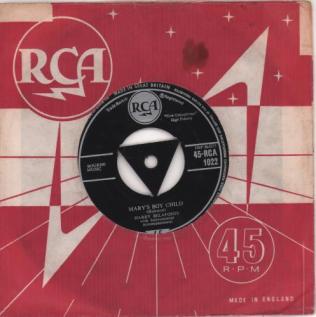
65. ‘Mary’s Boy Child’, by Harry Belafonte

HARRY_BELAFONTE_MARYS+BOY+CHILD+-+1ST-572716

Mary’s Boy Child, by Harry Belafonte (his 1st and only #1)

7 weeks, from 22nd November 1957 – 10th January 1958

Must we?

Maybe it’s because we are approaching mid-summer as I sit down to this, but I am really not in the mood to write a post about a Christmas song… Especially a song as dull as this one.

You surely all know it: Long time ago, In Bethlehem, So the Holy Bible says… Mary had a baby – one Jesus H. Christ – and the herald angels sang. The shepherds saw a star. Man will live for ever more… So on and so forth…

I am potentially the most-irreligious person going and so, to avoid offending any sensibilities, I will refrain from any cynical interpretations of these lyrics. Plus, Harry Belafonte is a titan, both of pop music and of the Civil Rights Movement, and to belittle this song (his only appearance at the top of the UK charts) would be to belittle the seventy-year career of a ninety-one-year-old man, who has achieved more in life than most of us could ever hope to.

Actually, talking of the Civil Rights Movement, the most notable thing about this record is how black it is. And how Harry Belafonte becomes, five years after its inception, the first man of colour to top the UK singles chart. And considering the sheer number of black male artists who have topped the charts – some of the biggest names in popular music history – that’s a pretty cool trail to blaze. He’s of course not the very first black artist to reach the top… So far we’ve had Winifred Atwell playing old-fashioned, white, music hall tunes on her piano, and The Teenagers with Frankie Lymon giving us a good dollop of Doo-Wop. And that’s been it. The charts are still very white. But here, Belafonte sings in a Jamaican patois (a heavily diluted patois, but still). And lines like: While shepherds watch their flock by night, Them see a shining star… are almost subversive in their flaunting of proper grammar! This is technically a Calypso record, but I struggle to hear anything particularly Calypso-ish about the strings and violins that swirl around Belafonte’s voice.

432466bq

Let’s treat this is an interlude, then – a moment’s respite from the advancing march of rock ‘n’ roll. The songs that top the charts at Christmas time are rarely reflective of current tastes (cough Cliff Richard cough cough Bob the Builder). Normal service will be resumed presently. Though to call this record’s stint at the top a ‘moment’ is a slight under-exaggeration (what is the opposite of an exaggeration?) It stayed there for seven weeks – hitting the top spot as early as the second last week in November! People clearly loved it.

Searching out the right version of this song has been a bit tough. Belafonte recorded various live versions, and an extended version in the early-60s, though the link below should be the song that topped the charts for Christmas ’57. But if you asked me what the best version of ‘Mary’s Boy Child’ is, I’d have to say Boney M’s!

56. ‘Young Love’, by Tab Hunter

s-l300 (1)

Young Love, by Tab Hunter (his 1st and only #1)

7 weeks, from 22nd February – 12th April 1957

I’ve been bigging up the arrival of rock ‘n’ roll to the top of the UK charts for so long – especially back when we were plodding through all those dreary, brow-furrowingly earnest pre-rock ballads – that this next statement goes against every instinct I have…

By the time it got to the top of the UK charts, rock ‘n’ roll was over. Finished. Defunct. Obsolete.

I recently claimed that the rock era began on 11th January 1957, when bona fide teen-idol Tommy Steele sneered his way to a week at the top. I’m now claiming that the rock era ended on 22nd February 1957, when this limp little record grabbed a scandalous seven weeks at the top.

Because, by God this is bland! That this made it into the record books before Elvis, before Buddy Holly, before Jerry Lee and all the rest doesn’t make sense. It is a rock ‘n’ roll record – there’s a guitar riff and solo, drums, oohs and aahs and all the rest. Plus, the lyrics are all about two kids falling in love for the first time. And it’s called ‘Young Love’!

They say for every boy and girl there’s just one love in this whole world, And I-I-I know I’ve found mine… Young love, First love, Filled with true devotion…

But it’s delivered in such a soppy way that I refuse to acknowledge this as any kind of rock and/or roll. Tab Hunter’s voice is deep and sonorous, but in pictures he looks like the all-American boy next door: rosy-cheeks, blonde curls, blue eyes, church on Sundays, part-time job in the gas station. Your mum would have liked him as much as she would have disliked Tommy Steele. I can imagine a young Cliff Richard taking notes as he planned his assault on stardom a couple of years later (and there are a lot of similarities between Hunters voice here and Cliff’s on, say, ‘Living Doll’). And note the role-reversal – now it’s the Americans giving us staid and boring while the Brits grin and wink! Fittingly, this was #1 on the day my mum was born. I say ‘fittingly’, because she has just about the blandest taste in music going (and is a huge fan of Sir Clifford of Richard).

maxresdefault

And that’s about it. The shortest entry yet. At least, that was going to be it… Until I did my customary Wikipedia-based research about Tab Hunter. Turns out this American-as-apple-pie captain-of-the-school-football-team was – dum dum dum – gay! Is gay, he’s still alive, aged eighty-six. He had to cover it up for most of his career, obviously, and had fake flings with Debbie Reynolds and Natalie Wood among others to throw the newspapers off the scent. Which adds a bittersweet layer to his one and only UK chart topping single, and the lines about boys and girls falling in love.

I’ve listened to ‘Young Love’ several times now, trying to find something to like about – I usually love me a bit of rock ‘n’ roll – but I can’t do it. It’s insipid. And so that’s it. Rock is dead. If it ever existed. Obviously, the top of the pop charts is never the place to look for cutting edge music, but I’m surprised there wasn’t a bit more of an explosion, with some real rockers, before the sell-out began. Or maybe I should just accept that lines were always blurred, that rockabilly merged with blues which had merged with jazz which had merged with the music of the cotton fields to create rock ‘n’ roll over several decades, and not in an afternoon. No more attempting to pinpoint the birth of a musical movement to a particular record.

Anyway, in my next post… The moment skiffle was born!

(Edit: Tab Hunter sadly passed away shortly after this post was published. The Guardian published this obituary, touching on some of the themes mentioned above.)

50. ‘Lay Down Your Arms’, by Anne Shelton

R-1777608-1390913449-3620.jpeg.jpg

Lay Down Your Arms, by Anne Shelton (her 1st and only #1)

4 weeks, from to 21st September to 19th October 1956

We hit the half-century and meet a genre we haven’t encountered yet… The military march!

A couple of times now I’ve mentioned records that, upon reaching the top of the chart, represent a ‘one step forward, two steps back’ moment. Most famously when David Whitfield took the frightfully stiff ‘Cara Mia’ to the top shortly after Johnnie Ray’s superbly raunchy ‘Such a Night’. But this… This takes it to another level.

*Ah 1, 2, ah 1, 2, 3* Come to the station, Jump from the train, March at the double, Down lover’s lane, Then in the glen, Where the roses entwine, Lay down your arms… And surrender to mine!

Anne Shelton loves a soldier, but he’s been called away on duty. Such is a soldier’s life. He gets some leave but now, after spending all week doing what the Seargent demands, he has to manfully obey his lover’s commands. I feel sorry for him. Anne Shelton sounds pretty high-maintenance.

There is one word for this record… One adjective to do it justice. It is twee. So very twee. I’d brand it as a novelty song, if it weren’t all so very earnest. Shelton sounds like a Girl Guide leader – albeit one on her third sherry of the evening – striding out betwixt the heather, bellowing out the chorus as if summoning her hounds. It’s like a P.G. Wodehouse character, one of Bertie Wooster’s aunts perhaps, has come to life and recorded a hit single.

For the most part Shelton’s pronunciation is immaculate, her ‘t’s clipped and her ‘r’s rolled. Yet at the end of every verse, she gets a little… um… playful. She admonishes her serviceman: You’ve got to do your duty, wherever you may be, And now you’re under orders, To hurry home to me… I can’t describe the way she delivers the last part of that line. It’s not with a giggle, but… It’s like a middle-aged biology teacher flirting with a 6th-form boy on the last day of term.

lay-down-your-arms-and-surrender-to-mine-featuring-anne-shelton

It’s a bizarre record. But the more I listen to ‘Lay Down Your Arms’, the more I like it. It’s kooky, in a way. I have no idea why it hit #1 in the autumn of 1956. It sounds as if it should have been a smash in 1941. Perhaps it was the revenge of the old-timers, who saw all these young stars with their shiny teeth and their guitars beginning to clog up the charts, and decided to restore order. But the fact that this was a chart-topper after ‘Why Do Fools Fall in Love’, and just a few months before the rock ‘n’ roll invasion really took hold, is an example of why the pop charts are such wonderful things. Anything can get to the top as long as enough people want it to.

I, of course, knew nothing about Anne Shelton before coming across this record. It seems she was a bit of a mini-Vera Lynn, in that she was another ‘Forces Sweetheart’ who recorded inspirational songs for troops, and also performed at military bases during the war. But this song was written and recorded for the first time in 1956 – eleven years after the war’s end. Somehow, there was still a demand for this kind of thing. Maybe it struck a chord with people in the days of National Service? I was joking a minute ago, when I suggested the old folks were somehow responding to rock ‘n’ roll by sending some ‘proper’ music up the charts, but maybe there’s some truth in that too.

Or, maybe it’s as simple as the fact that, throughout chart history, every so often an oldie gets through. Louis Armstrong did it. Cher did it. Cliff kept doing it. The grannies unite, everybody else sneaks out to buy it when their mates aren’t looking, and Anne Shelton gets a month on top of the UK singles charts.

49. ‘Whatever Will Be, Will Be (Que Sera Sera)’, by Doris Day

doris-day-whatever-will-be-will-be-philips-78-s

Whatever Will Be Will Be (Que Sera Sera), by Doris Day (her 2nd of two #1s)

6 weeks, from 10th August to 21st September 1956

Following on from one super-famous song is… another super-famous song. An even more super-famous song. One of the most famous songs ever?

Que sera sera, Whatever will be will be, The future’s not ours to see, Que sera sera…

People know these lyrics. Even today, sixty-two years on, I’ll bet if you stopped someone on the streets, even a fairly young person, and started singing that line they would be able to finish it. Go on – try it today. (I won’t be held responsible for any subsequent strange looks or slaps in the face).

But, having actually listened to the song, I now wonder if the lyrics are more famous than the recording. It’s very Italiany, with a flourish of guitars (mandolins?) at the start. It’s short and very simple – just said guitar, Doris Day, some violins and the mandatory backing singers. The singer asks her mother if she’ll be pretty and rich, then asks her sweetheart what lies ahead, then fields the very same questions from her own children. It’s a mantra for life: Que sera sera.

As I noted in her previous entry, Day has an irresistible voice. A proper voice, with all the proper enunciation and pronunciation; but with enough of a giggle, and a little huskiness, to make it the sort of voice you want to listen to. She only had two chart-toppers, but ‘Secret Love’ clung to the top spot for nine weeks while this one took up residency for six. There are plenty of acts with more #1s but far less time spent at the top. And as this is the last we’ll hear from Miss Day, let me take the time to point you in the direction of her 1963 classic ‘Move Over Darling’, a song I first heard as a pup on a ‘Steve Wright’s Sunday Love Songs CD’ and which I love to this day. It’s far superior to either of her chart-toppers too, IMHO…

The_Man_Who_Knew_Too_Much_trailer_screenshot_Doris_Day_Que_Sera,_Sera

I’ve done my obligatory Wikipedia-based research and have turfed up two little interesting facts. This song, like ‘Secret Love’, was from a movie in which Day starred: Hitchcock’s ‘The Man Who Knew Too Much’ (it really doesn’t sound like a song from a Hitchcock film, but hey). And… the title is neither correct in French (which I – with a decent A-Level in said language – assumed it was), Spanish or Italian. It is, essentially, gibberish.

But, before we end, let’s step back and look at the bigger picture. I really feel that this, along with ‘Why Do Fools Fall in Love’ before it, is ushering in a new era at the top of the UK chart. Two huge, well-known songs. This song has become a football chant, still used to this day, for God’s sake! Plus, Doris Day is still going strong, aged ninety-six, as is Pat Boone from two chart-toppers ago. These songs covered in this countdown are slowly growing more and more tied to the modern world.

Perhaps this song’s influence is best summed up by this tale. Every year I go to a German beer festival in Hong Kong. And every year, without fail, before the overweight men in nipple tassels, before the ‘Big German Horn Blowing Contests’ and before we do the YMCA on the tables, the band plays ‘Whatever Will Be Will Be’. And everyone sings along.

47. ‘I’ll Be Home’, by Pat Boone

PAT_BOONE_ILL+BE+HOME+-+SILVER-562513

I’ll Be Home, by Pat Boone (his 1st and only #1)

5 weeks, from 15th June to 20th July 1956

Having just read back through my last post – poor old Ronnie Hilton – I feel I’ve been a bit harsh recently. So I’ve decided: I need to approach these records with emptier ears, by dropping all my modern inclinations and pre-conceptions and by just listening to the records. By realising the difference between a record that is bad, and one that I simply dislike. By being – and this is going to be an immense struggle for someone like me – less judgemental. Here goes…

I’ll be home… My darling… Please wait for me… We’ll stroll along together… Once more our love will be free… A piano plinks, a guitar strums, the backing singers hum. This is possibly the gentlest number one yet. And Pat Boone? Well, there’s only one word for what he’s doing. He is crooning. He is crooning the hell out of this record. This is dictionary-definition crooning

This is a post-pre rock/pre-rock n roll ballad, if you get what I mean. File it alongside ‘It’s Almost Tomorrow’ from a few posts ago. The lyrics are a little more youth-orientated (some lines about meeting at the corner drug store on a Saturday) and the chord progressions are that of a modern pop song. I do quite like what he does with the words moo-ooo-ooon light and toge-e-e-ther, and the abrupt pause after the line My mind’s made up… There’s a playful hint to the song. But it’s way too saccharine. It reminds me of that ‘Father Ted’ episode, where Mrs Doyle wins a competition to meet a Daniel O’Donnell-esque singer (Eoin McLove – I’ve just checked). Eoin McLove would definitely have sung this song.

There’s also – abruptly and brilliantly – a spoken word section. Oh yes. Midway through, Boone draws up to the mic, and talks directly to us, making this the first in a niche group of #1 hits, along with classics such as ‘Are You Lonesome Tonight’, and ‘Never Ever’ by All Saints. Darling, as I write this letter, here’s hoping you’re thinking of me… His love shouldn’t worry, he’ll be home soon (HOW MANY MORE of these male-led hits are going to be about pining for your loved one?? I get that these were days of war in Korea and of National Service but still – I doubt we’ll ever see a more dominant lyrical theme in any other era!) I’ll be home, to start serving you… That’s nice. It’s a nice (ish) song. There. Maybe not worth a 5 week stay at the top, but hey. I managed a critique without writing anything too biting. Well done me. But, wait a second…

A sinister under-belly requires tickling. You see, this particular song is an example of something that went on a lot in the fifties. Pat Boone, Frankie Laine, Elvis et al got rich and famous by recording songs written and originally recorded by black artists. Because they were white an’ wholesome, their records sold more. It was a big thing in the US; less in the UK (see Winifred Atwell and the record that succeeded this one at the top). ‘I’ll Be Home’ was originally recorded by The Flamingoes, a black doo-wop group. The B-side was a whitewashed cover of ‘Tutti Frutti.’ A sign of the times, but not great.

6a00d8341c85cd53ef01b8d06e3638970c-800wi

And the plot thickens further. Before this, I’d heard of Pat Boone for two reasons. One, was a line in a Snoop Dogg song (‘Beautiful’) where he claims a girl is too good and wants to stay home listening to Pat Boone, of all people. Two – Mr Boone (who’s still alive, aged eighty-three) is an ultra-conservative Christian. A proper Fox News, evangelising, pray-the-gay-away kind of Christian. I knew this, somehow, but didn’t know quite how bad it was. And it’s bad. Here are some of his greatest hits – all from Wikipedia, take from that what you will – which have nothing to do with his sole chart topping hit in 1956, but sure are amusing (make that terrifying):

A) He refused to star in a film with a star as sexy as Marilyn Monroe, as it would have compromised his beliefs. B) He has compared liberalism to cancer. C) He has compared gay rights activism to Islamic terrorism, and has campaigned against Democratic candidates with the claim that they want to turn Kentucky into San Francisco. D) He loves war, and has claimed that any opponents of the Vietnam War, and both Iraq wars, neither loved their country nor respect their elders. E) He – perhaps inevitably – believes that Barack Obama shouldn’t have served as President, due to his fluency in Arabic and his love for the Koran… Suddenly, all that money and recognition he stole off black artists in the ’50s starts to look even more sinister, no?

Hilariously, he was kicked off a Gospel Music show he hosted in 1997 after releasing an album of heavy metal and hard rock covers, including ‘Smoke on the Water’, ‘Paradise City’ and, oh yes, ‘No More Mr. Nice Guy’. Tragically this album doesn’t seem to be on Spotify, but I’m including the link to his version of ‘Enter Sandman’ here. You have been warned…

I could go on but don’t have all day, and that did go slightly off topic. Apologies. Basically, Pat Boone, it was nice meeting you. You sound a bit mental. Onwards.

46. ‘No Other Love’, by Ronnie Hilton

271927944821

No Other Love, by Ronnie Hilton (his 1st and only #1)

6 weeks, from 4th May to 15th June 1956

Through writing these blog posts, I’m becoming a strong believer in nominative determinism. I.e. through looking at the name of the recording artist one can anticipate what the song will sound like. Not that anyone’s been called Sax Jazzington, or anything silly like that. More like how Kay Starr sounds fun and flirty, Slim Whitman sounds grizzled and lonesome, Jimmy Young sounds… normal, and a little dull. I feel that Ronnie Hilton should fall into the latter category.

And, lo and behold, he does. It starts dramatically enough, though: a burst of cymbals, then another, then another… Then it feels like a step back in time, to the dark days of *shudder* David Whitfield. It’s semi-operatic, its over the top, it’s not a particularly easy listen. Hilton’s voice is overwrought. It’s a powerful voice, a technically very good voice, the sort of voice that your gran would have approved of; but it’s too much. It’s probably no worse than the Whitfield, Laine days of a couple years back, but it already sounds very dated coming so soon after more progressive-sounding records by Bill Haley, Alma Cogan and even Dean Martin.

Lyrically too, this is a song that’s been done before. No other love have I… Into your arms I’ll fly… Waiting to hear you say… ‘No other love have I’. He’s a little lovelorn, is Mr Hilton. I’ve mentioned it before, but why is it the girls that have all the fun in these early chart toppers? With a few exceptions (Vera Lynn, cough cough) they get to be perky and flirty while the men stay at home and stoically wait for their love to be fulfilled.

One thing I was certain of, without doing any kind of research, is that Ronnie Hilton was British. His voice has that properness, that stoicism, void of any kind of vulgar, American swagger. One other thing that I was pretty certain of, again before delving into Wikipedia and around, is that ‘No Other Love’ must have been from a soundtrack, such is its unnervingly bombastic approach to what is an otherwise very basic love song. And yes, it’s a Rogers & Hammerstein number, from their 1953 show ‘Me and Juliet’.

A-439529-1148657608.jpeg

Actually, the most surprising thing I could uncover about Ronnie Hilton – this is his only appearance at the top so let’s give him a moment in the sun – is that ‘Ronnie Hilton’ was his stage name. He was born Adrian Hill. Let that sink in for a second: he, or somebody advising him, thought Adrian Hill was a little too boring, a little too staid, and that ‘Ronnie Hilton’ would get the girls swooning. I think that just sums him, this song, and this whole pre-rock era up… If you’re going to change your name in an attempt to gain fame and glory for God’s sake try to come up with something slightly sexy. No?

And – perhaps just as interestingly – Hilton recorded a fairly successful (in the UK at least) version of ‘The Wonder of You’, eleven years before Elvis Presley made it a standard. But… listen to Hilton’s version, then Presley’s version, and it becomes clear why the latter was one of the most famous voices, and personalities, of the 20th Century and the former wasn’t.

I’m being a little down on Ronnie Hilton, really, so let’s give him a break and end with something completely unrelated. Something that just occurred to me as I wrote the intro to this post. The only reason that my nominative determinism theory works is because I have heard so few of these early number one hits. I write the title down, search them out on Spotify, and take a step into the unknown. But, looking down the list of UK #1s through the remainder of 1956, through ’57 and ’58, this is going to become less and less of a thing. I know several of the next twenty or thirty records. Soon I’ll know the majority of them. Of course, every so often, even as we get to the eighties and nineties, there will be songs I simply have never heard before (I have no idea how ‘Doop’, by Doop, goes for example – and it had 3 weeks at the top in 1994) but, on the whole, we are slowly stepping out of the mist and onto firmer, better known ground.

43. ‘It’s Almost Tomorrow’, by The Dream Weavers

R-4052394-1471122223-8022.jpeg

It’s Almost Tomorrow, by The Dream Weavers (their 1st and only #1)

2 weeks, from 16th – 30th March / 1 week, from 6th – 13th April 1956 (3 weeks total)

Perhaps it’s time to christen a brand new era in popular music. I’ll call it: the ‘post-pre-rock age’! We’ve had the first wave of the rock ‘n’ roll explosion – the very first rock ‘n’ roll number one – but the waves have receded and we are stood on soggy sand waiting for them to return. And they will, they will… Just not yet.

What I mean is that, to all intents and purposes, we are still in the pre-rock age but that the rules have changed ever so slightly. Of course, the very top of the charts is never where you look for music’s cutting edge. You get to the top of the pop charts by being, well, popular, and by appealing to the largest number of people. But… even if you look at the Top 20 from the week in March ’56 that this latest song hit #1, there are very few records that stand out as being rock songs: Bill Haley is at #7 with ‘See You Later Alligator’, Lonnie Donegan is at #9 with ‘Rock Island Line’ (a skiffle track, admittedly, but still) and there’s a song called ‘Pickin’ a Chicken’ by Eve Boswell which sounds like a rock song involving a funky dance move (a la ‘The Twist’) but is actually just a pretty dull song about having a picnic. The rest is Sinatra, Jimmy Young, Slim Whitman

And, as with ‘Memories Are Made of This’ which preceded it, ‘It’s Almost Tomorrow’ has elements of rock ‘n’ roll in it – enough, perhaps, to attract the youngsters but not enough to put off the old folks. Thus the gap between the worlds of Eddie Fisher and Elvis is deftly bridged.

Anyway, to the song. And after that big build-up, all that stuff about it being a brand new era in popular music, ‘It’s Almost Tomorrow’ is a bit dull. The idea behind it is that the singer’s sweetheart is falling out of love with him, and that she will leave him ‘tomorrow’. And yet he hopes it will be otherwise… My dearest, my darling, tomorrow is near, The clouds will bring showers of sadness, I fear… ‘Emotions As Weather’ – the first chapter in ‘Cheesy Love Songs 101’. It’s almost tomorrow, but what can I do? Your kisses all tell me that, your love is untrue…

It’s a bit cloying, what with its backing singers and plinky-plonky pianos. A bit of a nursery rhyme, too – I can’t decide if it sounds more like ‘Puff the Magic Dragon’ or ‘Away in a Manger’. And again, it’s another very simple #1. The production is very rich – the piano and backing singers turned up to 11 – but there isn’t much there. And, unfortunately, there’s a bit of a THIS IS THE END OF THE SONG ending: You’ll always be miiiiiiiiiiiine!

0c35382efac3ea5f3d8299d3381300a1

But, in the ‘pros’ column there is a rather wonderful key-change – a very rock ‘n’ roll touch. I’m a big fan of a well constructed key-change. I can’t resist them. Who can? Its inbuilt in most people, I think. A Pavlovian reaction. And this is not just a key change, but a mid-note key change… Your love is untruuuu *key change* uuuueeeee. I’m not going to lie – it did give me a mild covering of goose bumps the first time I heard it. But that’s far and away the best thing about this song. A song which we could brand the very first rock ballad to hit the top of the UK Singles Chart, if it didn’t feel a bit of a waste to use up such an honorific title on such an average record.

This is The Dream Weavers only appearance in this countdown, and in the charts. They were big ol’ one hit wonders, you see. Though we should give them a shout out for being one of the few acts so far to have hit the top with an original composition. The Dream Weavers consisted of two high school friends – Gene Adkinson and Wade Buff (great name!) – and a rotating cast of back-up singers. Adkinson and Buff wrote ‘It’s Almost Tomorrow’ themselves, and so are pretty unique among the forty-two songs that we’ve written about previously.

And we’ll leave it there for now. A simple love song – all key changes and not an orchestra in sight – but with familiarly mopey lyrics about rain and heartache, as well as a silly, bombastic ending. One leg in the new world; one leg stuck firmly in the past.

42. ‘Memories Are Made of This’, by Dean Martin

Memories-Are-Made-Of-This-Dean-Martin

Memories are Made of This, by Dean Martin (his 1st and only #1)

4 weeks, from 17th February to 16th March 1956

Sweet sweet mem’ries you gave to me…

This is one of those #1s that fall into the ‘I can sing a line or two before listening to it’ category. See also ‘That Doggie in the Window’ and ‘This Ole House’. At first I thought I might have sung this in my days as a primary school choirboy. But then, after listening more closely, I realised that the lyrics are perhaps a bit rich for a group of eight year olds.

Take one fresh and tender kiss, add one stolen night of bliss…

So, yeah… Then I got to thinking that the intro sounds a lot like the intro to ‘King of the Road’ – that sliding da dum dum dum guitar – which I definitely did sing in my primary school choir. So maybe that’s what I was thinking of.

Anyway. I wrote in the last post that we were having a bit of a minimalist phase in terms of our chart topping records, after the bombast of ’53 and ’54, and this track follows suit. There’s a guitar, some backing singers, and Dean Martin. It’s nice.

Lyrically, the song describes the ‘recipe’ for a happy life. Lots of ‘taking’, ‘adding’ and ‘folding’. With His blessings from above, Serve it generously with love… Which is fine. It actually reminds me a bit of ‘Christmas Alphabet’, in a way – another pop song as step by step guide. It is, though, a metaphor which can only go so far. The lines: Then add the wedding bells, One house where lovers dwell, Three little kids for the flavour… Stir carefully through the days, See how the flavour stays… Are either a little too saccharine, or a little too cannibalistic, to really work.

These lines, however, come during the middle-eight in which – and I may be going out on a limb here but bear with me – we have a bit of a rock ‘n’ roll chord progression. I am completely incapable of describing it in words, having no musical ability on which to base my idea, so you’ll just have to take a listen below to see what I mean. The very fact that this is a Verse Chorus Verse Chorus Middle Eight Verse Chorus (Ok, the chorus is one line, but still) kind of song is interesting in itself. It’s by no means a ‘rock’ song; but there’s a whiff of something there.

deanmartin

And it’s another one of those occasions in which we tick off a musical legend’s sole moment at the top of the UK charts. Vera Lynn’s had her moment, Tony Bennett’s had his, now it’s Dean’s turn. It just seems right that he got there at least once. To be honest, I know very few concrete facts about about Dean Martin – I tend to get all the rat-pack type singers muddled up together – but I see that he sang songs that are probably more famous than he now is: ‘Volare’, ‘That’s Amore’, ‘Sway’… In fact, it seems safe to say that ‘Memories Are Made of This’ is Dean Martin’s most famous song in which he wasn’t hamming up his eye-talian side. It sounds like I imagine all Dean Martin records to sound like: laidback, slightly louche, very nonchalant… He sounds as if he’s phoning it in, to an extent, but that just adds to the appeal. ‘The King of Cool’, indeed.

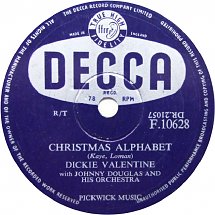
40. ‘Christmas Alphabet’, by Dickie Valentine

dickie-valentine-christmas-alphabet-decca-78-s

Christmas Alphabet, by Dickie Valentine (his 2nd of two #1s)

3 weeks, from 16th December 1955 to 6th January 1956

And so we come across something I never considered when I started this blog: the fact that I will, every so often, have to listen to Christmas songs on repeat. When it most emphatically isn’t Christmas. No matter. ‘Tis a burden I shall bear stoically.

The very first Christmas song to hit #1 in the UK is based around a simple concept – an acrostic poem as hit single. C is for the candy trimmed around the Christmas tree, H is for the happiness with all the family… All the way to the final S which is for Ol’ Santa who makes every kid his pet, Be good and he’ll bring you everything in your Christmas alphabet… Repeat. Done. Note that I am not referring to it as the very first ‘Christmas Number One’, as that wasn’t a ‘thing’ until the ’70s and, technically, Al Martino, Frankie Laine and Winifred Atwell have all already had one.

It’s kind of cute on first listen, but quickly becomes so sugary sweet that you begin to fear diabetes. As I mentioned at the time of his 1st number one, Dickie Valentine still sings like an American crooner (apart from when his ever-so-proper English accent sneaks through in the line about the ‘tree so tawl’). And while this little ditty is a world away from any kind of rock ‘n’ roll – from the record which bookended this song’s stay at the top, for example – he is cementing his image as the first British teen idol.

dicky-valentine

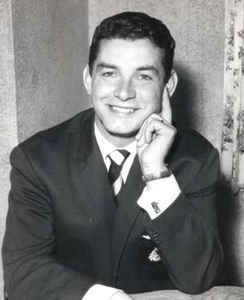
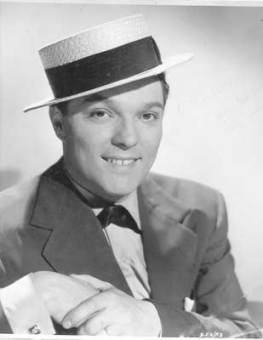
A quick look at the career of Mr. Valentine – which we should do now, as we won’t be hearing from him again – proves this to be true. He made his name singing with big bands, then by impersonating singers such as Frankie Laine and Johnnie Ray. His marriage in 1954 caused hysteria among his young fans, though it clearly didn’t kill his career. An image search throws up lots of cheeky grins, often accompanied by a boater-hat and a bow-tie – a definite ‘cheeky-chappie’. He scored the first and last #1s of 1955 but, like so many of these early chart-toppers, his recording career died a death in the ’60s, and he himself died the most rock ‘n’ roll death of all the artists featured so far: in a car crash aged just 41.

To finish, I do have a little anecdote about Dickie Valentine – and it’ll perhaps be my most tenuous link to any of the artists featuring in this rundown. Years ago (we’re talking early high school, here) I had a friend whose family loved going on cruises. I’ve never understood the appeal of cruises myself, but I suppose that’s irrelevant here. My friend mentioned a cruise they’d been on in which each cabin had – for some reason – a live feed of the ship’s ballroom that passengers could tune into any time of the day or night. My friend was watching it one night – disco night – when an old man, unimpressed by the DJs more modern tastes, walked past the camera and shouted ‘Play some Dickie Valentine!’. I have NO IDEA why my friend told me this uninteresting story; or indeed why I have remembered it to this day. I’d never heard of Dickie Valentine at the time; neither, presumably, had my friend. I suppose it is quite a funny name (‘Hur, hur… Dickie…’). But of all the things in life I’d have been better off remembering… The mind is a strange, strange thing.