96. ‘Why’, by Anthony Newley

We’ve only just started with 1960, yet suddenly it’s March! Time flies! And it seems that if the early sixties is going to have an on-running theme at the top of the charts, then said theme will be ‘Whimsical’.

ANTHONY_NEWLEY_WHY-558515

Why, by Anthony Newley (his 1st of two #1s)

4 weeks, from 5th February – 4th March 1960

Because this is another gossamer light record, as ethereal and floaty as its predecessor: ‘Starry Eyed’. Here the chimes come from a xylophone, or maybe a glockenspiel, or any other instrument with bars that you might strike with a little furry ball on a stick. I’ll never let you go, Why? Because I love you… I’ll always love you so, Why? Because you love me… There are a lot of questions in this record, lots of ‘Why?’s, and the answer to every single one is that Newley loves his girl, or that she loves him. It’s a lovey-dovey song; a song to make you gag.

The lyrics to this #1 are, quite frankly, a cheesefest. And super simple. I think you’re awfully sweet, Why? Because I love you… You say I’m your special treat, Why? Because you love me… Anthony Newley’s voice is reedy, and clipped. Slightly camp. I’m picturing him as a bit of a dandy, nice mustard chinos and a tartan jacket, something eye-catching in the buttonhole, serenading his objet au desire from the lamppost outside her bedroom window. Yet somehow he just manages to keep the song from tipping over into silly territory. He is very earnest, with buckets of boyish innocence to spare, and this just about carries the day.
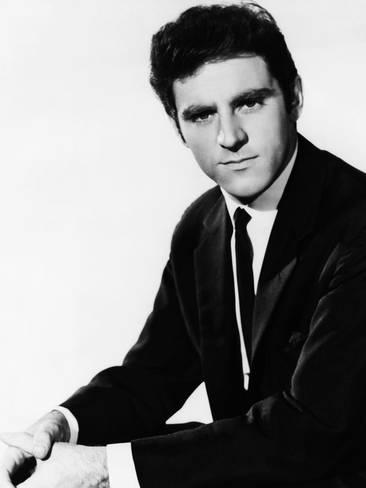
let-s-get-married-anthony-newley-1960_a-G-9917305-4985769

A couple of moments do threaten to ruin things completely. When the backing singers launch into their couple of lines like a tipsy Broadway chorus you can really picture, and are almost blinded by, the shine coming off their manic grins. And Newley’s final lines are particularly cloying: I love you, And you love me, We’ll love each other dear, Forever… You can imagine twelve-year-olds up and down the land theatrically retching, fingers in mouths, when their older sisters dropped this 7” on the gramophone. It’s amazing to think that three months back – just five chart-toppers ago – Bobby Darin was singing about a mass-murderer. And now this. Who says there’s no variety at the top of the pop charts, eh?

At best this #1 could be described as ‘cute’; and at worst as ‘positively vomit-inducing’. But I’m willing to give Newley the benefit of the doubt as he is so very earnest, so utterly proper throughout, that he simply must mean what he says. The pictures thrown up by a quick image search don’t really show him as a foppish man-about-town, more as a bank clerk with hair slightly longer than his manager might think appropriate. He did, though, manage four marriages, one of them to no less a glamazonian as Joan Collins, and so who knows? Maybe this simple little love-ditty helped in that regard. He’ll be back at the top before long, so we’ll save any further bio for then.

One final thing of note… I just noticed that we are in the middle of another long run of male-led number one hits. Shirley Bassey was the last woman to top the charts, a year ago now (though there was a female member of The Platters after that), and we’re going to have to wait another year to hear the next female voice on this countdown! 1960 will join 1957 as a lady-less year at the top of the UK Singles charts. An interesting quirk? Or a sign of a crushing patriarchy? If today’s ‘Guardian’ had been around in 1960 there would have been opinion pieces, that’s for sure…
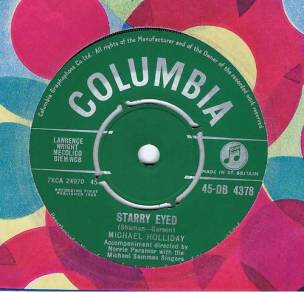
95. ‘Starry Eyed’, by Michael Holliday

Here we go then. One tentative foot in front of the other. A hop and a skip and… We’re into the 1960s! Hurrah! It’s one small step for man… as someone will quite famously say before this decade is through.

BtTnVMQBmkKGrHqEH-D8EvE9BvcOBL7ZdIM5g_12

Starry Eyed, by Michael Holliday (his 2nd of two #1s)

1 week, from 29th January – 5th February 1960

On first listen, however, the 1960s sounds suspiciously like the 1950s. Backing singers? Check. Basic rock ‘n’ roll guitar? Check. Croony male lead singer? Check. Where’s the innovation? Where are the groovy new sounds? Where are all the drugs and free love?

Bum-bam-bum-bam-bum… Why am I so starry-eyed, Starry-eyed and mystified, Every time I look at you, Fallin’ stars come into view… So far so standard. A song about being in love, and about seeing stars because you’re so in love, and to be honest it’s been done a million times before. When we touch I hear angels sing, When we kiss I hear wedding bells ring… Yeah yeah, blah blah blah.

But actually, to dismiss this song because of its unremarkable lyrics would be to do it a huge disservice. Because, on a second, third and fourth listen, this record has got a lot going for it. Firstly there are the backing singers and their Bum-bam-bums. They’re not just any old Bum-bam-bums – they sound echo-y and ethereal, like woozy church bells or a trippy version of the intro to ‘Mr. Sandman.’ It’s really cool.

Adding to this effect is the guitar, which is restricted to a few strums during the verses and chorus but which comes in nice and layered, fed through the same robotic distortions as the backing singers, during the solo. It gives the record a real dreamy quality, like the singer’s dazed after a blow to the… Wait, I get it! He’s starry-eyed. He has been whacked over the head. With love!

78964385

I could complain about Michael Holliday’s sonorous voice being a little too sombre, a little too straight-laced for this song but, after a few listens, it kind of works. His voice has an innocence to it, as he gazes into his lovers mystical eyes and his pupils morph into cartoon love-hearts. Underpinning it all there’s a groovy little rhythm – a bossanova? – that actually makes it quite a sexy record. A record to which there’s more than meets the ear and which improves with every listen. We’re not in the swinging sixties just yet; but this is a sniff of what’s to come…

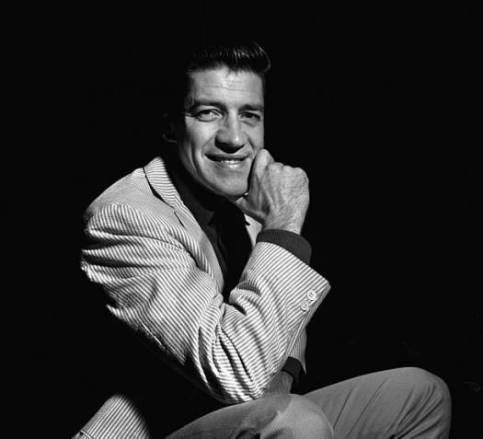
‘Starry Eyed’ is certainly a lot better than the song which first brought Mr. Holliday to our attention a couple of years back – the fairly bland and saccharine ‘The Story of My Life’. I mentioned then that he only ever scored a handful of hits in his career – in fact he managed to squeeze two #1s from just three top ten hits. The story of his life – see what I did there! – is in truth quite a tragic one. Holliday suffered from crippling stage fright and, shortly after ‘Starry Eyed’ hit the top spot, he suffered a nervous breakdown. He took drugs to keep going and sadly died of an overdose in 1963, aged just thirty-eight. He joins the ‘Died Far Too Early’ club along with the likes of Dickie Valentine and Buddy Holly, perhaps proving that pop stars have always died young and in dubious circumstances, and that it didn’t just start with Jimi Hendrix. Remember him this way: by discovering – as I’ve just done – this forgotten gem of a UK Number One.

92. ‘Travellin’ Light’, by Cliff Richard & The Shadows

We waited a long time for Cliff to make his first appearance at the top of the UK singles chart; we didn’t have to wait long for him to return. Seven weeks, to be precise. You better get used to this…

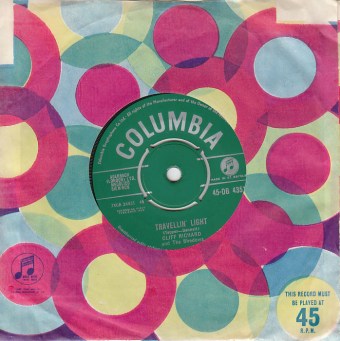
cliff-richard-travellin-light-dynamite-db-4351-m--35093-p

Travellin’ Light, by Cliff Richard & The Shadows (Cliff’s 2nd of fourteen #1s / The Shadows 2nd of twelve #1s)

5 weeks, from 30th October – 4th December 1959

‘Travellin’ Light’ treads very much the same path as ‘Living Doll’ did. In fact I wouldn’t be surprised to discover that they were recorded during the same session, within minutes of one another. It’s jaunty, it’s stripped-back… It’s, again, surprisingly minimalist. It’s a cooler record than its forbear – it would be a tough struggle to be less cool, in all honesty – as seen through the missing ‘g’ at the end of ‘Travellin’. Cliff don’t need no proper pronunciation.

His voice is light and airy, with an eerie echo. Got no bags and baggage to slow me down, I’m travellin’ so fast my feet ain’t touchin’ the ground… You can imagine him strolling alongside a dusty highway, or riding with the hobos on an empty freight train carriage. It’s a very American sounding recorded, steeped in the atmosphere of the open prairie, from Britain’s foremost rock ‘n’ roller.

And there’s something quite endearing about this song, something that ‘Living Doll’ lacked. The lines: No comb an’ no toothbrush, I got nothin’ to haul… And: I’m a hoot and a holler, Away from paradise… give it a nice homely feel. Cliff sounds relaxed, as if he’s just jamming with his buddies. The one time it does veer into cheese-territory is at the end of the bridge: I’m carrying only, A pocket full of dreams, A heart full of love, An’ they weigh nothing at all… We get it, we get it – you’re racing home to the girl you love. Whatever…

32F708E500000578-0-image-a-11_1460113522164

Actually, the more I listen to this song, the more I can see an incongruity between the music and the lyrics. Music: laid-back, chilled, goin’ nowhere in a hurry. Lyrics: all about rushing to get back to ‘see my baby tonight’. The two don’t really go together. But, hey, I don’t think this type of pop song is ever designed to be put under very intense scrutiny. It is what it is; and I like it a lot better than I did ‘Living Doll.’

Still though, The Shadows (who are now properly ‘The Shadows’, having dropped ‘The Drifters’ due to legal reasons) get another chart-topping credit without having to do an awful lot. One acoustic guitar pins the whole song together. Someone shakes a tambourine. The same, dreamy surf guitar that gave us the solo in their first #1 is back, purring away in the background  with little ad-libbed guitar licks, improvised morsels of music more complex than they need to be, which suggests the guitarist – Hank Marvin, I’m guessing – may have been feeling a little restricted in his role.

To conclude, then. This is better, cooler even, than ‘Living Doll’. And yet… It’s still very safe. We are still to meet Cliff the Rock ‘n’ Roller and, by this point at the tail-end of the 1950s, looking ahead at his chart-toppers to come, I’m not sure if we will. Cliff the Rock ‘n’ Roller may already be dead and gone.

90. ‘Here Comes Summer’, by Jerry Keller

Number ninety! If this was Bingo we’d be top of the shop. And to celebrate this milestone – a record I’d never ever heard before.

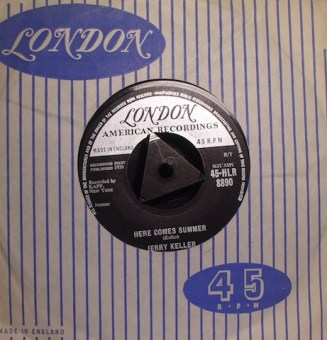
OLYMPUS DIGITAL CAMERA

Here Comes Summer, by Jerry Keller (his 1st and only #1)

1 week, from 9th – 16th October 1959

I’ve mentioned this a couple of times now, but what was quite common back when I started this blog is now pretty rare. I know more and more of these songs as we push on through the first flushes of rock ‘n’ roll and into the canon of pop and rock. So it’s quite nice to come across a disc that I have truly never heard of. ‘Here Comes Summer’? Nope. Jerry Keller? Who’s he?

Well, I think he may be related to Cliff. Cliff’s long lost American cousin, perhaps? I take it all back – what I said in my last post, and before, about US singers being intrinsically cooler than their British counterparts. Because this is a twee little number.

First things first – I quite like the riff that underpins this song. Though I’m not sure it counts as a riff, more of a chug. It’s kind of a proto-Beach Boys, gentle surf-rock lilt. If that makes any sense. And towards the end an organ comes in for emphasis, which is pretty nice. The backing singers are very ‘pre-rock’, but Jerry Keller himself is very clean-cut rock ‘n’ roll. And beyond all that… we have the lyrics.

Here comes summer… do-do-do-do… School is out, Oh happy day… It’s the summer holidays, and Jerry couldn’t be happier. He’s got lots of plans: hanging out with his girl, hanging out with his buddies… We’ll go swimming every day, Oh let the sun shine bright, On my happy summer home…

What follows are lyrics about his flat-top (which I always thought was a type of open-top car – turns out it’s a short back and sides!), drive-in movies, (double features – more time to hold her tight!), sittin’ by the lake and meetin’ the gang at Joe’s Café. It is a song that drips images of milkshakes, preppy sweaters, ball-games and sock-hops on to the floor of the juke-joint until we are ready to drown in all the cuteness.

jerry-keller

I guess, like so many of the cheesy sounding US-recorded hits that have topped the charts before this (I’m looking at you ‘Diana’, ‘When’, and ‘All I Have to Do Is Dream’) it appealed because it sounded really exotic to British schoolkids in, say, Scunthorpe, whose dads still had an Anderson shelter in the garden and whose mums were still darning tights.

The song finishes on a romantic note. Jerry has high hopes for him and his girl: If she’s willing, We’ll go steady right away… (Aww..) And then, with a Here comes summer time at last… we reach an abrupt end. Summer is over. And summer was truly over when this reached the top of the UK charts. On the 9th of October. When the schools had been back for well over a month…

This is a perfectly harmless, kind of cute little song that zips along nicely for a couple of minutes. Beyond that I’m not sure it has much of a wider significance. There are strong notes of earlier, preppy-rock (a new genre I’ve just invented) #1s such as The Dream Weavers ‘It’s Almost Tomorrow’ and Tab Hunter’s ‘Young Love’. Looming largest of all, though, is good old Pat Boone who, if Wiki is to be believed, was Keller’s friend from church and introduced him to his manager.

Jerry Keller is a one-hit wonder in the purest sense, in that he had had zero previous chart hits – in either the US or the UK – and would go on to have zero more. A 100% strike-rate for him, then. Well done! He’s still alive – aged eighty-one – and was apparently the go-to guy for TV jingles in the ‘70s and ‘80s! Well there ya go. Next up – a recap!

86. ‘Roulette’, by Russ Conway

I think we’ve heard this record before… ‘Roulette’ may, in fact, be identical to Russ Conway’s first number one. Or it may sound completely different. Who knows? Who even cares?

71zX-m93JPL._SX355_

Roulette, by Russ Conway (his 2nd of two  #1s)

2 weeks, from 19th June – 3rd July 1959

Actually, they do sound the same. Same perky piano, same lightly strummed guitar as accompaniment. In fact, to illustrate my point, let me quote verbatim from my post on ‘Side Saddle’ (which was #1 barely two months before):

“Upon first listen of this latest chart-topping record, two questions spring immediately to mind: What is this? And why did it spend a whole month at the top of the charts? It’s an instrumental, Mr. Russ Conway tinkling away at his piano, and… that’s about it. It’s got a melody, which plods along pleasantly enough without going anywhere very far, and then it ends, in under two minutes.”

Swap ‘whole month’ for ‘two weeks’- and ‘pleasantly’ for ‘irritatingly’ because that’s the mood I’m in today – but you’re still pretty much there. This record is equally short, similarly jaunty, and is still searching for a tune that never quite seems to materialise. And why ‘Roulette’? Is it because the cascading notes that tumble at intervals throughout the song sound like a rolling roulette wheel? Or is that me putting way too much though in?

I think I hate this more than I did Conway’s first #1. It was bland; this is criminally perky and is played in an irritatingly high key. Plus those little flourishes at the end of every second note are starting to make me feel a little sick. Way, way back in one of my early posts I claimed the idea of the ‘shadow number one’ – the chart topping record that only gets there due to the reflected glow of a preceding hit. Frankie Laine had one when ‘Hey Joe’ followed the chart-humping ‘I Believe’. Rosemary Clooney had one with ‘Mambo Italiano’ hot on the heels of ‘This Ole House’ (though ‘Mambo…’ was probably the bigger record). Guy Mitchell had one in ‘Rock-A-Billy’ after his huge hit ‘Singing the Blues’. And now we have to suffer a second dose of Russ Conway because grannies across the land liked ‘Side Saddle’, and probably thought he looked like a nice boy.

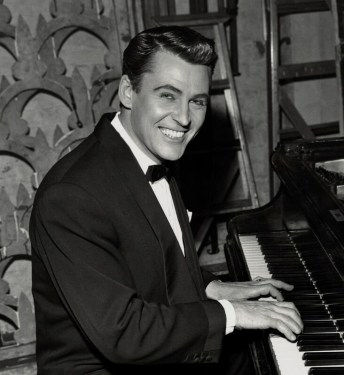
roulette-featuring-russ-conway-piano-solo

In fact, for a ‘nice boy’ Conway led a fairly troubled life. Let’s face it, anyone who records songs of such fake jollity and forced perkiness is going to be a little screwed-up inside… Alcoholism, crippling self-doubt, a reliance on anti-depressants, an eighty (80!) a day cigarette habit – all of which can probably be attributed to his being gay but having to keep it hidden for fear of losing everything (shades of Johnnie Ray there). Unlike Ray, however, Conway remained fairly popular throughout his career, and was still performing publicly just two weeks before he died in 2000. He had actually sliced the tip of a finger off during the war, so it’s pretty impressive that he could play the piano at all I suppose.

God, I have been a little harsh on ole Russ here, haven’t I? I just had a quick listen to some of the other hits from his late fifties heyday – the likes of ‘China Tea’ and ‘Party Pops’ – in an attempt to redeem his chart career. But. I’m sorry to confirm that they ALL. SOUND. THE BLOODY. SAME! In desperation I tried to look for some clue as to the inspiration for ‘Roulette’, but the Wiki entry is one line long and there ain’t much else out there. What little I could find all seemed to prefer this disc to ‘Side Saddle’ (come on, people!) But then I found this, and I started with a quote so I’ll end with one too.

Thanks to the guy(s) at fiftiesnumberones.blogspot.com – which I will wholeheartedly recommend as long as you promise to still read my blog – for their brilliant description of ‘Roulette’ as an ice-cream van jingle… “albeit an ice cream van plying its trade around the dusk tinged streets of a council estate on a late October evening. In the rain.”

<kiss fingers gif>

End post

83. ‘Side Saddle’, by Russ Conway

And so, The Winter of the Ballad, which I took such pains to introduce in my previous post, experiences a sudden thaw. Spring has sprung, and has brought with it a perky piece of piano-pop.

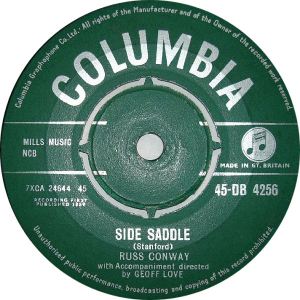
russ-conway-side-saddle-columbia

Side Saddle, by Russ Conway (his 1st of two #1s)

4 weeks, from 27th March – 24th April 1959

Upon a first listen of this latest chart-topping record, two questions spring immediately to mind: What is this? And why did it spend a whole month at the top of the charts? It’s an instrumental, Mr. Russ Conway tinkling away at his piano, and… that’s about it. It’s got a melody (of sorts), which plods along without going anywhere very far, and then it ends, in under two minutes.

The obvious comparison to draw here is with Winifred Atwell, who has already claimed two UK chart-topping singles with records sounding very similar to this. But Atwell at least had a kind of frantic energy about her piano-playing – you could picture her bashing out the hits with a smile and a bead of sweat rolling down her temple. Whereas you can only imagine Conway plodding his way through ‘Side Saddle’ with a cheesy grin-slash-wink combo. The other piano-led #1 single which springs to mind at this time is, of course, ‘Great Balls of Fire’. But to compare that record to this record is, to my mind, heresy of the highest order. There is a slight concession to rock ‘n’ roll here, in that someone in the background is tickling a drum kit in time to Conway’s piano, but that’s strictly it.

It’s a strange chart-topping record, this. At best I’d describe it as incidental music, or silent movie music: you can imagine it going down quite well as an accompaniment to Buster Keaton running down a railroad track. It is very 1932. Which means we have to pose a 3rd question: Why now? Why did this curio of a record zoom to the top of the charts in the spring of 1959? My research has thrown up no answers. It wasn’t an old song; it was written and released in ’59, apparently recorded for a TV adaptation of ‘Beauty and the Beast’ – which at least helps explain the olde-worlde feel of the song. There’s no clue as to how the melody concerns a horse-riding style popular with posh old ladies. According to Wiki “the song was a staple of the BBC’s ‘Housewives Choice’ radio programme”, which perhaps says more than anything I could ever write.

mw148586

Due to summer holiday commitments, this is the first time in over a fortnight that I have sat down to write one of these posts. In that time, I’ve listened to very little music, and the music I have heard has been radio-friendly, modern pop. Perhaps ‘Side Saddle’, then, is suffering from being the oldest record I’ve heard for a while. Perhaps if I were in the swing of things – in my mid-season form of writing a post every couple of days – it wouldn’t stand out so much. But then again… maybe not. I fear that, whatever way you look at it, this track is simply a relic. And, glancing down my list o’ number one singles… Oh, goody. There’s more to come from our Russ in very short order.

One final thing of note… If you click on the video below and discover a hitherto unrevealed love of bland, piano-based background Muzak, Spotify has the most extensive collection of Russ Conway back-catalogue ever seen. Like, seriously. There must be fifty-odd albums on there. Knock yourselves out!

76. ‘It’s All in the Game’, by Tommy Edwards

If the previous two chart toppers have been ‘clickety-clacking’ and ‘rollicking’ respectively, then this next one is… not. Sorry. ‘It’s All in the Game’, by Tommy Edwards, is merely ‘sedate’ and ‘swaying’.

Tommy-Edwards-Its-All-In-The-Game

It’s All in the Game, by Tommy Edwards (his 1st and only #1)

3 weeks, from 7th – 28th November 1958

Many a tear has to fall, But it’s all, In the game… All in the wonderful game, That we know, As love… This is a song about arguments, and how having them is part of being in love. About how a guy not calling you back is just a tactical move, a rook to bishop four. A song about not sweating it – ’cause it’ll all turn out right in the end. And you believe Tommy, you really do. He’s got a voice you’d trust.

You have words, With him, And your future’s looking dim… But these things, Your hearts can rise above… Pretty soon, according to Tommy, you’ll be back kissing and a-cuddling. In a way, it’s a very old fashioned song – counselling a woman to put up with a man’s vagaries and inconsistencies. Especially given that it’s a man singing it. You might get away with it in 2018 if it was a woman dishing out sage advice to her girlfriends; a sort of ‘Independent Woman’ type of song. (Though that was nearly twenty years ago and I think the underlying message of that song was that Beyoncé and co. weren’t taking no more shit).

Tommy Edwards, though, manages not to come across as patronising. He simply comes across as very, very smooth: a sort of omniscient father figure looking down at the trials and tribulations of couples in love. And it is, at least, an interesting angle to come from. We’ve had a few super-basic love songs topping the chart recently – ‘Diana’, ‘All I Have to Do Is Dream’, ‘When’ – and it’s good to get a little cerebral every once in a while.

Then he’ll kiss, Your lips… And caress your waiting finger tips… And your hearts, Will fly, Away… If pressed, I’d have to add one more adjective to those that I used at the start of this post: ‘classy’. This is a classy song; the sort of song that George Clooney puts on as he pours a glass of wine for his date. I’m not sure if it’s a rock ‘n’ roll record, or a swing record, or just a plain old easy-listening disc. Edwards certainly croons the arse off it. Maybe it’s another of those new, hybrid songs – the fusion of rock and pre-rock that I mentioned back in my post on the Everly Brothers.

edwards

‘It’s All in the Game’ is one of the (slowly dwindling) number of #1 hits that I’d never heard before. Though perhaps I should have as alongside this there have been Top 5 charting version by Cliff and by The Four Tops, as well as a highly respected version by Van Morrison. But somehow these had all passed me by.

What also almost passed me by is the fact that Tommy Edwards was black. Which makes him *drum roll please* only the second black male soloist to top the UK Singles Chart. Edwards would only go on to have one more, minor hit on these shores before dying in 1979, aged but fifty-seven.

One other fascinating little tit-bit before I go… The lyrics to ‘It’s All in the Game’ were written in 1951 but the melody was composed way back in 1911 by a Mr. Charles G. Dawes, who would go on to serve as Vice-President of the United States of America. Thus, when you press play on the video link below, you will be listening to the only #1 single to have been co-written by a US Vice-President. That is some Grade A trivia right there, people. Over, and out.

73. ‘All I Have to Do Is Dream’, by The Everly Brothers

THE_EVERLY_BROTHERS_ALL+I+HAVE+TO+DO+IS+DREAM+-+1ST-504360

All I Have to Do Is Dream, by The Everly Brothers (their 1st of four #1s)

7 weeks, from 4th July – 22nd August 1958 (including 1 week joint with Vic Damone from 4th – 11th July)

We have an opening chord, then a pause… And then those voices. Those harmonious voices. The Everly Brothers certainly could harmonise.

Dre-e-e-eam, Dream, Dream, Dream, Dream…. Dre-e-e-eam, Dream, Dream, Dre-eam….

This is undeniably a classic, and most people will at least be familiar with the dream dream dream refrain. It’s also a very simple song. A song in which a lover, starved of attention from the object of his desires, turns to dreaming about her. All he has to do is dream. When I want you, In my arms, When I want you, And all your charms, Whenever I want you, All I have to do, Is dre-e-e-eam… You know what this song is going to be about just by glancing at the title. Simple. As.

I can make you mine, Taste your lips of wine, Anytime… Night or day… The Everlys sing (Is it Phil? Or Don? Or Both? Those harmonies are so damn tight they sound like the same voice) before delivering the classic line: Only trouble is, Gee Whizz, I’m dreamin’ my life away… Can we have a shout out for that ‘Gee Whizz’! So dorky; yet so appropriate. So ‘All-American-Boy-Next-Door’.

I’m going to go out on a limb here, and make a bold statement. That this record, ‘All I Have to Do Is Dream’, is the perfect fusion of rock and pre-rock. I’ve been continually mentioning that all through 1958 we’ve had a couple of rock ‘n’ roll #1s here, a couple of easy-listening, croony #1s there. Never before, though, have we had both styles melded together in the one record. This is it. This is where the previous seventy chart-topping records have been leading us. We’ve arrived. Bear with me…

everly-brothers-588fc7865f9b5874ee60dcf3

Musically, this is rock ‘n’ roll (very gentle, very country-tinged rock ‘n’ roll, but still) sung by a couple of fresh-faced young things. Don Everly was twenty-one when this hit the top spot, Phil was nineteen. But lyrically this is the same kind of schmaltz guys like Al Martino and Eddie Fisher were churning out back in 1952. Take the line: I need you so, That I could die, I love you so, And that is why… Melodramatic or what? I get that it’s trying to convey the helpless passion of a teenage crush; but I much prefer the cocksure swagger that The Crickets brought to ‘That’ll Be the Day’, or the cynical shrug of the shoulders offered by The Teenagers on ‘Why Do Fools Fall in Love’.

How long have I known this song? I’ve no idea. Forever? It’s always been there; though it isn’t a song I’d ever rush to listen to. It’s just a little too much on the cheesy side for me, thanks. Structurally, it is an AABA song which I believe, though I’m no songwriter, is code for ‘a bit basic’. It will, though, always remind me of karaoke sessions from my days teaching in Thailand. Along with Andy Williams and The Carpenters, ‘All I Have to Do Is Dream’ was one of the few English songs that my Thai colleagues knew. That’s quite a good barometer of a song’s fame, isn’t it? ‘It’s popular, but do they sing it at karaoke in Thailand?’

Personally, I see this record as Everly Brothers MK I. They’ve yet to hit their stride. They will be back at the top of the UK charts on three more occasions, each time with a song better than this one. They will return with a slightly harder edge, and with huskier voices. There will be no disputing that they are a rock ‘n’ roll act by then. In fact, the next time we hear from them they will be topping the charts with – hands down – one of the best pop songs ever recorded…

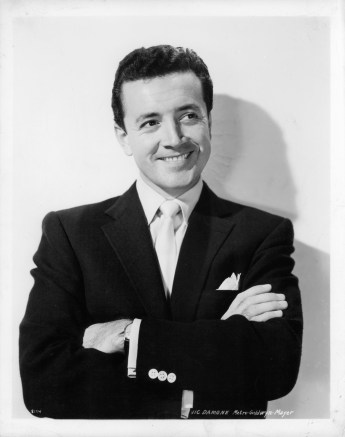
72. ‘On the Street Where You Live’, by Vic Damone

vic-damone-with-percy-faith-on-the-street-where-you-live-philips

On the Street Where You Live, by Vic Damone (his 1st and only #1)

2 weeks, from 27th June – 11th July 1958 (including 1 week joint with The Everly Brothers from 4th – 11th July)

Oh Lordy, that intro! Whipping us right back to 1952. The crescendo that kicks us off here is almost identical to that which announced the very first UK chart-topper, Al Martino’s ‘Here in My Heart’Plus ca change…

Oooooh, the towering feeling! Just to know somehow you are near… Vic Damone howls the opening line as if on a mission to wake the dead. And then… we sit back down, chill out, and listen to a song about a man wandering down a street.

This is, of course, a song from ‘My Fair Lady’ – I know it well; without ever having heard this version. I’ve always thought of ‘My Fair Lady’ as the musical without any decent songs. Or without anywhere near as many decent songs as other musicals of similar stature. Apart from this song, and maybe ‘Wouldn’t It Be Lovely’ or ‘I Could Have Danced All Night, the others are short, semi-comic skits, while Professor Higgins’s numbers are almost early-form rap tracks.

Anyhoo… From ‘My Fair Lady’ it is, which makes sense in as much as the show debuted on Broadway in ’56 and in the West End two years later. Damone sings it well, with cut-glass, stage school diction, and goes from full-on belting it out – see above – to subtle, almost whispered lines like: People stop, and stare, They don’t bother me… On a technical level, this is ‘better’ singing than that of the young rock ‘n’ roll stars we’ve been hearing from recently, and my gran would certainly have preferred Viccy D to Buddy H. But it already sounds – and bear in mind it is only the summer of 1958 here – super old-fashioned. And again we have an easy-listening interlude after a couple of rock ‘n’ roll chart-toppers. This is definitely the ongoing theme of ’58.

Vic Damone

One problem – and this is one that regularly arises when stage songs are recorded away from the context of the show for which they were written – is that lyrically this song sounds pretty weird. It is essentially about a man lurking outside the house of a woman with whom he is besotted. Does enchantment pour, Out of Ev’ry door? No, it’s just on the street where you live… I’m getting flashbacks to Eddie Fisher’s ‘I’m Walking Behind You’. At least, though, when heard towards the end of Act I of ‘My Fair Lady’, this song is quite cute. Fisher, on the other hand, was just being a creep.

Another problem with stage-show songs being recorded as pop records arises here too: namely the question of how to finish. On stage you can’t fade out. But the flourishes that signal the end of the song in a show sounds trite and cheesy on record. Here they’ve gone for the flourish, and I can’t help but think there must have been a better way to end this song than with a plop!

But it is a diverting little interlude in UK Chart history, if nothing else. Showtune #1s don’t come along every day, and Vic Damone won’t go on to have much further success in the UK. I would have bet a large sum of money, before doing any sort of research, that Vic Damone was some sort of Italian-American, Rat-Pack type singer. And… of course he was. He idolised Sinatra, had various mob connections, married five times, and died earlier this year, aged eighty-nine. A life well lived, it would seem.

And note – yet another tie for number one. The third time it’s happened, and it will happen one final time before the decade’s out. I covered the reasons for these anomalies a few posts back – if you care to read further – but it does raise an important issue. Do we record Vic Damone’s ‘On the Street Where You Live’ as having spent a single week at the top? Or two weeks? Or one and a half? Questions, questions, questions…

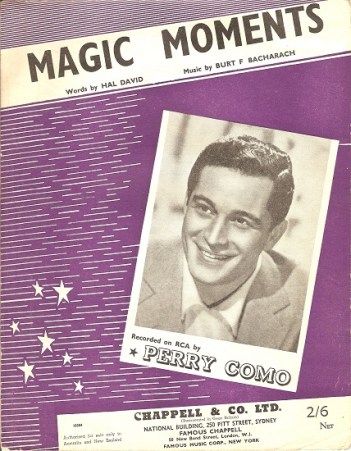
69. ‘Magic Moments’, by Perry Como

perry-como-magic-moments-1958-7

Magic Moments, by Perry Como (his 2nd of two #1s)

8 weeks, from 28th February – 25th April 1958

I’ve grown so used to describing this period in popular music history as the ‘rock ‘n’ roll revolution’ that I’m growing, quite frankly, bored of typing it (‘rock ‘n’ roll’ is actually a difficult phrase to type quickly – those two commas round the n, you see – and I will be relieved when I can start typing phrases like ‘New Wave’ and ‘Disco’).

And if I were to stop calling this the ‘rock ‘n’ roll era’, I’d be very tempted to re-christen it ‘The Age of Whistling’. Because I make this the sixth UK #1 in a little over a year to be very heavy on the whistling: ‘Just Walkin’ in the Rain’, both versions of ‘Singing the Blues’, ‘Butterfly’, ‘The Story of My Life’ and now ‘Magic Moments’ (and I’m sure I’ve forgotten about a few stray whistles elsewhere…) I suppose it’s cheap and easy to do. And I suppose it’s better than humming. But to me it creates an air of fake jollity around a song, a feeling of enforced fun – a sense that some red-faced, chain smoking record executive was yelling ‘Sound relaxed, dammit!’ just before they pressed record.

But, hey. At least the whistling is fairly sporadic here – after the first few bars Perry Como comes in with some very famous lines: Magic… Moments… When two hearts are carin’, Magic… Moments… Mem’ries we’ve been sharing… While this standard may have receded somewhat into the mists of time, surely everyone still knows the chorus. I can pinpoint the first time I became aware of this song – an advert for (I think) ‘Quality Street’ back when I was a lad – and it is one of those songs, along with, say, ‘Que Sera Sera’ or ‘I Believe’, that make up the background music of one’s life. It’s also another Bacharach and David number, hot on the heels of ‘The Story of My Life’, and while it’s a bit more memorable than Michael Holliday’s record it is still pretty bland in comparison to their later hits.

The best you can say about ‘Magic Moments’ is that it’s a very safe song: super laid-back and super-inoffensive. Como sounds like he recorded it from his bed, or at least from a very comfy armchair. Which kind of makes sense, as the singer of this song is supposed to be an older gentleman contentedly reflecting on happy times. The backing singers, meanwhile, are working overtime – taking on at least a third of the lines.

perry-como-magic-moments-1958

Away from the chorus, the verses flesh out just what the ‘magic moments’ were. Moments such as: The time that the floor fell outta my car when I put the clutch down… The way that we cheered whenever our team was scoring a touchdown… They are sweet little vignettes; lyrically quite modern in the way that they eschew grandiose statements about love for real life scenarios. There’s also a link here between this and Pat Boone’s ‘I’ll Be Home’ from a couple of years earlier, in the way that the song invokes cute images of small-town, suburban (super white and WASPy, obviously) America.

I’ve mentioned it before, but it bears repeating, how interesting it is to see the ebb and flow of the UK charts around this time; the old guard tussling with the new. You get a couple of very forward-looking, very cool, very new hits in ‘Great Balls of Fire’ and ‘Jailhouse Rock’ before the waves slowly recede and leave a saccharine blob like this beached at the top – for 8 (eight!) weeks. There are certain records that I can imagine having appealed to both young and old – ‘Diana’, for example – but I really struggle to imagine anyone under the age of forty buying this disc. Como himself was forty-five when this hit the top spot making him – and I’ve not checked this at all, but hey – the oldest chart-topper yet. Definitely one of the oldest. Probably.

Before we put the needle back into its holder for another post, let us bid farewell to the ‘King of Casual’. He has an impressive gap between his two #1s – ‘Don’t Let the Stars Get in Your Eyes’ (the 5th UK #1) and this (the 69th) – which is surely a sign of his enduring appeal. Though I do have to state that, personally, there is no contest as to which is the better song: the ever-so-jaunty ‘Don’t Let the Stars…’ all the way. Como will go on to have Top 10 hits as late as the mid-1970s – and would have had many more hits had the UK charts begun earlier than 1952 (his first US successes came in the early forties). A true titan of easy listening, he died, aged eighty-eight, in 2001.