593. ‘It’s a Sin’, by Pet Shop Boys

Ah, yes. Cleansing the palate after the rotten ‘Star Trekkin’, it’s a, it’s a, it’s a… classic. In fact, with Whitney before and Pet Shop Boys after, we have two beauties sandwiching a stinking turd. Such are the pop charts…

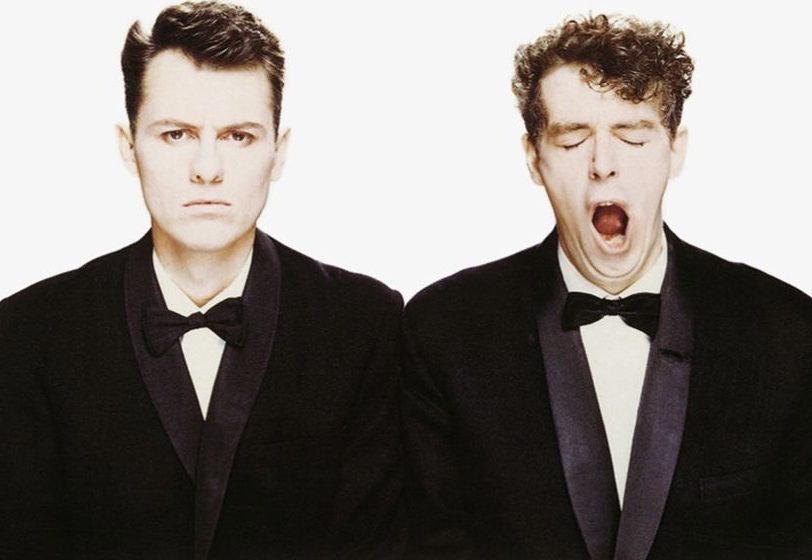
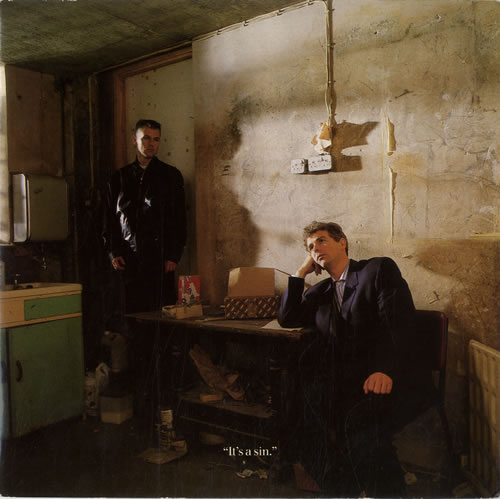
It’s a Sin, by Pet Shop Boys (their 2nd of four #1s)

3 weeks, from 28th June – 19th July 1987

It’s an epic, statement intro, juddering in like a train about to overshoot its platform, followed by a dramatic ‘Skoosh!’ It’s a sound effect last heard on ‘Relax’, and that’s a comparison I think could be maintained for the entirety of this post. Not only in the skooshing, but in the fact that ‘It’s a Sin’ is every bit as gay as its more infamous predecessor.

If ‘Relax’ was an unrepentant celebration of all things queer, then ‘It’s a Sin’ is a little more introspective. A lot more. When I look back upon my life… Neil Tennant announces… It’s always with a sense of shame… I’ve always been the one to blame… Tennant had gone to a Catholic school, where he was taught that pretty much every natural urge he had would earn him a one-way ticket to hell. For everything I long to do, No matter when or where… Or who… It’s a sin…

As serious as the lyrics are, though, the PSBs keep things moving, and shaking. You can pay scant attention to the words, if you wish, and just dance. Tennant himself has said he wrote the song more in a camp than an angry frame of mind. That comes through in the ‘do’ and ‘who’ rhyme, and I can’t help but picture a Noël Coward-esque arched eyebrow on the They didn’t quite succeed… line.

While if you listen harder still, you realise that he isn’t quite as ashamed as he first suggests. In the glorious Father forgive me… middle eight, he ends with a chest-beating moment of affirmation: I didn’t care, And I still don’t understand… It’s a brilliant feat, to write a song about something so unpleasant – his experiences could be seen as child abuse, who knows – but make it so catchy, and so funny. ‘Relax’ was in your face; ‘It’s a Sin’ outs itself more slowly, but just as effectively.

‘West End Girls’ is the Pet Shop Boys’ song which is routinely crowned as one of the best songs of the 1980s, if not of all time. But for me, this one beats it all ends up. Tennant and Lowe wanted Stock Aitken Waterman to produce it, but Pete Waterman hated the demo version. The one that got away… (I’d love to hear the SAW take on it.) Tennant has also likened it to a heavy metal song, in its tempo, it’s portentous chords and it’s overblown production. I’d also like to hear a metal version, and the closest I could find was this take by Finnish (of course they are) band The Jade… None of them can touch the original, though. One of the high points of the entire decade.

Advertisements

583. ‘Jack Your Body’, by Steve ‘Silk’ Hurley

1987, then. Officially the ‘late-eighties’. I think you can divide the 1980s into roughly three chunks: the early, new-wave, post-punk years (‘80-‘82), the gloopy, synthy, new-romantic years (‘83-‘85)… I’m excluding ’86 from this, as I’m still trying to wrap my head around that strange year… And the poppier, dancier, HI-NRG years of ‘87-‘89. And speaking of dance music…

(Steve ‘Silk’ is on the left)

Jack Your Body, by Steve ‘Silk’ Hurley (his 1st and only #1)

2 weeks, from 18th January – 1st February 1987

We have our first ever house #1. In fact, we probably have our first modern dance chart-topper, if by ‘modern dance’ you mean a repetitive, electronic beat twinned with a repetitive, inane lyric. Steve ‘Silk’ Hurley was a DJ, a leading light in the Chicago house scene, and jacking is a free-style dance move that looks like a cross between the robot and break dancing (and which Wikipedia helpfully reminds us is not to be confused with ‘jacking off’… something not seen on a dancefloor since ‘Relax’).

It is repetitive and, yes, it is inane. The shortest edit I can find of ‘Jack Your Body’ on Spotify is over five minutes, which is three minutes too long. YouTube has the single edit, which has few more vocals thrown in: some Uhhs and a Jack it up out there… to end on. And yet, there is something thrilling about it, something that still sounds fresh and modern. It’s a window into the future, a line in the sand as we reach the halfway point in our journey through the charts… This is a sound that will last from here to eternity. In the UK, there have been several dance #1s this year. Beyonce, no less, borrowed a bass line that sounds a lot like ‘Jack Your Body’ for her recent smash ‘Break My Soul’.

The part of this record I enjoy the most is the complicated bit, around the midway point, where several different synth lines build together. It sounds a little like a fifties piano instrumental gone wrong – like Winifred Atwell on Ecstasy. Dance music isn’t really my thing, as you’ll see as we delve into the nineties, though I’m not morally opposed to it as some rock-leaning people are. Yet I’m glad that this made #1, both for the variety and the statement that it makes, and that I can claim it as a birthday #1 (I turned one year old on its last day at the top).

Being born in January means that I have an interesting mix of birthday number ones: indie faves, nu-metal, a Disney theme, and the only Chicago house chart-topper. Steve Hurley had limited chart success following this hit, but he continues to DJ and in his work as a Grammy winning remixer has worked with Madonna, New Order and both Michael and Janet Jackson.

Except… Controversial postscript alert! Turns out ‘Jack Your Body’ should never actually have been a number one single. The 12” was too long (ooh-er!), running to over twenty-five minutes which meant it should have counted towards the album rather than the singles chart. Apparently nobody at the Official Charts Company had bothered listening to it until it made the top and so, rather than delete it, they quietly let it remain there. Luckily the worst thing that happened was that ‘Reet Petite’ and then our next chart-topper were both denied an extra week at number one…

Advertisements

576. ‘Don’t Leave Me This Way’, by The Communards with Sarah Jane Morris

Back to business, then. Our next #1 ups the pace, thankfully, after the past two treacly chart-toppers. It’s a soaring piano ‘n’ strings intro, a mish-mash of ‘I Will Survive’ and ‘It’s Raining Men’ – in my head anyway – which means disco is back, baby, for four weeks at least…

Don’t Leave Me This Way, by The Communards with Sarah Jane Morris (their 1st and only #1)

4 weeks, from 7th September – 5th October 1986

In comes a throbbing, Hi-NRG synth beat, and a high-pitched voice: Don’t leave me this way, I can’t survive, Can’t stay alive… Jimmy Somerville is the latest addition to our list of androgynous eighties voices, a worthy successor to Boy George, Limahl, Pete Burns and co. He hits some genuinely astonishing high notes, especially as the song builds towards the end. The only downside is that he makes this bloody hard to sing along to…

Aaaaah… Baby! That’s a great hook – one that is fun to sing along with – especially when, ahead of the final chorus, the ‘Aaaah’ is drawn out even further and followed by a ridiculously life-affirming key-change. Over the top brilliance! Meanwhile guest singer Sarah Jane Morris, who wasn’t officially a Communard, complements Somerville’s falsetto with a warmer, deeper voice on the second verse and in her Come satisfy me… lines.

Oh and there’s also the ear-catching solo, with a clattering piano and horns. I’m enjoying this. It’s fun, frothy, and full of life (something much of 1986 has been lacking…) ‘Don’t Leave Me This Way’ was a cover of a cover. Harold Melvin & The Blue Notes’ disco-soul original had made #5 in 1977, while a pure disco version by Thelma Houston (on which The Communards’ take is based) had made #13 around the same time.

Houston’s version had been taken on as a gay anthem, with significance added to the lyrics as AIDS swept through the community. Both Communards were gay, Somerville having left the poor area of Glasgow he’d grown up in for London, becoming a sex worker in Soho. He’d been in the Top 10 before, with Bronski Beat, but this was his first and only #1. And if he had the interesting back-story, then keyboardist Richard Coles has had the more interesting after-story, becoming an actual Church of England priest, and radio presenter.

Sarah Jane Morris, meanwhile, worked with the duo on several more songs, before moving into jazz and opera. The Communards were only together for two albums, and for three Top 10 singles. A short and sweet chart-career, though one that did give them the biggest-selling single of 1986. This has felt like a bit of a palate-cleanser after the mix of novelties and mawkish ballads that had begun to bog things down. A straight-up, pop banger for the ages. Aaaaaaaaaah… Baby!

Advertisements

554. ‘Into the Groove’, by Madonna

You can dance… For inspiration… With these words, we welcome an icon. The most successful female artist in British chart history. Come on… I’m waiting…

Into the Groove, by Madonna (her 1st of thirteen #1s)

4 weeks, from 28th July – 25th August 1985

Madonna’s first of thirteen (13!) chart-toppers is an ode to the joys of dance: Get up on your feet, Yeah step to the beat… Her boy has to prove his love for her by boogying. She feels free, she feels sweet sensations… It’s a revelation. For someone who grew up with provocative, cone-bra, sex book Madonna, this early hit feels a little trite, a little bit too teenybopper.

But it’s impossible not to at least tap your feet to this record even if, like me, you’re a terrible dancer. It’s got that hi-NRG beat that recent hits from Chaka Khan and Dead or Alive had, which is a very welcome development after some stodgy production and tempo from the class of ’83-’84. May the BPMs keep rising for the remainder of the decade.

One of the (many) criticisms aimed at Madonna over the years is that her voice is a little… limited? Which I think is harsh, but her early hits do bear this out somewhat. Her voice on this one is high-pitched, and a little one-note (plus, the song being at least a minute too long doesn’t help). Over time her voice will deepen and improve.

As I’m writing, and listening, I’m beginning to wonder if there’s not more to this tune than first meets the ears. When she sings that at night I lock the doors where no one else can see…. and complains that she’s tired of dancing by herself… Is this actually a bit filthy? Is the order to get into the groove actually total smut, if you see what I mean? Or am I just desperate to hear controversial, attention-seeking Madonna from the off? A quick internet search proves I’m not alone in thinking this… That’s more like it, Madge!

‘Into the Groove’ is a decent enough debut for Madonna as a chart-topper. A solid enough song for someone who is the template for every single-named female pop star hereafter, from Kylie to Rihanna to Gaga. But in my perfect world her first #1 would have been the throbbing ‘Like a Virgin’, or the ultimate school dance smoocher ‘Crazy for You’ – both of which had been huge hits without making top spot. Madonna was already a giant star when she finally scored a #1 (shades of Elvis back in 1957), and ‘Into the Groove’ was from the soundtrack to her first film, ‘Desperately Seeking Susan’. Love or loathe her, Madonna was one of the biggest artists in the world in this moment, and will remain so for the next twenty years.

Advertisements

550. ’19’, by Paul Hardcastle

Well now, what to make of this…

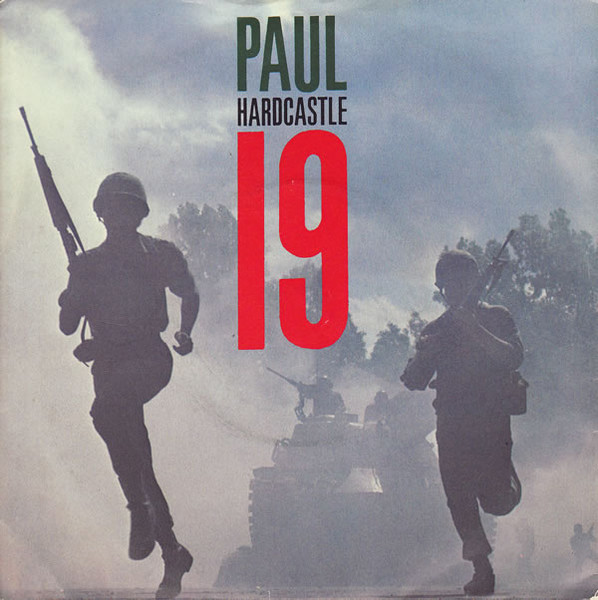
19, by Paul Hardcastle (his 1st and only #1)

5 weeks, from 5th May – 9th June 1985

Seriously. What to make of this? I’ve listened to our next #1 three times, and still can’t think how to approach it. Do we go with ground-breaking, game-changing slice of electronic music? Hugely important, anti-war chart-topper? First #1 with only numbers in the title… Or do we go with dated, clunky, hot mess of a song?

Let’s start with this as a game-changing chart-topper. We open with a reporter telling us that: In World War II the average age of a combat soldier was twenty six, In Vietnam he was nineteen… Very few, if any, number ones have used speech to this effect, sampled and chopped up. (Paul Hardcastle was inspired to write this after watching an ABC report entitled ‘Vietnam Requiem’, and the music video features footage from it.) There’s the reporter (from ‘Vietnam Requiem’), a ’60s newscaster, and an interview with a soldier – “I wasn’t really sure what was going on” – none of which were recorded specifically for the song. It’s quite powerful: I particularly like the line about how, eight to ten years after coming home, tens of thousands of men are still fighting the Vietnam war…

Unfortunately, a lot of the message is lost behind really heavy production. The song’s main hook – the stuttering na-na-na-na-na-na-nineteen-nineteen – is probably meant to echo a PTSD-suffering soldier’s nerves, but it just sounds like Hardcastle’s cat was walking across the keyboard as he recorded. If that line wasn’t annoying enough, we also get Sa-Sa-Sa-Sa-Saigon, an electronic impersonation of a military bugle, and some very dramatic (and very cheap sounding) synth notes as we build to a finale.

Then there are the backing vocalists, who lay the song’s message on a bit thick: Destruction! Of men in their prime! Whose average age was nineteen… I don’t want to be overly harsh towards a record that is, I think, pretty fondly remembered. But it’s difficult to listen now, thirty-five years on, and hear how thrilling it may have once sounded. It’s also a bit harsh to criticise the clunky production, as techniques were limited in the mid-eighties, while Paul Hardcastle was hardly a big name with lots of cash at his disposal (this was his first Top 40 hit).

And yet. Do I particularly want to hear this again any time soon…? No, not really. It’s an interesting song, with a worthy message (it’s yet another ‘war’ chart topper – I make that four in just over a year, along with ‘Pipes of Peace’, ’99 Red Balloons’, and ‘Two Tribes’) that is clumsily delivered. But it’s definitely not boring. And that is, as always, my bottom-line. Don’t be boring!

Paul Hardcastle would only have one further Top 10 hit in the UK following ‘19’s huge success, although he continues to record and released his latest album just this year (he’s a big name in smooth jazz). And ‘19’s success was huge: a #1 across the world, from New Zealand to the Netherlands. He cleverly released it featuring different news reports, in different languages, to maximise its appeal. It’s certainly an influential chart-topper: you can hear its fingerprints in the many electronic dance #1s to come during the latter half of the eighties, nineties and onwards… But who would want to – in fact, who should – be dancing to a song about teenagers being sent to die…?

Advertisements

546. ‘You Spin Me Round (Like a Record)’, by Dead or Alive

We finally – hooray! – end our run of ballads, in the most emphatic manner possible. It’s as if the Gods of Hi-NRG dance decided that all the fist-clenching and soft-focus videos had gotten too much, and so sent to earth their only son. Pete Burns…

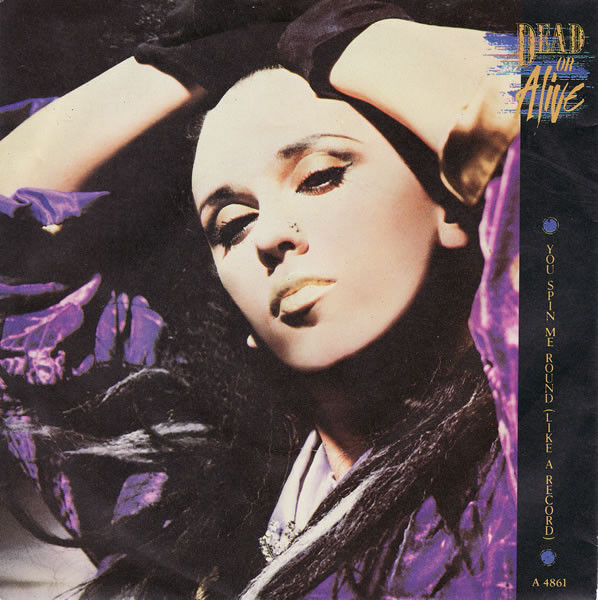
You Spin Me Round (Like a Record), by Dead or Alive (their 1st and only #1)

2 weeks, from 3rd – 17th March 1985

This is a record that starts in the middle. In medias res, if we’re being literary. There’s no build up, no intro of any description. Just a slap! around the chops, a sloppy kiss on the mouth, a nose-full of sweat and poppers… A clanging, throbbing synth beat, and a very distinctive voice.

If I… I get to know your name… Pete Burns sounds almost operatic, the way his voice at times soars, then intones, then growls. Just listen to the way he’s going for it in the fade-out. He sounds mildly terrifying. I-I-I… I get to be your friend now baby… If you did meet him in a club, you’d probably go out of your way not to give him your name. He sounds like he’d eat you alive. And I’ve always misheard the line before the chorus for something truly filthy. What I half-thought was ‘open up your loving hole cos baby here I come’ is actually ‘loving arms…’ (I’m quite disappointed…)

I’ve been quite down on the 1980s while writing this blog and, knowing some of the #1s on the way, I will continue being quite down on the 1980s. But this record is the ‘80s at their best. Yes it’s cheap and trashy, tacky and deep as a puddle… But it’s a perfect floor-filler. It’s also something of a line in the sand… We’ve just passed the midway point of the decade, and ‘You Spin Me Round’ is our first Stock Aitken Waterman produced chart-topper. The sound of the late-eighties, for better or for worse, starts here.

If you were being unkind you could brand Dead or Alive as a knock-off Frankie Goes to Hollywood. The similarities are there: Liverpudlians, brash dance-pop, the sheer gayness of both bands… But while Frankie’s chart-career was fairly short lived, I’m not sure Dead or Alive exist in the public’s consciousness at all beyond this hit. They were together for a long time, though, much longer than Frankie. They were genuinely huge in Japan (their look was a big influence on J-Pop acts of the 1990s). So huge that Michael Jackson apparently had to rearrange his tour dates in the country to fit around Dead or Alive concerts…

I’m also not sure if the general public realises that Dead or Alive were a band, rather than just Pete Burns (I must admit I was surprised to see three other members in the video…) Burns’ personality looms large. I grew up with the heavily ‘enhanced’ version often seen on reality TV and quiz shows in the ‘00s, but even before he found fame he was a force to be reckoned with, sending customers from the record shop he worked in if he disliked their choice of purchase. My favourite Pete Burns anecdote: upon hearing Culture Club’s comeback single ‘The War Song’, he sent Boy George a wreath with a note that simply read: ‘Condolences…’

A couple of years ago, The Guardian did a feature on the 100 Greatest #1 Singles and placed ‘You Spin Me Round (Like a Record)’ at number five, to a lot of derision in the comments section. While I wouldn’t quite have it as the fifth best chart-topper of all time, it is still a very fresh-sounding semi-classic. Though, to be honest, I think I’m just relieved that it’s not a ballad…

Advertisements

536. ‘Two Tribes’, by Frankie Goes to Hollywood

Slap bang in the middle of 1984 comes the year’s biggest hit, from the year’s biggest band.

Two Tribes, by Frankie Goes to Hollywood (their 2nd of three #1s)

9 weeks, from 10th June – 12th August 1984

Make that the decade’s biggest hit. No record will spend longer at #1 during the 1980s than this. Nine weeks, in which the best-selling song across the land was an ode to nuclear war. There are very few chart-toppers that have lines like: We’ve got the bomb, Yeah… Sock it to me biscuits now… But this is one. When two tribes go to war, A point is all that you can score…

On this, just their second release, Frankie (and producer Trevor Horn) were clearly sticking to the same formula as their first smash, ‘Relax’. Pounding, aggressive, disco-rock… check. A subject matter (and video) designed to raise eyebrows… check. Just the right mix of catchy and clever…?

Almost. The bass riff is thrilling, the splicing of Russian classical music with high-NRG dance is fun… But to my ears it’s all a bit of a mess, especially in the verses. It’s been a theme this year: hard-edged pop that’s bursting at the seams, constantly threatening to implode but just about keeping it together. ‘Relax’, ’99 Red Balloons’, ‘The Reflex’, now this… Maybe it was the impending threat of nuclear destruction (this is also already the 3rd chart-topper of the year to reference war and/or peace…), or maybe it was cocaine. But something was definitely in the air in 1984.

The video is another event in itself, with Ronald Reagan and Russian leader Konstantin Chernenko throwing one another around a sawdust ring. Chernenko only led the Soviet Union for a year or so – despite being nowhere near as famous as Stalin, Khrushchev, Gorbachev and co., he’s the one immortalised in this video… He grabs Reagan by the balls. Reagan bites his ear off. Holly Johnson drinks it all in as the ringside announcer. As the song reaches its final note, the planet explodes. If I had to choose, though, I think I’d spend my last moments on earth in the ‘Relax’ video, rather than this one.

I want to love this as much as I do ‘Relax’, but it falls short for me… I think it’s because ‘Relax’ is so simple, so gloriously filthy, and so universal. Songs about sex generally work. Songs about geopolitical tension can be hit or miss. Frankie try so hard to make it work – and it is still a banging, clanging, throbbing, pulsing wonder – but I think they overreach and, slightly, overcook it.

There were a million and one remixes of ‘Two Tribes’ – the ‘Annihilation Mix’, anyone? – but I like the classic single mix, with the air raid siren, and the public information announcer opening the song with: The air attack siren sounds like… By contrast, the album version is a little short, and missing the very Russian-sounding middle eight.

No doubt all those mixes helped this record to its giant stay at the top – the longest since 1977 – as well as similar promotion tactics to those that worked so well for ‘Relax’. But that’s not to suggest Frankie Goes to Hollywood weren’t genuinely massive in 1984. As ‘Two Tribes’ set up camp at #1 for the summer, their previous five-week chart-topper climbed back up to #2, making them only the fourth act to occupy both Top 2 positions after The Beatles, John Lennon and, um, John Travolta… They have one final number one coming up this year. And after two synth-rock thumpers, they’ll be changing tack, just in time for Christmas…

Advertisements

531. ‘Relax’, by Frankie Goes to Hollywood

Heresss Frankie! In a way, I dread coming across (filthy pun very much intended…) #1 records like this. Huge megalithic-hits that have had everything written about them, and then some. But we gotta cover them all, so…

Relax, by Frankie Goes to Hollywood (their 1st of three #1s)

5 weeks, from 22nd January – 26th February 1984

That’s not to say I dislike this record. Far from it: this is almost the perfect number one. It’s catchy, it’s memorable, it’s a real cultural moment… and it pissed off all the right people. In fact, that first bit – ‘Relax’s catchiness – is the one aspect of this song that possibly gets overlooked.

Let’s do the music first, then. An ominous intro floats in – I’ve always wondered what is being sung here (it’s M-i-ine, Give it to me one time now…) – before giving way to some grinding synths. I’ve been a bit down on synthesisers at times in this blog, but these are great. These are played like guitars, and could flatten a skyscraper. Apparently, singer Holly Johnson was the only band member to feature on the recording. Producer Trevor Horn – last heard on another synth-pop classic ‘Video Killed the Radio Star’ – took complete control of what was a jingly demo, and created a monster.

A monster that demands to be played loud. This is no shrinking violet of a song. It’s all out there, slapping you about the face… Which brings us on to the lyrics. Everyone knows what this one’s about… Relax, Don’t do it, When you wanna suck it to it… (there’s some debate about those lyrics, but the band have apparently confirmed them) When you wanna… Come! For reasons of public decency, I will be spelling it as ‘come’ throughout, when we all know it should be… Anyway. Question is, did anyone ever think ‘Relax’ was about anything else? The band half-heartedly claimed it was about ‘motivation’ when the song was first released, but by the time the album came out bassist Mark O’Toole confessed it “really was about shagging.”

And not just any old shagging. The video sees singer Holly Johnson entering a gay bar in his sensible work suit, and after three minutes of face-spitting, banana-licking, tiger-fighting, and cage-wrestling, he ends up straddling a writhing mass of bodies… and that’s just the edited version. Meanwhile, a Roman emperor unleashes a torrent of piss from the balcony (putting the ‘number one’ in number one single…) on the biggest Come! of the song, complete with a super-soaker sound effect. It’s gloriously tasteless, clearly designed to get a reaction. And get a reaction it did…

Two weeks before ‘Relax’ made top spot, the BBC had banned it from being played before 9pm. Radio 1 DJ Mike Read even pulled it off (the record, that is…!) live on air, in apparent disgust. For the five weeks that it was #1, ‘Top of the Pops’ showed nothing but a picture of the band. MTV followed suit. You can kind of see why – even today the video raises an eyebrow – but at the same time would this record have been as huge if they’d just played it without blinking? Maybe not.

But the band new what they were doing. Two of the members were out and proud, and the song’s promo played on this with gay abandon. One ad saw keyboardist Paul Rutherford dressed a sailor, alongside the phrase “All the nice boys love sea men.” The record sleeve, above, which Mike Read took such exception too, features a man and a woman in a little bit of leather and not much else. If you’re of a negative disposition, you could argue that all this represents the worst of the 1980s, a triumph of image and promotion over substance. But… pop music has never just been about the music. Even before Elvis wiggled those hips, pop and sex have been inextricably linked. ‘Relax’ was just the latest update on the theme. Sadly, as we know all to well, this didn’t herald a sea-change in British attitudes towards homosexuality. The AIDS crisis was just around the corner, and Section 28 would be in place by the end of the decade. Yet for the five weeks that this was #1, it must have felt like quite the moment.

It all ends in a cresecendo, and one final, bellowed Come! Then we all slink off to the bathroom to hose ourselves down… 1984 truly will be Frankie Goes to Hollywood’s year. Three chart-toppers with their first three releases (the first act to do this since fellow Liverpudlians Gerry & The Pacemakers), and fifteen weeks at number one. Two of the biggest-selling hits of all time. And their very own t-shirt. Is ‘Frankie Say…’ the most famous rock logo, aside perhaps from the Rolling Stones’ lips and tongue? Possibly. So, much more to come from Frankie, then, before long. Though it is worth saying that, of their three #1s, this is my favourite. Everything that was great and gaudy about the mid-1980s wrapped up in a four-minute mini masterpiece.

Advertisements

525. ‘Give It Up’, by KC & The Sunshine Band

Back when I was a student at university, I worked part-time in bowling alley. It was a great job, with great friends, and I had a great time… Why do I bring it up now though, at the start of this post? Because I hear the opening bars of our next #1, and am instantly transported back to AMF Bowling circa. 2005…

Give It Up, by KC & The Sunshine Band (their 1st and only #1)

3 weeks, from 7th-28th August 1983

The lights are dimmed, save for flashing neon and spinners – Saturday night means ‘Disco Bowl’ – and the DJ we get in especially for these occasions has just started playing ‘Give It Up’, as he does every single weekend. I am probably cleaning up a spill on Lane 12. Everybody wants you… Everybody wants your love…

It’s a fond memory, and I never grew to hate this song – no matter that I heard it every weekend for three solid years. How can anyone truly hate this song? It’s the very definition of a fun, throwaway hit. And yet… I don’t love it, and that’s not simply down to overplaying. There’s something about it that’s always sounded a little forced, a little soulless. It’s a catchy song, but the nanananananas and the funky synths feel pre-programmed, almost cynical, while the singer – KC himself – doesn’t really sound like he’s enjoying himself.

There are probably prejudices at work here… I think ‘Give It Up’ lacks some of the funky rawness of the Sunshine Band’s big seventies hits: ‘That’s the Way (I Like It)’, ‘Shake Your Booty’ and the like. And yes, despite promising to try not mentioning 1980’s production values in my last post… I think that the 1980’s production is the problem here. That glossy, electronic sheen. Or maybe all those years of hearing it like clockwork have at least dulled my senses, and my ability to analyse this record, even if they haven’t made me actively dislike it.

This was a bit of a comeback for KC & The Sunshine Band, who had had plenty of huge disco smashes in the ’70s (including five US #1s), but who had struggled in the new-wave, ‘disco sucks’ years. Credit to them then, for regrouping, adopting the sounds of the time, and getting one final hit, their biggest by far in Britain. The band were led by Harry Wayne Casey (‘KC’, gettit?) and a revolving cast of musicians who made up The Sunshine Band, and when I say one final hit I mean it: they never went higher than #59 after this swansong… They’ve been around though, in one form or another, since re-forming in the early 1990s.

Maybe I’m being a bit harsh on this one. I have had it forced on me an incredible number of times and still don’t hate it… That must mean there’s something great in there, right? And isn’t memory a strange thing? Certain sounds instantly transporting you somewhere… The clatter of bowling pins, the sound of a drink being spilled over on Lane 12, the opening bars of ‘Give It Up’ by KC & The Sunshine Band…

Advertisements

519. ‘Let’s Dance’, by David Bowie

Ah…. Ah…. Ah…. Ah….! Bowie’s back. His 4th number one might not be his very best – it would take something to outdo ‘Space Oddity’ – but it’s definitely his biggest, brightest, catchiest moment on top of the pop charts.

Let’s Dance, by David Bowie (his 4th of five #1s)

3 weeks, 3rd – 24th April 1983

I love the mix of sixties pop – the intro ripped from ‘Twist and Shout’, the background harmonising, and the woozy horns – with hard-edged eighties funk. Let’s dance! the Duke commands… Put on your red shoes and dance the blues… And you are powerless to resist. Like ‘Billie Jean’, when a DJ launches this one down your local disco then they know what they are doing.

But as with ‘Billie Jean’, this record isn’t just a simple dance number. It’s David Bowie, and there’s an edge to it, a hidden strain of weirdness. Not so much in the lyrics, more in the way he delivers them. The yelped: Tremble like a flow-er! for example, stands out, as does the Under the moonlight, The serious moonlight! There’s a gravel in Bowie’s voice here, a soulful edge that wasn’t present in any of this three earlier #1s. He sounds like he’s enjoying belting this out, reborn after the lost years of the late-seventies, but there’s also an edge to his voice you don’t often get in dance music.

There’s also some weirdness in the video, which features two Aboriginal Australians trying on the red shoes in the song, and being transported to a capitalist wonderland of jewellery shops and posh restaurants. In the end they smash the shoes, and dance their way back into the outback. I’m not sure the song needs such a statement video, and it perhaps stems from Bowie’s discomfort at releasing such a commercial record.

I fully admit to sometimes not getting David Bowie. I love his glam hits, and two of his three previous chart-toppers, ‘Space Oddity’ and ‘Under Pressure’. (‘Ashes to Ashes’ was less of a smash with me.) But I get this one. What’s not to get? If anything, I’m properly realising just how great ‘Let’s Dance’ is, in all its funky glory. The funk here is brought by the song’s producer, Nile Rodgers. His influence is all over it, and not just in the fact he plays guitar on the recording. (The solo at the end, meanwhile, is performed by Stevie Ray Vaughan.) Bowie had written it as folk number, until Rodgers came along.

As great as it is, the success of ‘Let’s Dance’ sent David Bowie off course for the rest of the decade. He confessed that the MTV success of this single and the subsequent album, and the newer, younger fans that it brought him, left him unsure of his direction. But let’s not worry about that for now. In this moment, we can celebrate what is perhaps his ultimate singles chart moment, a good fifteen years into his career as a chart star.

That’s an interesting point. We’re right in the middle of a run of era-defining singles, that are launching the 1980s as we know it. But only really Duran Duran could be described as an ‘eighties’ act, and even they were several years into their career. Bowie, Michael Jackson and Bonnie Tyler were all seventies, if not sixties, veterans. But it is they who are at the forefront of this bright new era.

Advertisements