Daniel Bedingfield’s debut hit, ‘Gotta Get Thru This’, was a breath of fresh air: a fun moment that balanced garage and dance nicely, in a way that summed up the sound of the early ‘00s.
If You’re Not the One, by Daniel Bedingfield (his 2nd of three #1s)
1 week, 1st – 8th December 2002
It was also a bit of a false dawn, because I think gloop like this is what Daniel Bedingfield is better remembered for these days, if he’s remembered for anything at all. Syrupy, heartfelt ballads. And syrupy, heartfelt ballads are not my thing. But I will try to see the best in this record, which I remember being fairly inescapable for a good few months.
That word: heartfelt. This definitely is, and Bedingfield’s commitment to the soppy sentiments makes it bearable. Even the falsetto note he hits at the end of each chorus. Then there’s the doubt, the fact that this song is about being with someone but worrying they might not stay. I hope I love you all my life… is probably the most powerful line. Plus, there’s something about the relatively low-key production, the heartbeat drums and echoing synths, that reminds me of Phil Collins’ ‘In the Air Tonight’
I’m actually surprised that I’m enjoying listening to this song, as I hated it at the time. Not only was it soppy, but it was everywhere. I remember it climbed back into the Top 10 for Valentine’s Day, a good two and a half months after it was released, something that didn’t happen often in the charts of the early ‘00s.
Daniel himself, though, went on record saying that he found the song too cheesy, and didn’t want it included on his debut album. He had, he said, deliberately set out to write a Westlife-ish song. And I’d say he failed, because this is quite subtly heartfelt, lacking the bombastic cheese of most Westlife tunes, and because there’s no key change. As far as I can tell all the interviews in which he said these things came from 2003 onwards, and I’d also say it’s easy to claim you don’t like a song once it’s been at #1 and made you lots of money.
I’m also sceptical of Bedingfield’s claims because his not far-off final chart-topper is an equally simpering ballad. If you don’t like these songs, why do you keep writing, recording and releasing them then, Daniel?
Today, September 18th, marks fifty-five years since the death of perhaps the greatest rock guitarist of all time, Jimi Hendrix.
Hendrix’s death in 1970, due to an overdose of barbituates, granted him marquee status in the 27 Club, and also brought about his one and only UK chart-topper. ‘Voodoo Chile’, a previously unreleased track, was released in the wake of his death and spent a week at #1, becoming one of the hardest rocking tracks ever to do so.
It’s fitting that he did manage a posthumous moment on top of the British charts, because he had been consistently more successful in the UK than in his homeland. In fact, Hendrix had moved to London in 1966, after spells in the US Army and then as a backing guitarist for the Isley Brothers and Little Richard. In London he and his manager, Chas Chandler of the Animals, put together a band: The Jimi Hendrix Experience, with Noel Redding on bass and Mitch Mitchell on drums. Their first single was a cover of ‘Hey Joe’, making #6 in early 1967.
The origins of ‘Hey Joe’ are disputed, but despite the first released version being by The Leaves just two years earlier, it had fast become a garage-rock classic, with versions by the Surfaris, the Byrds, and Love before Hendrix’s definitive take. Compare its thick chords and raw production with the poppier acts of the day. It must have sounded wild, with its tale of a man on his way to shoot his unfaithful lover. The follow-up single, ‘Purple Haze’, then gave Hendrix the biggest hit of his lifetime.
It made #3 in May of 1967. Sitting above it in the chart were ‘Puppet on a String’ and ‘Somethin’ Stupid’, both classics of the time, but both blown out of the water by the bloodthirsty energy of this record. Anything released in 1967 with ‘haze’ in the title was going to encourage rumours concerning it being about drugs. Hendrix, though, describes it as a love song. The intro in particular is razor sharp, and jarring. Apparently a dissonant interval such as this is known as diabolus en musica i.e. “Devil in music”. Which is pretty much the most aptly rock ‘n’ roll description going.
Hot on ‘Purple Haze’s heels came The Jimi Hendrix Experience’s third Top 10 in less than six months. Jazzy ballad ‘The Wind Cries Mary’ was recorded in twenty minutes, and was allegedly inspired after an argument with Hendrix’s girlfriend Kathy ‘Mary’ Etchingham over lumpy mashed potatoes. Such an innucuous start for a lyrically dense love song, proof that he was more than just a virtuoso guitar player.
The final Top 10 hit of Hendrix’s short life came a year later, with a cover of Bob Dylan’s ‘All Along the Watchtower’. Despite it being the song most performed by Dylan in concert, it remains synonymous with Hendrix. Here he is performing it at the Isle of Wight Festival in 1970, just weeks before his death.
Rolling Stone Brian Jones, another rock star not long for this world, contributed to the percussion on this track, including the rattles in the intro played on the brilliantly named ‘vibraslap’. Ever since this cover was released, Dylan has peformed it in the style of a tribute to Hendrix.
‘All Along the Watchtower’ was lead single from the Experience’s third album in fourteen months, ‘Electric Ladyland’. In his recording career of barely four years, Hendrix released a total of three studio albums, a live album, and a greatest hits. The final single to chart in his lifetime was not a huge hit (#37), but is my personal favourite: ‘Crosstown Traffic’.
It’s bluesy, it’s psychedelic, it’s headbanging… and yet it’s got a brilliant pop hook. And despite being the greatest guitarist of his age, Hendrix wasn’t ashamed to go back to basics with a paper and comb to make that distinctive riff. That feels like it sums him up: supremely talented, precocious, lyrically mystical, but with an ear for a simple sledgehammer riff and a Top 40 hook. Who knows where the 1970s would have taken Hendrix, had he been around to enjoy them…
Jimi Hendrix, 27th November 1942 – 18th September 1970
Two posts ago, as we endured B*Witched’s ‘C’est la Vie’, I hinted at an impending tween-pop takeover. Well, don’t say I didn’t warn you…
Because We Want To, by Billie (her 1st of three #1s)
1 week, from 5th – 12th July 1998
Was ‘tweenager’ a word back in 1998? Apparently yes – it was first used in 1949. So we can use it freely to describe this next #1. ‘Because We Want To’, by fifteen-year-old Billie Piper, is perhaps the ultimate tween-pop record: vital to anyone aged eight to twelve when it came out; anathema to anyone even slightly older.
Why you gotta play that song so loud? Because we want to… Why you always run around in crowds? Because we want to… This ode to tweenage rebellion is simplistic, dumb, and annoyingly catchy. The lyrics feel so forced that the modern Gen Alpha cyborgs that pass for children these days would laugh in its face. But the late ‘90s were a simpler time, and clearly this struck a chord with the youth of the day. (I was twelve, and I found it irritating and irrelevant, so I assume most of the 80,000 copies that sent it straight to number one were bought by kids significantly younger than me…)
As much as I don’t like this record, I will make one important distinction: it’s better than ‘C’est la Vie’. But the production is cheap and dated – opening with the quacking duck synths last heard on Whigfield’s ‘Saturday Night’ – and it thumps its way into your brain with its silly, chanty chorus. The middle-eight is the best bit of the song, and owes a debt to the Spice Girls: a mix of Mel B’s rap from ‘Wannabe’ and the chorus of ‘Who Do You Think You Are’.
And right there is the problem. The Spice Girls had been so successful in grabbing the attention – and the pocket money – of children across the world that we’re starting to see a whole range of lesser copycats spring up. First B*Witched, now Billie… Just be glad that Vanilla’s ‘No Way, No Way’ fell short. (Although, let’s be honest, that would have made an iconic number one…)
As with B*Witched, this breakthrough hit set Billie up for a short of burst of chart-topping glory, and she’ll return to these pages soon enough. ‘Because We Want To’ made her the second-youngest female to top the charts, and the youngest since Helen Shapiro in 1961. A lot was made at the time of Billie being the youngest artist ever to ‘enter the charts at #1’, but that seems like an pointless distinction when almost every record was entering the charts at #1 in 1998. Still, it’s an impressive achievement, surpassing anything I was doing aged fifteen (most of which wouldn’t be fit to publish in such polite company…)
You’re listening to Smooth FM, The smoothest hits, All day long… No, come come. That’s not fair. Just because this next #1 is an easy-listening classic, it doesn’t mean it’s not great.
I’m Not In Love, by 10cc (their 2nd of three #1s)
2 weeks, from 22nd June – 6th July 1975
Before we get into the nitty-gritty of the song itself, the first thing of note is just how far this is from 10cc’s first chart-topper, the rollicking ‘Rubber Bullets’. They were a band that kept things interesting. That record was keeping it pretty glam; ‘I’m Not In Love’ is giving us lush, mid-seventies soft-rock.
And I mean lush. There are layers upon layers, vocals and synths that melt together, that ebb and flow. At one point, in between the verses, we are in full ‘Sounds of the Rainforest’ mode, and you can imagine yourself face down on a massage table, covered in lavender oil. I knew that a lot of production went into this disc – that’s pretty well known – but the actual facts and figures are amazing. It took three weeks of Eric Stewart recording the other band members going ‘ahhh-ahhh’, until he had forty-eight tracks to lay on top of one another.
It’s a wall of sound, though not of the Phil Spector variety, that makes this record utterly distinctive. You can literally hear the amount of work that went into it, but it hangs together in a very nonchalant way. Helping with this a great deal are the lyrics: I’m not in love… The singer tries to convince himself… It’s just a silly phase I’m going through… He then tries to shrug off the things that might make him seem like he’s actually in love. If he calls: Don’t make a fuss… Don’t tell your friends about the two of us…. He might have her picture on the wall: It hides a nasty stain, That’s lying there…
Let’s be honest, he sounds a bit of a dick. Oooh, you’ll wait a long time for me… (Let’s hope she didn’t.) And then, in the middle, there’s a whispered: Be quiet, Big boys don’t cry… that I take to be the voice of a mother figure from the past, explaining the difficulty the singer has in admitting he’s in love. It was recorded by the studio’s receptionist, who had been chatting while the band recorded. They loved her voice, and she all of a sudden found herself front and centre on a worldwide hit single!
I think the reason that this song works is that underneath all the dressing it’s a perfectly simple pop song. It would work just as well in a higher tempo (see the Fun Lovin’ Criminals swinging version, for example). Plus it’s got a hook that everyone remembers. I’m not in love… No, no… While most other pop songs, especially those in the same soft-rock ballpark, are about being very much in love.
It is, if I had to nit-pick, a bit too long. With a runtime of 6:04 it is the second longest #1 single yet – still way behind ‘Hey Jude’ – and towards the end it begins to drag. (In the US it was edited down to under four minutes.) But hey, Stewart had forty-eight vocal tracks and dammit he was going to use them all! In the final thirty seconds it builds to a slightly terrifying crescendo, then tinkles a dreamy close.
So there it is: Pt II of 10cc’s chart-topping trio, straddling the mid-seventies. Completely different from their first, and from their last. By the time that one comes along, the band will have split in two and be nearing the end of their chart careers. But that’s for the future. With this #1, 10cc were at the peak of their powers. Enjoy.
I’ll be trying out a new feature this week – drumroll please – Random Runners-up! Yes, a moment in the sun for the singles that didn’t quite make it to the top. These aren’t particularly long-running, or unlucky #2 singles. They may not even be particularly good… They all simply peaked in the runners-up position.
I used random.org (the website you never knew you’d need) to generate five random dates from between the start of the UK singles chart in November 1952, through to our most recent chart-topper in September 1973. I then checked what record was sitting at #2 that week and, as long as it wasn’t a record that had been at, or was heading to, the top of the charts, I chose it.
First up…
‘Gimme Some Loving’, by The Spencer Davis Group
#2 for 1 week, behind ‘Good Vibrations‘, from 24th Nov. – 1st Dec. 1966
Hey! Not a bad way to kick things off! Listen to that organ blast out like a train that’s just spotted the bridge up ahead has collapsed. Hey! The Spencer Davis’s had had two #1s in 1966 – ‘Keep On Running‘ and ‘Somebody Help Me‘ – but for my money this is the best of the three. Hey!
Well, my temperature’s rising’, Got my feet on the floor… Crazy people knocking cos they want some more… Steve Winwood’s having a party, and everybody wants in. This is a song that hums, throbs, positively trembles with energy. It’s a song for Friday night, for casting off the cares of the week and shaking your ass.
I would have bet good, good money on this being a Motown cover… But no. It was written by the boys in the band – Steve, his brother Muff, and, of course, Spencer Davis. Which makes ‘Gimme Some Loving’ surely one of – if not the – finest example of sixties blue-eyed soul around. (Dusty excepted… Obvs.) It would go on to have a second-wind following its inclusion in The Blues Brothers movie some fifteen years later.
I won’t write as much about these songs as A) I don’t have time and B) they weren’t #1s. Still, this song doesn’t need much analysing. Just get up and start shaking something. It should have been a chart-topper, surely it should, but when the record that holds you off the top is ‘Good Vibrations’ then you probably have to say ‘fair enough’.
Growing up, the two things that I knew about Cilla Black was that she presented ‘Blind Date’ on a Saturday night (a program I wasn’t allowed to watch as a child, due to my mother’s long-held distrust of ITV) and that her real name was Cilla White.
As I got older, and all teenage, it would have been harder to think of anyone less cool than Cilla Black. She hung out with Cliff Richard, campaigned for the Tories, and had her hair set in a perfect early-nineties bouffant. Years ago I stumbled across a forum in which BA cabin crew posted horror stories about serving Ms. Black (always ‘Ms. Black’), how she would only sit in seat 1A, only drank a particular champagne, and would make her demands known only through her PA… (although, are you even a real celebrity if cabin crew don’t have a few bad things to say about you…?)
The one thing I didn’t know Cilla Black for, really, was the thing that started her off on her career of matchmaking and terrorising cabin crew: her singing.
While her hit-making career didn’t last too long, the two chart-toppers she had in 1964 are both excellent ballads interpreted very well, by a very young woman. The first – ‘Anyone Who Had a Heart’ – a Bacharach & David number that stands as the highest-selling single of the 1960s by a British woman.
I love the way, in that performance, how she starts off simply, quite unspectacularly, before dropping an octave and letting loose. Then a few months later came ‘You’re My World’, an Italian melody with English lyrics. Both these hits stood out, when I wrote about them for this blog, because they stood out so much from Cilla’s contemporaries, the Merseybeat bands, and in particular her Cavern Club mates, The Beatles (who are in the audience for the performance below).
She would continue to have hits as the sixties went on, though no further number ones. I can’t claim to be the biggest expert on the later musical career of Cilla Black (and I will happily take recommendations from those who know better), but if I can choose one more video to embed, it would be her final UK Top 10, a #3 from 1971: ‘Something Tells Me (Something’s Gonna Happen Tonight)’.
Following this the hits dried up, although she kept on recording music even after reinventing herself as the 1980s/1990s go to woman for Saturday night ‘trash’ TV. (My mother’s words, not mine…) On this, the fifth anniversary of her death then, it is worth remembering that Cilla Black was, first and foremost, a lady who could hold a tune, and whose musical achievements have been slightly overshadowed by what came next.
Usually one of our recaps is summed up by the ‘sound’ of the previous thirty chart-toppers. This recap, though, really doesn’t have an all-encompassing sound. We’ve been pinging around all over the place for the past couple of years. What sums up this thirty is the world outside the charts – the end of the sixties, the death of the hippy dream, Vietnam and Nixon, the Beatles’ split… All of which has fed into what we’ve been hearing at #1.
Perhaps this is best summed up by the three number ones during the summer of ’69. Two years previous it had been ‘All You Need is Love’, and ‘San Francisco’; now we got the final call towards a hippy utopia (‘Something in the Air’) before being dragged back down to earth by Zager & Evans’ terrifying visions of the year 2525. And in between those two we had The Rolling Stones doing what the The Rolling Stones do best, some low-down sleazy rock ‘n’ roll, consoling us with the knowledge that the world might be going to shit but we still have the Stones. (Hell, that still applies in 2020.)
Actually, ‘Honky Tonk Women’ was their final #1 – we had to bid them farewell. As we did The Beatles, who bowed out with ‘The Ballad of John and Yoko’. It feels strange to think that this recap still includes The Fab Four, such is the distance we’ve travelled since then. In fact, this recap also includes the first solo chart-topper by a Beatle: George Harrison’s ‘My Sweet Lord’. Plus, we had an Elvis record at #1 again! And with the soaringly cheesy ‘The Wonder of You’ he became the first act to score chart-toppers in three different decades.
There have been plenty of outliers too, to keep things interesting. Which means awarding the latest WTAF Award will be a decision to ponder. There was alleged live, recorded sex (!) from Jane Birkin & Serge Gainsbourg, Rolf Harris riding the war-theme with ‘Two Little Boys’, a letter ‘Back Home’ from the England World Cup Squad, and Clive Dunn sitting all alone in his rocking chair, thinking… Plus the aforementioned Lee Marvin (with Clint Eastwood on the ‘B’-side!), Zager & Evans, and the bizarre-but-brilliant ‘Double Barrel’. But, for the terrifying imagery and the genuine feeling of impending doom… I’m awarding it to ‘In the Year 2525 (Exordium and Terminus)’.
It’s much harder to name a ‘Meh’ Award winner, for the record that struggled to make much of an impact because, to be honest, most of the past thirty songs have made an impression, for better or worse… I could give it to our most recent #1, Dawn’s ultra-cheesy ‘Knock Three Times’ but, I can’t lie: I was humming that in the kitchen this morning… No. One record stands out for me not being able to really remember it: Matthews’ Southern Comfort, with their cover of ‘Woodstock’. Pleasant, but completely unmemorable.
Although, ‘Woodstock’ does tie into what I was saying at the start about the charts beginning to reflect the wider world. That last Beatles’ #1 literally documented the end of the Beatles (it was quite meta, if you think about it), while I count two #1s about the end of the world, two about war, two related to Woodstock, one to the World Cup, two with fairly overtly religious themes, and one in which an old man contemplated his own mortality (see, even the novelties were thought-provoking this time out…)
However, in the early months of 1971, a new ‘sound’ finally emerged, one of the seventies own making. ‘Spirit in the Sky’ had hints of it, as did ‘I Hear You Knocking’. But with Mungo Jerry’s outrageous ‘Baby Jump’ and then T. Rex’s ‘Hot Love’ hitting the top – Glam Rock has arrived! It’ll dominate the next thirty number ones, and I can’t wait…
UNSPECIFIED – JANUARY 01: (AUSTRALIA OUT) Photo of Norman GREENBAUM; Posed portrait of Norman Greenbaum with acoustic guitar (Photo by GAB Archive/Redferns)
To the big two awards, then. What was the worst chart-topper of the past couple of years? I could do the big build-up, teasing a few sub-standard number-ones before WHAM! announcing a left-field winner. But, to be honest, this time it wasn’t much of a contest. Dana, my dear, step forward and accept your award for ‘All Kinds of Everything’. A toe-curlingly bad song about seagulls and lollipops and lots of other stuff I don’t care to remember. It’s our latest Very Worst Chart-Topper.
And the best? Thankfully, there’s a whole load of competition this time. One song that I have to get out the way first is ‘Band of Gold’… I had no idea how highly-regarded that song is. It’s on all kinds of ‘Best Songs Ever’ lists. I mean, it’s a great Motown-sounding song, but it’s not going to be my Very Best Chart-Topper. There’s also T. Rex’s ‘Hot Love’. I love T. Rex, but I can’t do any more than really, really like ‘Hot Love’, and would be awarding it for reasons beyond the song. Plus, they’ve got three more #1s to come so there’s every chance that they’ll be winners in my next recap.
I’ve got it down to three. And I’m smiling as I write this, like King Joffrey at a beheading, because I know deep down what I’m about to do. In the blue corner, Simon and Garfunkel’s ‘Bridge Over Troubled Water’. In the red corner, the Jimi Hendrix Experience with ‘Voodoo Chile’. And in the green corner (this is a triangular wrestling ring)… ‘Baby Jump’, by Mungo Jerry. Simon and Garfunkel are there because I feel obliged to have them. They are the dweeby kids my mum has forced me to invite to my birthday party. ‘Bridge Over Troubled Water’ is an amazing, epic piece of music… But I just can’t love it like I should. It’s out.
‘Voodoo Chile’, in terms of sound, is one of the most forward facing, exciting, swaggering records to have ever topped the UK singles chart. It is a better song than ‘Baby Jump’, I am under no illusion (as is ‘Bridge…’) BUT. ‘Voodoo Chile’ was a song from 1968, re-released because Hendrix had died. I’m eternally grateful that it did get a week at #1, but it did so in the wrong decade, under special circumstances… Which means, in all its belligerent, crunching, leering, drunken beauty, Mungo Jerry’s house party from hell ‘Baby Jump’ is the winner! Hurrah!
(Hey, I spent the entire last decade very sensibly naming all the classics, your ‘Satisfactions’ and your ‘Whiter Shades of Pales’, as my Very Best Chart-Toppers. Allow me a moment of indulgence!)
To recap the recaps:
The ‘Meh’ Award for Forgettability:
‘Hold My Hand’, by Don Cornell.
‘It’s Almost Tomorrow’, by The Dream Weavers.
‘On the Street Where You Live’, by Vic Damone.
‘Why’, by Anthony Newley.
‘The Next Time’ / ‘Bachelor Boy’, by Cliff Richard & The Shadows.
‘Juliet’, by The Four Pennies.
‘The Carnival Is Over’, by The Seekers.
‘Silence Is Golden’, by The Tremeloes.
‘I Pretend’, by Des O’Connor.
‘Woodstock’, by Matthews’ Southern Comfort
The ‘WTAF’ Award for Being Interesting if Nothing Else:
‘I See the Moon’, by The Stargazers.
‘Lay Down Your Arms’, by Anne Shelton.
‘Hoots Mon’, by Lord Rockingham’s XI.
‘You’re Driving Me Crazy’, by The Temperance Seven.
‘Nut Rocker’, by B. Bumble & The Stingers.
‘You’ll Never Walk Alone’, by Gerry & The Pacemakers.
‘Little Red Rooster’, by The Rolling Stones.
‘Puppet on a String’, by Sandie Shaw.
‘Fire’, by The Crazy World of Arthur Brown.
‘In the Year 2525 (Exordium and Terminus)’, by Zager & Evans.
The Very Worst Chart-Toppers:
‘Cara Mia’, by David Whitfield with Mantovani & His Orchestra.
‘The Man From Laramie’, by Jimmy Young.
‘Roulette’, by Russ Conway.
‘Wooden Heart’, by Elvis Presley.
‘Lovesick Blues’, by Frank Ifield.
‘Diane’, by The Bachelors.
‘The Minute You’re Gone’, by Cliff Richard.
‘Release Me’, by Engelbert Humperdinck.
‘Lily the Pink’, by The Scaffold.
‘All Kinds of Everything’, by Dana.
The Very Best Chart-Toppers:
‘Such a Night’, by Johnnie Ray.
‘Cherry Pink and Apple Blossom White’, by Perez ‘Prez’ Prado & His Orchestra.
‘Great Balls of Fire’, by Jerry Lee Lewis.
‘Cathy’s Clown’, by The Everly Brothers.
‘Telstar’, by The Tornadoes.
‘She Loves You’ by The Beatles.
‘(I Can’t Get No) Satisfaction’, by The Rolling Stones.
‘A Whiter Shade of Pale’, by Procol Harum.
‘I Heard It Through the Grapevine’, by Marvin Gaye.
We last recapped in late 1964, and the past thirty #1s have brought us right through 1965 and out the other side. The very middle of the mid-sixties. And, to be honest, we’ve been spoiled.
For example. This was a genuine, consecutive run of chart-topping singles, from the summer of ’65: ‘Mr. Tambourine Man’, by The Byrds… followed by The Beatles, with ‘Help!’… then ‘I Got You Babe’… and finally ‘(I Can’t Get No) Satisfaction’, by The Rolling Stones. No filler in between. Those singles, over the course of just nine weeks, were the top selling songs in Britain. Timeless hit after timeless hit. Songs that are still ubiquitous to this day, some fifty-five years later. Amazing.
This is why it’s good to pause, momentarily, and look back. Otherwise I’d start taking for granted the huge musical moments that are becoming almost commonplace. Dotted around elsewhere in the past year or so we’ve had non-consecutive gems too: our first Motown #1 from The Supremes, a karaoke classic from Tom Jones, the distilled essence of The Swinging Sixties TM from Nancy Sinatra and a contender for best pop song ever from The Righteous Brothers. It’s like the best all-you-can-eat buffets – you never have enough room to appreciate every morsel.
The sound of these number ones has also been moving forward at lightning speed. We’ve seen the Beat sound disintegrate into straight-up blues, folk, baroque pop, and garage rock. Glance back two years, to early 1964, and things were much more homogenous. Merseybeat followed by Merseybeat followed by – hey – more Merseybeat. And most of those discs were great. But variety is the spice of life. I’m really loathe to be one of those ‘things were much better back in the day’ types… but… compare pop music from 2019 with that of 2017 – or even 2007 – and would you see that much of a difference? Of course, everything here was new, just waiting to be discovered and experimented with. Dirges and harpsichords on hit singles? Why not!
Even the outliers, the singles that deviated from the irresistible forward thrust, had the good sense to be eclectic. Elvis returned and took us to church, Georgie Fame gave us some Latin soul, Roger Miller represented the country side of things while, in Unit 4 + 2, we had genuine one-hit wonders. We’ve also heard several more female voices than we have in past recaps: Sandie, Jackie, Nancy, Diana Ross and the gang, and a lady called Cher.
All of which means I’m struggling to dish out the more negative awards – the ‘Meh’ Award and my equivalent of a Razzie: The Very Worst Chart-Topper. But let’s not kid ourselves. I’ve not enjoyed every single song going. I struggled to get the appeal of The Seekers after hearing their bland chart-topping double. Meanwhile, Cliff returned as boring as ever… Plus there’s my unresolved childhood history with The Moody Blues, which means I want to award one to ‘Go Now!’, even though I love that one song. ‘Where Are You Now (My Love)’ was OK, though I’m struggling to really remember it, while The Overlanders’ cover of ‘Michelle’didn’t really need to exist. And then there was Ken Dodd’s ‘Tears’ – the 3rd biggest selling single of the decade. Yes, you read that correctly. But that would be like kicking a puppy, naming that as the worst record…
Ken Dodd with his golden disc for 100, 000 copies of his record sold “Tears” presented to him in his dressing room at the London Palladium.
I’ve got it. The ‘Meh’ Award goes to ‘The Carnival Is Over’, by The Seekers. A funeral dirge, plain and simple, with some cheek for having the word ‘Carnival’ in the title. I still can’t believe it sold over a million. And the very worst of the past bunch goes to Country Cliff, for the soporific ‘The Minute You’re Gone’. Compared to some of the past ‘worst #1s’ it’s fairly inoffensive. Russ Conway, David Whitfield and Elvis in Lederhosen were much worse crimes against music. It’s just that, while everybody was twisting, Cliff was sticking, even going backwards.
Before we choose the ‘good’ awards, we should mention that over the past thirty #1s, one of the greatest ‘rivalries’ in pop music has really taken off. After the last recap, everybody was trailing in The Beatles’ wake. But… The Stones have arrived. Both bands have scored four chart-toppers in this segment. In a recent post I claimed that, for the moment, The Stones were ahead of The Fabs, just. Those of you who took the bait disagreed… But I’m sticking with it. Yes, ‘I Feel Fine’, ‘Ticket to Ride’, ‘Help!’ and ‘Day Tripper’ / ‘We Can Work It Out’ are superb records. No debate. Imperious. But look at The Stones’ four: ‘Little Red Rooster’ (authentic, full-on Blues), ‘The Last Time’ (the weakest, for sure, but still a great, swaggering rock song), ‘Satisfaction’ and then ‘Get Off Of My Cloud’ (those riffs, along with a tonne of angst and venom, and general dissatisfaction with the world around them – It’s punk, metal, emo… It’s the future!) On that note, I’m going to give the ‘WTAF’ Award, the award for our more ‘out there’ #1s, to ‘Little Red Rooster’, because that’s a slice of pure Chicago blues that had no business getting to the top of the British singles charts – though I’m so glad it did.
Which just leaves the crème de la crème. As always, I’ve got it down to four. ‘You’ve Lost That Lovin’ Feelin’’, ‘Help!’, ‘Satisfaction’, and our most recent #1: ‘These Boots Are Made for Walkin’’. And I’m going to instantly eliminate The Beatles and Nancy Sinatra for being great, but just not great enough. So… Perhaps the toughest decision I’ve ever had to make. The Righteous Brothers, or The Rolling Stones. I’m listening to both songs one more time as I mull…. God, why don’t I just call a tie…? No, that sets a dangerous precedent for me (in this completely unnecessary and self-imposed situation)… Ga! I love rock music, at heart. Rock ‘n’ roll always wins. As great as ‘…Lovin’ Feelin’’ is, it ain’t rock. ‘Satisfaction’ takes it.
The Very Worst Chart-Toppers: 1. ‘Cara Mia’, by David Whitfield with Mantovani & His Orchestra. 2. ‘The Man From Laramie’, by Jimmy Young. 3. ‘Roulette’, by Russ Conway. 4. ‘Wooden Heart’, by Elvis Presley. 5. ‘Lovesick Blues’, by Frank Ifield. 6. ‘Diane’, by The Bachelors. 7. ‘The Minute You’re Gone’, by Cliff Richard.
Phew. We’ll pause for a bit, before hitting the next thirty. Thirty discs that’ll take us through the ‘Summer of Love’ and beyond. Next up, I’m going to spend a week looking at some of the people behind the #1s… Coming soon, to a blog feed near you…
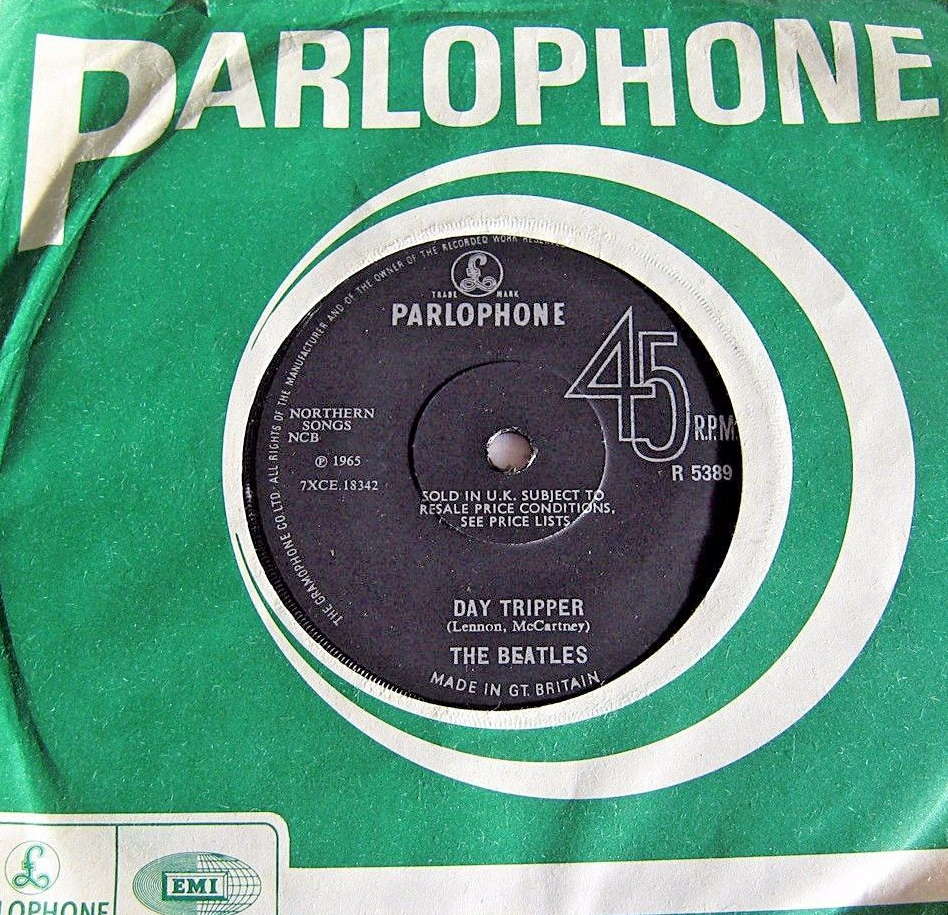
The Fab Four claim their third straight Christmas number one (before Christmas number ones were a thing, but still), and they do so with their most straight-up rock record yet.
Day Tripper / We Can Work It Out, by The Beatles (their 9th of seventeen #1s)
5 weeks, from 16th December 1965 – 20th January 1966
There’s a riff – a riff we all know – dun-duh-duh-duh-duh-dun-dada-da-dada – (riffs never really work when written out…) which keeps on going till the end. It’s a riff record – maybe, just maybe, they’d been listening to The Stones –a great, straight-up rock song.
I like the way the intro builds: guitar, then bass, then drums, and the way that the solo is basically the riff, beefed-up. It’s a simple song – there’s no reinventing the wheel here. I guess it’s experimental, in the sense that they’re experimenting with a heavier sound, but that’s stretching it a bit. It’s a John Lennon number, and one of the things I like most about him is that he never lost his rock ‘n’ roll roots, never stopped being a fan of Chuck and Buddy, no matter how avant-garde he and his bandmates seemed to get.
Of course, like any great rock song, there’s a fair amount of raunch here too. She’s a big teaser, She took me half the way there now… Not much imagination needed. Especially after Lennon admitted that he would have made it ‘prick teaser’, had he been allowed. Tried to please her, She only played one night stands… So on and so forth. Another layer of innuendo comes when you consider the ‘trip’ aspect of the lyrics. A ‘day tripper’ would be someone who only drops acids on special occasions. A weekend hippy, a ‘Sunday driver’.
Whether it’s about drugs or sex, or both, doesn’t really matter, though. This is a cracking rock number – one that I’ve enjoyed reacquainting myself with for this post. It’s one of those Beatles songs that kind of gets lost among the mega-hits. But, actually, listen to the soooooo long growl, and the way that the solo ascends to a climax with a hint of ‘Twist and Shout’, and try telling me that this isn’t one of their best. And, come to think of it, I can think of two other songs off the top of my head in which the ‘Day Tripper’ riff makes an appearance: ‘Hair of the Dog’, which gleefully rips it off to the extent that when Guns N’ Roses covered it they gave up the pretence and by the end were just playing the Beatles’ riff, and The Wildhearts’ ‘My Baby Is a Headfuck’. So maybe I’m underestimating it…
What of the flip-side? We’ve not had a double-‘A’ side #1 for a while (nearly three years to be precise) and ‘We Can Work It Out’ is the perfect companion for ‘Day Tripper’, in that it sounds pretty much the opposite. I’ve always thought that double-‘A’s should contrast, one should be the yin to the other’s yang, and so gone is the electric guitar and the bravado, replaced by acoustics and recriminating.
It’s a folk-rock waltz of a record, in which Paul McCartney muses on a failing relationship: Try to see it my way, Do I have to keep on talking till I can’t go on?… Think of what you’re saying, You can get it wrong and still you think that it’s all right… He remains positive – the title is ‘We Can Work It Out’ after all – but if you listen closely to the lyrics it becomes clear that any compromise will be on his terms: While you see it your way, There’s a chance that we might fall apart before too long… Very passive-aggressive… Actually, the more I listen, the more I realise how the singer of this song is being a bit of a dick. Life is very short, And there’s no time, For fussing and fighting my friend… (So hurry up and just admit I’m right!)
The accordion-slash-harpsichord sounding instrument which characterises this disc – the one that creates the woozy, trippy feel at the end of the bridge, and that closes the song with a little riff – is a harmonium, apparently. This is where pop music has been heading throughout 1965, with the baroque-folk stylings of The Byrds, Sonny and Cher and The Walker Brothers, and it’s nice to close out the year in this way. A sign of where The Beatles were heading. ‘Rubber Soul’ was released while this disc sat at #1, and ‘Revolver’ would be coming up very shortly after.
This was The Beatles first double-‘A’ side as they couldn’t agree on which record was the more commercial sounding. Lennon was the one who forced ‘Day Tripper’ to get equal-billing, but in terms of airplay at the time ‘We Can Work It Out’ was the winner. In the US they were released separately, with ‘We Can Work It Out’ hitting the top of the Billboard 100 and ‘Day Tripper’ only making #5. But for me rock always wins. ‘Day Tripper’ all the way…
And so we cross the midway point of The Beatles’ chart-topping run. Nine down, seven to go. To celebrate, I thought I’d do a quick rank of the hits that have gone so far. Based solely on personal preference not artistic merit. Let me know if you agree or are scandalised by my ignorance. In ascending order (worst – best), then:
Actually, that was really hard and kind of pointless. I don’t dislike any of those songs. A ‘bad’ Beatles disc is another act’s signature song. But it’ll be interesting to add the next seven to the list, and to see where they fit in. Anyway, look! Suddenly it’s 1966. Onwards!
Listen to every number one so far – by The Fab Four or otherwise – with this playlist:
Another dose of easy-listening, faux-folk from Australia’s biggest band? (That wasn’t a question – you’re getting it whether you like it or not.)
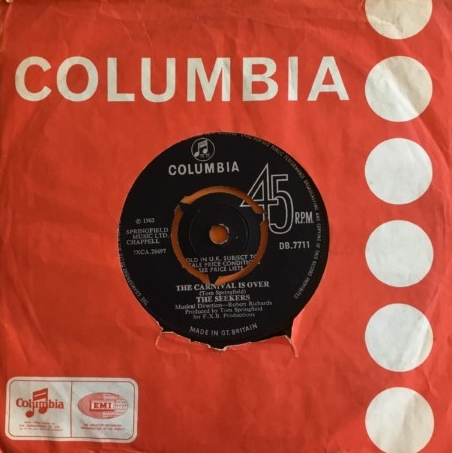
The Carnival Is Over, by The Seekers (their 2nd and final #1)
3 weeks, from 25th November – 16th December 1965
I just about managed to see the positive side of The Seekers’ first number one, ‘I’ll Never Find Another You’, for all it’s tweeness. But I think I’ll have to draw the line here… The term ‘dirge’ has cropped up once or twice in recent entries – The Beatles experimented with it in the background on ‘Ticket to Ride’, while ‘I Got You Babe’, for all its cuteness, was propped up with a pretty flat bass rhythm. ‘The Carnival Is Over’, though, is A Dirge, plain and simple.
The beat plods, the backing vocals are lifeless. You can almost picture the coffin being lowered into the ground. You start wishing they’d just get on with it… Say goodbye, My own true lover, As we sing, A lover’s song, How it breaks it my heart to leave you, Now the carnival is gone… Judith Durham, the lead singer, is once again on fine Sunday school teacher round the campfire form. Don’t get me wrong, she sings it very well; but it’s painfully proper.
It’s a song about two lovers, Pierrot and Columbine. Has Columbine fallen in love with a traveller? A handsome stranger who set up camp for a week or two? It’d have to have been a sailing carnival, thanks to the line about ‘harbour lights’… So maybe not. Or is ‘the carnival’ a metaphor for love, a love that’s no longer? Though the carnival is over, I will love you ‘till I die…
This record follows the same formula as The Seekers’ first #1, in that it was written and produced by Tom (brother of Dusty) Springfield. The melody was borrowed from an old Russian folk song, and once you learn that you think ‘Yes!’, this tune would make complete sense when bellowed out by a sturdy serf, gathering hay on the steppe. Not so much as a hit single in 1965. Yes, yes, yes it’s part of the folk-rock movement that’s become huge this year, but it’s a spectacularly lifeless song. You just want to shake them by the shoulders and tell them to liven it up a bit.
Apparently Springfield was inspired to write the lyrics after seeing the Rio carnival. Which seems hard to believe, as this record doesn’t exactly scream samba and piña coladas on the beach. In the bridge, there is an attempt at livening things up, with a nifty Spanish guitar riff. But that’s it. Plus the bridge also has a line about kisses ‘sweet as wine’, which is a metaphor I’ve never understood, what with most wines not being sweet at all. It should be ‘sweet as sherry’ is all I’m saying.
And so we plod to a close. That’s that for The Seekers at the top of the UK charts. They would have three further Top 10 singles before splitting in 1968. They’ve reformed twice since then, and still perform to this day, minus Durham who retired in 2013. They were huge in their homeland, and were even voted ‘Australians of the Year’. I can see why, too, what with US and UK acts dominating since the dawn of rock ‘n’ roll, it’s always nice to feel a local connection to a successful artist.
One more thing to say about ‘The Carnival Is Over’ – it was a spectacularly high-selling record. Late 1965 seems to have been a high point for record sales as, after Ken Dodd’s ‘Tears’ had become the 3rd best-selling single of the decade, this disc also did well over a million. At last count it was sitting at No. 30 in the best-sellers of all time list. Not bad for a dirge. I’m clearly in the minority…




 The UK Number Ones Blog