536. ‘Two Tribes’, by Frankie Goes to Hollywood

Slap bang in the middle of 1984 comes the year’s biggest hit, from the year’s biggest band.

Two Tribes, by Frankie Goes to Hollywood (their 2nd of three #1s)

9 weeks, from 10th June – 12th August 1984

Make that the decade’s biggest hit. No record will spend longer at #1 during the 1980s than this. Nine weeks, in which the best-selling song across the land was an ode to nuclear war. There are very few chart-toppers that have lines like: We’ve got the bomb, Yeah… Sock it to me biscuits now… But this is one. When two tribes go to war, A point is all that you can score…

On this, just their second release, Frankie (and producer Trevor Horn) were clearly sticking to the same formula as their first smash, ‘Relax’. Pounding, aggressive, disco-rock… check. A subject matter (and video) designed to raise eyebrows… check. Just the right mix of catchy and clever…?

Almost. The bass riff is thrilling, the splicing of Russian classical music with high-NRG dance is fun… But to my ears it’s all a bit of a mess, especially in the verses. It’s been a theme this year: hard-edged pop that’s bursting at the seams, constantly threatening to implode but just about keeping it together. ‘Relax’, ’99 Red Balloons’, ‘The Reflex’, now this… Maybe it was the impending threat of nuclear destruction (this is also already the 3rd chart-topper of the year to reference war and/or peace…), or maybe it was cocaine. But something was definitely in the air in 1984.

The video is another event in itself, with Ronald Reagan and Russian leader Konstantin Chernenko throwing one another around a sawdust ring. Chernenko only led the Soviet Union for a year or so – despite being nowhere near as famous as Stalin, Khrushchev, Gorbachev and co., he’s the one immortalised in this video… He grabs Reagan by the balls. Reagan bites his ear off. Holly Johnson drinks it all in as the ringside announcer. As the song reaches its final note, the planet explodes. If I had to choose, though, I think I’d spend my last moments on earth in the ‘Relax’ video, rather than this one.

I want to love this as much as I do ‘Relax’, but it falls short for me… I think it’s because ‘Relax’ is so simple, so gloriously filthy, and so universal. Songs about sex generally work. Songs about geopolitical tension can be hit or miss. Frankie try so hard to make it work – and it is still a banging, clanging, throbbing, pulsing wonder – but I think they overreach and, slightly, overcook it.

There were a million and one remixes of ‘Two Tribes’ – the ‘Annihilation Mix’, anyone? – but I like the classic single mix, with the air raid siren, and the public information announcer opening the song with: The air attack siren sounds like… By contrast, the album version is a little short, and missing the very Russian-sounding middle eight.

No doubt all those mixes helped this record to its giant stay at the top – the longest since 1977 – as well as similar promotion tactics to those that worked so well for ‘Relax’. But that’s not to suggest Frankie Goes to Hollywood weren’t genuinely massive in 1984. As ‘Two Tribes’ set up camp at #1 for the summer, their previous five-week chart-topper climbed back up to #2, making them only the fourth act to occupy both Top 2 positions after The Beatles, John Lennon and, um, John Travolta… They have one final number one coming up this year. And after two synth-rock thumpers, they’ll be changing tack, just in time for Christmas…

Advertisements

531. ‘Relax’, by Frankie Goes to Hollywood

Heresss Frankie! In a way, I dread coming across (filthy pun very much intended…) #1 records like this. Huge megalithic-hits that have had everything written about them, and then some. But we gotta cover them all, so…

Relax, by Frankie Goes to Hollywood (their 1st of three #1s)

5 weeks, from 22nd January – 26th February 1984

That’s not to say I dislike this record. Far from it: this is almost the perfect number one. It’s catchy, it’s memorable, it’s a real cultural moment… and it pissed off all the right people. In fact, that first bit – ‘Relax’s catchiness – is the one aspect of this song that possibly gets overlooked.

Let’s do the music first, then. An ominous intro floats in – I’ve always wondered what is being sung here (it’s M-i-ine, Give it to me one time now…) – before giving way to some grinding synths. I’ve been a bit down on synthesisers at times in this blog, but these are great. These are played like guitars, and could flatten a skyscraper. Apparently, singer Holly Johnson was the only band member to feature on the recording. Producer Trevor Horn – last heard on another synth-pop classic ‘Video Killed the Radio Star’ – took complete control of what was a jingly demo, and created a monster.

A monster that demands to be played loud. This is no shrinking violet of a song. It’s all out there, slapping you about the face… Which brings us on to the lyrics. Everyone knows what this one’s about… Relax, Don’t do it, When you wanna suck it to it… (there’s some debate about those lyrics, but the band have apparently confirmed them) When you wanna… Come! For reasons of public decency, I will be spelling it as ‘come’ throughout, when we all know it should be… Anyway. Question is, did anyone ever think ‘Relax’ was about anything else? The band half-heartedly claimed it was about ‘motivation’ when the song was first released, but by the time the album came out bassist Mark O’Toole confessed it “really was about shagging.”

And not just any old shagging. The video sees singer Holly Johnson entering a gay bar in his sensible work suit, and after three minutes of face-spitting, banana-licking, tiger-fighting, and cage-wrestling, he ends up straddling a writhing mass of bodies… and that’s just the edited version. Meanwhile, a Roman emperor unleashes a torrent of piss from the balcony (putting the ‘number one’ in number one single…) on the biggest Come! of the song, complete with a super-soaker sound effect. It’s gloriously tasteless, clearly designed to get a reaction. And get a reaction it did…

Two weeks before ‘Relax’ made top spot, the BBC had banned it from being played before 9pm. Radio 1 DJ Mike Read even pulled it off (the record, that is…!) live on air, in apparent disgust. For the five weeks that it was #1, ‘Top of the Pops’ showed nothing but a picture of the band. MTV followed suit. You can kind of see why – even today the video raises an eyebrow – but at the same time would this record have been as huge if they’d just played it without blinking? Maybe not.

But the band new what they were doing. Two of the members were out and proud, and the song’s promo played on this with gay abandon. One ad saw keyboardist Paul Rutherford dressed a sailor, alongside the phrase “All the nice boys love sea men.” The record sleeve, above, which Mike Read took such exception too, features a man and a woman in a little bit of leather and not much else. If you’re of a negative disposition, you could argue that all this represents the worst of the 1980s, a triumph of image and promotion over substance. But… pop music has never just been about the music. Even before Elvis wiggled those hips, pop and sex have been inextricably linked. ‘Relax’ was just the latest update on the theme. Sadly, as we know all to well, this didn’t herald a sea-change in British attitudes towards homosexuality. The AIDS crisis was just around the corner, and Section 28 would be in place by the end of the decade. Yet for the five weeks that this was #1, it must have felt like quite the moment.

It all ends in a cresecendo, and one final, bellowed Come! Then we all slink off to the bathroom to hose ourselves down… 1984 truly will be Frankie Goes to Hollywood’s year. Three chart-toppers with their first three releases (the first act to do this since fellow Liverpudlians Gerry & The Pacemakers), and fifteen weeks at number one. Two of the biggest-selling hits of all time. And their very own t-shirt. Is ‘Frankie Say…’ the most famous rock logo, aside perhaps from the Rolling Stones’ lips and tongue? Possibly. So, much more to come from Frankie, then, before long. Though it is worth saying that, of their three #1s, this is my favourite. Everything that was great and gaudy about the mid-1980s wrapped up in a four-minute mini masterpiece.

Advertisements

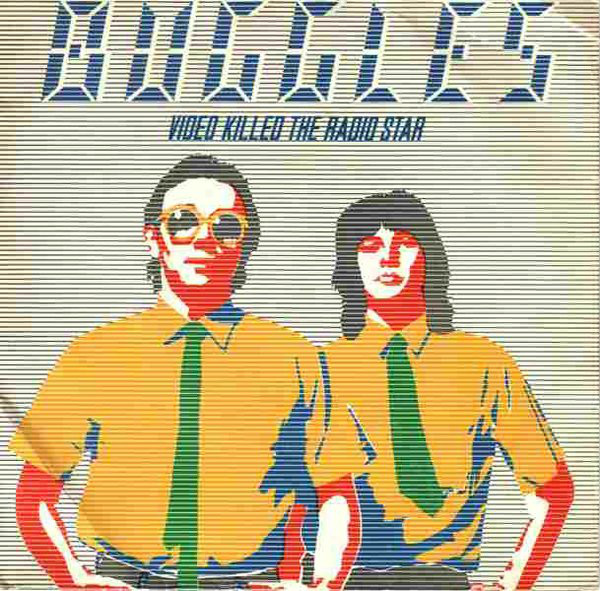
444. ‘Video Killed the Radio Star’, by The Buggles

First up today, I’m going to christen 1979 as not only the best year of the decade for chart-topping singles, but also ‘The Year of the Piano Intro’. We’ve had Gloria Gaynor’s iconic flourish, The Boomtown Rats’ mini rock opera, and now this. A synth piano announcing that: this, this is going to be interesting…

Video Killed the Radio Star, by The Buggles (their 1st and only #1)

1 week, from 14th – 21st October 1979

I heard you on the wireless back in ’52… The singer reminisces about a simpler time, when music had a human touch. ‘Music was better in my day…’ Except, the twist is, this is a pretty avant-garde, electro-pop song. Exactly the type of music the lyrics complain about. Or are they complaining at all? Are they instead mocking people with nostalgic views on music…? Pictures came and broke my heart, Put the blame on VCR…

The lyrics, though, are not the first thing that slaps you around the chops when you hear this record. Like Tubeway Army, it is almost aggressive in its desire to sound like the future, though with a very different, perkier sound. I saw it described it as an ‘extended jingle’, which is pretty perfect. Even the two voices, a bubblegum girl and a morose lead, are filtered through various effects.

I like this, it’s fun, it’s a classic… But I can’t shake the feeling that it’s a little showy. That some bits – the noodley synth flourishes and the aww-ah-oh fills – are a bit much. It took, apparently, three months to record and, again in another link to Tubeway Army, was inspired by a sci-fi story, this time by JG Ballard. Still, they reign it in for the iconic, driving chorus: Video killed the radio star… In my mind and in my car, We can’t rewind, We’ve gone too far… It’s a bit Queen, a bit Sparks, and more than a bit unique.

The Buggles were a duo, Trevor Horn and Geoff Downes. Horn in particular had been around the music biz for a while, producing jingles among other things. ‘Video Killed the Video Star’ was their first and by far their biggest hit, though they’re not quite one-hit wonders. Horn certainly isn’t, he was lead-singer of Yes for a year or so before becoming a full-time producer. His fingerprints will be on several future number ones, well into to the 2000s.

What many won’t know is that this wasn’t the first recording of ‘Video…’ Horn and Downes had originally written it with Bruce Wolley, who released a still-interesting but slightly more one-dimensional version in 1978. What many will know is that this was the very first record to be played on MTV, on 1st August 1981. Which is cute, I guess, but led me to believe for many years that this was the first ever music video (which is nonsense, they’ve been around since the ‘60s). It also led me to believe that this song had been released in the ‘80s. It seems a bit strange to me that a brand-new, impossibly modern channel like MTV would launch by playing a near two-year old song, regardless of the apt lyrics. But then again, the 6th video played on MTV was ‘We Don’t Talk Anymore’, by Cliff Richard. Perhaps they weren’t going for ‘cutting edge’.

Finally, it’s worth noting that after decades of having to publish every one of my posts with those boring, stock-standard record-label sleeves… The age of the picture sleeve is upon us! Most of 1979’s chart-toppers seem to have had glossy (!), colourful (!) sleeves with pictures of the actual recording artists (!) Just like LPs! What on earth took them so long? While punk has to take the credit for the wild variety of sounds in this new-wave era; I’m giving disco, and the genre’s love for the 12” remix, the credit for sending pop music into technicolour. Just in time for a new decade…