Today’s Top 10 – March 31st, 1970

A Happy Easter to all who celebrate it. I’m launching a new feature this Easter Sunday, something to enjoy while rendered immobile by one too many chocolate eggs… ‘Today’s Top 10’! My blog focuses very intently on every song that’s made #1 in the UK, and I often try to draw conclusions on how popular music has been shaped, and has shifted, over the years based on one tune alone. Which is actually quite limiting, because the singles charts have always been about more than just the number one. Over the 70-plus years of the singles chart, we’ve had a weekly Top 12, a Top 30, a Top 40, a Top 75, and now a Top 100.

So I want to, every so often, single out a random Top 10 from history, to look at in more detail. My version of ‘Pick of the Pops’, if you will. Cue the music….! Completely at random, using an online date generator, the first to come out the hat was 1970: the singles chart as it stood fifty-four years ago today. It features, inevitably, a #1 we’ve met before (plus one former #1), as well as songs by some of the biggest acts of all time. So let’s crack on…

#10 – ‘Don’t Cry Daddy’, by Elvis Presley (down 1 / 6 weeks on chart)

The early-seventies was a sort of musical wilderness: after the post-sixties comedown, a year or so out from the glam rock takeover of 1972-73. Speaking of musical wildernesses, here’s Elvis with a maudlin ballad about a break-up (or is it a mother’s death?) written from the POV of the couple’s daughter. Elvis croons the life out of it, and that voice could sell anything, but even he struggles to imbue lines like Daddy you’ve still got me and little Tommy, Together we’ll find a brand new mommy… with any sort of gravitas. He was still capable of greatness in the early seventies – in a few months he’d be back on top with one of his biggest hits, ‘The Wonder of You’ – but this is pretty saccharine.

#9 – ‘Everybody Get Together’, by The Dave Clark Five (down 1 / 5 weeks on chart)

The DC5 had scored their one and only #1, the stomping ‘Glad All Over’, more than six years earlier. So it is impressive that they were still hanging around the Top 10, when so many of their ’60s contemporaries had already faded away. This is a call-to-arms, a song with a message: Everybody get together, Try to love one another right now… Originally written as a folk song, and a hit in 1967 for the Youngbloods at the height of flower-power, The Dave Clark Five clearly felt that the sentiment was worth one more go. But there’s a droning, heavy feel to this version that feels weary, as if they’ve given up on the message even before the end of the song. It’s appropriately downbeat, perhaps, for the end of the sixties and the start of an uncertain new decade. Fitting too, as this was the Five’s final Top 10 hit. They would disband by the end of the year.

#8 – ‘Something’s Burning’, by Kenny Rogers & The First Edition (up 3 / 9 weeks on chart)

New to this week’s Top 10, and maintaining our run of hits by artists that we’ve already met in the #1 position, it’s Kenny Rogers and The First Edition with a sexy, sexy song. The verses are soft and slinky, lines like You lie in gentle sleep beside me, I hear your warm and rhythmic breathing… but it builds to a heated crescendo in the chorus. Kenny growls Here it comes, Can’t you feel it baby… and we know he’s not talking about the No. 42 bus. Lord have mercy…! It’s a world away from his much more gentle, much more ‘country’, solo hits like ‘Lucille’.

#7 – ‘Let It Be’, by The Beatles (down 3 / 4 weeks on chart)

Some of you may have heard this one before… The last single released before Paul McCartney’s departure heralded the end of history’s greatest group. There’s nothing new I can say about the record as a whole, so I’ll single out my two personal favourite moments. George Harrison’s snarling solo (especially on the album version) and the way Paul’s scouse accent sneaks through in the word ‘trouble’. Perhaps I’m just used to the streaming age, where songs hang around the charts for……ever, but for a song as legendary as ‘Let it Be’ not to make #1, and then be slipping down to #7 after just four weeks, seems surprising.

#6 – ‘That Same Old Feeling’, by Pickettywitch (down 1 / 6 weeks on chart)

I can’t say I’ve ever heard this one, though it had been as high as #5. It’s a nice enough, Motown-leaning tune done in a late-sixties, bubblegum style. Pickettywitch – I can’t decide if that’s a great or a terrible name – are another sign that though we may be in March of 1970, we’re still in the sixties going by much of this Top 10. Lead singer Polly Brown has a decent voice, reminding me of Diana Ross.

#5 – ‘Young, Gifted and Black’, by Bob & Marcia (up 1 / 4 weeks on chart)

I’ve made many a reference to the fact that reggae is the most indestructible of genres on the UK singles chart. Never the defining sound of an age, but always popping up when you least expect it. In 1970, it really was a new sound, Desmond Dekker having scored the first ‘official’ reggae #1 (if you ignore The Equals, and ‘Ob La Di…’) the year before. This is reggae + , with lots of strings, and rocking drums, but I’d say it still counts. More significant, though, are the lyrics: In the whole world I know, There’s a million boys and girls, That are young, gifted and black… And that’s a fact! Written and originally recorded by Nina Simone a few months earlier, right at the end of the decade that had brought the Civil Rights Movement to a head, for this to make the Top 10 in the UK feels very significant, and the second song in this rundown that could be described as a ‘rallying cry’.

#4 – ‘Wand’rin’ Star’, by Lee Marvin (down 2 / 9 weeks on chart)

A former number one – which I go into much more detail on here – that had kept ‘Let It Be’ from top spot a few weeks before. It was taken from the movie version of ‘Paint Your Wagon’, which was a box office flop. A bizarre #1 at the start of a decade full of bizarre #1s, Lee Marvin officially has the lowest voice ever heard on a chart-topping single (*disclaimer – may not be true*), and uses it brilliantly on this anti-social anthem: I never seen a sight that didn’t look better lookin’ back…

#3 – ‘Can’t Help Falling in Love’, by Andy Williams (non-mover / 4 weeks on chart)

Elvis makes a second appearance in the Top 10, in spirit at least, with Andy Williams’ belting cover of the King’s 1962 #1, ‘Can’t Help Falling in Love’. If it was impressive that the DC5 were still having hits in 1970, then we should also give a nod to the fact that Williams debuted with ‘Butterfly’ – his sole chart-topper – in 1957. But then again, crooners like Williams are timeless, much less prey to shifting trends than pop groups. The video above, which I think comes from later in the decade, is a spectacular glimpse into ’70s variety shows: the multi-coloured steps, the giant ‘ANDY’, the cardigan…

#2 – ‘Knock, Knock Who’s There?’, by Mary Hopkin (up 5 / 2 weeks on chart)

Venture deep enough into a springtime chart, and there’s a good chance you’ll meet a Eurovision Song Contest entry. ‘Knock, Knock Who’s There?’ was the UK’s 1970 offering, finishing second on the night to Ireland’s Dana. This is very schmaltzy, very middle of the road – not a patch on Hopkin’s huge breakthrough #1 ‘Those Were the Days’ – but it’s a darn sight better than the horrible ‘All Kinds of Everything’. This was a big departure from Hopkin’s usual, folky offerings, and she wasn’t a fan: “I was so embarrassed about it. Standing on stage singing a song you hate is just awful.” Hate it though she might have, it brought about her final Top 10 hit.

#1 – ‘Bridge Over Troubled Water’, Simon & Garfunkel – (non-mover / 7 weeks on chart)

In the middle of a three-week run at the top, ‘Bridge Over Troubled Water’ was just the 3rd number one of the 1970s, but is probably one of the decade’s biggest and best-loved songs. Simon wrote it, while Garfunkel gave one of the great vocal performances (something that apparently irks Paul to this day…) You can read my original post here.

In a way, ‘Bridge Over Troubled Water’ is the perfect number one for this chart. March 1970 wasn’t the sixties, but it’s wasn’t the seventies as we remember it either. ‘Bridge…’ is timeless, not beholden to many of the styles of the time, and could have been a #1 at most points in chart history. Elsewhere in the Top 10, we tick a few common chart boxes: soundtrack hits, Eurovision, Elvis, The Beatles… Maybe the two most relevant songs, though, are ‘Everybody Get Together’, and ‘Young, Gifted and Black’, which represent the social and civil rights movements that had defined the latter part of the 1960s. The hippy dream may have died, Dr King may have been killed, but hope springs eternal…

That was fun, and hopefully worthwhile. I’ll do another one sometime, as a break from our normal proceedings. Next up it’s back to 1996…

700. ‘Twist and Shout’, by Chaka Demus & Pliers with Jack Radics & Taxi Gang

The 700th UK number one single. My word, haven’t we come far! Not only that, it’s the first #1 of 1994 – officially the mid-90s. Bring. It. On!

Twist and Shout, by Chaka Demus & Pliers with Jack Radics & Taxi Gang (their 1st and only #1s)

2 weeks, from 2nd – 16th January 1994

And it’s pretty fitting that this landmark chart-topper is a reggae song. For all the dance tunes, boyband pop, and the Britpop hits yet to come, I’ve already made the argument that reggae was the sound of 1993-5. And what I like about this, as with Shaggy’s ‘Oh Carolina’, is that it’s pretty uncompromising reggae. This isn’t dub, as heard recently from Ace of Base or UB40; it’s a proper sweaty dancehall track.

‘Twist and Shout’ is a fairly well known tune, mostly in the frantic version the Beatles’ released on their debut album, featuring a famous vocal performance from John Lennon. And so you could be forgiven for wondering if we really needed a reggae version. We definitely do, though. As with all the best cover versions, Chaka Demus and Pliers (a Jamaican DJ and singer) turn it into a completely different song.

The bare bones are still there: the chorus and, most importantly, the ascending aaahs that lead us to it. But beyond that there’s lots of toasting and rapping that neither Lennon, nor the Isley Brothers (who first had a hit with ‘Twist and Shout’ in 1962), could have imagined. Get up and move your body… One time… Pliers sings… Ooh man you drivin’ me crazy… The purists may have frowned, but I think it’s charming, and a lot of fun.

You couldn’t have picked a less likely time of year for this to be a hit, with it reaching the top the day after New Year’s. But we all need a bit of tropical escapism, don’t we, especially in a miserable British January? Plus, Chaka Demus & Pliers had already made the Top 5 twice in 1993 (tease me, tease me… till I lose control…) and this cemented them as Britain’s favourite reggae act.

For the recording, they roped in Jack Radics, who I believe is the gruffer voice you hear on the chorus, and Taxi Gang, a rhythm section associated with Jamaican music legends Sly & Robbie. This gives the song’s credits a very modern look, with four different artists attributed (I think this might have been a record at the time). It was Chaka Demus and Plier’s last big hit in the UK, though they would carry on until 1997, and still get together every now and again.

Every time we reach a century of #1s, it’s always good to take stock. Do they tell us anything about the styles of the time…? Well, in this case, yes. Reggae was enjoying a big resurgence in the charts. It’s certainly more relevant than the 500th #1 (Eurovision cheese from Nicole), or the 400th (Julie Covington’s ‘Don’t Cry for Me Argentina’). The most ‘of its time’, though, remains the 200th: the Beatles’ ‘Help’.

Random Runners-Up: ‘Do You Want to Know a Secret?’, by Billy J. Kramer & The Dakotas

Our next randomly selected #2 comes from what, for my money, must have been the most exciting time to be a pop music fan. Come with me back to the summer of 1963, and the Merseybeat explosion…

‘Do You Want to Know a Secret?’, by Billy J. Kramer & The Dakotas

#2 for 2 weeks, from 30th May to 12th June 1963, behind ‘From Me to You’

And its one Liverpudlian act, Billy J. Kramer, covering another, The Beatles. Many of the early beat bands ended up relying on Lennon & McCartney hand-me-downs, and The Dakotas were no different. A few months after this, their debut hit, they would score a first number one with another Beatles cast-off, ‘Bad to Me’.

‘Do You Want to Know a Secret?’ had featured on the Fab Four’s first album, ‘Please Please Me’, released in March that year. (I only just realised that it was sung by George Harrison, who sounds remarkably like Paul McCartney on the recording.) It’s a sweet, simple song, but not one which really indicates that the band were going to be the biggest pop phenomenon the world had ever seen. And The Dakotas’ version is even more diluted, a little more ramshackle, a little old-fashioned in a rockabilly kind of way. Again nice, but they’d pick up the pace on ‘Bad to Me’.

It made #2 during the seven-week run of The Beatles’ first chart-topper, ‘From Me to You’ (not the last time Lennon & McCartney would occupy a Top 2…) It may even have been the best-selling single in the country at some point during its run, but not on the Record Retailer chart, which is what the Official Charts now recognise. It’s the reverse of the situation a few months earlier, when The Beatles’ ‘Please Please Me’ had stalled at #2 in Record Retailer, and therefore the history books, behind yodeller supreme Frank Ifield.

Billy J. Kramer would remain popular for a year or two, scoring a second chart-topper with the ever so slightly creepy ‘Little Children’. Like so many of the earliest Merseybeat stars, though, his star had waned by 1965. The original ‘Do You Want to Know a Secret?’, meanwhile, would go on to be released as a single in the US, where it also made #2.

Results: Your Best (and worst) Number One Singles

Last week, to celebrate reaching the 600th UK number one, I published a poll and opened the floor so everyone could vote for their best and worst chart-topping singles. I limited it to the 20 winners/losers from my regular recaps, allowed folks to cast as many votes as they wanted… And the results are interesting!

The Worst

Interestingly, almost twice as many votes were cast for the ‘Best’ record than were cast for the ‘Worst’. Nice to see that so many people just want to stick with the positives! Those who did indulge their negative side gave us a Top 3 that looks like this…

Joint 3rd Place (10% of the vote each): ‘There’s No One Quite Like Grandma’, and ‘Wooden Heart’

A stinkingly saccharine Christmas #1 from 1980, and The King with one of his worst movie soundtrack hits (and there’s plenty of competition in that mini category!) from 1961. Yep, don’t disagree with either of those…

2nd Place (15% of the vote): ‘Star Trekkin”

Our most recent ‘Worst’ chart-topper, from May 1987, but one that instantly goes down as one of the most unforgiveable #1s, ever. Again, I’d have put it this high myself and so can only applaud our voters.

1st Place (20% of the vote): ‘No Charge’

But if I’d had to choose one song to finish above even ‘Star Trekkin”, it would have been this teeth grindingly, forehead smashingly, cloying, preaching, sanctimonious, spoken-word horror from 1976. Well done all! Democracy in action!

I was quite pleased with these results (though, I should really have been pleased with any winner, seeing as I hand-picked my twenty least favourite #1s). Interestingly, the least-worst #1s (those with no votes at all) were ‘Lily the Pink’, ‘Release Me’, and ‘Don’t Give Up on Us’.

The Best

So here we go. Officially, undebateably, 100% verified… The three best British chart-topping singles, ever. (Or, actually, the five best, as we have one three-way tie.) One from the ’60s, three from the ’70s, one from the ’80s…

3rd place (6.5% of the vote): ‘The Winner Takes It All’

Of course. You couldn’t have a Top 3 without this. Third place might be too low, to be honest, but at least it’s there. Timeless pop from the best pop group… ever?

Joint 2nd place (8% of the vote each): ‘She Loves You’, ‘I Feel Love’, and ‘Heart of Glass’

We’ve had ABBA. We couldn’t not have the Beatles…

Plus Donna Summer and Giorgio Moroder, with what still sounds like the most futuristic number one – forty five years on!

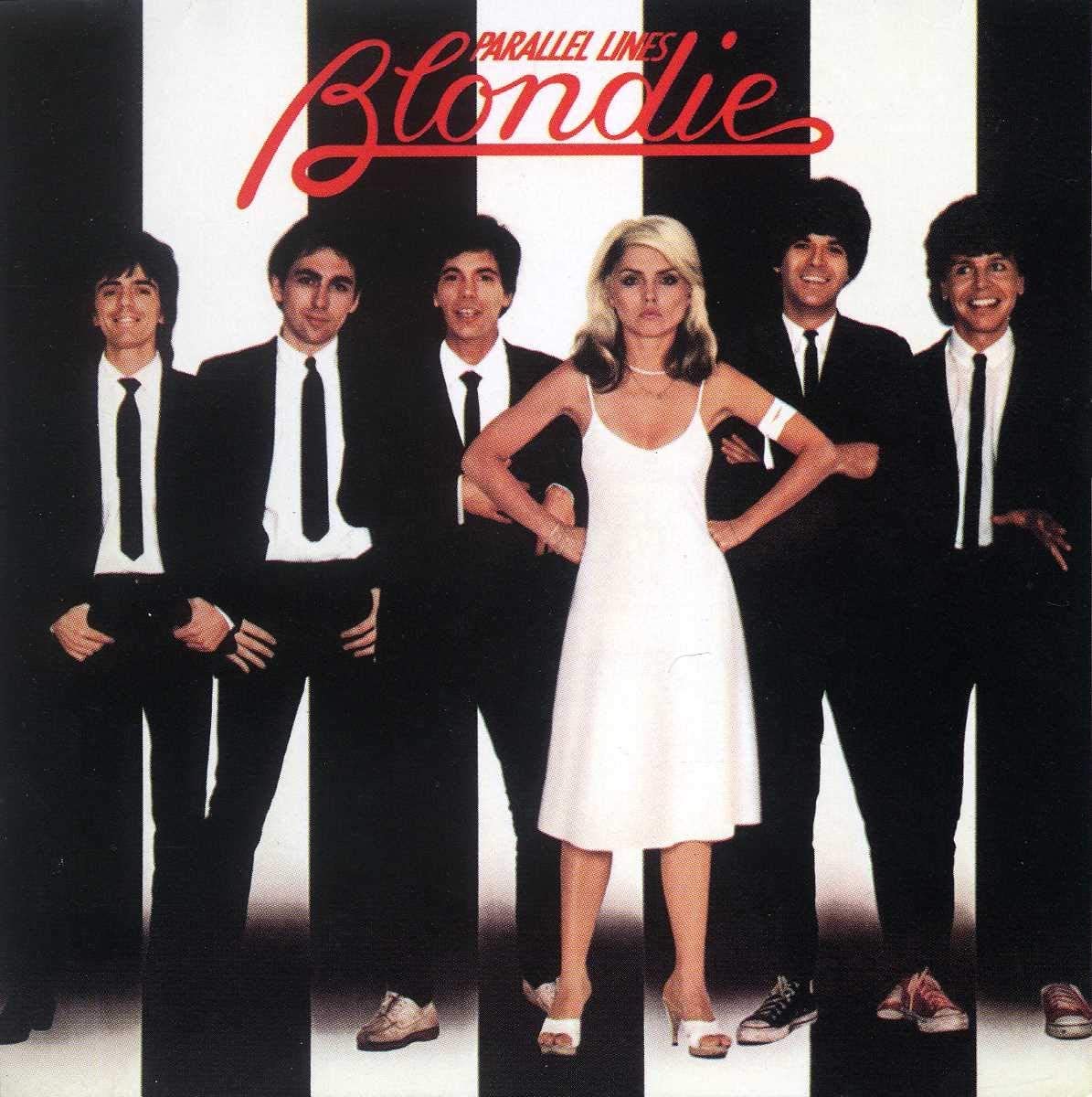
And Blondie, with their first in what has to be one of the strongest chart-topping runs, between 1979 and 1980.

1st Place (13.5% of the vote): ‘Baby Jump’

Yes. It’s official. Mungo Jerry’s ‘Baby Jump’ is the best #1 single, of the 600 to make top spot between 1952 and 1987. Um… There’s a bit of a backstory to this. When I published my original post on ‘Baby Jump’ (a glowing post, because I really do love this rocking, drunken, leery stomper of a song) it was quickly re-posted on a Mungo Jerry fansite. (It even, apparently, came to the attention of Ray Dorset – Mungo Jerry’s lead-singer.) And it seems many of these Mungo fans have stayed on as regular readers, because they came out in their droves make the band’s 2nd and final #1 my poll winner. And who am I to argue? It’s one of the least likely sounding #1s, ever. It’s one of the most forgotten #1s, ever (I doubt it would have gone Top 10 without the preceding success of ‘In the Summertime’). But it’s our Very, Very Best.

A quick consolatory shout-out to the two ‘best’ records that got nil points: Bucks Fizz with ‘My Camera Never Lies’ (seems I am out on my own in naming that as one of the very best), and ‘Cherry Pink and Apple Blossom White’ by Perez Prado (which presumably nobody has listened to for seventy-odd years… It is good though!)

These polls will remain open, and I guess it’ll be interesting to revisit every so often and see if anyone has stumbled across them and added a vote. For now, though, thanks to all who took part! Coming up, I’ll be celebrating a classic Christmas #2, then continuing with the regular countdown next week.

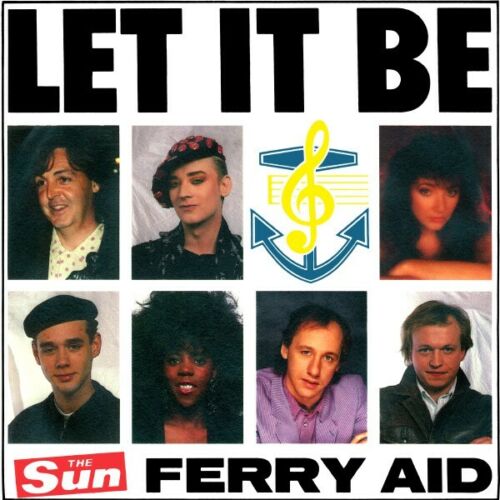
588. ‘Let It Be’, by Ferry Aid

Uh-oh, charity single ahoy…!

Let It Be, by Ferry Aid

3 weeks, from 29th March – 19th April 1987

OK. That intro might have been slightly tasteless, especially given the disaster that prompted this latest charity chart-topper. On 6th March 1987, a passenger ferry left Zeebrugge in Belgium bound for Dover. The bow door, the one that lets cars drive on, was left open as the ship set off, and it capsized almost immediately. One hundred and ninety three people lost their lives.

Undoubtedly tragic. But the nautical analogy holds up, I think. You’re floating along through the mid-to-late eighties, when along comes a hulking iceberg of a record. Charity songs, with their casts of thousands, their cramming of different styles and voices into one, their overlong runtimes, really do knock the charts off course. And when the record in question is a cover of ‘Let It Be’, one of the world’s best-loved songs, by the world’s best-loved band, you can’t help but wince, no matter how worthy the cause.

But we must listen, and ponder. The best part of an charity ensemble singalong is seeing how many people you can identify. It kicks off with the song’s writer, Paul McCartney, doing his best chirpy Uncle Macca impersonation. Then there’s the still heroin-husky Boy George, carrying the first verse. There’s Andy Bell from Erasure. There’s someone who looks like Marti Pellow (it’s not…) There’s Mel & Kim, again! They (sort of) join the exclusive club of acts who have replaced themselves at #1. There’s Kim Wilde and Nik Kershaw. There’s Kate Bush, who purrs her way through a couple of lines, sounding like she’s been spliced on from a completely different recording. There’s Edwin Starr, of ‘War!’ fame.

There are two guitar solos, from Gary Moore, and Mark Knopfler. Moore’s in particular is pretty blistering, marking this out from the usual charity single fare. There are two guys – one with a bottle of beer, the other smoking a fag – who aren’t quite giving the occasion the respect it deserves. Turns out they’re one half of Curiosity Killed the Cat. This is the second best aspect of a charity single: flash in the pan acts immortalised by being in the right place at the right time. (Also present here is Taffy – no, me neither – who qualified for a line or two thanks to her recent #6 hit ‘I Love My Radio’.)

By the end it’s descended into a pub-singalong, as all charity singles must. I refer to Wikipedia, because it looks like there are at least five-hundred people in the throng, to find it’s actually a ‘Who’s Who’ of previous chart-topping acts: Bucks Fizz, Suzi Quatro, Alvin Stardust, Bonnie Tyler, Doctor and the Medics, Frankie Goes to Hollywood and The New Seekers. Alongside The Drifters… the actual Drifters??… Gloria Hunniford, and Anne Diamond. Of course. They all look far happier than they should, given that it was the deaths of almost two hundred people that brought them all together.

I haven’t commented much on the music, because what’s the point? Charity singles aren’t bought to be listened to. Before you press play, imagine what a cover version of ‘Let It Be’, recorded for charity, in the late-eighties, would sound like. I’ll bet you come pretty close. (Oh and don’t forget to throw in a completely incongruous, but brilliant, guitar solo.) It is what it is. We listen once, and we move on.

Remembering Alma Cogan

I’ve covered 342 #1 singles since starting this blog. Some have been classics, some have been terrible, some have been by the most famous acts in pop music history, some have been by acts unknown to me until that moment… One of the singers I have been happiest to discover on my journey, is the singer of the 35th UK #1 single, Alma Cogan.

Born in East London in 1932, she went from singer-in-residence at a hotel, to the biggest British female star of the fifties. ‘The Girl with the Giggle in Her Voice’ – a nickname she earned after bursting into laughter during an early recording session – with huge frocks and a healthy pair of lungs – to listen to her early hits is to lose yourself in unpretentious pop perfection. Of which ‘Dreamboat’, her one and only chart-topper, is perhaps the perfect example.

(You can read my original post on it here.) Voted Outstanding British Female Singer by NME readers four times between 1956-1960, she scored hits throughout the decade by covering standards such as ‘Mambo Italiano’ and ‘Why Do Fools Fall in Love?’, ‘Little Things Mean a Lot’ and ‘Hernando’s Hideaway’. Being a popular singer in the fifties and early sixties meant that she also recorded her fair share of novelties – ‘Never Do a Tango with an Eskimo‘ – and showtunes. But she sings them with such a twinkle in her eyes that you forgive even her cheesiest moments. Here she is, belting out ‘As Long as He Needs Me’ from ‘Oliver!’ (Apparently the part of Nancy was written with Cogan in mind, and she does have a fantastic cockney rasp in her voice, compared to other more stage-school actresses who have played the role.)

The swinging sixties killed off her chart-topping days, as they did to many stars of the fifties. But there is a fascinating coda to Alma Cogan’s career – her friendship with The Beatles…

Cogan’s star was waning and the Fab Four’s was on the rise, but they would still meet at the same TV recordings. She was the first person that Paul played ‘Yesterday’ to, and she allegedly had an affair with John. She also tried to relaunch herself back into the charts by covering some of the bands hits – her ‘Eight Days a Week’ is a particular moment of overblown brilliance.

For whatever reason, she couldn’t seem to reignite her singles career – in the UK at least – and died tragically young from cancer in 1966. She was just thirty-four. Which terrifies me, as I am thirty-four and I have neither enjoyed a decade-long singing career nor had an affair with a Beatle… Just what have I done with my life?

Here’s one of Alma Cogan’s later TV performances – a cover of ‘The Tennessee Waltz’ – as introduced by her (supposed) lover John Lennon. They do flirt quite heavily in this clip, I must say…

And if that doesn’t leave with a smile on your face, then I don’t know what medication to recommend…

Alma Cogan, 19th May 1932 – 26th October 1966

272. ‘The Ballad of John and Yoko’, by The Beatles

Well then. For one last time, for the 17th time in just over six years, for the 67th, 68th and 69th weeks in total… The Beatles top the UK singles chart.

Beatles1969_5_18

The Ballad of John and Yoko, by The Beatles (their 17th and final #1)

3 weeks, from 11th June – 2nd July 1969

Coming so hot on the heels of ‘Get Back’ – only 1 week of Tommy Roe splits them – ‘The Ballad of John and Yoko’ sounds like an off-cut from the same recording session. It’s a bit rough and ready, there are the same squiggly guitars that we heard on ‘Get Back’, the same country-rock feel… Famously it features only John and Paul, no George or Ringo. I know it didn’t happen like this, but I do like to imagine the pair – the most famous song writing partners in British rock history – waiting behind after all the others had gone home for the day, putting their ever-growing differences aside and recording one last smash hit in a semi-lit studio.

As the title suggests, this is the story of John and his new wife Yoko, and the story of their marriage. They tried to get married in Paris, managed to do it in Gibraltar, and honeymooned in Amsterdam, in the face of some stiff opposition. All told over a simple riff, with Lennon’s vocals growing ever angrier as the verses rattle on.

I get about half the references… Drove from Paris to the Amsterdam Hilton, Talkin’ in our beds for a week… = the pair’s ‘Bed-In’ against the Vietnam War. The newspapers said, She’s gone to his head, They look just like two gurus in drag… = Lennon’s feelings of victimisation around his divorce and his new, foreign wife. The way things are goin’, They’re gonna crucify me… A cheeky reference to Lennon’s remarks from a few years earlier, about The Beatles being bigger than Jesus.

Other references are more obscure. The trip to Vienna, eating chocolate cake in a bag is a reference to their ‘bagism’ phase, where they wore bags over their heads in a statement against racial prejudice (everyone looks the same in a bag, right?) The fifty acorns tied in a sack? That took some digging, but is apparently about a pair of acorn trees that John and Yoko planted in the grounds of Coventry Cathedral.

And then there’s the blasphemy. The Christ! that kicks off every chorus – I always enjoyed shouting it out in the car as a kid – with the final one being particularly venomous. Perhaps predictably, this caused a big kerfuffle in the States, with several radio stations at best bleeping the word out or, at worst, refusing to play the record at all. The BBC avoided it, too. 1969 is truly becoming the year in which swearing makes it to the top of the charts, after Peter Sarstedt’s ‘damn’ in ‘Where Do You Go To…’ Meanwhile, in Spain, ‘The Ballad of John and Yoko’ caused controversy not because of the Christ!s but because of the references to Gibraltar being ‘near’ Spain. As far as Franco was concerned, Gibraltar was very much part of Spain, muchas gracias

8c115fcdcc97d80a379331da5a7e557f

Is it slightly disappointing that this song is the final Beatle’s record we get to hear in this countdown? Before writing, I would have said yes; but the more I listen and the more I find out about this record, I’m not so sure. It’s John at his spikiest, it’s Lennon and McCartney reunited, it’s quite funny in places… Sure it doesn’t sound much like The Beatles, but what Beatles #1 since 1966 has? Plus, the riff that closes out ‘The Ballad of John and Yoko’, the final notes of their final number one, is lifted from an old rock ‘n’ roll number, ‘Lonesome Tears in My Eyes’, by Johnny Burnette, which The Beatles, or The Quarrymen, used to play way back in the early days. Which is lovely.

I was going to rank all The Beatles 17 #1s in order of preference, but to be honest I can’t face it. I’d need a spare half-day to decide… Of course, this isn’t their final hit single. ‘Come Together’, ‘Something’, ‘Let It Be’ and ‘The Long and Winding Road’ are all still to come. Abbey Road hasn’t been released yet. But, the limitations of this blog are clear: if it doesn’t get to #1 then it doesn’t get a look-in.

And, of course, John, Paul and George will pop up many, many more times in this countdown as solo stars, as part of new bands, in re-releases and in amongst charity singles, well into the 2000s. There is only one man we need to bid farewell to here, then. Ringo. He will go on to achieve great things without bothering over the trifling business of topping the pop charts; namely narrating ‘Thomas the Tank Engine’, and becoming the most influential voice of my pre-school days… (apologies to my parents.)

270. ‘Get Back’, by The Beatles with Billy Preston

For the penultimate time – shock! horror! – it’s the Fab Four. And this time they bring with them a riff that can only be described as chugging…

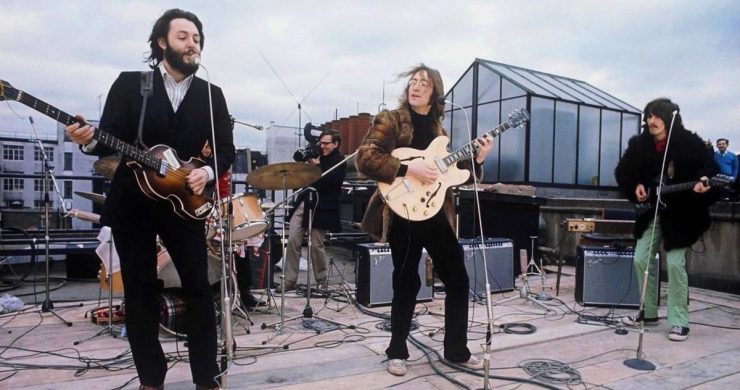
beatles-rooftop-e1548864435814

Get Back, by The Beatles (their 16th of seventeen #1s) with Billy Preston 

6 weeks, from 23rd April – 4th June 1969

The Beatles, since they left the Merseybeat days behind them in 1965, have gone trippy, gone heavy, gone epic. This time they’ve gone country. The guitar licks that shimmer around the main rhythm are pure C & W, while the lyrics take us straight to the wild west. JoJo was a man who thought he was a loner, But he knew it couldn’t last, JoJo left his home in Tucson Arizona, For some California grass… (Drug references! We have drug references in #1 singles, people. What a time to have been alive!)

Alongside JoJo we find sweet Loretta Martin, who thought she was a woman, but she was another man… She, or he, or they, also needs to get back, back to where she once belonged… All the girls around her say she’s got it comin’, But she gets it while she can… Pretty risqué stuff, I’d say, even for 1969. Though perhaps I just have a dirty mind.

Having not listened to it properly in several years, ‘Get Back’ is a much weirder song than I remember. There’s those lyrics for a start, then there are the squeaking noises and Paul McCartney’s very nasal, Kermit the Frog style vocals. There are also lines where he sounds close to laughter. Theories abound as to what the hell it’s actually about, including it being a satire of anti-immigrant views. I like John Lennon’s theory, though, that the get back to where you once belonged refrain was a McCartney dig at Yoko Ono.

R-6128850-1520005406-9513.jpeg

Although it’s their sixteenth chart-topper, this record is a Beatles ‘first’ for a couple of reasons. Most importantly, it’s their first and only single to officially feature another musician. Technically this is ‘The Beatles with Billy Preston’, as he contributes the funky keyboard solo – for my money the song’s best bit. It was also the first, and only, Beatles’ #1 to enter the charts in top spot, rather than climb there, which means they finally match Elvis and Cliff’s achievements from the start of the decade.

And, though we may be scraping the barrel here, it’s the only Beatles’ single to feature a spoken-word section. Before the final chorus, the riff tightens and Loretta is urged, once again, to get on home. Your mummy’s waiting for you, Wearin’ her high-heeled shoes and a low-necked sweater… And that’s that. Looking at The Beatles’ post-1965 #1 singles… you can’t claim they ever rested on their laurels. Every one is different, every one a work of art in its own way (even ‘Hello, Goodbye’.)

‘Get Back’ also, significantly, puts The Beatles out clear in the UK #1 singles leaders table. They now sit on sixteen while Elvis, for so long miles out in front, has fifteen. The Shadows are on twelve. Cliff is on nine. The Stones on seven. No other act so far has more than four.

Finally, this is the 4th Beatles chart-topper in a row to have had Paul as the lead writer. Was he carrying them by this point? Or was he just writing the stuff they knew would sell? John will have the final say, though, when he gets the credit for their final #1 single, coming up very, very shortly. And it was he who had the final word when they closed their final ever live performance, from the roof of the Apple studios in January ‘69. ‘Get Back’ was the very last song they played, before the police spoiled the fun, with Lennon thanking their impromptu audience and adding: “I hope we’ve passed the audition.”

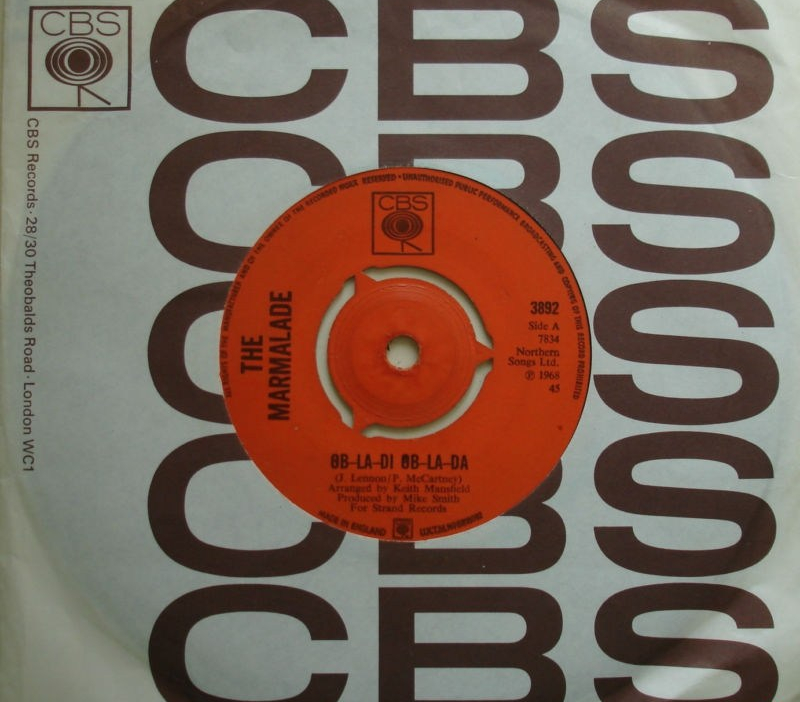
263. ‘Ob-La-Di Ob-La-Da’, by The Marmalade

Our first #1 of 1969, which hit the top just as the New Year’s bells rang out. Throughout January it was locked in a bit of a jig with our last chart-topper, ‘Lily the Pink’. Both records replaced one another at the summit. And when you listen to this disc, that makes sense…

c27629b64f9be56ecf844e470e622c78

Ob-La-Di Ob-La-Da, by The Marmalade (their 1st and only #1)

1 week, from 1st – 8th January / 2 weeks, from 15th – 29th January 1969 (3 weeks total)

For ‘Ob-La-Di, Ob-La-Da’ is cut from the same silly, music-hall cloth as Lily and her medicinal compounds. This is another strange tale – the tale of Desmond, Molly and their market stall. Desmond says to Molly girl I like your face, And Molly says this as she takes him by the hand…

You probably know what comes next, because this is a song by a very famous band, from a very famous album. Ob-la-di, Ob-la-da, Life goes on, Wo-oah… La-la how the life goes on… Yep, it’s the fifth cover of a Beatles’ song to make #1 in the UK, following on from ‘Bad to Me’, ‘A World Without Love’, ‘Michelle’, and hitting the top only a couple of months after the last one, ‘With a Little Help From My Friends’. Add these to the Beatles’ fifteen #1s, and that’s a cool twenty chart-toppers for Misters Lennon and McCartney. (Listen to the original here – John apparently hated it.)

Out of the previous covers, I’d say that this has most in common with The Overlanders’ ‘Michelle’. It’s a perfectly functional copy of the original, one that adds nothing new into the mix. It still bounces along on the same ska-ish beat, Desmond still buys Molly a diamond ring, Molly still does her pretty face and sings with her band in the evening – they still have the drag verse at the end – but it’s basically karaoke.

marmalade-ob-la-di-ob-la-da-beatles-song-n-mint-cbs-7-inch-45-rpm

In fact, the bits I like about the original ‘Ob-La-Di…’ are the cut from this. They don’t shout ‘Bra!’ in the chorus, instead changing it to ‘woah’. There’s no ‘ha ha ha ha’ between the bridge and the third verse, no plinky-plonky piano. Plus, at the end they change So if you want some fun… to So if you want some jam… Because, I’m guessing, they were called The Marmalade. So actually, they’ve taken an average song, and made it worse. Oh well.

And it’s sung in a very strange, slightly Indian, slightly Scouse, slightly Fagin from ‘Oliver!’ accent. The Marmalade were from Glasgow, but that ain’t no Glaswegian… It’s tough, I know, to assess a song like this on its own merits, having been familiar with The Beatles’ version since I was about eight. It’s fine, but coming so soon after Cocker’s outrageous interpretation of ‘With a Little Help…’ it falls pretty flat. The Marmalade would, to be fair, have several other, self-written Top 10 hits through to the early seventies. They were no one-hit wonders.

P.S. Before we finish, it’s worth noting the reggae-ish undertones in this disc. Last year we had the first ska-tinted number one from The Equals, while the ‘Desmond’ in this song was apparently inspired by Desmond Dekker, one of the first reggae stars to make it big in the UK. The ‘Bra!’ in the original was apparently meant to be more like ‘Brah!’ – ‘brother’ or ‘friend’ in West Indian patois. Nowadays Paul McCartney would probably get savaged for such cultural appropriation… What it all means is that reggae has arrived at the top of the charts, just in time to add yet another layer to an amazingly diverse musical decade.

P.P.S. This is the 19th disc to have two (or more) separate runs at the top since the charts began sixteen years ago. Amazingly, it will be the last disc to have a return to number one (without being re-released) until 1993!

260. ‘With a Little Help From My Friends’, by Joe Cocker

I recently did a series of posts on cover versions of #1 songs – previous chart-toppers that had been reimagined in different ways by different artists. ‘Different’ being the important word – a good cover version should bring something new to the table. What’s the point in releasing a karaoke version of the original? And while we have had plenty of cover versions hit number one already, this one takes the concept to another level.

Joe Cocker

With a Little Help From My Friends, by Joe Cocker (his 1st and only #1)

1 week, from 6th – 13th November 1968

The Beatles’ version of ‘With a Little Help From My Friends’ had been released the year before, on the ‘Sgt. Pepper’s Lonely Hearts Club’ LP. Joe Cocker, a British blues-rocker who had been around for a few years without enjoying much chart success, took it and made it his own. It’s slower, heavier, longer, downer and dirtier… Re-acquaint yourself with the original here, then settle in for the Cocker treatment.

It begins with a distant organ, as if you were standing outside a church before evensong. It’s an ominous build-up… You’re ready for something to happen. Then wham. Guitar! Proper hard-rock guitar. Hendrix and Clapton kind of guitar. The type of guitar that’s been nowhere near the top of the charts before. It’s bombastic, and outrageous. It makes you want to make devil-horns and punch the air.

The lyrics are the ones you know. What would you do, If I sang out of tune, Would you stand up and walk out on me…? But it sure isn’t Ringo singing it. Cocker’s voice is husky, and soulful. He delivers the lines late, squeezes the words in before the next one comes along. The backing singers, so important in any version of this song, sound like a gospel choir: How do I feel at the end of the day…? Are you sad because you’re on your own?

The best bit is the bridge – the Do you need anybody… bit. The guitars go super heavy and crunchy, like a motorbike revving up. The second time around, especially, when Cocker howls and the backing singers soar and we launch into the final minute of a mini rock-opera. I know we’ve had a lot of soul number ones in recent years – The Small Faces, Chris Farlowe, Long John Baldry and more – but this takes it to the next level.

s-l400

It kind of sounds a bit like a jamming session, or at least a live version, and that really adds something to the song. They captured lightning here. They would never have been able to re-record this exactly the same – it’s too raw, too intense. It lacks the polish of a regular #1 single, but you’re oh so glad that it somehow managed to have its week in the top spot

As I mentioned, it’s another long number one. You wait years for a #1 single that lasts longer than five minutes, then three come along at once. And that’s not all that links this to the previous two #1s. We’ve now had a number one recorded by The Beatles (‘Hey Jude’) replaced by one that was produced by a Beatle (‘Those Were the Days’) replaced in turn by a number one written by The Beatles. In case you’ve lost count, this is the fourth Beatles cover to reach the top in the past five years. They may have been reaching the end of their career as a band, but their grip on the charts wasn’t weakening.

We end in a frenzy of organs and guitars, as Cocker ad-libs over the fade-out. Phew. It’s not a subtle re-interpretation, I will admit, but for me it works. I knew this record by reputation, but it’s been great to give it an in-depth listen. ‘With a Little Help From My Friends’ is a song that will pop up another two times in this countdown, and I don’t think it’s giving too much away to say that neither of the upcoming covers are fit to lick this one’s boots…

Joe Cocker will only have one more Top 10 hit, until the early-eighties when he will record ‘Up Where We Belong’ with Jennifer Warnes for the soundtrack to ‘An Officer and a Gentleman.’ From Sheffield, but sadly no relation to Jarvis Cocker, he was still scoring Top 20 albums in the ‘00s and the 2010s. He died in 2014.