Happy Birthday… Petula Clark

Today we send birthday wishes to an icon, a titan even, of British pop. Petula Clark, who turns ninety-four today.

Clark started her singing career as a child, entertaining the forces during World War II, and released her first records in 1949, before a British singles chart even existed.

Her first chart hit came in 1954, when ‘The Little Shoemaker’ made #7. It was probably a banger by the standards of the day, upbeat and peppy, but still very old-fashioned to our modern ears. Who’d have thought that of all the pre-rock stars seen off by rock ‘n’ roll and the beat groups, Petula Clark would be one of the few to make it through the following two decades?

Her first of two UK #1s came in 1961, with ‘Sailor’, an English re-write of a German schlager tune. Read my original post on it here. And here she is singing it, introduced by a fresh-faced Cliff Richard.

The mid-sixties was Clark’s most successful period, not just in Britain, and the US, but in Europe. She was arguably most famous in France, where she had an entirely separate chart career, as well as recording records in German and Spanish. Here’s her first French hit, ‘Prends mon Coeur’, which you might recognise as a French re-write of a song Elvis had taken to number one in 1959.

Of course, we couldn’t do this birthday post without including Clark’s signature hit, perhaps the defining hit of the ‘swinging sixties’: ‘Downtown’ – a UK #2 and a US #1. But have you ever heard it in German, where it was also a chart-topper? And did you know that the German for ‘downtown’ is… ‘downtown’?

In 1966, right in the middle of this prolific spell, with Clark in partnership with writer and producer Tony Hatch, and his wife Jackie Trent, she released what I would list in my Top 5 pop songs of all time. Just absolutely perfect pop. Pop perfection. I may be biased, as ‘I Couldn’t Live Without Your Love’ was on a sixties compilation cassette that my parents would listen to in the car when I was wee, and therefore it is just about the first pop song I can remember hearing. And thirty-five years on it still sounds amazing.

Her partnership with Hatch and Trent also brought about another US number one in ‘My Love’, and the #4 hit ‘Don’t Sleep in the Subway’. Her second British chart-topper – the delightfully cheesy ‘This Is My Song’ – wasn’t written by Hatch and Trent. Instead it was composed by one Charlie Chaplin. Clark supposedly never liked it, but it would prove to be her final British Top 10 hit for twenty-one years, until a remix of ‘Downtown’ made #10 in 1988.

After a chart career spanning pre-rock, rock ‘n’ roll and the swinging sixties, Clark’s fortunes finally gave out as the seventies arrived. But she continued to record and perform, and act – she’s been in at least twenty-five films, as well as starring in ‘Mary Poppins’ in the West End at the ripe age of eighty-seven.

Her most recent release was this gem from 2013, in which she gave Lana del Rey a run for her money…

And here she is in the same year, covering our most recent #1 – ‘Crazy’ – for Jools Holland’s Hootenanny, and delivering us all a lesson in how to make a song your own.

Many happy returns, Ms Clark!
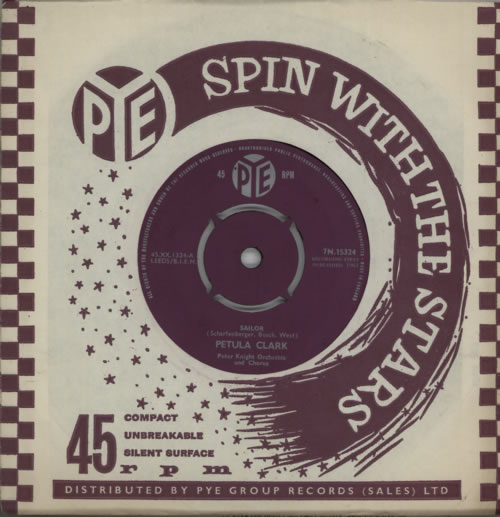
113. ‘Sailor’, by Petula Clark

Ladies and Gentlemen, something strange is about to occur atop the British Singles Chart. For the first time since 20th March 1959 – that’s twenty-three months and thirty-two #1s ago – the following chart-topper will be sung by – dun dun dun – a woman!

clark-p

Sailor, by Petula Clark (her 1st of two #1s)

1 week, from 23rd February – 2nd March 1961

The gap between this song and Shirley Bassey’s ‘As I Love You’ is, I’m going to assume, some kind of record for the longest gap between female-led number ones. Though, quickly glancing down my list o’ chart-toppers, it is genuinely surprising how male-dominated the sixties will be. Certain consistent stars aside – Cilla Black, Sandie Shaw, Nancy Sinatra and the like – there will be huge swathes of #1 territory taken up by blokes with guitars. I wonder that more hasn’t been made of it, to be honest. But, I suppose, that’s all a story for another day. We have a new number one – let’s take a look at it…

It starts with a harmonica, an instrument under-represented so far in this countdown… Sailor, Stop your roamin’, Sailor, Leave the sea… Sailor, When the tide turns, Come home, Safe to me… It’s cute, and lilting, like the waves upon the ocean. Then comes the chorus, and it’s a proper sing-along one: As you sail across the sea all my love is there beside you…

It’s kind of old-fashioned. Kind of cheesy. Above all I’d describe it as ‘sentimental;  what the Germans call a ‘schlager’ song. It’s a hard one to place –  a song that might have been a hit any time between 1940 and 1975 – and one that reminds me of certain #1s from years already gone by. It’s a ‘Come Home to Me, My Love’ kind of song, the sailor in the title presumably being in the navy and separated from his amour against his will, as in Anne Shelton’s 1956 hit ‘Lay Down Your Arms’. But I’m more reminded of Jo Stafford’s ‘You Belong to Me’ – the second ever UK #1 – when Clark lists all the countries to which her man is sailing: In Capri or Amsterdam, Honolulu or Siam… (not sure which war he’s fighting in to take him on that erratic route, but anyway).

And then the pub-at-closing time feel of the chorus puts me in mind of The Stargazer’s 1954 smash ‘I See The Moon’, albeit with the crazy dialled back several shades. It’s a light little song that just about stays on the right side of cheesy, aside from the line about his final destination being ‘the harbour of her heart’…

PETULA_CLARK_SAILOR-419791

To be honest this song is perhaps best used as an excuse to draw people’s attention to the Life and Times of Petula Clark. In my post on the last female chart topper, I referred to Shirley Bassey as the First Lady of British pop. But that title might just as equally go to Ms. Clark. She went from being a childhood star, to a WWII Forces’ Sweetheart, to a global, multi-lingual superstar – equally as popular in France (‘Sailor’ was released there, in French  as ‘Marin’, reaching #2) and the USA as she was in Britain. Her first chart hit – ‘The Little Shoemaker’ – came in 1954, although she had been releasing singles since the dusty pre-chart days of 1949. And then, while all the big female pre-rock stars fell by the wayside – Vera Lynn, Kitty Kallen, Kay Starr, Rosemary Clooney et al – Clark kept going. Rock ‘n’ roll didn’t hurt her. In fact, she grew in popularity. Not even the Merseybeat revolution will be able to see her off!

We’ll meet Petula again in six years or so for her second #1, which is officially A Good Thing. Between then and now she will release her signature hit, ‘Downtown’, and my personal favourite – possibly the most uplifting song ever – ‘I Couldn’t Live Without Your Love’, which featured on a cassette of sixties hits that stayed on heavy rotation in our family car back when I was eight or nine. The songs on it were strictly 2nd-tier hits in chart terms – no Beatles, Elvis or Stones for obvious licensing reasons but plenty of Tremeloes, Emile Ford, Kenny Ball and T. Rex (sixties T. Rex, before they were particularly famous) – but I’d give anything to find out what the hell that tape was called. My love for all this glorious fifties and sixties pop stems directly from that compilation – in fact this very blog probably stems from what that tape awakened in me. As a small child I listened to very little music recorded post-1969. Until I turned ten and The Spice Girls came along, that is… But that’s yet another story for yet another day.