We got it together didn’t we…? Lord, that voice. Nobody but you, and me… Thick as gravy and deep as a canyon: Mr Barry White. Add some dramatic strings and you’ve got one hell of an intro. Was this on the original single version…? I hope so.
You’re the First, the Last, My Everything, by Barry White (his 1st and only #1)
2 weeks, from 1st – 15th December 1974
After a bit of a break we’re back on a disco vibe – the sound of late-1974 – with one of the genre’s defining hits. My first, my last, my everything… And the answer to, All my dreams… A record can be as cheesy as you like, and this is a disc dripping in the stuff, but when a singer sells the vocals like Barry White sells them here… well, you can’t argue with it.
The way he belts out the Girl you’re my reality, But I’m lost in a-a-a-a dream… line, and the way he drops several octaves for the my everything… in the chorus is superb. But it’s not just the vocals that make this a classic. There are the pause-clicks between lines – perfect for drunk dancing – and the simple but effective chord progression. ‘You’re the First…’ was originally written as a slightly less sincere, country and western song: ‘You’re my First, My Last, My In-Between’. And you realise, during the interlude, with its soaring strings and backing singers, that that’s why this song is so damn catchy: it’s a simple country song, a vaudeville ditty even, dressed up as disco.
Any wedding DJ worth their salt will launch this record onto the turntable at some point in the evening. It matters not when: this is a song to dance to with wild, drunken abandon, making all the trademark ‘disco’ hand gestures. You know, the flicks and the pointing. The earnestness in White’s voice almost commands you: My first! My last! MY EVERYTHING!
I’d say that for people of my age, Barry White’s image precedes his music. Maybe it’s because most of us met him through his cameo on The Simpsons. His size, his voice, his curls… ‘The Walrus of Love’ is one hell of a nickname – though I’m not sure it’s the most complimentary – and well-earned as, according to his Wikipedia entry, White fathered ‘at least’ nine children.
He was more than just this hit and a Simpsons cameo, though. There’s ‘Can’t Get Enough of Your Love, Babe’, a US #1 to which ‘You’re My First…’ was the follow-up, and ‘You See the Trouble With Me’ (which will be remixed and taken to #1 many years from now) among others.
In the end, the thing we all know Barry White for was the thing that sadly killed him. The Walrus suffered from exhaustion, kidney failure, diabetes and high blood pressure. He passed away at the very young age of fifty-eight, in 2003. His biggest hit, however, will live on for as long as people keep getting married (and drunk, and dancing…)
It’s a recap of a pop music scene in flux. The last recap was ‘The Glam Recap’ – with huge hits from Slade, T Rex, the Sweet, Wizzard et al – while these past thirty discs have seen glam lose its grip on the top of the charts, to be replaced by disco and soul. The change, when it did come in the summer of ’74, was swift and merciless.
But let me take you back, to the spring of ’73. We started this run off with some heavy hitters: Suzie Quatro telling us to ‘Can the Can’, Slade going straight in at the top with the Slade-by-numbers (but still catchy as hell) ‘Skweeze Me Pleeze Me’. Then enter Gary Glitter. Not the disgraced pervert we think of these days, but a sparkly jump-suited behemoth declaring ‘I’m the Leader of the Gang! (I Am!)’ By the time we reached the final #1s of ’73, two glam rock records entered at the top and sold a million, one by Glitter and one which you have probably heard a lot this month, and it all proved too much to maintain.
Glam rock died in the spring of 1974. It descended into the rock ‘n’ roll pastiches of, yes, Gary Glitter – as catchy as he was – Alvin Stardust and The Rubettes. Decent enough pop songs, but nowhere near the level of ‘Get It On’ or ‘Block Buster!’ The corpse still had a few decent farts left in it, though. Nobody can deny the stupid brilliance of ‘Tiger Feet’, or of ABBA’s glorious arrival on the scene with ‘Waterloo’. (Meanwhile, the man I always hold up as the gold-standard of glam, Ziggy Stardust himself, has been noticeably absent from the top of the charts, for now. Maybe by our next recap…)
Then arrived the other-worldly ‘Rock Your Baby’, bringing disco and soul in equal measure, and suddenly American pop was the standard-bearer once again. The Three Degrees followed, Carl Douglas went ‘Kung Fu Fighting’, and John Denver wrote a song for his love Annie.
Of course, this is only telling half the story. Not every number one fits the narrative. Dotted in between these genre-defining hits we’ve had solid, timeless pop from the likes of Peters and Lee, The New Seekers (making up for their horrid Coca-Cola jingle), the classy Charles Aznavour and the glossy Sweet Sensation (who showed that the Brits can get just as soulful as the Yanks.)
We also bid farewell to the decade’s biggest teen-idols: Donny and David. Donny’s final #1 was a limp cover of Tab Hunter’s ‘Young Love’, which confirmed the 1950s as ancient history ripe for rediscovering. His brothers also nabbed their one and only chart-topper, too, while David Cassidy skipped off into the sunset singing ‘Daydreamer’. But with the most recent #1 we met another David, Essex this time, and he might just be the man to take over as idol du jour.
To the awards, then. First up, the ‘Meh’ Award. The song that moved me least this time around. I could say ‘Love Me For a Reason’, but that’s at least solid pop song. I could also say ‘Billy – Don’t Be a Hero’, by talent-show winners Paper Lace, or Ken Boothe’s ‘Everything I Own’. But again… no. I’m going to give it to John Denver’s ‘Annie’s Song’, for being a perfectly pleasant three minutes of folk-tinged country pop, but also for failing to get my pulse up in any way.
To be honest, the charts have been slightly more eclectic this time around. For the last recap we had some solid-gold classics to whittle down; and some complete stinkers to wade through. There just aren’t the same extremes this time. The records I name best and worst will not be the ‘Best’ and ‘Worst’ of all time. They will just have been in the right or wrong place at the wrong or right time.
But before all that, we must award a WTAF Award for being interesting if nothing else. There was ‘The Streak’, but I think I’ll save that for later. There was the Simon Park Orchestra’s ‘Eye Level’, from ‘Van Der Valk’, but it feels like a cop-out just giving it to the random TV theme #1. There was even 10cc’s ‘Rubber Bullets’, a zany, ping-pong record that packed a lot into its runtime. But… I think I’ll award it to a record that maybe suffers in its ubiquity. It’s a classic, one everyone knows, but if you sit down and actually listen to it… It is a strange, strange song. Carl Douglas’s ‘Kung Fu Fighting’ takes it.
To The Very Worst Chart-Topper, then, of the past thirty. Whoever takes this can count themselves unfortunate to sit alongside utter turds like ‘Wooden Heart’ and ‘All Kinds of Everything’. But thems the breaks. Someone has to get it. Many would argue the case for ‘Seasons in the Sun’, but I can’t help kind of liking that one. Others would make a strong case for Donny O’s insipid cover of ‘Young Love’, but he won the last Worst award, and two in a row would just be plain bullying. So… Step forward Ray Stevens, Ethel and the News Reporter, for their work on the ‘The Streak’. A song, as I wrote in my original post, to make your teeth clench.
What, then, will be the 12th disc to join the ranks of The Very Best Chart-Toppers? I immediately have it down to three. ‘Waterloo’: the song I am this very moment naming The Last Great Glam #1. Except, I have a feeling that ABBA might be capable of even better than this, so I’ll place them 3rd and save them for later. Which means it comes down to a straight shoot-out: Wizzard’s often overlooked, Phil Spector inspired masterpiece, ‘Angel Fingers’, or Mud’s irrepressible ‘Tiger Feet’?
For the longest time, I assumed I’d give it to Wizzard. They just missed out last time, ‘See My Baby Jive’ finishing runner-up. And ‘Angel Fingers’ is wonderful – a million instruments and references crammed into five minutes of perfect pop. It did also, arguably, herald the descent of glam into rock ‘n’ roll tribute act, but I won’t hold that against it. And then there’s ‘Tiger Feet’, a song I’ve loved since I was a kid, and it would feel like a betrayal of the 10-year-old me to overlook it. And so, despite being aware that ‘Angel Fingers’ is the superior song, that must have taken weeks of Roy Wood’s loving effort, while Mud probably knocked ‘Tiger Feet’ out in an afternoon… ‘Tiger Feet’ takes it! Dumb, disposable pop wins. It always wins in the end.
Recapping the recaps:
The ‘Meh’ Award for Forgettability:
‘Hold My Hand’, by Don Cornell.
‘It’s Almost Tomorrow’, by The Dream Weavers.
‘On the Street Where You Live’, by Vic Damone.
‘Why’, by Anthony Newley.
‘The Next Time’ / ‘Bachelor Boy’, by Cliff Richard & The Shadows.
‘Juliet’, by The Four Pennies.
‘The Carnival Is Over’, by The Seekers.
‘Silence Is Golden’, by The Tremeloes.
‘I Pretend’, by Des O’Connor.
‘Woodstock’, by Matthews’ Southern Comfort.
‘How Can I Be Sure’, by David Cassidy.
‘Annie’s Song’, by John Denver
The ‘WTAF’ Award for Being Interesting if Nothing Else:
‘I See the Moon’, by The Stargazers.
‘Lay Down Your Arms’, by Anne Shelton.
‘Hoots Mon’, by Lord Rockingham’s XI.
‘You’re Driving Me Crazy’, by The Temperance Seven.
‘Nut Rocker’, by B. Bumble & The Stingers.
‘You’ll Never Walk Alone’, by Gerry & The Pacemakers.
‘Little Red Rooster’, by The Rolling Stones.
‘Puppet on a String’, by Sandie Shaw.
‘Fire’, by The Crazy World of Arthur Brown.
‘In the Year 2525 (Exordium and Terminus)’, by Zager & Evans.
‘Amazing Grace’, The Pipes & Drums & Military Band of the Royal Scots Dragoon Guard.
‘Kung Fu Fighting’, by Carl Douglas.
The Very Worst Chart-Toppers:
‘Cara Mia’, by David Whitfield with Mantovani & His Orchestra.
‘The Man From Laramie’, by Jimmy Young.
‘Roulette’, by Russ Conway.
‘Wooden Heart’, by Elvis Presley.
‘Lovesick Blues’, by Frank Ifield.
‘Diane’, by The Bachelors.
‘The Minute You’re Gone’, by Cliff Richard.
‘Release Me’, by Engelbert Humperdinck.
‘Lily the Pink’, by The Scaffold.
‘All Kinds of Everything’, by Dana.
‘The Twelfth of Never’, by Donny Osmond.
‘The Streak’, by Ray Stevens.
The Very Best Chart-Toppers:
‘Such a Night’, by Johnnie Ray.
‘Cherry Pink and Apple Blossom White’, by Perez ‘Prez’ Prado & His Orchestra.
‘Great Balls of Fire’, by Jerry Lee Lewis.
‘Cathy’s Clown’, by The Everly Brothers.
‘Telstar’, by The Tornadoes.
‘She Loves You’ by The Beatles.
‘(I Can’t Get No) Satisfaction’, by The Rolling Stones.
‘A Whiter Shade of Pale’, by Procol Harum.
‘I Heard It Through the Grapevine’, by Marvin Gaye.
I’m not sure what I was expecting from this next #1, the pre-penultimate chart-topper of 1974… But it definitely wasn’t an outrageously catchy synth hook.
Gonna Make You a Star, by David Essex (his 1st of two #1s)
3 weeks, from 10th November – 1st December 1974
Seriously, this sounds really futuristic. Not since Chicory Tip have we had such an electronic song at the summit. It starts with a simple enough, acoustic riff, then wham. Add to this the fact that David Essex sings with such a thick, yes, Essex accent, which sounds to my ears quite, sort of… punky. It is 1974… but it’s not.
Oh is he more, Too much more, Than a pretty face…? It’s so strange the way he talks, It’s a disgrace… David Essex seems to be singing in the character of a critic, of himself as a singer, before answering them directly: Well I know I’m not super hip, And I’m liable to take a slip…
It’s a cynical take on the music industry, as cynical a song as we’ve had at #1. Essex is keen to let us know that he’s not just a pretty-boy teen idol, another Donny or David Cassidy. Except, going by the picture above, he really could have been. Which probably made him even more determined to go against type. We’re gonna make you, A sta-a-ah-ar, We’re gonna make you, A sta-a-ah-ar… The title line becomes a sort of mantra, you imagine a crowd of greedy execs crowding around, pawing at young, innocent David…
I really like this record. It is, as I said, not what I was expecting. It is a very hard song to place, and to sum up. Put it in this way: it sounds like they rounded up a group of blokes on their way home from Upton Park, asked them to have a pub-rock singalong, then at the last minute replaced the guitars with synths. Seriously, replace these synths with crunchy guitars and you’d have a glam rock anthem to rival anything T Rex or Slade came up with. And I particularly love the cheeky I don’t fink so… response to the ‘Is he more than a pretty face?’ question.
Maybe part of the problem that Essex had with the music industry was that he had been in bands for years, since the mid-sixties. He released the first of several unnoticed singles in 1965, and it wasn’t until he moved into musical theatre in the early seventies that he started to gain recognition. So to some he might have seemed a stage-school upstart, putting on the mockney accent for authenticity. While in reality he was a kid from Plaistow, the son of Irish travellers who had had played for West Ham, which in my book gives you every right to sing your cockney heart out.
None of which explains the synths, though… They really do come out of nowhere. Jeff Wayne produced this single – he of ‘War of the Worlds’ fame – so perhaps that has something to do with it. Essex will go on to star on ‘War of the Worlds’ but, as he has a second #1 coming up next year I’ll save the bio for then. Up next, a recap…
In my last post, I dubbed the autumn of 1974 as the ‘Disco-Fall’, so glistening and shimmering has it been, dripping with the season’s hot new sound. But there have been detours, brief intermissions in the programme – think John Denver’s ‘Annie’s Song’, for example. And now this.
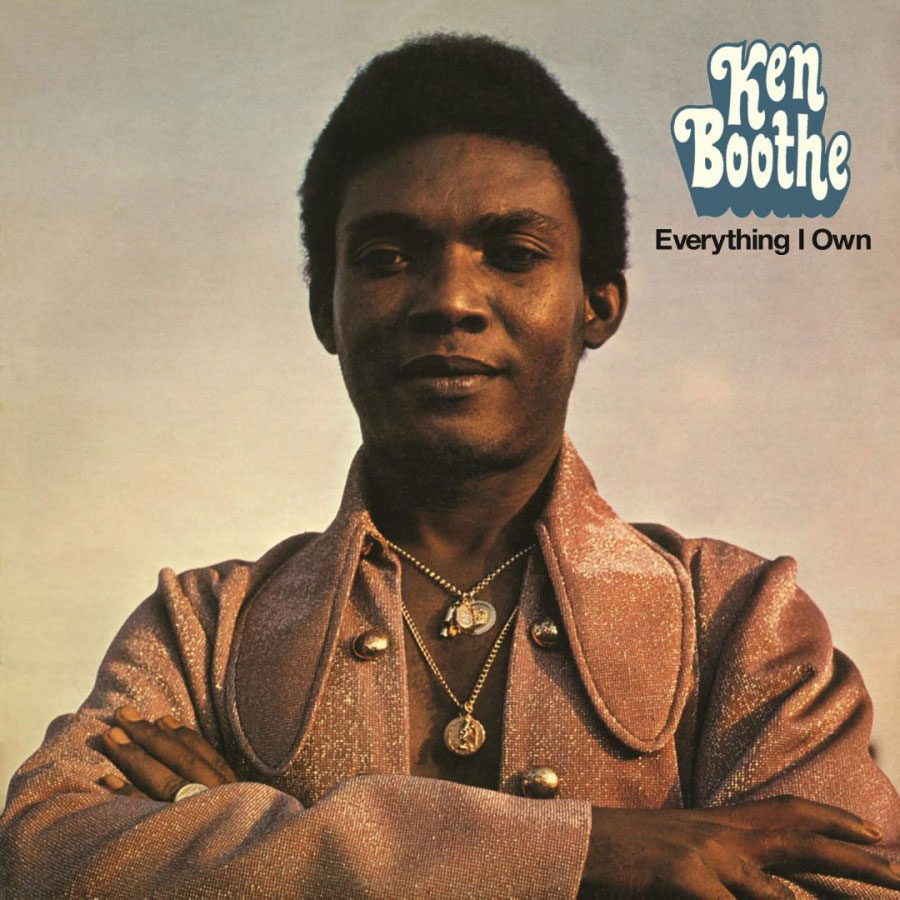
Everything I Own, by Ken Boothe (his 1st and only #1)
3 weeks, from 20th October – 10th November 1974
Though ‘Everything I Own’ isn’t so much a detour from the disco-soul sounds of recent #1s; it is more like being dumped in the middle of the Amazon with no compass. It is a slice of incredibly laid-back reggae, with incredibly earnest vocals and a tempo that never gets above crawling pace. Reggae is a strange genre, in chart terms, as it never seems to come or go. We’ve had reggae chart-toppers since the late sixties, and they’ll crop up every now and then until the present day. See also: country and western.
You sheltered me from harm, Kept me warm… You gave my life to me, Set me free… It’s a love song, a thank you letter to a loved one. It’s so sincere and sweet that it might even be a hymn. God himself might be the loved one… He’s not, it becomes clear, but the comparison is valid. This is record is just very… nice.
I would give anything I own, Give up my life, My heart, My home… (It’s odd, but the phrase ‘everything I own’ never features, it’s always ‘anything…) It’s nice, it’s very calming, almost like an audible massage, but I’m waiting for the hook… Still waiting… And then it fades. Oh well. It would work very well playing in the background, in a beach bar, in Thailand.
‘Everything I Own’ was originally a soft-rock hit for Bread, in 1972, before being adapted here into soft-reggae. It has been covered by everyone with a penchant for AOR, from Rod Stewart to Boyzone. It will also appear again at the top of the charts, in 1987, but I won’t give the game away on that just yet.
I have to say that, despite not loving this record, it is the version that I’m enjoying the most. Ken Boothe has a fine voice, and he enunciates every syllable in a manner your nan would approve of. His chart career mirrors perfectly that of our previous chart-toppers, Sweet Sensation. A #1, followed by a #11, and then done. I like that symmetry. Boothe made a sum total of $0 from this hit, as his record label went bust before they paid him. He is still alive, has been awarded the Jamaican Order of Distinction, and released his most recent album in 2012.
One thing that becomes clear the longer this trawl through the charts goes on… If a hot new sound makes its way across the Atlantic – be it rock ‘n’ roll, Motown, or disco – it won’t be long before the Brits are trying it out for themselves.
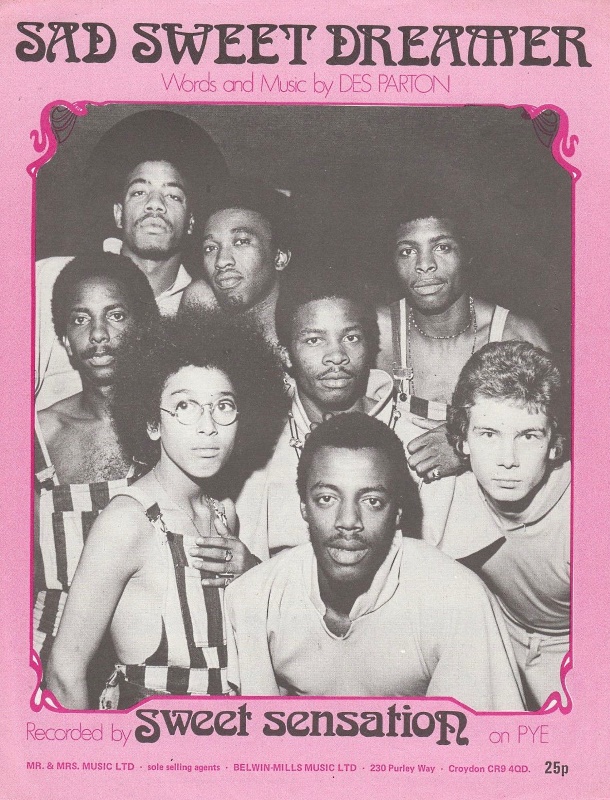
Sad Sweet Dreamer, by Sweet Sensation (their 1st and only #1)
1 week, from 13th – 20th October 1974
I was genuinely surprised to find out that Sweet Sensation were a UK based band, from Manchester, so drenched is this record in the Philly-soul sound. Ooh-wah-wah-ooh-wah-wah-ooh… We’ve got strings, saxophones (a proper ‘Baker Street’ sax-riff), and that wonderful, trademark chukka-chukka disco guitar. Sad sweet dreamer, It’s just one of those things you put down to experience… That chorus is sung by the band, in response to the lead singer’s tale of heartbreak.
Been another long night and I’ve missed you girl… I was also genuinely surprised to discover that the lead vocals are not being sung by a woman, so soft and gentle is the falsetto. (That and the fact they’re singing about a girl… Which would have been very progressive for 1974.) Marcel King was just seventeen years old when this hit #1, which makes sense both in terms of how young he sounds and in the way he’s cast as the lovelorn teen: the sad sweet dreamer. I’ve been thinking about you girl, All night long…
I like this record. It’s a grower – a sexy, glossy, sophisticated disco-soul track, from what I am now naming ‘The Disco Fall’ (gettit, like a ‘disco ball’??) There’s something slightly suspect about bands whose name and biggest hit share words. It screams ‘novelty ahoy’! (Think Las Ketchup with ‘The Ketchup Song’, or Mr. Blobby). But in the case of Sweet Sensation’s ‘Sad Sweet Dreamer’ I think it’s just a coincidence. They were, however, very nearly one-hit wonders. The follow up to this made #11, and that was that.
Some interesting titbits about this record. Sweet Sensation sprang to national attention by winning a TV talent contest, ‘New Faces’. Which means we can add them alongside Peters and Lee, and Paper Lace, in this category. But ‘Sad Sweet Dreamer’ feels like a ‘real’ record – if one record can indeed be any realer than another. It fits right in with earlier, high-quality chart-toppers from The Three Degrees and George McCrae in shaping the sound of late-74.
It was also produced by one Tony Hatch, whose wife Jackie Trent had enjoyed her very own #1 single back in 1965. She even features as a backing vocalist here, scoring her 2nd chart-topper by proxy. And finally, ‘Sad Sweet Dreamer’ is another one of those records that is nowhere to be seen on Spotify… unless you want a ropey cover from a band called The Top of the Poppers. Meanwhile, a completely unrelated band called Sweet Sensationcan be found, offering their brand of late-eighties, Hi-NRG dance-pop, if that’s your bag…
Finally, we get a respite from all the disco, by lurching as far away from the dance hall as possible.
Annie’s Song, by John Denver (his 1st and only #1)
1 week, from 6th – 13th October 1974
I didn’t think I knew this one… Until after ten seconds, when the vocals begin: You fill up my senses, Like a night in a forest… Of course I know this. It’s an easy listening classic. Like the mountains in spring time, Like a walk in the rain… A girl – Annie, we might presume – stimulates John Denver in ways that normally only nature does. You fill up my senses, Come fill me again…
I have to admit, I remain unconvinced by that line. It just sounds… odd. (Yes, I am well aware that my mind is in the gutter.) And I have to admit, I remain unconvinced by this song. By this entire genre of acoustic, singer-songwriter balladry on the whole. It is just not my cup of tea. Whenever one of these #1s comes along, as they will do from time to time, I will endeavour to put my prejudices aside and judge fairly.
It might not be disco, but it is still a very American sounding record. The Billboard charts of the mid-seventies were choc-a-bloc with soft, countryish rock like this. For whatever reason, ‘Annie’s Song’ was one of the few that managed to break through to the top across the Atlantic. (I had my suspicions that this was a posthumous chart-topper, which would maybe have explained why it made it to the top, because I knew that John Denver died in a plane crash. Except that was in 1997…)
As the song progresses, the production becomes more and more overblown. In come strings, and mandolins, and melodic hums from the backing vocalists. The lyrics also become a little OTT: Let me drown in your laughter, Let me die in your arms… Maybe I’m giving myself away as completely unromantic, but he is laying it on a little bit thick.
‘Annie’ was Denver’s wife at the time, and he was inspired to write the song while on a ski-lift in Aspen, Colorado. He claimed he skied back down the mountain and wrote it in an hour. Colorado was the inspiration for much of his music – he used the capital as his stage name, and was named the state’s poet laureate. When he did indeed die in a plane crash, his ashes were scattered across the Rocky Mountains.
What amazes me is that this was John Denver’s one and only hit record in the UK. He was a huge chart star in the States – four number ones to his name – but a bona-fide one-hit wonder in Britain! His most famous songs that aren’t ‘Annie’s Song’ – ‘Take Me Home, Country Roads’ and ‘Leaving on a Jet Plane’ – were hits, though, for Olivia Newton-John and Peter, Paul and Mary. A chart quirk, then; and probably the most prolific one-hit wonder in UK chart history!
Good Lord, we did fall hard for disco in the summer of 1974, didn’t we! It suddenly feels like I’m covering the charts of a completely different country, so quickly has the musical landscape changed.
Kung Fu Fighting, by Carl Douglas (his 1st and only #1)
3 weeks, from 15th September – 6th October 1974
‘Kung Fu Fighting’ becomes the third disco #1 in four, which means that disco was cool for precisely two songs. Because this record, for all its many good points, is not ‘cool’. It’s – let’s be honest – ridiculous. Woah-oh-ho-ho… everyone knows the intro, the slow build up, the Oriental riff… Woah-oh-ho-ho…
And then click. Disco time. Everybody was kung fu fighting… Huh!… Hah! Those kicks were fast as lightning… (There seems to be no consensus on whether it is ‘those kicks’, ‘those kids’ or ‘those cats’. I’ve always thought it was ‘kicks’ – it makes sense in a song about a martial art – so I’ll stick with it.) This was the era of the classic Hong Kong Kung Fu movie – Bruce Lee, ‘Enter the Dragon’ and all that – and the songwriters seized the zeitgeist, mixed it with the up and coming new club sound, and scored a ginormous number one hit all around the globe.
Even in 2020, it is a song that most people will know. I’m not sure lines like they were funky Chinamen from funky Chinatown… would pass the censors these days, mind, especially when coupled with the aforementioned ‘Oriental riff’. (Though the way they manage to translate the riff into disco strings is probably the best bit of the whole song.) Come verse II, we meet funky Billy Chin and little Sammy Chong… he said, ‘Here comes the Big Boss’, let’s get it on… I mean, it’s dumb, but you’ll struggle to argue that it’s not fun.
Actually, it’s a hard song to really place. It’s a little too hip to be a novelty, but it’s way too silly to be treated as a serious pop record. Let’s treat it, then, as a slice of classic cheese. Throw it on at the end of a wedding disco and watch people fly. Literally, in some cases. Meanwhile, twelve-year-old me still has a massive soft spot for the Bus Stop version, which reached #8 in the late ‘90s, and which takes the disco of the original, ups the Kung Fu sound effects, adds rapping and a manic Eurodance beat to create something… Well, let’s just call it ‘something.’
Perhaps unsurprisingly, there was nobody of Chinese origin involved in the making of ‘Kung Fu Fighting’. Carl Douglas was Jamaican, while producer Biddu (a disco pioneer) was British-Indian. Douglas is almost the very definition of a one-hit wonder… alas the follow-up to this – ‘Dance the Kung Fu’ – made #35 (while he was also credited on the Bus Stop version.) To his credit, he is still happy to perform the song live, more often than not in his red Shaolin monk’s uniform, and if he’s proud of his biggest hit then who am I to judge?
It’s time. A little later than you might have expected, but The Osmonds have their number one single.
Love Me For a Reason, by The Osmonds (their 1st and only #1)
3 weeks, from 25th August – 15th September 1974
It’s every bit as cheesy and tinkling as you might expect. It soars, it swoops, it blinds you with the whiteness of its teeth. Suddenly the UK charts sound very ‘American’, with three glossy, shining number ones in a row. But while George McCrae and The Three Degrees were pretty cool… this one really ain’t.
Don’t love me for fun girl, Let me be the one, girl… Love me for a reason, Let the reason be love… For the second time this year, we come to a #1 that I first heard as a child thanks to an Irish boyband. I knew ‘Seasons in the Sun’ through Westlife’s cover, I knew this thanks to their predecessors Boyzone, who took their ‘Love Me For a Reason’ to #2 in 1994.
If love ever-lasting, Isn’t what you’re asking… I’ll have to pass, girl, And be proud to take a stand… Maybe I’m showing my prejudices here, but isn’t it usually girls that sing about love that lasts? The Three Degrees, for example, were just asking when they’d see you again. Or there was Freda Payne lamenting broken promises on her wedding night. Guys are usually happy with, well, something more instant. But, The Osmonds were good ol’ Mormon boys that needed more than just physical attraction (their words.) All of which culminates in the spectacular line: My initial reaction is, Honey give me love, Not a facsimile of…
Any song that can crowbar the word ‘facsimile’ into its lyrics cannot be all bad and, to tell the truth, this is a decent pop song with a highly singalongable chorus. It also has one hell of a key change towards the end, that sounds as if a sound engineer accidentally leant on a dial. And, even though I introed this post by suggesting that The Osmonds had waited longer than most for their shot at #1, ‘Love Me for a Reason’ was only their sixth chart hit in the UK. It feels like a longer wait because, unusually, the solo Osmond(s) topped the charts long before the band. Donny’s been there three times, and Little Jimmy (while not technically a member of ‘The Osmonds’ at this point) has summited once.
The band would go on releasing albums until the end of the seventies, before splitting up and moving into different ventures. Donny would be the most successful, with his sister Marie. But this is it for them, in terms of topping the charts as a group. Just the one. And I’m sure most would agree that, if they could choose the one Osmonds disc they would allow to top the charts, it wouldn’t be this one. It would be… Well, I might just do a separate post on that very soon. Watch this space…
As if to confirm that our last helping of disco-soul – George McCrae’s ‘Rock Your Baby’ – wasn’t a fluke, here’s another slice. Go on, you know you want to…
When Will I See You Again, by The Three Degrees (their 1st and only #1)
2 weeks, from 11th – 25th August 1974
This is an impossibly glitzy record – you can’t help imagine a shimmering disco ball slowly spinning above The Three Degrees as they sing – and, as with our previous #1, it’s supremely glossy. Back in the fifties, I used to write that American singers sounded so polished and mature, so sexy, next to our gurning music hall stars. So it is again. We were dancing like loons to ‘Sugar Baby Love’; they were coolly shimmying to records like this.
Hoooo…. Haaaa… Precious moments…. It’s a reboot of the classic sixties girl-groups – The Shirelles, The Ronettes and, of course, The Supremes. When will I see you again…? Lyrically, this is very close to ‘Will You Still Love Me Tomorrow’, with the singers asking if what’s just passed is the real thing or just a fling. When will we share precious moments…? It’s such a perfect pop song, so well put together, so smooth and silky, that I’m struggling to pick it apart. Maybe it’s one that simply needs listening to, and appreciating, and I can shut up. Post over.
It’s also a record that gets better as it progresses. I like it when lead singer Sheila Ferguson gets insistent: Are we in love, Or just friends… Is this my beginning, Or is this the end…? Enter a funky brass section, on top of the swirling strings, which I feel shouldn’t work but which does, wonderfully.
Apparently Ferguson really didn’t like ‘When Will I See You Again’ when it was first offered to the group. “I thought it was ridiculously insulting to be given such a simple song, and that it took no talent to sing it,” she said later. Not the first, nor the last, example of a singer not knowing a hit song even if it jumped up and bit them on the behind.
I’m amazed at how few big hits The Three Degrees enjoyed in the UK. This was the biggest of just five Top 10s. In the US – and this truly has me flabbergasted – this record reached #2… and then they never had a hit again! I didn’t know much about them, but The Three Degrees just sound like such a classic pop group. I’d have had them up there with the aforementioned sixties girl groups in terms of hit singles.
Still, as I’ve said before, if you’re gonna have a limited number of hits, you better make ‘em good ones. This is definitely a ‘good one’. It is also, by all accounts, one of Prince Charles’s favourite songs – the group performed it for him, in Buckingham Palace, for his thirtieth birthday. The man has taste. The Three Degrees are still a going concern, with one of the ladies whom you can hear on this record: Valerie Holiday. Of the other two, Fayette Pinkney, a founding member of the group, passed away in 2009, and Sheila Ferguson went solo in the ‘80s. There have been fifteen members in total but, for obvious reasons, only three at one time…
This next #1 arrives like a fluffy cloud, a soft pillow upon which you might rest your head after a long day. Satin bedsheets. Rose petals scattered. A heavy-breathed Sexy…. Smooth. As silk.
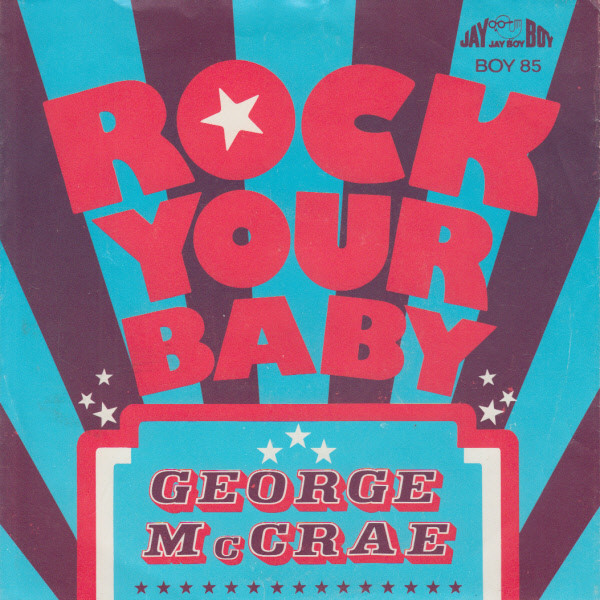
Rock Your Baby, by George McCrae (his 1st and only #1)
3 weeks, from 21st July – 11th August 1974
Woman, Take me in your arms, Rock your baby… The voice sounds as if it’s coming from on high, slightly out of focus, drenched in echo. Is he singing about dancing, or sex? Dancing then sex? There’s nothing to it, Just say you wanna do it… I’d go with sex. Especially with that chucka-chucka rhythm nudging us along, like the soundtrack to a classic, moustaches and chest-hair porno.
There’s not a huge amount to this record. It floats in then floats out. Chilled, funky, and soulful. Kids today would call it a ‘mood’. George McCrae’s voice is honeyed and high-pitched, especially when he reaches for the falsetto at the end of the Now let your lovin’ flow, Real sweet and slow… line. (Ok, there’s no way this song isn’t about sex…)
This is soul with a capital S, the sound that had been dominating US pop music for years, and that had made headway in the UK charts in the late sixties/early seventies, before getting turfed out the way by glam. But it’s back, baby. The backing track existed before the lyrics, recorded by a member of KC and the Sunshine band and using a drum machine when that was a very experimental thing to do. McCrae came along, added his vocals and scored a huge debut hit around the world.
But wait. A. Second. Calling this ‘soul’ isn’t telling the whole picture. ‘Rock Your Baby’ is something else too. One of those watershed moment that come along every so often, when a #1 single points to the future. A five letter future: D. I. S. C. O. The five most sneered upon letters in pop music…?
Not that I’ve got anything against disco. I’m really looking forward to writing posts on some of the decades later, cheesier disco hits. And I’ve nothing against this song. It’s cool, and catchy. Get this track down your headphones this while walking along the street and you won’t be able to stop swaggering. It sounds so much more grown-up, so much more sophisticated, when compared to the year’s earlier chart-toppers from Gary Glitter and – as much as do I love it – Mud. This is a disc your cool older sister would have been listening too while you were still blasting ‘Tiger Feet’.
George McCrae struggled to follow-up this monster hit – it was #1 everywhere – but he’s still alive and still performs, in his mid-seventies. Press play, then, and enjoy the sound of the summer of ’74. As we pass the midway point of the year, popular music gently ticks over into a new era…