55. ‘The Garden of Eden’, by Frankie Vaughan

Before I begin my next post in this countdown, I would just like to address something. The elephant in the room, if you will. As I mentioned back when writing about Guy Mitchell’s ‘Singing the Blues’, one of its weeks in the top spot was shared with the record that’s up next: Frankie Vaughan’s ‘The Garden of Eden’. It’s the second time we’ve encountered this situation, and it won’t be the last. Which begs the question… How did records end up sharing the top spot with such regularity in the 1950s? Well, the answer’s pretty simple. But it kind of whips the rug away from under this whole countdown. You see, the charts back in the early days of their existence simply weren’t very accurate.

Way back in my intro I mentioned that the concept of a ‘singles chart’ was introduced in November 1952 by the NME. And the UK Singles Charts company has since incorporated this chart into the ‘official’ chart – even though such a thing didn’t exist at the time. There were various other charts published every week in the 1950s: the Melody Maker chart, the Record Mirror chart, the Record Retailer chart… and the NME chart, which is recognised as the most comprehensive. But not completely comprehensive. There are still many bones of contention. Which I won’t go into here – they can be easily searched for online.

The number of record stores surveyed by the NME for their chart was surprisingly low and the methods very old fashioned compared to the instant downloading and streaming databases used in 2018 – they basically called up a bunch of record stores and asked them to keep a record of what they were selling. The first chart – topped by the record we met in my earliest post, Al Martino’s ‘Here in My Heart’ – was compiled using data from only 20 (twenty!) major record stores. And thus, every so often, because they were working from such a small sample, there were ties. David Whitfield and Frankie Laine in 1953, Guy Mitchell and Frankie Vaughan in 1957… In 1960, the Record Retailer Chart became the UK Chart Company’s chart of choice and there were no further ‘joint’ number ones (though there were still several contested number ones). Then in 1969 the British Market Research Bureau took over chart-compiling duties and steadied the boat further, while in 1982 chart compilation went digital. Since then, it’s been on the straight and narrow. 100% reliable.

So, while it may be distressing to some to discover the records that you have read about during this countdown may not actually have been the best selling records in a particular week, I thought it was only correct that I address the issue. And with that, today’s sermon is brought to a close. On with the next (presumed?) Number One Single!

s-l300

The Garden of Eden, by Frankie Vaughan (his 1st of two #1s)

4 weeks, from 25th January – 22nd February 1957 (including 1 week joint with Guy Mitchell from 1st – 8th February 1957)

So I press play on this record, ‘The Garden of Eden’ by Frankie Vaughan, and pretty soon I get to thinking that, from ‘Just Walkin’ in the Rain’ to this, I don’t think we’ve encountered such a run of similar-sounding songs. Here we have yet another male singer, with yet another performance involving guitar and vocals and not much else. I’m gearing up for another recap, so I don’t want to get too introspective right now, but it seems like we are settling into a groove which – glancing ahead at what’s to come – might last for a while yet.

I am not left thinking this for too long, however. This record is slightly deceiving. It does start off with a simple guitar strum, and with understated backing singers, but halfway through someone flicks a switch. We get trumpets, and a cymbal clash. Things escalate pretty quickly. The drums go up several notches, and suddenly the vocals are accompanied by a full-on big-band swing section. It’s a never ending crescendo, a key-change drawn out for two and a half minutes, and I like it! You can imagine this being performed on TV, the curtain opening to show Frankie Vaughan alone on stage. Then, as the song progresses, the lights draw further and further back to reveal, by the end, the full-blown orchestra that are bringing us to climax. It’s not rock ‘n’ roll, in terms of the sound, but it is in terms of the frenzied tempo.

Lyrically we are in somewhat stranger territory too. Recent number ones have been lovelorn, and wry. This is… well to tell the truth I’m not entirely sure what this is: When you walk in the garden, The garden of Eden, With a beautiful woman, And you know how you care… And a voice in the garden, The garden of Eden, Tells you she is forbidden, Can you leave her there?

It goes on… When you’re yearning for loving, And she touches your hand, Can you leave her to heaven, And obey the command, Can you walk from the garden, Does your heart understand?

It’s a parable, maybe. Resist temptation? Don’t resist temptation? I don’t really know what it’s about even after several listens. My best bet is that this is Vaughan explaining his behaviour to St. Peter at the Pearly Gates. “Yes, m’lord, I should have resisted the advances of that beautiful woman but, to be honest, she was far too hot…”

hqdefault

Without knowing any of this track’s backstory, I imagine it must have been pretty risqué to have had this many religious references in a pop song back in early 1957. Remember how, back in 1953, Frankie Laine and David Mitchell had remove the ‘My Lord’ from the title of their versions of ‘Answer Me’? But I can’t find mention of any controversy online. So that’s that.

Also of note is the fact that, once again, it’s a British artist doing the rockin’ and a rollin’. Vaughan was a Liverpudlian for whom this appearance at the top of the UK charts was the culmination of a few years of growing success – he was voted ‘Showbusiness Personality of the Year’ in 1956, and was one of the biggest stars of the late fifties. Pictures show him in dickie-bows and top-hats, so we know what kind of territory we’re in. And we will meet Mr. Vaughan again, in a few years, though I feel he has been somewhat forgotten over time, considering how famous he once was.

54. ‘Singing the Blues’, by Tommy Steele and The Steelmen

Tommy+Steele+Singing+The+Blues-553316

Singing the Blues, by Tommy Steele & The Steelmen (their 1st and only #1)

1 week, from 11th – 18th January 1957

If there’s one thing I’ve learned from doing this countdown, from listening to all these number ones of old, it’s that the ‘pre-rock’ era is a very hard thing to pin down. What was it? What did it sound like? Who were its biggest stars? And… when did it end?

Did it end in November 1955, when ‘Rock Around the Clock’ brought a teenaged frenzy to the top spot? Not really – that was a bit of a false dawn. Did it end in April ’56, when ‘Rock n Roll Waltz’ reached #1? Not really – the only thing rock ‘n’ roll about that song was the title. Was it when The Teenagers claimed a chart topper last summer? Not really – they may have been kids, but they were doo-woppin’ rather than rockin’.

So, I’m about to stick my neck out and make a bold claim. Are you ready? The 11th January 1957 marks the end of the ‘pre-rock’ era and the beginning of the ‘rock n roll’ era. In the UK at least. I can’t speak for anywhere else.

Why the 11th January 1957? Well, it’s when one Tommy Steele and his band The Steelmen (see what he did there?) hit the top spot with their version of ‘Singing the Blues’. Steele was the UK’s first rock ‘n’ roller, the pre-Cliff Richard if you will, and he grabbed this song away from Guy Mitchell’s nice-enough-but-somewhat-bland version, gave it a good shake and a slap, and ushered in a new era.

Not that you’d notice straight away. The song starts with the same plinky-plonky guitar and the same twee ba bum bum bums from the backing singers. And the trumpets and hand claps added to this version give it a slightly camp, Butlins-esque air. No, the one thing that makes this record rock is Steele himself: We-hell.. a-never felt…m’re like singin’ the blues… cos I never thought Ivrlose… yr love… dear

I’m not having a fit as I type – that’s really how he sings: like the last old man crawling out the pub. He’s slurring. He goes quiet, then loud, then quick, then slow. He sounds snotty, and bratty. When he delivers the lines The moon and stars no longer shine… The dream is gone I thought was mine… There’s nothin’ left for me t’ do, than cry-y-y OVER YEEW he starts off sounding quite posh and proper but ends the lines dripping in insincerity. He sounds like he’s taking the piss. You can picture him sneering and gyrating. It’s a world away from previous British male chart-toppers like David Whitfield, even Dickie Valentine. I don’t think it’s too much of a leap to say he sounds like a cross between David Bowie and Johnny Rotten. Seriously.

tommy_1

And had I been a fifteen-year-old girl – Susan, let’s call me – sitting in the gloom and cold of January 1957, my heart would have gone a-flutter when this record dropped onto the turntable. Steele sounds like a bad boy; the sort that flicks ink-blots at the teacher and smokes behind the gym. He sounds much younger than Guy Mitchell while singing the same lyrics (Steele was twenty, Mitchell was thirty when they had their turns at #1) Susan’s mum would definitely have preferred Mitchell’s version. Her dad would probably have grumbled something about Steele needing a good stint in the army.

And so that’s it. In the two minutes twenty seconds it takes Tommy Steele to rattle through his version of ‘Singing the Blues’, we cross the Rubicon. There’s no going back from here. Steele’s star shone brightly and briefly – we won’t be hearing from him again beyond this solitary week at the top – but he did what he had to do, and changed the face of British popular music forever.

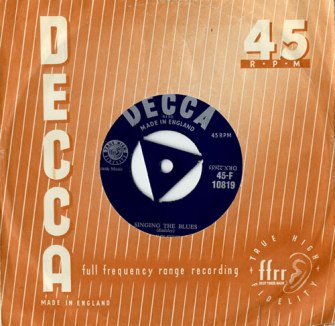
53. ‘Singing the Blues’, by Guy Mitchell

10-78Rpm-Guy-Mitchell-Singing-The

Singing the Blues, by Guy Mitchell (his 3rd of four #1s)

1 week, from 4th – 11th January / 1 week from 18th – 25th January / 1 week joint with Frankie Vaughan, from 1st – 8th February 1957 (3 weeks total)

I feel I should post a warning ahead of this next chart-topper because, for the second song in a row: CONTAINS WHISTLING.

Well I never felt more like singin’ the blues, ‘Cause I never thought that I’d ever lose, Your love dear… Why d’you do me this way?

It’s another long gap between #1s for one of the biggest pre-rock stars – longer than the wait endured by Frankie Laine and Johnnie Ray before him – it’s been almost three and a half years since Mitchell’s second chart-topper ‘Look at That Girl’. It’s quite nice too, in a way, that the three biggest male singers of the early to mid 1950s have lined up for one last hurrah before the new guard swoop in. And it’s understandable that artists like Guy Mitchell and Johnnie Ray experienced – I don’t know if you could call it a ‘resurgence’, as they had remained popular – success at the dawn of rock ‘n’ roll. I commented on Mitchell’s rock ‘n’ roll edge way back in September 1953, and his voice is just as suited to this rockabilly number.

Like ‘Just Walkin’ in the Rain’, this is another simple little record: guitar, backing singers, Guy Mitchell, and some whistling. Whether or not the whistling is Mitchell’s is unconfirmed. A piano pitches in towards the end to give us the big finish.

Lyrically too, this song is very similar to the one it replaced at the top. He’s feeling lonesome thanks to a lost love. And, instead of taking matters into his own hands, or looking for divine inspiration, as earlier chart-topping stars might have done, he’s just going to have a good old wallow in his misery. He’s resigned to his fate. He’ll cry and cry…

The moon and stars no longer shine, The dream is gone I thought was mine, There’s nothing left for me to do, But cr-y-y-y over you…

3dfa9028eb05e4f4072a50a1d556666a--american-artists-classic-rock

I knew this song, vaguely, as a sort of ‘Heartbeat’ compilation album standard, without ever having really listened to it. It’s a nice tune – much jauntier than its subject matter would suggest – and it’s easing us into what looks like a big ol’ run of rock ‘n’ roll hits. In the ‘Guy Mitchell #1s Chart’ I’d put it in second place, behind ‘Look at That Girl’ but well ahead of the reprehensible ‘She Wears Red Feathers’. #2 out of his #1s, if that makes any sense at all.

However, perhaps the most interesting thing about this record is its bizarre chart run. I mean, just look at that title up there… 1 week on, 1 week off, 1 week one, 1 week off, 1 week joint, divorced, beheaded, survived…. It is, I believe, one of only five records in UK chart history to return to #1 more than once. Let me help you to make head and/or tail of this…

Are you sitting comfortably? Guy Mitchell’s ‘Singing the Blues’ spent four weeks on the chart before climbing to the top for a week. It was then replaced by Tommy Steele with – wait for it – a different version of ‘Singing the Blues’. Mitchell then deposed Tommy Steele after just a week and returned to the top. A week after that he was knocked off for a second time by Frankie Vaughan (thankfully not with another version of ‘Singing the Blues’). A week later it returned to the top for a final week, but had to share pole position with Vaughan, who then claimed the #1 position back for himself a week later and Mitchell’s time at the top finally ended. Phew… It’s possibly the messiest five weeks in UK Charts history. And, frankly, getting replaced at the top by a different version of the same song before returning to number one but having to share the top spot is soooo 1950s! It’s all happened before, of course – David Whitfield and Frankie Laine’s versions of ‘Answer Me’ shared #1 in 1953 while two versions of ‘Cherry Pink and Apple Blossom White’, by Perez Prado and Eddie Calvert, hit the top in 1955 – but never in such a short space of time. It’s peak 1950s! It’s 1950s AF!

52. ‘Just Walkin’ in the Rain’, by Johnnie Ray

R-832873-1374063649-1755.jpeg

Just Walkin’ in the Rain, by Johnnie Ray (his 2nd of three #1s)

7 weeks, from 16th November 1956 to 4th January 1957

And, just like that, we zoom to the end of 1956. And we are reacquainted with another artist whom we haven’t seen for a while…

The last time we met Johnnie Ray, he was snatching a week at number one with the superb ‘Such a Night’. I voted it as ‘Best Record So Far’ in an earlier recap, it was that good. But that was almost three years ago, in the spring of ’54. Ray stood out like a sore thumb – a groaning, pleading, cavorting thumb – amongst the frightfully proper records that were topping the charts back then. Now we’re in somewhat more relaxed, ever-so-slightly more liberal times, it’s no surprise that Johnnie’s back.

The first thing that hits you, as the needle drops, is the whistling. It’s a whistly record. The first record featuring whistling to top the UK Singles Chart. And it’s another simple record – just Ray’s voice, his backing singers, and a guitar. It crossed my mind that it might be a pastiche of ‘Singin’ in the Rain’, as the two songs do bear some similarities. ‘Singin’ in the Rain’s depressed, heartbroken brother perhaps?

Just walkin’ in the rain, Gettin’ soakin’ wet, Torturin’ my heart, By trying to forget…

The way Ray delivers that little ‘by’ is a thing of beauty. He barks it out, angry, heartbroken. You really believe him. As before, his voice makes the whole record. It’s not a regular voice, nor a technically perfect voice, but it is unmistakeable: raspy and croaky – he really does sound like man who’s been up all night, walking in the rain.

Anyway, his walk is a form of water-based therapy, perhaps, as he tries to get over his departed lover. Or maybe it’s water-torture, as there’s a masochistic edge to proceedings: People come to windows, They always stare at me, Shake their heads in sorrow, Sayin’ who can that fool be? He knows they’re watching, but he continues anyway. Lyrically, we are at a crossroads, in terms of male-recorded #1s. These the are self-flagellating lyrics that we have heard many, many times before, about how much pain he is in (see also ‘Here in My Heart’, ‘Outside of Heaven’, ‘Answer Me’, ‘Give Me Your Word’, I could go on…) BUT, unlike in those songs, there is no chance of a positive outcome here. Ray never mentions any hope that his love will return. He’s simply trying to forget. This, then, is more of the sugar-coated cynicism that started creeping into our chart topping records with ‘Why Do Fools Fall in Love’ back in the summer.

By the end of the song, Johnnie is weepin’ and a-wailin’ in superbly melodramatic fashion. I said it before, and I’ll say it again: it’s a crime that he gets looked over in the pantheon of rock ‘n’ roll pioneers/superstars. I can’t sing his praises highly enough. This is a great record (not as great as ‘Such a Night’, but still great). Of course, as I also mentioned in his earlier post, his being erased from the History of Pop Music had a lot to do with his homosexuality. And I did notice, the eagle-eared guy that I am, how there are no pronouns in this song. No hint as to the gender of his lost love….

johnnie-ray-just-walking-in-the-rain-1956-78

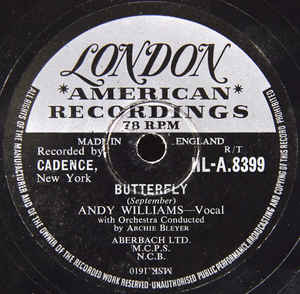
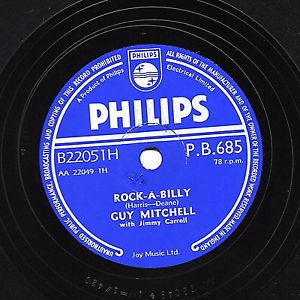
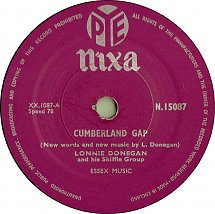
Johnnie Ray will appear one more time in this countdown – fairly soon, in fact – and so I will stop myself from going on too much about how amazing he was. (Though he was) And to finish I’ll address something that’s been bugging me for a while. At the top of each post I always include a picture of the record I’m going to be writing about. And they all look the bloody same. Black vinyl with a little disc circle of colour in the middle (and even that dash of colour is predictable: Phillips records are always blue, Capitol are black, Decca are navy…) I can never seem to find a picture of the record sleeve and, when I do (the jpg that headers Johnnie Ray’s earlier entry, ‘Such a Night’, for example) they are just as bland as the disc. You may have noticed that I sometimes include a picture that looks like it could be the record sleeve -I’ve included the one for ‘Just Walkin’ in the Rain’ above. That’s actually the sheet-music cover, a relic from the days before everyone had gramophones – they would buy the score and learn to play it themselves at home. There were even sheet-music charts before the NME started the record chart upon which this countdown is based. Even more frustratingly, it seems that LPs and EPs did get colourful covers in the 50s; it was only singles that were left to languish in boring, beige paper slips.

Anyway, the point of mentioning this is… I know it looks dull and I wish I could do something about it. I can’t wait for the days when artists and labels actually care about standing out on the shelves, and start including pictures of the band or, shock horror, an artistically though-out design on the cover. Though I fear that may be several years off…

51. ‘A Woman in Love’, by Frankie Laine

s-l300 (2)

A Woman in Love, by Frankie Laine (his 4th and final #1)

4 weeks, from to 19th October to 16th November 1956

Look who’s back!

Almost three years since we last saw him, Frankie Laine is back at the top of the charts for one final hurrah. And it’s not too much of an exaggeration to say that this is something of a re-invention.

I think this is the very first ‘big band’ #1 we’ve seen. It’s from the film version of ‘Guys and Dolls’, and I think it might be a tango, or a foxtrot (I ain’t no dancer). Either way, it begins with a bang, and then it starts swinging. Frankie Laine is a-swingin’.

Your eyes are the eyes of a woman in love, And oh how they give you away… Why try to deny, You’re a woman in love, When I know very well, When I say…

Who is this woman head over heels with? Well, Frankie of course. At least that’s what he thinks: Those eyes are the eyes of a woman in love, And may they gaze ever more into mine…

Contrast these lyrics with Laine’s last chart-topping single from December ’53. ‘Answer Me’ was all about him pleading for a sign that his lover was still, well, in love with him. In ‘A Woman in Love’ he doesn’t need any reassurance, any prayers answered. He knows she’s hot for him. The times they are a-changing.

And then we have one of the best musical interludes that we’ve heard so far in this countdown. The previous chart-toppers haven’t really gone in for solos, but this one does. The whole band gets stuck into a swinging little thirty seconds. There is a lot of swagger in this record. I’m quite enjoying sticking one-word labels on these recent #1s: Pat BooneCrooner, Anne SheltonTwee, Frankie Laine – Swagger! We’ve had an eclectic run of songs hitting the top spot recently, perhaps the most varied run of this countdown so far, but in a way they’ve all been very of their time. Popular music right on the cusp of the rock ‘n’ roll invasion.

The only thing that spoils this record is the finale. Frankie may have re-invented himself, but he still loves a big ending: Crazily, ga-aze, e-ever mo-ore into MIIIIIIINNNNEEE! Every time I hear an ending like that it sounds more and more old-fashioned. I can’t imagine there’ll be many more, though. Surely. But, overall, this is a small complaint. It’s a great song. Laine’s voice is as warm and as listenable as ever. He and Doris Day should have recorded a duet (*edit* they did – ‘Sugarbush’ back in 1952).

06cab955448883c79c5103ab82addae5--arthur-godfrey-singer

And so we bid farewell to perhaps the biggest of all the pre-rock stars. Four number one singles adding up to 32 (thirty-two!) weeks at the top. That’s pretty darn impressive, and leaves him at 5th place in the all-time list behind only…. I’ll give you a few seconds to guess… Elvis, The Beatles, Cliff and The Shadows. And, actually, I’m harping on about this being a ‘re-invention’ and a ‘comeback’ for Laine, but he hadn’t been anywhere. In the three years between his 3rd and 4th #1s he had still racked up a whole pile of top ten hits. He was huge. ‘A Woman in Love’ would, though, be his penultimate top ten single in the UK.

One final thought… This track made Frankie Laine the artist with the most UK #1s at this point. With four. It’s noticeable that we haven’t yet met an artist who has scored, or will even go on to score, more than four. These early charts were a very egalitarian place – songs only got to the top because they were… I don’t want to say ‘good’ because, well… let’s say: ‘universally popular’. The days of super-star idols, of huge fan-base acts whose every release races to the top of the charts – your Take Thats, Westlifes, Spice Girls – are still not upon us. But they will be sooner than you might think, and their arrival has a lot to do with this new-fangled thing called rock ‘n’ roll.

50. ‘Lay Down Your Arms’, by Anne Shelton

R-1777608-1390913449-3620.jpeg.jpg

Lay Down Your Arms, by Anne Shelton (her 1st and only #1)

4 weeks, from to 21st September to 19th October 1956

We hit the half-century and meet a genre we haven’t encountered yet… The military march!

A couple of times now I’ve mentioned records that, upon reaching the top of the chart, represent a ‘one step forward, two steps back’ moment. Most famously when David Whitfield took the frightfully stiff ‘Cara Mia’ to the top shortly after Johnnie Ray’s superbly raunchy ‘Such a Night’. But this… This takes it to another level.

*Ah 1, 2, ah 1, 2, 3* Come to the station, Jump from the train, March at the double, Down lover’s lane, Then in the glen, Where the roses entwine, Lay down your arms… And surrender to mine!

Anne Shelton loves a soldier, but he’s been called away on duty. Such is a soldier’s life. He gets some leave but now, after spending all week doing what the Seargent demands, he has to manfully obey his lover’s commands. I feel sorry for him. Anne Shelton sounds pretty high-maintenance.

There is one word for this record… One adjective to do it justice. It is twee. So very twee. I’d brand it as a novelty song, if it weren’t all so very earnest. Shelton sounds like a Girl Guide leader – albeit one on her third sherry of the evening – striding out betwixt the heather, bellowing out the chorus as if summoning her hounds. It’s like a P.G. Wodehouse character, one of Bertie Wooster’s aunts perhaps, has come to life and recorded a hit single.

For the most part Shelton’s pronunciation is immaculate, her ‘t’s clipped and her ‘r’s rolled. Yet at the end of every verse, she gets a little… um… playful. She admonishes her serviceman: You’ve got to do your duty, wherever you may be, And now you’re under orders, To hurry home to me… I can’t describe the way she delivers the last part of that line. It’s not with a giggle, but… It’s like a middle-aged biology teacher flirting with a 6th-form boy on the last day of term.

lay-down-your-arms-and-surrender-to-mine-featuring-anne-shelton

It’s a bizarre record. But the more I listen to ‘Lay Down Your Arms’, the more I like it. It’s kooky, in a way. I have no idea why it hit #1 in the autumn of 1956. It sounds as if it should have been a smash in 1941. Perhaps it was the revenge of the old-timers, who saw all these young stars with their shiny teeth and their guitars beginning to clog up the charts, and decided to restore order. But the fact that this was a chart-topper after ‘Why Do Fools Fall in Love’, and just a few months before the rock ‘n’ roll invasion really took hold, is an example of why the pop charts are such wonderful things. Anything can get to the top as long as enough people want it to.

I, of course, knew nothing about Anne Shelton before coming across this record. It seems she was a bit of a mini-Vera Lynn, in that she was another ‘Forces Sweetheart’ who recorded inspirational songs for troops, and also performed at military bases during the war. But this song was written and recorded for the first time in 1956 – eleven years after the war’s end. Somehow, there was still a demand for this kind of thing. Maybe it struck a chord with people in the days of National Service? I was joking a minute ago, when I suggested the old folks were somehow responding to rock ‘n’ roll by sending some ‘proper’ music up the charts, but maybe there’s some truth in that too.

Or, maybe it’s as simple as the fact that, throughout chart history, every so often an oldie gets through. Louis Armstrong did it. Cher did it. Cliff kept doing it. The grannies unite, everybody else sneaks out to buy it when their mates aren’t looking, and Anne Shelton gets a month on top of the UK singles charts.

49. ‘Whatever Will Be, Will Be (Que Sera Sera)’, by Doris Day

doris-day-whatever-will-be-will-be-philips-78-s

Whatever Will Be Will Be (Que Sera Sera), by Doris Day (her 2nd of two #1s)

6 weeks, from 10th August to 21st September 1956

Following on from one super-famous song is… another super-famous song. An even more super-famous song. One of the most famous songs ever?

Que sera sera, Whatever will be will be, The future’s not ours to see, Que sera sera…

People know these lyrics. Even today, sixty-two years on, I’ll bet if you stopped someone on the streets, even a fairly young person, and started singing that line they would be able to finish it. Go on – try it today. (I won’t be held responsible for any subsequent strange looks or slaps in the face).

But, having actually listened to the song, I now wonder if the lyrics are more famous than the recording. It’s very Italiany, with a flourish of guitars (mandolins?) at the start. It’s short and very simple – just said guitar, Doris Day, some violins and the mandatory backing singers. The singer asks her mother if she’ll be pretty and rich, then asks her sweetheart what lies ahead, then fields the very same questions from her own children. It’s a mantra for life: Que sera sera.

As I noted in her previous entry, Day has an irresistible voice. A proper voice, with all the proper enunciation and pronunciation; but with enough of a giggle, and a little huskiness, to make it the sort of voice you want to listen to. She only had two chart-toppers, but ‘Secret Love’ clung to the top spot for nine weeks while this one took up residency for six. There are plenty of acts with more #1s but far less time spent at the top. And as this is the last we’ll hear from Miss Day, let me take the time to point you in the direction of her 1963 classic ‘Move Over Darling’, a song I first heard as a pup on a ‘Steve Wright’s Sunday Love Songs CD’ and which I love to this day. It’s far superior to either of her chart-toppers too, IMHO…

The_Man_Who_Knew_Too_Much_trailer_screenshot_Doris_Day_Que_Sera,_Sera

I’ve done my obligatory Wikipedia-based research and have turfed up two little interesting facts. This song, like ‘Secret Love’, was from a movie in which Day starred: Hitchcock’s ‘The Man Who Knew Too Much’ (it really doesn’t sound like a song from a Hitchcock film, but hey). And… the title is neither correct in French (which I – with a decent A-Level in said language – assumed it was), Spanish or Italian. It is, essentially, gibberish.

But, before we end, let’s step back and look at the bigger picture. I really feel that this, along with ‘Why Do Fools Fall in Love’ before it, is ushering in a new era at the top of the UK chart. Two huge, well-known songs. This song has become a football chant, still used to this day, for God’s sake! Plus, Doris Day is still going strong, aged ninety-six, as is Pat Boone from two chart-toppers ago. These songs covered in this countdown are slowly growing more and more tied to the modern world.

Perhaps this song’s influence is best summed up by this tale. Every year I go to a German beer festival in Hong Kong. And every year, without fail, before the overweight men in nipple tassels, before the ‘Big German Horn Blowing Contests’ and before we do the YMCA on the tables, the band plays ‘Whatever Will Be Will Be’. And everyone sings along.

48. ‘Why Do Fools Fall In Love’, by The Teenagers ft. Frankie Lymon

s-l300 (1)

Why Do Fools Fall in Love, by The Teenagers ft. Frankie Lymon (their 1st and only #1)

3 weeks, from 20th July to 10th August 1956

Ah-doo-ma-da-doo-ma-da-doo-ma-doo-doo-doo…

The perfect antidote to our recent, saccharine-heavy chart toppers.

Ooh-wa-ooh-wa-wa…

This is one of the very few songs we’ve covered so far that I don’t think I need to really describe. Surely everyone knows this?

Why do birds si-ing, so gay? And lovers await the break of day? Why do they fall in love?

It’s a breathless, relentless song: two minutes twenty seconds packed with vocal harmonies, scattish drums and a brilliantly aggressive saxophone solo. There are certain records that simply had to have topped the charts, so seismic are they in shaping the history of pop music. This is one of them. It’s a great record. A classic. I love it.

But… That’s not good enough. I can’t leave it there – the shortest post yet. Let’s do this track justice. Why is it such a classic?

Firstly, Frankie Lymon’s voice. One of the things I know about this track, without doing any research, is that Lymon was just thirteen when he recorded this song. His voice is perfect. Not technically perfect, mind: it cracks and breaks a couple of times. But perfect for a song about first love, about being in love and getting rejected and, rather than wallowing in self-pity and whining about how you’ll wait for ever and a day for your loved one (c.f pretty much every male-led #1 thus far), it’s about shrugging your shoulders and realising what a fool you’ve been. It’s a wonderfully cynical record. Lymon sounds just like a heart-broken teenage boy, full of hurt and bravado. Because he was.

frankielymonteens-56d4fa3a5f9b5879cc92ad60

Which brings us onto the second reason. This is a song for teenagers, by teenagers. Literally: it’s by ‘The Teenagers’. Lymon was the youngest of the five, but none of the others were any older than sixteen when this song hit the top spot. Bill Haley, on the other hand, was thirty. This is the next big step in rock ‘n’ roll’s evolution. While this is strictly a doo-wop record, I make it the 4th rock ‘n’ roll record to top the charts. And I’m being pretty generous in making it four. But, interestingly, the four tracks have all been lyrically very distinct. Bear with me. ‘Such a Night’ was all about sex, ‘Rock Around the Clock’ about partying (and maybe a little bit of sex), ‘Rock And Roll Waltz’ about uncool parents and now ‘Why Do Fools…’ gives us hormonal heartbreak. We just need a song about vomiting all over a friend’s back garden at a house party to get the full set.

Reason number three? This is the first song I’ve covered on this blog, I believe – and bear in mind that we are forty-eight songs in now – in which you can’t make out all the words. The line I quoted back at the start? I had to check the lyrics online. I thought it went And lovers who wait to play all day… And the line: Why does my heart skip a crazy beat? Before I know it will reach defeat… I always thought it was… it will re-tweet tweet… Whatever that might have meant in 1956. A basic cornerstone of rock music is slurred lyrics that you can’t immediately understand and which, more importantly, annoy your parents because they’re not sung PROPERLY!

The fourth, and final, reason…? Well, it’s just a great song. A summer smash. It oozes New York city: steam, water spraying from a sidewalk valve, the sun blasting down, the Jets and the Sharks… I dunno. I grew up in small town Scotland. I first really got to know this song after buying an old second-hand CD compilation called ‘Don’t Stop, Doo-Wop’. It was brilliant; twenty-odd fifties and sixties doo-wop tracks, a few more of which will feature in this countdown. I wish I knew what I’d done with it.

Unfortunately, this will be The Teenagers one and only appearance here. Not that they were one-hit wonders, though, as they followed this classic up with the excellently titled ‘I’m Not a Juvenile Delinquent’.

Even more unfortunately – tragically, in fact – Frankie Lymon trod a very rock ‘n’ roll path following this early success. By 1957 he had struck out on his own, away from The Teenagers. Aged 15, however, he was also a heroin addict and a lover to women twice his age. His career was ended by this addiction, and by the simple fact of his voice breaking. He lost his only child when she was just two days old. He died of an overdose, in 1968, at the horribly young age of twenty-five, on his grandmother’s bathroom floor. I mean… That’s a grim tale. As trite as it sounds though, what better way to remember him than as a fresh-faced, fresh voiced kid singing about fools in love?

One more time then: Ooh-wa-ooh-wa-wa…

47. ‘I’ll Be Home’, by Pat Boone

PAT_BOONE_ILL+BE+HOME+-+SILVER-562513

I’ll Be Home, by Pat Boone (his 1st and only #1)

5 weeks, from 15th June to 20th July 1956

Having just read back through my last post – poor old Ronnie Hilton – I feel I’ve been a bit harsh recently. So I’ve decided: I need to approach these records with emptier ears, by dropping all my modern inclinations and pre-conceptions and by just listening to the records. By realising the difference between a record that is bad, and one that I simply dislike. By being – and this is going to be an immense struggle for someone like me – less judgemental. Here goes…

I’ll be home… My darling… Please wait for me… We’ll stroll along together… Once more our love will be free… A piano plinks, a guitar strums, the backing singers hum. This is possibly the gentlest number one yet. And Pat Boone? Well, there’s only one word for what he’s doing. He is crooning. He is crooning the hell out of this record. This is dictionary-definition crooning

This is a post-pre rock/pre-rock n roll ballad, if you get what I mean. File it alongside ‘It’s Almost Tomorrow’ from a few posts ago. The lyrics are a little more youth-orientated (some lines about meeting at the corner drug store on a Saturday) and the chord progressions are that of a modern pop song. I do quite like what he does with the words moo-ooo-ooon light and toge-e-e-ther, and the abrupt pause after the line My mind’s made up… There’s a playful hint to the song. But it’s way too saccharine. It reminds me of that ‘Father Ted’ episode, where Mrs Doyle wins a competition to meet a Daniel O’Donnell-esque singer (Eoin McLove – I’ve just checked). Eoin McLove would definitely have sung this song.

There’s also – abruptly and brilliantly – a spoken word section. Oh yes. Midway through, Boone draws up to the mic, and talks directly to us, making this the first in a niche group of #1 hits, along with classics such as ‘Are You Lonesome Tonight’, and ‘Never Ever’ by All Saints. Darling, as I write this letter, here’s hoping you’re thinking of me… His love shouldn’t worry, he’ll be home soon (HOW MANY MORE of these male-led hits are going to be about pining for your loved one?? I get that these were days of war in Korea and of National Service but still – I doubt we’ll ever see a more dominant lyrical theme in any other era!) I’ll be home, to start serving you… That’s nice. It’s a nice (ish) song. There. Maybe not worth a 5 week stay at the top, but hey. I managed a critique without writing anything too biting. Well done me. But, wait a second…

A sinister under-belly requires tickling. You see, this particular song is an example of something that went on a lot in the fifties. Pat Boone, Frankie Laine, Elvis et al got rich and famous by recording songs written and originally recorded by black artists. Because they were white an’ wholesome, their records sold more. It was a big thing in the US; less in the UK (see Winifred Atwell and the record that succeeded this one at the top). ‘I’ll Be Home’ was originally recorded by The Flamingoes, a black doo-wop group. The B-side was a whitewashed cover of ‘Tutti Frutti.’ A sign of the times, but not great.

6a00d8341c85cd53ef01b8d06e3638970c-800wi

And the plot thickens further. Before this, I’d heard of Pat Boone for two reasons. One, was a line in a Snoop Dogg song (‘Beautiful’) where he claims a girl is too good and wants to stay home listening to Pat Boone, of all people. Two – Mr Boone (who’s still alive, aged eighty-three) is an ultra-conservative Christian. A proper Fox News, evangelising, pray-the-gay-away kind of Christian. I knew this, somehow, but didn’t know quite how bad it was. And it’s bad. Here are some of his greatest hits – all from Wikipedia, take from that what you will – which have nothing to do with his sole chart topping hit in 1956, but sure are amusing (make that terrifying):

A) He refused to star in a film with a star as sexy as Marilyn Monroe, as it would have compromised his beliefs. B) He has compared liberalism to cancer. C) He has compared gay rights activism to Islamic terrorism, and has campaigned against Democratic candidates with the claim that they want to turn Kentucky into San Francisco. D) He loves war, and has claimed that any opponents of the Vietnam War, and both Iraq wars, neither loved their country nor respect their elders. E) He – perhaps inevitably – believes that Barack Obama shouldn’t have served as President, due to his fluency in Arabic and his love for the Koran… Suddenly, all that money and recognition he stole off black artists in the ’50s starts to look even more sinister, no?

Hilariously, he was kicked off a Gospel Music show he hosted in 1997 after releasing an album of heavy metal and hard rock covers, including ‘Smoke on the Water’, ‘Paradise City’ and, oh yes, ‘No More Mr. Nice Guy’. Tragically this album doesn’t seem to be on Spotify, but I’m including the link to his version of ‘Enter Sandman’ here. You have been warned…

I could go on but don’t have all day, and that did go slightly off topic. Apologies. Basically, Pat Boone, it was nice meeting you. You sound a bit mental. Onwards.

46. ‘No Other Love’, by Ronnie Hilton

271927944821

No Other Love, by Ronnie Hilton (his 1st and only #1)

6 weeks, from 4th May to 15th June 1956

Through writing these blog posts, I’m becoming a strong believer in nominative determinism. I.e. through looking at the name of the recording artist one can anticipate what the song will sound like. Not that anyone’s been called Sax Jazzington, or anything silly like that. More like how Kay Starr sounds fun and flirty, Slim Whitman sounds grizzled and lonesome, Jimmy Young sounds… normal, and a little dull. I feel that Ronnie Hilton should fall into the latter category.

And, lo and behold, he does. It starts dramatically enough, though: a burst of cymbals, then another, then another… Then it feels like a step back in time, to the dark days of *shudder* David Whitfield. It’s semi-operatic, its over the top, it’s not a particularly easy listen. Hilton’s voice is overwrought. It’s a powerful voice, a technically very good voice, the sort of voice that your gran would have approved of; but it’s too much. It’s probably no worse than the Whitfield, Laine days of a couple years back, but it already sounds very dated coming so soon after more progressive-sounding records by Bill Haley, Alma Cogan and even Dean Martin.

Lyrically too, this is a song that’s been done before. No other love have I… Into your arms I’ll fly… Waiting to hear you say… ‘No other love have I’. He’s a little lovelorn, is Mr Hilton. I’ve mentioned it before, but why is it the girls that have all the fun in these early chart toppers? With a few exceptions (Vera Lynn, cough cough) they get to be perky and flirty while the men stay at home and stoically wait for their love to be fulfilled.

One thing I was certain of, without doing any kind of research, is that Ronnie Hilton was British. His voice has that properness, that stoicism, void of any kind of vulgar, American swagger. One other thing that I was pretty certain of, again before delving into Wikipedia and around, is that ‘No Other Love’ must have been from a soundtrack, such is its unnervingly bombastic approach to what is an otherwise very basic love song. And yes, it’s a Rogers & Hammerstein number, from their 1953 show ‘Me and Juliet’.

A-439529-1148657608.jpeg

Actually, the most surprising thing I could uncover about Ronnie Hilton – this is his only appearance at the top so let’s give him a moment in the sun – is that ‘Ronnie Hilton’ was his stage name. He was born Adrian Hill. Let that sink in for a second: he, or somebody advising him, thought Adrian Hill was a little too boring, a little too staid, and that ‘Ronnie Hilton’ would get the girls swooning. I think that just sums him, this song, and this whole pre-rock era up… If you’re going to change your name in an attempt to gain fame and glory for God’s sake try to come up with something slightly sexy. No?

And – perhaps just as interestingly – Hilton recorded a fairly successful (in the UK at least) version of ‘The Wonder of You’, eleven years before Elvis Presley made it a standard. But… listen to Hilton’s version, then Presley’s version, and it becomes clear why the latter was one of the most famous voices, and personalities, of the 20th Century and the former wasn’t.

I’m being a little down on Ronnie Hilton, really, so let’s give him a break and end with something completely unrelated. Something that just occurred to me as I wrote the intro to this post. The only reason that my nominative determinism theory works is because I have heard so few of these early number one hits. I write the title down, search them out on Spotify, and take a step into the unknown. But, looking down the list of UK #1s through the remainder of 1956, through ’57 and ’58, this is going to become less and less of a thing. I know several of the next twenty or thirty records. Soon I’ll know the majority of them. Of course, every so often, even as we get to the eighties and nineties, there will be songs I simply have never heard before (I have no idea how ‘Doop’, by Doop, goes for example – and it had 3 weeks at the top in 1994) but, on the whole, we are slowly stepping out of the mist and onto firmer, better known ground.