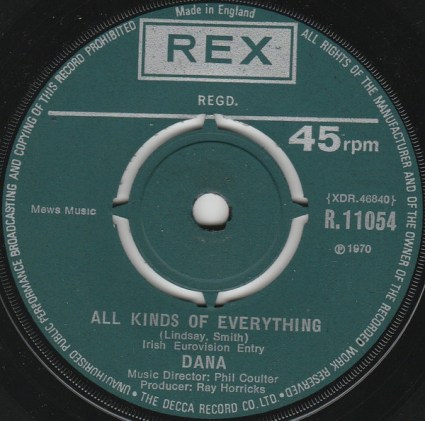
284. ‘All Kinds of Everything’, by Dana

We are only four #1 singles into the 1970s, and we already have a contender for the worst chart-topper of the decade. Prepare yourselves…

dana

All Kinds of Everything, by Dana (her 1st and only #1)

2 weeks, from 12th – 26th April 1970

The intro comes in like the theme-tune to an educational show, aimed at nursery school kids. You brace for something bad, but nothing can quite prepare you for just how bad it’s going to be. Snowdrops and daffodils, Butterflies and bees, Sailboats and fishermen, Things of the sea… The entire song is a list. A list of the things that remind the singer of her special someone. Seagulls, And aeroplanes, Things of the sky… (Seagulls? Who sees a seagull and thinks of their beloved? Maybe he saved her from one that was trying to steal her chips?) All kinds of everything, Remind me of you…

Literally everything reminds her of him. Insects, the wind, wishing wells, morning dew, neon lights, postcards, grey skies or blue… Everything. It just doesn’t work. These are lyrics that could have been written by a ten-year-old (though, actually, I teach ten-year-olds, and it’s insulting of me to think they couldn’t write something better than this.) The only way this song works is if the singer is a wide-eyed child, no older than thirteen.

And, to be fair, Dana does have a very innocent, childlike voice. She sells the drivel that she’s singing, in her lilting Irish accent, and sounds like she believes in it… (*Edit* She was eighteen when ‘All Kinds of Everything’ was released. Far too old.) Things take a slightly creepy turn when she starts to sing of dances, romances, things of the night… And you think, be careful Dana, I know what happens to young Irish girls that find themselves ‘in trouble’. I’ve seen ‘Philomena’…

R-1706278-1477809062-9075.jpeg

This was a hit thanks to the Eurovision Song Contest – an evening famous for terrible music. But not this type of terrible. Eurovision is over the top, camp, cheesy glitz. We’ve had one winner hit #1 so far – Sandie Shaw’s ‘Puppet on a String’ – as well as Cliff’s ‘Congratulations’, which took the runners-up position. Neither of those records were very credible, but they were fun. This, though, isn’t interesting terrible or fun terrible… It’s just terrible terrible. And yet… it won. The rest of Europe heard ‘All Kinds of Everything’ and thought, yeah, go on then.

‘All Kinds of Everything’ was Dana’s first big hit, though she had been releasing music since 1967, and it gave Ireland their first Eurovision win. She would have hits in Ireland, and in Europe, throughout the seventies, but her star slowly waned. By the eighties she had turned to more traditional, Christian music before she was elected as a member of the European Parliament for Connacht-Ulster in 1999. She still records music (in 2007 she released an album called ‘Good Morning Jesus!’, no less.)

Well then. It’s been a scattergun start to the seventies. Like I said, we’re only on the 4th number one and we’ve already had some catchy, no-nonsense pop, a grizzled actor and a genuine classic at the top. And now this… The charts come and go in peaks and troughs. We’re definitely hitting a bit of a trough through the tail-end of ‘69 and into the seventies. But then, the golden days of the swinging sixties couldn’t last forever, could they? We will wait with bated breath for the 1970s to spring fully into life…

275. ‘In the Year 2525 (Exordium and Terminus)’, by Zager & Evans

You see the title of this next #1 hit, and you prepare yourself for something special. We’re off to the year 2525… With a duo that sound like a second-rate magic act.

mainZAGER

In the Year 2525 (Exordium and Terminus), by Zager and Evans (their 1st and only #1)

3 weeks, from 24th August – 14th September 1969

It gets underway with a Spanish guitar and Mariachi-band backing. It reminds me of Dave Dee and Co’s ‘The Legend of Xanadu’, another Latin-flavoured glimpse into a strange world. In the year 2525, If man is still alive, If woman can survive, They may find…

In comes a relentless galloping beat, over which a terrifying vision of the future is unveiled. By the year 3535, you’ll be taking pills to tell you what to think, by 4545 you won’t need your teeth or your eyes… You won’t find a thing to chew, Nobody’s gonna look at you… In 5555, the machines will have taken all the jobs, rendering our limbs obsolete. And by 6565: Ain’t gonna need no husband, Won’t need no wife… You’ll pick your son, Pick your daughter too, From the bottom of a long glass tube… Woah-woah…

Fair to say it’s a pretty pessimistic view of the future. It has the air of a crazed evangelist, preaching angrily from his pulpit, as all the while the beat goes on, and on. The predictions change to years ending in ten, for rhyming purposes, as we go forward. And by 8510, God will have had enough, and will come down to rip it all up and start again. It’s a crazy record. I’m not sure I like it all that much, but it is entertaining…

The final verse is probably the most prescient. In the year 9595, I’m kinda wonderin’, If man is gonna be alive, He’s taken everything this old earth can give, And he ain’t put back nothin’… Woah-woah… Doesn’t that pretty much sum up the fears of 2020, with our rising temperatures, killer viruses and plastic-swilling oceans? In fact, Zager & Evans’ vision of the future hinges on its opening line: If man is still alive… Who here’s willing to put money on humans being around in 2125, let alone 2525?

ZAGER_&_EVANS_IN+THE+YEAR+2525-640089

We’re used to science fiction that looks into the near-future: ‘Back to the Future’ in 2015, ‘Terminator’ in 2029 and so on, so that we can chuckle when we reach the date in question and point out that none of what was predicted has come to pass. But who can actually get their head around the year 2525? It’s five hundred and five years away! And the year 9595, on which the song ends – it is practically impossible for the human mind to imagine that far forward in time. ‘In the Year 2525’ was nominated for a ‘Hugo Award’, for the best science fiction / fantasy works of the year, though, so who am I to question it?

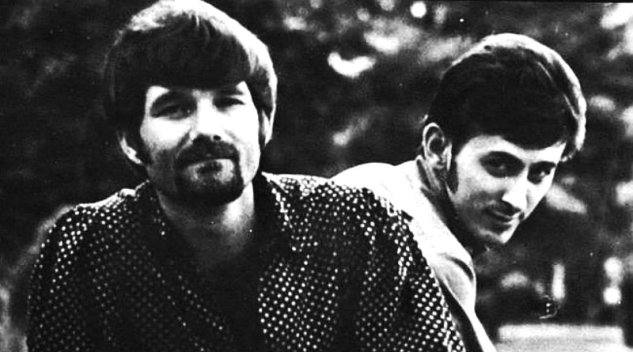
Denny Zager and Rick Evans were a duo from Lincoln, Nebraska, and they are the purest of one-hit wonders. None of their subsequent follow-ups made the charts. This is their sole chart-topping single, on either side of the Atlantic (fittingly, it was #1 in the US as Neil Armstrong set foot on the moon.) Zager is still alive, but Evans sadly passed-away in 2018.

We’re drawing to the end of the 1960s, and this record is almost the direct antithesis of a lot of the positivity we’ve seen in pop music throughout the decade. In fact, 1969 has been a year for some pretty cynical chart-toppers: Peter Sarstedt’s cutting ‘Where Do You Go To…’, The Beatles sarcastic ‘Ballad of John and Yoko’, The Move’s melodramatic break-up in ‘Blackberry Way’. Now this anti-flower power anthem. Two years ago it was ‘All You Need Is Love’; now it’s all the ways in which we, as a race, are doomed…

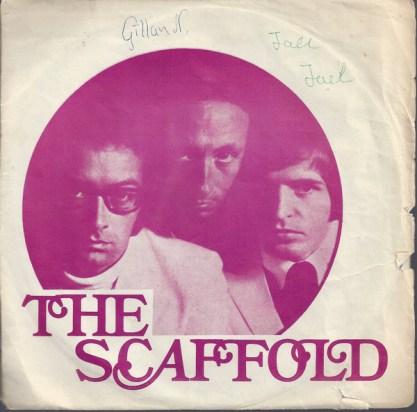
262. ‘Lily the Pink’, by The Scaffold

The final number one single of 1968! Over the course of the twenty-one records that have topped the charts this year, we’ve met a wide range of characters: Bonnie & Clyde, Quinn the Eskimo, Cinderella Rockefella, Lady Madonna… Now please welcome, last but by no means least, Lily the Pink!

Scaffold-1010482

Lily the Pink, by The Scaffold (their 1st and only #1)

3 weeks, from 11th December 1968 – 1st January 1969 / 1 week, from 8th – 15th January 1969 (4 weeks total)

We’ll drink a drink a drink, To Lily the Pink, The saviour of, The human race… The pace is frenetic, the song charges along on an oompah-band beat. For she invented, Medicinal compound, Most efficacious, In every case… And it’s not just Lily the Pink that we meet either, but the cast of poor souls that her medicinal compound has helped.

There’s Mr Frears, with his sticky-out ears… The notably bony Brother Tony… Old Ebeneezer, who thought he was Julius Caesar… Jennifer Eccles, with her terrible freckles… You get the idea. It’s a novelty song. Perfect for a Christmas party, last-orders down the pub sing-along when everybody’s a bit pissed. Pure music-hall.

It reminds me of two, very different songs. First, there’s ‘Oom-pah-pah’, from the musical ‘Oliver!’ Another rowdy bar-room tune, in which the drinkers raise their glasses to the life-giving properties of the mythical ‘oom-pah-pah’. It’s a classic. Secondly, this also reminds me, with its boing-boing rhythm, of another (in)famous Christmas #1… ‘Mr Blobby’. (Which very much isn’t a classic.)

‘Lily the Pink’ falls somewhere in between these two songs. It’s fun, for a verse or two, and then it gets pretty old pretty quick. There’s an unfortunate stuttering verse – Johnny Hammer, Had a terrible s-s-s-s-stammer… – and it’s very hammy by the end, when the medicinal compound proves too strong even for Lily the Pink, and she snuffs it. It’s definitely a song that would improve the more you drink…

R-8669325-1546580204-5379.jpeg

Speaking of which, it is based on a much older, American drinking song – ‘The Ballad of Lydia Pinkham’ – which in turn was inspired by an actual drug – Lydia E. Pinkham’s Vegetable Compound, from the 1870s, which relieved menstrual cramps. The fact that it was 40 proof alcohol meant that plenty of people not suffering from period-pains drank it anyway… And apparently the original verses were saucier even than The Scaffold’s end-of-the-pier version.

Just as interesting as the song’s origins are the musicians involved in its recording. The Scaffold were a comedy trio from Liverpool – one of whom was Peter McCartney (brother of Paul.) Musicians they were not, and so to help them on ‘Lily the Pink’ you can hear Graham Nash of The Hollies (the line about ‘Jennifer Eccles’ is a reference to a Hollies’ hit), Tim Rice and an unknown singer by the name of Reginald Dwight, who may or may not have gone on to bigger things under a different name.

What’s that? You thought that 1968 was going to finish off with some bland, run-of-the-mill pop song? Well you haven’t been paying attention, have you? This year has brought us the most eclectic bunch of #1s so far. We’ve veered from silly novelties, to bizarro fantasy epics, from spaghetti western soundtracks to the birth of shock-rock. All with healthy doses of jazz, crooning, rock ‘n’ roll, and Cliff, in between. Next up, we tick on over into the final year of the swinging sixties, and hope that it can be half as interesting as the year just gone…

Enjoy all the number ones from 1968, and earlier, here:

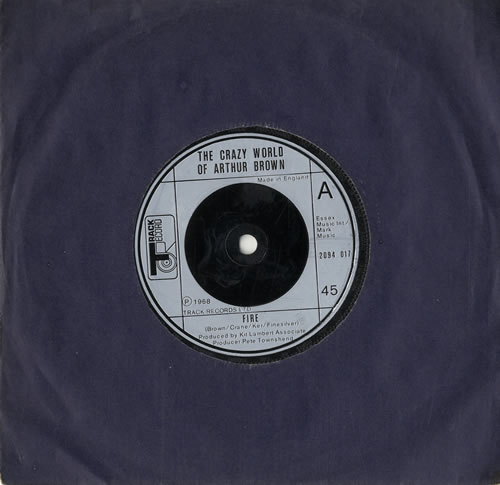
255. ‘Fire’, by The Crazy World of Arthur Brown

1968 strikes again! Our next #1 kicks off with a yell straight from the sulphurous pits. I am the God of hell-fire, And I bring you…! Well, they do say that rock ‘n’ roll is the devil’s music…

A8D9EE94-33C2-40A9-AD2A-FB394DE92EB0

Fire, by The Crazy World of Arthur Brown (their 1st and only #1)

1 week, from 14th – 21st August 1968

Fire, I’ll take you to burn…! As an opening statement, it’s pretty aggressive…. Fire, I’ll take you to learn…! Demonic horns and a Satanic organ, playing as if it were possessed, join in with the fun as the ground splits in two below our feet and we tumble into the roasting furnace. I’ll see you burn…

This is, and I mean this in the best possible way, a crazy record. The Crazy World of Arthur Brown certainly live up to their name. That it hit the top of the singles chart for a week in the summer of ’68 is something to be marvelled at, and enjoyed. It’s harsh, it’s angry… It’s an anthem dedicated to nihilism and arson: You fought hard, And you saved and earned, But all of it’s going to burn… Arthur Brown then launches into an Ohhh Noooo and a series of yelps and squawks that Axl Rose in his prime would have been proud of. Wiki lists ‘Fire’ as ‘psychedelic’, which it is… But that’s only telling a tiny part of the story. This is hair metal and shock-rock, Alice Cooper, Ozzy Osbourne and Iron Maiden, before any of that was a thing. Fire… To destroy all you’ve done…

The second verse slows down, like the soundtrack to an eerie, cheapo haunted mansion ride, before the grinding organ and horns snap back in and we head relentlessly towards the finish. We get crazed laughter, shrieks, the horns blasting ever stronger, before the winds of hell blow us on our way. You’re gonna burn…burn burn burn burnburnburn…! Apparently Brown used to perform this track while wearing a helmet that had been doused in fuel and set alight (see the pic above). Because of course he did…

ARTHUR_BROWN_FIRE-549906

They also say that the devil has the best tunes, but I’m not so sure about that being the case here. This is an amazing record, an experience; but not one that I’m desperate to repeat many more times. Perhaps it’s a truly awesome record… ‘Awesome’ in the literal sense of inspiring fear, as in the ‘awesome’ power of an atomic bomb.

I am convinced that there must have been some controversy around this disc hitting the top of the charts – that at least Mary Whitehouse and the Archbishop of Canterbury got their knickers in a twist over it – but can’t find much evidence online. It shows how far society had come in the decade or so since Elvis was getting cropped at the waist, I guess.

The Crazy World of Arthur Brown, largely Brown and organist Vincent Crane, are one-hit wonders in the truest sense. None of their other singles – either before or after – managed to chart in the UK. But their legacy lives on –  all the metal stars I listed above count them as an influence, while ‘Fire’ has been sampled by The Prodigy and Marilyn Manson. Arthur Brown still performs, aged seventy-seven, and still sets his helmet on fire…

I feel like I’ve been writing this at the end of nearly every recent post, but it bears repeating… What else has 1968 got in store for us? Surely it can’t get any weirder than this…?

246. ‘The Legend of Xanadu’, by Dave Dee, Dozy, Beaky, Mick & Tich

Just what on earth was being pumped into the British water supply in early 1968? Trad jazz, Bonnie and Clyde, Eskimos and yodelling duos… Something pretty heavy duty was being passed around, by both record makers and record buyers, to induce this carnival of craziness. And it shows no signs yet of letting up. For we’re off to Xanadu!

61eoLpiILKL._SY355_

The Legend of Xanadu, by Dave Dee, Dozy, Beaky, Mick & Tich (their 1st and only #1)

1 week, from 20th – 27th March 1968

We open on a dusty Andalucian plain. Spanish guitars tremble, somebody mumbles something something esta es… Then wham. A whip cracks. Or somebody shoots a B-movie ray-gun. Whatever it is, it wakes up both you and this song. We’re in cartoon soundtrack territory. Imagine Scooby Doo on a far-away planet that looks a lot like Mexico. That sentence might sound crazy, but that’s where we are right now, with #1 single 246.

You’ll hear my voice, On the wind, ‘Cross the sand… For all the zaniness of the extra bits – the sound effects, the Mariachi band and what have you – the main melody of the song is pretty traditional. Old-fashioned even – something with a hint of 1961 about it. If you should return, To that black, barren land that bears the name of… Xanadu!

The lyrics, as far as I can follow, are about a spurned lover destined to see out his days in a forgotten land. I’m listening carefully, to see if there might be a metaphor hidden away in there – that the singer is actually just imagining himself in this black, barren land – but I can’t find any. This is literally a song about a far-off place called Xanadu, and a lonely man who lives there.

We arrive, of course we do, at a spoken word section that makes this song feel even more like a theme-tune. What was it to you that a man laid down his life for your love…? So wait… he’s dead? And Xanadu is some kind of afterlife? It ends with a question: Will you find your way back someday, To Xanadu…?

71vwdmJYYML._SL1280_

Not if I can help it, mate… I jest. I like this song. It’s grown on me over the past four or five listens. I now find myself swaying and shaking imaginary maracas as it ends. ‘The Legend of Xanadu’ is crazy – the craziest record yet this year (and that’s a high bar!) But I’m going to have to do some research to find out what on earth inspired this hit single and got it all the way to the top of the charts…

It’s not from a movie, nor is it the theme to a cartoon. It’s a stand-alone pop single by an already established band. More on them later. Research into ‘Xanadu’ takes you all the way to Inner Mongolia in the late 13th Century – a capital of China, used as a residence by the Khans and ‘discovered’ by Marco Polo, via the biggest private estate in the world from the movie ‘Citizen Kane’. In both these examples, Xanadu was an example of opulence and splendour; whereas in ‘The Legend of…’ it’s painted as a wasteland, a place of exile. And, famously, this won’t be the last chart-topping single to name-check it…

Dave Dee, Dozy, Beaky, Mick and Tich (with a name like that you couldn’t expect them to release normal music) were several years into their careers by this point, their biggest hits having been ‘Bend It!’, the superb, and really heavy for its time ‘Hold Tight!’, and ‘Zabadak!’ (which makes ‘Xanadu’ sound conventional.) They seem fun, loved an exclamation mark in their titles, and are a band I’m keen to listen to more of. Wiki lists them as ‘Freakbeat’, which I think sums up this song perfectly. Like so many bands we have met these past few years, Dave Dee and Co.’s chart success ended as the sixties drew to a close.

So we forge on, past the Eskimos, the Rockefellas and the Cinderellas, across the sands of Xanadu, to find out what 1968 has in store for us next. Whatever it is, it surely won’t be dull…

245. ‘Cinderella Rockefella’, by Esther & Abi Ofarim

Why, isn’t 1968 just turning into the most eclectic year? Ballads about infamous crime duos, folk-pop about Eskimos… and now this.

OFARIM2

Cinderella Rockefella, by Esther & Abi Ofarim (their 1st and only #1)

3 weeks, from 28th February – 20th March 1968

We start off with a trad-jazz vibe – woozy pianos, banjos and illicit cocktails – and I’m enjoying it because I’m genetically programmed to like this kind of music hall silliness. But then the yodelling starts. Yodelladayodalladay… Pure Alpine throat-bending, which turns out to actually be saying You’re the lady, You’re the lady that I love… I’m the lady, The lady whooooo…

But before the Frank Ifield flashbacks really hit, thankfully they start singing more normally. A man and a woman. Woman: I love your touch… Man: Thank you so much… The lyrics aren’t up to a great deal (Man: I love your chin… Woman: Say it again…), but at least they aren’t being yodelled.

The man, Abi, and the woman, Esther are wooing one another, in a speakeasy. Musically, this could be from the soundtrack to ‘Chicago’ – minus the yodelling – and it means that half of this year’s #1 singles so far have had a retro-jazz vibe to them. Though, for my money ‘The Ballad of Bonnie and Clyde’ was far superior to this. It’s a song that doesn’t really go anywhere, and one that raises plenty of questions… What? Who? Why?

Esther-Abi-Ofarim-Cinderella-Rockefella-Uk

That ‘What?’ first. Rockefeller is the New York magnate responsible for The Rockefeller Centre. Cinderella is, well, Cinderella. Cinderella is beautiful and JD Rockefeller was rich ergo = the perfect couple. ‘Cinderella Rockefeller’, I know, is a school musical staple – though one I’ve neither been involved in nor seen. Any song list from the musical that I can find online does not list ‘Cinderella Rockefella’ as one of its songs. And the Wiki page for the song doesn’t mention the musical…

On to the ‘Who?’ Esther and Abi Ofarim were an Israeli husband and wife duo – the one and only Israeli act to top the British charts. Abi sings low; Esther sings high. She’s very shrill. The song had been performed on various US variety shows before they picked it up.

And the ‘Why?’ I really don’t know. Novelty hits are novelty hits and often come out of nowhere. Maybe you had to have been there, in the spring of ’68. Maybe people were getting sick of all the high-brow, forward facing, boundary pushing pop of the recent years and were ready to embrace some cheesy tosh.

I can’t say I hate it. It’s kind of fun, and I do love the musical arrangement. But… the yodelling. If, before starting this blog, someone had asked me how many #1 hits would feature yodelling I would have answered with a flat zero. But no. Slim Whitman, old Frank and now this. It’s a record that’s 20% intriguing, and 80% irritating. One things for sure, in my next recap it’s going to be difficult to choose the weirdest chart-topper from this most recent bunch…

Listen to every #1 hit so far:

137. ‘Come Outside’, by Mike Sarne with Wendy Richard

The charts of spring/summer 1962 have proven to be a little schizophrenic… We’ve veered from the safe ‘Wonderful Land’ to the zany ‘Nut Rocker’ to the bland ‘Good Luck Charm’, and now to this. How to describe this latest #1? This… This is a ‘Carry On…’ film distilled into a two and a half minute pop song.

wr_g1

Come Outside, by Mike Sarne with Wendy Richard (their 1st and only #1s)

2 weeks, from 28th June – 12th July 1962

Mike Sarne is at a dance with his girl. She wants to keep dancing; he wants to get her outside for a spot of you-know-what. Little doll, We’ve been jivin’ all night long, Little doll, got a feelin’ something’s wrong, Cause it ain’t right to wanna keep on dancin’, There won’t be any time left, For romancin’… The chords are copy-paste rock ‘n’ roll, the backing singers straight out of a Neil Sedaka number.

It’s a novelty record; but it’s a very listenable novelty record. That’s one thing worthy of noting: so far all the ‘silly’ chart-toppers have still had a high level of musicianship and song-writing go into them. From ‘That Doggie in the Window’, to ‘Hoots Mon!’ to the aforementioned ‘Nut Rocker’ – they may have been at various points irritating, cloying and/or twee, but they were all still produced with the same level of skill and attention as a ‘straight’ hit single. Whereas, growing up as a child of the nineties, ‘novelty’ songs meant cheap and nasty tracks like ‘Mr Blobby’, ‘Bob the Builder’ and the ‘Crazy Frog’.

So, I wonder when we’ll have our first truly bad novelty chart-topper. ‘Come Outside’ certainly isn’t it. This is a loving pastiche of all that’s great about rock ‘n’ roll music, with a very British twist. You can tell that Sarne isn’t a natural born singer, yet he tries his best, plays it straight, and I love his sub-cockney accent. Richard, his co-star, doesn’t sing any lines herself – she’s there to voice her objections to his advances. ‘Vocal interjections’ are, I believe, the technical term… Sarne: Come outside… Richard: What for? S: Come outside… R: What’s the rush? S: There’s a lovely moon out there… R: It’s cold outside…

dedae2d4922d292e46309c108364555b

This is a linguistic time-capsule of a record. When Richard shouts ‘Belt up!’ and ‘Give over!’, it suddenly sounds very old-fashioned, and I’m pretty sure that nobody has referred to ‘slap and tickle’ for at least thirty years. Plus, the reason that Sarne is so desperate to get his bird outside is because he’s promised her old man to have her home ‘bout  half past ten, which is peak-1962. By the final chorus Sarne has gotten very insistent – perhaps a little too insistent to these post-#metoo ears – causing Richard to shout ‘Lay off!’ and ‘Stop shoving!’. But, to be fair, she sounds like she could take care of herself, and come the end she’s given in very easily: Come outside… You are a one… Come outside… Oh all right… Come outside… Not for too long… The fade-out, in which the couple make their way out of the dancehall, bickering about how he needs a shave, is the high point of the whole disc.

Mike Sarne had a handful of minor hits in the UK, none of which came close to matching this debut. He went into acting, presenting and directing. Wendy Richard went on to become one of the most recognisable actresses on British television, starring in ‘Are You Being Served?’ (a show every bit as silly and camp as this song) and, of course, in ‘EastEnders’ for twenty-odd years. She died in 2009.

While I do like this record on its own merits; it also reminds me of lazy, hazy Saturday mornings a decade or so ago listening to ‘Sounds of the Sixties’ on Radio 2. My radio alarm would wake me to the voice of the late, great Brian Matthew – a voice, rich and syrupy, that I would happily have paid to hear read the phone-book. It was on one such morning that I heard ‘Come Outside’ for the first time, and it’s had a spot on my playlists ever since.