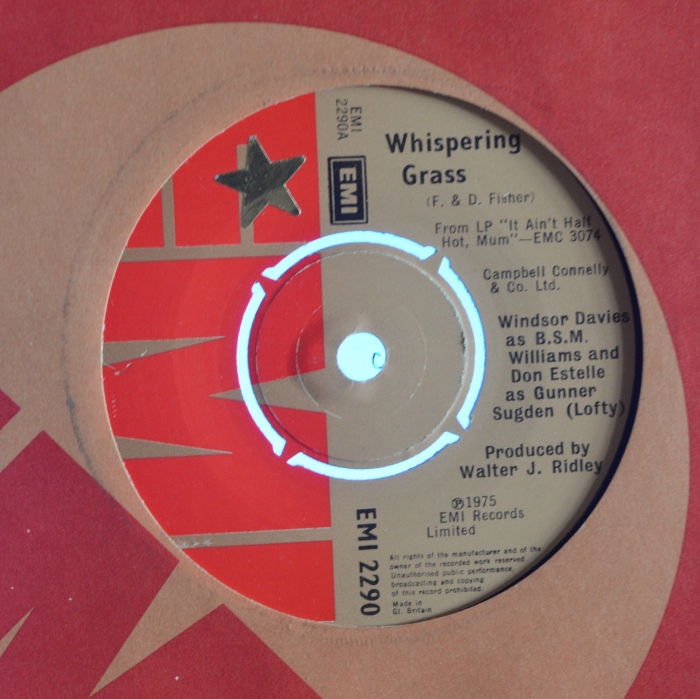
371. ‘Whispering Grass’, by Windsor Davies & Don Estelle

Well, what have we here then… On first glance, I thought it sounds quite poetic: ‘Whispering Grass’. Something Wordsworth might have written about on one of his Lakeland walks…

Whispering Grass, by Windsor Davies & Don Estelle (their 1st and only #1)

3 weeks, from 1st – 22nd June 1975

I’m going to have to split this review into two parts. Part I is what I make of the song, Part II will be what the hell this record actually is. Here goes. It’s quite nice – a lilting piano and some nice harmonies – and very old-fashioned. This must be a cover of an oldie, from the twenties or thirties.

The two vocalists, I am unsure which one is Davies and which is Estelle, are contrasting. One has a deep, Welsh baritone, and does a spoken intro and outro, and some backing bum-bum-bums. The other does most of the actual singing: Why do you whisper, Green grass…? Whispering grass, The trees don’t have to know….

So it’s a bit of a pun: grass as in the green stuff growing from the ground, and grass as in a tell-tale. It’s cute. Don’t you tell it to the trees, Or she will tell it to the birds and bees… the Welshman intones. It’s a novelty, that much is clear, but it’s not an offensively annoying one. This is quite a listenable record. But… I give up. Time for Part II. Help me, Google…

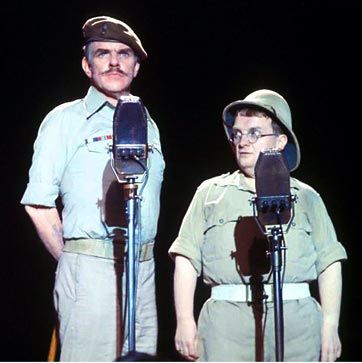
OK, so I half-knew that this was a spin-off single from a popular sitcom, ‘It Ain’t Half Hot, Mum’, set among an army theatre troop in British India in the Second World War. Windsor Davies and Don Estelle are performing it in character: Davies as Sgt Major Williams and Estelle as Gunner ‘Lofty’ Sugden. It was quite the popular show, running for eight series until 1981.

But, as pleasant as this record is, I can’t help feeling a bit left out. It’s clearly some kind of in-joke that you would have got had you been alive in 1975, and a fan of the programme. At this far of a remove it’s little more than a shrug and move along moment. I have never seen ‘It Ain’t Half Hot, Mum’, as it doesn’t get repeated very often. (A ‘70s sitcom, set in the colonies, with white actors playing Indians, featuring lots of men in theatre drag… You can imagine it being deemed ‘problematic’ nowadays. Having never seen it, I will defer judgement.)

‘Whispering Grass’ was indeed a hit from the ‘40s – 1940 to be precise – for The Ink Spots. What’s clear from this and the previous #1 – ‘Stand By Your Man’ – is that the grown-ups had momentarily wrested control of the top spot from the young ‘uns. You can imagine this record being bought by mums and dads, grannies and grandads, in their droves. While the kids, and the bloggers writing about the song forty-five years later, look slightly bemused, and then move on.

356. ‘Kung Fu Fighting’, by Carl Douglas

Good Lord, we did fall hard for disco in the summer of 1974, didn’t we! It suddenly feels like I’m covering the charts of a completely different country, so quickly has the musical landscape changed.

Kung Fu Fighting, by Carl Douglas (his 1st and only #1)

3 weeks, from 15th September – 6th October 1974

‘Kung Fu Fighting’ becomes the third disco #1 in four, which means that disco was cool for precisely two songs. Because this record, for all its many good points, is not ‘cool’. It’s – let’s be honest – ridiculous. Woah-oh-ho-ho… everyone knows the intro, the slow build up, the Oriental riff… Woah-oh-ho-ho…

And then click. Disco time. Everybody was kung fu fighting… Huh!… Hah! Those kicks were fast as lightning… (There seems to be no consensus on whether it is ‘those kicks’, ‘those kids’ or ‘those cats’. I’ve always thought it was ‘kicks’ – it makes sense in a song about a martial art – so I’ll stick with it.) This was the era of the classic Hong Kong Kung Fu movie – Bruce Lee, ‘Enter the Dragon’ and all that – and the songwriters seized the zeitgeist, mixed it with the up and coming new club sound, and scored a ginormous number one hit all around the globe.

Even in 2020, it is a song that most people will know. I’m not sure lines like they were funky Chinamen from funky Chinatown… would pass the censors these days, mind, especially when coupled with the aforementioned ‘Oriental riff’. (Though the way they manage to translate the riff into disco strings is probably the best bit of the whole song.) Come verse II, we meet funky Billy Chin and little Sammy Chong… he said, ‘Here comes the Big Boss’, let’s get it on… I mean, it’s dumb, but you’ll struggle to argue that it’s not fun.

Actually, it’s a hard song to really place. It’s a little too hip to be a novelty, but it’s way too silly to be treated as a serious pop record. Let’s treat it, then, as a slice of classic cheese. Throw it on at the end of a wedding disco and watch people fly. Literally, in some cases. Meanwhile, twelve-year-old me still has a massive soft spot for the Bus Stop version, which reached #8 in the late ‘90s, and which takes the disco of the original, ups the Kung Fu sound effects, adds rapping and a manic Eurodance beat to create something… Well, let’s just call it ‘something.’

Perhaps unsurprisingly, there was nobody of Chinese origin involved in the making of ‘Kung Fu Fighting’. Carl Douglas was Jamaican, while producer Biddu (a disco pioneer) was British-Indian. Douglas is almost the very definition of a one-hit wonder… alas the follow-up to this – ‘Dance the Kung Fu’ – made #35 (while he was also credited on the Bus Stop version.) To his credit, he is still happy to perform the song live, more often than not in his red Shaolin monk’s uniform, and if he’s proud of his biggest hit then who am I to judge?

350. ‘The Streak’, by Ray Stevens

Oh Lordy. Did anyone order a country rock, spoken word, novelty song about a sprinting nudist…? Anyone? Anyone?

The Streak, by Ray Stevens (his 1st and only #1)

1 week, from 9th – 16th June 1974

No punches pulled: this is a song that makes your teeth clench. The mix of sound effects and voice acting, not to mention liberal use of a banjo, does not make for a relaxing listen. Then there’s a wheeee noise that SongFacts describes as a: ‘zipppp kazoo sound.’ Eeesh! It is a story told by two characters: a roving news reporter, and a slack-jawed yokel who, for some unspecified reason, is being followed by a streaker.

Oh yes they call him ‘the streak’, Fastest thing on two feet… Off he goes, around the supermarket, through the gas station, over to the basketball stadium… He’s just as proud as he can be, With his anatomy, He goin’ give us a peek… The yokel is appalled by ‘The Streak’, but the same can’t be said for his wife Ethel… No matter how much of a warning her husband gives her, she always ends up catching a glimpse…

I don’t want to sound like a po-faced prude, but… This song isn’t very funny. Its closest chart-topping companion would be Benny Hill’s ‘Ernie’, but at least that was witty and warm, and just plain old silly. ‘The Streak’, though, is brash, in your face, and just plain old irritating. The lowest point is the canned laughter – actual canned laughter – as if the producers deep down knew that it wasn’t in any way hilarious and needed to convince themselves.

Some of the lines are kind of clever, I guess: he’s always makin’ the news, wearing just his tennis shoes… and I do like the image of ol’ Ethel disobeying her husband to have a glance. By the end, she’s made her choice and has stripped off too. Ethel you shameless hussy! (Her husband’s words, not mine, and apparently mis-heard by many for something much ruder…)

I wasn’t around, but apparently there was a streaking craze in the mid seventies. In March ’74 alone there was a streaker at an Arsenal Vs Man City match, that Wikipedia debatably describes as ‘the first instance of streaking in English football’, and a streaker at a cricket test between Australia and New Zealand. Meanwhile, a ‘streaking epidemic’ was hitting US college sports. There was even a streaker at the 1974 Oscars! Clearly the world was ready for a hit single about running in the nude. And Ray Stevens delivered… I dunno, maybe you had to be there.

Stevens had been around since the fifties – a country singer-songwriter who flipped between serious and comedic singles at random. His two biggest hits before this had been ‘Ahab the Arab’ – a US #5 in 1962 – and the primary school hymn ‘Everything Is Beautiful’ – an actual Billboard #1 in 1970. An eclectic range, to put it mildly…

But back to ‘The Streak’. The main problem with this is that it is obnoxious. I’ve said it before – some novelties are novelties by accident, through experiment, trial and error. ‘Mouldy Old Dough’, for example, or even ‘Telstar’ – a glorious, weird outlier in the history of the charts. Other novelties set out from the start to amuse, entertain or, more often than not, annoy. Did anyone who bought ‘The Streak’ actually listen to it more than twice? Probably not. But there it is: a transatlantic #1 hit.

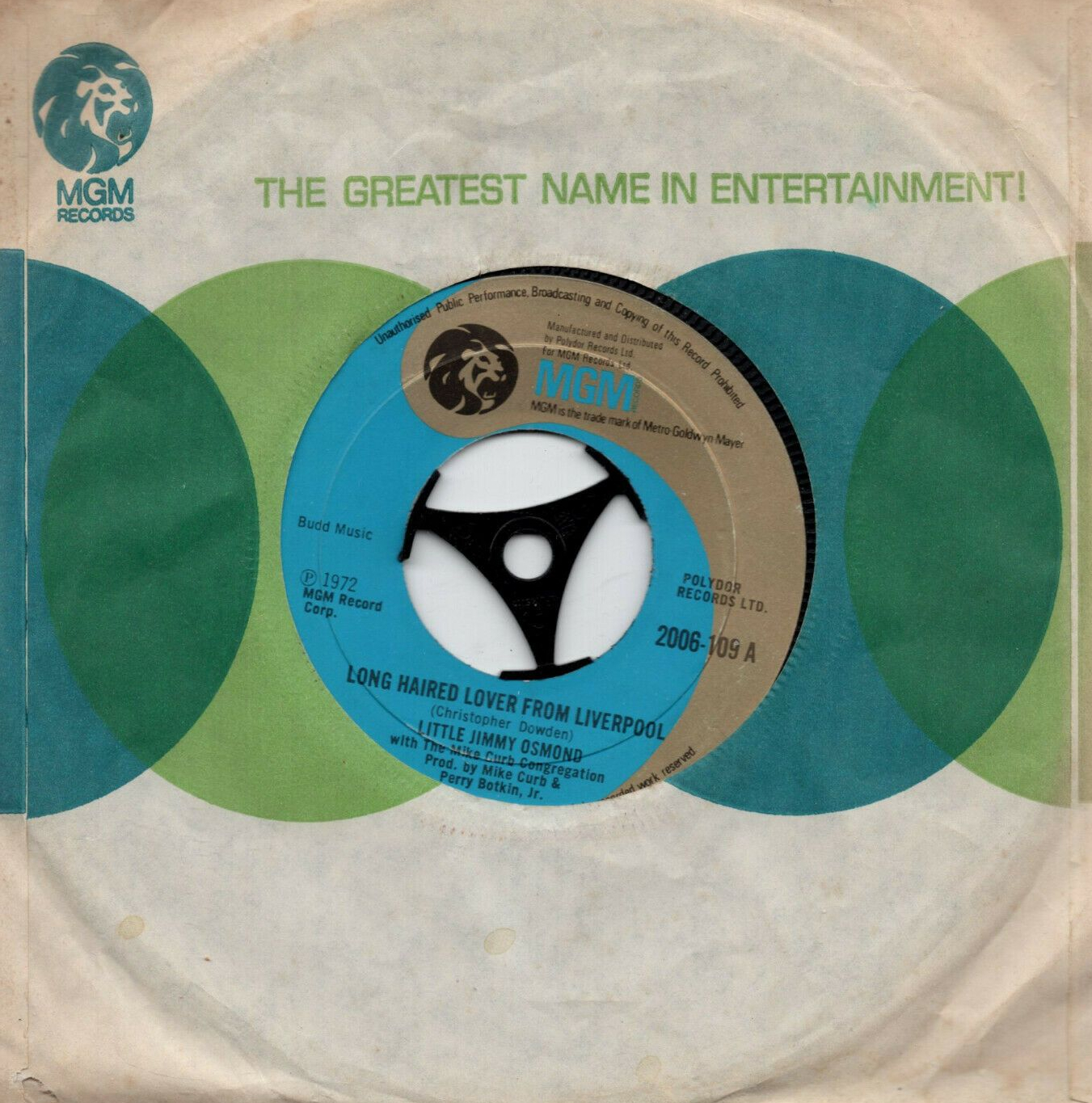
324. ‘Long Haired Lover From Liverpool’, by Little Jimmy Osmond

Hot on the heels of Chuck Berry’s smut-fest ‘My Ding-A-Ling’ comes another Christmas novelty, and 1972’s festive #1. Two novelty chart-toppers in a row! Aren’t we the lucky listeners…?

1729225JPG

Long Haired Lover From Liverpool, by Little Jimmy Osmond (his 1st and only #1)

5 weeks, from 17th December 1972 – 21st January 1973

Actually no. We are not. For everything that ‘My Ding-A-Ling’ got right, ‘Long Haired Lover From Liverpool’ gets wrong… It’s not funny, it’s not subversive, it’s not got a bawdy bone in its body. It’s a nine-year-old boy singing a music hall ditty, and it is intensely, painfully, terrifyingly catchy.

I first listened to it a few days ago, after finishing my previous post, and it has been lodged in my brain ever since. I’ll… Be… Your… Long-haired lover from Liverpool, And I’ll do anything you say… Was Little Jimmy Osmond from Liverpool? No, obviously not. They were Mormons from Ogden, Utah. Had he ever been to Liverpool? Doubtful. But he’ll say he is, and that he has, for his sunshine daisy from LA…

He’ll also be her leprechaun sitting on a toadstool, her clown, her puppet, her April Fool… Anything she asks, as long as she’s his sunshine daisy from LA… You have to wonder if Little Jimmy had any idea what the hell he was singing. But he does it like a pro, like the youngest son from a family steeped in showbiz. Before I’d even seen any pictures of him, I could picture his cheeky grin and chubby cheeks. His voice is ear-piercingly high, especially on the title line, but then I suppose nine-year-old’s voices usually are.

s-l1600

It’s strange. On the one hand I am aware that this is a genuinely heinous piece of music. Meanwhile the other hand is tapping along happily. But lo! Suddenly, just past the two-minute mark, the song fades. Finished. I like to think that the sound engineer just couldn’t take it anymore and slid the volume dial down, while Jimmy and his band kept going for another three minutes, unaware…

‘Long Haired Lover From Liverpool’ had been written and recorded a few years earlier, by a Christopher Kingsley, and played on local radio. That’s where Mother Osmond heard the song and thought it would be perfect for her Jimmy. And it was – Osmond mania was sweeping the world in late ‘72. Little Jimmy was, apparently, particularly huge in Japan. We’ve had one Osmond at the top of the charts already this year, and I have to admit that I’d choose ‘Long Haired Lover From Liverpool’ over Donny’s ‘Puppy Love’ any day of the week.

At nine years and eight months old Jimmy Osmond was – and still is – the youngest artist to be credited with a UK #1 single. (Though younger children have featured on #1s, without getting a credit… more on that anon.)

And that’s that for 1972. What a strange year for chart-toppers! Some have been era-defining, others have been heart-breaking, while some have been hilarious. And a few have just been really, really bad. Roll on 1973!

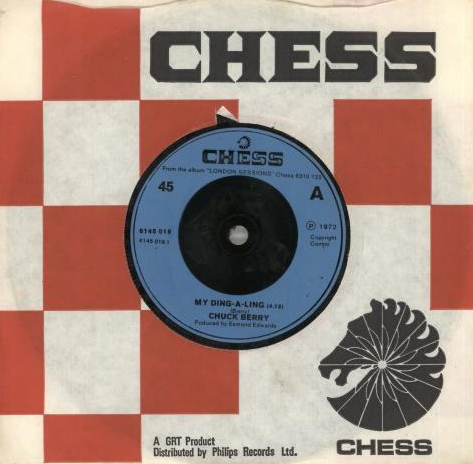
323. ‘My Ding-A-Ling’, by Chuck Berry

And so we come to our alma mater. We must do our alma mater

bb24-2017-coda-berry-billboard-1548-768x433

My Ding-a-Ling, by Chuck Berry (his 1st and only #1)

4 weeks, from 19th November – 17th December 1972

Come along one and all, for the touching tale of a young boy and his favourite childhood toy: When I was, A little bitty boy, My grandmother bought me a cute little toy… Silver bells, Hanging on a string, She told me it was my ding-a-ling-a-ling…

In this live-est of live number ones, the audience sing approximately half of the song. The girls in the audience give us My… While the boys give us Ding-a-Ling! Girls: I want you to play with my… Boys: Ding-a-Ling! While Chuck croons his encouragement: Beautiful! I think it’s a beautiful little song, really I do…

Mum takes the boy to grammar school, but he stops off in the vestibule. (Find me, if you can, another #1 single that includes the word ‘vestibule’.) Every time that bell would ring, Catch me playing with my ding-a-ling-a-ling… Life brings along many trials and tribulations for the hero of the piece but first and foremost, no matter the danger, the lad looks after his prized possession. Climbing the garden wall, swimming across Turtle Creek… All the while holding onto his ding-a-ling. You can guess where every verse is going after the first line; but that’s the beauty of it. Like all lame jokes you can see it coming a mile off, bounding over the horizon like a big dumb dog.

And Chuck Berry’s enthusiasm for this silliest of silly songs really helps to sell it. The spoken asides – the two girls singing in harmony, the guy singing in rhyme (that’s alright, brother, you gotta right baby) – are the best bits. In an extended version that runs to well over eleven minutes, Berry can be heard briefing the audience on how to sing. It is complete end-of-the-pier, pantomime smut, with lines like: We’ll teach the boy’s first, cos they’ve only got one part… (You notice how the boy’s part starts rising right there?)… Now boys you gotta come in strong with your ding-a-lings… It’s a very funny listen – those aren’t even the dirtiest bits – if your sense of humour is as underdeveloped as mine… When it comes to the verse dedicated to those who will not sing, the glee in Berry’s voice as he changes the lyrics to Your ding-a-ling, Your ding-a-ling, We saw you playin’ with your ding-a-ling…! is unmistakeable.

Chuck+Berry+My+Ding-A-Ling+-+Inj-493600

I’ve been looking forward to writing about ‘My Ding-A-Ling’ ever since I started this blog. For a start, it’s Chuck Berry finally getting a #1 single. He, more than any other artist, is rock ‘n’ roll. He’d only had one (1!) Top 20 hit in the fifties – ‘Sweet Little Sixteen’, which peaked at #16! In the sixties, when his influence on beat bands became evident, he started hitting the top 10 with discs like ‘No Particular Place to Go’. By 1972, though, he was a veteran; a legacy act. This had been recorded in February, at the Lanchester Arts Festival in Coventry, and was belatedly pushed as a single by a radio station in Boston.

The other reason I’d been looking forward to writing about this record? The controversy, of course. Radio stations refused to play it (duh). Not that there’s anything wrong with the lyrics on face-value, but the fun that Chuck and the audience are having singing along like drunks at closing time means that even the most innocent of minds can get in on the innuendo. Mary Whitehouse, last seen campaigning against Alice Cooper’s ‘School’s Out’, claimed that whole classes of young boys across the nation were lowering their trousers, ‘singing the song and giving it the indecent interpretation… that is so obvious.’ Which, if they weren’t doing before Mary made this claim; they certainly were afterwards.

This tune had been around for a long time, since the 19th century in fact, in the form of the American folk number ‘Little Brown Jug’. It was first recorded as ‘My Ding-a-Ling’ by Dave Bartholomew in 1952, and if you thought Berry’s version was bawdy then you’re in for a treat with the original (sample lyric: When you’re young and on the go, Your ding-a-ling won’t ever get sore…)

There are a lot of people who think of it as sacrilege that this was Chuck Berry’s biggest hit. Which I understand, on one level. But, at least it’s fun. Compare and contrast with Eddie Cochran – another rock ‘n’ roller who, after genre-defining hits like ‘Summertime Blues’ and ‘C’mon Everybody’ reached #1 with the soppy ‘Three Steps to Heaven’. Plus, he was dead. Chuck Berry had decades of playing with his ding-a-ling to come after this (though, given some of the allegations made against him over the years that might not be the best way to phrase it). He died in 2017, aged ninety.

To conclude, then. This may be puerile, and silly. It may not be anywhere near as momentous a record as ‘Johnny B. Goode’, or ‘Rock ‘n’ Roll Music’, or ‘Maybelline’, or hundreds of Chuck Berry’s earlier hits. But I love it for what it is. Somehow, some way, ‘My Ding-A-Ling’ is every bit as rock ‘n’ roll as his classic hits.

Follow along with my #1s Blog playlist, here.

321. ‘Mouldy Old Dough’, by Lieutenant Pigeon

I’ve heard of this song before – for better or for worse – but don’t think I’d ever heard it, in full, until now. And boy, is it strange…

lieutenantpigeon000

Mouldy Old Dough, by Lieutenant Pigeon (their 1st and only #1)

4 weeks, from 8th October – 5th November 1972

It starts with a military drum beat, and for a second I’m worried that we’re getting 1972’s second pipes ‘n’ drums #1 single. Then we get a flute, and I’m picturing an orange march. Then we get a boozy, woozy, synthesised rock ‘n’ roll piano, and we’re in a crowded German beerhall.

Two immediate points of reference jump out at me. There’s Chicory Tip’s similarly stomping ‘Son of My Father’ from a few months back. And then there’s the work of Joe Meek a decade ago: The Tornados, and ‘Have I the Right?’ and so on. There’s a lot of similarities there, but they don’t fully explain what the hell is going on here.

‘Mouldy Old Dough’ is an instrumental, save for the title being growled by what sounds like a very old man with no teeth. Apparently the line Dirty old man… is also buried in there, deep within the soupy mix, but I can’t make it out. It is so rough and ready, this record. It sounds like an old demo that was burnt, buried in a shallow grave, then dug up years later, released and sent to the top of the charts…

download

Have you ever eaten durian? It’s a huge spiky fruit, really popular in south-east Asia, with a smell somewhere between sweaty socks and rotten onions. Apparently, though, if you can get past the stench the actual flesh of the fruit is quite nice. I’ve never been able to get past the stink but feel that ‘Mouldy Old Dough’ might be the durian fruit of #1 singles. Get past your initial doubts and reservations, your initial what the hell?, and by the third or fourth listen you start to find something charming buried deep within its relentless, plodding, churning beat.

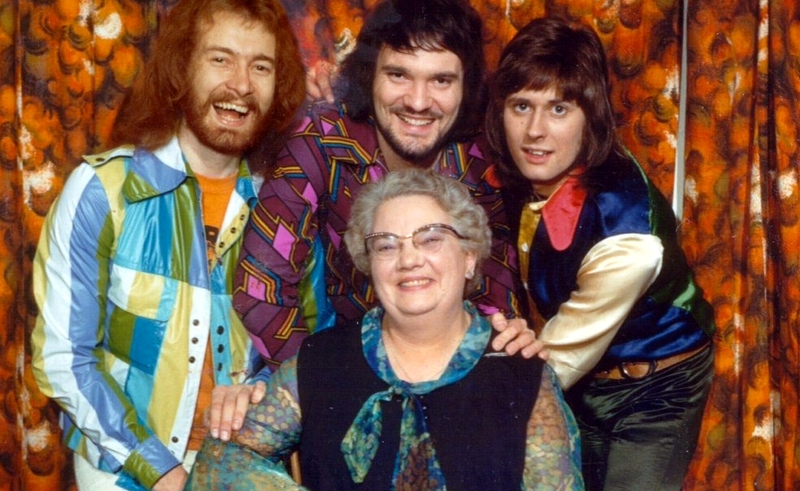
The backstory of Lieutenant Pigeon only adds to the record’s charm. They were an experimental band from Coventry, fronted by Rob Woodward, and featuring his mum, Hilda, on piano. She’s basically the star of this record, as it’s her melancholy piano line that holds it all together. ‘Mouldy Old Dough’ was recorded in their living room (what I mistook for synths is just poor sound insulation!) When asked what it was all about, Rob admitted that he had no idea… Despite being the composer. Honest. I like it. The follow-up to this, ‘Desperate Dan’, made #17 and after that the charts were a Pigeon-free zone… The Woodwards are still the only mother and son combo to ever top the UK singles chart.

And isn’t that nice? Lieutenant Pigeon still record and release music to this day, mainly online, while Hilda died twenty years back. She was fifty-eight when this record hit the top of the charts, and she’s still in the Top 10 oldest people to feature on a number one single. By the end the marching beat has transformed into a glam-rock stomp as we fade out. As weird as this record sounds – and it does sounds pretty darn weird – it still somehow fits in with the styles of the time…

308. ‘I’d Like to Teach the World to Sing (In Perfect Harmony)’, by The New Seekers

I knew the chorus of this song, as everyone does, what with it having firmly imbedded itself in our popular culture. And so, I was fully expecting a cheesy, sing-along record…

p03kyxdn

I’d Like to Teach the World to Sing (In Perfect Harmony), by The New Seekers (their 1st of two #1s)

4 weeks, from 2nd – 30th January 1972

…but was not prepared for just how sickly saccharine this song truly is. Do not play this record on a full stomach! The melody is jaunty, the vocals are twee: I’d like to build the world a home, And furnish it with love… Grow apple trees, And honey bees, And snow-white turtle doves… I mean, eeesh. (*Insert vomiting emoji*)

The singers, with their gentle acoustic guitars, sound like earnest church youth-camp leaders around a campfire. Or the bouncy volunteers that confront you on the street, asking for your signature in some worthy cause. I’d like to teach the world to sing, In perfect harmony, And I’d like to hold it in my arms, And keep it company… They sound utterly insufferable – in case I wasn’t making that clear – though I wouldn’t bet against at least two of them having a crippling drug addiction, because nobody is naturally this perky. I do like the bass-line, though.

The message is one of peace and love, obviously, which is nice and all. But the lyrics never get above ‘primary school assembly’ level. We’d all like everyone to get along better and love another, obviously, but the Summer of Love has been and gone – with far better music than this – while a couple of years ago it was all doom and gloom at the top of the charts: ‘Bad Moon Rising’ and ‘In the Year 2525’. This record is the sound of people giving up on the hippy dream and/or a cynical counter-culture, and settling for meaningless crap. And listening to this today, given the absolute shitshow that 2020 has been so far, well it’s almost unbearable.

Plus. Plus, plus, plus. The one other thing that everyone knows about ‘I’d Like to Teach the World to Sing’, other than the sugary chorus, is that it originated from a jingle in a Coca-Cola advert. I’d like to buy the world a coke… etc. etc. For this ‘anthem’ of world-peace to have stemmed from one of the world’s mega-corporations, a company that floods every corner of the globe with its spectacularly unhealthy soft drinks and subsequent litter, is the piece de resistance. It’s actually quite funny.

R-541726-1541433490-4759.jpeg

I’ll get down from my high-horse now. This record wasn’t meant to be taken so seriously. It’s just a cute little pop song aimed at the kids. But, at the same time – back on the high horse for a second – I can’t help feeling that, for people in 1972, spending a few pounds on this shite was the same as people nowadays changing their Facebook profile to reflect whatever the week’s worthy cause is. Making the doer feel better about their privilege, while making no difference whatsoever to the world’s problems.

In fact, I’ve grown to detest this record so much in the past half an hour that I’m going to make a bold, bold claim. That it is worse than ‘Chirpy Chirpy Cheep Cheep’. Yes. ‘CCCC’ was inane and annoying. ‘ILTTTWTS(IPH)’ – that’s one hell of an abbreviation – is inane, annoying, and has ideas way above its station.

Finally, one question needs answering. What relation did The New Seekers have to The (old) Seekers, the Australian folk-pop act who scored two #1s in 1965 with the average ‘I’ll Never Find Another You’ and the dirgey ‘The Carnival Is Over’. Well, both bands share one member: Keith Potger, guitarist, who founded The New Seekers in 1969. They had scored a #2 the year before with ‘Never Ending Song of Love’ and will, I’m sure you’ll be thrilled to discover, top the charts one more time before leaving us in peace forever. Till then…

Follow along through the first (almost) 20 years of the charts, with this playlist:

307. ‘Ernie (The Fastest Milkman in the West)’, by Benny Hill

Oh God. You know we must have reached the festive season, when a song like this comes along. Join us then, for the story of Ernie, driver of the fastest milk-cart in the west, and his sworn rival, Two-Tonne Ted, the baker…

ernie-the-fastest-milkman

Ernie (The Fastest Milkman in the West), by Benny Hill (his 1st and only #1)

4 weeks, from 5th December 1971 – 2nd January 1972

It’s set to a faux-Spaghetti Western theme, but narrated (‘sung’ would be too generous a verb) in a west-country accent by comedian Benny Hill. And did someone say ‘innuendo’? Because this song is an innuendo smorgasbord, a triple-shot of double-entendres…

Ernie comes galloping into Market Street, to meet his lady-love, a widow called Sue. They said she was too good for him, She was haughty, proud and chic, But Ernie got his cocoa there, Three times every week… Oo-er, matron, and so forth. On we go – this is a story told at breakneck speed.

Ernie can’t compete with Ted’s wide range of pastries: He tempted her with his treacle tarts, And his tasty wholemeal breads, And when she saw the size, Of his hot-meat pies, It very near turned her head… I’m smiling as I listen, even though I should really know better… He knew once she’d sampled his layer-cake, He’d have his wicked way… Meanwhile, Ernie can but offer milk, and not much else.

So Ernie and Ted have a shoot-out, as must happen in all the best Westerns. As he leapt down from his van, Hot-blood through his veins did course, And he went across to Ernie’s cart, And he didn’t ‘alf kick his ‘orse… (Do you have to be British to get this ropey wordplay?) …whose name was Trigger… Two-Tonne Ted fights dirty, of course, throwing a stale pork-pie that kills Ernie. Sob. Now it’s a pastiche of the old early sixties death-discs, ‘Tell Laura I Love Her’, ‘Johnny Remember Me’ and the like. Two piss-takes for the price of one!

bennyhill-ernie(thefastestmilkmaninthewest)(3)

But. A woman’s needs are many-fold. Sue marries Ted regardless. And on their wedding night, as they lie in their bed, they are haunted by Ernie’s ghostly gold-tops a-rattling in their crate… They won’t forget Ernie! It’s actually a bit of a dud finish to what, compared to most novelty records, has been a pretty funny song. You know, for its time. It also has what must be one of the first music videos – see below. (I do enjoy the fact that Ted still has his hat on in bed.)

For the fourth year running, then, we have a novelty #1 single at Christmas. You can blame The Scaffold for starting it, with the irritating ‘Lily the Pink’, then it was ‘Two Little Boys’, ‘Grandad’ (which hit top-spot just after New Year), and now this. And, for what it’s worth, I like ‘Ernie’ the best of the four. It’s aiming squarely for silly. Not smart, not sentimental… Just plain old pantomime, music-hall, very British, ‘silly’. Not that I’m rushing to add it to my Spotify queue, either, but still.

Benny Hill actually was a milkman, before hitting the big-time, and had written this back in the fifties. He performed it on his show – which in 1971 was pulling in 21 million viewers! (there were only three channels, to be fair) – and then released it as a single. For me, Hill is a slightly vague figure from a time before I was born. He wasn’t on TV growing up, having been pushed aside by the new wave of comedy acts in the eighties. He’s reduced, in my mind, to his famous theme tune playing as he gets chased by an irate crowd.

At the same time, though, I just watched a few of clips on YouTube, and they raised a smile. They’re old-fashioned, and ‘of their time’, but they’re funny, in the worthy tradition of Charlie Chaplin (a huge fan of Hill’s) and Mr. Bean. Plus, you’ll just have to get used to silly novelty songs cropping up every December… and not many will be as tolerable as this!

301. ‘Chirpy Chirpy Cheep Cheep’, by Middle of the Road

On with the next three-hundred! And our 301st #1 gets going with a promising glam rock stomp. Seriously, this is a great record… for the first three or four seconds.

maxresdefault

Chirpy Chirpy Cheep Cheep, by Middle of the Road (their 1st and only #1)

5 weeks, from 13th June – 18th July 1971

Then the handclaps come in, and a voice that sounds like a knock-off Lulu. Where’s your mama gone? (Where’s your mama gone?)… Little baby bird… Far, far away… Mummy bird’s gone, flown the coop. Where’s your papa gone? (Where’s your papa gone?)… Daddy bird too. That’s half the song.

Then: Last night I heard my mama singin’ a song, Woke up this morning and my mama was gone… Oo-wee, Chirpy chirpy cheep cheep! That’s the second half of the song. It gets annoying, quickly. Did anyone say ‘bubblegum’?

No, that’s harsh. ‘Bubblegum’ needn’t be a dirty word. ‘Dizzy’, for example was a fine slice of bubblegum pop. I should have asked: did anyone say ‘cloyingly irritating novelty’? This is a record that shouldn’t appeal to anyone over the age of five. And yet, we all know it. I don’t think I’ve ever heard ‘Chirpy Chirpy Cheep Cheep’ in its entirety until now, but I sure as hell knew that chorus.

The lyrics – the four lines that make up this entire song – are actually quite sad. The singer is either a bird, abandoned in her nest. Or the singer is a child, abandoned by her parents, who sees an abandoned bird and feels a sense of kinship. To her credit, though, she’s not wallowing in despair. Oh no. She sounds as if she’s determined to make something of her life regardless of the tough start. Chirpy chirpy cheep cheep chirp!

2v2JVEhh8xAqeaq

I don’t mind a novelty, but this song makes very little sense, and midway through the chorus starts repeating over and over, and over. Let’s go now! You frantically check that this record isn’t actually six minutes long. All together now! No, just forty seconds left, thank God. One more time now! Phew.

Middle of the Road were (‘are’ actually, they’re still going) a Scottish band, who had a brief burst of fame in the UK in the early seventies, with this and other hits such as ‘Tweedle Dee, Tweedle Dum’ – which I listened to and found to be not as bad as their only #1. They were huge across Europe – I guess the simple lyrics and sugary tunes translated well – and I’ve seen some sources label them as a predecessor to ABBA. (Which is like saying the first ever wheel carved from a hunk of rock by a hairy caveman is a predecessor to a Ferrari.)

Anyway, that’s that. Had Middle of the Road arrived at the top of the charts just a few weeks earlier, then Dana would have had some stiff competition for ‘Worst Chart-Topper’ last time out. But they’re safe, for now…

Enjoy all the previous 300 number ones with this playlist (I promise most of them are better than this.)

295. ‘Grandad’, by Clive Dunn

What have we here then? A Christmas novelty that made it to #1 a fortnight too late? I know this song, vaguely – well, the chorus at least – and brace myself to write a terrible review.

p03gz7y5

Grandad, by Clive Dunn (his 1st and only #1)

3 weeks, from 3rd – 24th January 1971

Grandad, Grandad, You’re lovely, That’s what we all think of you… And yep, the chorus is truly horrifying. It’s sung by little kids, to their grandpa, but in the creepily lifeless tones of horror-movie children, the sort with shining eyes that lure unsuspecting people into dark, misty forests… However, the song becomes more complex when you get to the verses. This is no saccharine ode to grandparents, oh no.

I’ve been sitting here all day, Thinking… Same old thing ten years away, Thinking… An old man sits in his rocking chair, getting all misty-eyed for days gone by. Penny-farthings on the street… Bows and hoops and spinning tops… The days when motorcars were new and scary, when happiness was a Charlie Chaplin matinee…

But there’s no resolution, no ‘oh getting old isn’t all bad’ twist at the end. In fact it gets worse. After listing all the things he misses, we get a final gut-punch: Familiar things I keep around, Near me… Mem’ries of my younger days, Clearly… Come into my mind… I’m no old man, but I can’t think of a better way to describe the feeling of getting older, of slowly losing your mind to age, of seeing death approaching over the horizon. Get beyond the banjo and the parping tuba, and this is a really depressing number one hit.

But then those bloody kids keep coming in to ruin it. Grandad, You’re lovely… What are they doing? Trying to cheer him up? If I were their grandad I’d be praying for the end to come even quicker. This would be a far, far better, and actually quite subversive, record without them. (I’m not even convinced that they’re real children, though I’m not sure that they had the technology in 1970 to computer-generate such creepy sounding voices.)

CLIVE_DUNN_GRANDAD-572221

Clive Dunn does sound quite geriatric when he sings, especially when he pronounces ‘telephones’ as ‘jelly-phones’, but he was only fifty when ‘Grandad’ hit #1 – a young grandad in anyone’s books. He was, I guess, playing upon his dotty Corporal Jones character from ‘Dad’s Army’, which was one of the biggest shows on TV at the time. Presumably the show’s popularity can explain this strange record’s huge success.

It’s a novelty; but not particularly funny. It’s a children’s record; but more complex and bittersweet than most children would be able to grasp. I can imagine thousands of them bought their grandfathers this record for Christmas, sending the old men into a depressive spiral when they sat down and actually listened to it. Plus, if we assume that the ‘Grandad’ in this record is looking back fifty years, to 1920, then isn’t it weird to think that if this were re-recorded today then the singer might reference ‘listening to Clive Dunn singing ‘Grandad’’ fifty years ago in the lyrics? Mind-bending…!

The UK Number Ones Blog Playlist is here.