44. ‘Rock and Roll Waltz’, by Kay Starr

371636453311

Rock and Roll Waltz, by Kay Starr (her 2nd of two #1s)

1 week, from 30th March to 6th April 1956

You remember how, in my last post, I single-handedly invented a new era in popular music – ‘The Post-Pre-Rock Age? You do? Excellent.

Well, the 44th UK #1 single perfectly encapsulates this brave new age. The Rock and Roll (New! Exciting! Sexy!) Waltz (Old! Boring! Not very sexy!) And it’s a fun little record. A record that tells a story:

One night I was late, came home from a date, slipped out of my shoes at the door…          Then from the front room, I heard a jump-tune, I looked in and here’s what I saw…

What is it that she sees…? Well…

There in the night, was a wonderful scene… Mom was dancing with dad, to my record machine… And while they danced only one thing was wrong… They were trying to waltz to a rock and roll song!

Mum! Dad! You silly old squares! All the cool cats know you can’t waltz to a rock ‘n’ roll song!

This, lyrically at least, is rock and roll. Old people not getting this hip new music. Young people rejecting the music of their parents. The chorus is a simple cluster of catchphrases: 1, 2 and then rock… 1, 2 and then roll… It’s good for your soul… It’s old but it’s new… And what is rock ‘n’ roll but a load of nonsensical catchphrases? 1, 2, 3 o’clock, 4 o’clock rock… Whop Bop a Loo Bop a Whop Bam Boo… Goodness! Gracious! Great Balls of Fire!

Musically, though, this isn’t rock ‘n’ roll. There are no guitars, there’s a slightly waltzy rhythm, a boogie-woogie bass and a great big jazzy swing. It’s fun, it’s perky and you can certainly dance to it, but it ain’t rock. It’s a novelty, and Kay Starr sings it in manner that suggests she knows exactly what a piece of throwaway fluff it is.

1ae274ad8f446f05b76cdbb6860e5a35--kay-starr-music-publishing

I mentioned in her last entry, the flirty and fun ‘Comes A-Long A-Love’, that Starr has a magnetic voice. You can tell that ‘Rock and Roll Waltz’ isn’t perhaps the type of record that she’s used to singing – it’s easy to imagine that she wasn’t impressed by the suggestion that she move away from her usual style – but she sells it with warmth and with playfulness. It feels like a long time since I wrote about ‘Comes A-Long A-Love’, and I suppose three years and two months is quite a long gap to have between your two number one hits. Two number ones – the 3rd and the 44th in UK chart history – both spending a solitary week at the top. And both very different records. I’m glad that writing this countdown introduced me to Ms Starr, though, and it’s a shame that we won’t be hearing from her again.

One final thing about this record, though, is very rock ‘n’ roll. At least ‘rock ‘n’ roll’ in a 1956 sense. The song may be a story told through the eyes of a teenager; but Kay Starr certainly wasn’t one. She was, in fact, coming up for thirty-four when this song hit the top spot. As was the similarly decrepit Bill Haley as he rocked around the clock. This new style of music may have been for teenagers, but it wasn’t being recorded by teenagers just yet.

And to finish on a personal note – this was number one on the day my dad was born. Fitting, perhaps, that it’s a song about two uncool parents attempting to dance around their living room. Or not, seeing as my father has never danced a step in his life, I don’t think. Still, it’s not a bad song to have as your birthday #1. OK, it’s a strange little number that nobody has actually listened to for many years; but there are far, far worse songs to have been born under…

43. ‘It’s Almost Tomorrow’, by The Dream Weavers

R-4052394-1471122223-8022.jpeg

It’s Almost Tomorrow, by The Dream Weavers (their 1st and only #1)

2 weeks, from 16th – 30th March / 1 week, from 6th – 13th April 1956 (3 weeks total)

Perhaps it’s time to christen a brand new era in popular music. I’ll call it: the ‘post-pre-rock age’! We’ve had the first wave of the rock ‘n’ roll explosion – the very first rock ‘n’ roll number one – but the waves have receded and we are stood on soggy sand waiting for them to return. And they will, they will… Just not yet.

What I mean is that, to all intents and purposes, we are still in the pre-rock age but that the rules have changed ever so slightly. Of course, the very top of the charts is never where you look for music’s cutting edge. You get to the top of the pop charts by being, well, popular, and by appealing to the largest number of people. But… even if you look at the Top 20 from the week in March ’56 that this latest song hit #1, there are very few records that stand out as being rock songs: Bill Haley is at #7 with ‘See You Later Alligator’, Lonnie Donegan is at #9 with ‘Rock Island Line’ (a skiffle track, admittedly, but still) and there’s a song called ‘Pickin’ a Chicken’ by Eve Boswell which sounds like a rock song involving a funky dance move (a la ‘The Twist’) but is actually just a pretty dull song about having a picnic. The rest is Sinatra, Jimmy Young, Slim Whitman

And, as with ‘Memories Are Made of This’ which preceded it, ‘It’s Almost Tomorrow’ has elements of rock ‘n’ roll in it – enough, perhaps, to attract the youngsters but not enough to put off the old folks. Thus the gap between the worlds of Eddie Fisher and Elvis is deftly bridged.

Anyway, to the song. And after that big build-up, all that stuff about it being a brand new era in popular music, ‘It’s Almost Tomorrow’ is a bit dull. The idea behind it is that the singer’s sweetheart is falling out of love with him, and that she will leave him ‘tomorrow’. And yet he hopes it will be otherwise… My dearest, my darling, tomorrow is near, The clouds will bring showers of sadness, I fear… ‘Emotions As Weather’ – the first chapter in ‘Cheesy Love Songs 101’. It’s almost tomorrow, but what can I do? Your kisses all tell me that, your love is untrue…

It’s a bit cloying, what with its backing singers and plinky-plonky pianos. A bit of a nursery rhyme, too – I can’t decide if it sounds more like ‘Puff the Magic Dragon’ or ‘Away in a Manger’. And again, it’s another very simple #1. The production is very rich – the piano and backing singers turned up to 11 – but there isn’t much there. And, unfortunately, there’s a bit of a THIS IS THE END OF THE SONG ending: You’ll always be miiiiiiiiiiiine!

0c35382efac3ea5f3d8299d3381300a1

But, in the ‘pros’ column there is a rather wonderful key-change – a very rock ‘n’ roll touch. I’m a big fan of a well constructed key-change. I can’t resist them. Who can? Its inbuilt in most people, I think. A Pavlovian reaction. And this is not just a key change, but a mid-note key change… Your love is untruuuu *key change* uuuueeeee. I’m not going to lie – it did give me a mild covering of goose bumps the first time I heard it. But that’s far and away the best thing about this song. A song which we could brand the very first rock ballad to hit the top of the UK Singles Chart, if it didn’t feel a bit of a waste to use up such an honorific title on such an average record.

This is The Dream Weavers only appearance in this countdown, and in the charts. They were big ol’ one hit wonders, you see. Though we should give them a shout out for being one of the few acts so far to have hit the top with an original composition. The Dream Weavers consisted of two high school friends – Gene Adkinson and Wade Buff (great name!) – and a rotating cast of back-up singers. Adkinson and Buff wrote ‘It’s Almost Tomorrow’ themselves, and so are pretty unique among the forty-two songs that we’ve written about previously.

And we’ll leave it there for now. A simple love song – all key changes and not an orchestra in sight – but with familiarly mopey lyrics about rain and heartache, as well as a silly, bombastic ending. One leg in the new world; one leg stuck firmly in the past.

42. ‘Memories Are Made of This’, by Dean Martin

Memories-Are-Made-Of-This-Dean-Martin

Memories are Made of This, by Dean Martin (his 1st and only #1)

4 weeks, from 17th February to 16th March 1956

Sweet sweet mem’ries you gave to me…

This is one of those #1s that fall into the ‘I can sing a line or two before listening to it’ category. See also ‘That Doggie in the Window’ and ‘This Ole House’. At first I thought I might have sung this in my days as a primary school choirboy. But then, after listening more closely, I realised that the lyrics are perhaps a bit rich for a group of eight year olds.

Take one fresh and tender kiss, add one stolen night of bliss…

So, yeah… Then I got to thinking that the intro sounds a lot like the intro to ‘King of the Road’ – that sliding da dum dum dum guitar – which I definitely did sing in my primary school choir. So maybe that’s what I was thinking of.

Anyway. I wrote in the last post that we were having a bit of a minimalist phase in terms of our chart topping records, after the bombast of ’53 and ’54, and this track follows suit. There’s a guitar, some backing singers, and Dean Martin. It’s nice.

Lyrically, the song describes the ‘recipe’ for a happy life. Lots of ‘taking’, ‘adding’ and ‘folding’. With His blessings from above, Serve it generously with love… Which is fine. It actually reminds me a bit of ‘Christmas Alphabet’, in a way – another pop song as step by step guide. It is, though, a metaphor which can only go so far. The lines: Then add the wedding bells, One house where lovers dwell, Three little kids for the flavour… Stir carefully through the days, See how the flavour stays… Are either a little too saccharine, or a little too cannibalistic, to really work.

These lines, however, come during the middle-eight in which – and I may be going out on a limb here but bear with me – we have a bit of a rock ‘n’ roll chord progression. I am completely incapable of describing it in words, having no musical ability on which to base my idea, so you’ll just have to take a listen below to see what I mean. The very fact that this is a Verse Chorus Verse Chorus Middle Eight Verse Chorus (Ok, the chorus is one line, but still) kind of song is interesting in itself. It’s by no means a ‘rock’ song; but there’s a whiff of something there.

deanmartin

And it’s another one of those occasions in which we tick off a musical legend’s sole moment at the top of the UK charts. Vera Lynn’s had her moment, Tony Bennett’s had his, now it’s Dean’s turn. It just seems right that he got there at least once. To be honest, I know very few concrete facts about about Dean Martin – I tend to get all the rat-pack type singers muddled up together – but I see that he sang songs that are probably more famous than he now is: ‘Volare’, ‘That’s Amore’, ‘Sway’… In fact, it seems safe to say that ‘Memories Are Made of This’ is Dean Martin’s most famous song in which he wasn’t hamming up his eye-talian side. It sounds like I imagine all Dean Martin records to sound like: laidback, slightly louche, very nonchalant… He sounds as if he’s phoning it in, to an extent, but that just adds to the appeal. ‘The King of Cool’, indeed.

41. ‘Sixteen Tons’, by Tennessee Ernie Ford

s-l300

Sixteen Tons, by Tennessee Ernie Ford (his 2nd of two #1s)

4 weeks, from 20th January to 17th February 1956

Hmmm… What’s going on here, then?

It is more interesting, I suppose, approaching these distant number ones – apart from the handful that I already knew – and not knowing what I’m going to get. It wasn’t always like this – for most of 1953 and ’54 the chart toppers followed a rather overwrought formula. Now they are growing much more eclectic.

But, at the same time, I feel ‘Sixteen Tons’ has been done before. We’re back on ‘Man from Laramie’, ‘Hernando’s Hideaway’ territory here – back in the cheesy Western soundtrack album. This is what I expected from a man named Tennessee Ernie Ford, much more so than his earlier, bombastic #1: ‘Give Me Your Word’.

It’s a song about loading something… coal, I think… Loading sixteen tons of it, to be precise. You load sixteen tons, what d’ya get? Another day older and deeper in debt. St Peter don’t you call me cos I can’t go, I owe my soul to the company store… The singer is a hard man; shovellin’ sixteen tons ain’t nothin’ to him, no Sir.

After describing his working day, he goes on to big himself up: raised by a lion, fightin’ and trouble are his middle names, if you see him coming then you better step aside etc. etc. One fist of iron, the other of steel, If the right one don’t get you then the left one will… It’s all a bit silly, but Ford sings it with tongue firmly in cheek. He even giggles at one point, as he delivers the line: Can’t no high-toned woman make me walk the line… He knows it’s silly – and the listener can enjoy it for what it is. But, importantly, he doesn’t disrespect the song. It’s skilfully done. I kind of wish it had been Tennessee Ernie singing ‘The Man from Laramie’, rather than stiff old Jimmy Young, as what that song dearly needed was a slightly looser delivery; a delivery with the eyebrows raised. I’ve had a look, but unfortunately can’t find any sign that he ever recorded a version.

The only musical accompaniment to the lyrics is a guitar/clarinet combo, some light drumming, and some finger clicks. It’s minimalist. In fact, almost all of the most recent number ones have toned down the orchestral accompaniment and the backing singers (‘Rose Marie’ and ‘Christmas Alphabet’, the simple guitar riff of ‘The Man from Laramie’ and ‘Hernando’s Hideaway’s castanets). Unfortunately, at the same time, ‘Sixteen Tons’ resurrects a technique that we haven’t heard for a while – the THIS IS THE END OF THE SONG! technique. We end on a long, drawn out repetition of the final I OOOOOWWWWEEEEEE MY SOOUULLL blah blah blah… line. It spoils the whole song, truly it does. The sooner this trick dies a death the better!

123e46cdd35aa14e0ccd46e41eaa78ee

Each time I’ve listened to this track over the past half hour, somewhere in the back of my mind is the nagging suspicion that I’ve heard this somewhere before. I probably have – it is Ford’s signature hit, after all. And it’s a simple song. So simple that it sounds like it might be… Nope, I can’t place it.

And on that note, we will bid farewell to Tennessee Ernie Ford. But don’t you worry about him. He had a long and distinguished career back in the US, in the Country & Western world, releasing albums such as ‘This Lusty Land’, ‘Great Gospel Songs’, ‘Civil War Songs of the North’ and, er, ‘Civil War Songs of the South’ (maybe it was a ‘Use Your Illusion’ I & II kind of thing?) Whatever, he had clearly found his niche. He also had a TV show – ‘The Ford Show’ – and a catchphrase: ‘Bless your pea-pickin’ heart.’

Yee-hah! Let’s leave it there…

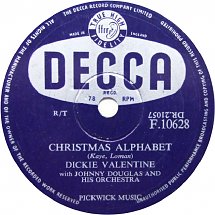
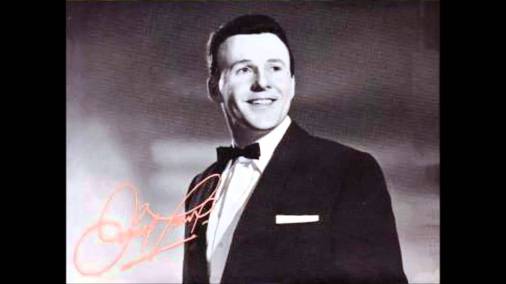
40. ‘Christmas Alphabet’, by Dickie Valentine

dickie-valentine-christmas-alphabet-decca-78-s

Christmas Alphabet, by Dickie Valentine (his 2nd of two #1s)

3 weeks, from 16th December 1955 to 6th January 1956

And so we come across something I never considered when I started this blog: the fact that I will, every so often, have to listen to Christmas songs on repeat. When it most emphatically isn’t Christmas. No matter. ‘Tis a burden I shall bear stoically.

The very first Christmas song to hit #1 in the UK is based around a simple concept – an acrostic poem as hit single. C is for the candy trimmed around the Christmas tree, H is for the happiness with all the family… All the way to the final S which is for Ol’ Santa who makes every kid his pet, Be good and he’ll bring you everything in your Christmas alphabet… Repeat. Done. Note that I am not referring to it as the very first ‘Christmas Number One’, as that wasn’t a ‘thing’ until the ’70s and, technically, Al Martino, Frankie Laine and Winifred Atwell have all already had one.

It’s kind of cute on first listen, but quickly becomes so sugary sweet that you begin to fear diabetes. As I mentioned at the time of his 1st number one, Dickie Valentine still sings like an American crooner (apart from when his ever-so-proper English accent sneaks through in the line about the ‘tree so tawl’). And while this little ditty is a world away from any kind of rock ‘n’ roll – from the record which bookended this song’s stay at the top, for example – he is cementing his image as the first British teen idol.

dicky-valentine

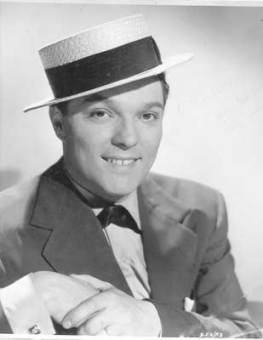
A quick look at the career of Mr. Valentine – which we should do now, as we won’t be hearing from him again – proves this to be true. He made his name singing with big bands, then by impersonating singers such as Frankie Laine and Johnnie Ray. His marriage in 1954 caused hysteria among his young fans, though it clearly didn’t kill his career. An image search throws up lots of cheeky grins, often accompanied by a boater-hat and a bow-tie – a definite ‘cheeky-chappie’. He scored the first and last #1s of 1955 but, like so many of these early chart-toppers, his recording career died a death in the ’60s, and he himself died the most rock ‘n’ roll death of all the artists featured so far: in a car crash aged just 41.

To finish, I do have a little anecdote about Dickie Valentine – and it’ll perhaps be my most tenuous link to any of the artists featuring in this rundown. Years ago (we’re talking early high school, here) I had a friend whose family loved going on cruises. I’ve never understood the appeal of cruises myself, but I suppose that’s irrelevant here. My friend mentioned a cruise they’d been on in which each cabin had – for some reason – a live feed of the ship’s ballroom that passengers could tune into any time of the day or night. My friend was watching it one night – disco night – when an old man, unimpressed by the DJs more modern tastes, walked past the camera and shouted ‘Play some Dickie Valentine!’. I have NO IDEA why my friend told me this uninteresting story; or indeed why I have remembered it to this day. I’d never heard of Dickie Valentine at the time; neither, presumably, had my friend. I suppose it is quite a funny name (‘Hur, hur… Dickie…’). But of all the things in life I’d have been better off remembering… The mind is a strange, strange thing.

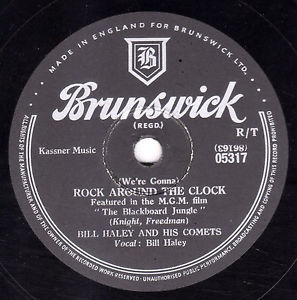
39. ‘(We’re Gonna) Rock Around the Clock’, by Bill Haley & His Comets

s-l300 (1).jpg

(We’re Gonna) Rock Around the Clock, by Bill Haley and His Comets (their 1st and only #1)

3 weeks, from 25th November to 16th December 1955 / 2 weeks, from 6th to 20th January 1956 (5 weeks total)

This is it. Strap yourselves in! A new era begins right… Now!

1, 2, 3 o’clock, 4 o’clock rock! 5, 6, 7 o’clock, 8 o’clock rock! 9, 10…

You know how it goes. Everyone does! Put your gladrags on, join me hon’…

It is undoubtedly ‘rockier’ than anything that’s gone before. Earlier chart toppers have featured guitars and drums – I’ve been surprised by just how many – but none have used the instruments in this way. The guitars stab at the listener, the double bass twangs and the drums bang out a very frisky rhythm. There are lyrics about dancing (more than just dancing…?) and never going to bed, while there’s also a pretty aggressive saxophone solo.

There are two things to consider here, both of which affect how I approach this seminal record. To my cynical modern ears, first of all, it sounds pretty tame, a bit of a nursery-rhyme, a bit babyish. Sixty-three years have done a lot to blunt its edge. Much in the same way that nobody in 2018 is going to be truly disturbed while watching ‘Psycho’, or truly terrified by ‘The Exorcist’, nobody is quite going to get the visceral thrill that this record must have provided when bored sixteen year olds across the land lowered the needle and heard that gunshot-drum intro.

Of course, ploughing my way through the thirty-eight earlier #1s, through the David Whitfields, the Eddie Calverts and the Vera Lynns, has undoubtedly helped this record to stand out. I can understand why this would have been thrilling to the kids and alarming to their parents. I can picture Aunt Marjorie clutching at her pearls. I get why it was so big; why it was the UK’s 1st million-selling record.

ip_2718995

But. Yes, now for the ‘buts’… There’s the well-trodden argument that ‘rock ‘n’ roll’ in this form was already just weak R&B, diluted for a white audience. And Bill Haley wasn’t exactly a shock-rocker. He was in his thirties by the time ‘Rock Around the Clock’ became a hit – plump and very white, with a weird-looking curl of hair stuck to his forehead. The rest of his Comets were similarly plain.

Plus, there’s the fact that this wasn’t a new song, at least not by the time it hit #1. It had been released almost a year earlier, hitting the lower reaches of the chart. Then it was re-promoted and crawled its way to the top, taking longer than any of this year’s other chart-toppers to get there. It certainly didn’t arrive at the top out of nowhere. And, it goes without saying, this wasn’t the first rock ‘n’ roll hit single. Number one singles don’t tell the whole story of the charts.

And, just to cap off my attempt to single-handedly destroy the reputation of this much-admired record, I’ve always thought The Comet’s follow-up single, ‘Shake, Rattle and Roll’ was much heavier, much more in the true spirit of ROCK (fists clenched!) with it’s misogynistic references to women, it’s sax-slash-guitar riff, and its genuinely raunchy lyrics: I’m a one-eyed cat, creepin’ in a seafood store (a very abstract innuendo, but think about it…) It was a cover of an even more raucous rhythm and blues hit, but only reached #4. Compare and contrast here.

So, in summary, this wasn’t the first rock ‘n’ roll record, or even the first hit rock ‘n’ roll record. It wasn’t the first release of the song, it hit the top in the UK nearly two years after it’s first recording, and Bill Haley recorded better, heavier rock songs. But… But, but, but. This is the one that everyone remembers. The times they were a-changing. Something has to represent this new musical wave, this spirit of teen rebellion, and this record is it. At least until Elvis comes along.

One final note. Back in the mid-nineties, when I had a short-lived attempt at learning the keyboard, this was one of the very first songs I could play. At least, I could play the intro. Just about. And this, perhaps more than anything, signals that we are in new territory here. I wasn’t learning ‘I Believe’, or ‘Rose Marie’. And yes, ‘Rock Around the Clock’ is a stupidly easy song to play – the intro is the same note played nine times in a row – but it is also a song that everyone knows. The mist is clearing, we are emerging from the pre-rock swamp, and an increasing number of these #1 singles are going to be songs that I, you, people, know.

37. ‘The Man from Laramie’, by Jimmy Young

jimmy-young-the-man-from-laramie-decca

The Man from Laramie, by Jimmy Young (his 2nd of two #1s)

4 weeks, from 14th October to 11th November 1955

He’s back. Like Rosemary Clooney earlier in 1955, Jimmy Young grabs two chart-toppers – his only two chart toppers – in pretty short order. Burning briefly but brightly.

Back in the autumn of ’53, when Frankie Laine was pounding the charts with hit after hit, I introduced the concept of the ‘shadow hit’ – the song that does well because it follows on from a massive hit record. Laine spent 18 weeks at number one with ‘I Believe’ before the somewhat less memorable ‘Hey Joe’ grabbed a fortnight in its wake. Well, we have our second ‘shadow number-one’ right here. As much as I struggled to appreciate Jimmy Young’s interpretation of ‘Unchained Melody’, I cannot argue that it isn’t a classic and a 20th Century standard. ‘The Man from Laramie’, however…

It’s a song that tells a story. The story of a man. The man from Laramie. The man with the peaceful turn of mind, kinda sociable and friendly, friendly as any man could be… BUT underestimate him at your peril. For you never saw a man outdraw – the Man from Laramie! The ladies loved him, everyone admired him, danger was this man’s speciality… You get the picture.

Musically this is very watered down, music-hall Country & Western (BBC C&W, perhaps?) compared to the record it replaced at the top. The music itself is nothing more than an irritatingly simple rhythm picked out on a guitar. It’s all about the lyrics. And lyrically we are deep in the Wild West. Shoot-outs at noon, a fearless stranger with notches on his gun…

It’s a strange song. At least, it’s a strange song to have topped the sales charts for a whole month. The lyrics are so incredibly specific that they would only really make sense if they were from a musical or a movie (*Googles frantically*) And yes – ‘The Man from Laramie’ was indeed a film, a Western (obviously) starring James Stewart and this was the theme song. Our old friend Al Martino recorded – and only reached #19 – with his version. Jimmy reined supreme.

Out of interest, I gave the Martino version a listen. And while it’s the same cheesy song, with lyrics about shoot-outs blah blah blah that just sound weird away from the context of the movie, it sounds more professional, more polished, classier… better! I’ve mentioned it before – and I’ll doubtless mention it again – but this really has been a dominant theme among these early number ones. Americans really were doing it better. Why did they sound so cool, while the Brits still sounded so uptight and stuffy? Don’t believe me? Here’s a link to the Al Martino version. Compare and contrast it with the video below.

maxresdefault (1)

I don’t need to go over again how I endured hours of Jimmy Young on the radio during my formative years (read all about it in the ‘Unchained Melody’ post). The hits dried up soon after he claimed these two chart-toppers and by the sixties he had moved into broadcasting where he remained popular and well-respected for four decades. I can’t help feeling, though, that he was someone who resented newer, more successful pop stars. I bet he loved complaining that you couldn’t make out a word Mick Jagger was singing. That music was so much better in his day. That kids these days didn’t know they were alive. He just had that air about him… (God, I clearly still have issues regarding those long car journeys that need working through.)

Anyway, if you enjoyed this latest chart-topper, this strange, time-capsule of a song with lyrical references to a movie that nobody has watched for decades, then you are in luck. Hang around for the 38th UK #1, coming shortly.

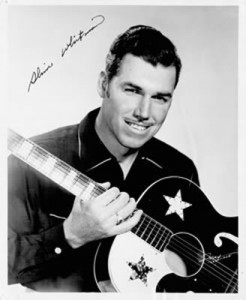
36. ‘Rose Marie’, by Slim Whitman

Slim+Whitman+Rose+Marie+-+VG-569464

Rose Marie, by Slim Whitman (his 1st and only #1)

11 weeks, from 29th July to 14th October 1955

Yee-Hah! I hoped, back when Tennessee Ernie Ford was topping the charts with ‘Give Me Your Word’, that we might be seeing our first Country and Western #1. Well, Ernie didn’t quite live up to his name but we didn’t have to wait long. This is country with a capital C O U N T R and Y.

Slim Whitman stands alone on the prairie. The setting sun casts an orange glow across this horizon. Cacti spread their long shadows over the dirty ground. A tumbleweed bounces lazily by. Slim picks up his spittoon, clears his throat, and begins… Oh Rose, my Rose Marie… I love you… I’m always dreaming of you…

It’s an atmospheric record, I’ll grant you that. Just a piano, a simple rhythm and that weird noise which is the epitome of old, Nashville C&W: strange and echoing, made either by guitars submerged in water or sped up recordings of whale noises. You’ll know it as soon as you hear it.

Anyway, Slim can’t forget Rose Marie, and even wishes he’d never met her. Then he hums as he thinks of her. It’s quite effective. You really can picture him wandering plaintively past hail bays and broken barn doors, as the light finally fades.

There are definitely some pros to this 36th UK chart topper: it is quite an understated ballad, lacking the OTT grandstanding of some of its predecessors, while there are definitely some ‘rockier’ elements to the song too in the twangy guitars and the piano riff. But there are definitely some cons too: Whitman’s voice comes far too close to yodelling for my liking (My Ro-OOse Marie), for example. Some nice touches; some things jar.

I was planning to write something indignant about this record spending 11 (Eleven!) consecutive weeks at the top – setting a record that would last for thirty-six years. But the more I listen to it, the more ‘Rose Marie’ is getting under my skin. It’s simple, it’s heartfelt, it’s kinda cute. There’s another fade, rather than a bombastic finale: a long drawn out note and a piano refrain.

3288955

It’s not a bad way to claim your sole chart-topper – double figures then out – though Slim Whitman did have a handful of other hits. Pictures of him show a very dapper looking pseudo-cowboy with a natty little moustache. It almost goes without saying, by now, that he lived to a ripe old age: dying at ninety in 2013. ‘Rose Marie’ itself (herself?) dates from far earlier than 1955 – from a 1924 opera of the same name, written by none other than Oscar Hammerstein II. And that, fact fans, is that.

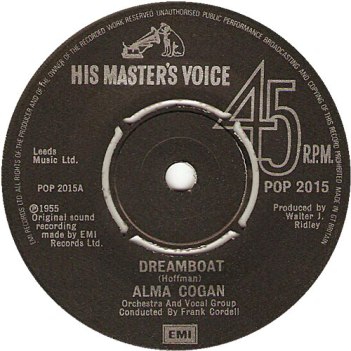
35. ‘Dreamboat’, by Alma Cogan

alma-cogan-dreamboat-hmv

Dreamboat, by Alma Cogan (her 1st and only #1)

2 weeks, from 15th to 29th July 1955

This is more like it! This is a pop song – a pop song as we would recognise one today. In our countdown so far I would count perhaps only Guy Mitchell’s ‘Look at that Girl’, and now this, as examples of The Modern Pop Song. No orchestras, no silly declarations of love, no grandstand finishes… Just a quick beat, a doo-doo-doo, and some lyrics about how in love the singer is.

I know this song quite well, and have it in regular rotation in my Spotify library, though I’m not sure how or why. I know next to nothing about Alma Cogan and, as you may have been able to tell from previous posts, I haven’t explored this era in popular music very extensively at all. It must have popped up as a suggestion – Spotify does love a suggestion – and I must have liked it enough to save it.

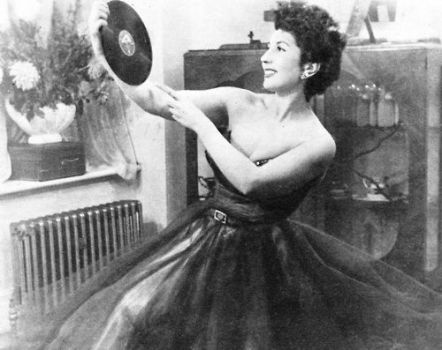
Anyway, know it I do. In fact, I don’t just know it – I love it! Cogan has this little flip in her voice at the start of every line, which makes her sound like an excitable school girl. And, for this song it really works. She’s got a crush, you see: You dreamboat, you loveable dreamboat, the kisses you gave me, set my dreams afloat… She’s besotted, and would follow the object of her desire anywhere – she would sail the seven seas, in fact: even if you told me to go and paddle my own canoe (I can’t help but think that sounds like a euphemism – ‘Just off to paddle my canoe darling, don’t wait up’).

There isn’t much else to ‘Dreamboat’ -it’s a fun little ditty. Cogan sings it well, with the perfect pronunciation we’ve come to expect but also with a light, playful touch that’s been missing from many of the number ones thus far. She sounds like she’s having a ball, as if she has a big, broad smile on her face while belting it out. Again, it’s a female singer having a good time. Contrast this with the song it replaced at the top – Jimmy Young’s painfully earnest take on ‘Unchained Melody’. Even in 1955 girls were having all the fun. It’s a noticeably shorter record than all the previous chart toppers as well, clocking in at well under two minutes, and that’s one of the most important things to consider when writing a brilliant pop song: make sure that it doesn’t outstay its welcome!

de565d5d80ca47f8aae75ff675d21485--vinyl-records-singers

It’s a shame, I think, that this is Alma Cogan’s only song on this countdown. I like the cut of her gib. She was another young, British-born singer who, along with Ruby Murray and Dickie Valentine earlier in 1955, was dragging popular music away from old crusties like Vera Lynn and David Whitfield and towards the teenagers, towards rock ‘n’ roll. This is a song, essentially, about a hunk and his sweet kisses.

A quick look at Cogan’s Wiki throws up a colourful picture: the highest paid female star of the late ’50s, serial winner of the NME Outstanding British Female Singer award, and perennial visitor to the Top 10. Parties with Princess Margaret, Cary Grant and Noel Coward. An affair with a young John Lennon just as the Beatles were shooting to fame. And then dead at the tragically young age of thirty-four…

A life well lived, though cut far too short. I have a feeling that I’ll miss her even more – this ‘Girl with the Giggle’ – when we return to the bog-standard, plodding ‘pre-rock’ songs that I fear are still to clock up the charts, before rock truly lands.

34. ‘Unchained Melody’, by Jimmy Young

s-l300

Unchained Melody, by Jimmy Young (his 1st of two #1s)

3 weeks, from 24th June to 15th July 1955

Forget ‘I Believe’, discard ‘How Much is that Doggie’, don’t mention ‘Mambo Italiano’… For the first time in this countdown, we have a song that everyone knows.

We’ve flirted with legend so far. Sinatra and Doris Day have hit the top, but not with any of their most famous recordings. Frankie Laine has set an unbeatable chart record with a song that will be unmistakeable to people of a certain age. And there have been other chart toppers that people might be able to sing a couple of lines from. But everyone, and I repeat everyone, knows ‘Unchained Melody’.

But not everyone will know this version. 4 (Four!) versions of ‘Unchained Melody’ have hit top spot in the UK charts – take a bow The Righteous Brothers, Robson & Jerome, and Gareth Gates, we shall hear from you anon. With these versions – the former especially – ingrained in popular culture, Jimmy Young’s version is a strange listen.

The tempo is faster, for a start. Then there are the Spanish guitars, when we are used to it being a piano led song. And then there is the clipped, British delivery. No glossy, American vocals here. Young’s voice is deep, sonorous even. It’s technically a good voice. But there is more than a whiff of David Whitfield about it, especially when he belts out the line Are you still MIIIIIIINE?

He still needs your love, and would like God to speed your love to him. It is the same song, but it’s not. I think that were this a more forgotten hit – a ‘Give Me Your Word’ for example -it might simply file in amongst all the other stiff, slightly overwrought, pre-rock ballads that we have sat through so far. But, unfortunately for Jimmy Young, people took this song and turned it into one of the most instantly recognisable pieces of popular music ever recorded. And his version, while still not the original (there were, inevitably, four other versions in the chart during the summer of ’55), now sounds very dated next to the more modern interpretations.

Interestingly, though, as we study the evolution of the number one record through time, we have a first here. At least, I think it’s a first (I can’t be bothered going back and listening to all the previous thirty-three). So many of these hits have favoured a bombastic THIS IS THE END OF THE SONG approach to the final chorus (to be referred to from now on as a TITEOES ending). And what song would have better suited this kind of OTT climax than ‘Unchained Melody’? But no. What we have here is Young singing the last line – God speed your love to me – the final note being held, the guitars strumming and a fade. A fade! And it works pretty well. It is, ironically – considering the time in which it was recorded – the most understated ending out of the four chart topping versions.

Why, though, is it called ‘Unchained Melody’ when the lyrics make no reference to being ‘unchained’? Is it because the singer is unchaining his heart, and pouring out his feelings to the one he loves? That would be a sensible guess, but no. We might as well address this here, though I am aware that I will have sod all to write about by the time we stumble across the Gareth Gates version. The song is from a film called ‘Unchained’, and is therefore the melody from ‘Unchained’. Kind of like Mantovani’s ‘Song from Moulin Rouge’. Simple. The film has been forgotten, but it lingers on in the title of a world-famous love song. And, it keeps up our run of film soundtrack #1s – four in a row, and counting. Of course, ‘Unchained Melody’ is also very well known for being in an ultra famous scene from another movie: ‘Ghost’. Which is turning this all very meta – kind of like the play within a play. Or not. I think I should stop writing soon.

jimmy-young-musical-career_1478869423

But I can’t finish without mentioning the man who has played barely a supporting role in this post so far: Jimmy Young himself. I’ve not so far been able to relate many of these early chart toppers to life events, experiences, or memories… But I do have a special place in my heart for Jimmy Young.

He was known by most as a Radio 2 DJ, rather than a singer. My parents love a bit of Radio 2 – as parents tend to do – and while I did put in some half-hearted protests for Radio 1, or even a commercial station (Shock! Horror!), I didn’t actually mind long car journeys with Steve Wright or Wogan or whoever. But I hated the two hours over lunch when Jimmy Young came on to talk about, ugh, politics, the world, society and the issues of the day. Then I would really protest, and my parents would usually concede to putting ‘ABBA Gold’ on for a bit.

Young just came across as a crusty old man, who thought youngsters didn’t know how easy they had it, who was definitely in favour of bringing back National Service, maybe even hanging… This is obviously all complete speculation on my part (though I see now that he had a column in the Daily Express – draw your own conclusions there…) and he’s dead so I shouldn’t be too rude. He did talk an awful lot, though. And yet I look back on those days fondly now, sitting in a car on our way to a fortnight in, I don’t know, Devon, listening to an old man chuntering on – an old man I had no idea had been a chart-topping singer.