78. ‘It’s Only Make Believe’, by Conway Twitty

Before we begin writing anything about this record, let’s take a minute to appreciate the name of the man who recorded it… Mr. Conway Twitty. It’s a strange name – ‘Conway’ being quite rugged and windswept, and ‘Twitty’ being somewhat less so. It’s a name you don’t forget in a hurry; which I suppose is a good thing in show-business.
R-7902310-1451306561-6539.jpeg

It’s Only Make Believe, by Conway Twitty (his 1st and only #1)

5 weeks, from 19th December 1958 – 23rd January 1959

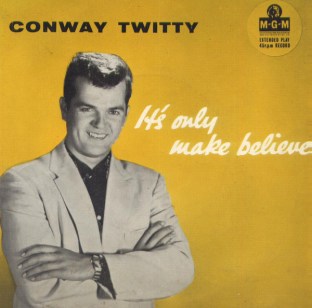
And note! I’ve finally – seventy-eight number ones in! – managed to locate some genuine cover art to stick at the top of my post. This, I am strongly led to believe, was the genuine cover that people would have seen in British record stores when they went to pick up their copies of ‘It’s Only Make Believe’.

To the song. A guitar strums… People see us everywhere… Another strum… They think you really care… Strum… But myself I can’t deceive… I know it’s only… Make… Believe… Conway loves a gal, but she ain’t lovin’ him back. Bizarrely enough, it sounds quite like the intro to ‘Runaround Sue’ – but that’s a story for another day.

My only prayer will be, Some day you’ll care for me, But it’s only Make… Believe… Is she using him to get back at an ex? Is she leading him on? Is she just a tease…? The reasons as to why they are leading this pretend-life remain tantalisingly out of reach. But Conway’s got it bad. His heart is a-achin’.

This is a rock ‘n’ roll ballad. We’ve toyed with the concept up to now. Was ‘It’s Almost Tomorrow’ the first? Or was it ‘Young Love’? Or was it neither? Because this is heart on your sleeve balladry. This is the real deal, and the starting point for all manner of Bon Jovi / Aerosmith-type fist clenching, air-punching soft-RAWK. Not that it actually sounds anything like a late ’80s power ballad; but mark my words – the seeds are being sown. The lyrics are super-overwrought: lots of my all, my everything, I’d give my life for you etc. etc. But Twitty sells it, just about, with some top-notch wailing. You really believe that his heart is cracking in twain as he sings.

This is also, I’m pretty confident in saying, our first slice of country rock at the top of the UK charts. We’ve had country before – a bit of Frankie Laine here, a little Slim Whitman there – but this is rock ‘n’ roll with a country twang. The Eagles, Dolly and Shania, even Tay-Tay before she went basic, stem from this kind of thing.

I know, I know… That’s a very bold statement. But it’s useful, as we reach the end of 1958, to take a step back and admire the bigger picture. We’re over two years into the ‘rock’ age and, as I’ve commented on several recent chart-toppers, there is more and more of a fusion going on. Songs like ‘The Story of My Life’, ‘All I Have to Do Is Dream’ and ‘It’s All in the Game’ topped the charts this year, and were all pop songs – hummable, easy listening numbers – with a distinct whiff of rock ‘n’ roll. The year started out with two utter classics – tracks one and two on Now That’s What I Call Rock N Roll: ‘Great Balls of Fire’ and ‘Jailhouse Rock’. Since then, though, the overriding theme of 1958 has been one of much ‘blander’ rock ‘n’ roll. And so ‘It’s Only Make Believe’, is in many ways the perfect track to round the year off – a rock song much more likely to appeal to mum, and gran, than the kids.

twitty2

The worst thing about this whole record is that Conway Twitty was not the singer’s real name. Boo! He was actually one Harold Jenkins, and apparently got his stage name after blindly opening a map and finding a town named Conway in Arkansas and one called Twitty in Texas. So far, so C&W. ‘It’s Only Make Believe’ was his only big success on the UK charts, so I make it three-in-a-row in the one-hit wonders stakes. He stumbled through the 1960s before becoming an absolute demon on the US Country Charts in the ’70s and ’80s, with hits like ‘Tight Fittin’ Jeans’ and ‘Red Neckin’ Love Makin’ Night’. Yee-haw! Best of all, he lived in a self-built multi-million dollar ‘country music entertainment complex’ called, wait for it… ‘Twitty City’. He died in 1993, aged but fifty-nine.

We’ll leave him here, caterwaulin’ us into 1959, the final year of the decade that gave us rock ‘n’ roll, Elvis, Buddy and Jerry Lee. Beyond that lie the 1960s, and nothing much of musical interest happened then. Did it?
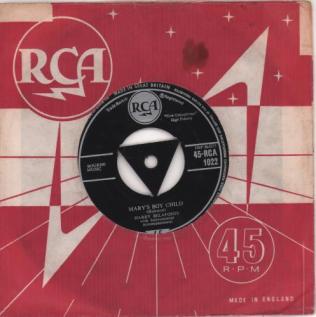
65. ‘Mary’s Boy Child’, by Harry Belafonte

HARRY_BELAFONTE_MARYS+BOY+CHILD+-+1ST-572716

Mary’s Boy Child, by Harry Belafonte (his 1st and only #1)

7 weeks, from 22nd November 1957 – 10th January 1958

Must we?

Maybe it’s because we are approaching mid-summer as I sit down to this, but I am really not in the mood to write a post about a Christmas song… Especially a song as dull as this one.

You surely all know it: Long time ago, In Bethlehem, So the Holy Bible says… Mary had a baby – one Jesus H. Christ – and the herald angels sang. The shepherds saw a star. Man will live for ever more… So on and so forth…

I am potentially the most-irreligious person going and so, to avoid offending any sensibilities, I will refrain from any cynical interpretations of these lyrics. Plus, Harry Belafonte is a titan, both of pop music and of the Civil Rights Movement, and to belittle this song (his only appearance at the top of the UK charts) would be to belittle the seventy-year career of a ninety-one-year-old man, who has achieved more in life than most of us could ever hope to.

Actually, talking of the Civil Rights Movement, the most notable thing about this record is how black it is. And how Harry Belafonte becomes, five years after its inception, the first man of colour to top the UK singles chart. And considering the sheer number of black male artists who have topped the charts – some of the biggest names in popular music history – that’s a pretty cool trail to blaze. He’s of course not the very first black artist to reach the top… So far we’ve had Winifred Atwell playing old-fashioned, white, music hall tunes on her piano, and The Teenagers with Frankie Lymon giving us a good dollop of Doo-Wop. And that’s been it. The charts are still very white. But here, Belafonte sings in a Jamaican patois (a heavily diluted patois, but still). And lines like: While shepherds watch their flock by night, Them see a shining star… are almost subversive in their flaunting of proper grammar! This is technically a Calypso record, but I struggle to hear anything particularly Calypso-ish about the strings and violins that swirl around Belafonte’s voice.

432466bq

Let’s treat this is an interlude, then – a moment’s respite from the advancing march of rock ‘n’ roll. The songs that top the charts at Christmas time are rarely reflective of current tastes (cough Cliff Richard cough cough Bob the Builder). Normal service will be resumed presently. Though to call this record’s stint at the top a ‘moment’ is a slight under-exaggeration (what is the opposite of an exaggeration?) It stayed there for seven weeks – hitting the top spot as early as the second last week in November! People clearly loved it.

Searching out the right version of this song has been a bit tough. Belafonte recorded various live versions, and an extended version in the early-60s, though the link below should be the song that topped the charts for Christmas ’57. But if you asked me what the best version of ‘Mary’s Boy Child’ is, I’d have to say Boney M’s!

52. ‘Just Walkin’ in the Rain’, by Johnnie Ray

R-832873-1374063649-1755.jpeg

Just Walkin’ in the Rain, by Johnnie Ray (his 2nd of three #1s)

7 weeks, from 16th November 1956 to 4th January 1957

And, just like that, we zoom to the end of 1956. And we are reacquainted with another artist whom we haven’t seen for a while…

The last time we met Johnnie Ray, he was snatching a week at number one with the superb ‘Such a Night’. I voted it as ‘Best Record So Far’ in an earlier recap, it was that good. But that was almost three years ago, in the spring of ’54. Ray stood out like a sore thumb – a groaning, pleading, cavorting thumb – amongst the frightfully proper records that were topping the charts back then. Now we’re in somewhat more relaxed, ever-so-slightly more liberal times, it’s no surprise that Johnnie’s back.

The first thing that hits you, as the needle drops, is the whistling. It’s a whistly record. The first record featuring whistling to top the UK Singles Chart. And it’s another simple record – just Ray’s voice, his backing singers, and a guitar. It crossed my mind that it might be a pastiche of ‘Singin’ in the Rain’, as the two songs do bear some similarities. ‘Singin’ in the Rain’s depressed, heartbroken brother perhaps?

Just walkin’ in the rain, Gettin’ soakin’ wet, Torturin’ my heart, By trying to forget…

The way Ray delivers that little ‘by’ is a thing of beauty. He barks it out, angry, heartbroken. You really believe him. As before, his voice makes the whole record. It’s not a regular voice, nor a technically perfect voice, but it is unmistakeable: raspy and croaky – he really does sound like man who’s been up all night, walking in the rain.

Anyway, his walk is a form of water-based therapy, perhaps, as he tries to get over his departed lover. Or maybe it’s water-torture, as there’s a masochistic edge to proceedings: People come to windows, They always stare at me, Shake their heads in sorrow, Sayin’ who can that fool be? He knows they’re watching, but he continues anyway. Lyrically, we are at a crossroads, in terms of male-recorded #1s. These the are self-flagellating lyrics that we have heard many, many times before, about how much pain he is in (see also ‘Here in My Heart’, ‘Outside of Heaven’, ‘Answer Me’, ‘Give Me Your Word’, I could go on…) BUT, unlike in those songs, there is no chance of a positive outcome here. Ray never mentions any hope that his love will return. He’s simply trying to forget. This, then, is more of the sugar-coated cynicism that started creeping into our chart topping records with ‘Why Do Fools Fall in Love’ back in the summer.

By the end of the song, Johnnie is weepin’ and a-wailin’ in superbly melodramatic fashion. I said it before, and I’ll say it again: it’s a crime that he gets looked over in the pantheon of rock ‘n’ roll pioneers/superstars. I can’t sing his praises highly enough. This is a great record (not as great as ‘Such a Night’, but still great). Of course, as I also mentioned in his earlier post, his being erased from the History of Pop Music had a lot to do with his homosexuality. And I did notice, the eagle-eared guy that I am, how there are no pronouns in this song. No hint as to the gender of his lost love….

johnnie-ray-just-walking-in-the-rain-1956-78

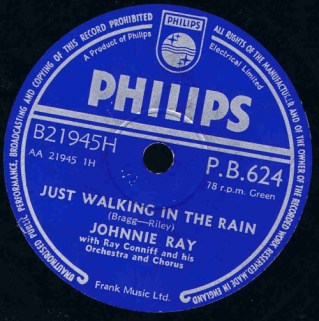
Johnnie Ray will appear one more time in this countdown – fairly soon, in fact – and so I will stop myself from going on too much about how amazing he was. (Though he was) And to finish I’ll address something that’s been bugging me for a while. At the top of each post I always include a picture of the record I’m going to be writing about. And they all look the bloody same. Black vinyl with a little disc circle of colour in the middle (and even that dash of colour is predictable: Phillips records are always blue, Capitol are black, Decca are navy…) I can never seem to find a picture of the record sleeve and, when I do (the jpg that headers Johnnie Ray’s earlier entry, ‘Such a Night’, for example) they are just as bland as the disc. You may have noticed that I sometimes include a picture that looks like it could be the record sleeve -I’ve included the one for ‘Just Walkin’ in the Rain’ above. That’s actually the sheet-music cover, a relic from the days before everyone had gramophones – they would buy the score and learn to play it themselves at home. There were even sheet-music charts before the NME started the record chart upon which this countdown is based. Even more frustratingly, it seems that LPs and EPs did get colourful covers in the 50s; it was only singles that were left to languish in boring, beige paper slips.

Anyway, the point of mentioning this is… I know it looks dull and I wish I could do something about it. I can’t wait for the days when artists and labels actually care about standing out on the shelves, and start including pictures of the band or, shock horror, an artistically though-out design on the cover. Though I fear that may be several years off…

40. ‘Christmas Alphabet’, by Dickie Valentine

dickie-valentine-christmas-alphabet-decca-78-s

Christmas Alphabet, by Dickie Valentine (his 2nd of two #1s)

3 weeks, from 16th December 1955 to 6th January 1956

And so we come across something I never considered when I started this blog: the fact that I will, every so often, have to listen to Christmas songs on repeat. When it most emphatically isn’t Christmas. No matter. ‘Tis a burden I shall bear stoically.

The very first Christmas song to hit #1 in the UK is based around a simple concept – an acrostic poem as hit single. C is for the candy trimmed around the Christmas tree, H is for the happiness with all the family… All the way to the final S which is for Ol’ Santa who makes every kid his pet, Be good and he’ll bring you everything in your Christmas alphabet… Repeat. Done. Note that I am not referring to it as the very first ‘Christmas Number One’, as that wasn’t a ‘thing’ until the ’70s and, technically, Al Martino, Frankie Laine and Winifred Atwell have all already had one.

It’s kind of cute on first listen, but quickly becomes so sugary sweet that you begin to fear diabetes. As I mentioned at the time of his 1st number one, Dickie Valentine still sings like an American crooner (apart from when his ever-so-proper English accent sneaks through in the line about the ‘tree so tawl’). And while this little ditty is a world away from any kind of rock ‘n’ roll – from the record which bookended this song’s stay at the top, for example – he is cementing his image as the first British teen idol.

dicky-valentine

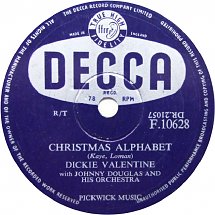
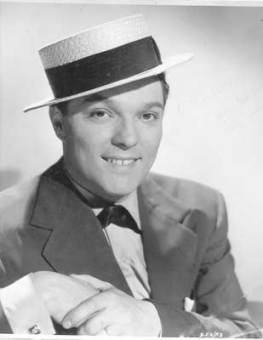
A quick look at the career of Mr. Valentine – which we should do now, as we won’t be hearing from him again – proves this to be true. He made his name singing with big bands, then by impersonating singers such as Frankie Laine and Johnnie Ray. His marriage in 1954 caused hysteria among his young fans, though it clearly didn’t kill his career. An image search throws up lots of cheeky grins, often accompanied by a boater-hat and a bow-tie – a definite ‘cheeky-chappie’. He scored the first and last #1s of 1955 but, like so many of these early chart-toppers, his recording career died a death in the ’60s, and he himself died the most rock ‘n’ roll death of all the artists featured so far: in a car crash aged just 41.

To finish, I do have a little anecdote about Dickie Valentine – and it’ll perhaps be my most tenuous link to any of the artists featuring in this rundown. Years ago (we’re talking early high school, here) I had a friend whose family loved going on cruises. I’ve never understood the appeal of cruises myself, but I suppose that’s irrelevant here. My friend mentioned a cruise they’d been on in which each cabin had – for some reason – a live feed of the ship’s ballroom that passengers could tune into any time of the day or night. My friend was watching it one night – disco night – when an old man, unimpressed by the DJs more modern tastes, walked past the camera and shouted ‘Play some Dickie Valentine!’. I have NO IDEA why my friend told me this uninteresting story; or indeed why I have remembered it to this day. I’d never heard of Dickie Valentine at the time; neither, presumably, had my friend. I suppose it is quite a funny name (‘Hur, hur… Dickie…’). But of all the things in life I’d have been better off remembering… The mind is a strange, strange thing.