Time for another trio of randomly selected (thanks to Random.org) number two hits from this date in chart history. Or, as I like to call them, our Random Runners-Up…
‘You See the Trouble With Me’, by Barry White – 2 weeks at #2, from 28th March – 10th April 1976 (behind ‘Save Your Kisses for Me’)
First up, a perfect marriage of disco and soul from the master of merging disco with soul, Barry White. In this song, the lyrics are limited, and way back in the mix, as if the most important thing here is the beat, and that’s hard to disagree with. The final minute of what is only a three and a half minute track is just grooving. Just what is the trouble with Barry? He can’t do nothing without his baby…
This was White’s fifth and final UK Top 10 hit, though he remained very much active until his death in 2003. A few years before that, ‘You See the Trouble With Me’ had been reduced to something of a novelty by dance act Black Legend… and reached to #1. They had to use a Barry White soundalike, as he refused to clear a sample, saying the remix was “cheap, and had no soul”.
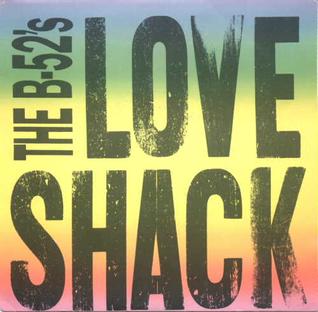
‘Love Shack’, by the B-52’s – 3 weeks at #2, from 18th March – 14th April 1990 (behind ‘Dub Be Good to Me’ and ‘The Power’)
On this day in 1990 – though not a song you could possibly date just by hearing it – the B-52’s were enjoying their biggest UK chart success in an already decade-long career. Wikipedia lists ‘Love Shack’ as pop rock, dance rock, surf rock and funk rock, as well as new-wave. (The B-52’s were originally new-wave, but I don’t think you could still have called them that in 1990.) Anyway, that melange of genres pretty much sums up this devilishly catchy tune.
‘Love Shack’ was a comeback for the band, after less than stellar chart fortunes, and the death of founding member Ricky Wilson in 1985. With lyrics about partying in a rusty shed, it is exuberant, and danceable, even if I have to be honest and admit that I’ve always found it a little irritating.
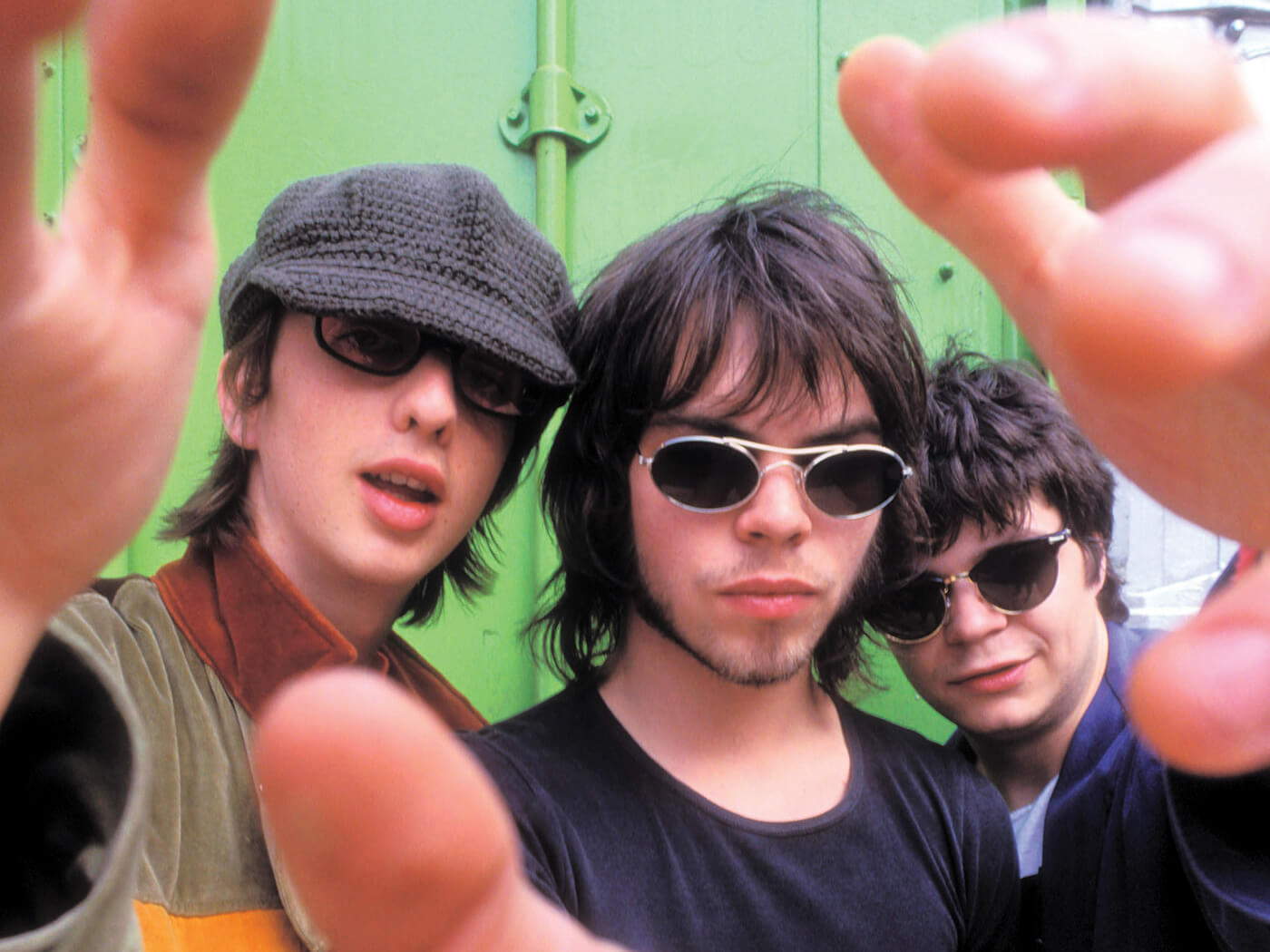
‘Richard III’, by Supergrass – 1 week at #2, from 6th – 13th April 1997 (behind ‘I Believe I Can Fly’)
I will argue long and hard for Supergrass as Britpop’s fourth best band… Okay, maybe 5th, after Suede. This banging track is now long forgotten, while the similarly heavy Britpop classic that made #2 the week after (‘Song 2’) lives on and on and on.
Supergrass could blend proper rock with perfect pop melodies, and this is one of their greatest songs, in a peerless run of singles between the mid-nineties and the mid-noughties. Oh, and it features a theramin, which always sounds fun. It is not about the famously hunchbacked king, nor about the Shakespeare play on the subject. It is a placeholder title – Supergrass gave all their tracks-in-progress people’s names – though they have since drawn a connection between the dark and menacing lyrics and the much-maligned historical character. And tell me that a line like Spent too much time, Wondering why, I got an opinion… isn’t Shakespearean-level thinking for the modern age.
Hope you enjoyed this threesome of #2s… Back to the regular stuff in a couple of days!
My intro to this next number one amounts to four simple words: Thank God for Oasis.
The Hindu Times, by Oasis (their 6th of eight #1s)
1 week, from 21st – 28th April 2002
Not just for cleansing the palate after the Pop Idol syrup-fests that had hogged the charts for several weeks previous, but for returning guitars to the top spot after what has probably been their longest hiatus. Not counting George Harrison’s posthumous comeback, I think this is the first rock #1 since, gulp, Limp Bizkit in January 2001.
Yes, this isn’t one of their classics. But I also think ‘The Hindu Times’, and anything Oasis released post-1998, gets unfairly maligned. They were great at side one, track one songs like this (and ‘Hello’, and ‘Turn up the Sun’, and ‘Fuckin’ the Bushes’), songs the sole purpose of which is to reassure the listener that, yes, they are listening to Oasis.
And I love it when Oasis are being Oasis. If you aren’t a fan then you might struggle with a song so droning, so snarly, so unrepentantly simple, but that’s your loss. If you can’t appreciate the way Liam drags out the you’re my sunshine you’re my rain… line in the chorus, presumably a knowing nod to ‘Live Forever’, then Oasis simply aren’t for you.
Experimentation feels like a dirty word in an Oasis context, one that soft southerners might use. But there is a bit of that going on. The ‘sitar’ riff, the droning, the gigantic wall of sound feel. It’s as big and beefy as they’d sounded since ‘Definitely Maybe’, and it’s not completely crazy to suggest that a higher tempo ‘Hindu Times’ wouldn’t sound out of place on their debut album. Despite the sitar sound, and the title, Noel had not been spending time with the Maharishi like his ‘60s idols; he saw the title as a slogan on a t-shirt.
With this single, and the subsequent ‘Heathen Chemistry’ album, Oasis debuted two new members in Gem Archer and Andy Bell (not the Erasure Andy Bell, though that would have been a direction I’d love to have heard Oasis go in…) Archer and Bell remained in the band until their split in 2009, and have returned for the reunion tour. The album is okay – sixteen-year-old me thought it was amazing – but second single ‘Stop Crying Your Heart Out’ is probably the one 21st century Oasis single that people are happy to compare with their nineties output. For me, though, I’d go with the lovely ‘Songbird’, the album’s fourth single and the first to be written by Liam. I was very disappointed to see that the only post-1998 song they were playing on their recent tour was ‘Little by Little’, which I’ve always thought a dull plodder.
Despite rock music being back, baby, it won’t be hanging around for long. No Oasis #1 ever spent more than a week on top, and the next identifiably ‘rock’ chart-topper is more than a year away… Luckily though, we’re about to embark on a run of pretty decent, non-rocking number ones, starting with a ‘00s girl group classic.
Now that my most recent recap has drawn the ’90s to a close, it’s time to announce what are officially my 10 Best Number Ones of the Decade. Conclusively, ultimately, unarguably….
I’ve done this for all the previous charts decades – follow the links if you’d like to catch up (the ’50s, the ’60s, the ’70s, the ’80s) – and it works like this. Every recap I’ve named a Very Best Chart-Topper, plus some other #1s that came close. This isn’t me retrospectively choosing my ten best, this is what I chose as I went. No changing of mind allowed, for better or worse. For the previous Top 10s this method threw up some interesting choices, and the 1990s is no different…
‘Nothing Compares 2 U’, by Sinéad O’Connor – #1 for 4 weeks in January/February 1990
I think the records at the very top and bottom of this list are perhaps the two songs people can have the fewest complaints about. For who can dispute ‘Nothing Compares 2 U’s haunting beauty? It was only the 3rd #1 of the nineties, but remains one of the decade’s strongest, and was the Very Best Chart-Topper in my end of the 80s/early 90s recap. Plus the stories around it have passed into legend: Prince’s reaction, Sinéad’s solitary tear… Read my original post here.
‘Would I Lie to You?’, by Charles & Eddie – #1 for 2 weeks in November 1992
1991 provides no number ones for this list, probably because Bryan Adams was on top of the charts for roughly half that year. So the next winner of my ‘Very Best Chart-Topper’ award was this retro-soul number from Charles and Eddie, a #1 in November 1992. It’s not a song I had thought much about before writing my post on it, but it charmed me, standing out in unashamedly old-fashioned style in the charts of the time.
‘No Limit’, by 2 Unlimited – #1 for 5 weeks in February/March 1993
Okay, here’s where things get a little silly. I actually named ‘No Limit’ as runner-up to ‘Would I Lie to You?’. Whether this is a reflection of the poor quality of competition at the time (the early-to-mid nineties were a weird no-man’s land of cheap dance, reggae revival, and power ballads), nostalgia blinding my eyes (‘No Limit’ is one of the first pop songs I can remember in ‘real time’), or me being on the wine while writing that recap, I don’t know. Of course, ‘No Limit’ has no right being on any ‘Best Of’ list. But at the same time… It’s a banger. I regret nothing. Techno, techno, techno, techno…
‘Stay Another Day’, by East 17 – #1 for 5 weeks in December 1994/January 1995
The undisputed winner of my ’93-’95 recap, East 17’s stately ballad remains one of, if not the, best boyband number one of all time. Written about a brother’s suicide, the timely additional of church bells turned this into a festive classic, with most people assuming its about the singer begging a lover to remain around at Christmas time. Whether or not it’s a Christmas hit is up for debate; what’s not up for debate is the record’s undoubted quality. Read my original post here.
‘Firestarter’, by The Prodigy – #1 for 3 weeks in March/April 1996
Runner-up in the following recap, it’s one of the decade’s most controversial number ones. I’m the bitch you hated, Filth infatuated… With the ‘Fat of the Land’ album, the Prodigy rebranded themselves from cool dance act to public enemy number one, and ‘Firestarter’ was only the beginning. It’s an acquired taste, but an era-defining chart-topper. This also means that 1995 becomes the decade’s other year not to place a song on this list, and that’s because, looking back, 1995 could well be the worst year on record for number one singles… (Robson and Jerome…. The Outhere Brothers… Cotton Eyed Joe… shudder…)
‘Setting Sun’, by The Chemical Brothers – #1 for 1 week in October 1996
Just edging the Prodigy out to win a ‘Very Best’ award, with a track carved from very much the same block of stone as ‘Firestarter’, it’s the Chemical Brothers. Well, it’s two for the price of one, as an uncredited Noel Gallagher also features (I had to squeeze Oasis in here somehow, even if none of their own songs feature on this list). Original post this way.
‘Your Woman’, by White Town – #1 for 1 week in January 1997
The decade’s 5th ‘Very Best’ number one, and one of its strangest. Recorded by a fairly nerdy man in his bedroom, and based around a trumpet sample from 1932, it has an eerie, yet goofy, oddness to it which you don’t often find at the top of the charts. I debated long and hard about choosing this, or the record below (which is also the record that knocked it off the top of the charts), as The Best. But in the end, they both get to feature on this list. Original post here.
‘Beetlebum’, by Blur – #1 for 1 week in January/February 1997
Replacing ‘Your Woman’ at the top, (which makes that fortnight in January 1997 officially the best two weeks of chart music, ever…) here’s Blur. It’s the ’90s, so we really had to have one Britpop song on this list. Problem is, most of the truly great Britpop anthems famously failed to make it to #1. So we’re left with this fuzzy dirge, and Damon Albarn slurring some lyrics about being on heroin, that many now claim marked the beginning of the end of Britpop…
‘Believe’, by Cher – #1 for 7 weeks from October-December 1998
We seem to have become side-tracked. The past few songs are great pieces of music – I mean, that’s why I chose them – but they’re hardly the first tunes people remember when they think of ‘the nineties’. Luckily, we finish on a gigantic pop big-bang. Starting with Cher’s biggest-selling record. In fact, the best-selling single ever released by a member of the female race. It was my final ‘Very Best’ record of the decade, it introduced the world to autotune, and it remains a stone-cold, classic floorfiller to this day.
‘…Baby One More Time’, by Britney Spears – #1 for 2 weeks in February/March 1999
But is ‘Believe’ better than this…? I still don’t know. They’re both great, they both bring this rundown to a close, and both represent the best of the nineties’ poppy final years. In my mind, though, ‘Believe’ is ’90s through and through, whereas ‘…Baby One More Time’ feels much more of the 21st Century. Which means it’s the prefect record to end on, really.
Since this officially closes both the 1990s, and the 20th century, as far as this blog is concerned, here are the fifty best number one singles of the singles chart’s first five decades, according to me. Deep breath…
‘Look at that Girl’, by Guy Mitchell (1953) ‘Such a Night’, by Johnnie Ray (1954) ‘Mambo Italiano’ by Rosemary Clooney (1955) ‘Cherry Pink and Apple Blossom White’, by Perez Prado & his Orchestra (1955) ‘Dreamboat’, by Alma Cogan (1955) ‘Why Do Fools Fall in Love’, by Frankie Lymon & the Teenagers (1956) ‘That’ll Be the Day’, by The Crickets (1957) ‘Great Balls of Fire’, by Jerry Lee Lewis (1958) ‘Who’s Sorry Now’, by Connie Francis (1958) ‘Dream Lover’, by Bobby Darin (1959) ‘Cathy’s Clown’, by The Everly Brothers (1960) ‘Shakin’ All Over’, by Johnny Kidd & the Pirates (1960) ‘Telstar’, by the Tornadoes (1962) ‘She Loves You’, by The Beatles (1963) ‘Needles and Pins’, by The Searchers (1964) ‘You’ve Lost That Lovin’ Feelin”, by The Righteous Brothers (1965) ‘(I Can’t Get No) Satisfaction’, by The Rolling Stones (1965) ‘Good Vibrations’, by The Beach Boys (1966) ‘A Whiter Shade of Pale’, by Procol Harum (1967) ‘I Heard It Through the Grapevine’, by Marvin Gaye (1969) ‘Bridge Over Troubled Water’, by Simon & Garfunkel (1970) ‘Baby Jump’, by Mungo Jerry (1971) ‘Metal Guru’, by T Rex (1972) ‘See My Baby Jive’, by Wizzard (1973) ‘Tiger Feet’, by Mud (1974) ‘Can’t Give You Anything (But My Love)’, by The Stylistics (1975) ‘Space Oddity’, by David Bowie (1975) ‘Dancing Queen’, by ABBA (1976) ‘I Feel Love’, by Donna Summer (1977) ‘Heart of Glass’, by Blondie (1979) ‘Atomic’, by Blondie (1980) ‘The Winner Takes It All’, by ABBA (1980) ‘My Camera Never Lies’, by Bucks Fizz (1982) ‘Total Eclipse of the Heart’, by Bonnie Tyler (1983) ‘Relax’, by Frankie Goes to Hollywood (1984) ‘You Spin Me Round (Like a Record)’, by Dead or Alive (1985) ‘The Power of Love’, by Jennifer Rush (1985) ‘It’s a Sin’, by Pet Shop Boys (1987) ‘Theme from S-Express’, by S’Express (1988) ‘Ride on Time’, by Black Box (1989) ‘Nothing Compares 2 U’, by Sinéad O’Connor (1990) ‘Would I Lie to You?’, by Charles & Eddie (1992) ‘No Limit’, by 2 Unlimited (1993) ‘Stay Another Day’, by East 17 (1994) ‘Firestarter’, by The Prodigy (1996) ‘Setting Sun’, by The Chemical Brothers (1996) ‘Your Woman’, by White Town (1997) ‘Beetlebum’, by Blur (1997) ‘Believe’, by Cher (1998) ‘…Baby One More Time’, by Britney Spears (1999)
*Abba and Blondie get around my ‘1 song per artist’ rule by cleverly releasing two brilliant number one singles in two different decades… And 1955 emerges as officially the best year for chart-toppers! Though the ’50s had an obvious advantage in the fact that I was choosing ten #1s out of seven (and a bit) years instead of a full decade. Maybe I should trim it down to eight ’50s number ones… But that would spoil my nice round fifty.
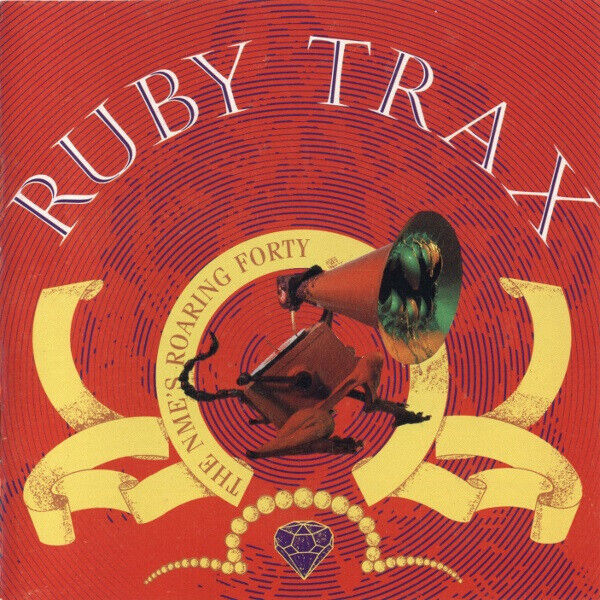
In 1992, to celebrate the 40th anniversary of the UK Singles Chart, the NME released ‘Ruby Trax’: an album of forty cover versions of number one singles. It featured acts as diverse as Billy Bragg, Dannii Minogue, and the Jesus and Mary Chain, and it is a wonder. And something I shall be mining for all my upcoming ‘Cover Versions of #1s…’ posts.
Starting with two covers by two of the early nineties’ biggest alternative bands. November 1992 saw British rock on the verge of a big shift. The following May, Blur would release the first of their Britpop trilogy, ‘Modern Life Is Rubbish’, shortly after the arrival of the eponymous debut LP from Suede.
Suede had only released two singles when they contributed this cover of the Pretenders’ ‘Brass in Pocket’ to ‘Ruby Trax’, but they were already darlings of the music press. ‘The Best New Band in Britain’ according to Melody Maker upon the release of their first single (and, in hindsight, probably the very first ‘Britpop’ single) ‘The Drowners’.
Their cover of ‘Brass in Pocket’, is a slow-burn, adding a layer of menace that the more upbeat, seize-the-day feel of the original lacks. Brett Anderson’s voice, though, has persuasive charm like Chrissie Hynde, albeit the persuasive charm of someone begging you for drugs at a party (note also the subtle lyrics changes that add some early-nineties edge). This cover wasn’t released as a single, but was included on a 2018 re-issue of Suede’s debut album.
The only single released from ‘Ruby Trax’ was by perhaps the hottest band in Britain in 1992: Manic Street Preachers. Their take on ‘Suicide is Painless’, AKA the theme from ‘M*A*S*H’, became the band’s first Top 10 hit, peaking at #7.
I’m reluctant to ever claim a cover version as ‘better’ than an original – can you ‘better’ something that isn’t your original work? – but I will say that the Manics’ version sounds much more how I imagine a song titled ‘Suicide Is Painless’ should sound. Despite the sombre topic, the light arrangment and the choral voices of the original theme mean it can’t help sounding like a TV show theme. Which, I’ll admit, was probably the point.
In the Manics’ hands, overwrought lyrics like The game of life is hard to play, I’m gonna lose it anyway… hit home. Even the clunky title line Suicide is painless, It brings on many changes… works. Just about. Of course, knowing now the widely-believed fate of Richey Edwards adds a very sad edge to the Manics singing a song about suicide. Here though, Edwards joins the band in bringing the song to a garage rock crescendo.
I hope you enjoyed these two covers, especially if they’re new to you. If anything, it’s been nice to break up the relentless pop and dance of the year 2000’s chart-toppers for a moment… A very brief moment. I’ll feature some more covers from ‘Ruby Trax’ later in the year.
The new millennium. The 21st century. The two thousands. The noughties. Here we go. Off with a bang.
The Masses Against the Classes, by Manic Street Preachers (their 2nd and final #1)
1 week, from 16th – 23rd January 2000
Could it be any more Manic to combine rushing punk rock, some of the most instant chord progressions of this entire year’s run of #1s, and extracts from Noam Chomsky and Albert Camus? All in a song named after a quote by Victorian-era Prime Minister William Gladstone.
Whatever you make of the their politics (the sleeve art for this was literally the Cuban flag), you can hopefully admire the way the Manics unashamedly used it in creating some of the day’s best rock music. Their first chart-topper ‘If You Tolerate This…’ referenced the Spanish Civil War, but the band had also received criticism from some of their die-hard fans for allegedly selling out with a softer, more pop-leaning sound.
Which means that ‘The Masses Against the Classes’ works as a socialist anthem, but also as a middle finger to those that accused them of discarding their punk roots. Hello it’s us again… sneers James Dean Bradfield, after a distorted rip-off of the Beatles’ ‘Twist and Shout’… We’re still so in love with you… Success is an ugly word, Especially in your tiny world… It all culminates, as the guitars splinter and distort, with that Camus quote: A slave begins by demanding justice, And ends by wanting to wear a crown… Which, if you think about it, is the best description of toxic fandom going.
For such an influential genre, punk rock has been very poorly served at the top of the charts. Which makes sense, for what could be less punk than having commercial success? I have at various points argued for ‘School’s Out’, ‘Pretty Fly (For a White Guy)’, and even Mr. Blobby, being the most punk number ones. Add to that stellar list, then, ‘The Masses Against the Classes’. Punk aside, it’s just nice to hear some freaking guitars back at the top of the charts!
Not this record’s success indicates in any way that the year 2000 is going to see a rock resurgence after the pop-heavy late-nineties. Sorry, things are going to stay just as poppy over the course of this year’s forty-two chart-toppers (a record turnover of #1s). The Manic Street Preachers were one of the few guitar acts that could break through to the top at this time, and they did so by releasing in dead mid-January, and by publicly deleting the single from production on the Monday it was released (which is also very punk, to be fair).
All this also means that it stands out as a bit of an oddity in the Manics’ back-catalogue. One of their two #1s, that very few casual listeners could sing the chorus to. There are far better known songs by the band that didn’t make it so high in the charts, but then isn’t that the way with so many acts? They would go on scoring Top 20 hits until the early 2010s, and are releasing their 15th studio album later this month. I feel a Manic Street Preachers’ ‘Best of the Rest’ is a post I’ll be doing soon enough…
The only video made was this live version, recorded in Cardiff on the Millennium’s Eve…
Launching our second new feature of the year, we’re going to celebrate the flip-sides to some famous chart-toppers. In my posts on every UK #1 between 1952 and 1999, I’ve stuck fairly rigidly to reviewing just one side of each chart-topping disc. On occasion I may have mentioned them in passing, and I’ve always given them a spin if they’re listed as a double-‘A’; but by and large I’ve avoided the B-sides.
To be honest, I was born at the tail end of the B-side era, so sometimes overlook their importance. By the mid-to-late-nineties, when I started buying music, the bonus tracks on a CD or cassette single were often just remixes of the A-side, or maybe a live version of an earlier hit. And the download/streaming era has killed off the concept for good. But cast an eye back further, to the days when an act’s singles were the main event, rather than a plug for their current LP, and the ‘other’ side of a hit single was a source of countless hidden gems.
And besides (see what I did there), many’s the big chart-topping hit that was originally intended as back-up to a song that, for whatever reason, didn’t catch the imagination. ‘Rock Around the Clock’, ‘Maggie May’, ‘I Feel Love’… The list is long, and often surprising. So, let’s kick things off with one of the last bands to recognise the power of a good B-side…
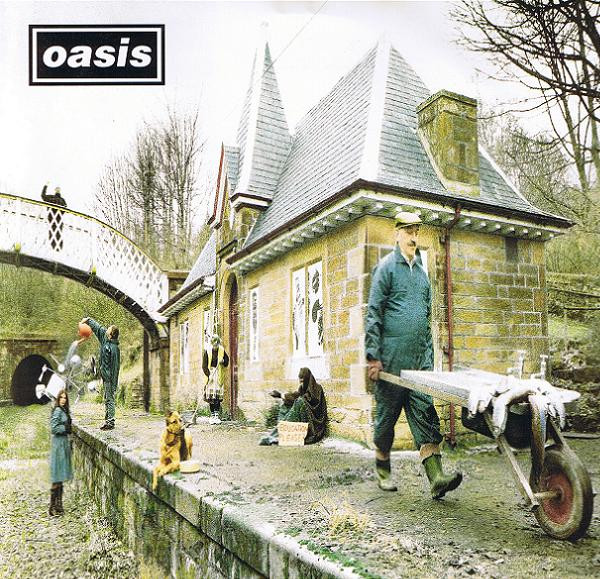
‘Some Might Say’ made number one in April 1995, Oasis’s first chart-topping single. You can read all about that song here. It was only their sixth release, but already the Gallaghers and co. had built a reputation for spoiling their fans with cult classics hidden behind the actual hits. ‘Half the World Away’ on ‘Whatever’, ‘Listen Up’ and ‘Fade Away’ on ‘Cigarettes & Alcohol’. But on ‘Some Might Say’, the lead single from their soon to be multi-multi-platinum second album ‘(What’s the Story) Morning Glory?’, Oasis included not one, not two, but three great B-sides. Starting with…
‘Talk Tonight’ is a classic of the Noel-with-an-acoustic guitar genre, a common theme for their B-sides. It was written about a woman in San Francisco, to whom he escaped after a concert went wrong (another common Oasis theme). Oasis at their best produced songs about very specific moments – visiting a park with a woman you barely know – that feel very universal. Everyone has some absent friend with whom they would like to talk tonight.
‘Acquiesce’ meanwhile is Oasis with a capital OASIS. One of very few tracks on which the brothers share vocal duties: Liam at his sneery best on the verses, Noel stretching his vocal chords on the chorus. Plus, the lyrics speak to their brotherly bond: Because we need each other, We believe in one another… (Noel has claimed that the only reason he sang the chorus was because Liam couldn’t reach the high notes). The moment when the pair collide at the start of the second verse is possibly the best five seconds in Oasis’s entire back-catalogue.
For a famous rock band, the moments in which Oasis let loose and just fucking ROCKED are actually quite few and far between. ‘Headshrinker’ may well be the heaviest song they ever recorded, with ten-tonne weighted chords, and lyrics like Lost in the fog, I’ve been treated like a dog, And I’m outta here… about an unhinged lady-love. Their biggest hits may have long since been lost to bland ubiquity, but gems like this remind us that on their day Oasis could be pretty punk.
Noel Gallagher has long since bemoaned the fact that he used up so many great songs as B-sides, especially after years of fame (and booze and drugs) had blunted his songwriting edge. Stick any of these three featured songs onto ‘Standing on the Shoulders of Giants’ and they would instantly be the best tracks on the album. But then again, chucking classics like these away on the one CD single encapsulates the carefree, live-in-the-moment ethos of early Oasis, and of Britpop before it soured, and was a huge part of their appeal.
I hope you enjoyed this first installment in what I hope to make a semi-regular feature. If you have any suggestions for B-sides (to UK #1 singles) that I can feature, please let me know in the comments!
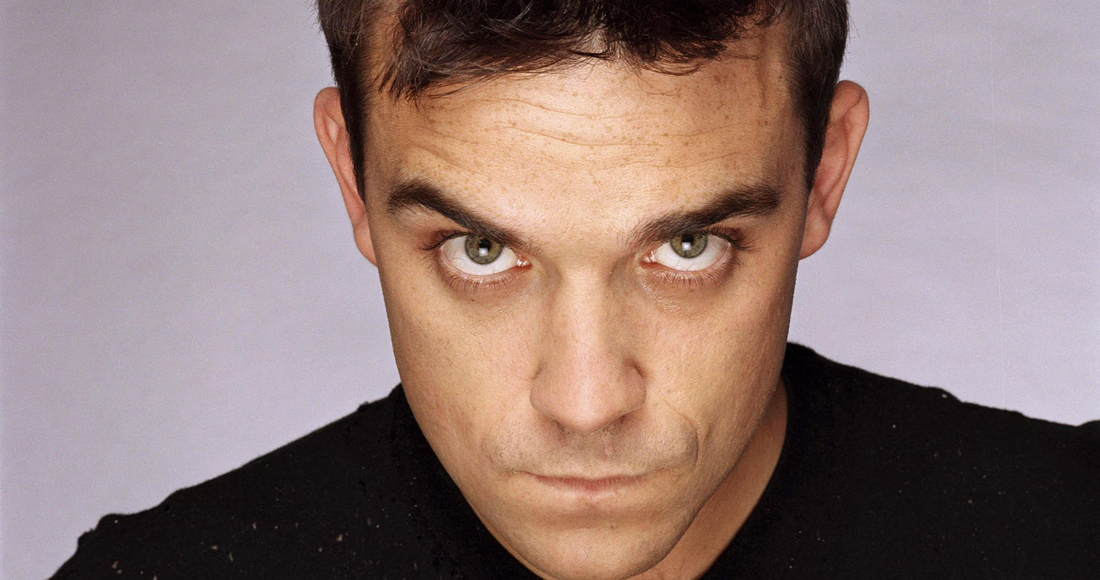
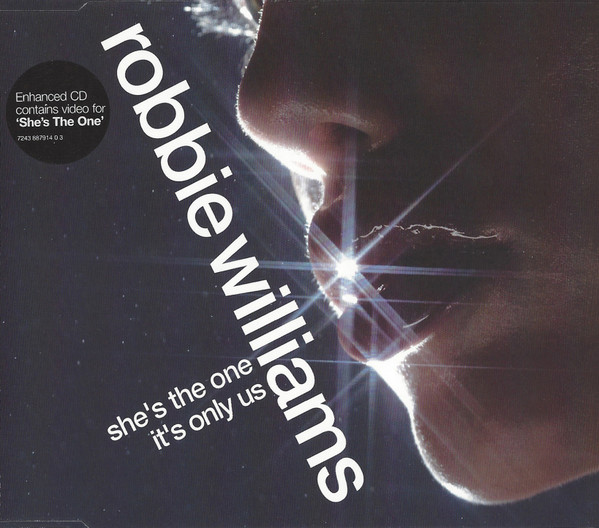
‘She’s the One’ is not Robbie Williams’ best known number one. Nor does it get the airplay of a ‘Rock DJ’, a ‘Feel’, or an ‘Angels’. But if you’ll let me, I’d like to suggest that it’s one of his very best.
She’s the One / It’s Only Us, by Robbie Williams (his 2nd of seven solo #1s)
1 week, from 14th – 21st November 1999
At least, I always thought so. Until today, when everything I believed was rocked to its core… ‘She’s the One’ is a cover. World Party, a project fronted by former Waterboys member Karl Wallinger, recorded and released the original in 1997, and it was an Ivor Novello-winning, film soundtrack appearing, performed-on-Jools-Holland sort of hit. I’m ashamed of myself for not discovering this much earlier…
Robbie Williams delivers a facsimile of this song – same instrumentation, same harmonies, same vocal range – and delivers it very well. It is a lovely song; a very late-Britpop, arms around your mates in the pub sort of tune. It could easily have been recorded by Oasis, which of course means it has lots of nice Beatlesy touches to it, in the drum-fills and the backing vocals. But I feel slightly cheated now, after all these years of enjoying this so-called Robbie Williams hit.
What the original doesn’t have is a Brit Award winning video set in the world of competitive figure skating, with Robbie playing a has-been skater given one last chance at glory. Plus, it means Barry Davies, the greatest football commentator of my lifetime, can claim a number one single. (My dream aged thirteen, when this song came out, was to be Barry Davies.)
There was some drama, and some fairly ungentlemanly behaviour from Williams, when he started claiming that ‘She’s the One’ was the best song he had ever written. Some of Wallinger’s band played on the cover, unknown to Wallinger himself, and he suffered a brain aneurysm around the time it was hitting #1. Still, he did well off the royalties, and in interviews has claimed that this record saved him from penury. Williams has also, more recently, finally admitted that he didn’t write the song.
What of the double-‘A’ side, ‘It’s Only Us’? The fact I don’t think I’d ever heard this suggests it was more of a jumped-up ‘B’-side than a true double-‘A’. It was written for the soundtrack to FIFA 2000 and, again, it’s very Britpop indebted, this time more Supergrass than Oasis. It rollocks along nicely with lyrics that namecheck Williams’ hometown of Stoke-on-Trent, as well as ‘Rock Me Amadeus’, and with a fun end-of-the-pier organ solo. It’s also one of those songs where Robbie makes a drugs reference – We’re just after cheaper thrills, Since the price went up on pills… – of the sort that always feels a little try-hard for a former boyband member, like a teenager trying to shock his parents. We get it, Robbie. We get it.
It’s worth noting that this was the fourth single from ‘I’ve Been Expecting You’, the album that had given us ‘Millennium’ well over a year earlier. Taking the fourth single from an already huge-selling album to number one requires some serious star power, something that Robbie had in abundance in the late ‘90s. In fact, this moment saw the breakout star from the decade’s biggest boyband knocking his female counterpart, Geri Halliwell, off top-spot. The following year the pair would even date for a couple of months. Geri and Robbie, top of the pops and pretending to be a couple for the tabloids… Pop culture doesn’t get any more turn-of-the-21st-century that that.
I have a recap coming up in a couple of posts, in which I’ll name the best/worst/weirdest/dullest of the most recent number one singles. But if I ever decide to dish out awards for ‘Best Song Title’, then we’ll have an easy all-time winner…
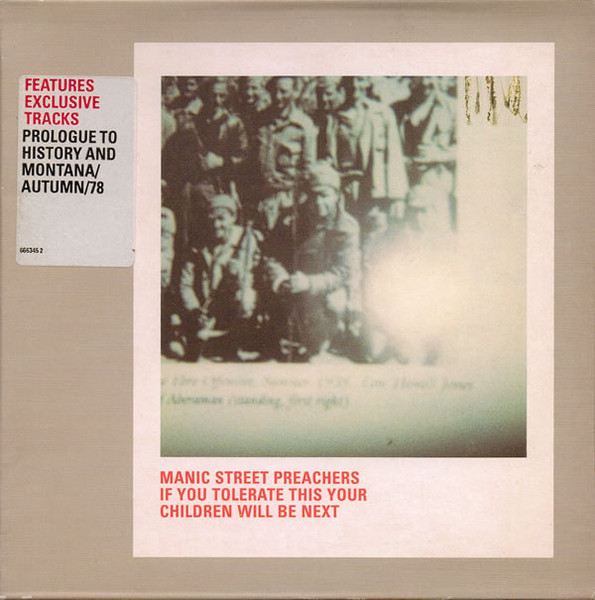
If You Tolerate This Your Children Will Be Next, by Manic Street Preachers (their 1st of two #1s)
1 week, from 30th August – 6th September 1998
I make the nine-word ‘If You Tolerate This Your Children Will Be Next’, to be the second longest chart-topping title not to feature brackets (and obviously not counting double-‘A’s). Bonus points for naming the eleven-word winner of that award… Anyway, so far so interesting. But is the song any good…?
Well, the dreamy reverb on the guitars is cool, and the song has a big, beefy wall-of-sound feel to it. It’s confident, and orchestral, and as the lead single from their fifth album it declares the Manics to be perhaps the biggest band in post-Britpop Britain. It’s also fairly mid-tempo, a bit Radio 2, when compared to some of their earlier, spikier hits.
Of course, with a title like that, the lyrics were surely going to be the most interesting aspect of this song. And on one level they don’t let us down. So if I can shoot rabbits, Then I can shoot fascists… is a line unlike most others in the preceding seven hundred and ninety-eight #1s. Inspiration for the song came from a Spanish Civil War-era poster, showing a child killed by Franco’s forces with the title-line printed below. The singer is singing from a modern viewpoint though, and feels gutless when he thinks about the generations before him who fought fascism.
The lyrics are also what leave me a little cold, when faced with writing a post on this record. I’d like to celebrate the Manics making number one – a rock song making number one in the very poppy charts of late ’98 – but they have better songs in their canon. And it’s not that I’m put off by the preachy-ness of it (the hint is in the band’s name, after all), but ‘A Design for Life’ did the socialist-statement-with-strings-and-a-massive-chorus much better than this two years earlier (and only made #2). ‘If You Tolerate This Your Children Will Be Next’ is a little too on the nose, a little too much edge without substance. And, removed from the song’s actual lyrics, it can be co-opted by any crackpot conspiracy theorists, as happened in 2009 when the BNP used the song on their website.
I go through phases with the Manics where I listen to them a lot; and then at other times I seem to forget they exist. They always remained somewhat outside the world of Britpop, pre-dating the movement by several years, and by managing hits well into the 2000s, long after most of the other big nineties rock acts had imploded. I do like them, though. And just to prove that I don’t mind political statements in songs, as long as the song itself is strong enough to carry said statement, I will be giving their second number one a glowing write-up.
***I should also mention that I’ve written a post for Kinks Week at Powerpop Blog, which was published earlier today. Please do check it out, along with the rest of Max’s always entertaining and informative posts on music and pop culture!***
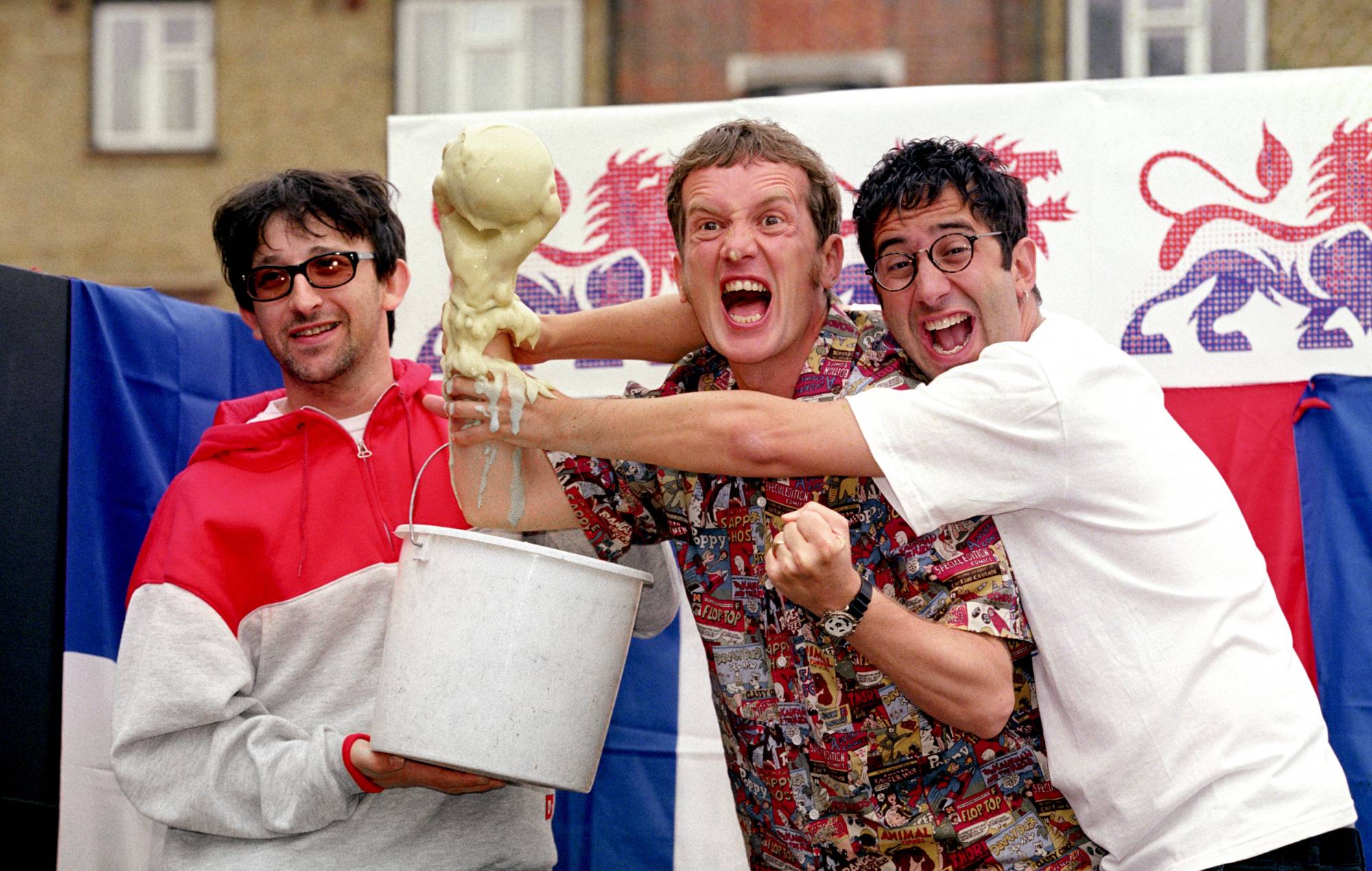
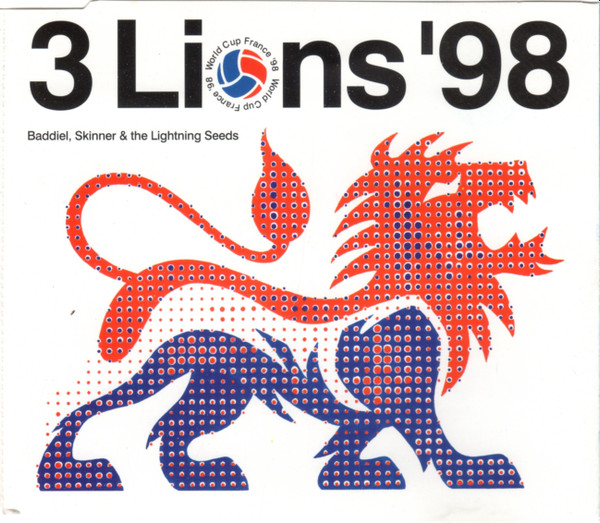
So successful was the original ‘Three Lions’, buoyed by England’s near miss at the 1996 European Championships, that the only logical thing for David Baddiel, Frank Skinner and Ian Brodie to do was re-record it for the next big international tournament: the 1998 World Cup.
3 Lions ‘98, by Baddiel, Skinner & the Lightning Seeds (their 2nd and final #1)
3 weeks, from 14th June – 5th July 1998
It starts off very meta, with the Wembley crowd singing the original chorus, and Jonathan Pearce reliving Gareth Southgate’s missed penalty that lost them the ’96 semi-final. After that it’s business as usual, with the sound perhaps a bit beefier than the earlier version. The lyrics are different too, with the first verse focusing on how close England came two years before, and the second focusing on how this will be their year in France.
‘3 Lions’ has been accused, as I mentioned in my first post on the song, of being a bit arrogant by those who don’t want England to do well at international tournaments (i.e. most people who aren’t English). I would argue that the 1998 version is even more over-confident, as thirty years of hurt is now no more years of hurt (okay, thirty-two years of hurt wouldn’t have scanned well, but still….)
This isn’t a football blog, so in short: football didn’t ‘come home’ in 1998, Argentina saw to that by beating England in the round of sixteen. David Beckham, Diego Simeone and all that… In fact, ‘3 Lions ‘98’ was at #1 for longer than England were in the tournament. And football still hasn’t come home in the near thirty years since, though it has come closer recently (too close for comfort for this Scot…) Just last month England lost the Euro 2024 final to Spain.
And as much as I find it annoying as a modern cultural behemoth, I again cannot argue that ‘3 Lions’ isn’t a good song. The daddy of all football pop songs. Plus, the video is good fun, once more featuring Geoff Hurst, and Robbie Williams, a lot of Germans with mullets, and a bit of fun with the fact that Stefan Kuntz had scored Germany’s equaliser two years before.
Away from the football, there’s a serious question to ask here: is this a different song to the original ‘Three Lions’? I’d say it obviously is – different name, different lyrics, different production – and so make it chart-topper #793, and not just a re-entry of chart-topper #740. However, the OCC now combine the versions when the song starts climbing the charts every two years (it will make #1 again in 2018). This is something our blog will have to consider in the 21st century, with several former number ones preparing to re-top the charts. Do they count as separate records – therefore deserving of an entirely new post written about them – or are they the same record returning to the top decades later? ‘Bohemian Rhapsody’ has already been back to the summit, but that was twinned with a new song – ‘These Are the Days of Our Lives’ – and I treated it as a new number one. Something to consider, then, and I’d welcome the thoughts of any seasoned chart watchers out there.
‘3 Lions’ meanwhile has been re-released several times, and re-recorded several more. There’s a 2010 version with Russel Brand and Robbie Williams (singing this time) which made #21. There’s a 2022 Lionesses’ version, and a Christmas version to tie-in with the winter World Cup in Qatar. Thanks to England’s Euro 2024 run, it returned to #8 just a couple of weeks ago. It’s no exaggeration to state that this song is now up there with ‘Hey Jude’ and the aforementioned ‘Bohemian Rhapsody’ as one of the best-known, best-loved, best-remembered chart toppers of all time.
Up next, a quirky little number one. An indie-pop tune about classic Indian movies, by a band who had never previously been higher than #60 in the charts…
Brimful of Asha, by Cornershop (their 1st and only #1)
1 week, from 22nd February – 1st March 1998
‘Brimful of Asha’ had originally been released in 1997, in a more pedestrian, lo-fi version. It’s nice – a different angle on British rock in the late-Britpop years – but it needed a sprinkling of stardust to turn it into a hit. Enter Norman Cook, AKA Fatboy Slim. This is already Cook’s third chart-topping persona, following a spot as a member of the Housemartins in 1986, and with Beats International in 1990.
Compared to some of the other big dance acts of the time – think Prodigy or the Chemical Brothers – Cook’s work as Fatboy Slim has a much poppier, more accessible style. The production on this record – the chunky drum fills, the loops – is very late nineties. But it probably sounds ‘very late nineties’ because Fatboy Slim was one of the defining sounds of that era. ‘Brimful of Asha’ was the launchpad for him to enjoy several years of hits.
And while it does sound rooted in the late-90s, ‘Brimful of Asha’ also has nods back to the sixties in the guitar line, and the fact that Cook added a sample from ‘Mary, Mary’, by the Monkees. The ‘Asha’ in the title refers to Asha Bosle, a famous soundtrack singer and one of the most influential names in Bollywood. And of course there’s the famous hook: Everybody needs a bosom for a pillow, Everybody needs a bosom… It all comes together to create an intoxicatingly catchy song.
Cornershop were from Wolverhampton, and had been ploughing an alt-indie furrow since 1991. Their references to Indian cinema came from founders and brothers Tjinder and Avtar Singh (though Avtar had left in 1995), and the band’s name is a tongue-in-cheek reference to the stereotypical line of work that Indian immigrants tended to take up in the UK. It’s actually quite a big cultural moment, this: British Indians topping the charts with a song celebrating their ancestral country. It’s also a surprisingly early nostalgic tribute to vinyl records (Brimful of Asha on the ’45…) just after the format had been largely killed off, and before hipsters rediscovered it.
Sadly, Cornershop would struggle for hits when Norman Cook wasn’t involved. The follow-up, ‘Sleep on the Left Side’, made #23, and their last Top 100 appearance came in 2004. They remain active, though, both recording and touring. Norman Cook, meanwhile, went from strength to strength after this. In the months following ‘Brimful of Asha’s success, he had his first hit as Fatboy Slim with ‘The Rockafeller Skank’, setting him up for several years of solo success. I have a feeling that his poppy, Big Beat style might have been looked down upon in more fashionable dance circles, but he was always undeniably catchy. And he’ll be back along with his own solo #1 very soon!









 The UK Number Ones Blog