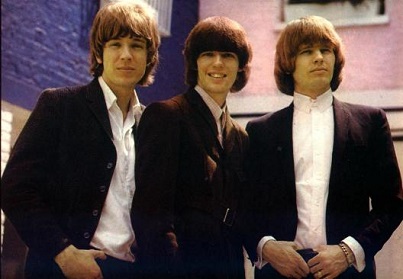
Back to business, then. And not a bad record to get back to! Though it starts with an intro that is as folksy as anything we’ve had so far. Very of its time. Guitars round the campfire, a tambourine shakes… I’m getting Seekers flashbacks. Am I about to be underwhelmed by The Walker Brothers, for the second time…?
The Sun Ain’t Gonna Shine Anymore, by The Walker Brothers (their 2nd and final #1)
4 weeks, from 17th March – 14th April 1966
Of course not. Because in come the drums. Suddenly it’s not a folk song – it’s gorgeous, string-drenched, Wall of Sound-at-its-finest, pop. Loneliness, Is a cloak you wear… A spaghetti Western lone whistle… Because, why not? A deep shade of blue, Is always there…
Then it all comes together. The drums cascade, the voices swirl together… The sun ain’t gonna shine anymore, The moon ain’t gonna rise in the sky… It’s a song about being dumped, essentially. About being sad and lonesome. But never has sadness sounded so appealing. By the time we get to the Bay-yay-ay-bay! I’m sold. Sign me up for the misery!
It’s a brilliantly melodramatic record. All the things that I didn’t think worked on The Walker’s 1st chart-topper – the slightly knowing ‘Make It Easy on Yourself’ – come together here. I think it’s because the music is so compelling, so lush and enveloping, that the OTT lyrics work. I criticised Scott Walker’s crooning on that record, but I love it here. It all culminates in the middle-eight: Lonely, Without you, Baby… through to a glorious I can’t go o-o-o-on…! It’s a song for wallowing in, with a bottle of wine and the curtains drawn.
Everything about ‘The Sun Ain’t Gonna Shine Anymore’ points towards one man: Phil Spector. He must, you think, have produced this record. It sounds like the inside of his head. But, no. One Johnny Franz was on production duties. And yet the debt is clear. This is a Phil Spector record, even if he was nowhere near the studio.
It all builds to a climax, with the layered vocals on the fade-out working brilliantly. And it ends on a high, leaving you uplifted despite the subject matter. This could be a sad, depressing song, if you stripped it all back, but it isn’t. Thank God. It is ten, twenty times, better than the Walker’s previous chart-topper, and an early contender for best record in my next recap. It’s that good.
Interestingly, this isn’t the original version of ‘The Sun Ain’t Gonna…’ It had been recorded a year earlier by Frankie Valli. His version sounds a little heavy-handed, but surprisingly similar to this one. It, however, made no impact on the charts. It’s also been covered by Cher, in the ‘90s. She is perhaps the only person who could make this song sound more OTT than Scott Walker…
This was the peak of The Walker Brother’s success, their popularity such that their fan-club allegedly had more members than The Beatles’. They had several further hits, and yet disbanded in 1968, largely due to Scott Walker’s dissatisfaction with being seen as a mere teen-idol. I can’t say I’ve listened to that much of his solo output, though I do know it has a reputation for being ‘challenging’… That’s probably what’s putting me off. It’s also been very influential: David Bowie, Pulp, Radiohead, The Arctic Monkeys… the list is a long one. He passed away in March of this year. John Walker had died in 2011, leaving Gary as the sole surviving ‘brother’.
But we’ll leave them here. Bowing out with their crowning glory. A song I knew was good, but hadn’t realised quite how good. Yet another supreme mid-sixties pop moment. Keep ‘em coming!
Our last entry in this mini-series takes us from the middle of the road hit-machine that was Norrie Paramor, to somebody slightly more niche.
Not that Robert George ‘Joe’ Meek didn’t have his moments in the spotlight; but his was a chart-career that favoured quantity over quality. The bold over the bland. Crazy over sane. Would one expect anything less from a man whose mother supposedly dressed him as a girl for the first four years of his life…?
The achievements in his short career are many and varied – he recorded what was potentially the first ever rock opera, and pioneered the idea of independent record distribution – as well as making music that simply didn’t sound like anything else around at the time… There was overdubbing, distortion and sampling (more on which later…) He worked with big acts like Frankie Vaughan, Lonnie Donegan, Chris Barber’s Jazz Band, and a young Tom Jones. But this is the UK #1s blog and we are here, primarily, for the chart-toppers.
And what a trio of chart-toppers. First came the gothic ludicrousness of John Leyton’s ‘Johnny Remember Me’, in which a dead lover calls across the moors to her still-living beau, daring him to even think about forgetting her. Up last came ‘Have I The Right?’, by The Honeycombs, in which Merseybeat was fed through an electronic blender. And sandwiched in between, the perfect weird filling in a bizarre sandwich, sits The Tornado’s ‘Telstar’. I don’t have the time or space to give that record another write-up – just follow the link here for my original post or press play on the video below. Suffice to say that it is one of the very best chart-toppers that we’ve covered so far. Top five? Definitely. Top three? Probably.
‘Telstar’ sold five million copies around the world, topped the UK charts for five weeks and became only the second British chart-topper on the Billboard 100, a full year before the British Invasion truly kicked off. And it, like most of his hits, was recorded above a shop on the Holloway Road in North London. He used something called a Clavioline on the recording – a sort of proto-synthesiser – to create that alien-craft-hovering-right-above-you sound. But Meek wasn’t fussy, or a slave to technology; the ‘drums’ on ‘Have I the Right?’, for example, came from the band stamping on his stairs.
And as mad, zany and out-there as his hit records were, they can’t compare to Meek’s life story. This is a man who took recording equipment into graveyards to capture the voices of the dead, who held seances with Buddy Holly, who talked to cats, who thought that the photographs in his studio were trying to communicate with him… It’s perhaps not surprising that some found him a little difficult to work with… Meek was a man, it seems, who knew what he liked. He turned down the chance to work with a young David Bowie, and tried to persuade Brian Epstein not to sign The Beatles. He allegedly ran screaming, with his fingers in his ears, from a 16-year old Rod Stewart the second he began to sing…
Which all sounds perfectly absurd and entertaining; but it’s probably not fair to make light of it. Meek had serious troubles with addiction and paranoia in the later years of his life, stemming largely from the fact that he was gay and feared being outed. He was arrested for ‘immoral acts’ in a public toilet in 1963, which signalled the start of his downward spiral. Somewhat touchingly, it seems that he feared being outed to his mother much more than the general public…
On top of this, he faced lawsuits from one his main collaborators over exactly who wrote ‘Have I The Right?’, and from a French composer for the melody from ‘Telstar’ (which meant he never received a single royalty cheque for his biggest hit.) Meek was, in all honesty, a bit of a musical magpie, and seems not to have had much regard for licensing and copyright. He was above all those prosaic concerns – a true artiste. A one-off. No constraints, no boundaries. Which is why he could create a record as ahead of the curve as ‘Telstar’.
But it’s also why, when he heard rumours that every ‘known homosexual’ in London was going to be interviewed over the murder of a young man, a paranoid and desperate Meek shot himself and his innocent landlady. It was 1967 – he was just thirty-seven. He had had nothing to do with the murder, he simple feared the notoriety and possible prison sentence that came with being gay in the sixties. It’s tragic, given that five years later Bowie was dressing up as Ziggy Stardust on Top of The Pops, and that barely fifteen years later Frankie were saying ‘Relax’. Meek was born just that little bit too early.
He died on 3rd February, the same day as his idol, Buddy Holly, and his ghost can still be heard banging about in his old recording studio every year on that date, if you believe in that sort of thing. I’m including the videos for his three chart-toppers below – knock yourselves out – and would recommend Darryl W. Bullock’s book ‘David Bowie Made Me Gay’, in which I first read about unhinged genius of Joe Meek.
We’ve covered 210 chart-toppers so far in this countdown, going from the very first chart through to Nancy Sinatra and her boots in early 1966. And it’s only fair that we turn our attention to the man that, up to now, has been involved in more of these #1 singles than anybody else, more than Lennon and McCartney, Jagger and Richards, Bacharach and David…! Norrie Paramor.
Born in 1913, Paramor had worked as a pianist and arranger through the thirties and forties, before being appointed recording director at EMI in 1952 – the very year that the singles chart he was to help shape began. Having developed his sound during the light-programme, easy listening days, Paramor was perfectly positioned to help the pre-rock stars sway (albeit gently). He was responsible for trumpeter Eddie Calvert’s hits, and the Northern-Irish warbler Ruby Murray’s ‘Softly, Softly’. Then there was Michael Holliday. Already a pretty impressive body of chart-topping work… And it was about to become all the more impressive, because along came Cliff.
Cliff Richard has had eight number ones so far in our countdown, all of which have been produced by Norrie Paramor. And each time I’ve complained that ‘rock ‘n’ roll Cliff’ was nowhere to be seen… Britain’s answer to Elvis etc. etc. Yeah right. He had a handful of truly rocking singles in ’58, but by the time he’d gotten down to the business of topping the charts the rock had become more of a gentle toe-tap. And a lot of that was probably down to Paramor. He wasn’t a rock ‘n’ roll producer; he was a light-entertainment, easy listening kind of guy. I get the feeling he wasn’t convinced by rock and roll, probably saw it as a fad, and was willing to allow it as long as it was successful. Still, he moulded Cliff’s sound. One wonders how Cliff would have turned out had he had someone else’s hands on the tiller…
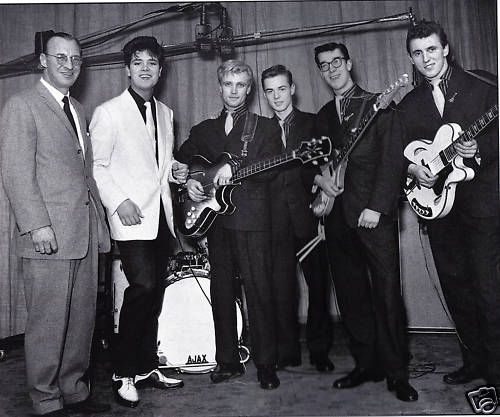
(An early pic of Paramor, Cliff and The Shadows)
Of course, wherever Cliff went The Shadows weren’t far off. Paramor produced all of their chart-toppers too. Which makes for a more interesting comparison of styles, as discs like ‘Kon-Tiki’ and ‘Dance On!’ were actually pretty rocking little numbers. Perhaps it’s unfair, then, to write Paramor off as a dinosaur. Add to this the fact that he also oversaw Helen Shapiro’s wonderful 1961 chart-topping double – the bubbly ‘Walkin’ Back to Happiness’ and the melodramatic ‘You Don’t Know’ – and it’s clear that he wasn’t all bad…
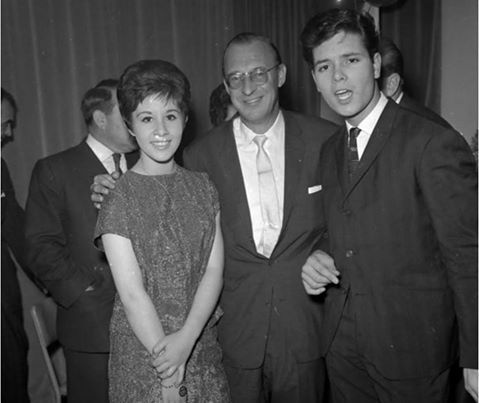
(Paramor with Cliff, again, and Helen Shapiro in the early sixties)
Wait, though… On the flip side of this particular coin lies one Frank Ifield. Yep, Norrie Paramor produced all four #1s from ‘The Year of Ifield’, pre-rock’s final hurrah before The Beatles and The Pacemakers saved us all… The yodelling horror that is ‘Lovesick Blues’ remains, for me, far worse than anything that Cliff has inflicted.
A mixed bag, then, from Norrie Paramor, prolific producer of the chart’s early years. In total (I think, it’s hard to keep track) he put his name to around twenty five chart-topping singles before the seventies arrived. He also acted as musical director for the Eurovision Song Contest, and wrote multiple film scores, before passing away in 1979. And, in a sentimental twist, the artist that was sitting at #1 in the UK as Paramor drew his final breath, with his first chart-topper in over a decade, was… Cliff!
Taking a break from the usual proceedings, I’m going to use this week to take a look at the folks behind some of the 210 #1s we’ve heard so far. The writers, the producers and, in the case of our first post, the conductors…
In the early days of the charts, when big productions and even bigger voices were all the rage, any self-respecting chart-topper needed an orchestra to back up them up. On the 45s of the time, nearly every #1 is assigned to both a lead artist and an orchestra. ‘Here in My Heart’, by Al Martino, with Orchestra under the direction of Monty Kelly… ‘Outside of Heaven’, by Eddie Fisher with Hugo Winterhalter’s Orchestra and Chorus…
Perhaps for reasons of convenience, the Official Singles Chart don’t list the orchestra, or it’s conductor, for any of the early chart-toppers. Which is strange, I suppose, as in modern times we have no problem with crediting ‘featured’ artists on a dance or rap track. Maybe it’s because we don’t actually hear their voices… Whatever the reason, several men have missed out on their moment in the record books. Winterhalter and Kelly, Frank Cordell, Stanley Black, Harold Mooney, Mitch Miller…
I’ve chosen Paul Weston as the frontman for this piece, though, thanks largely to his work with Frankie Laine. Weston was a Massachusetts born musician, who had been a pianist in a dance band, before becoming a song-writer and music director at Capital, and then Colombia Records. He conducted and arranged all three of Laine’s 1953 hits: ‘I Believe’ (still the song with the most weeks at #1 in the UK, sixty-five years on), ‘Hey Joe!’ and ‘Answer Me’. He also conducted on Jo Stafford’s ‘You Belong to Me’, Britain’s 2nd ever chart-topper. Stafford and Weston had married not long before recording the song.
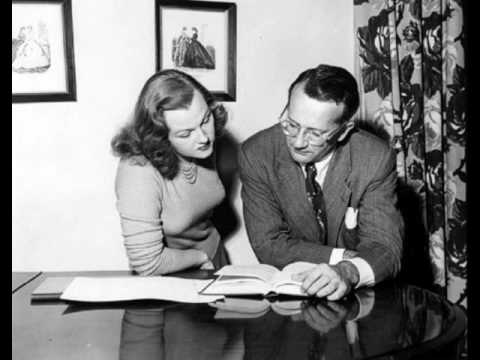
Paul Weston with his wife, Jo Stafford
If Paul Weston were actually credited with his work on #1 singles, he would sit at joint 10th place in the all-time weeks at the top of the UK singles chart list with 29 weeks’ worth of chart-toppers, tied with ABBA and Take That, and one week behind Drake. Later in the 1950s he went on to do TV work, helped to start up the Grammy Awards, and worked for Disney. He passed away in the mid-nineties.
One conductor who did get credited on his hit records was the Italian, Annunzio Paulo Mantovani who, like all the best pop stars, went by just the one name: Mantovani. He was popular enough to score a solo, instrumental number one single in 1953: The Song from ‘The Moulin Rouge’, which had been a big hit in the cinemas that year. This success, and his subsequent fame is, I’m guessing, why he is the only conductor to be credited by the Official Charts Company, for his orchestral accompaniment on David Whitfield’s overwrought ‘Cara Mia’ in 1954.
Mantovani, doing his thing
Conductors and their orchestras became less essential once rock ‘n’ roll arrived, but they still occasionally popped up on the more bombastic number ones. The last one I can think of was Shirley Bassey’s ‘Climb Ev’ry Mountain’ / ‘Reach for the Stars’ double-‘A’ side from 1961, which was credited, on the vinyl at least, to Geoff Love and His Orchestra.
To the conductors, then, and their batons, which shaped the sound of the singles chart’s earliest years.
We last recapped in late 1964, and the past thirty #1s have brought us right through 1965 and out the other side. The very middle of the mid-sixties. And, to be honest, we’ve been spoiled.
For example. This was a genuine, consecutive run of chart-topping singles, from the summer of ’65: ‘Mr. Tambourine Man’, by The Byrds… followed by The Beatles, with ‘Help!’… then ‘I Got You Babe’… and finally ‘(I Can’t Get No) Satisfaction’, by The Rolling Stones. No filler in between. Those singles, over the course of just nine weeks, were the top selling songs in Britain. Timeless hit after timeless hit. Songs that are still ubiquitous to this day, some fifty-five years later. Amazing.
This is why it’s good to pause, momentarily, and look back. Otherwise I’d start taking for granted the huge musical moments that are becoming almost commonplace. Dotted around elsewhere in the past year or so we’ve had non-consecutive gems too: our first Motown #1 from The Supremes, a karaoke classic from Tom Jones, the distilled essence of The Swinging Sixties TM from Nancy Sinatra and a contender for best pop song ever from The Righteous Brothers. It’s like the best all-you-can-eat buffets – you never have enough room to appreciate every morsel.
The sound of these number ones has also been moving forward at lightning speed. We’ve seen the Beat sound disintegrate into straight-up blues, folk, baroque pop, and garage rock. Glance back two years, to early 1964, and things were much more homogenous. Merseybeat followed by Merseybeat followed by – hey – more Merseybeat. And most of those discs were great. But variety is the spice of life. I’m really loathe to be one of those ‘things were much better back in the day’ types… but… compare pop music from 2019 with that of 2017 – or even 2007 – and would you see that much of a difference? Of course, everything here was new, just waiting to be discovered and experimented with. Dirges and harpsichords on hit singles? Why not!
Even the outliers, the singles that deviated from the irresistible forward thrust, had the good sense to be eclectic. Elvis returned and took us to church, Georgie Fame gave us some Latin soul, Roger Miller represented the country side of things while, in Unit 4 + 2, we had genuine one-hit wonders. We’ve also heard several more female voices than we have in past recaps: Sandie, Jackie, Nancy, Diana Ross and the gang, and a lady called Cher.
All of which means I’m struggling to dish out the more negative awards – the ‘Meh’ Award and my equivalent of a Razzie: The Very Worst Chart-Topper. But let’s not kid ourselves. I’ve not enjoyed every single song going. I struggled to get the appeal of The Seekers after hearing their bland chart-topping double. Meanwhile, Cliff returned as boring as ever… Plus there’s my unresolved childhood history with The Moody Blues, which means I want to award one to ‘Go Now!’, even though I love that one song. ‘Where Are You Now (My Love)’ was OK, though I’m struggling to really remember it, while The Overlanders’ cover of ‘Michelle’didn’t really need to exist. And then there was Ken Dodd’s ‘Tears’ – the 3rd biggest selling single of the decade. Yes, you read that correctly. But that would be like kicking a puppy, naming that as the worst record…
Ken Dodd with his golden disc for 100, 000 copies of his record sold “Tears” presented to him in his dressing room at the London Palladium.
I’ve got it. The ‘Meh’ Award goes to ‘The Carnival Is Over’, by The Seekers. A funeral dirge, plain and simple, with some cheek for having the word ‘Carnival’ in the title. I still can’t believe it sold over a million. And the very worst of the past bunch goes to Country Cliff, for the soporific ‘The Minute You’re Gone’. Compared to some of the past ‘worst #1s’ it’s fairly inoffensive. Russ Conway, David Whitfield and Elvis in Lederhosen were much worse crimes against music. It’s just that, while everybody was twisting, Cliff was sticking, even going backwards.
Before we choose the ‘good’ awards, we should mention that over the past thirty #1s, one of the greatest ‘rivalries’ in pop music has really taken off. After the last recap, everybody was trailing in The Beatles’ wake. But… The Stones have arrived. Both bands have scored four chart-toppers in this segment. In a recent post I claimed that, for the moment, The Stones were ahead of The Fabs, just. Those of you who took the bait disagreed… But I’m sticking with it. Yes, ‘I Feel Fine’, ‘Ticket to Ride’, ‘Help!’ and ‘Day Tripper’ / ‘We Can Work It Out’ are superb records. No debate. Imperious. But look at The Stones’ four: ‘Little Red Rooster’ (authentic, full-on Blues), ‘The Last Time’ (the weakest, for sure, but still a great, swaggering rock song), ‘Satisfaction’ and then ‘Get Off Of My Cloud’ (those riffs, along with a tonne of angst and venom, and general dissatisfaction with the world around them – It’s punk, metal, emo… It’s the future!) On that note, I’m going to give the ‘WTAF’ Award, the award for our more ‘out there’ #1s, to ‘Little Red Rooster’, because that’s a slice of pure Chicago blues that had no business getting to the top of the British singles charts – though I’m so glad it did.
Which just leaves the crème de la crème. As always, I’ve got it down to four. ‘You’ve Lost That Lovin’ Feelin’’, ‘Help!’, ‘Satisfaction’, and our most recent #1: ‘These Boots Are Made for Walkin’’. And I’m going to instantly eliminate The Beatles and Nancy Sinatra for being great, but just not great enough. So… Perhaps the toughest decision I’ve ever had to make. The Righteous Brothers, or The Rolling Stones. I’m listening to both songs one more time as I mull…. God, why don’t I just call a tie…? No, that sets a dangerous precedent for me (in this completely unnecessary and self-imposed situation)… Ga! I love rock music, at heart. Rock ‘n’ roll always wins. As great as ‘…Lovin’ Feelin’’ is, it ain’t rock. ‘Satisfaction’ takes it.
The Very Worst Chart-Toppers: 1. ‘Cara Mia’, by David Whitfield with Mantovani & His Orchestra. 2. ‘The Man From Laramie’, by Jimmy Young. 3. ‘Roulette’, by Russ Conway. 4. ‘Wooden Heart’, by Elvis Presley. 5. ‘Lovesick Blues’, by Frank Ifield. 6. ‘Diane’, by The Bachelors. 7. ‘The Minute You’re Gone’, by Cliff Richard.
Phew. We’ll pause for a bit, before hitting the next thirty. Thirty discs that’ll take us through the ‘Summer of Love’ and beyond. Next up, I’m going to spend a week looking at some of the people behind the #1s… Coming soon, to a blog feed near you…
One of the coolest intros ever – a twangy guitar that slides and droops like a wilting sunflower on a southern summer’s day – leads us into one of the coolest number one hits you’re ever likely to hear.
These Boots Are Made For Walkin’, by Nancy Sinatra (her 1st of two #1s)
4 weeks, from 17th February – 17th March 1966
The sixties are truly swinging. There’s been attitude and swagger, even drug references (!) at the top of the charts. And now here’s Nancy, bringing the sass. The way she pauses between the lines, the way she delivers them like she can’t be bothered, as if the man she’s singing about is barely worth the oxygen.
You keep sayin’, You’ve got something’ for me… Her man’s been taking her for a ride; but Nancy ain’t no fool. You’ve been a-messin’, Where you shouldn’t’ve been messin’… He’s in for it. These boots are made for walkin’, And that’s just what they’ll do… One of these days these boots … cut the beat, leave it all to the vocals… are gonna walk all over you…
It’s a fairly minimalist record – sparse instrumentation and a lot of room for the echoey vocals to do their job. Which means there’s lots of time for all the gorgeous little details that make this such a great song to shine through. The whispered ‘yeah!’ between verses one and two, the sarcastic ‘Ha!’ after the You keep thinkin’, That you’ll never get burned… line. The way the horns come in halfway through, the same horns that will go wild for the fade-out (a very mid-sixties touch.) Then there’s the made up words – the ‘samin’ and the ‘truthin’. Nancy’s too cool to bother with proper English.
‘These Boots…’ is a big development in terms of female-recorded #1s. In every photo-shoot from the time, Nancy Sinatra appears as a very sensual character: big, just-woken up hair, mascara-ed eyes, lots of cleavage. She’s sexy. A siren. In a way that Cilla (the girl next door) and Sandie Shaw (kooky and cute) weren’t. Helen Shapiro was still a kid, Doris Day was basically your aunt. The closest female star I can think of, from previous #1 hits, is Connie Francis, who was bringing the girl power on ‘Who’s Sorry Now’ seven years ago. But even she pales in comparison with Nancy Sinatra’s mini-skirts and thigh-high boots.
Surprisingly, this wasn’t her first attempt at a singing career. I had imagined that she simply appeared, fully-formed, as the superstar daughter of Frank Sinatra. But she had been releasing singles since 1961, to little interest on either side of the Atlantic. By 1965, she was about to get dropped by her label. It wasn’t until she paired up with Lee Hazelwood (the man with hands down the coolest voice ever committed to vinyl) that success came her way. He wrote ‘These Boots…’, and several other songs before she became his full-on muse and they recorded three albums together.
Though, I wonder … While being daughter of one of the most famous male singers of all time clearly didn’t bring her instant success, did it perhaps help mould her image? She had to distance herself from her fuddy-duddy dad, whose hit single career had stalled of late, hence the sexy looks; while her family name perhaps also gave her a safety net that meant she didn’t need to fit the ‘girl next door’ image adopted by most other female stars of the time. Was she in a constant state of teenage rebellion?
For a star who has become so synonymous with The Swingin’ Sixties TM, Nancy Sinatra wasn’t all that big a deal on the UK singles charts. But the impact left by this record alone is more noteworthy than the careers of many, more ‘successful’ stars. And she does still have one further chart-topper coming up – one of the sweetest (or should that read creepiest) #1 singles ever.
I’m starting out a new feature today, remembering some of the biggest stars that we have met so far. The only requirements needed to feature here are that we have already covered your chart-topping careers on this countdown, and that you are dead…
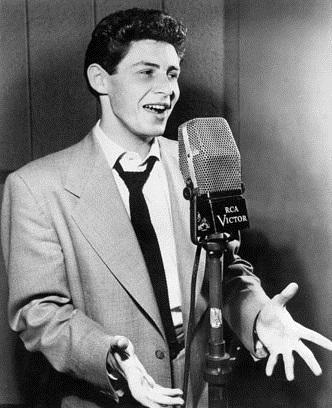
On this day, then, nine years ago, Eddie Fisher – the King of pre-rock ‘n’ roll – passed away, aged 82. The first artist to score multiple #1 singles in the UK. An artist whose two chart-toppers came in the blink of an eye, in the first eight months of the singles chart’s existence. Numbers 4 and 10.
First came the sombre ‘Outside of Heaven’, in which he stood outside the house of the girl he once loved. You can read my original post here. It’s sedate, proper… traditional.
Then came the equally sombre ‘I’m Walking Behind You’ – a duet with Sally Sweetland – in which he followed his ex to church on her wedding day. Again it’s sedate, proper, traditional… and pretty darn creepy when you listen carefully.
I struggled to really get his chart-topping singles when I originally wrote about them, and still do. He had a good voice, they were well-constructed songs… They were just so old-fashioned. Old-fashioned sounding even among their contemporaries, and incredibly old-fashioned when compared to where we are now in the countdown – slap bang in the middle of the swinging sixties (amazingly, given the way pop music has changed, we’re only actually thirteen years down the line in real time…)
What the songs do offer is an interesting glimpse into how music sounded before rock ‘n’ roll came along, and Fisher – along with Frankie Laine, Guy Mitchell, Johnnie Ray – was one of the biggest male stars of the late forties / early fifties. Only one of his singles failed to make the UK Top 10, while he enjoyed 25 (!) US Top 10s, including 4 #1s.
He had quite the life outside of the recording studio, too. That is, yes, him with Elizabeth Taylor, his second wife (he was number four of eight for her). He left his first wife, Debbie Reynolds – Taylor’s best friend! – for her. It was quite the scandal, and proof that misbehaving pop stars weren’t a rock ‘n’ roll invention. He was married five times in total, and had four children over the course of them. The oldest of whom was the late, Star Wars great, Carrie Fisher.
So, if you can, take a moment out of your day, click on the links, and transport yourself back to 1953, when Eddie Fisher was crooning his way to the top of the charts and was, for a short time, the man with the most UK #1 singles in history.
Eddie Fisher, August 10th 1928 – September 22nd 2010
For those counting, we arrive at the 3rd Beatles cover to top the UK charts. Which means that in a little under three years, Lennon & McCartney have been responsible for twelve chart-toppers! Not bad, not bad at all. A couple of posts ago I mentioned them in comparison with Bacharach and David, who recently wrote The Walker Brothers #1 ‘Make It Easy on Yourself’. But, having done some digging, it turns out that they were still way behind John and Paul with just 6 chart-topping compositions to their name, in well over double the time.
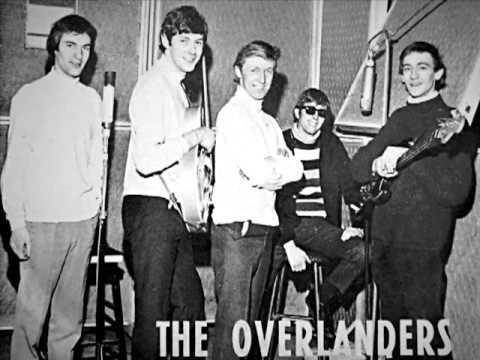
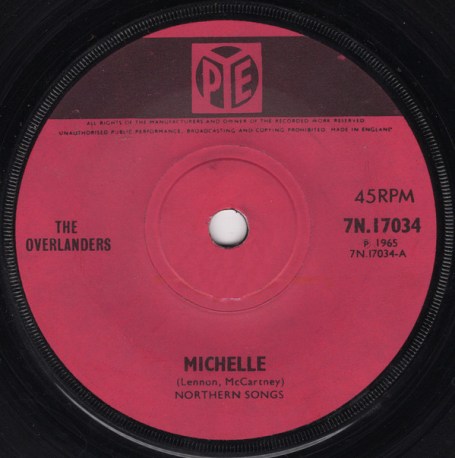
Michelle, by The Overlanders (their 1st and only #1)
3 weeks, from 27th January – 17th February 1966
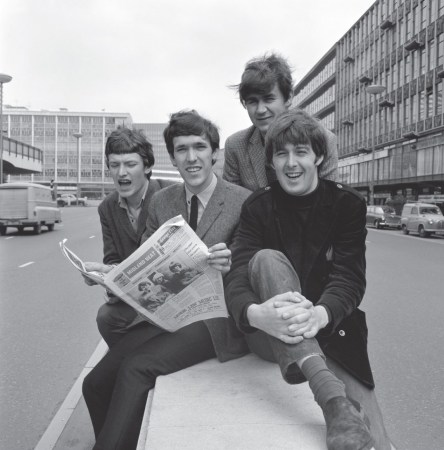
Anyway, that’s all well and good; but this next chart-topper isn’t by The Beatles. Note the name at the start of this post: The Overlanders. You know, the British folk-rock-cum-pop combo? Nope? Well this was their one and only hit. And it’s a pretty faithful, note for note, cover of the original.
I’d like to write about this without comparing it to The Beatles’ version, but that would mean erasing a song that I’ve been listening to since I was a kid from my memory for the next half an hour. And I don’t have the technology to do that… Michelle, Ma belle, These are words that go together well, My Michelle… Alongside a jaunty, perky, French-salon tune. It’s slightly heavier, more deliberate version – the instruments and the vocals have a deeper finish and a gloss that the original doesn’t. The Beatles’ version is more subtle, lighter… (Oh fine, here’s a link. Compare them for yourself.)
Probably the most notable thing about this disc is that it has a full line of French in it, which is a first for a UK chart-topper. Michelle, Ma Belle, Son les mots qui vent très bien ensemble, Tres bien ensemble… Even if, like me, you have only the most basic of French abilities, you can work out that it’s just a direct translation of the preceding, English line. Still, aside from ‘Que Sera Sera’, which is actually gibberish, this is the first in a long line of ‘non-English’ #1s, or ‘not-completely-English #1s’, which will take us through ‘Je T’Aime…’ to ‘La Isla Bonita’, to, um, ‘Gangnam Style’…
As a hit record, this is alright. It might as well have been done by a pub covers band for all the personality they bring to it, but it’s OK. It’s not as good as the original, you’d never choose to listen to this version over it, but the only bit I think that really lets The Overlanders down is the creaky I love you… before the solo.
What it kind of reminds me of is the electronic keyboard that I had as a kid, for the six months or so I attempted to learn, which had a bunch of famous songs pre-programmed into it. ‘Michelle’ wasn’t one of them; but if it had been I bet it would have sounded quite like this. Perhaps the problem is that, unlike the previous two Lennon & McCartney written chart-toppers, everyone thinks of ‘Michelle’ as a Beatles song. It’s a well- known track from one of their best-regarded albums, ‘Rubber Soul’, and features on several Greatest Hits compilations (which is where I first heard it all those years ago.) Whereas, Billy J. Kramer, and Peter and Gordon, could more easily pass ‘Bad to Me’ and ‘A World Without Love’ off as their own, with no ‘official’ version of those hits ever recorded by The Fab Four, The Overlanders wouldn’t be as lucky.
But then again, if you wanted a guaranteed hit in the mid-sixties, you couldn’t do any better than nabbing yourself a Beatles’ cast-off. They got their big smash; but very few people remember them for it. Like I wrote at the start, this was The Overlanders’ one and only hit record. It raises a philosophical question to finish on: What’s better, plugging away valiantly on your own with little recognition, or riding the coattails of the world’s biggest band for three weeks of reflected glory?
We skip on into 1966, where the first number one is, perhaps unexpectedly, neither folkey nor baroquey. It’s a straight-up rocker!
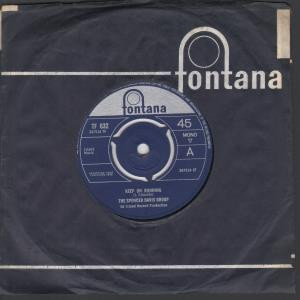
Keep on Running, by The Spencer Davis Group (their 1st of two #1s)
1 week, from 20th – 27th January 1966
A dirty drum and bass riff kicks it off, and then we get a blast of some kind of feedback-slash-scuzzy chord couplet. It makes you sit up, makes you take notice. Keep on runnin’, Runnin’ from my arms… It’s not as heavy as The Stones have been recently, but it’s not as poppy as anything from the Merseybeat days. It’s like a perfect marriage of the two…
Actually, it’s got a real soul vibe to it too, as if Sam Cooke was now fronting a Beat combo. It’s cool – catchy and funky. I love the Hey! Hey! Hey!s, and the way that the intro riff returns for the now customary wig-out at the end. It’s clear that any self-respecting rock record in 1965-66 has to fade-out with the lead singer going a little bit crazy…
I know this song, but know very little about the band – The Spencer Davis Group (don’t ‘The Spencer-Davis’s’ sound like a posh couple that you avoid in Sainsbury’s?) I would have bet they were American, with their funky soul sound, but no. They were from Birmingham (and not the one in Alabama.) Interestingly, ‘Keep on Running’ isn’t a cover of a soul song, but a cover of a reggae hit from the year before. Check it out here… Unsurprisingly, it sounds completely different. I’ve never been a huge reggae fan – something that I’m sure will crop up in this countdown as the genre grows in popularity – so I’ll take The Spencer-Davis’s version, thankyouverymuch.
It’s a great record. Though I feel, before we go much further, that the lyrics need some scrutinising. They’re a bit… overbearing? That’s putting it politely. The title refers to a woman who, try as she might, will not be able to escape the singer’s attentions. One fine day I’m gonna be the one, To make you understand, Oh yeah, I’m gonna be your man… It gets worse when you realise that he’s motivated not by love, but because his mates are laughing at him: Everyone is talkin’ about me, Makes me feel so bad, Everyone is laughin’ at me, Makes me feel so sad…
Hmmm. The more you think about them, the worse they get. But hey, this was the sixties. Different times, different levels of tolerance for possessive wierdos… File under ‘Catchy but Creepy’, with ‘What Do You Want to Make Those Eyes at Me For?’ and ‘Oh, Pretty Woman’.
The Spencer-Davis’s will be back, and very shortly, for the second part of their chart-topping brace. They had had a few low charting singles in the previous couple of years, but ‘Keep on Running’ propelled them to another level entirely. It’s not quite a classic, a standard, but it has a hook that most people could sing. And, despite what I said about the lyrics, I do really like it. It’s fun, and a little rough around the edges. Like all the best rock songs should be… A great way to kick off a new year.
The Fab Four claim their third straight Christmas number one (before Christmas number ones were a thing, but still), and they do so with their most straight-up rock record yet.
Day Tripper / We Can Work It Out, by The Beatles (their 9th of seventeen #1s)
5 weeks, from 16th December 1965 – 20th January 1966
There’s a riff – a riff we all know – dun-duh-duh-duh-duh-dun-dada-da-dada – (riffs never really work when written out…) which keeps on going till the end. It’s a riff record – maybe, just maybe, they’d been listening to The Stones –a great, straight-up rock song.
I like the way the intro builds: guitar, then bass, then drums, and the way that the solo is basically the riff, beefed-up. It’s a simple song – there’s no reinventing the wheel here. I guess it’s experimental, in the sense that they’re experimenting with a heavier sound, but that’s stretching it a bit. It’s a John Lennon number, and one of the things I like most about him is that he never lost his rock ‘n’ roll roots, never stopped being a fan of Chuck and Buddy, no matter how avant-garde he and his bandmates seemed to get.
Of course, like any great rock song, there’s a fair amount of raunch here too. She’s a big teaser, She took me half the way there now… Not much imagination needed. Especially after Lennon admitted that he would have made it ‘prick teaser’, had he been allowed. Tried to please her, She only played one night stands… So on and so forth. Another layer of innuendo comes when you consider the ‘trip’ aspect of the lyrics. A ‘day tripper’ would be someone who only drops acids on special occasions. A weekend hippy, a ‘Sunday driver’.
Whether it’s about drugs or sex, or both, doesn’t really matter, though. This is a cracking rock number – one that I’ve enjoyed reacquainting myself with for this post. It’s one of those Beatles songs that kind of gets lost among the mega-hits. But, actually, listen to the soooooo long growl, and the way that the solo ascends to a climax with a hint of ‘Twist and Shout’, and try telling me that this isn’t one of their best. And, come to think of it, I can think of two other songs off the top of my head in which the ‘Day Tripper’ riff makes an appearance: ‘Hair of the Dog’, which gleefully rips it off to the extent that when Guns N’ Roses covered it they gave up the pretence and by the end were just playing the Beatles’ riff, and The Wildhearts’ ‘My Baby Is a Headfuck’. So maybe I’m underestimating it…
What of the flip-side? We’ve not had a double-‘A’ side #1 for a while (nearly three years to be precise) and ‘We Can Work It Out’ is the perfect companion for ‘Day Tripper’, in that it sounds pretty much the opposite. I’ve always thought that double-‘A’s should contrast, one should be the yin to the other’s yang, and so gone is the electric guitar and the bravado, replaced by acoustics and recriminating.
It’s a folk-rock waltz of a record, in which Paul McCartney muses on a failing relationship: Try to see it my way, Do I have to keep on talking till I can’t go on?… Think of what you’re saying, You can get it wrong and still you think that it’s all right… He remains positive – the title is ‘We Can Work It Out’ after all – but if you listen closely to the lyrics it becomes clear that any compromise will be on his terms: While you see it your way, There’s a chance that we might fall apart before too long… Very passive-aggressive… Actually, the more I listen, the more I realise how the singer of this song is being a bit of a dick. Life is very short, And there’s no time, For fussing and fighting my friend… (So hurry up and just admit I’m right!)
The accordion-slash-harpsichord sounding instrument which characterises this disc – the one that creates the woozy, trippy feel at the end of the bridge, and that closes the song with a little riff – is a harmonium, apparently. This is where pop music has been heading throughout 1965, with the baroque-folk stylings of The Byrds, Sonny and Cher and The Walker Brothers, and it’s nice to close out the year in this way. A sign of where The Beatles were heading. ‘Rubber Soul’ was released while this disc sat at #1, and ‘Revolver’ would be coming up very shortly after.
This was The Beatles first double-‘A’ side as they couldn’t agree on which record was the more commercial sounding. Lennon was the one who forced ‘Day Tripper’ to get equal-billing, but in terms of airplay at the time ‘We Can Work It Out’ was the winner. In the US they were released separately, with ‘We Can Work It Out’ hitting the top of the Billboard 100 and ‘Day Tripper’ only making #5. But for me rock always wins. ‘Day Tripper’ all the way…
And so we cross the midway point of The Beatles’ chart-topping run. Nine down, seven to go. To celebrate, I thought I’d do a quick rank of the hits that have gone so far. Based solely on personal preference not artistic merit. Let me know if you agree or are scandalised by my ignorance. In ascending order (worst – best), then:
Actually, that was really hard and kind of pointless. I don’t dislike any of those songs. A ‘bad’ Beatles disc is another act’s signature song. But it’ll be interesting to add the next seven to the list, and to see where they fit in. Anyway, look! Suddenly it’s 1966. Onwards!
Listen to every number one so far – by The Fab Four or otherwise – with this playlist: