285. ‘Spirit in the Sky’, by Norman Greenbaum

In my last post, after deciding that I could take no more of Dana’s execrable ‘All Kinds of Everything’, I prayed that the seventies would get going, and soon…

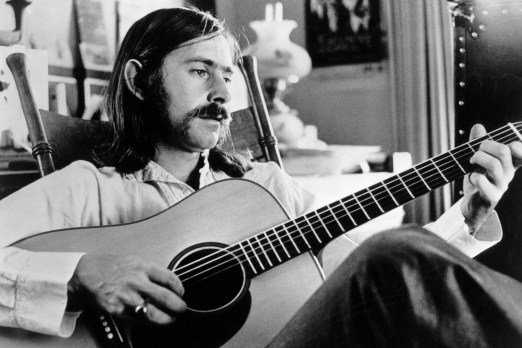
Photo of Norman GREENBAUM

Spirit in the Sky, by Norman Greenbaum (his 1st and only #1)

2 weeks, from 26th April – 10th May 1970

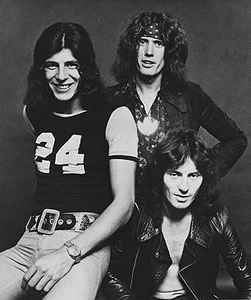
Well here we are. I’d suggest that this might the moment the new decade truly kicks off, with a record facing right towards the future. It all starts with a fuzzy, scuzzy guitar riff, with plenty of echo, as if it’s being recorded from the end of a very long hallway. Then in come the stomping drums, and the catchy handclaps, and you realise that you might be witnessing the first glam rock number one.

When I die, And they lay me to rest, Gonna go to the place that’s the best… Several recent #1s have been concerned with death, dying and the end of the world. But ‘Spirit In the Sky’ puts a more positive spin on it. Going up to the spirit in the sky… Norman Greenbaum has a Calvinist’s assurance that he’s heading straight for heaven.

Never been a sinner, Never sinned, I got a friend in Jesus… He’s definitely confident. But now for the big question… Is this a religious record? Or is he taking the piss? I’d like to see it as a satire of the type of Christian who believes they’ll get to heaven, even though they’ve spent most of their time on earth being a dick.

Plus, it doesn’t sound like a Christian song. It sounds sleazy and dirty, with two long, heavy guitar solos – not something you’d hear on the organ in church. It feels like ages since we’ve had a proper guitar solo at the top of the charts, not since ‘Honky Tonk Women’, last summer. Greenbaum was in fact, Jewish, and had decided to write a ‘gospel’ song just to see if he could. He finished it, he claimed, in fifteen minutes. And, yeah, the lyrics are pretty basic. But that’s probably what’s given this record its longevity – the fact that it could be a one-dimensional religious song just as much as it could be a cynical piss-take. To this day it remains a popular choice for funerals…

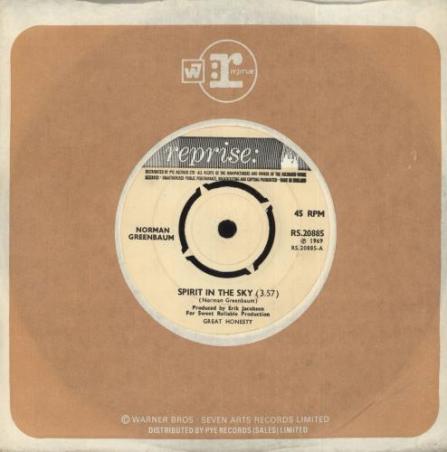
NORMAN_GREENBAUM_SPIRIT+IN+THE+SKY+-+4PR-385695

I love that this isn’t a record that rushes. It stretches its two little verses and chorus out over four minutes, with plenty of bluesy riffing and glam-rock stomping, and what sounds like a cash-register opening and closing, opening and closing. It’s also the perfect song for the turn of this new decade, as if the optimism of the summer of love has soured and burned itself out on acid. The sentiment is still there; but the sound has been distorted.

Norman Greenbaum was a blues/folk singer from Massachusetts who burst out of nowhere with this monster hit, and then retreated back into anonymity. He lives these days in California. ‘Spirit In the Sky’ is probably one of pop music’s most famous one-hit wonders, the song that people would go for if they had name such a record.

In fact, ‘Spirit In the Sky’ will have a more successful chart career than its creator. We will meet it two more times at the top of the charts, in an eighties and then a noughties guise. It’s a great song, one that resonates to this day, one that I’ve been aware of since I was very young. And one that stands out even more in this countdown – like a sparkly beacon of light – sandwiched as it is between two truly terrible songs… The second of which is up next.

273. ‘Something In the Air’, by Thunderclap Newman

The first number one of the post-Beatles era. One of those songs where you press play and go ah yes… I know this…

500

Something in the Air, by Thunderclap Newman (their 1st and only #1)

3 weeks, from 2nd – 23rd July 1969

It was in an advert for something, I realise, midway through the first listen, and it is prefect background-music-for-an-advert. Light, floaty, chords forever heading upwards… A positive sounding song. The lyrics are forward-facing too – There’s something in the air – a change is a-coming. We have got to get it together, now… They are very sixties-ish lyrics. The revolution’s here… You know it’s right… They sound more like a bunch of slogans strung together than an actual song. A gentle clarion call for young, liberal types. Hippies, but with sensible shoes.

I called it the start of the post-Beatles era, but the Fab Four’s influence is here in this record. In my last post, I mentioned all the times that a Beatle will top the charts solo. I should also have mentioned all the acts that will top the charts by channelling The Beatles’ sound. And here one is – straight away.

Midway through, and I’m starting to get a bit bored. It’s fine, it’s nice, it’s a bit bland. Thank God, then, for the demented piano solo that comes along out of nowhere, all jazzy and jarring. Like someone doing the Charleston on acid. Why? I don’t know. But it saves this record from slipping into slightly dull and forgettable territory.

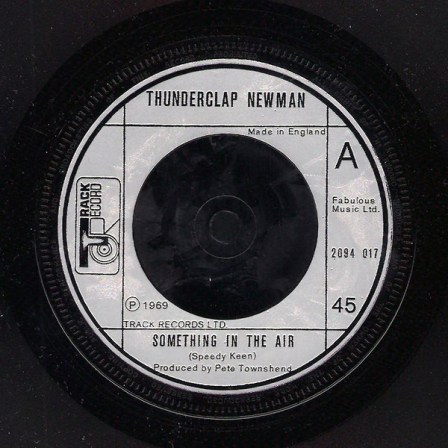
thecrazyworldofarthurbrownthunderclapnewman-firesomethingintheair

Normal service is resumed for the final verse, as the revolutionary fervour is upped. Hand out the arms and ammo, We’re gonna blast our way through here… It’s a deceptively angry song. I just wish it had a little more oomph to it. (In keeping with the theme of ‘revolution’, the song apparently has a snippet of ‘La Marseillaise’ towards the end, though I can’t hear it.)

And, after a bit of research, I can confirm that ‘Something in the Air’ has been used to advertise British Airways, Austin Minis, Coca-Cola and mobile phones. It’s clearly a song that lends itself well to advertisements – make up your own mind as to whether or not this is a good thing.

Thunderclap Newman, which is a great name for a band to be fair, were the brain-child of The Who’s Pete Townshend, and he actually plays bass on this single, which is as close as a member of The Who is going to get to a #1 single, sadly. Andy ‘Thunderclap’ Newman was the man who pulled out the brilliant piano solo. Their guitarist, Jimmy McCulloch, was only fifteen when they recorded their sole chart-topper, making him a de facto member of the Youngest Chart-Toppers club. He would go on to join Wings. Which means that, in wrapping up the 1st post-Beatles chart-topper, I’ve managed to end with another Beatles reference. There really is no escaping them…

270. ‘Get Back’, by The Beatles with Billy Preston

For the penultimate time – shock! horror! – it’s the Fab Four. And this time they bring with them a riff that can only be described as chugging…

beatles-rooftop-e1548864435814

Get Back, by The Beatles (their 16th of seventeen #1s) with Billy Preston 

6 weeks, from 23rd April – 4th June 1969

The Beatles, since they left the Merseybeat days behind them in 1965, have gone trippy, gone heavy, gone epic. This time they’ve gone country. The guitar licks that shimmer around the main rhythm are pure C & W, while the lyrics take us straight to the wild west. JoJo was a man who thought he was a loner, But he knew it couldn’t last, JoJo left his home in Tucson Arizona, For some California grass… (Drug references! We have drug references in #1 singles, people. What a time to have been alive!)

Alongside JoJo we find sweet Loretta Martin, who thought she was a woman, but she was another man… She, or he, or they, also needs to get back, back to where she once belonged… All the girls around her say she’s got it comin’, But she gets it while she can… Pretty risqué stuff, I’d say, even for 1969. Though perhaps I just have a dirty mind.

Having not listened to it properly in several years, ‘Get Back’ is a much weirder song than I remember. There’s those lyrics for a start, then there are the squeaking noises and Paul McCartney’s very nasal, Kermit the Frog style vocals. There are also lines where he sounds close to laughter. Theories abound as to what the hell it’s actually about, including it being a satire of anti-immigrant views. I like John Lennon’s theory, though, that the get back to where you once belonged refrain was a McCartney dig at Yoko Ono.

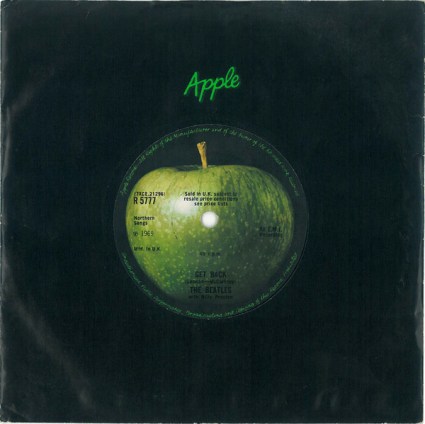
R-6128850-1520005406-9513.jpeg

Although it’s their sixteenth chart-topper, this record is a Beatles ‘first’ for a couple of reasons. Most importantly, it’s their first and only single to officially feature another musician. Technically this is ‘The Beatles with Billy Preston’, as he contributes the funky keyboard solo – for my money the song’s best bit. It was also the first, and only, Beatles’ #1 to enter the charts in top spot, rather than climb there, which means they finally match Elvis and Cliff’s achievements from the start of the decade.

And, though we may be scraping the barrel here, it’s the only Beatles’ single to feature a spoken-word section. Before the final chorus, the riff tightens and Loretta is urged, once again, to get on home. Your mummy’s waiting for you, Wearin’ her high-heeled shoes and a low-necked sweater… And that’s that. Looking at The Beatles’ post-1965 #1 singles… you can’t claim they ever rested on their laurels. Every one is different, every one a work of art in its own way (even ‘Hello, Goodbye’.)

‘Get Back’ also, significantly, puts The Beatles out clear in the UK #1 singles leaders table. They now sit on sixteen while Elvis, for so long miles out in front, has fifteen. The Shadows are on twelve. Cliff is on nine. The Stones on seven. No other act so far has more than four.

Finally, this is the 4th Beatles chart-topper in a row to have had Paul as the lead writer. Was he carrying them by this point? Or was he just writing the stuff they knew would sell? John will have the final say, though, when he gets the credit for their final #1 single, coming up very, very shortly. And it was he who had the final word when they closed their final ever live performance, from the roof of the Apple studios in January ‘69. ‘Get Back’ was the very last song they played, before the police spoiled the fun, with Lennon thanking their impromptu audience and adding: “I hope we’ve passed the audition.”

260. ‘With a Little Help From My Friends’, by Joe Cocker

I recently did a series of posts on cover versions of #1 songs – previous chart-toppers that had been reimagined in different ways by different artists. ‘Different’ being the important word – a good cover version should bring something new to the table. What’s the point in releasing a karaoke version of the original? And while we have had plenty of cover versions hit number one already, this one takes the concept to another level.

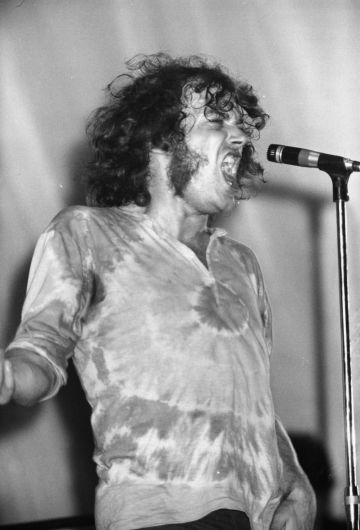
Joe Cocker

With a Little Help From My Friends, by Joe Cocker (his 1st and only #1)

1 week, from 6th – 13th November 1968

The Beatles’ version of ‘With a Little Help From My Friends’ had been released the year before, on the ‘Sgt. Pepper’s Lonely Hearts Club’ LP. Joe Cocker, a British blues-rocker who had been around for a few years without enjoying much chart success, took it and made it his own. It’s slower, heavier, longer, downer and dirtier… Re-acquaint yourself with the original here, then settle in for the Cocker treatment.

It begins with a distant organ, as if you were standing outside a church before evensong. It’s an ominous build-up… You’re ready for something to happen. Then wham. Guitar! Proper hard-rock guitar. Hendrix and Clapton kind of guitar. The type of guitar that’s been nowhere near the top of the charts before. It’s bombastic, and outrageous. It makes you want to make devil-horns and punch the air.

The lyrics are the ones you know. What would you do, If I sang out of tune, Would you stand up and walk out on me…? But it sure isn’t Ringo singing it. Cocker’s voice is husky, and soulful. He delivers the lines late, squeezes the words in before the next one comes along. The backing singers, so important in any version of this song, sound like a gospel choir: How do I feel at the end of the day…? Are you sad because you’re on your own?

The best bit is the bridge – the Do you need anybody… bit. The guitars go super heavy and crunchy, like a motorbike revving up. The second time around, especially, when Cocker howls and the backing singers soar and we launch into the final minute of a mini rock-opera. I know we’ve had a lot of soul number ones in recent years – The Small Faces, Chris Farlowe, Long John Baldry and more – but this takes it to the next level.

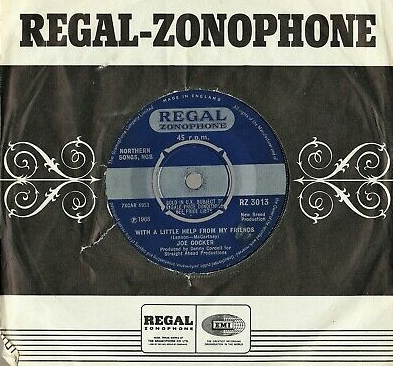
s-l400

It kind of sounds a bit like a jamming session, or at least a live version, and that really adds something to the song. They captured lightning here. They would never have been able to re-record this exactly the same – it’s too raw, too intense. It lacks the polish of a regular #1 single, but you’re oh so glad that it somehow managed to have its week in the top spot

As I mentioned, it’s another long number one. You wait years for a #1 single that lasts longer than five minutes, then three come along at once. And that’s not all that links this to the previous two #1s. We’ve now had a number one recorded by The Beatles (‘Hey Jude’) replaced by one that was produced by a Beatle (‘Those Were the Days’) replaced in turn by a number one written by The Beatles. In case you’ve lost count, this is the fourth Beatles cover to reach the top in the past five years. They may have been reaching the end of their career as a band, but their grip on the charts wasn’t weakening.

We end in a frenzy of organs and guitars, as Cocker ad-libs over the fade-out. Phew. It’s not a subtle re-interpretation, I will admit, but for me it works. I knew this record by reputation, but it’s been great to give it an in-depth listen. ‘With a Little Help From My Friends’ is a song that will pop up another two times in this countdown, and I don’t think it’s giving too much away to say that neither of the upcoming covers are fit to lick this one’s boots…

Joe Cocker will only have one more Top 10 hit, until the early-eighties when he will record ‘Up Where We Belong’ with Jennifer Warnes for the soundtrack to ‘An Officer and a Gentleman.’ From Sheffield, but sadly no relation to Jarvis Cocker, he was still scoring Top 20 albums in the ‘00s and the 2010s. He died in 2014.

255. ‘Fire’, by The Crazy World of Arthur Brown

1968 strikes again! Our next #1 kicks off with a yell straight from the sulphurous pits. I am the God of hell-fire, And I bring you…! Well, they do say that rock ‘n’ roll is the devil’s music…

A8D9EE94-33C2-40A9-AD2A-FB394DE92EB0

Fire, by The Crazy World of Arthur Brown (their 1st and only #1)

1 week, from 14th – 21st August 1968

Fire, I’ll take you to burn…! As an opening statement, it’s pretty aggressive…. Fire, I’ll take you to learn…! Demonic horns and a Satanic organ, playing as if it were possessed, join in with the fun as the ground splits in two below our feet and we tumble into the roasting furnace. I’ll see you burn…

This is, and I mean this in the best possible way, a crazy record. The Crazy World of Arthur Brown certainly live up to their name. That it hit the top of the singles chart for a week in the summer of ’68 is something to be marvelled at, and enjoyed. It’s harsh, it’s angry… It’s an anthem dedicated to nihilism and arson: You fought hard, And you saved and earned, But all of it’s going to burn… Arthur Brown then launches into an Ohhh Noooo and a series of yelps and squawks that Axl Rose in his prime would have been proud of. Wiki lists ‘Fire’ as ‘psychedelic’, which it is… But that’s only telling a tiny part of the story. This is hair metal and shock-rock, Alice Cooper, Ozzy Osbourne and Iron Maiden, before any of that was a thing. Fire… To destroy all you’ve done…

The second verse slows down, like the soundtrack to an eerie, cheapo haunted mansion ride, before the grinding organ and horns snap back in and we head relentlessly towards the finish. We get crazed laughter, shrieks, the horns blasting ever stronger, before the winds of hell blow us on our way. You’re gonna burn…burn burn burn burnburnburn…! Apparently Brown used to perform this track while wearing a helmet that had been doused in fuel and set alight (see the pic above). Because of course he did…

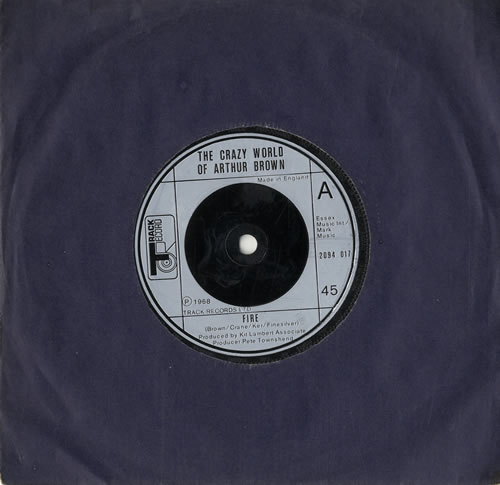
ARTHUR_BROWN_FIRE-549906

They also say that the devil has the best tunes, but I’m not so sure about that being the case here. This is an amazing record, an experience; but not one that I’m desperate to repeat many more times. Perhaps it’s a truly awesome record… ‘Awesome’ in the literal sense of inspiring fear, as in the ‘awesome’ power of an atomic bomb.

I am convinced that there must have been some controversy around this disc hitting the top of the charts – that at least Mary Whitehouse and the Archbishop of Canterbury got their knickers in a twist over it – but can’t find much evidence online. It shows how far society had come in the decade or so since Elvis was getting cropped at the waist, I guess.

The Crazy World of Arthur Brown, largely Brown and organist Vincent Crane, are one-hit wonders in the truest sense. None of their other singles – either before or after – managed to chart in the UK. But their legacy lives on –  all the metal stars I listed above count them as an influence, while ‘Fire’ has been sampled by The Prodigy and Marilyn Manson. Arthur Brown still performs, aged seventy-seven, and still sets his helmet on fire…

I feel like I’ve been writing this at the end of nearly every recent post, but it bears repeating… What else has 1968 got in store for us? Surely it can’t get any weirder than this…?

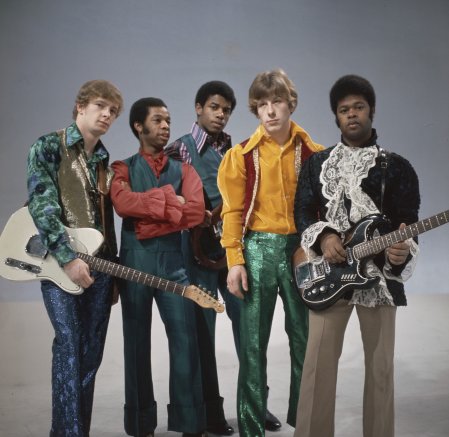
252. ‘Baby Come Back’, by The Equals

I can remember very precisely the moment that I first heard this next number one, playing on our car radio when I was about fourteen. I remember it so specifically because when the DJ announced that he was about to play The Equals, my mum thought he had said The Eagles.

The_Equals_(1968)

Baby Come Back, by The Equals (their 1st and only #1)

3 weeks, from 3rd – 24th July 1968

She then spent a very confused three minutes wondering why she had never heard this Eagles’ song before, and how she had managed to miss out on the band’s short-lived reggae phase. My mum can be quite dramatic when confused. Anyway… This is definitely not The Eagles. It’s The Equals, with ‘Baby Come Back.’ And we do welcome reggae to the top of the British singles charts!

Except, is this really reggae? Or is it rock? Reggae-rock? Or am I just assuming it’s some kind of reggae because it’s sung with a Jamaican-sounding accent? The opening, cut-glass riff is very rock, while the bouncy rhythm is – to my ears at least – quite reggae. Ding-ding-dinding-dung-ding! It’s a great intro, and it’s probably the best thing about the entire record.

Not that it’s a bad song other than that. It’s simple enough – a song in which a man implores a woman to not leave him. Come back baby don’t you leave me, Baby baby please don’t go… he sings. Come back, I said baby come back… goes the chorus. It all sounds very heartfelt until you listen carefully to the second verse, and notice that he admits to flirting around behind her back.

The Equals were a London-based band cut from the same interracial cloth as The Foundations. They had two white and three black members, the foremost of which was one Eddy Grant! I knew of him as an eighties star – he’ll feature again on the countdown in around fourteen years – but had no idea he was around in the sixties, until today. And he doesn’t have a Jamaican accent, as I suggested above – he’s originally from Guyana, in South America.

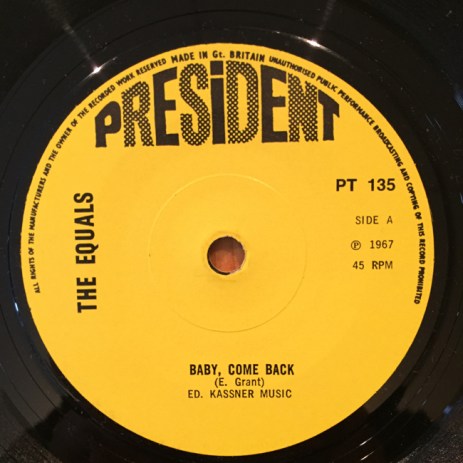
SAS2271

This is a fun record, one that bounces along and stays buried in your head for a while after. I like the asides as the band build towards each chorus – Hey! (Alright!) – and the free-styling towards the end, especially when one member shouts out Rude Boy! It might have stood out as even more new and refreshing, had the chart-toppers of 1968 not already been so bloody strange…

The Equals had been releasing singles since 1966 – ‘Baby Come Back’ had been released once already and done nothing. They would have a couple more Top 10s following this; but ‘Baby Come Back’ was their biggest hit by far. Not only will we meet Eddy Grant again in this countdown, but this song will top the charts again in a very different-sounding nineties version. Much more for another day, then.

I really struggled to find the original recording of this disc. YouTube has it – I think – and you can listen to it below. Spotify has every re-recording under the sun but not, as far as I’m aware, the original. Which is of no concern to anyone but me, as it has spoiled the perfection of my UK #1s Blog Playlist…

Follow my playlist below, with (almost) all the original versions of the 252 #1s encountered so far:

251. ‘Jumpin’ Jack Flash’ by The Rolling Stones

Normal service is resumed, with a bang. The sixties’ baddest band are back! After a mid-decade run where they never seemed to leave the top of the charts, this is The Stones’ first #1 since ‘Paint It, Black’ a little over two years ago. Has their sound changed while they’ve been away?

4524373-LKRHUBBQ-7

Jumpin’ Jack Flash, by The Rolling Stones (their 7th of eight #1s)

2 weeks, from 19th June – 3rd July 1968

Yes, and no. The second you press play you know it’s a Rolling Stones’ song. It’s got that vibe and that swagger – with an intro that begs to be turned up. But it’s heavier than what came before, heavier even than the pounding ‘Get Off Of My Cloud’, or the cynical ‘Paint It, Black.’ The one thing that we’ve been missing in recent months – years even – amongst all the eclectic, easy-listening, flower-power hits of ’67-’68, is finally here: some down and dirty rock ‘n’ roll.

Watch it! The lyrics are equally in your face: I was born, In a cross-fire hurricane, And I howled in the morning drivin’ rain… (or is it: at my ma in the drivin’ rain….?) Either way, it’s the story of a boy, a creature, who appears to have risen from the deep to terrorise the world… I was raised, By a toothless bearded hag… All told over the same simple, relentless riff. Some sources claim that Jagger and Richards were inspired by the latter’s taciturn gardener, Jack Dyer. Others that it was inspired by the poetry of William Blake. Keith Richard’s biographer claims that the opening lines – the ‘crossfire hurricane’ -refers to the fact that he was born during a German bombing raid in 1943.

Like many legendary rock songs, its origins are perhaps lost to the mist of time (and possibly because the band were too high to remember). Also like many legendary rock songs, the lyrics are pretty out there. The last verse goes all biblical: I fell down, To my feet and saw they bled… I was crowned, With a spike right through my head… ‘Jumpin’ Jack Flash’ was written around the same time as ‘Sympathy for the Devil’, in which they portrayed Satan as a man of wealth and taste. Were they doing the opposite to Jesus here? In the end, though, his tough back-story doesn’t matter. He’s Jumpin’ Jack Flash and life’s a gas, gas, gas… The overriding message being don’t sweat it? Things’ll turn out alright in the end? Enjoy it while it lasts.

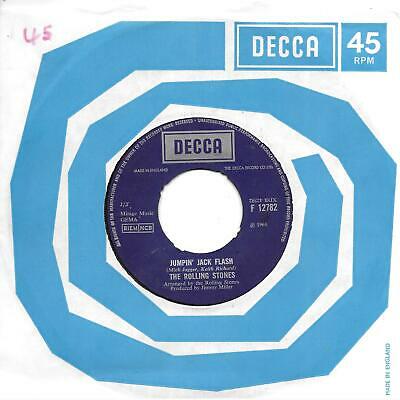
The-Rolling-Stones-Jumpin-Jack-Flash-Large-Jukebox

I mentioned in a previous post – ‘The Last Time’, I think – that every time a Stones record comes along at the top it feels like your big brother’s cool but slightly terrifying friends have crashed your party. You’re floating along with your nice Manfred Mann discs and your catchy Union Gap records and then wham! – Mick and the boys rock up. They fade into ubiquity sometimes, and have certainly become caricatures of themselves in their old age, but hearing The Rolling Stones in context like this really shows how thrilling and dangerous they were. This was never my favourite song of theirs growing up, but hearing it now for the first time in a while… I’m enjoying it way more than I thought I would. And I’ve got it turned up loud.

The outro goes slightly trippy, as the band intone Jumpin Jack Flash, It’s a gas… and the organ and the guitars intertwine. At the time, this was a bit of a comeback statement. They had tried to jump on the psychedelic bandwagon with singles like ‘We Love You’ and ‘She’s a Rainbow’ and, while not commercial disasters, they weren’t monster hits like ‘Satisfaction’ either. And let’s face it, you don’t come to the Stones for hippy-love vibes, do you? You want them to rock, and rock this single certainly does. They’ve played it at pretty much every live show since. It’s their most performed song, one of their signature hits. And it’s with a tear in our eyes that we realise they only have one more chart-topper to go…

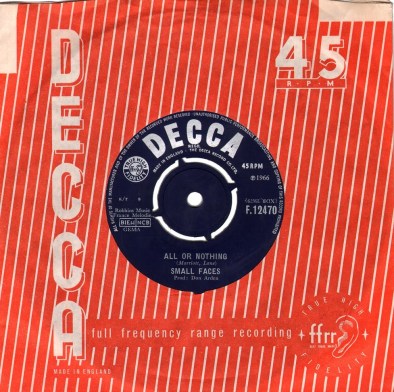
223. ‘All or Nothing’, by The Small Faces

1966 has been a pretty cool year in terms of its chart-toppers. Nancy’s boots, The Walker Brothers, the cynical Stones and Dusty finally making it… Plus a lot of soul: The Spencer Davis Group, Georgie Fame and, most enjoyably of all, Chris Farlowe. To that list you can now add The Small Faces.

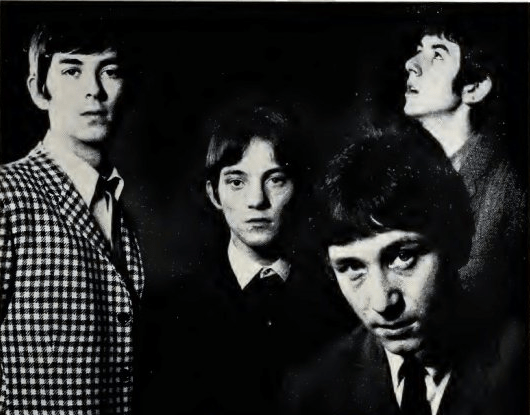
SmallFaces1966

All or Nothing, by The Small Faces (their 1st and only #1)

1 week, from 15th – 22nd September 1966

This is another cool record, and it’s cool from the very start – from the fade-in drum roll. We’ve not had one of those before at the top of the charts. Then a trippy riff, and a wistful voice: I thought you’d listen, To my reasoning, But now I see, You don’t hear a thing… Intelligent lyrics, and I do love the bravado required to rhyme ‘reasoning’ with ‘hear a thing’. The singer is trying to make his lover see that he doesn’t share. Things could work out, Just like I want them to, If I could have, The other half of you… And then an ultimatum: All or nothing, For me…

The guitars in the chorus are thick and chunky. Very forward-thinking. Very power-pop. It’s The Undertones come a decade early. I’d rank it along with ‘You Really Got Me’ and ‘Get Off Of My Cloud’ as one of the heaviest #1 singles so far. Although ‘All or Nothing’s heaviness is more subtle, not as in your face.

And it doesn’t last the whole song through. There’s a mellow ba-ba-ba-baba refrain mid-way through, and then a funky breakdown towards the end. And lots of great soul shout-outs from the lead-singer Steve Marriott. It’s amazing to think that he was just nineteen when this was recorded. Aw Yeahs, and Hear my children sing!, and Gotta keep on tryin’! And when he belts out the crucial I ain’t tellin you no lie, So don’t just sit there and cry! line, it’s a real finger-kiss moment. It’s a record that packs a lot in to its three minutes. Funky, heavy, soulful… A song I knew vaguely; but hadn’t realised just how forward facing it sounded. If you were a pop-loving kid in 1966, this is what your cool older brother would have been listening to.

7503405132_3ee2877a47_b.jpg

That’s the best word for this record. Cool. No point searching for a better one. Another cool chart-topper for the year. In pictures from the time, The Small Faces look the part too. Mods, with long hair and sharp suit jackets. And they crammed a lot into their four years together. (It is amazing, isn’t it, how many of these mid-sixties groups fell apart after just a few years – with a couple of obvious exceptions…) Like The Troggs from two posts back, certain other of their hits far outshine their one and only chart-topper. ‘Itchycoo Park’ made #3 the following year, and ‘Lazy Sunday’ – for many a year the only Small Faces song I knew – made the runners-up position in 1968. Neither of those songs sound anything like the heavy, soulful R&B on ‘All or Nothing’, which speaks to the band’s quality and creativity.

I have to admit that I thought I had imagined some link between The Small Faces and The Faces – assuming that it was just a coincidence in naming. But no, I was right: Marriot left, the remaining Faces dropped the ‘Small’ and recruited Rod Stewart. Rod the Mod, as he was back then. The rest is history. Marriot died tragically young, in a house-fire aged just forty-four. He’s kind of forgotten today, in the pantheon of sixties stars, which is a shame, as his legacy helped shape both punk and Britpop. The Jam and Blur certainly owe him a debt, anyway.

The Small Faces, then, with their one and only week atop the British Singles chart. Sit back, and Hear the children sing!

Keep up with this Spotify playlist:

217. ‘Paperback Writer’, by The Beatles

If you can draw a line in the sand, between early-era Beatles #1s and late-era Beatles #1s – if you really want to locate the moment when they stopped being ‘The Fab Four’ – then I’d say this is it.

BEATLES PICTURED IN PHOTO RELEASED BY CAPITOL RECORDS

Paperback Writer, by The Beatles (their 10th of seventeen #1s)

2 weeks, from 23rd June – 7th July 1966

There’s the echoey, layered intro – Paperback writer, writer, writer… A simple, harder than anything that’s gone before, riff. A filthy bassline. It’s not a clean line in the sand – it’s not as if The Beatles hadn’t been getting progressively heavier, cooler, druggier with every chart-topper since ‘I Feel Fine’ – but this does feel like a significant step away from their earlier days. 1966 would be the year of ‘Revolver’ and their last ever stadium concerts.

The biggest difference though, for me, comes in the lyrics. All their previous #1s have been boy-meets-girl, girl treats boy well or badly, pop songs (with the exception of ‘Help!’) ‘Paperback Writer’, however, is a song about a, well, a paperback writer, written by Paul McCartney after he was challenged to write a song about anything but ‘love’.

Dear sir or madam, Will you read my book, It took me years to write, Will you take a look…? It’s a song in the form of a letter – our very first epistolary chart topper? – from a wannabe pulp-fiction writer, presumably living in a cramped attic, to some unnamed publishers. It doesn’t, to be honest, sound like a very appealing read: a dirty story of a dirty man (whose) clinging wife doesn’t understand… And the unnamed writer doesn’t sound like much of an artiste: I need a job and so I wanna be a paperback writer…

360_214e15f9f8f054990022bb0ace81d936

It’s actually quite a funny record, satirical even. The hero of this trashy story also wants to be a paperback writer, while the book is already a thousand pages long, with more to come in a week… In the background, the other members of the band harmonise, in falsettos, over the French nursery rhyme ‘Frere Jacques’.

It’s also a short record, just over two minutes long, which sounds loveably rough and ready, as if it were knocked out in one take over a single afternoon. And that’s not a bad thing. It’s probably The Beatles’ heaviest chart-topper, and a song that’s always felt like a bit of an anomaly in their discography. Although, if you think the lyrics to ‘Paperback Writer’ are a big change of pace, their next #1 will be about an old woman who cleans churches…

Before we finish, let’s just pause to notice that the past three chart-toppers have gone The Rolling StonesFrank Sinatra – The Beatles… has there ever been a more illustrious run of #1s?