182. ‘Little Red Rooster’, by The Rolling Stones

Pack your welly boots, your straw hat and some industrial strength bug spray – we’re off to the country. To a farm somewhere in the Miss’ippi Delta. With The Rolling Stones.

TV Rehearsal

Little Red Rooster, by The Rolling Stones (their 2nd of eight #1s)

1 week, from 3rd – 10th December 1964

It feels like the Stones’ arrival, earlier this year, passed us by. ‘It’s All Over Now’ sneaked a week at the top in the summer, but surrounded as it was by some colossal pop tunes from some legendary acts I had basically forgotten about it. The first Stones #1 should have been a bigger thing, I feel. So, they’re back. And this time they’re making sure we notice them.

Their tactic? To return with a song so unlike any of the one hundred and eighty-one previous chart-toppers that you instantly sit up and start listening. A slow, woozy blues riff comes along, reeling you in, lulling you into a vision of sipping ice-tea on a farmhouse veranda, before Mick Jagger’s languorous vocals… I am the little red rooster, Too lazy to crow for days… I am the little red rooster, Too lazy to crow for days… It’s an atmospheric song – the dusty, heat-hazed farmyard unfolds before your very eyes. Dogs begin to bark, And hounds begin to howl… All the while the hypnotic, twelve-bar blues riff continues to drag you along. Watch out strange cat people, Little red rooster’s on the prowl…

1964 has been a year, by and large, of peerless pop. But this is no pop song, not by any stretch of the imagination. There are no verses, or chorus, or bubble-gum bridge here. This is low-down and dirty blues. It’s like the band pressed record on a jamming session, a warm-up before recording the actual single, and decided to release it instead. I’m listening to it on repeat as I write this, and it’s very easy to miss when the song starts over. It could be three minutes long; or thirty minutes.
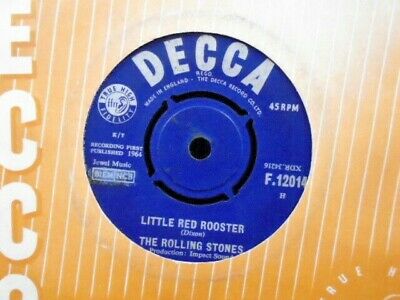
THE-ROLLING-STONES-LITTLE-RED-ROOSTER

While the lyrics might sound like the Mick Jagger manifesto – I am the little red rooster… Keep everything in the farmyard upset in every way… – one that he’s been following for the best part of sixty years, the real star here is Brain Jones and his slide guitar. The main rhythm is acoustic, but Jones’s electric guitar flirts, and slinks, and playfully cavorts around every line. One minute it’s making the sound of dogs barking, then horses rearing, then it’s the little red rooster itself. Jones was blues through and through, and felt some discomfort at the band ‘selling out’ and becoming a pop group. As the sixties progressed and the Stones moved further and further away from their bluesy roots, he became a marginalised figure on the edge of the band, until his tragic death. Looking back, it’s easy to forget that he was as much a part of the original Stones as Jagger and Richards. This record is perhaps his finest hour, and a kind of vindication. He had managed to get a full-on blues song to #1 in the British charts – the only time that has ever happened.

‘Little Red Rooster’ had originally been recorded by Howlin’ Wolf, one of the Stones’ biggest early influences, in 1961. But it’s a folk song at heart, handed down through the mists of time, probably from well back in the 1800s. His version is very raw, while another version by Sam Cooke is much more polished, with a snazzy organ doing the work of Brian Jones’s slide guitar. In those earlier versions the singer has a little red rooster, rather than being the little red rooster – which brings to mind some saucy connotations. I’m surprised Mick and the lads changed it…

Understandably, the band’s management was against releasing this as a single. It doesn’t exactly scream ‘#1 smash hit’. But it was. And I feel that this, along with all their earliest singles, have been somewhat erased from The Rolling Stones canon. For years I thought – according to the greatest hits CDs I had – that their career began with ‘Time Is On My Side’. But now I know. And while I would never name ‘Little Red Rooster’ as one of my favourite Stones songs, I am truly glad that they took this slice of Delta blues to the top of the charts for a cold and drizzly December’s week.

173. ‘It’s All Over Now’, by The Rolling Stones

Lock up your daughters, the headlines screamed. It’s The Rolling Stones! And with a discordant, clanging intro – an intro that strongly hints at this being a band about to get up to no good – here they are.

chron1964

It’s All Over Now, by The Rolling Stones (their 1st of eight #1s)

1 week, from 16th – 23rd July 1964

Once the intro is out of the way, the song settles down into a jaunty, chugging rhythm. There’s a natty little bassline and jazzy drum-fills. In my previous post I billboarded this as Pt. II of the Great British Blues Invasion, following on from ‘The House of The Rising Sun’. But ‘It’s All Over Now’ sounds a little lightweight compared to The Animals’ record – a song that could have rattled the gates of hell. Anything would feel lightweight after that, to be fair.

Well baby used to stay out, All night long, She made me cry, She done me wrong… Lyrically this #1 follows a well-trodden path – the brave-face-on-a-break-up theme we’ve heard in discs like ‘That’ll Be the Day’, ‘Who’s Sorry Now’ and ‘Needles and Pins’ to name but a few. Except this is The Stones, authors of feminist anthems like ‘Heart of Stone’ and ‘Under My Thumb’, and so the barbs are aimed a little lower and hit a little harder than those fired by, say, The Searchers.

Well, She used to run around, With every man in town, Spending all my money… At this point we arrive at a momentous occasion in our countdown – the first genuine swear word!… Playing her half-assed game. (I know it’s nothing shocking in this day and age, but I bet the BBC weren’t playing it at the time.) She put me out, It was a pity how I cried, Tables turn and now, Her turn to cry…

51nBOTurhML._SX355_

It’s a slightly sloppily written song: note the ‘cried’ being rhymed with ‘cry’, while the line about ‘every man in town’ is also recycled in the final verse. It wasn’t originally a Stones song either, as it had been released, in the US at least, in a much more soulful, funkier version by Bobby Womack & The Valentinos. In this sense, then, it is a Stones song – the ominous, passive-aggressive, arrogance of this version is all them. It’s a song with swagger. The Stones were here, with added swearing and no time for heartache.

We reach the solo – a manic, disjointed effort from Brian Jones which I don’t think would win any technical awards but which sums up the early-Stones perfectly. This and the solo from Elvis’s ‘Devil in Disguise’ were the two solos I wanted to learn guitar in order to play, aged sixteen. (I still haven’t got round to it…) Mick Jagger squawks and squeals in the background, in a manner we just haven’t heard over the past hundred and seventy two #1s. Then we fade to black with the same clanging chords from the intro, but only after Jagger has promised that he won’t be taken for that same old clown. Because he used to love her; but it’s all over now.

There we have it. Two debut number ones. Both of which managed only a solitary week at the top of the UK singles charts; but both of which changed the direction of British pop as we know it. The bad boys were on top! Listen to ‘It’s All Over Now’ and then ‘I Like It’ by Gerry and The Pacemakers and tell me who you think would win in a fight… One thing’s for sure – pop music was evolving at an astonishing rate in the mid-sixties and we can now safely declare that – barely a year after it broke through – Merseybeat is dead, trampled under Jagger, Richards, Jones and co’s wedge-heeled brogues.

Listen to every #1 so far in this handy playlist:

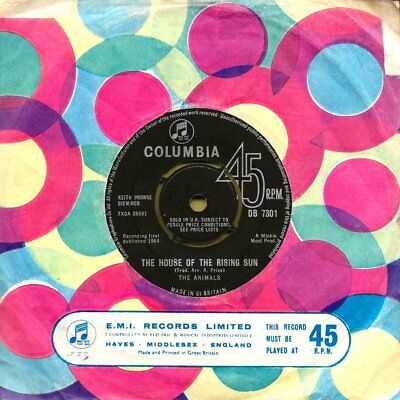
172. ‘The House of the Rising Sun’, by The Animals

What have we here, then? A riff kicks in – and keeps on kicking for the next four and a half minutes – beckoning us towards a song about a whorehouse-slash-gambling den. Is this the moment in which the ‘and roll’ is dropped, and ‘rock’ strikes out on his own, with a capital R, O, C and K?

via-abkco-records-b8dfd84a5f29dc9250e2a8cc1c62a10fe6b81eab-s800-c85

The House of the Rising Sun, by The Animals (their 1st and only #1)

1 week, from 9th – 16th July 1964

It’s an ominous, minor-key intro. Nothing good is going to come of it. And when the vocals start, the mood darkens further. There is, A house, In New Orleans… They call the Rising Sun… (I’ve always liked the flamboyant way that the singer pronounces ‘New Orlay-ons’ in his sonorous voice.) And it’s been the ruin, Of many a poor boy, And God, I know, I’m one…

A young man, son of a tailor-woman and a gambler, heads into the latter-day Sodom and Gomorrah that is The Big Easy, and comes unstuck. How exactly he comes unstuck isn’t elaborated on – it is still only 1964, after all – but you can imagine. Cards, booze, women… If this were a movie, then the frenzied organ solo at the midway point would be the soundtrack to his descent into depravity.

Then comes a word of warning: Oh mother, Tell your children, Not to do what I have done… Except, the singer can’t heed his own advice – can’t resist the temptation of New Orleans: I got one foot on the platform, The other foot on the train, I’m going back to New Orleans, To wear that ball and chain… The organ grows more and more intense, the vocals wracked and howling – a voice that could cause avalanches. It’s completely different to Roy Orbison’s approach in the preceding #1, but it’s every bit as impressive. And the final, drawn-out horror movie chord that the song ends on is, frankly, terrifying.

This is something different… Every so often we arrive at #1s which feel like a level-up – chart-topping discs that raise the stakes (gambling pun very much intended). ‘Rock Around the Clock’, ‘Great Balls of Fire’, ‘How Do You Do It?’… and now this. After ‘House of the Rising Sun’ has blasted your eardrums, The Beatles and their Merseybeat chums sound like school kids. The Animals were men. The name alone is raw, and untamed. It’s also the longest number one single so far by some distance. The Animals didn’t edit their singles for nobody!

The-Animals-The-House-Of-The

They were a five-piece from Newcastle, and the lead singer with the voice of a wolf was one Eric Burden, a man who started smoking aged 10, fell in love with an older woman aged 13, and who preferred drinking ale to going to school (they breed them tough in the north-east.) He is, allegedly, The Eggman of ‘I Am the Walrus’ fame, due to an incident involving amyl nitrate and a fried breakfast… I really want to read his autobiography. Besides this disc, The Animals gave us two more ‘Best of the 60s’ perennials – ‘Please Don’t Let Me Be Misunderstood’ and ‘We’ve Got to Get Out of This Place’. They weren’t ones for shortening their song titles either…

‘House of the Rising Sun’ has an equally interesting, and hard-edged history. Sources differ, but it seems certain that the song is as old as the 17th century. It originated either in England or France. The lyrics were originally about a woman led astray; The Animal’s version was the first to reverse the gender.

If this record hitting #1 is a game-changer – giving us pure, southern R&B at the top of the hit parade – then it has to be viewed as the first of a two-parter. While this is a seminal record; The Animals chart career didn’t last. Our next, bluesy chart-topper may not be as well-known, but the group that recorded it are perhaps the most famous rock ‘n’ roll band in history…