42. ‘Memories Are Made of This’, by Dean Martin

Memories-Are-Made-Of-This-Dean-Martin

Memories are Made of This, by Dean Martin (his 1st and only #1)

4 weeks, from 17th February to 16th March 1956

Sweet sweet mem’ries you gave to me…

This is one of those #1s that fall into the ‘I can sing a line or two before listening to it’ category. See also ‘That Doggie in the Window’ and ‘This Ole House’. At first I thought I might have sung this in my days as a primary school choirboy. But then, after listening more closely, I realised that the lyrics are perhaps a bit rich for a group of eight year olds.

Take one fresh and tender kiss, add one stolen night of bliss…

So, yeah… Then I got to thinking that the intro sounds a lot like the intro to ‘King of the Road’ – that sliding da dum dum dum guitar – which I definitely did sing in my primary school choir. So maybe that’s what I was thinking of.

Anyway. I wrote in the last post that we were having a bit of a minimalist phase in terms of our chart topping records, after the bombast of ’53 and ’54, and this track follows suit. There’s a guitar, some backing singers, and Dean Martin. It’s nice.

Lyrically, the song describes the ‘recipe’ for a happy life. Lots of ‘taking’, ‘adding’ and ‘folding’. With His blessings from above, Serve it generously with love… Which is fine. It actually reminds me a bit of ‘Christmas Alphabet’, in a way – another pop song as step by step guide. It is, though, a metaphor which can only go so far. The lines: Then add the wedding bells, One house where lovers dwell, Three little kids for the flavour… Stir carefully through the days, See how the flavour stays… Are either a little too saccharine, or a little too cannibalistic, to really work.

These lines, however, come during the middle-eight in which – and I may be going out on a limb here but bear with me – we have a bit of a rock ‘n’ roll chord progression. I am completely incapable of describing it in words, having no musical ability on which to base my idea, so you’ll just have to take a listen below to see what I mean. The very fact that this is a Verse Chorus Verse Chorus Middle Eight Verse Chorus (Ok, the chorus is one line, but still) kind of song is interesting in itself. It’s by no means a ‘rock’ song; but there’s a whiff of something there.

deanmartin

And it’s another one of those occasions in which we tick off a musical legend’s sole moment at the top of the UK charts. Vera Lynn’s had her moment, Tony Bennett’s had his, now it’s Dean’s turn. It just seems right that he got there at least once. To be honest, I know very few concrete facts about about Dean Martin – I tend to get all the rat-pack type singers muddled up together – but I see that he sang songs that are probably more famous than he now is: ‘Volare’, ‘That’s Amore’, ‘Sway’… In fact, it seems safe to say that ‘Memories Are Made of This’ is Dean Martin’s most famous song in which he wasn’t hamming up his eye-talian side. It sounds like I imagine all Dean Martin records to sound like: laidback, slightly louche, very nonchalant… He sounds as if he’s phoning it in, to an extent, but that just adds to the appeal. ‘The King of Cool’, indeed.

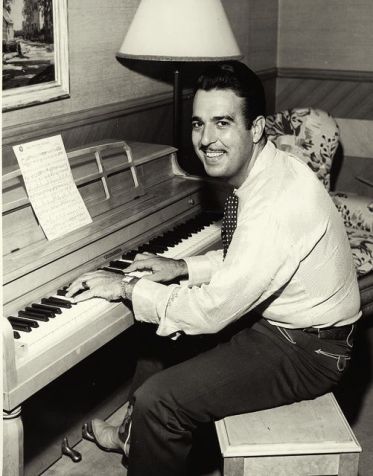
41. ‘Sixteen Tons’, by Tennessee Ernie Ford

s-l300

Sixteen Tons, by Tennessee Ernie Ford (his 2nd of two #1s)

4 weeks, from 20th January to 17th February 1956

Hmmm… What’s going on here, then?

It is more interesting, I suppose, approaching these distant number ones – apart from the handful that I already knew – and not knowing what I’m going to get. It wasn’t always like this – for most of 1953 and ’54 the chart toppers followed a rather overwrought formula. Now they are growing much more eclectic.

But, at the same time, I feel ‘Sixteen Tons’ has been done before. We’re back on ‘Man from Laramie’, ‘Hernando’s Hideaway’ territory here – back in the cheesy Western soundtrack album. This is what I expected from a man named Tennessee Ernie Ford, much more so than his earlier, bombastic #1: ‘Give Me Your Word’.

It’s a song about loading something… coal, I think… Loading sixteen tons of it, to be precise. You load sixteen tons, what d’ya get? Another day older and deeper in debt. St Peter don’t you call me cos I can’t go, I owe my soul to the company store… The singer is a hard man; shovellin’ sixteen tons ain’t nothin’ to him, no Sir.

After describing his working day, he goes on to big himself up: raised by a lion, fightin’ and trouble are his middle names, if you see him coming then you better step aside etc. etc. One fist of iron, the other of steel, If the right one don’t get you then the left one will… It’s all a bit silly, but Ford sings it with tongue firmly in cheek. He even giggles at one point, as he delivers the line: Can’t no high-toned woman make me walk the line… He knows it’s silly – and the listener can enjoy it for what it is. But, importantly, he doesn’t disrespect the song. It’s skilfully done. I kind of wish it had been Tennessee Ernie singing ‘The Man from Laramie’, rather than stiff old Jimmy Young, as what that song dearly needed was a slightly looser delivery; a delivery with the eyebrows raised. I’ve had a look, but unfortunately can’t find any sign that he ever recorded a version.

The only musical accompaniment to the lyrics is a guitar/clarinet combo, some light drumming, and some finger clicks. It’s minimalist. In fact, almost all of the most recent number ones have toned down the orchestral accompaniment and the backing singers (‘Rose Marie’ and ‘Christmas Alphabet’, the simple guitar riff of ‘The Man from Laramie’ and ‘Hernando’s Hideaway’s castanets). Unfortunately, at the same time, ‘Sixteen Tons’ resurrects a technique that we haven’t heard for a while – the THIS IS THE END OF THE SONG! technique. We end on a long, drawn out repetition of the final I OOOOOWWWWEEEEEE MY SOOUULLL blah blah blah… line. It spoils the whole song, truly it does. The sooner this trick dies a death the better!

123e46cdd35aa14e0ccd46e41eaa78ee

Each time I’ve listened to this track over the past half hour, somewhere in the back of my mind is the nagging suspicion that I’ve heard this somewhere before. I probably have – it is Ford’s signature hit, after all. And it’s a simple song. So simple that it sounds like it might be… Nope, I can’t place it.

And on that note, we will bid farewell to Tennessee Ernie Ford. But don’t you worry about him. He had a long and distinguished career back in the US, in the Country & Western world, releasing albums such as ‘This Lusty Land’, ‘Great Gospel Songs’, ‘Civil War Songs of the North’ and, er, ‘Civil War Songs of the South’ (maybe it was a ‘Use Your Illusion’ I & II kind of thing?) Whatever, he had clearly found his niche. He also had a TV show – ‘The Ford Show’ – and a catchphrase: ‘Bless your pea-pickin’ heart.’

Yee-hah! Let’s leave it there…

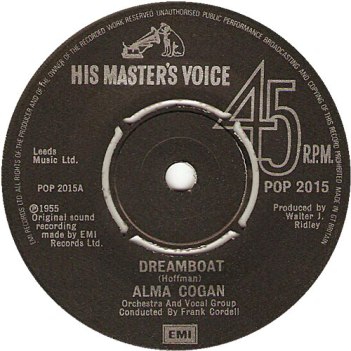
35. ‘Dreamboat’, by Alma Cogan

alma-cogan-dreamboat-hmv

Dreamboat, by Alma Cogan (her 1st and only #1)

2 weeks, from 15th to 29th July 1955

This is more like it! This is a pop song – a pop song as we would recognise one today. In our countdown so far I would count perhaps only Guy Mitchell’s ‘Look at that Girl’, and now this, as examples of The Modern Pop Song. No orchestras, no silly declarations of love, no grandstand finishes… Just a quick beat, a doo-doo-doo, and some lyrics about how in love the singer is.

I know this song quite well, and have it in regular rotation in my Spotify library, though I’m not sure how or why. I know next to nothing about Alma Cogan and, as you may have been able to tell from previous posts, I haven’t explored this era in popular music very extensively at all. It must have popped up as a suggestion – Spotify does love a suggestion – and I must have liked it enough to save it.

Anyway, know it I do. In fact, I don’t just know it – I love it! Cogan has this little flip in her voice at the start of every line, which makes her sound like an excitable school girl. And, for this song it really works. She’s got a crush, you see: You dreamboat, you loveable dreamboat, the kisses you gave me, set my dreams afloat… She’s besotted, and would follow the object of her desire anywhere – she would sail the seven seas, in fact: even if you told me to go and paddle my own canoe (I can’t help but think that sounds like a euphemism – ‘Just off to paddle my canoe darling, don’t wait up’).

There isn’t much else to ‘Dreamboat’ -it’s a fun little ditty. Cogan sings it well, with the perfect pronunciation we’ve come to expect but also with a light, playful touch that’s been missing from many of the number ones thus far. She sounds like she’s having a ball, as if she has a big, broad smile on her face while belting it out. Again, it’s a female singer having a good time. Contrast this with the song it replaced at the top – Jimmy Young’s painfully earnest take on ‘Unchained Melody’. Even in 1955 girls were having all the fun. It’s a noticeably shorter record than all the previous chart toppers as well, clocking in at well under two minutes, and that’s one of the most important things to consider when writing a brilliant pop song: make sure that it doesn’t outstay its welcome!

de565d5d80ca47f8aae75ff675d21485--vinyl-records-singers

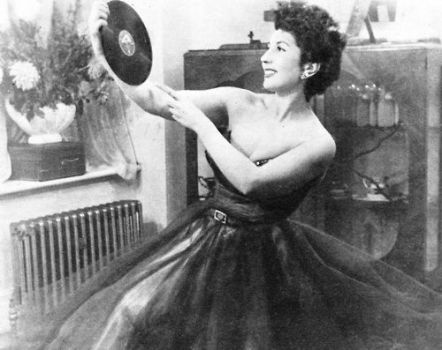
It’s a shame, I think, that this is Alma Cogan’s only song on this countdown. I like the cut of her gib. She was another young, British-born singer who, along with Ruby Murray and Dickie Valentine earlier in 1955, was dragging popular music away from old crusties like Vera Lynn and David Whitfield and towards the teenagers, towards rock ‘n’ roll. This is a song, essentially, about a hunk and his sweet kisses.

A quick look at Cogan’s Wiki throws up a colourful picture: the highest paid female star of the late ’50s, serial winner of the NME Outstanding British Female Singer award, and perennial visitor to the Top 10. Parties with Princess Margaret, Cary Grant and Noel Coward. An affair with a young John Lennon just as the Beatles were shooting to fame. And then dead at the tragically young age of thirty-four…

A life well lived, though cut far too short. I have a feeling that I’ll miss her even more – this ‘Girl with the Giggle’ – when we return to the bog-standard, plodding ‘pre-rock’ songs that I fear are still to clock up the charts, before rock truly lands.

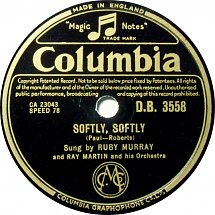
29. ‘Softly, Softly’, by Ruby Murray

ruby-murray-softly-softly-1955-3-78-s

Softly Softly, by Ruby Murray (her 1st and only #1)

3 weeks, from 18th Feb to 11th Mar 1955

Aaaah…

That wasn’t a cry of anguish you just heard; more an exhalation of boredom. Or an extended pause while I tried to think of something to stop this from being my shortest post yet.

But maybe it should be a short post. Ruby Murray, claiming the twenty-ninth UK #1 with a perfectly forgettable song. It’s basically an amalgamation of what’s gone before: the string intro to ‘Secret Love’, Mantovani’s violins, Eddie Fisher’s ethereal backing singers, plus a sprinkle of Kitty Kallen and a half-teaspoonful of Kay Starr… Almost as if someone was using an algorithm specifically designed to write a mid-1950s chart hit. However they did it; it worked – ‘Softly Softly’ logged a very respectable three weeks at the top.

Softly, softly, Miss Murray purrs, come to me, touch my lips, so tenderly… The lyrics are all about kissing and caressing, about her lover taking his time to open up her heart. But it’s not a sexy song at all. It’s a bit nursery ryhme-ish, and a bit dull after ‘Mambo Italiano’.

Murray has a nice enough voice and, notably, this is the second example, after Dickie Valentine, of a British singer trying to sound like an American. She breathes and tickles the lines in a way that Vera Lynn most certainly would not have approved of. Actually, Ruby Murray was from Belfast and, by my reckoning, this makes her the first in a very long line of Irish crooners to have topped the UK Singles Chart.

2016-10-31_lif_25887021_I1

Ruby Murray is also (and this is the only thing that I knew about her prior to writing this post) cockney rhyming slang for curry. As in: It’s Friday night, we’re off dahn the Taj Mahal for a cheeky little Ruby Murray, innit. She is therefore the second chart topping artist so far, after Mantovani, to have remained enshrined in the public consciousness less for her music and more for the way her surname sounds. But her music was very popular. Though this was her sole #1, she recorded eight further Top 10 hits between 1954-59. Only two of her releases failed to make the Top 10, actually. I guess it’s a bit of a shame that she’s now remembered solely for having a name that rhymes with curry.

I’m pretty sure I could go out on a limb and declare that I’m the only person in the world who has listened to a Ruby Murray song today. ‘Softly Softly’ is by far her most listened to song on Spotify, at 104,676 plays. A quick bit of maths, dividing that number by the 70 million total users on Spotify, gives you 0.00014 plays of ‘Softly Softly’ per user. And that’s after I’ve played it five times in the past half hour.

Still – it is pretty amazing that every single one of these prehistoric chart toppers is available nowadays at the click of a button. Had I tried to do this blog a decade or so earlier I would have had to rely on wading through weird re-recordings on YouTube, or to opening my laptop up to all sorts of viruses on Pirate Bay. Had I attempted this twenty or thirty years ago (before blogging existed, I know, but bear with me) I’d have had to spend a fortune in ‘Sounds of the 50s’ compilations. These are enlightened times in which we live. And there, that wasn’t such a short post after all.

28. ‘Mambo Italiano’, by Rosemary Clooney & The Mellomen

images

Mambo Italiano, by Rosemary Clooney (her 2nd of two #1s) & the Mellomen

1 week, from 14th to 21st Jan / 2 Weeks, from 4th to 18th Feb 1955 (3 weeks total)

Just like that, Rosemary Clooney’s pops up again. She had two number ones, within a couple of months, and then she was done. (I’m being a little disingenuous here – she was a chart force for several years – but we are only concerning ourselves with number ones hits here, no room for second best).

And good old Rosie – her time at the top may have been fleeting, but at least she had a bit of fun while she was there. This is an even more frenzied bop than ‘This Ole House’. We start out with a bit of nonsense about a girl going back to Napoli, because she misses the scenery. And then… Hey Mambo!

On first listen I thought she was really singing in Italian, but she is just listing food: Hey mambo… try an enchilada with the fish bacalla and other cod-Italian phrases. Something something mozzarella, something something Calabrese… I think there’s a Como se dice in there. To be honest, Miss Clooney doesn’t know como se dice very much at all. And anyway, that’s Spanish. But it’s OK – you can’t help but want to dance to this. For the solo, the bouncy piano from ‘This Ole House’ returns, and it ends with a brilliant That’s Nice! OOH! As for ‘The Mellomen’… who knows? They do little more than your average ’50s backing singers – a few ‘Hey Mambo’s here and there – so I’m not sure why they got a credit. But, just like that, they have a UK Number One single.

clooney-94b833378517905808a9405ad88dff3bcfe05e4b-s900-c85

If this were released today, people might pick up on the gibberish mix of English and Italian, and the picture it paints of Italian-Americans, and they may perhaps view it in an unfavourable light. Remember how Justin Bieber got in trouble for singing about Doritos to the tune of ‘Despacito’? But actually, this is a song about a girl returning to a native land where she now feels confused and out of touch. The lyrics are meant to be mumbo-jumbo. We’re not meant to understand them… Kinda clever when you think about it.

The song also features the line: If you gonna be a square, you ain’t a-gonna go nowhere, ‘Square’, as far as I’m concerned, is the archetypal ’50s slang word: Be there or be square… You’re so square, baby I don’t care… So, while this is a mambo record, sung by an easy-listening singer-slash-actress, this is rock ‘n’ roll. It may be fun and funky, but it just about manages to retain an air of cool around all the silliness. While we were waiting for Bill Haley to come along and kick-off things off, the ideals and attitudes, if not the actual sounds, of rock ‘n’ roll were being sneaked in right under our noses.

As with her previous chart topper, I knew this song already. Most people do. I have vague memories of a late-90s remix. Plus, Miss Clooney is remembered nowadays as the aunt of housewives’ heartthrob George Clooney. But – remixes and celebrity descendants aside – we should all take a minute to appreciate her for the few weeks, in late ’54/early ’55, when she slapped a good dollop of fun into an otherwise pretty staid and stuffy UK singles chart.

27. ‘The Finger of Suspicion’, by Dickie Valentine with The Stargazers

dickie-valentine-the-finger-of-suspicion-decca-78-s

The Finger of Suspicion, by Dickie Valentine (his first of two #1s) with the Stargazers (their 3rd of 3 #1s)

1 week, from 7th to 14th Jan / 2 Weeks, from 21st Jan to 4th Feb 1955 (3 weeks total)

We race on into 1955 with a song that sounds like it could be very interesting. The Finger of Suspicion! Dickie Valentine calls out his unfaithful love. He knows what she did! And he’ll stand for it no longer!

Except, no. This isn’t an era of surprises, of shocks… of excitement (with a few notable exceptions). This is a cloying little love song, putting the ‘easy’ into easy-listening. The crimes for which the accusing finger points are things like stealing a beat or two from the singer’s heart, robbing him of sleep etc. etc… All very smooth, Dickie, but the title promised so much more.

Musically it’s right down the middle of the road. Not too dull; but far from thrilling. There are snatches of film-noir soundtrack between the verses, and an extremely sedate guitar-cum-trumpet solo. Peak pre-rock!

Perhaps the most interesting thing about the song – and perhaps I’m clutching at straws here – is that Dickie Valentine is a Brit who sings like an American. Bear with me… So far in the British chart-toppers corner we’ve had folks such as David Whitfield, Vera Lynn, and Eddie Calvert. All very proper, all very sedate, all very… pleasant. They’ve sang their number one hits in a restrained, decidedly British fashion. Calvert even played his trumpet in a restrained, decidedly British fashion. Whilst the Americans – the Frankie Laines, the Guy Mitchells, the Rosemary Clooneys – have all had a bit of a swagger about them. And Valentine, here, has clearly learned from them. He doesn’t have the greatest voice, but it’s a bit louche, and slightly knowing. He sounds like he’s having a good time singing this song. Even the name, Dickie Valentine, sounds fun and stagey (his real name was the far more prosaic Richard Maxwell). We are witnessing the birth of the British pop star here, the first in a long line of cheeky, yet loveable faces that ranges from Cliff to Olly Murs, via Rod Stewart and Robbie Williams. It’s a moment of some significance.

85334960

Almost as interesting is the manner in which Valentine ends the song. It seems that we are set up for the big, overly-dramatic finish so beloved of this era’s biggest stars. The finger of suspicion – dum dum dum dum dum dum – you’re ready for it, no matter the fact that it won’t suit the song – and then we get an ever so gentle points… at… you… Expectations well and truly subverted.

We are, of course, meeting The Stargazers again as well. Their first chart-topper was dire, their second was bizarre, and their final one is this standard little ditty. In truth, they barely feature here, save for a few backing lines. You wouldn’t even know they were involved if they weren’t credited. When this hit the top they became the act with the most UK Number Ones – joint with Frankie Laine. Best leave them there. They won’t hold onto this record for long, and will soon fade into the mists of chart history as an act very much of their time.

25. ‘This Ole House’, by Rosemary Clooney

R-803732-1160416687.jpeg

This Ole House, by Rosemary Clooney (her first of two #1s)

1 week, from 26th Nov. to 3rd Dec. 1954

Now this is more like it! After an incredibly sedate run of number ones – seriously, nothing since early-May of this year has been enough to get even a toe tapping – we are rocking and a-rolling!

You probably know this song. I certainly knew of it, for a couple of reasons. One is that Shakin’ Stevens revived it in the early ’80s. The other is that I can recall, way back in the mists of time, reading an ‘Oor Wullie’ comic (link provided for non-Scottish readers) in which this song was playing at a party, the words changed to something suitably Scottish (‘This ole house ain’t got no lino’, perhaps). My grandparents kept piles of old ‘Oor Wullie’ annuals lying about, and so have no idea whether it was a new-ish comic strip parodying the Shaky version, or a vintage comic parodying this version. Amazing, isn’t it? Anyone who tries to tell you that the charts don’t matter, and that the songs which make number one don’t form the backdrop to our lives, is very, very wrong. Anyway. You will know this song, I assure you – it’s got a sort of nursery rhyme feel to it and goes a little something like this:

            * raucous piano, or maybe a harpsichord (???) or an organ *

        This ole house once knew his children, This ole house once knew his wife, This ole house was home and comfort as they fought the storms of life, This ole house once rang with laughter, This ole house heard many shouts, Now he trembles in the darkness when the lightnin’ walks about…

Yes, it’s the tale of a lonely old man. Clooney then goes on to detail the repair work that this house needs – the floor, the hinges, the windowpane, even the shingles (I’m pretty confident that this is the only #1 hit to reference shingle). But he needn’t bother, this lonely old man, as he: Ain’t gonna need this house no longer, He’s getting ready to meet the saints…

This is a strange ole song. In a musical landscape of mopey, flowery, boringly chaste love-songs this is a best-selling song about a man sitting in his dilapidated house, waiting for the sweet embrace of death. The piece de resistance is the line: Oh his knees are a-gettin shaky, But he feels no fear or pain, ‘Cause he sees an angel peekin’, Through a broken windowpane…

Like, seriously. WTF? – as they most certainly didn’t say in 1954. I love it. It’s weird, morbid, almost sadistic. It’s quite modern, in a way, the juxtaposition of upbeat music with some with very downbeat, depressing lyrics. It’s interesting, anyway, and a lot better than some of the guff we’ve had to listen to recently. The gulf between this record and ‘My Son, My Son’ – its predecessor at #1 – is what makes a singles chart so interesting. The next chart-topper can always be something completely different.

thisolehouse1

Rosemary Clooney’s voice is standard, mid-1950s American. Polished, glossy, accessible. She even throws in a Westlife style key-change after the twangy piano solo which, if I’m not mistaken, is the first we’ve heard in this rundown. I, for my sins, love a good key-change. And we must mention her brilliantly deep-voiced backing singer – with his ain’t a-gonna need this house no longer, ain’t a-gonna need this house no more – who adds an even more bizarre edge to an already pretty bizarre record.

This was Clooney’s first of two number ones, the second of which will be coming up very shortly indeed. And, I can tell you now, it’s another cracker!

19. ‘Such a Night’, by Johnnie Ray

s-l300

Such A Night, by Johnnie Ray (his 1st of three #1s)

1 week, from 30th April to 7th May 1954

For the first time since beginning this blog, we arrive at a song that I know. And I don’t mean ‘know’ in the way I’d heard ‘Secret Love’ without realising, or in the way I knew ‘I Believe’ because of it’s chart domination. I know this song, I actively listen to it, and I love Johnnie Ray.

It’s a jaunty (that word again), quick-tempo song with a simple enough riff and some ‘ooby dooby’s in the background. Nothing too unusual there. But what makes it, and elevates it to a classic, are Ray’s vocals. Like Doris Day before him there’s an effortlessness to his voice that draws you in and yanks you along. But his voice is nothing like the clean-cut, honeyed tones of Miss Day. ‘Such a Night’ isn’t being sung here – it’s being ridden, it’s being humped… it’s being performed.

Ray has help in this performance from some seriously risqué lyrics. This is the story – and let’s remind ourselves that we are writing here about a record that topped the charts in April 1954 – of a one-night stand.

            It was a night, Ooh what a night it was, It really was, Such a night… It was a kiss, Ooh what a kiss it was, It really was, Such a kiss…. Just the thought of her lips, Sets me afire, I reminisce and I’m filled with desire…

This is pretty saucy stuff right here. It starts out as a kiss in the moonlight, but suddenly…

            Came the dawn, And my heart and her love and the night was gone… But I’ll never forget that kiss in the moonlight, Ooh, such a kiss, Ooh, such a night!

It’s clever really. Obviously they couldn’t go writing a song with lyrics that touched on anything more than kissing, but are we really meant to believe that they just kissed all the way till sunrise? By the end, given the way Ray is ooh-ing and aah-ing, the answer is pretty obvious. Ain’t no kiss ever that good. The BBC, and various radio stations across the world, responded by banning the record. The first example, then, of a song’s infamy equalling a #1 hit? See also: Serge Gainsbourg, Frankie Goes to Hollywood, anything by Eminem…

MI0001415403

But wait, it gets even better. While the song is about a woman, and all the pronouns female, Johnnie Ray was gay. Those are gay ‘oohs’ and ‘aaahs’ and ‘mmms’, sitting at the top of the UK Singles Chart. In 1954. When that sort of thing was very much illegal, and gay men were being hunted, prosecuted and made to choose between jail or chemical castration. Now, that is something.

This is rock ‘n’ roll. OK, the music here is more jazzy, swing, whatever, but I am putting it out there that this is the first rock ‘n’ roll record to ever make the top of the charts. This is rock ‘n’ roll in all but name, surely? That’s what makes this idea of the pre-rock era so difficult to figure out, why it’s so hard to label this strange era in popular music.

Johnnie Ray will go on to hit the top spot a couple more times, so I will wait until then to write more about just how amazing he was, and how it’s a crime that he doesn’t sit alongside Elvis, Chuck Berry, Little Richard, Buddy Holly et al in the pantheon of ’50s music greats (*spoiler alert* him being gay might have had a lot to do with this.) I will, though, take the chance to recommend Elvis’s own version of ‘Such a Night’, recorded several years later. Remember a few posts ago, when I said that drums rarely define a record? Well, the King’s version of this record is one of the exceptions.

But, for now, let’s end by simply being thankful that this gloriously raunchy track sneaked a week at #1, ghosting in amongst all the schmaltzy easy-listening that preceded and followed it. Ooh. Aah. Mmm. Yes!

17. ‘I See the Moon’, by The Stargazers

the-stargazers-i-see-the-moon-1953-4-78

I See the Moon, by The Stargazers (their 2nd of three #1s)

5 weeks, from 12th March to 16th April / 1 week from 23rd April to 30th April 1954 (6 weeks total)

And now for something completely different…

Imagine an East-End pub, filled with smoke and ruddy cheeks, a jovial barman rings the bell and calls for last orders over the hubbub… Last orders, and one last song. Old Mrs. Fozzywinkle sits at the piano, shouting down someone who’s just said something saucy, and then… The opening bars of ‘I See the Moon’.

Over the mountain, over the sea, back where my heart is longin’ to be… Please let the light that shines down on me, shine on the one I love… Thematically, we are treading familiar ground: it’s a tale of two separated lovers, one hoping that the other still thinks of them. We’ve heard it a few times in this countdown so far. But, beyond the lyrics, this is something else entirely.

The first thing that comes to mind is the scene in ‘Oliver!’, where Nancy leads the pub in a rousing chorus of ‘Oom Pah Pah’. This song isn’t quite as rowdy, or raucous, but it has an unhinged quality that none of the previous chart toppers have had. Even the novelty tracks that have gone before it – the likes of ‘How Much is that Doggie?’ and ‘She Wears Red Feathers’ – still felt as if they had been professionally recorded, perhaps over several takes. This song doesn’t…

The first verse is sung – horribly – in a fake German (Polish? Transylvanian??) accent, the voice cracking as it fails to reach the high notes, with voices roaring in approval in the background. The second verse takes the form of a skit – a plummy voiced announcer introduces a little lady with a tambourine, who proceeds to come in at the wrong cue not once, not twice, but three times. Once she gets going, the announcer asks her to sing quieter, then louder, presumably until everyone listening at home is guffawing helplessly at the ridiculousness of it all. It’s funny(-ish), in a pantomime kind of way. We’re back in the music halls, here. Actually, it reminds me of a ‘Comic Relief’ track – you know the kind recorded by Cliff Richard and the cast of ‘The Young Ones’, or by French and Saunders as the Spice Girls. It has that same sort of anarchic energy, and in that regard it’s quite ahead of its time. It’s a truly bizarre song.

And when you look back to The Stargazers previous #1 – the morose ‘Broken Wings’ – it sounds even more crazy. What happened? What went wrong? (Or right, depending on your tastes?) What in God’s name did they take before hitting the recording studio? At least it’s an interesting song, though I’m not sure I’ll be revisiting it once I’ve finished writing this post.

5aa73dbf26f7295aa31761462f020c03

Information on The Stargazers is hard to come by. There are at least two other bands with the same name: an Irish folk trio, and a rock ‘n’ roll revival group from the ’80s. An image search requires some discerning before you can work out which band is which. But the original Stargazers were pretty popular in their day – the NME voted them ‘Best Vocal Group’ for five years in a row. But – and this is something that’s just occurred to me – ‘pre-rock’, the competition for that title wasn’t fierce. There simply weren’t very many groups going. This was an era of solo stars.

One other little titbit of interesting info. I’ve unearthed regarding this song: the lyric I see the moon and the moon sees me was first used in a nursery rhyme from the 1780s. We are then, listening to both the 17th UK Number One hit, and the very earliest UK Number One hit. Mind-bending…

13. ‘Hey Joe!’, by Frankie Laine

hqdefault (1)

Hey Joe!, by Frankie Laine (his 2nd of four #1s)

2 weeks, from 23rd October to 6th November 1953

One thing you soon realise as you become a seasoned chart-watcher (OK, chart-geek), is that songs don’t do well on the charts just because they’re good. Being good often has no correlation to whether or not a song is a hit.

Of course, sure, there are plenty of songs that hit the top of the charts because they’re brilliant. We’ve already seen ‘I Believe’ – a stone-cold classic – and we’ll see many, many more as we meander down this long list of Number 1s.

There are also the catchy numbers: not always classics, but songs that hit the right vein at the right time (‘Look at That Girl’ being one such) and you can completely understand why they got to the top.

Then there are the novelty hits, the so-bad-they’re-good hits, the comeback hits, the posthumous hits… Songs hit the top for a hundred and one reasons.

But one of the most interesting reasons for a song hitting the top is what I am dubbing – for the very first time, right here – the ‘shadow hit’. Example: Frankie Laine has just spent 18 weeks at #1 with a monster hit. He releases ‘Hey Joe!’, a song nowhere near as powerful, nowhere near as epic, nowhere near as good, and within a fortnight it’s hit the top spot. Had he released ‘Hey Joe!’ first, would it have performed anywhere near as well…? I’m going to have to say ‘nope’.

Not for the first time, I’ll describe this record as a bit ‘musical theatre-y’. The ‘Joe’ of the title is the singer’s love rival, and the song is basically a two-minute long pea-cocking session, a listing of why the girl should ditch Joe and get with him. I can picture the two of them having a dance-off in a barn: Frankie Vs Joe, two parts ‘Oklahoma’, one part ‘West-Side Story’.

Hey Joe! She’s got skin that’s creamy-dreamy, eyes that look so lovey-dovey, lips as red as cherry berry wine… She’s a honey, she’s a sugar pie, I’m warnin’ you I’m gonna try, to steal her from you… Lyrically it’s a bit…rich. He and Joe, it turns out, were buddies. But no longer. Girls’ll do that to a guy.

It’s not terrible. It’s up-tempo, it’s jaunty (I don’t think I’ve ever written that word so often as since I started this blog), it’s diverting and doesn’t outstay its welcome. It’s very wordy – again – and there’s another guitar solo: a genuinely trippy fifteen seconds with an effects pedal that is at least twenty years ahead of it’s time. It is completely different to ‘I Believe’, and nobody could have accused Mr. Laine of resting on his laurels.

frankie_lainehey_joe

Late 1953 was a period of utter chart domination for Frankie Laine. Having seen that he had three chart toppers in quick succession, I looked up the actual charts for this period and, in ‘Hey Joe!’s 2nd week at the top, Frankie also had brand new hit ‘Answer Me’ (more on that to follow soon) at #3, ‘Where the Winds Blow’ at #5 and the record-setting ‘I Believe’ still at #6 in its 31st week on the chart. A chart which only had 12 places! Very few artists can claim to have ever had four songs in the top six.

So, there we have it. Our first ‘shadow’ number one. More will follow, don’t you doubt it, scurrying along in the wake of bigger, better hits. As an interesting aside, some sources list this song as ‘Hey! Joe’ – the ‘Essential Frankie Laine’ album on Spotify being one. But the Official Charts Company, which I feel compelled to go along with due to years of loyalty, have done away with the exclamation mark. And I think that’s a bit of a shame. What song title isn’t enlivened by an exclamation mark?