69. ‘Magic Moments’, by Perry Como

perry-como-magic-moments-1958-7

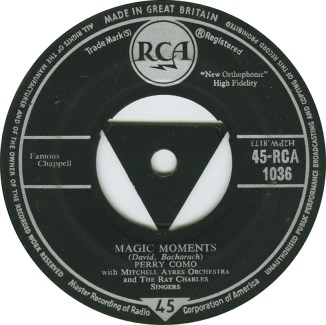
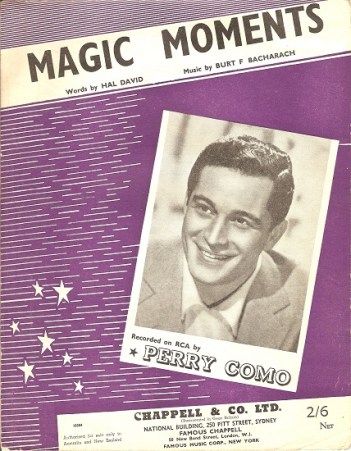
Magic Moments, by Perry Como (his 2nd of two #1s)

8 weeks, from 28th February – 25th April 1958

I’ve grown so used to describing this period in popular music history as the ‘rock ‘n’ roll revolution’ that I’m growing, quite frankly, bored of typing it (‘rock ‘n’ roll’ is actually a difficult phrase to type quickly – those two commas round the n, you see – and I will be relieved when I can start typing phrases like ‘New Wave’ and ‘Disco’).

And if I were to stop calling this the ‘rock ‘n’ roll era’, I’d be very tempted to re-christen it ‘The Age of Whistling’. Because I make this the sixth UK #1 in a little over a year to be very heavy on the whistling: ‘Just Walkin’ in the Rain’, both versions of ‘Singing the Blues’, ‘Butterfly’, ‘The Story of My Life’ and now ‘Magic Moments’ (and I’m sure I’ve forgotten about a few stray whistles elsewhere…) I suppose it’s cheap and easy to do. And I suppose it’s better than humming. But to me it creates an air of fake jollity around a song, a feeling of enforced fun – a sense that some red-faced, chain smoking record executive was yelling ‘Sound relaxed, dammit!’ just before they pressed record.

But, hey. At least the whistling is fairly sporadic here – after the first few bars Perry Como comes in with some very famous lines: Magic… Moments… When two hearts are carin’, Magic… Moments… Mem’ries we’ve been sharing… While this standard may have receded somewhat into the mists of time, surely everyone still knows the chorus. I can pinpoint the first time I became aware of this song – an advert for (I think) ‘Quality Street’ back when I was a lad – and it is one of those songs, along with, say, ‘Que Sera Sera’ or ‘I Believe’, that make up the background music of one’s life. It’s also another Bacharach and David number, hot on the heels of ‘The Story of My Life’, and while it’s a bit more memorable than Michael Holliday’s record it is still pretty bland in comparison to their later hits.

The best you can say about ‘Magic Moments’ is that it’s a very safe song: super laid-back and super-inoffensive. Como sounds like he recorded it from his bed, or at least from a very comfy armchair. Which kind of makes sense, as the singer of this song is supposed to be an older gentleman contentedly reflecting on happy times. The backing singers, meanwhile, are working overtime – taking on at least a third of the lines.
perry-como-magic-moments-1958

Away from the chorus, the verses flesh out just what the ‘magic moments’ were. Moments such as: The time that the floor fell outta my car when I put the clutch down… The way that we cheered whenever our team was scoring a touchdown… They are sweet little vignettes; lyrically quite modern in the way that they eschew grandiose statements about love for real life scenarios. There’s also a link here between this and Pat Boone’s ‘I’ll Be Home’ from a couple of years earlier, in the way that the song invokes cute images of small-town, suburban (super white and WASPy, obviously) America.

I’ve mentioned it before, but it bears repeating, how interesting it is to see the ebb and flow of the UK charts around this time; the old guard tussling with the new. You get a couple of very forward-looking, very cool, very new hits in ‘Great Balls of Fire’ and ‘Jailhouse Rock’ before the waves slowly recede and leave a saccharine blob like this beached at the top – for 8 (eight!) weeks. There are certain records that I can imagine having appealed to both young and old – ‘Diana’, for example – but I really struggle to imagine anyone under the age of forty buying this disc. Como himself was forty-five when this hit the top spot making him – and I’ve not checked this at all, but hey – the oldest chart-topper yet. Definitely one of the oldest. Probably.

Before we put the needle back into its holder for another post, let us bid farewell to the ‘King of Casual’. He has an impressive gap between his two #1s – ‘Don’t Let the Stars Get in Your Eyes’ (the 5th UK #1) and this (the 69th) – which is surely a sign of his enduring appeal. Though I do have to state that, personally, there is no contest as to which is the better song: the ever-so-jaunty ‘Don’t Let the Stars…’ all the way. Como will go on to have Top 10 hits as late as the mid-1970s – and would have had many more hits had the UK charts begun earlier than 1952 (his first US successes came in the early forties). A true titan of easy listening, he died, aged eighty-eight, in 2001.

68. ‘The Story of My Life’, by Michael Holliday

MICHAEL_HOLLIDAY_THE+STORY+OF+MY+LIFE-408385

The Story of My Life, by Michael Holliday (his 1st of two #1s)

2 weeks, from 14th – 28th February 1958

For the first time in a while, we pull up alongside a song I hadn’t ever heard before… Not since Lonnie Donegan’s ‘Gamblin’ Man / Puttin’ on the Style’ have I been able to approach a record with my ears fresh and untainted like this. What, then, do we have here…?

First things first – this is a big step back from the frenzied piano, and then snarling guitar, of the previous two #1s. It’s got the lilting acoustic guitar that sounds soooo 1957 (see ‘Just Walkin’ in the Rain’, ‘Singing the Blues’ and ‘Young Love’ for reference). It is a rock ‘n’ roll record; but super gentle rock ‘n’ roll – diluted and a little wishy-washy.

There are also some super cheesy touches – irritating whistles at the end of lines, some toodle-oohs and bum-bum-bums from the backing singers – which almost tip it over into pastiche territory. It’s very interesting, the fact that we have seen rock ‘n’ roll fragmenting before our very ears over the past few entries: Jerry-Lee Lewis and Lonnie Donegan have given us balls-out – dare I say real – RAWK. Elvis has given us superstar, super-polished rock. Paul Anka, and now Michael Holliday, are giving us what I’d call 2nd generation rock ‘n’ roll – pop music with rock touches, designed to appeal to the kids and their parents.

To the lyrics: Michael wants to write the story of his life: I’ll tell about, The night we met, And how my heart can’t forget, The way you smiled at me… Awwww. Basically his love is his life. But wait… They broke up! No wait… They made up! Safe, safe.

The story of his life isn’t quite over, though. It won’t be until – you guessed it – they get hitched. There’s one thing left to do, Before my story’s through, I’ve got to take you for my wife, So the story of my life can start… and end… with you… It’s nice. This is a perfectly nice, perfectly sweet and utterly forgettable record. I was actually shocked to discover, as I embarked on a little Wikipedia-ing, that ‘The Story of My Life’ was written by Burt Bacharach and Hal David, the first of this legendary duo’s songs to top the UK charts. A shock because, compared to the classics they wrote later in their careers, this is very, very meh. A big contender for the ‘Meh Award’ in my next recap, I’d say.

00000tmp

I’d hoped to pad this post out by delving a little into just who Michael Holliday was – as he’s someone I’d never heard – but I’ve just realised that we’ll meet him again, briefly, in a couple of years. Best hold something back for then. Suffice to say, he made the most of a short career – scoring two number ones out of only ten charting singles – before dying at the shockingly young age of thirty-eight. He has a nice, if unremarkable, voice on this nice, if unremarkable, record. Wiki sums it up best in their succinct entry on Holliday: ‘a British crooner popular in the late 1950s and early 1960s.’

Fin.

63. ‘Diana’, by Paul Anka

paul-anka-diana-columbia

Diana, by Paul Anka (his 1st and only #1)

9 weeks, from 30th August – 1st November 1957

In which we encounter the best opening line in pop music history. Or is it the worst? I can’t really tell…

Paul loves Diana, and has written a song for her. How does he begin said paean to his one true love? What is his grand opening declaration? It’s: I’m so young and you’re so old, This my darling I’ve been told…

Phew! I’ll bet there was no holding Diana back after she heard that. And the lyrics that follow aren’t much better. You and I will be as free, As the birds up in the trees… I love you with all my heart, And I hope that we will never part… Hold me darling, Hold me tight, Squeeze me darling with all your might… (If I could add a puking emoji right here, I would) This is pure pop-song-as-love-letter-written-by-fifteen-year-old. Elsewhere ‘me’ is rhymed with ‘see’, ‘my lover’ with ‘no other’ and ‘arms’ with ‘charms’… It’s by far the tritest, most banal, utterly cheesiest song we’ve met in this countdown.

But wait… It turns out that this song, which sounds like it was written by a randy fifteen-year-old, was written by… a randy fifteen-year-old! (OK, Paul Anka was sixteen when it was recorded and seventeen by the time it hit #1, but for the purposes of this next paragraph lets imagine he wrote it in his bedroom, aged fifteen). See, Paul had a crush on a girl at church, called Diana, and was thus inspired to write a song entitled ‘Diana’. Simple! Quite how old ‘so old’ is I can’t find any info on. She was probably only nineteen, but part of me really hopes Diana was a forty-five-year-old cougar.

paul-anka-diana-1957-3

Musically this record is super-diluted rock ‘n’ roll. It sounds like a pastiche of rock ‘n’ roll as recorded for the ‘Grease’ soundtrack. There’s a cheesy sax riff and some ‘doobeedoobees’ from the backing singers. Actually, to refer to this as a ‘rock’ song sounds ridiculous – I take back that last sentence. This is pure, bubblegum pop – a genre we haven’t seen too much of so far (strangely enough for the pop charts) – and I’d put it along with ‘Dreamboat’ and ‘Look at That Girl’, and perhaps ‘Butterfly’, as the purest ‘pop’ chart-toppers thus far.

Earlier I described Guy Mitchell’s ‘Rock-A-Billy’ as a sherbet dib-dab of a song – a song that you can’t resist despite knowing that it cannot be good for you. Well, if that was a sherbet dib-dab, then listening to ‘Diana’ is like drowning in a swimming pool filled with Coca-Cola. And, just as with ‘Rock-A-Billy’, as much as you want to dislike this utter cheese-fest it worms its way in and doesn’t let go. You’ll be belting it out in the shower after a couple of listens, trust me. Then again, I am a sucker for a catchy hook and a silly-but-simple lyric. It’s harder than you think to write a song like this, I’ve heard…

Anka’s voice is pretty strong too – it simultaneously sounds like the voice of a fifteen-year-old, and that of a middle-aged bloke. And by the time he belts out the champagne line: OOOOH, pleeeeeaaasseee stay-eee by me… Diana… you’re won over. Actually, the way he lowers his voice to sing her name does indeed sound like a kid trying to impress an older woman. It’s quite clever, in a way. Anka won’t have any more #1s, but when you’re debut single hits the top and stays there for nine weeks do you really need any more? He’s had a long chart career but is perhaps more famous as a songwriter, having written ‘It Doesn’t Matter Anymore’ for Buddy Holly and ‘She’s a Lady’ for Tom Jones. Oh, and ‘My Way.’ So he did alright for himself in the end.

To end, it’s perhaps worth noting how quickly rock ‘n’ roll has diversified since Bill Haley announced its arrival at the top of the charts. In quick succession we’ve had the raw, proto-punk of Lonnie Donegan, a low-key and slightly tropical sounding debut for Elvis Presley, and now this. After a run of very samey sounding #1s, we are getting a little more variety at the top. And I’m excited to hear what will come next!

62. ‘All Shook Up’, by Elvis Presley

elvis-presley-all-shook-up-that-s-when-your-heartaches-begin-hmv-pop-359--53154-p

All Shook Up, by Elvis Presley (his 1st of twenty-one #1s)

7 weeks, from 12th July – 30th August 1957

And so it begins…

Between the 12th July 1957 and the 6th February 2005, Elvis Presley will score 21 UK #1 singles… (The most any artist we’ve met so far has managed is four). He will spend 80 weeks at #1, 386 weeks in the Top 10, 1062 weeks in the Top 40, 1304 weeks in the Top 75… And that’s before we get started on the albums chart… Elvis won’t just dominate the UK charts; he’ll hump their brains out.

I feel like whatever way I introduce the ultimate pop star (rock star, performer, King of Whatever) it won’t be enough. I’ve already struggled to set the scene for Sinatra, and I’m sure I’ll struggle similarly when it comes to The Beatles, Michael Jackson and co. Best thing is, I think, to just jump straight into the song.

‘All Shook Up’ is actually a fairly low key start for Elvis. There’s a roly-poly riff, a little Hawaiian guitar and someone slapping on a cardboard box (?). There’s no solo, no change of pace, and it’s over inside two minutes. Although I knew what to expect from this song, it does sound a little underwhelming as the record that announced ELVIS PRESLEY’S!! ARRIVAL at the top of the charts. (Of course, this was far from being his debut single – it was Presley’s 7th Top Ten appearance – and I can’t help feeling that some of the singles that went before, such as ‘Heartbreak Hotel’, ‘Hound Dog’ or ‘Blue Suede Shoes’, would have made much more of a statement as his first #1).

What the minimalist production does do, however, is show off Elvis’s voice to perfection. We’ve got the now iconic I’m all shook up – uh huh huh… which impersonators will be doing dodgy copies of until the end of time. We’ve also got the beautiful moment at the end of either verse (not that this song really has ‘verses’, but still) when the instruments pause and we are left with nothin’ but Elvis: My heart beats so an’ it scares a-me to death…

My favourite bit of the whole song, though, comes towards the end. And it’s not a lyric or a guitar lick or anything like that. For a song that’s about the feeling of being in love, and of being all shaken up from falling in love, the lyrics are quite tame. Lots of knees shakin’ and tongues gettin’ tied and so on. But just before the second last I’m all shook up, in a moment of silence, Elvis lets out a little grunt – a tiny little orgasmic sigh – and in that moment we catch the merest whiff of the scandalous Elvis: the Elvis that was causing a moral panic, ‘Elvis the Pelvis’ who couldn’t be shown from below the waist on TV.

article-2256834-16BE3173000005DC-708_634x834

I suppose I should state from the beginning that I know every one of Elvis’s chart-toppers very well. There will be no surprises as far as he’s concerned. I bought my first Greatest Hits when I was around sixteen and never looked back and, while I don’t listen to him as often as I used to, he’s been a pretty constant part of my life’s soundtrack for near twenty years. But it will be interesting to listen to these records in a more critical way, to dissect them as the little pieces of history that they are.

Of course, there’s the well-trodden argument that even by 1957 Elvis had sold-out. Purists will tell you that he recorded all his best, his rawest and most compelling singles, during the Sun years, before he signed to RCA. And there’s some truth to that. There’s also some (a lot?) of truth to the notion that he recorded some utter drivel in the 1960s. But it would be criminal to discount the late-50s singles – utter cornerstones of pop music the lot of them – many of which we will be encountering on this countdown erelong. And ‘All Shook Up’ – while it has never been one of my favourites – deserves its place amongst them…

Uh-huh-huh!

60. ‘Yes Tonight, Josephine’, by Johnnie Ray

s-l300 (3)

Yes Tonight, Josephine, by Johnnie Ray (his 3rd and final #1)

3 weeks, from 7th – 28th June 1957

We’re picking up pace again with the 60th #1, after an ever-so-slight respite under the poppier grooves of Andy William’s ‘Butterfly’, as Johnnie Ray takes us a-rockin’ and a-rollin’ on his final (sob!) chart topper.

Promise me your lips are mine, Josephine tonight’s the time, I will squeeze and hold you tight, Pack each kiss with dynamite…

This is pure rock ‘n’ roll territory – squeezing (!) holding (!), dynamite kisses (!). I noted way back when, during the post on Ray’s first #1, ‘Such a Night’, that the raunchy lyrics and suggestive groaning would have been outrageous, and shocking, for the time. That was only three years ago – in May 1954 – but it already seems a long way off. By the summer of ’57, rock ‘n’ roll was here to stay and lyrics about ‘tonight being the night’ were very much par for the course.

Everything, Josephine, will be alright… I’m gonna give my lips to you, Don’t ask me if I want you ‘cos you know I do… Yes tonight, Josephine! Yes, tonight! Little imagination is required to imagine what will be happening ‘tonight’. Not a quiet game of Canasta, that’s for sure.

The rest of the lyrics are rather throwaway: I’ll be Jack and you’ll be Jill, I have loved you from the start, Kiss me quick – knock me out… I used the term ‘basic’ for the previous number one and I’m reluctant to use it again here BUT, as much as I love Johnnie Ray, this isn’t his most innovative recording. It’s fun, perky and a very worthy attempt at jumping on the rock ‘n’ roll bandwagon, but it’s not in the same league as ‘Just Walkin’ in the Rain’, which in turn was a step down from the seminal ‘Such a Night.’

cb7c74a231dcd2dd49842e43981cd00f--josephine-musicians

Ray, too, sings it like he is aware of this. He doesn’t give it quite the same oomph as his earlier chart toppers. And while I know I mention it every time our Johnnie comes up… he was, after all, gay. And, if you are as gay as the day, then you aren’t going to put as much into a song about a ‘Josephine’ as you would into a song about a ‘Jonathan’, are you? Maybe that’s got something to do with Ray’s somewhat detached performance here? Or maybe he knew it just wasn’t as good a song…?

The best thing here, by far, is the backing singers. Backing singers have played a huge part in the history of the UK’s earliest chart topping singles; much more of a role than they play these days (does anyone have backing singers anymore?) Anyway, whereas most backing singers have been there for some oohs, aahs and the occasional bum-de-dum, Ray’s backers give us a – wait for it: Yip-yip-way-pa-de-boom-diddy-boom-diddy! At least, I think that’s what they’re giving us. There’s no way to be completely sure. But it’s utterly glorious.

If we include ‘Just Walkin’ in the Rain’ and ‘Yes Tonight, Josephine’, then we have now had nine consecutive chart-toppers which have all been variations on a rock ‘n’ roll theme. Never before have we seen such consistency in terms of the genre and style of our number one hits. Plus, they have all been recorded by male soloists and they have all been pretty much the same length: the trusty 2.5-minute pop single has suddenly appeared over the past few months. Plus, if we extend the reach to include Frankie Laine’s ‘A Woman in Love’ – which wasn’t a rock song – then I cannot think of ten chart-toppers I have enjoyed discovering and listening to as much these most recent discs. A Magic 10! I know I’ve called out the more recent ones for being a little basic, and Tab Hunter’s ‘Young Love’ was super-soppy; but when I think back to the depths of the pre-rock days I’d be lying if I said I’m not glad they’re long behind us! As this is the 60th #1, a recap will be up next, so I don’t want to go into much more detail than this – suffice to say that, glancing ahead, the run of rockers is set to continue for a while and – to be honest – long may it last!

I’ll end, then, by giving Johnnie Ray a big send-off. Out of all the artists we’ve covered on this countdown, he’s the one I knew the best and had already listened to extensively. He’s great, and it’s a crime that he never gets included in the list of the great early rock ‘n’ rollers. Beyond the three songs that made it to the top of the UK Charts I’d strongly suggest clicking on the links below and enjoying: his huge breakthrough hit ‘Cry’, ‘Let’s Walk That-a-Way’ – a sparkly duet with Doris Day, his cover of ‘Ain’t Misbehavin’, and ‘You Don’t Owe Me a Thing’ – a track released in between his final two chart-toppers, during this glorious spring of rock ‘n’ roll.

His popularity waned dramatically from 1959 onwards, especially in his native US and, while the same fate befell many stars of the forties and fifties once Elvis and then The Beatles had come along, it also had a lot to do with Ray’s homosexuality becoming more and more of an open secret-slash-scandal. He was also an alcoholic, and his addiction spiralled during the leaner years. He died in 1990. Our friend Kay Starr spoke at his funeral, while Tony Bennett described him as the ‘Father of Rock and Roll’. I couldn’t agree more.

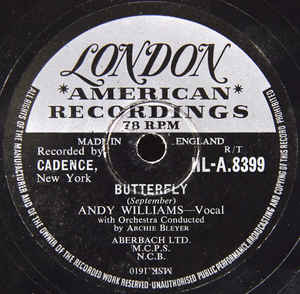
59. ‘Butterfly’, by Andy Williams

R-803538-1160399892.jpeg

Butterfly, by Andy Williams (his 1st and only #1)

2 weeks, from 24th May – 7th June 1957

Our latest chart topping single has it all: handclaps, finger-clicks, whistling, lots of bum-bum-bums and doo-waas from the backing singers… the whole shebang! The perky guitars and drums that have accompanied us over the past half-dozen #1s also remain. It’s a little gentler than ‘Cumberland Gap’ and a little poppier than ‘Rock-A-Billy’, but ‘Butterfly’ is undeniably a rock ‘n’ roll record.

The lyrics compare a girl to a butterfly because, well, she likes ‘flying around’ – if you catch my drift… You tell me you love me, You say you’ll be true, Then you fly around, With somebody new, But I’m crazy about you, You butterfly…

We’ve had lots (and lots) of references to unrequited love in the previous fifty-eight number ones, but the girls in songs like ‘Answer Me’ were simply described as being hard to get, as untouchable angels, paragons of female virtue. This is the first time we’ve had a girl described as something of a floozy. And Andy Williams, try as he might, can’t get over her: I knew from the first time I kissed you, That you were the troublin’ kind, Cos the honey that drips, From your sweet lips, One taste and I’m outta my mind…

But, he doesn’t plan on waiting. Male singers stoically waiting around for their love to notice them hasn’t been in vogue since mid-’55. No, no, no – that ain’t cool no more! These days they either wallow – see ‘Just Walkin’ in the Rain’ – or they take action – see Mr. Williams here: I love you so much, I know what I’ll do, I’m clippin’ your wings, Your flyin’ is through… That’s a slightly sinister metaphor, isn’t it? ‘Clipping’ his girlfriend’s ‘wings’… But hey, you could get away with that sort of thing in 1957.

gty_andy_williams_dm_120926_wblog

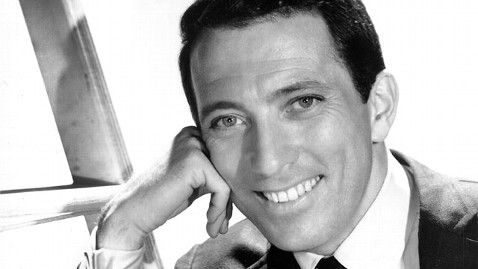
Andy William’s has a slightly softer voice than some of the male singers we’ve been hearing from recently, and this softens the song’s impact a little. You can imagine a singer with a real rasp in his voice turning ‘Butterfly’ into a proper rocker. As it is, it’s a fine little track that doesn’t outstay its welcome, but it’s a little… basic? Six months into the rock ‘n’ roll revolution and songwriters/performers are perhaps already resting on their laurels, churning out production-line hits.

Or maybe that’s a bit harsh. Williams is much better known – to me at least – for more easy-listening, cocktail lounge records such as ‘Can’t Take My Eyes Off You’, ‘Music to Watch Girls By’ and ‘It’s the Most Wonderful Time of the Year’ (one of those songs that drives you a little bit mental in shopping centres every Christmas.) He didn’t stick with the rock ‘n’ roll for long, it seems, which was probably a wise decision as it prevented him from being tarred with that particular brush, and allowed his chart career to extend well into the 1970s.

But ‘Butterfly’ was his sole UK chart topper. Like Tony Bennett, Dean Martin, Bill Haley et al before him, he ticks ‘Get a UK Number One’ off his to-do list pretty early on in his career. And, as with those other luminaries, it seems only right that he had his moment at the top. He’s undeniably a legend of popular music, whose recordings remain admired today. Case in point: a decade ago I spent six months teaching in Thailand, and one of the most popular songs when my Thai colleagues dug the karaoke machine out – which was very, very often – was ‘Can’t Take My Eyes Off You’. I somehow doubt they’d heard of ‘Butterfly’, though. Which is a shame, I suppose.

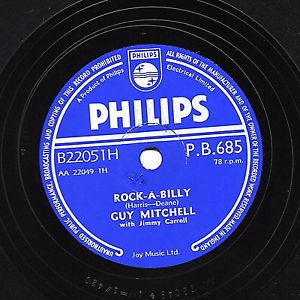
58. ‘Rock-A-Billy’, by Guy Mitchell

s-l300 (2)

Rock-a-Billy, by Guy Mitchell (his 4th and final #1)

1 week, from 17th – 24th May 1957

Part 58, in which Guy Mitchell scores his latest UK #1 single with a rockabilly record entitled… ‘Rock-a-Billy.’ Imagine if Eminem were to release a song called ‘Rap’, or Ed Sheeran were to record one called ‘Bland Shite’ – that’s where we are right now. This is a record that does exactly what it says on the tin.

It’s another fast-paced chart topper – not quite as frantic as ‘Cumberland Gap’, but then what is? – that rolls along on jaunty guitars and a Winifred Atwell-esque piano. While lyrically it takes the term ‘generic’ to new levels. This is a song about a man and his love for rock ‘n’ roll music, to which the chorus goes:

Rockabilly, rockabilly, rockabilly, rock… Rockabilly, rockabilly, rock, rock, rock… Rockabilly, rockabilly, rockabilly, rock… Rockabilly, rockabilly… Rock! Rock!

Anyone who claims that modern pop is dumbed-down nonsense; point them in the direction of this record. The verses aren’t much more highbrow. There’s some silliness about the history of rockabilly music – it came from Tennessee, spread on out to the lone prairie – and then a lot of advice on how to dance to this crazy new music:

From the moment that you feel this crazy beat, You gotta lose control of your two left feet, Give me mountain juice, Turn me loose, Leave me wave my arms about…

It’s the latest song in a growing list where I’ve had to look the lyrics up online, rather than transcribe them by simply listening to them, as Guy Mitchell does a good bit of growling and slurring. (Actually, if you listen to his first chart-topper, back in 1953, and now this, Mitchell’s voice does have a harder edge – perhaps he was altering it to fit the style of the time? Or maybe he was just getting older?) Plus… is that reference to ‘mountain juice’ the first mention of alcohol, of drugs, of any kind of intoxicant in a UK Number One Single? I think it might just be… We truly are rockin’ and rollin’!

However, although I’m bandying terms like ‘generic’ and ‘silliness’ around, I wouldn’t want anyone to think for a second that I don’t like this song. It’s great. It’s dumb. It’s fun. I like it like how I like sherbet dib-dabs: I know there are ‘better’ foodstuffs to shove down my gullet, but I know I wouldn’t enjoy them half as much. It is a song that I dare anyone to dislike, a song that’s programmed to hit all the most primal happiness receptors in your brain. It’s got four key-changes, for God’s sake! The best bit of all is the bridge, which strangely comes right at the end, and which is positively life-affirming: You know what rockabilly’s all about, You know it’s gonna make you sing and shout, You know you’re gonna act like a crazy fool, Who cares? It’s cool! Yes, dance people! Dance like no one’s watching. Guy says so!

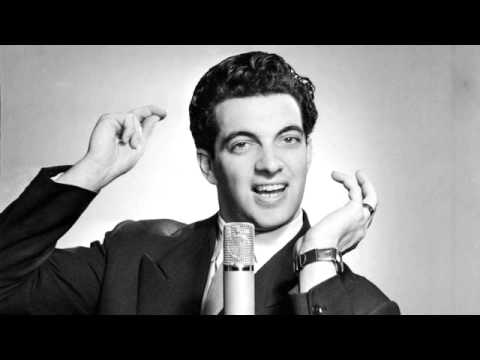
1100-86

We have to bid farewell to Mr. Mitchell here, following this short encore at the top of the charts. And I have to admit that I’ll miss searching for pictures of his handsome face to add to these posts. His first chart-topper was… interesting, but the subsequent three – ‘Look at That Girl’, ‘Singing the Blues’ and now this – can legitimately go down as classics of the early rock ‘n’ roll/pop crossover. Few, if any, artists can claim to have been as consistently popular throughout the 1950s as Guy Mitchell: he had his first US Top 10 single in 1950 and his last in 1959. And we leave him here as the man with the joint most UK #1s, a record which he’ll hold for a couple more years.

Anyway, I’m on my seventh listen of ‘Rock-a-Billy’ as I type this sentence, and with every listen I like it more. I’d better stop before I begin claiming that it’s the best song ever recorded. One final thought, though: it’s telling that the biggest stars of this fledgling ‘rock age’, at least in UK chart terms, were Guy Mitchell and Johnnie Ray – two already very established artists who jumped on the rockin’ bandwagon and started scoring huge hits once again. A case of mass-appeal, perhaps? The kids liked the cool new music, while mum and dad trusted good ol’ Guy to keep it respectable? More respectable than arrivistes like Elvis, Chuck and Little Richard at least? Not that this will last long, but still. An interesting mini-era in rock music: the oldies outselling the upstarts.

56. ‘Young Love’, by Tab Hunter

s-l300 (1)

Young Love, by Tab Hunter (his 1st and only #1)

7 weeks, from 22nd February – 12th April 1957

I’ve been bigging up the arrival of rock ‘n’ roll to the top of the UK charts for so long – especially back when we were plodding through all those dreary, brow-furrowingly earnest pre-rock ballads – that this next statement goes against every instinct I have…

By the time it got to the top of the UK charts, rock ‘n’ roll was over. Finished. Defunct. Obsolete.

I recently claimed that the rock era began on 11th January 1957, when bona fide teen-idol Tommy Steele sneered his way to a week at the top. I’m now claiming that the rock era ended on 22nd February 1957, when this limp little record grabbed a scandalous seven weeks at the top.

Because, by God this is bland! That this made it into the record books before Elvis, before Buddy Holly, before Jerry Lee and all the rest doesn’t make sense. It is a rock ‘n’ roll record – there’s a guitar riff and solo, drums, oohs and aahs and all the rest. Plus, the lyrics are all about two kids falling in love for the first time. And it’s called ‘Young Love’!

They say for every boy and girl there’s just one love in this whole world, And I-I-I know I’ve found mine… Young love, First love, Filled with true devotion…

But it’s delivered in such a soppy way that I refuse to acknowledge this as any kind of rock and/or roll. Tab Hunter’s voice is deep and sonorous, but in pictures he looks like the all-American boy next door: rosy-cheeks, blonde curls, blue eyes, church on Sundays, part-time job in the gas station. Your mum would have liked him as much as she would have disliked Tommy Steele. I can imagine a young Cliff Richard taking notes as he planned his assault on stardom a couple of years later (and there are a lot of similarities between Hunters voice here and Cliff’s on, say, ‘Living Doll’). And note the role-reversal – now it’s the Americans giving us staid and boring while the Brits grin and wink! Fittingly, this was #1 on the day my mum was born. I say ‘fittingly’, because she has just about the blandest taste in music going (and is a huge fan of Sir Clifford of Richard).

maxresdefault

And that’s about it. The shortest entry yet. At least, that was going to be it… Until I did my customary Wikipedia-based research about Tab Hunter. Turns out this American-as-apple-pie captain-of-the-school-football-team was – dum dum dum – gay! Is gay, he’s still alive, aged eighty-six. He had to cover it up for most of his career, obviously, and had fake flings with Debbie Reynolds and Natalie Wood among others to throw the newspapers off the scent. Which adds a bittersweet layer to his one and only UK chart topping single, and the lines about boys and girls falling in love.

I’ve listened to ‘Young Love’ several times now, trying to find something to like about – I usually love me a bit of rock ‘n’ roll – but I can’t do it. It’s insipid. And so that’s it. Rock is dead. If it ever existed. Obviously, the top of the pop charts is never the place to look for cutting edge music, but I’m surprised there wasn’t a bit more of an explosion, with some real rockers, before the sell-out began. Or maybe I should just accept that lines were always blurred, that rockabilly merged with blues which had merged with jazz which had merged with the music of the cotton fields to create rock ‘n’ roll over several decades, and not in an afternoon. No more attempting to pinpoint the birth of a musical movement to a particular record.

Anyway, in my next post… The moment skiffle was born!

(Edit: Tab Hunter sadly passed away shortly after this post was published. The Guardian published this obituary, touching on some of the themes mentioned above.)

55. ‘The Garden of Eden’, by Frankie Vaughan

Before I begin my next post in this countdown, I would just like to address something. The elephant in the room, if you will. As I mentioned back when writing about Guy Mitchell’s ‘Singing the Blues’, one of its weeks in the top spot was shared with the record that’s up next: Frankie Vaughan’s ‘The Garden of Eden’. It’s the second time we’ve encountered this situation, and it won’t be the last. Which begs the question… How did records end up sharing the top spot with such regularity in the 1950s? Well, the answer’s pretty simple. But it kind of whips the rug away from under this whole countdown. You see, the charts back in the early days of their existence simply weren’t very accurate.

Way back in my intro I mentioned that the concept of a ‘singles chart’ was introduced in November 1952 by the NME. And the UK Singles Charts company has since incorporated this chart into the ‘official’ chart – even though such a thing didn’t exist at the time. There were various other charts published every week in the 1950s: the Melody Maker chart, the Record Mirror chart, the Record Retailer chart… and the NME chart, which is recognised as the most comprehensive. But not completely comprehensive. There are still many bones of contention. Which I won’t go into here – they can be easily searched for online.

The number of record stores surveyed by the NME for their chart was surprisingly low and the methods very old fashioned compared to the instant downloading and streaming databases used in 2018 – they basically called up a bunch of record stores and asked them to keep a record of what they were selling. The first chart – topped by the record we met in my earliest post, Al Martino’s ‘Here in My Heart’ – was compiled using data from only 20 (twenty!) major record stores. And thus, every so often, because they were working from such a small sample, there were ties. David Whitfield and Frankie Laine in 1953, Guy Mitchell and Frankie Vaughan in 1957… In 1960, the Record Retailer Chart became the UK Chart Company’s chart of choice and there were no further ‘joint’ number ones (though there were still several contested number ones). Then in 1969 the British Market Research Bureau took over chart-compiling duties and steadied the boat further, while in 1982 chart compilation went digital. Since then, it’s been on the straight and narrow. 100% reliable.

So, while it may be distressing to some to discover the records that you have read about during this countdown may not actually have been the best selling records in a particular week, I thought it was only correct that I address the issue. And with that, today’s sermon is brought to a close. On with the next (presumed?) Number One Single!

s-l300

The Garden of Eden, by Frankie Vaughan (his 1st of two #1s)

4 weeks, from 25th January – 22nd February 1957 (including 1 week joint with Guy Mitchell from 1st – 8th February 1957)

So I press play on this record, ‘The Garden of Eden’ by Frankie Vaughan, and pretty soon I get to thinking that, from ‘Just Walkin’ in the Rain’ to this, I don’t think we’ve encountered such a run of similar-sounding songs. Here we have yet another male singer, with yet another performance involving guitar and vocals and not much else. I’m gearing up for another recap, so I don’t want to get too introspective right now, but it seems like we are settling into a groove which – glancing ahead at what’s to come – might last for a while yet.

I am not left thinking this for too long, however. This record is slightly deceiving. It does start off with a simple guitar strum, and with understated backing singers, but halfway through someone flicks a switch. We get trumpets, and a cymbal clash. Things escalate pretty quickly. The drums go up several notches, and suddenly the vocals are accompanied by a full-on big-band swing section. It’s a never ending crescendo, a key-change drawn out for two and a half minutes, and I like it! You can imagine this being performed on TV, the curtain opening to show Frankie Vaughan alone on stage. Then, as the song progresses, the lights draw further and further back to reveal, by the end, the full-blown orchestra that are bringing us to climax. It’s not rock ‘n’ roll, in terms of the sound, but it is in terms of the frenzied tempo.

Lyrically we are in somewhat stranger territory too. Recent number ones have been lovelorn, and wry. This is… well to tell the truth I’m not entirely sure what this is: When you walk in the garden, The garden of Eden, With a beautiful woman, And you know how you care… And a voice in the garden, The garden of Eden, Tells you she is forbidden, Can you leave her there?

It goes on… When you’re yearning for loving, And she touches your hand, Can you leave her to heaven, And obey the command, Can you walk from the garden, Does your heart understand?

It’s a parable, maybe. Resist temptation? Don’t resist temptation? I don’t really know what it’s about even after several listens. My best bet is that this is Vaughan explaining his behaviour to St. Peter at the Pearly Gates. “Yes, m’lord, I should have resisted the advances of that beautiful woman but, to be honest, she was far too hot…”

hqdefault

Without knowing any of this track’s backstory, I imagine it must have been pretty risqué to have had this many religious references in a pop song back in early 1957. Remember how, back in 1953, Frankie Laine and David Mitchell had remove the ‘My Lord’ from the title of their versions of ‘Answer Me’? But I can’t find mention of any controversy online. So that’s that.

Also of note is the fact that, once again, it’s a British artist doing the rockin’ and a rollin’. Vaughan was a Liverpudlian for whom this appearance at the top of the UK charts was the culmination of a few years of growing success – he was voted ‘Showbusiness Personality of the Year’ in 1956, and was one of the biggest stars of the late fifties. Pictures show him in dickie-bows and top-hats, so we know what kind of territory we’re in. And we will meet Mr. Vaughan again, in a few years, though I feel he has been somewhat forgotten over time, considering how famous he once was.

54. ‘Singing the Blues’, by Tommy Steele and The Steelmen

Tommy+Steele+Singing+The+Blues-553316

Singing the Blues, by Tommy Steele & The Steelmen (their 1st and only #1)

1 week, from 11th – 18th January 1957

If there’s one thing I’ve learned from doing this countdown, from listening to all these number ones of old, it’s that the ‘pre-rock’ era is a very hard thing to pin down. What was it? What did it sound like? Who were its biggest stars? And… when did it end?

Did it end in November 1955, when ‘Rock Around the Clock’ brought a teenaged frenzy to the top spot? Not really – that was a bit of a false dawn. Did it end in April ’56, when ‘Rock n Roll Waltz’ reached #1? Not really – the only thing rock ‘n’ roll about that song was the title. Was it when The Teenagers claimed a chart topper last summer? Not really – they may have been kids, but they were doo-woppin’ rather than rockin’.

So, I’m about to stick my neck out and make a bold claim. Are you ready? The 11th January 1957 marks the end of the ‘pre-rock’ era and the beginning of the ‘rock n roll’ era. In the UK at least. I can’t speak for anywhere else.

Why the 11th January 1957? Well, it’s when one Tommy Steele and his band The Steelmen (see what he did there?) hit the top spot with their version of ‘Singing the Blues’. Steele was the UK’s first rock ‘n’ roller, the pre-Cliff Richard if you will, and he grabbed this song away from Guy Mitchell’s nice-enough-but-somewhat-bland version, gave it a good shake and a slap, and ushered in a new era.

Not that you’d notice straight away. The song starts with the same plinky-plonky guitar and the same twee ba bum bum bums from the backing singers. And the trumpets and hand claps added to this version give it a slightly camp, Butlins-esque air. No, the one thing that makes this record rock is Steele himself: We-hell.. a-never felt…m’re like singin’ the blues… cos I never thought Ivrlose… yr love… dear

I’m not having a fit as I type – that’s really how he sings: like the last old man crawling out the pub. He’s slurring. He goes quiet, then loud, then quick, then slow. He sounds snotty, and bratty. When he delivers the lines The moon and stars no longer shine… The dream is gone I thought was mine… There’s nothin’ left for me t’ do, than cry-y-y OVER YEEW he starts off sounding quite posh and proper but ends the lines dripping in insincerity. He sounds like he’s taking the piss. You can picture him sneering and gyrating. It’s a world away from previous British male chart-toppers like David Whitfield, even Dickie Valentine. I don’t think it’s too much of a leap to say he sounds like a cross between David Bowie and Johnny Rotten. Seriously.

tommy_1

And had I been a fifteen-year-old girl – Susan, let’s call me – sitting in the gloom and cold of January 1957, my heart would have gone a-flutter when this record dropped onto the turntable. Steele sounds like a bad boy; the sort that flicks ink-blots at the teacher and smokes behind the gym. He sounds much younger than Guy Mitchell while singing the same lyrics (Steele was twenty, Mitchell was thirty when they had their turns at #1) Susan’s mum would definitely have preferred Mitchell’s version. Her dad would probably have grumbled something about Steele needing a good stint in the army.

And so that’s it. In the two minutes twenty seconds it takes Tommy Steele to rattle through his version of ‘Singing the Blues’, we cross the Rubicon. There’s no going back from here. Steele’s star shone brightly and briefly – we won’t be hearing from him again beyond this solitary week at the top – but he did what he had to do, and changed the face of British popular music forever.