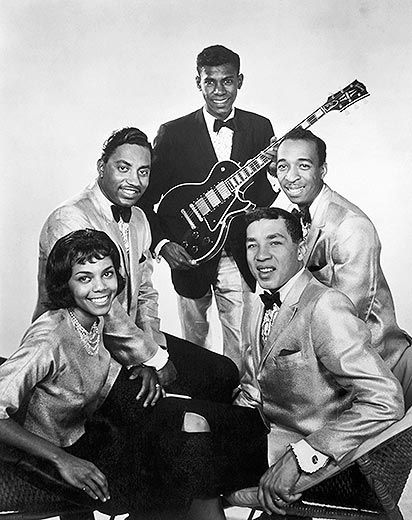
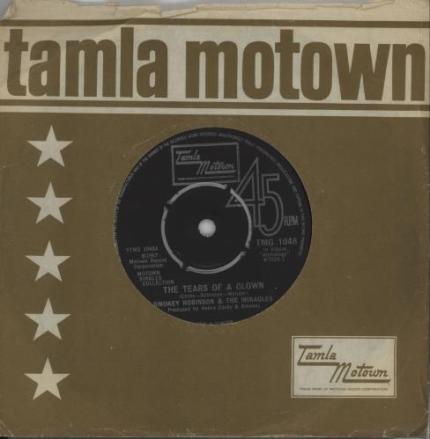
290. ‘The Tears of a Clown’, by Smokey Robinson & The Miracles

A perky riff kicks off this next number one, one that sounds like something The Pied Piper would play while leading the kids out of Hamelin. A jester’s riff, one that might play as a clown enters a room… It’s a riff, a motif, that repeats and holds the song together, while the rest is pure Motown.
ea6cd4a37212d4e210d47e8ca77489ea

The Tears of a Clown, by Smokey Robinson (his 1st of two #1s) & The Miracles

1 week, from 6th – 13th September 1970

Yes, Motown’s 4th #1 single in the UK, from one of its biggest acts, one that had been scoring Top 10 hits throughout the sixties in the States. And it’s another sad-lyrics-with-upbeat-accompaniment number… Really I’m sad, Oh, sadder than sad, You’re gone and I’m hurting so bad, Like a clown I’ll pretend to be glad…

It’s a song about putting a brave face on things, about not letting on when you’re heart is breaking. And it’s very wordy record… Sample lyric: Now if I appear to be carefree, It’s only to camouflage my sadness… There aren’t many #1 singles throwing words like ‘camouflage’ around. By the end Smokey’s referring to the famous clown opera ‘Pagliacci’… All very highbrow.

But it’s catchy, too. This is Motown after all. I have to admit that, for all this is a very highly regarded record, I’m struggling to really love it… Though I do love the bubblegum hook in the chorus: Now there’s some sad things known to man, But ain’t too much sadder than… The tears of a clown… 1970 really is jumping around all over the place, evading all attempts to define the ‘sound’ of the year. Some of its chart-topping singles have been true classics, others just truly dreadful. ‘The Tears of a Clown’ I’d place right in the middle, one of the purest ‘pop’ moments of the year.
-600883

It had actually been recorded back in 1967, and was only released due to Robinson’s reluctance to record new music with the band. It hit #1 on both sides of the Atlantic, and Smokey was convinced to spend another couple of years with them. He did eventually go solo, and he’ll go it alone at the top of the charts in a decade or so. The Miracles continued too, and had their own successes through the seventies. Also of note is the fact that ‘The Tears of a Clown’ was co-written by Stevie Wonder, who we have yet to meet in this countdown. I think it’s not giving too much away for me to say that this, his first writing credit at #1, is far better than either of the chart-toppers he’ll get under his own name…

Follow my Spotify playlist as we go!
288. ‘In the Summertime’, by Mungo Jerry

So we reach one of the most distinctive intros ever. Is it beatboxing? A comb and paper? A kazoo? Uh, ch-ch-ch… Who cares, it’s groovy, silly, fun, and it sets the tone for a brilliant #1 hit.

mungojerry002

In the Summertime, by Mungo Jerry (their 1st of two #1s)

7 weeks, from 7th June – 26th July 1970

Maybe it helps that I’m writing this in the garden on a fine spring afternoon, as the world prepares to tick over into what is hopefully a long, hot summer. But I’m sure that even if I were listening to this on a frigid mid-January’s morn, I’d get that holiday feeling. It’s irresistible – a record that sounds exactly as its title suggests. You can see why it settled in for a long old stretch at the top of the charts over June and July.

In the summertime, When the weather is high, You can stretch right up and touch the sky… It’s a little reggae-ish. There’s a music-hall piano in the mix, and a gentle guitar. Plus all the zzzhhs and the ooops that create the distinctive rhythm. It sounds like lots of things, and yet it’s distinctly original… Wiki lists it as ‘Skiffle’ and, yep, I can see that too… When the weather’s fine, You got women on your mind…

A group of lads, out looking for fun. The lyrics hit a little harder than the carefree beat suggests. Have a drink, Have a drive… (not a line you’d get away with these days, and indeed Shaggy had changed it by the time he took the song back into the Top 5 in the mid-nineties…) Go out and see what you can find…

And then a classic piece of advice: If her daddy’s rich take her out for a meal, If her daddy’s poor just do what you feel… They get away with it, though, by sounding like clumsy kids just looking for a good time. You can imagine them giving a cheeky wink as they sing it, the rascals. Life’s for livin’ that’s our philosophy…

R-4325405-1408464197-6623.jpeg

We get a little break, and some motorbike-revving sound effects thrown into the eclectic mix. Imagine driving along country roads to this, windows down, roof off. I have to admit I thought, right up until now, that the line in the second verse went ‘You can make it really good in the lay-by…’, you know, what with the driving theme. But no, that was just my mind in the gutter as usual. It’s: You can make it, make it good and really fine…

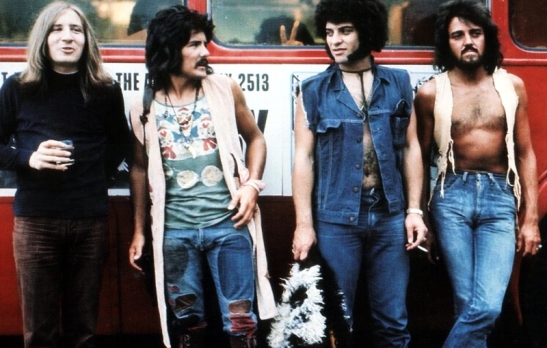
Mungo Jerry were a band led by Ray Dorset and an ever-changing cast of other musicians – even before they’d recorded this, their first hit, the line-up had changed, and it will do so again before their second chart-topper next year. The only thing I really knew about them, prior to writing this, was that Dorset had some spectacular lamb chop side-burns. But, they grew so big so quickly in the summer of 1970 that the phrase ‘Mungomania’ was coined. ‘In the Summertime’ hit #1 in a staggering twenty-six countries! We’ll meet them one more time, like I said, before long.

This is our third ‘summer’ themed number one, after Jerry Keller’s ‘Here Comes Summer’ and Cliff’s ‘Summer Holiday’, but I’d suggest that this is the definitive summer hit, one that still hits the spot fifty years on. Plus, it’s the only one of the three to actually hit #1 in the summer! Uh, ch-ch-ch… Uh, ch-ch-ch…

(EDIT! Having watched this video I’m now convinced that I’m correct on the ‘lay-by’ line! Watch his lips… And, to answer my question from the start – it’s a bottle!)

281. ‘Love Grows (Where My Rosemary Goes)’, by Edison Lighthouse

The first #1 of a new decade, and it’s a good ‘un. I love the simple, growling riff that starts us off, that grows and grows, has some horns added to it, and then…

p036gpsd

Love Grows (Where My Rosemary Goes), by Edison Lighthouse (their 1st and only #1)

5 weeks, from 25th January – 1st March 1970

She ain’t got no money, Her clothes look kinda funny, Her hair is kinda wild and free… Rosemary is a bit of a manic pixie dream girl – or a bit of a hippy, as they might have said at the time – who turns guys’ worlds upside down. Oh but love grows, Where my Rosemary goes, And nobody knows like me…

It’s a soaring pop song, one that seem to be constantly heading upwards, one that pushes all the right pleasure receptors in your brain and makes you smile. I might even go as far as to describe it as euphoric. Rosemary talks funny, and nobody knows where she came from, but she casts a spell. I imagine a girl in a floaty dress, with flowers in her hair, turning the world from black and white into technicolour as she skips past…

It’s a cheesy song, but one that stays on the right side of cheesy. Any song that includes a line like I’m a lucky feller and I just gotta tell her… is flying close to the wind, but ‘Love Grows…’ gets away with it. By the time we get to the end, which sounds a bit like a refrain of the main melody with extra strings and horns, I’m ready to say it. It’s pop perfection.

I’m not sure if this is simply because I know it’s the first number one of the 1970s, but something about this disc sounds new. Yes it sounds like some of the late-sixties bubblegum records – ‘Dizzy’, ‘Sugar Sugar’ – and the like, but it also sounds like the next step. A glossier, poppier take on sixties rock. But that might only be because I’m expecting it to be the next step… Either way, it’s a great start to the decade.

edison-lighthouse-love-grows-(where-my-rosemary-goes)

Edison Lighthouse were a London-based band – mildly surprising, because they sound very American to my ears – and ‘Love Grows…’ was their biggest hit by far. Their second highest charting single, ‘It’s Up to You, Petula’ made #49, which means they are officially one-hit wonders. Their lead singer, Tony Burrows, had a long career beyond the band, recording with Brotherhood of Man, who we’ll meet before long, and singing backing vocals for Elton John and Cliff Richard among others. Also, Edison Lighthouse are probably the only chart-topping act to be named after an actual lighthouse (Eddystone Lighthouse, in Devon.)

Records like this are, at the end of the day, what the pop charts are for. It’s interesting when strange hits make it to the top, ones that push boundaries – for better or worse – but there will always be a place for well-made, catchy pop. Plus, we can now add ‘Rosemary’ to our growing list of girls names which have made #1, alongside *deep breath* Rose Marie, Josephine, Diana, Mary, Cathy, Laura, Diane, Juliet, Michelle, Eleanor Rigby, Bonnie, Lady Madonna, Jude (though that could be a boy), Lily and Yoko!

Listen back to every number one from the sixties (and the fifties) here:

279. ‘Sugar, Sugar’, by The Archies

The second last #1 of the 1960s brings up one of its biggest hits. Eight whole weeks at the top, tying with Elvis’s ‘It’s Now or Never’ (1960) and The Shadows’ ‘Wonderful Land’(1962) for the honour of longest-running chart-topper of the decade. And when you hear the chorus, you begin to understand why…

mainARCHIES53-800x445

Sugar, Sugar, by The Archies (their 1st and only #1)

8 weeks, from 19th October – 14th December 1969

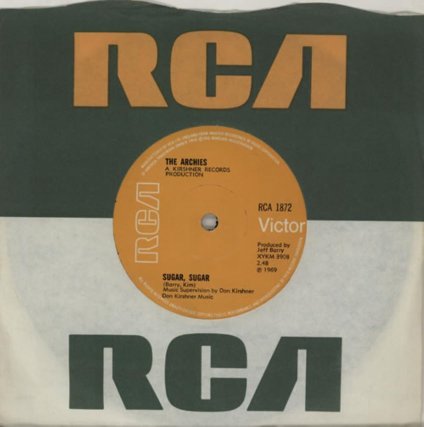
Sugar – do-do-do-do-do-do… Awww honey, honey – do-do-do-do-do-do… You are my candy girl… And you got me wanting you… It’s a chorus that everyone can sing, imprinted on our collective consciousness. In fact, to call it a ‘chorus’ isn’t very accurate – it is pretty much the entire song. As a record, it is undeniably catchy…

But then so are crabs. To be honest – ‘Sugar, Sugar’ is annoying, it’s simplistic, it’s basic… It’s bubble gum, and then some. Candy floss, sherbet and a huge dose of saccharine for good measure. I just can’t believe the loveliness of loving you… I just can’t believe the wonder of this feeling too… After a couple of listens you start to get a sugar-headache.

It’s one of pop music’s great clichés – love as candy. We’ve already had ‘Sweets for My Sweet’ at #1, and there will be more to come. ‘Candy Girl’, ‘Sweet Like Chocolate’, ‘Sugar Baby Love’… You can make quite the list… ‘Pour Some Sugar On Me’ (a classic, I won’t deny), ‘Brown Sugar’ (a filthy Stones’ take on the theme.) You catch my drift…

There are glimmers of hope here: the low-key verses contrast nicely with the all-out bubble gum of the chorus. And the ‘ad-libs’ towards the end are fun. Pour a little sugar on me honey… Aw yeah… (maybe a young Def Leppard were listening.) All in all though, and I say this as someone who loves pop music, ‘Sugar, Sugar’ is a bit much. I’m glad when it’s over.

61srqjm+c6L._SL1280_

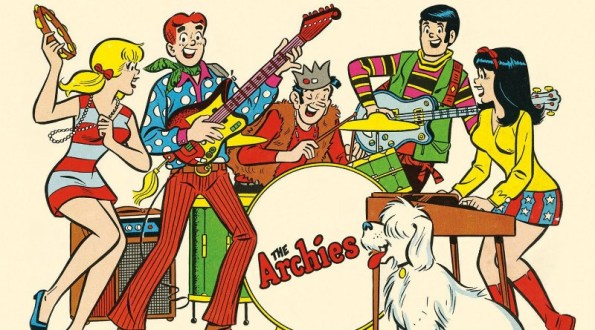
Adding to the sickly effect is the fact that The Archies were a cartoon band, plus a dog, that featured in their own TV variety show, ‘The Archie Show’. To me, they look like the ‘cast’ of ‘Scooby-Doo’ went and formed a band. Their records were recorded by session musicians, several of whom quit when they didn’t get any royalties from their hits. Despite the fact that just two weeks ago we had simulated orgasms at #1, I’d have to say that ‘Sugar, Sugar’ is the more offensive record.

In fact, this is perhaps the icing on the cake for the cynical second half of 1969. We’ve had horrifying visions of an apocalyptic future, and now an equally pessimistic vision of the future of pop music. We’ve had a pre-manufactured band from a TV show at #1 already, but it feels very unfair to compare The Monkees to this… They were real musicians who quickly broke away from their confines. Here you can’t help picturing a cynical record executive laughing and chucking wads of dollar bills in the air… “Who needs real people? Who needs real instruments? It’s mine! All mine!”

Or maybe that’s too much. We’ve had so much amazing music hit number one over the past decade, so perhaps we can cut this record some slack. It what it is, and what it is is fine in small doses. Assembly-line bubblegum is here to stay, and we’ll have to get used to it as we delve into the 1970s…

278. ‘I’ll Never Fall in Love Again’, by Bobbie Gentry

After all the in-your-face sex and apocalyptic predictions of the past few #1s, it’s nice to hear the gentle piano and bass intro of ‘I’ll Never Fall in Love Again’. The musical equivalent of closing your eyes and taking a deep breath.

bobbie10

I’ll Never Fall in Love Again, by Bobbie Gentry (her 1st and only #1)

1 week, from 12th – 19th October 1969

Not that this record is all sweetness and light, though. The title kind of gives that away. What do you get when you fall in love…? A guy with the pin to burst your bubble… Bobbie is convinced that she’s done with love. That’s what you get for all your trouble…

I love her voice – all tired and husky. It lends a perfect edge to possibly the best rhyming couplet ever to feature in a #1 single: What do you get when you kiss a guy…? You get enough germs to catch pneumonia, After you do he’ll never phone ya… Bacharach and David – racking up another UK chart-topper here – added the line after Burt had been hospitalised with the flu. It does make sense when you realise that this is a B&D number, with its gently soaring melody. They had written it for a musical called ‘Promises, Promises’, and Dionne Warwick had had the hit version of this song in the States.

You could add ‘I’ll Never Love Again’ to our run of recent cynical number ones – crushing the closing months of the swinging sixties – but for one line: So for at least, Until tomorrow… Who knows? She might just meet the man of her dreams tomorrow morning… And I’d argue that there’s something very late-sixties-positive about a young female artist singing about her love life in a matter-of-fact way: I’ve been there and glad I’m out… Women’s Lib reaching the top of the charts right here.

BOBBIE_GENTRY_ILL+NEVER+FALL+IN+LOVE+AGAIN+-+4+PRONG-654324

The fact that Bobbie Gentry is a woman is worth noting in itself. She’s the sole female chart-topper of 1969. In fact, in the past three years, only Bobbie, Mary Hopkin, Sandie Shaw and Petula Clark have topped the singles charts as solo females (Esther Obarim, Nancy Sinatra and Jane Birkin did so by duetting with men.) It really is surprising how few women topped the charts throughout the sixties, compared to later decades… I would work out the percentage, if I had any kind of mathematical ability.

Bobbie Gentry is also another artist whom I racially-profiled as a kid… Add her to the list along with Chris Farlowe and Georgie Fame. She isn’t black, she’s another white singer with a bit of soul in her voice, an American Dusty. My first exposure to her was through the superb ‘Ode to Billie Joe’, which was her biggest US hit – a gothic novel in a four-minute pop song – which shockingly only reached #13 in the UK… As nice as ‘I’ll Never Fall in Love Again’ is, it’s no ‘Ode to Billie Joe’.

But it is nice. Better than nice. It’s a great, late-sixties pop song with a hint of country. Bobbie Gentry has become very reclusive in her later years, not recording, performing or giving interviews since 1982. She lives to this day, people believe, in Memphis. And with that, we reach the penultimate number one single of the 1960s…

277. ‘Je T’Aime… Moi Non Plus’, by Jane Birkin & Serge Gainsbourg

We end our run of apocalyptic #1s at two, and turn to another of human kind’s most primal concerns. From death and survival, to sex… Though if the end of the world were nigh, you could probably do a lot worse than closing the curtains, dimming the lights, and slipping this disc onto the turntable…

4641

Je T’Aime… Moi Non Plus, by Jane Birkin and Serge Gainsbourg (their 1st and only #1)

1 week, from 5th – 12th October 1969

I mentioned Peter Sarstedt’s ‘Where Do You Go To…’ as a French #1. (Well, it was set in France, and the melody sounded French.) But this is the French #1. For a song to sound any more French, Edith Piaf would need to be singing ‘Frere Jacques’ on top of the Arc De Triomphe.

‘Je T’Aime…’ is a record that you picture in soft focus. All pinks and whites, scattered glasses of champagne with raspberries in them. The organ drones, the drums woozily keep time, and the strings flutter around the edges. I particularly love the filthy growl in the bass just before the main riff. Meanwhile Jane Birkin and Serge Gainsbourg breath, whine, mutter, whisper, and moan… Do everything but actually sing.

The lyrics are all en Francais: Je t’aime, Je t’aime, Oui je t’aime… sings Jane. I love you, Yes I love you! Moi non plus… mutters Serge. Me neither. Jane: Oh, mon amour… It’s been written off as nonsense – ‘I Love You, Me Neither’ – but I think it shows that the singers only have lust on their minds. From now on I’ll write the lyrics in English, even though they sound much better in French…

Like a vacillating wave, I go, I come and go, Inside of you… Ooh la la! Potent stuff. Even worse if you translate the Inside of you line literally. Entre te reins = Between your kidneys. Kind of gross. By the end, Birkin is faking a pretty convincing orgasm. At least, we think she’s faking… At the time there were rumours, or some well-contrived publicity, that ‘Je T’Aime…’ was a chart-topping single with live sex (!) on it.

R-1687183-1236951812.jpeg

Even today, in our cynical world, a record like this would raise eyebrows. In 1969, there was a fair amount of controversy. The record was banned, obviously, from radio, except in France, where it could be played after 11pm. The Vatican excommunicated the Italian label exec. who released it. Gainsbourg was unrepentant, claiming that it wasn’t about sex, but about the impossibility of true love. Others have argued that it is a feminist song, thanks to the line at the end when Birkin breathes: Non! Maintenant! Viens! (No! Come! Now!) She is in control of the love-making.

At the same time, while ‘Je T’Aime…’ is still a fairly attention-grabbing record, it also comes across as very camp and kitschy. I’m sure most people were buying it for a laugh, rather than as a soundtrack to romantic nights in. It’s also suffered the same fate as, say, ‘The Good, The Bad and The Ugly’, in that it’s become a cliché – a piece of music to play over a certain scene: in this case one involving a comical seduction. I’m not sure if or why anyone would want to sit down today and listen to it. Plus, at four and a half minutes it goes on for much longer than it needs to. But… In 1969 people lapped it up. ‘Je T’Aime…’ had already reached #2, been banned, then re-leased to make #1!

Birkin and Gainsbourg were a real-life couple when they recorded their sole chart-topper. She was twenty-three, he was forty-one. Their daughter is the actress Charlotte Gainsbourg. Serge had originally recorded it with Brigitte Bardot, but her husband had stopped them from releasing it. I know very little about their other recordings. Birkin still sings and acts to this day; Gainsbourg meanwhile is a legendary figure in France – provocative and boundary-pushing. It’s sad that most English speakers know him solely for this record, his chain-smoking and for the famous TV interview in which he told a young Whitney Houston that he wanted to ‘fuck her’ (his words.) He died in 1991 after years of alcoholism.

A notable #1 then – the first in a foreign language, the first to feature simulated sex, the first to get somebody excommunicated. And suddenly we’re three chart-toppers away from the 1970s!

273. ‘Something In the Air’, by Thunderclap Newman

The first number one of the post-Beatles era. One of those songs where you press play and go ah yes… I know this…

500

Something in the Air, by Thunderclap Newman (their 1st and only #1)

3 weeks, from 2nd – 23rd July 1969

It was in an advert for something, I realise, midway through the first listen, and it is prefect background-music-for-an-advert. Light, floaty, chords forever heading upwards… A positive sounding song. The lyrics are forward-facing too – There’s something in the air – a change is a-coming. We have got to get it together, now… They are very sixties-ish lyrics. The revolution’s here… You know it’s right… They sound more like a bunch of slogans strung together than an actual song. A gentle clarion call for young, liberal types. Hippies, but with sensible shoes.

I called it the start of the post-Beatles era, but the Fab Four’s influence is here in this record. In my last post, I mentioned all the times that a Beatle will top the charts solo. I should also have mentioned all the acts that will top the charts by channelling The Beatles’ sound. And here one is – straight away.

Midway through, and I’m starting to get a bit bored. It’s fine, it’s nice, it’s a bit bland. Thank God, then, for the demented piano solo that comes along out of nowhere, all jazzy and jarring. Like someone doing the Charleston on acid. Why? I don’t know. But it saves this record from slipping into slightly dull and forgettable territory.

thecrazyworldofarthurbrownthunderclapnewman-firesomethingintheair

Normal service is resumed for the final verse, as the revolutionary fervour is upped. Hand out the arms and ammo, We’re gonna blast our way through here… It’s a deceptively angry song. I just wish it had a little more oomph to it. (In keeping with the theme of ‘revolution’, the song apparently has a snippet of ‘La Marseillaise’ towards the end, though I can’t hear it.)

And, after a bit of research, I can confirm that ‘Something in the Air’ has been used to advertise British Airways, Austin Minis, Coca-Cola and mobile phones. It’s clearly a song that lends itself well to advertisements – make up your own mind as to whether or not this is a good thing.

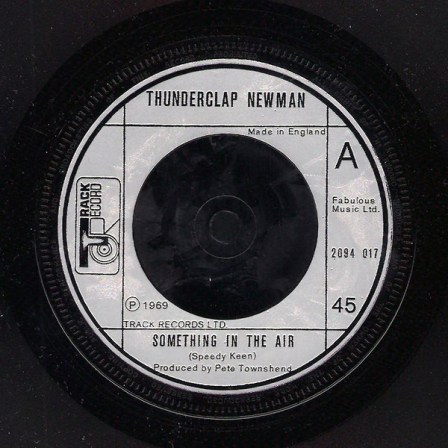
Thunderclap Newman, which is a great name for a band to be fair, were the brain-child of The Who’s Pete Townshend, and he actually plays bass on this single, which is as close as a member of The Who is going to get to a #1 single, sadly. Andy ‘Thunderclap’ Newman was the man who pulled out the brilliant piano solo. Their guitarist, Jimmy McCulloch, was only fifteen when they recorded their sole chart-topper, making him a de facto member of the Youngest Chart-Toppers club. He would go on to join Wings. Which means that, in wrapping up the 1st post-Beatles chart-topper, I’ve managed to end with another Beatles reference. There really is no escaping them…

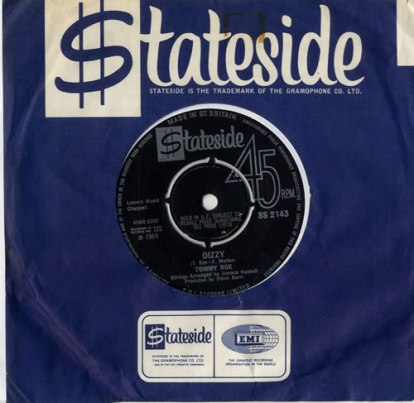
271. ‘Dizzy’, by Tommy Roe

Into the next thirty #1s, with perhaps the most ‘sixties’ sounding chart-topper that we’ve come across yet. It’s pure swinging-sixties montage music, a pop song that you would use in between scenes in an Austin Powers movie. You can see swirling lava-lamp colours, and mini-skirted girls jiving. Yeah baby!

Tommy_Roe

Dizzy, by Tommy Roe (his 1st and only #1)

1 week, from 4th – 11th June 1969

It’s a song that just about manages to stay on the right side of ‘cool’, rather than ‘cheesy.’ And considering that this is a song that uses terms like ‘fellas’ and ‘sweet pet’ in its lyrics, that’s a pretty impressive feat. It’s catchy, that’s for sure, and the drums are real swingin’. The strings too, have a kind of tongue-in-cheek drama to them. Plus, I keep losing count of how many key changes are crammed into its three minute run-time.

The title itself is also very sixties. ‘Dizzy’, because he’s in love, man. You’re makin’ me dizzy, My head is spinnin’, Like a whirlpool it never ends… I’d say it’s a chorus that’s entered the common tongue – though whether that’s down to this original or the comedy version that will take it back to the top of the charts in twenty years’ time I don’t know.

I prefer the pre-chorus, though – one that builds up an irresistible head of steam: Girl you’ve got control of me, Cos I’m so dizzy I can’t see, I need to call a doctor for some help… I like it. A nice palate-cleanser of a disc. A short, sweet blast of late-sixties goodness.

TOMMY_ROE_DIZZY+-+4PR-595290

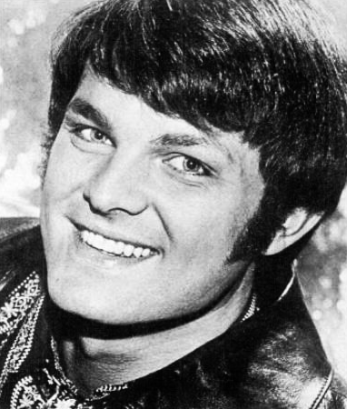
Tommy Roe’s story is quite interesting. ‘Dizzy’ was a huge comeback for a singer who had failed to have a chart hit of any kind in the UK since 1962-63, when he had had big success with the Buddy Holly influenced ‘Sheila’ – a US #1. Considering the massive changes in popular music that have happened in the past seven years, this was a pretty impressive feat. Not that the comeback lasted very long… One #24 follow-up single and that was that.

Still, it might go some way to explaining the winning combination of bubble-gum and mild psychedelica that makes ‘Dizzy’ such a funky pop tune. One foot in the past, one very much in the present. Tommy Roe continued to record and tour throughout the seventies and eighties, before announcing his retirement officially in 2018, aged seventy-five.

266. ‘(If Paradise Is) Half As Nice’, by Amen Corner

A nice song, to keep 1969 ticking along, nicely. If paradise were half as nice as this song, then paradise would be a perfectly pleasant place to be…

235285

(If Paradise Is) Half As Nice, by Amen Corner (their 1st and only #1)

2 weeks, from 12th – 26th February 1969

Tell the truth, I’m finding it hard to get very excited about this record. I like it, it’s fine, it’s nice… I suppose life would be fairly exhausting if you got excited about every song you heard. Sometimes it’s OK just to think something’s… OK. If paradise is half as nice as, Heaven that you take me to, Who needs paradise, I’d rather have you… It’s cute – a song about being the simple act of falling head over heels in love.

I’ve heard this song before, of course – it’s a bit of a ‘Sixties Best Of’ staple (the copyrights must be cheap?) and a mish-mash of the usual late sixties sounds. There are horns, it’s a bit trippy, and the lead singer has a very soulful voice. That’s my favourite thing about this song, Andy Fairweather Low’s husky voice, and his oh-woah-woah-woahs and oh yes I’d rather have yous in the chorus.

It’s a chilled-out #1, one that floats along and then out on a fluffy cloud. And, if in doubt, always stick in a la-la-la refrain – nobody minds a gentle dose of lalalas. Like a surprising number of previous chart-toppers have been, ‘(If Paradise Is) Half As Nice’ was originally written and recorded in Italian. Not that it sounds particularly Italian compared to, say, Elvis’s pair of operatic hits ‘It’s Now or Never’ and ‘Surrender’, but still.

AMEN_CORNER_(IF+PARADISE+IS)+HALF+AS+NICE+-+4+PRONG-555632

Amen Corner were a Welsh band, named after a soul club-night in a Cardiff ballroom. ‘If Paradise…’ was their 3rd of four Top 10 hits before they split up at the very end of the decade. (That’s something worth noting – how many of the 1960s’ chart-topping acts didn’t make it into the seventies.) Amen Corner recorded the definitive version – in the UK at least – of ‘Bend Me, Shape Me’, which surprises me, as it has a very different vibe to their sole #1.

Amen Corner, then. A short post for a perfectly acceptable song. I like it, but can’t help feeling that it doesn’t give the listener much to get their teeth into. A background number one – helping us float that bit further along on our journey through the years…

Follow every #1 so far here:

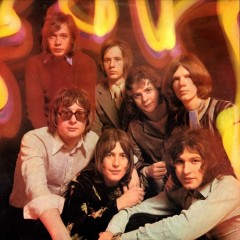
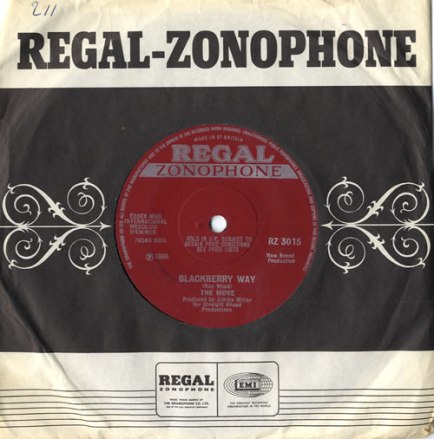
265. ‘Blackberry Way’, by The Move

This next #1 single is one that opens with a bang, right in the middle of the story. ‘In media res’, if you want to be fancy about it. Blackberry way, Absolutely pouring down with rain, It’s a terrible day…

690428-the-move

Blackberry Way, by The Move (their 1st and only #1)

1 week, from 5th – 12th February 1969

I like the absolutely pouring down with rain line – it sounds very British. As the picture is filled in, you really can picture a dull suburban street – probably lined with bungalows – in the rain, as girl ends it with boy. So now I’m standing on the corner, Lost in the things that I said…

It’s a dramatic record. Make that melodramatic. The strings moan like the soundtrack to a haunted house. The drums are thick and portentous. As the singer makes his way from Blackberry Way, through the park and past the boating lake, where the boats float: just like myself they are neglected… Before each chorus, he asks himself: What am I supposed to do now? He gets on the train, with one final look over his shoulder, to see if she’s followed him… We can assume that she hasn’t.

This is kind of fun; if a little OTT. Even though it’s about heartbreak ,the scale of the song, and the lyrics about the mundane things he sees on his walk in the rain, keep it slightly tongue-in-cheek. Only occasionally does it get ahead of itself – what exactly does the line: See the battlefields of careless sins, Cast the to the wind… mean? I like the fact that it’s quite a psychedelic sounding song, but one describing a fairly everyday scene. No flower-power here. And I like the contradiction in the chorus: Goodbye Blackberry Way, I can’t see you, I don’t need you… Sure to want me back another day… Ain’t that just how a break-up goes…?

THE_MOVE_BLACKBERRY+WAY+-+SOLID-296795

The Move were a Birmingham band, that had already enjoyed four Top 5 hits before they scored their sole chart-topper. I always liked ‘Fire Brigade’ as a kid – it must have been on a sixties-hits tape we had lying around – and ‘Flowers in the Rain’ was famously the first ever song played on Radio 1. They were quite a sonically experimental band, mixing Spector-ish production with innovative sounds and effects. You can hear the instruments on ‘Blackberry Way’, straining to make themselves the most important part of the song over the vocals. It’s a record that bursts from the speakers…

Central to The Move was songwriter and singer Roy Wood, who we will meet again in the coming decade – a man who played a big role in shaping the sound of the seventies when The Move morphed into Electric Light Orchestra. Wood didn’t hang around long with ELO, though, leaving to form glam-rockers Wizzard. Luckily for all of us, we’ll meet both of his bands-to-be later in this countdown. Not many artists can claim to have been involved in three hugely successful, chart-topping acts… Kudos to Wood!