355. ‘Love Me For a Reason’, by The Osmonds

It’s time. A little later than you might have expected, but The Osmonds have their number one single.

Love Me For a Reason, by The Osmonds (their 1st and only #1)

3 weeks, from 25th August – 15th September 1974

It’s every bit as cheesy and tinkling as you might expect. It soars, it swoops, it blinds you with the whiteness of its teeth. Suddenly the UK charts sound very ‘American’, with three glossy, shining number ones in a row. But while George McCrae and The Three Degrees were pretty cool… this one really ain’t.

Don’t love me for fun girl, Let me be the one, girl… Love me for a reason, Let the reason be love… For the second time this year, we come to a #1 that I first heard as a child thanks to an Irish boyband. I knew ‘Seasons in the Sun’ through Westlife’s cover, I knew this thanks to their predecessors Boyzone, who took their ‘Love Me For a Reason’ to #2 in 1994.

If love ever-lasting, Isn’t what you’re asking… I’ll have to pass, girl, And be proud to take a stand… Maybe I’m showing my prejudices here, but isn’t it usually girls that sing about love that lasts? The Three Degrees, for example, were just asking when they’d see you again. Or there was Freda Payne lamenting broken promises on her wedding night. Guys are usually happy with, well, something more instant. But, The Osmonds were good ol’ Mormon boys that needed more than just physical attraction (their words.) All of which culminates in the spectacular line: My initial reaction is, Honey give me love, Not a facsimile of…

Any song that can crowbar the word ‘facsimile’ into its lyrics cannot be all bad and, to tell the truth, this is a decent pop song with a highly singalongable chorus. It also has one hell of a key change towards the end, that sounds as if a sound engineer accidentally leant on a dial. And, even though I introed this post by suggesting that The Osmonds had waited longer than most for their shot at #1, ‘Love Me for a Reason’ was only their sixth chart hit in the UK. It feels like a longer wait because, unusually, the solo Osmond(s) topped the charts long before the band. Donny’s been there three times, and Little Jimmy (while not technically a member of ‘The Osmonds’ at this point) has summited once.

The band would go on releasing albums until the end of the seventies, before splitting up and moving into different ventures. Donny would be the most successful, with his sister Marie. But this is it for them, in terms of topping the charts as a group. Just the one. And I’m sure most would agree that, if they could choose the one Osmonds disc they would allow to top the charts, it wouldn’t be this one. It would be… Well, I might just do a separate post on that very soon. Watch this space…

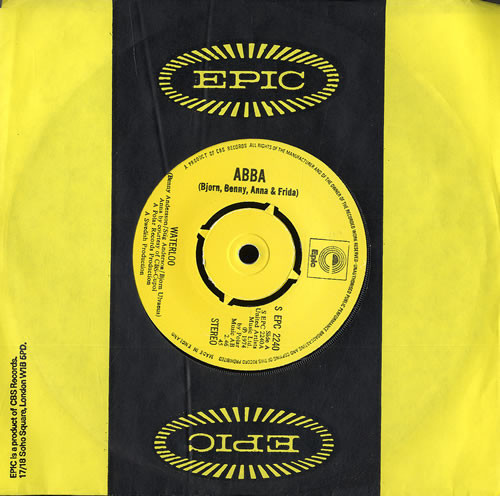
348. ‘Waterloo’, by ABBA

And entering, stage right: some genuine pop music legends.

Waterloo, by ABBA (their 1st of nine #1s)

2 weeks, from 28th April – 12th May 1974

Are ABBA the best pop group ever? Like, pure pop? Well, they get my vote. I will not hear a bad word spoken against them. And these days, you don’t often hear much bad spoken about ABBA – they’ve shaken off the image that they were fit only for gay bars and hen nights, and have assumed their rightful place in the pantheon. Everyone loves ABBA. But… I’m writing as if wrapping up their final chart-topper; not introducing their first. To business!

It is perfect, the manner in which Benny, Bjorn, Agnetha and Anni-Frid shoot out the blocks on their first #1. ‘Waterloo’ is not a record that takes its time to reveal its charms. It’s a wham, bam, thankyou ma’am sort of pop song. It won the Eurovision Song Contest, for God’s sake: a feat not often achieved through subtle means. The churning bass, the thumping piano… My, my! At Waterloo Napoleon did surrender…

For a band that specialised in camp melodrama, this opening line – comparing their love for someone to an 19th Century military leader’s last stand – is as camp and melodramatic as it comes. Oh yeah! And I have met my destiny in quite a similar way… Cue one of the catchiest choruses ever recorded: Waterloo! I was defeated you won the war, Waterloo, Promise to love you for ever more… (A big part of this song’s success, I think, is the way they pronounce the title in their Swedish accents: Wardahloo! With added emphasis on the ‘ooh’.)

It’s pointless looking for the hook here. The entire song is a two minute forty eight second long hook. The ridiculous saxophone licks, the woah-woah-woahs, the pounding piano ‘n’ drum intros to each chorus, something the band admits were ripped straight from Wizzard’s ‘See My Baby Jive’. ‘Waterloo’ is a huge, unashamed sugar rush of a song. Perfect, perfect pop.

In 1815, Napoleon Bonaparte was defeated once and for all, and exiled to the south Atlantic. In 1974, Agnetha and Anna-Frid give in and admit their love. As they put it in the song’s best line: So how can I ever refuse? I feel like I win when I lose! (The writers of ‘Mamma Mia – The Musical’ clearly gave up on trying to shoe-horn a song about a two-hundred year old battle into the story, and stuck in at the very, very end, as an encore.)

As a kid, this was my favourite track on ‘ABBA Gold’. It is no longer my favourite ABBA song, but it is the perfect first chart-topper for the band. They would go on to reach much greater heights of subtlety and sophistication; though it’s debatable whether they wrote a catchier hit. Meanwhile, it was also voted as the greatest Eurovision song for the contest’s 50th anniversary.

This hit proved to be a bit of a false start for ABBA, though. They struggled to follow ‘Waterloo’ up, in the UK at least, and we’ll have to wait almost two more years for their next #1. Once that arrives, however, there will be no looking back. It feels like we’ve entered a new phase in our journey through the chart-toppers… It’s the mid-seventies, and we’ve finally met the decade’s greatest band!

346. ‘Billy – Don’t Be a Hero’, by Paper Lace

There are two things that never bode well at the start of a new #1 single: a marching band drumbeat, and whistling. And what do we have here… A new #1 single that begins with a marching band drumbeat and whistling.

Billy – Don’t Be a Hero, by Paper Lace (their 1st and only #1)

3 weeks, from 10th – 31st March 1974

Before starting this blog, I never for a moment suspected that songs about soldiers going to/coming back from war would be such a prominent sub-genre of #1s. I count four: ‘Lay Down Your Arms’, ‘Distant Drums’, ‘Two Little Boys’, ‘Yellow River’, and that’s just off the top of my head. Now make that five…

The marching band came down along Main Street, The soldier blues fell in behind… The song is sung not from the soldier’s POV, nor from his fiancé’s, but from that of a nameless observer. He sees the lovely fiancé begging her boy not to go: Billy, don’t be a hero, Don’t be a fool with your life… Come back and make me your wife…

To cut a long story short, or at least to paraphrase the second verse, Billy is just too darn heroic. He volunteers to ride out on a special, incredibly dangerous mission. The song doesn’t have to specify what happens next… There’s one obvious connection to make here, as there is with nearly all the ‘#1s about war’ – Vietnam. This hit the top as US involvement in the war was drawing to an end, and after most popular support for the conflict had died away.

And tellingly, when his fiancé gets the letter telling her of Billy’s death, and that she should be proud of him, she doesn’t get it framed, or keep it under her pillow… I heard she threw that letter away… Cue marching band, whistling, and a fade-out. It’s actually quite powerful, and it’s a shame the rest of the song sounds like something a window-cleaner would whistle while he works.

Away from songs about soldiers, other similar chart-topping subgenres include ‘men in prison/on death row’ and ‘men who die in car/plane crashes’. I say similar, because all three involve blokes doing brave, strong, manly things while their sweethearts pine all doe-eyed after them, and all three lend themselves to mawkish, sentimental ballads. ‘Billy – Don’t Be a Hero’ isn’t the worst of them, but it’s not the best either.

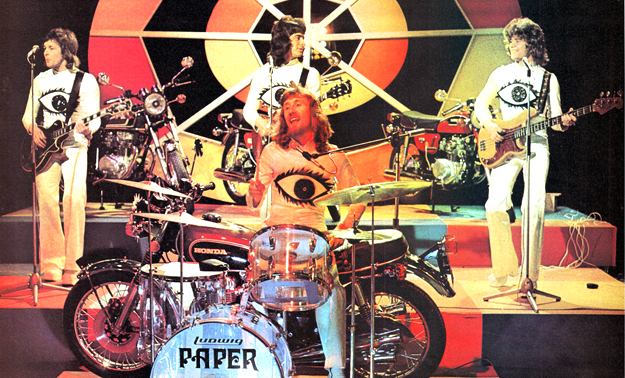
Paper Lace were a covers band from Nottingham, who had been around since the late sixties. They entered ‘Opportunity Knocks’ – the same talent show that gave us Peters & Lee – and were given this song to record as a result. (See, 2nd rate MOR, made for TV chart-toppers weren’t invented by ‘Pop Idol’ and ‘X Factor’!) They would have a handful more hits, one of which – ‘The Night Chicago Died’ – hit #1 in the US. (‘Billy…’ was also a US #1, but for a completely different band: Bo Donaldson & The Heywoods.) ‘Billy’ was Paper Lace’s biggest UK hit, and while it does have some nice glam-guitar flourishes to keep it sounding quite current, it commits the crime of fading without a final, rousing go at the chorus. Meh.

(The version in the video below and the version in my Spotify playlist differ, and I have no idea which is the original.

339. ‘Daydreamer’ / ‘The Puppy Song’, by David Cassidy

I was a bit underwhelmed by David Cassidy’s first #1 – his cover of ‘How Can I Be Sure’ – to the extent that I gave it a ‘Meh’ Award. But no hard feelings, Dave – I approach this double-‘A’ with open ears.

Daydreamer / The Puppy Song, by David Cassidy (his 2nd and final #1)

3 weeks, from 21st October – 11th November 1973

I do like his committed yet breathy delivery, the way he commits to every, single, sy-lla-ble. I remember April, When the sun was in the sky… I was worried when I pressed play and was presented with the lightest, tinkliest seventies soft-rock intro. But by the time we get to the chorus it’s turned into a nice, swaying pop song, with more than a hint of Bacharach and David to it: I’m… Just… A… Daydreamer, Walking in the rain…

Back in the spring he was in love; now he wanders after rainbows. You get the feeling he’ll be alright, though… Life is much too beautiful, To live it all alone… as he saunters off after that pot of gold. I would like another extra little hook to sell it to me properly. As it is, I quite like it – he won’t be winning another ‘Meh’ award for this one.

Another reason why this disc won’t be getting described as ‘Meh’ is thanks to the song on the flip-side. I have to admit, before listening to it, I feared the worst. The aural scars from the last chart-topper to feature the word ‘Puppy’ still linger. But I needn’t have worried, ‘The Puppy Song’ is a fun, music-hall tune.

If only I could have a puppy, I’d call myself so very lucky… He wants a pup, one to take everywhere and share a cup of tea with (dog’s don’t drink tea, David!) I know that he, No he’d never bite me… Part of me does wonder if the ‘puppy’ is going to be a metaphor – Cassidy’s ‘ding-a-ling’ as it were – but nope. It’s simply a song about wanting a friend.

It’s just as lightweight as ‘Daydreamer’; but more fun. David sounds like he’s enjoying himself, scatting and ad-libbing away. Come the end his friends have joined him for a good old fashioned knees-up… We, We’d be so happy together, Yodelly-odelly-odelly-oh! It’s a song so catchy and good-natured that I can even forgive the slight forays into yodelling.

Though it sounds like a relic from the 1920s, ‘The Puppy Song’ dates from as recently as 1969, when Harry Nilsson featured it on his first album. He had written it for another earlier chart-topper, Miss Mary Hopkin, who also included it on an album. Neither of these three versions stray very far from one another, but think I like the goofiness of Cassidy’s version best.

So, David Cassidy’s brief UK chart-topping career ends on a bit of a high with two very different sounding songs (though I do like the fact that they are both almost exactly the same length). He’d have one further Top 10 hit, though the truth was he struggled with his teen-idol status, and longed to be taken more seriously. The hysteria that followed him around was never to his liking, and it culminated in the death of a fourteen-year-old fan in a stampede at one of his shows in London. He quit touring and acting in 1975, focusing more on recording the music he wanted to. I remember him as a fixture on chat shows and light-entertainment growing up, but it seems he never really managed to feel at ease with himself and his public image. He died from liver-failure in 2017.

Which suddenly turns the silliness of ‘The Puppy Song’ into a tears-of-a-clown moment… Maybe he wasn’t enjoying himself very much at all when he recorded it. Maybe he really did just want a friend? A bit of a downer to end on, maybe. But then, the pop music business often isn’t as happy as the executives would have us believe. RIP David.

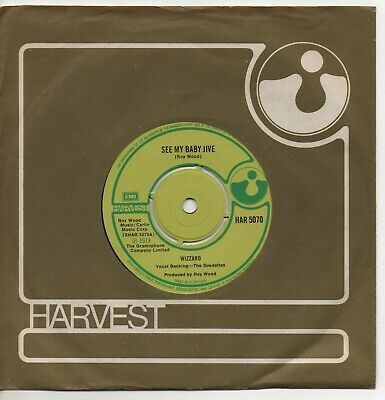
330. ‘See My Baby Jive’, by Wizzard

The last song before our next recap, and a late contender for one of the very best of the past bunch…?

See My Baby Jive, by Wizzard (their 1st of two #1s)

4 weeks, from 13th May – 10th June 1973

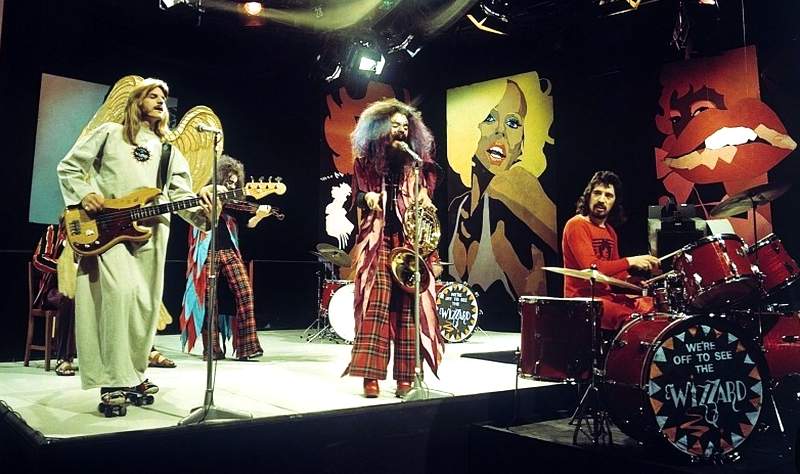
This record sets its stall out early. Remember when we thought The Sweet introing with an air-raid siren was ballsy? Well how about a Spitfire doing a fly-past, followed by some anti-aircraft fire? But this song is so good, you’ve somehow forgotten about the outrageous intro within ten seconds of the first verse. The guns turn into cascading drums, and a wall of sound comes in and kicks you up the backside.

Look out, Look out, Your momma would shout, You might as well go home… She said, My bed, Gets into your hair, So give me back my comb… Yeah… Me neither. These are definitely lyrics that need Googling. But as with most of the great glam singles from this era, the words don’t really matter. They’re about dancing, about making sweet music while strutting around in mascara and a feather boa. About how well your baby can move. See my baby jive, See my baby jive, She hangs on to me and she really goes, Woah, woah, woah…

That woah, woah, woah is perhaps the most gloriously uplifting, catchy moment that we’ve heard so far in any of the previous three hundred and twenty-nine number one records. It’s wonderful. It’s Prozac for the ears. In fact, the entire five minutes of ‘See My Baby Jive’ is pop perfection: a huge slice of glam, mixed with splashes of fifties malt shop and doo-wop, with a big knob of Phil Spector-esque production. Wizzard were an eight-man band, complete with cellists, saxophonists, clarinettists, French hornists, synthesisers, and more, all crammed into this one song, with a crazy genius at the helm.

Roy Wood has had one previous number one – The Move’s ‘Blackberry Way’ – and since then he’s founded Electric Light Orchestra. But it was with Wizzard that he really let loose, and showed just what he was capable of. And not many would be capable of taking all the different elements chucked into the mix on ‘See My Baby Jive’, and turning it into a hit.

The solo starts off classical, and finishes as jazz. The outro sounds like The Beach Boys are getting in on the act somewhere off in the background. (This record has too many references, too many Easter eggs, to keep track of. Five minutes long it may be, but it never drags.) All the while you can picture all the boys in town rushing down the street, just to see his baby jive. She’s an addictive woman, summed up in the brilliant line – one of the few that stand out against the chaos – You, You make things that get along, Turn out, So wrong…

Wizzard had had one previous hit, the almost as good – and just as loopy – ‘Ball Park Incident’ which made #6, and they will go on to have one further, brilliant chart-topper (and release a Christmas song that some of you may have heard, once or twice) before 1973 is out. But I’m not sure they ever topped ‘See My Baby Jive’. And I don’t think I’ve ever not loved this song. It was a regular feature of our ‘long family car journey’ tapes and CDs. (On many a trip did I sit in the back seat, waiting for the anti-aircraft fire to ring out…)

I don’t normally mention the ‘B’-sides to the #1 singles I cover, but how could I resist when I discovered that the flip-side to this single was called ‘Bend Over Beethoven’! Unfortunately, it’s nowhere near as outrageous as its title implies… Anyway, like I said at the top, a recap is up next, in which the other recent chart-toppers will have to go some to stop me naming ‘See My Baby Jive’ as the very best.

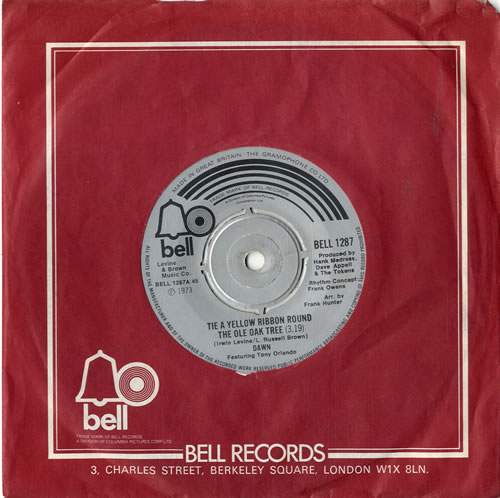
329. ‘Tie a Yellow Ribbon Round the Ole Oak Tree’, by Dawn ft. Tony Orlando

Two years after their first #1 single, Tony and his ‘tache are back on top!

Tie a Yellow Ribbon Round the Ole Oak Tree, by Dawn ft. Tony Orlando (their 2nd and final #1)

4 weeks, from 15th April – 13th May 1973

Back in ’71, he was asking his girl to ‘Knock Three Times’ if she felt like hooking up, now he’s asking her to ‘Tie a Yellow Ribbon Round the Ole Oak Tree’ if she still loves him. He is evidently a man who needs things spelled out for him.

It starts with a tune that can certainly be described as ‘jaunty’. Yep, the dreaded ‘J’ word. It’s a melody that must be from something else, some old German schlager hit, so familiar does it sound. It sounds as if it’s been playing in the back of your mind for years and years and, now that you’ve brought it to the forefront, it’ll be going round and round in there for years to come.

I’m comin’ home, I’ve done my time… Tony’s been in prison for crimes undefined… Now I’ve got to know what is and isn’t mine… He’s written ahead, and given his girl instructions what to do if she’s still into him: Tie a yellow ribbon round the old oak tree, It’s been three long years, Do you still want me…? If he doesn’t see a ribbon, he’ll stay on the bus and make a new life wherever he winds up.

Yes, it is utter cheese. But it’s a cute concept, and the melody – that melody – is undeniable. There’s a simple reason why this was a huge worldwide smash: it’s pretty darn catchy. It gets a bit much in places – the harmonica solo, for example – but, as with ‘Knock Three Times’, Tony and co. just about get away with it.

The bus draws close to his hometown. The tension is too much, he can’t look and begs the driver to check for him. It reminds me of Tom Jones’s ‘Green, Green Grass of Home’ in that it’s about a convict returning home to those he loves. Except, in that song it was all just a dream and he’s about to get shot at dawn. This one has a much happier ending…

For in verse three, we slow down, Tony drags it out: Now the whole damn bus is cheerin’, And I can’t believe I see… A hundred yellow ribbons round the old oak tree! A hundred! She must have really missed him (and forgiven whatever crimes he may or may not have committed.) Hurrah!

As before, Tony O’s backing singers don’t have very much to do, but they are two different singers from the band’s earlier #1. The ‘classic’ Dawn line-up of Tony, Telma Hopkins and Joyce Vincent Wilson was in place by the time they released ‘Tie a Yellow Ribbon…’ They had a few more hits to come on the Billboard chart, and around the world (seriously, this is a band with huge appeal in non-English speaking countries, with their traditional melodies and simple lyrics) but in the UK this was their last really big one.

And no, surprisingly, this wasn’t based on the melody of some old German hit… It was fresh off the press – written in 1973 – though the idea of a loved one wearing yellow for the return of as soldier (or a convict) had been around in American folklore since the 1800s. Apparently the track was offered to Ringo Starr, but – and I love this – an Apple Records Exec. told the writers that they ‘should be ashamed of their ridiculous song’. What wasn’t good enough for Ringo was good enough for Sinatra, Perry Como, Dean Martin, Bing Crosby… basically any crooner worth their salt has covered it. It has, more seriously, been used as a protest anthem in the Philippines and Hong Kong, in which yellow ribbons have been symbols. So there! Dismiss this as fluff at your peril… Take it away, Tony, one last time…

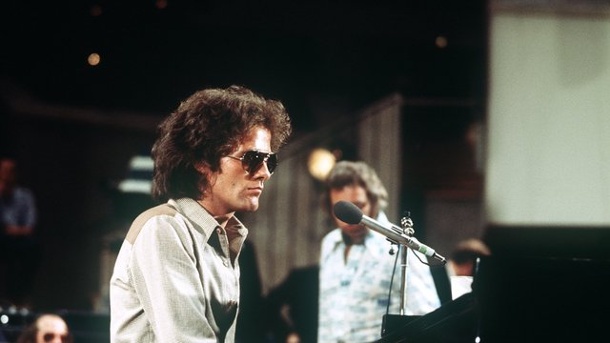
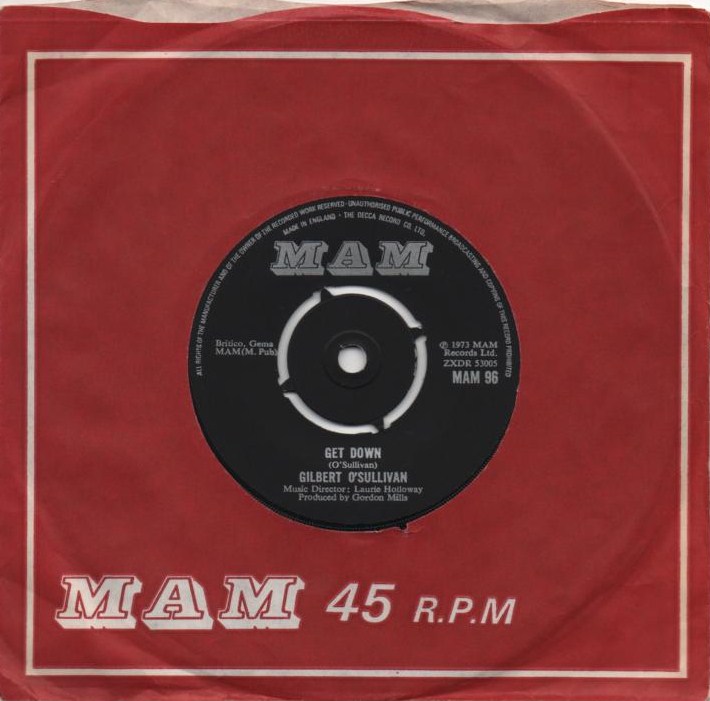
328. ‘Get Down’, by Gilbert O’Sullivan

We last heard from Gilbert O’Sullivan on ‘Clair’, crooning about a little girl he babysat for. I didn’t think much of it. Not the worst chart-topper ever, but far from a classic. But this – his second and final #1 – this is more like it, Gilbert!

Get Down, by Gilbert O’ Sullivan (his 2nd and final #1)

2 weeks, from 1st – 15th April 1973

Straight from the off we are into a stomping, glam rock groove – imagine a T. rex ‘B’-side covered by early-ABBA – and my feet are tapping. I know this song, from somewhere I cannot quite place, and I’m enjoying it. Told you once before and I won’t tell you no more… Get down, get down, get down…

Like ‘Clair’, this is another song that isn’t about what you immediately think. Any song, released in the seventies, called ‘Get Down’, should be about dancing. About ‘getting on down’, as I believe they called it back then. But no, as the lyrics progress: You’re a bad dog baby, But I still want you around…

It can’t be, surely, you wonder… He can’t have followed up his hit single about childminding with a song about how much he dislikes his dog climbing on the furniture…? Except no, the plot thickens. There are layers upon layers. Keep your hands to yourself, I’m strictly out of bounds…

Now, dogs don’t have hands. Which leads me to deduce that his isn’t singing about a frisky dog, but an amorous lady! Gilbert is sorely tempted, and this has led him to feel like a cat on a hot tin roof. (Cats, now. Is this what’s called a mixed-metaphor…?) Whatever, this is a groovy little record that shimmys in and shimmys out, that makes the listener shake their hips and drop their shoulders. A perfect pop number one.

I’m not sure I love his schtick, though, this writing songs about things but making it sound like he’s singing about other things. I have a feeling that Gilbert O’ Sullivan thought he was being clever. (One of his greatest hits collections is titled ‘The Berry Vest of…’) Plus, we do have to ignore that he is comparing a woman – a woman that he likes, no less – to a dog. Which isn’t very gentlemanly.

Gilbert O’Sullivan enjoyed thirteen Top 20 hits in the UK during the seventies and very early eighties, which is not to be sniffed at. He still writes and records: in 2018 his 19th studio album reached #20 (I love the symmetry there). In 1972, believe it or not, he was the biggest selling male solo act of the year. Worldwide…! But I can’t help feeling he’s been pretty much forgotten, though, in the grand scheme of things. Can your average man in the street name either of Gilbert O’Sullivan’s chart-topping records? The fact that he’s still not consistently on platforms such as Spotify – again, ruining my #1s Blog playlist! – is either a cause, or a symptom, of this. ‘Get Down’, at least, is worth remembering and so, if you have never heard it before, you’ll have to enjoy it on YouTube for now. And look down there – a link! How’s about that. Enjoy.

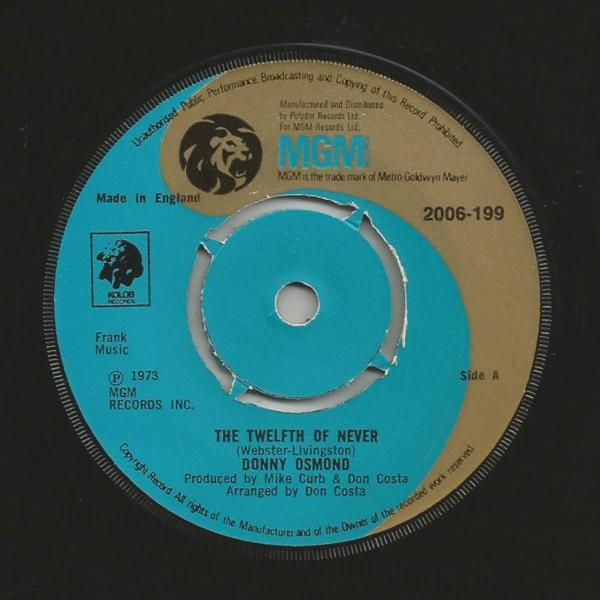
327. ‘The Twelfth of Never’, by Donny Osmond

I press play on this, the second part of Donny Osmond’s chart-topping trilogy, and the first word that comes to mind is ‘syrupy’. Listening to this record’s intro is like being dropped head first into a vat of treacle, and trying to swim to safety…

R-13845213-1562429675-6559.jpeg

The Twelfth of Never, by Donny Osmond (his 2nd of three #1s)

1 week, from 25th March – 1st April 1973

Second thing I notice is that lil’ Donny’s voice has broken. He’s become a man, or at least a proper teenager, and so, we wonder, will his music have grown up along with him? We last heard him chirping about his ‘Puppy Love’; is there any sign that Donny is pushing boundaries, experimenting on the lead single from his fifth (his fifth!) album?

No. If anything – and I have considered this statement very carefully – ‘The Twelfth of Never’ is worse than ‘Puppy Love’. (Meanwhile it makes his little brother Jimmy’s chart-topper sound genuinely enjoyable by comparison.) You ask how much I need you… Must I explain… I need you oh my darlin’, Like roses need rain… You really don’t need to hear any more of the lyrics to get the picture.

But, just in case you were enjoying it, he will love his girl until the roses don’t bloom, until the clover has lost its perfume, and until the poets have run out of rhyme… Until the twelfth of never, And that’s a long, long time… I’ll give this song one thing: it’s powerful. Certain songs make you sad, certain songs make you happy, certain songs make you nauseous. You can guess what category this one falls under…

I dunno. I feel a bit bad. He was only fifteen, and picking on this record feels a bit like taking candy from, well, a kid. I’m sure he was a nice young man, and your nan would certainly have approved (though she might have suggested a haircut), but Donny Osmond did release some utter shite. But then again, as I wrote in my post on ‘Puppy Love’, I am not and never have been a thirteen-year-old girl, and so am far, far away from being this song’s target audience.

‘The Twelfth of Never’, like ‘Puppy Love’, was a cover of an older hit. Johnny Mathis had released his version way back in 1956, and it is much less syrupy, almost gospel-ish. (Mathis, though, disliked the song and kept it as a ‘B’-side.) In the UK, Cliff Richard had had a #8 hit in 1964 with his own version…

Donny will have one last UK #1, coming up pretty soon, so brace yourselves. That one is interesting as it is not just a cover of an oldie, but a cover of an oldie that has already topped the charts! Until then, I need a glass of water and a ‘Rennies’…

Follow along with my #1s playlist…

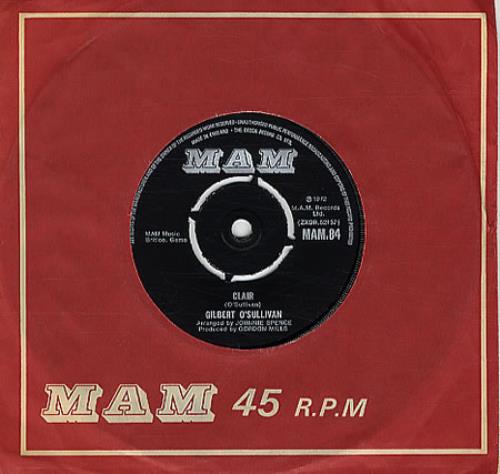
322. ‘Clair’, by Gilbert O’Sullivan

For the first time in three hundred and twenty-two #1 singles… I find one that is not on Spotify. At least not in my ‘region’. I realise that this may be of no interest to anyone but me, but damn it if it hasn’t ruined the #1s Blog Playlist I attach at the foot of every post!

mw293952

Clair, by Gilbert O’Sullivan (his 1st of two #1s)

2 weeks, from 5th – 19th November 1972

Actually, the fact that this isn’t on Spotify might be quite telling. Spotify might be on to something… Let me explain. First up, we have whistling. Whistling in pop records rarely leads to good things. (There are notable exceptions, I will admit, but still.) Clair, The moment I met you, I swear, I felt as if something somewhere, Had happened to me… The tune is jaunty but bittersweet, the production very soft-focus. It’s easy-listening – the softest of seventies soft-rock.

Who is Clair? Must be his girlfriend, right? A guy called Gilbert writes a song about a girl called Clair. Words mean so little, When you look up and smile… Yadda-yadda-yadda… I don’t care what people say to me, You’re more than a child… Wait a second. Plot twist. Why in spite of our age difference, Do I cry, Each time I leave you…

Ah… she’s his daughter. Which kind of excuses the cutesy shlock factor. He’s written a love song to his daughter. Aw… But no. The mystery of ‘Clair’ continues to unravel. Nothing means more to me than hearing you say, I’m going to marry you, Will you marry me Uncle Ray…? What now? Who’s Uncle Ray?? I give up, and resort to Wiki.

GILBERT_OSULLIVAN_CLAIR-347660

Where I discover that ‘Clair’ was the child of O’Sullivan’s producer, and Ray is Gilbert. He would sometimes babysit his friend/producer’s daughter. He has written a chart-topping single about a child he sometimes babysat for. Process that over the horrible harmonica solo…

It’s clever, I guess. It’s like a murder-mystery novel that keeps you guessing till the end. And it ends with a flourish – I quite like the lines in the final verse in which he’s trying to put Clair to bed: Get back into bed, Can’t you see that it’s late, No you can’t have a drink… It’s quite modern, like today’s beanie-hat wearing singer-songwriters picking lyrics out of the mundane. If Tom Walker wrote a song about babysitting, it might sound a bit like ‘Clair’.

But the final verse can’t redeem the song as a whole. It’s pretty terrible (and crucially, if you miss the bit about babysitting, it sounds super, super creepy…) And just to rubber-stamp this song’s terribleness, the real-life Clair giggles on the final note, like a doll in a horror movie. Oh Clair…

Gilbert (Raymond) O’Sullivan – I assume that he was going for a pun on ‘Gilbert & Sullivan’ with his stage name? – is an Irish singer-songwriter who had been scoring hits since a couple of years before his first #1. ‘Alone Again (Naturally)’ had been his biggest hit earlier in the year: a #3 in the UK and huge #1 on the Billboard 100. He’ll have one more chart-topper in early ’73, with a song I already know and that I can confirm is much better than this.

One final note: ‘Clair’ was at #1 for the twentieth anniversary of the UK Singles Chart. We have covered two decades’ worth of chart-topping singles, plus a diversion or two, in just over two and a half years, since my first post on Al Martino’s ‘Here in My Heart’! Well done to everyone who has been keeping up!

Listen to every other UK #1, here…