777. ‘Perfect Day’, by Various Artists

After several Comic Relief #1s (I count four, at least), it’s time for the UK’s other annual charity telethon to get a look-in. I may be a fully paid-up British citizen, but I would struggle to explain the difference between Comic Relief and Children in Need. One’s for children, the other’s for… comics?

Perfect Day, by Various Artists 

2 weeks, from 23rd November – 7th December 1997 / 1 week, from 4th – 11th January 1998 (3 weeks total)

At least the Children in Need number ones – and there are quite a few to come after this – don’t adhere to the same forced-funniness mantra that gave us Cliff & The Young Ones, or the dreaded Stonk. They tend to be genuine pop songs, co-opted for the event. Or, in classic charity single fashion, all-star singalongs like this one. In fact, this is probably the most impressive line-up ever seen for a charity single. ‘Do They Know Its Christmas?’ and ‘We Are the World’ eat your hearts out.

This take on ‘Perfect Day’ was first recorded as a promo for the BBC’s music coverage, and so covers a wide range of genres, from pop, to rock, to jazz, country and classical. We begin with Lou Reed, whose song this originally is. Of course, there are those who might raise their eyes at a famous ode to heroin being used by Auntie Beeb. But Reed has always denied that it is about drugs, rather that it is literally about a perfect day: Drink sangria in the park… Feed animals in the zoo… Then later a movie too…

Then it’s on to several massive names that we’ve met already on this blog: Bono, Elton John, David Bowie (who produced Reed’s original), Tammy Wynette, Tom Jones… Boyzone. And then lots of legendary names for whom this is their only glimpse of a UK #1 single: Suzanne Vega, Emmylou Harris, Shane MacGowan, Brett Anderson… Plus, there are people I don’t know much about but who are legends in their own right: the conductor Andrew Davis, the soprano Lesley Garrett, roots-reggae artist Burning Spear, blues artists Dr. John (whose pronunciation of ‘poifect’ is a highlight) and Robert Cray, plus a clarinet solo from jazz star Courtney Pine.

There’s even time for Huey Morgan from Fun Lovin’ Criminals, and the Joan Armatrading! Plus did I mention Lou Reed – on a number one single! And we can’t forget M People’s Heather Small, whose unsubtle reading of her your gonna reap what you sow line either makes or breaks the single, depending on your tolerance for her strident vocal style. Each star gets a line, barely a few seconds to make their mark, but the song hangs together remarkably well. It is somehow understated, despite the galaxy of names and different vocal styles on show (perhaps because it jumps from singer to singer so fast, even Bono isn’t allowed time to show-off…)

You might say this set a new standard for how to do charity singles. Maybe because it wasn’t originally intended to be used as a charity single… The fact that it remained in the Top 10 over Christmas 1997, then returned to the top in the new year, shows just how popular this record was. Sadly, the history books show that the standards set here weren’t adhered to. Children In Need will produce five more #1s, with several more from Comic Relief, and few will match the heights of this song. As a telethon, CiN actually outdates Comic Relief by several years, first broadcast in 1980. Surprising, then, that none of its earlier singles had ever charted higher than #24. Or not, when you see that its previous singles had been recorded by the likes of Sid Owen & Patsy Palmer, or Bruno Brookes and Jive Bunny. The previous year’s song had been ‘When Children Rule the World’, by something called the Red Hill Children, and had made #40.

Sadly for what may well be the ultimate novelty/charity number one, ‘Perfect Day’ has never been released on any digital platform thanks to the myriad copyright issues that so many different performers bring with them. It can only be enjoyed, then, in fairly grainy YouTube videos, as below.

774. ‘Something About the Way You Look Tonight’ / ‘Candle in the Wind 1997’, by Elton John

So here it is. The biggest-selling single of all time. Where to begin…?

Something About the Way You Look Tonight / Candle in the Wind 1997, by Elton John (his 4th of ten #1s)

5 weeks, from 14th September – 19th October 1997

I suppose we should begin in Paris, sometime after midnight on Sunday 31st August, 1997. This isn’t really the place to go into the gory details – we all know what happened. I had the dubious honour of breathlessly breaking the news to my family, after an early morning trip to a campsite newsagents. The papers all screamed of a crash, though I’m not sure if they had confirmed the death. Anyway, radios went on and the tragedy unfolded.

Fast-forward to the funeral on September 6th, where Elton John, close friend of the Princess of Wales, performed a new version of his 1973 hit ‘Candle in the Wind’ in her honour. Straight after the service he went to the studio to record it, with Sir George Martin as producer. Seven days after that it had become the fastest-selling single in history.

Interestingly, though, ‘Candle in the Wind 1997’ is listed as the second half of this double-‘A’, and so we begin with the completely incongruous ‘Something About the Way You Look Tonight’. It’s a decent enough, mid-career, soft-rock ballad. Very MOR, AOR… whatever acronym you prefer. It rises to a pretty soaring peak, with squealing guitars and Elton giving a full-throated vocal performance, before ending with a strangely flat final minute or so.

It was the 2nd single from his ‘The Big Picture’ album, and the way it piggybacked its way on to the biggest-selling single of all time is actually quite funny. It had been released by itself on the Monday, but by Saturday had been combined with ‘Candle in the Wind’. If it had been left on its own, or perhaps if Diana had fastened her seatbelt, then ‘Something About the Way…’ would probably have been headed for a #24 peak. (Elton was still capable of a decent sized hit in the mid-1990s, but they were an eclectic mix. His most recent Top 10s before this had been a duet with Pavarotti, and a duet with RuPaul.)

On to the main event then, the real reason that people flocked to buy this record. The fact that this nonsense is the best-seller of all time is proof of just how much the nation lost its collective mind in the wake of Diana’s death. At its peak ‘Candle in the Wind 1997’ was selling an estimated six copies per second, with news bulletins telling tales of people frenziedly buying fifty or more CDs each. Released on Saturday 13th, by the next day it was announced as the new number one, having sold half a million in twenty-four hours. By the end of its first full week on sale, it had comfortably passed two million.

The lyrics also lay bare the madness surrounding Diana’s death. Goodbye England’s rose, May you ever grow in our hearts… (As an aside, why not ‘Britain’s Rose? It still scans, and she was Princess of the whole island. It really gets my goat when people – often Americans – talk about ‘the King of England’. There’s no such person!) You called out to your country, And you whispered to those in pain, Now you belong to heaven, And the stars spell out your name…

So they start off bad, and get progressively worse. The lowest point probably being the line about us always carrying a torch for the nation’s golden child… My feelings on the posthumous beatification of Diana, on the Royal Family, on the British public in general, aside (stories for another day and another blog…) it’s simply a bad rewrite. The music is fine – the original ‘Candle in the Wind’, and it’s lyrics about Marilyn Munroe, is a standout in Elton’s back-catalogue – but the new words are simplistic, trite and saccharine. It makes ‘I’ll Be Missing You’, 1997’s other elegiac hit, sound like Tennyson.

And I know that Elton was her friend, and that she did lots of charity work, and that the Queen was a bit hard on her (I’ve watched ‘The Crown’!), and that all the proceeds from this record went to a good cause… But still, none of that can change the fact that it’s a truly rotten song, the worst of Elton’s ten chart-toppers (okay, joint-worst with that Ladbaby drivel).

Yet here it is, with an unassailable lead at the top of the all-time sellers list. Over five millions copies sold, with ‘Do They Know It’s Christmas?’ lagging some million sales away, and ‘Last Christmas’ behind that. The glimmer of hope is that these festive hits will slowly catch up thanks to a month’s worth of sales and streams every December, but that won’t happen for many years, if it happens at all. For now, the biggest single ever remains a hastily-rewritten dirge for a dead princess, that nobody has actually listened to in twenty-five years, and an average soft-rock tune that came along for the ride.

762. ‘Mama’ / ‘Who Do You Think You Are’, by The Spice Girls

Think ‘festive hits’, and your mind goes straight to Christmas, and then perhaps Halloween. Is there an Easter pop classic? Not that I can think of. What’s for certain is that the Spice Girl’s ‘Mama’ is the first, and only, number one single aimed at the Mother’s Day market.

Mama / Who Do You Think You Are, by The Spice Girls (their 4th of nine #1s)

3 weeks, from 9th – 30th March 1997

It’s a wonder why more acts haven’t tapped this under-used commercial seam… Or is it? Because ‘Mama’ pretty much ticks every box, sounding exactly how a pop song about how much we love our mothers should. ‘Mama’ killed the Mother’s Day hit off before it ever got going. It’s perfect.

But by perfect, I don’t mean it’s much good. It’s pleasant, with a nice minor-key melody, and is cleverly written as a letter of apology from a now adult child, for being such a little shit when they were growing up. I didn’t want to hear it then, But I’m not ashamed to say it now, Every little thing you said and did was right for me… And the Spices’ mums are in the video, holding pictures of the girls as kids, which is cute.

But by and large, it’s fairly bland. Plus, there are too many dated flourishes – scratchy fills between lines, and a strange organ riff – that distract from the actual song. It’s by far the weakest of their four singles so far. Luckily for us, ‘Mama’ is only half the main event here, and the record as a whole is redeemed by the other ‘A’-side.

‘Who Do You Think You Are’ is a fun slice of dance-pop: a tribute to the disco, funk and soul records of twenty years before. There’s a very funky bassline, and horns, and cheesy strings. There’s nothing particularly original in this pastiche, which means its only their second best song so far – still behind ‘Say You’ll Be There’ – but it’s become a wedding party staple. Plus it gave the world perhaps the ultimate Spice Girls image – Geri in her Union Jack dress, which she wore as the group performed the song at the 1997 Brit Awards.

‘Who Do You Think You Are’ was adopted as that year’s Comic Relief single, and a second video was made featuring The Sugar Lumps: a band comprised of French & Saunders, Kathy Burke, Llewella Gideon, and… Lulu. Who was a good sport because she’s actually, you know, a singer. This does mean, though, that she has been involved in the two biggest disco-pop hits of the nineties, after her feature on Take That’s ‘Relight My Fire’.

Charity records are at their best when they piggy-back on actual pop songs, and don’t inflict something ‘funny’ on the world in the name of a good cause. And this, with the Spice Girls at the height of their fame, probably made a lot more money than ‘The Stonk’. If I believed in such a thing as a ‘guilty pleasure’, then this would be one. Because who has not, at one point or another, belted out Mel C’s lines as the song closes? (She always got the best parts…)

The success of this pair of tunes confirmed a 100% chart-topping record for the Spices: four out of four. ‘2 Become 1’ had already lifted them into exalted company, as only the fifth act (and the first females) to reach #1 with their first three singles, behind luminaries such as Gerry & The Pacemakers, Frankie Goes to Hollywood… checks notes… Jive Bunny, and Robson & Jerome. And now this confirmed them as record breakers – chart-toppers with their first four, with many more to come.

754. ‘Knockin’ on Heaven’s Door’ / ‘Throw These Guns Away’, by Dunblane

On Wednesday March 13th 1996, the deadliest mass-shooting in British history took place at Dunblane Primary School, near Stirling, Scotland. The murderer entered the school gym, in which a Primary One class were preparing for a PE lesson. He started shooting, and within four minutes had killed sixteen children, as well as their teacher, Gwen Mayor, injuring fifteen others. He then turned the gun on himself. The children who died were all aged between five and six years old.

Knockin’ on Heaven’s Door / Throw These Guns Away, by Dunblane

1 week, from 15th – 22nd December 1996

I sat looking at a blank screen for a good few minutes today, working out how best to start this post. In the end, it I decided it would be easier if I just explained what happened, the history behind this record, and the horrific tragedy that inspired it. There will be no real comment on, or critique of the song, in this post. I wasn’t even sure if I should bother listening to it, as the song is not the story here.

It is, of course, a cover of Bob Dylan’s 1973 hit, which had also charted at #2 for Guns ‘n’ Roses in 1992. Scottish musician Ted Christopher wrote a new verse, one of very few times that Dylan has allowed his lyrics to be altered. Lord these guns have caused too much pain, This town will never be the same… He was supported by Mark Knopfler on guitar (his only appearance on a #1), as well as a choir of children from Dunblane. Christopher also penned the flip-side of the disc, ‘Throw These Guns Away’, which incorporates ‘Auld Lang Syne’. The proceeds from the record’s sales went to various children’s charities.

Over the course of this blog, we’ve featured several songs recorded to commemorate tragedies. Famine in Ethiopia, the Zeebrugge ferry disaster, Hillsborough… All horrible events, marked by largely average songs. But this one… It’s little children murdered in cold blood. I grew up thirty miles from Dunblane, and can remember leaving school that day to news of the mass murder. I remember my mum in tears. Even now, as a teacher in my day job, I’m more emotional than I thought I would be writing this.

The Dunblane Massacre may have been the worst shooting in British history, but thankfully it is unlikely to ever be surpassed. In 1997, two Firearm Acts were passed by parliament, banning almost all privately owned handguns in the UK. 

Thanks for reading. If you just stumbled across this blog then please believe that it’s not always like this! Up next, The Spice Girls will be lightening the mood with 1996’s Christmas number one.

717. ‘Love Can Build a Bridge’, by Cher, Chrissie Hynde & Neneh Cherry with Eric Clapton

Love Can Build a Bridge, by Cher (her 3rd of four #1s), Chrissie Hynde (her 2nd and final solo #1) and Neneh Cherry with Eric Clapton (their 1st and only #1s)

1 week, from 19th – 26th March 1995

What this? Cher… Chrissie Hynde?… Neneh Cherry and Eric Clapton? It can only mean one thing: charity single ahoy!

It probably means one other thing… That this record isn’t going to be much good. Not that it stinks – no, we’ve endured far worse chart-toppers in the name of a good cause. But following directly on from one of the all-time power-ballads, this one meanders by fairly blandly.

The three women gamely try to wring some cheer out of this tune, spending much of the video swaying arm in arm as if it was a trailer for ‘Steel Magnolia’s II’ (the fact that they do so while standing on a moving collage of famine victims seems slightly tasteless…) But really, a song with such an impressive cast-list should have little more life to it. The two moments that raise the pulse are the middle eight – When we stand together, It’s our finest hour… – and the solo, provided by one of the most famous guitarists ever to wield the instrument. File Eric Clapton under an ever-expanding folder titled: ‘legends poorly served by their ‘biggest’ hit’…

‘Love Can Build a Bridge’ was written and originally recorded by mother and daughter duo The Judds in 1990, with lyrics inspired by Naomi Judd’s battle against Hepatitis C. This version was the 1995 Comic Relief single, which is interesting, as there’s nothing ‘comic’ about this song. But considering that previous Comic Relief number ones have included Cliff and The Young One’s remake of ‘Living Doll’, and ‘The Stonk’, this comes as something of a relief (if you’ll pardon the pun).

Though this does mean that there’s not as much to write about here, compared to the truly heinous charity singles. The most noteworthy thing is that it is Clapton and Neneh Cherry’s highest-charting hit (it being the fourth of only five UK Top 10s for Cherry), and Chrissie Hynde’s final #1, after ‘Brass in Pocket’ with The Pretenders and a duet with UB40 (interestingly a cover of Sonny & Cher’s ‘I Got You Babe’). The one contributor that we will be hearing from again is, of course, Ms Sarkisian, who has the small matter of releasing the biggest-selling hit by a solo female… ever… to come.

688. ‘Five Live E.P.’, by George Michael & Queen with Lisa Stansfield

I have to admit my heart sinks each time I see an EP coming along. It’s hard enough writing about double-‘A’s (in fact, it can be hard writing about some of the standalone number ones…), but when it’s four songs to get through? Cancel my three o’clock…

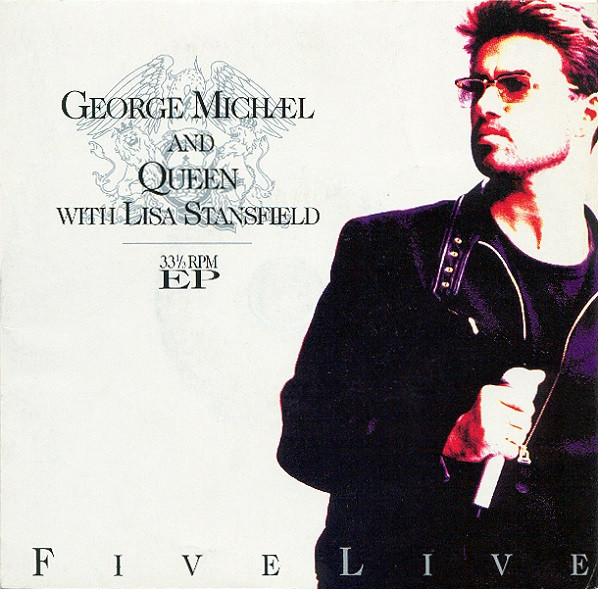
Five Live E.P., by George Michael (his 5th of seven #1s) & Queen (their 5th of six #1s) with Lisa Stansfield (her 2nd and final #1)

3 weeks, from 25th April – 16th May 1993

Luckily for me, the final EP to top the British singles chart has five whole tracks to get through! Five live tracks (hence the name) by George Michael, with assistance from Queen on two of them, and Lisa Stansfield on one. Let’s not tackle them in order, but take the two Queen covers first, recorded at the famous Freddie Mercury Tribute Concert a year earlier.

First up, George has a good old crack at ‘Somebody to Love’. It’s a thankless task, trying to do Freddie Mercury, singing one of his signature songs. But GM gives it a bloody good go. It might be the most impressive vocal performance of all seven of his solo #1s, especially given that it was recorded live. It’s a straightforward cover, but a decent one. And it takes to number one a Queen song that should, like many of their post-Bo Rap singles, have got there first time around. One wonders if this was where Brian May got the idea to start touring again, eventually, with the likes of Paul Rodgers and Adam Lambert.

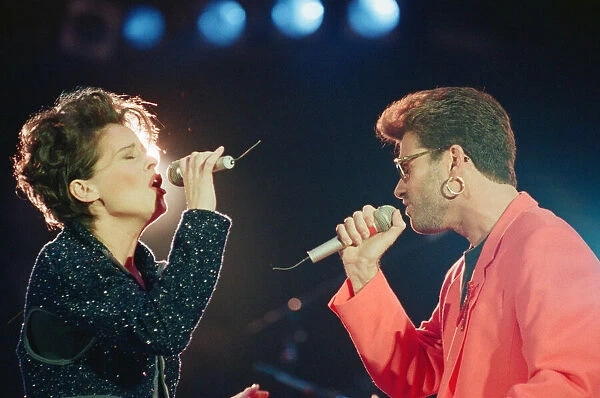
The other Queen cover is ‘These Are the Days of Our Lives’, the track that had made #1 in the immediate wake of Mercury’s death. George is joined by Lisa Stansfield, who he welcomes on stage remarking that she hasn’t any hoover or curlers (presumably referring to her performance of ‘I Want to Break Free’ earlier that night, and not just being sexist…) Again it’s fine, excellently sung – particularly by Stansfield, who didn’t really get to show off her vocal chops on ‘All Around the World’. I don’t imagine it was easy going on stage with George Michael in full flow and holding your own, but she manages. Yet this track isn’t as enjoyable, because a) it was #1 barely a year before and b) it’s not as good as ‘Somebody to Love’ in the first place.

The three other tracks are George Michael solo efforts, recorded in March 1991, again at Wembley (from the same tour that gave us his ‘Don’t Let the Sun Go Down on Me’ duet with Elton John). According to the records, he covered both Adamski’s ‘Killer’ and The Temptations’ ‘Papa Was a Rolling Stone’, but both tracks are hard to, well, track down. Luckily on the British version of the EP he used a shortened, medley version, and again it’s… OK. You’d need a good ear to hear these tracks as a medley, but it works.

However, I refer you back to my comments on Michael’s earlier live #1: live versions being rarely better than the originals and, unless you were actually at the concert, the crowd noises are little more than a distraction. It’s like modern-day shaky camera phone footage, but better produced. Still it was for charity, which is always good, benefiting the Mercury Phoenix Trust, an AIDS fund set up by the remaining members of Queen, their manager Jim Beach, and Mercury’s former partner Mary Austin.

Did we need a fifth track though, making this the longest record to ever make #1 (a milestone that is now almost impossible to break)? Not really. This is where we tip into real self-indulgence, something that George Michael was always prone to, with a cover of ‘Calling You’, originally recorded by soul singer Jevetta Steele for the film ‘Bagdad Café’. I hadn’t heard of it, although the crowd’s reaction suggests that some of them had, at least. And in fairness it did win the Best Original Song Oscar for 1988. The vocals are amazing, from both George and his backing singers, especially again considering it was recorded live. But… It does go on. It unfolds at a snail’s pace, over five minutes. My patience is well and truly tried.

The history of EPs – longer than singles but shorter than LPs – on the UK singles chart is hard to pin down. In the sixties, their heyday, they sold very well and had their own chart. Between the 70s and 90s they fell out of fashion, but could chart alongside the singles. We’ve had three earlier EP #1s, from Erasure, The Specials and Demis Roussos. ‘Five Live’ was the last one to make the top, and maybe this sprawling beast of a record helped to kill them off. Nowadays the closest we’ve got to an EP is a Maxi-CD, or a digital bundle, but since the download/streaming era individual tracks can simply chart in their own right. The same fate has also befallen the double-‘A’ record, though we’ve still got a few more of them to come before then…

671. ‘Don’t Let the Sun Go Down on Me’, by George Michael & Elton John

It’s been a while since we’ve had a live number one. And here’s one featuring two of Britain’s best-loved pop stars…

Don’t Let the Sun Go Down on Me, by George Michael (his 4th of seven #1s) & Elton John (his 3rd of ten #1s)

2 weeks, from 1st December – 15th December 1991

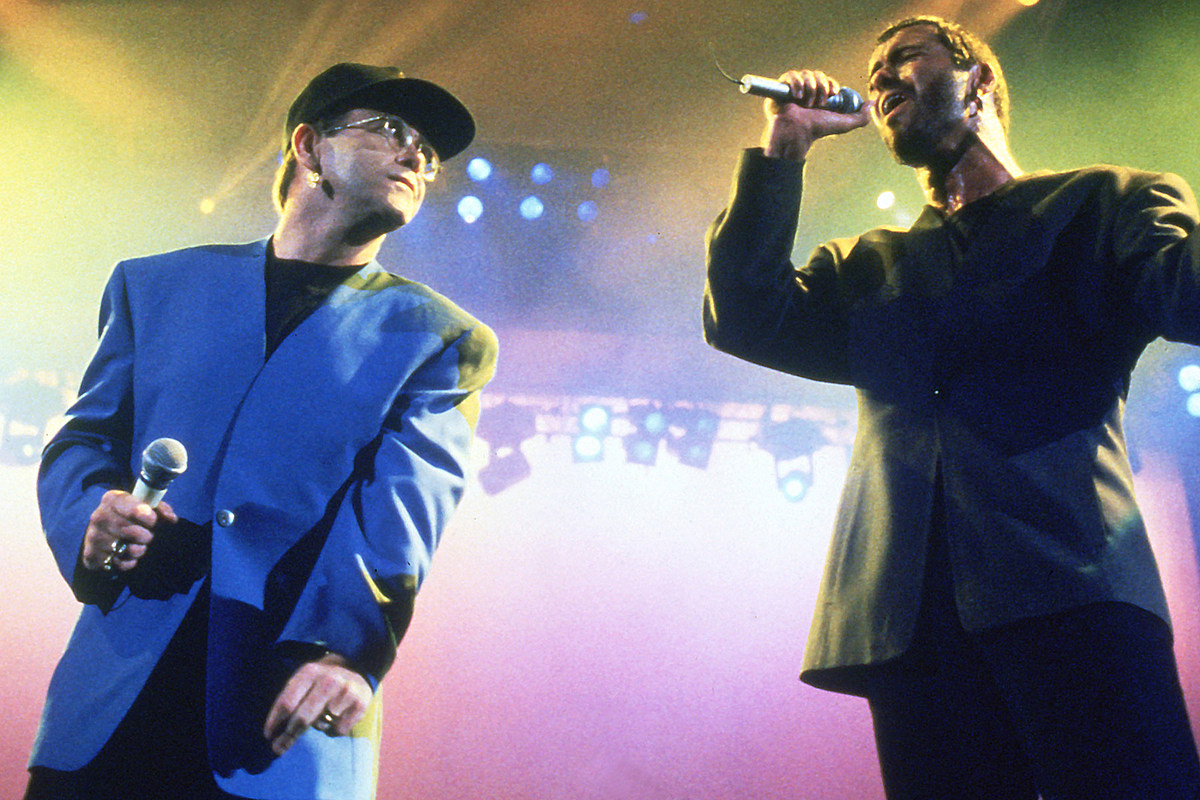
It starts off as George Michael doing a cover of a 1974 Elton John hit. It’s nice enough – Michael is an excellent singer, especially considering that it’s a live recording – but I’m not sure if live recordings are ever better than studio versions. They’re great at capturing the essence of an artist, and sound fine as long as you’re a singer as competent as George Michael. But unless you were there, in the crowd at Wembley Arena in March 1991, is this as enjoyable as it would have been in the studio?

What happens at the end of the first chorus, though, elevates it above most other live singles. The crowd noise rises… something’s happening… and George utters the immortal line: Ladies and gentlemen, Mr Elton John! The crowd’s reaction suggests it was a surprise, arranged for the closing night of Michael’s tour. From then on, this record becomes a moment in pop history. They had already performed the song together at Live Aid in 1985, while at Elton’s recent Glastonbury headline show he touchingly dedicated the song to his late partner in this duet.

What I will say in its favour is that, despite being almost six minutes in length, this cover doesn’t drag. The slow build of the intro and first verse, the revelation, and then the duet are all propelled along by the crowd’s reaction. There’s real drama there. Were this a studio recording then it may well have dragged (which the original does, a bit, despite it eventually reaching a pretty rousing climax, and despite having two out of the five Beach Boys on backing vocals…)

Like the artist they knocked from top spot, Michael Jackson, the 1990s would be among Elton and George’s ‘best’ periods for #1s, despite them being synonymous with earlier decades. It’s only Elton’s second chart-topper of the decade, and that’s already better than his ‘70s and ‘80s returns combined. Meanwhile, apart from his duet with Aretha Franklin, none of Michael’s ‘Faith’ era smashes made number one in the UK.

Aside from the fact that it featured two of the nation’s biggest pop stars, another reason for this record’s instant success (it entered at the top) was that all money raised went to AIDS charities. And our very next chart-topper might explain why, sadly, the disease was at the forefront of the public’s consciousness in late 1991.

662. ‘The Stonk’, by Hale & Pace and The Stonkers

Hot on the heels of The Clash, can we also claim this next number one as part of the recent rock revival…?

The Stonk, by Hale & Pace and The Stonkers (their 1st and only #1)

1 week, from 17th – 24th March 1991

Hear me out! There’s a boogie-woogie rhythm, and a honky-tonk piano… The lyrics are somewhat anarchic, vaguely saucy even, if you try hard enough… OK. No, I admit. This isn’t rock and/or roll. This is the return of the chart phenomenon that brought us such treats as Cliff Richard and the Young Ones remake of ‘Living Doll’: the Comic Relief single.

Those of you who live beyond British shores may never have enjoyed this bi-annual TV fundraiser, in which the great and the good of British light entertainment come together for an evening of forced merriment. Hence why the video for ‘The Stonk’ features Bruce Forsyth, Rowan Atkinson as Mr Bean, and (if my eyes didn’t deceive me) David Baddiel, while it opens with newsreader Angela Rippon being whacked out the way by a red-nosed Big Ben. (It is compulsory for Comic Relief to feature newsreaders doing stupid things. It’s funny, you see, because they are usually so serious.)

If this all sounds completely insufferable, then you’d be right. The gags, such as they are, all land flat. Ich bin ein Stonker… announces JFK, while Neil Armstrong claims one giant Stonk for mankind… Even Shakespeare isn’t safe: Shall I compare thee to a summer’s Stonk? someone asks, which makes no sense on any level. It’s shit, and completely unbothered about it. Proud of it, even. Maybe I’m a miserable sod, but I firmly believe that Red Nose Day would make even more money if people donated on the proviso that it would end an hour earlier for every million raised.

(Note the fact that this is advertised as a double-‘A’ side, alongside the much-loved Victoria Wood. The charts only mention Hale & Pace, however. Perhaps this record’s success had something to do with the other song on offer…)

And yet… I can’t list ‘The Stonk’ as one of the all-time worst chart-toppers. It’s not plumbing the depths alongside ‘Star Trekkin’ (which raised not a penny for charity) or ‘No Charge’ (the least humorous ‘novelty’ record of all time). That cheap, relentless boogie-woogie beat, and the chorus’s strong whiff of ‘The Timewarp’, does sort of hook me in. I didn’t want to, honestly I didn’t, but I’ve ended up tapping my feet.

It was written by comedy duo Gareth Hale and Norman Pace who, despite being TV mainstays throughout the 1990s, somehow never managed to become a part of my childhood. I couldn’t name a single one of their sketches or characters. Meanwhile, despite sounding as cheap and cheerful as a Butlin’s ‘knobbly knees’ contest, it does feature ‘proper’ musicians: British rock royalty even, in Queen’s Brian May and Roger Taylor, Black Sabbath’s Tommy Iommi, and Pink Floyd’s David Gilmour.

In wrapping this post up, I have no desire to ever hear this song again. I doubt anybody has actively listened to it since it left the Top 40 (as is the way with most charity singles). It isn’t on Spotify, and all that’s left as proof that this nonsense was, for one week in March 1991, the best-selling single in the country is this grainy YouTube video…

638. ‘Do They Know It’s Christmas?’, by Band Aid II

And so we reach the end of the 1980s. And, in some ways, the decade’s final number one single is quite perfect.

Do They Know It’s Christmas?, by Band Aid II

3 weeks, from 17th December 1989 – 7th January 1990

It’s a charity single, for a start, a ‘genre’ that has dominated the charts since the middle of the eighties. It’s a cover, of course, of the charity single, the one that kicked the whole trend off. Plus, it was produced by Stock, Aitken and Waterman, giving the trio their seventh #1 of the year. But beyond the good cause, and the production team, the tag ‘perfect’ quickly wears thin.

There’s a reason why none of the three subsequent Band Aids have ever been much played after their original chart runs; while the first is seen as a classic, a perennial returnee to the charts every Christmas. There’s a novelty factor each time, and the urge for people to be seen to be doing something for charity, that means a new Band Aid single will always chart highly. But beyond that initial burst of enthusiasm, there’s always the slow realisation that the new versions simply aren’t as good.

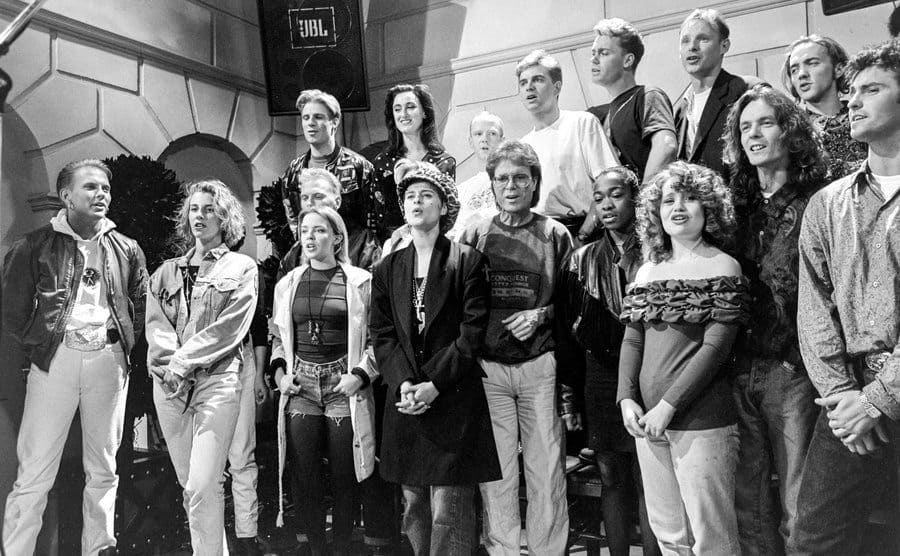
Here, we swap Bono, Boy George, Sting and Paul Young for a considerably younger crowd. Kylie is on opening line duties, followed by Chris Rea and Jimmy Somerville. We meet Jason Donovan, Sonia, Lisa Stansfield, Bros and Wet Wet Wet again, after their recent chart-topping successes. The only singers to reprise their roles from 1984 are two-thirds of Bananarama (Siobhan Fahey having left the year before). To be honest, I struggled to recognise many voices without watching the video, which isn’t a problem you have with the original. One voice stands out above the rest, though: Sir Cliff, who makes it two Xmas #1s in a row (and who will, without wanting to give too much away, soon be making it three).

The production is muted and respectful by SAW’s usual standards, which was probably to be expected. The video is standard: Michael Buerk reporting from Ethiopia, horrifying images of malnutritional babies spliced with footage of Marti Pellow and Matt Goss goofing about. We’ll leave Band Aid II to play out here, bringing the 1980s to a close, and instead muse on the final year of the decade.

1989 has been, I’m going to stick my neck out here, a game-changing year. It’s set the template for modern pop music, in various ways. Firstly, on a purely technical level, songs have started to enter regularly at #1. They’ll continue to do so throughout the 1990s, speeding up the turnover of chart-toppers. As well as that, we’ve had the first ‘modern’ dance #1 from Black Box, from which almost every subsequent dance smash can be traced. We’ve met the first ‘modern’ boy band too, in New Kids on the Block.

Meanwhile, rock music is no longer the force that it has been since the late ‘50s. Rock groups will still make #1, as U2 and Simple Minds have recently done, but often for one week only, thanks to fanbase support rather than genuine cultural heft. And finally, Madonna has defined the ‘modern’ female pop star, and the pop comeback (and comeback video) as a massive event that every pop star since 1989 has tried to mimic.

Next up, we’ll be embarking on the 1990s – the decade in which I came of age, among Britpop, dance, the Spice Girls and boy-bands. I’m looking forward to reliving it. But, you could argue that the nineties began a year earlier, in the final year of the decade that taste forgot…

628. ‘Ferry ‘Cross the Mersey’, by The Christians, Holly Johnson, Paul McCartney, Gerry Marsden & Stock Aitken Waterman

Of all the charity chart-toppers we’ve met in recent years – and we’ve met a fair few since Band Aid kicked it all off at Xmas 1984 – I’m most uncomfortable approaching this next one with anything like my usual light-hearted tone…

Ferry ‘Cross the Mersey, by The Christians (their only #1), Holly Johnson (his only solo #1), Paul McCartney (his 3rd and final solo #1), Gerry Marsden (his only solo #1) & Stock Aitken Waterman

3 weeks, from 14th May – 4th June 1989

We’ve had records raising money for famine in Africa, children’s charities, and a ferry disaster. We’ve already had one charity single for a disaster in a football stadium, when I was able to comment blithely on the fact that the Nolans and Lemmy from Motorhead were singing along together happily. But this one somehow hits deeper.

Three weeks before this record was released, Liverpool and Nottingham Forest were due to contest an FA Cup semi-final at Hillsborough stadium, in Sheffield. One of the stadium concourses, next to a stand housing the Liverpool supporters, had become dangerously overcrowded. To alleviate crowds outside the ground, with kick-off fast approaching, an exit gate was opened, which meant that people could enter the stand more quickly. This created an even bigger crush inside the stadium, from which there was no escape. The match was abandoned after five minutes, but by the end of the day ninety-four Liverpool supporters had been crushed to death. That number would rise in the coming months and years to ninety-seven. A further three hundred were hospitalised.

So far, so tragic. Of course what makes it worse, and what makes Hillsborough resonate to this day, was that South Yorkshire Police blamed the disaster on drunken hooligans rather than police mismanagement and incompetence, aided by sensationalism from various newspapers. Subsequent reports and inquests over the years uncovered that the crush wasn’t down to hooliganism, and that the police, the ambulance services and the stadium design were the main factors. It took almost thirty years for criminal charges to be brought against those responsible.

I’m not sure why this tragedy hits deeper, and I’m not sure if this is the place to ponder that question. Perhaps it’s because I’m a football fan, have been to many football stadiums, though usually in a seat (following the Hillsborough disaster, football stadiums used in the upper tiers of British football were required to transition from standing to seating). Then there’s the fact that it took so long for justice to be served. And the fact that crushes like this still happen at football matches (see last year’s Champions League final) and elsewhere (in Seoul, last Halloween). They tend to happen at what should be fun occasions – sporting events, concerts, nights out – and the people who die what must be excruciating deaths are never the ones to blame.

Musically this song is as you’d expect of a hastily-assembled charity single in 1989. It’s an interesting chart moment: a group of the biggest Liverpudlian pop stars claiming their only ‘solo’ #1s (Holly Johnson of Frankie Goes to Hollywood and Gerry & The Pacemakers’ Gerry Marsden) as well as the biggest songwriting team of the day (Stock Aitken Waterman) getting a rare credit. Oh, and an ex-Beatle scoring his last (officially credited) #1. Unlike previous charity singles the video doesn’t feature the stars – instead it features old footage of Liverpool, of the football team, of Hillsborough flooded with flowers in the aftermath of the disaster, with the name of each victim running by at the bottom of the screen.

‘Ferry Cross the Mersey’ had originally been a #8 hit for The Pacemakers in early 1965, their final Top 10 record after a burst of success at the start of the Merseybeat boom. It’s a nice enough song, though you’d assume that had ‘You’ll Never Walk Alone’ not been used by The Crowd then it would have been the chosen song, given its association with Liverpool FC. Anyway, here ends this sombre interlude, both in terms of the charts and this blog. Jason Donovan will be keeping things light and fluffy next, so until then…