Love Can Build a Bridge, by Cher (her 3rd of four #1s), Chrissie Hynde (her 2nd and final solo #1) and Neneh Cherry with Eric Clapton (their 1st and only #1s)
1 week, from 19th – 26th March 1995
What this? Cher… Chrissie Hynde?… Neneh Cherry and Eric Clapton? It can only mean one thing: charity single ahoy!
It probably means one other thing… That this record isn’t going to be much good. Not that it stinks – no, we’ve endured far worse chart-toppers in the name of a good cause. But following directly on from one of the all-time power-ballads, this one meanders by fairly blandly.
The three women gamely try to wring some cheer out of this tune, spending much of the video swaying arm in arm as if it was a trailer for ‘Steel Magnolia’s II’ (the fact that they do so while standing on a moving collage of famine victims seems slightly tasteless…) But really, a song with such an impressive cast-list should have little more life to it. The two moments that raise the pulse are the middle eight – When we stand together, It’s our finest hour… – and the solo, provided by one of the most famous guitarists ever to wield the instrument. File Eric Clapton under an ever-expanding folder titled: ‘legends poorly served by their ‘biggest’ hit’…
‘Love Can Build a Bridge’ was written and originally recorded by mother and daughter duo The Judds in 1990, with lyrics inspired by Naomi Judd’s battle against Hepatitis C. This version was the 1995 Comic Relief single, which is interesting, as there’s nothing ‘comic’ about this song. But considering that previous Comic Relief number ones have included Cliff and The Young One’s remake of ‘Living Doll’, and ‘The Stonk’, this comes as something of a relief (if you’ll pardon the pun).
Though this does mean that there’s not as much to write about here, compared to the truly heinous charity singles. The most noteworthy thing is that it is Clapton and Neneh Cherry’s highest-charting hit (it being the fourth of only five UK Top 10s for Cherry), and Chrissie Hynde’s final #1, after ‘Brass in Pocket’ with The Pretenders and a duet with UB40 (interestingly a cover of Sonny & Cher’s ‘I Got You Babe’). The one contributor that we will be hearing from again is, of course, Ms Sarkisian, who has the small matter of releasing the biggest-selling hit by a solo female… ever… to come.
I have to admit my heart sinks each time I see an EP coming along. It’s hard enough writing about double-‘A’s (in fact, it can be hard writing about some of the standalone number ones…), but when it’s four songs to get through? Cancel my three o’clock…
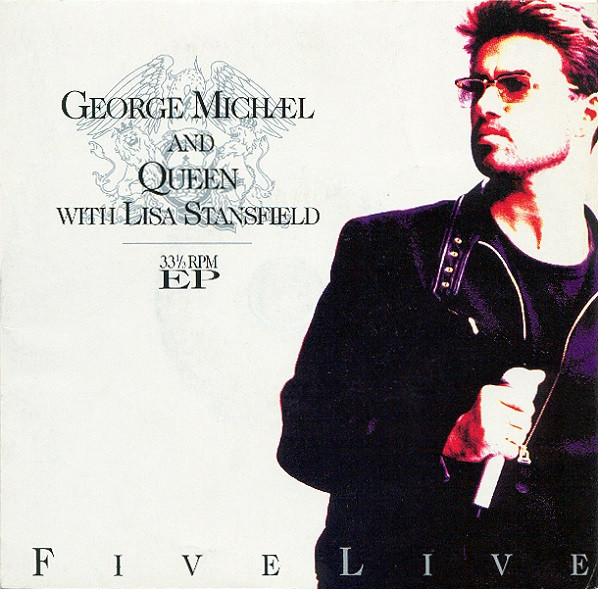
Five Live E.P., by George Michael (his 5th of seven #1s) & Queen (their 5th of six #1s) with Lisa Stansfield (her 2nd and final #1)
3 weeks, from 25th April – 16th May 1993
Luckily for me, the final EP to top the British singles chart has five whole tracks to get through! Five live tracks (hence the name) by George Michael, with assistance from Queen on two of them, and Lisa Stansfield on one. Let’s not tackle them in order, but take the two Queen covers first, recorded at the famous Freddie Mercury Tribute Concert a year earlier.
First up, George has a good old crack at ‘Somebody to Love’. It’s a thankless task, trying to do Freddie Mercury, singing one of his signature songs. But GM gives it a bloody good go. It might be the most impressive vocal performance of all seven of his solo #1s, especially given that it was recorded live. It’s a straightforward cover, but a decent one. And it takes to number one a Queen song that should, like many of their post-Bo Rap singles, have got there first time around. One wonders if this was where Brian May got the idea to start touring again, eventually, with the likes of Paul Rodgers and Adam Lambert.
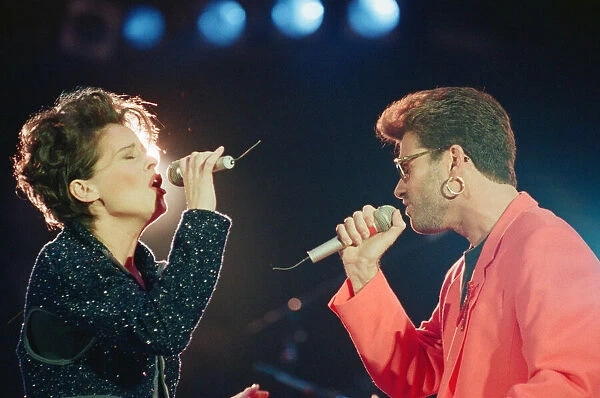
The other Queen cover is ‘These Are the Days of Our Lives’, the track that had made #1 in the immediate wake of Mercury’s death. George is joined by Lisa Stansfield, who he welcomes on stage remarking that she hasn’t any hoover or curlers (presumably referring to her performance of ‘I Want to Break Free’ earlier that night, and not just being sexist…) Again it’s fine, excellently sung – particularly by Stansfield, who didn’t really get to show off her vocal chops on ‘All Around the World’. I don’t imagine it was easy going on stage with George Michael in full flow and holding your own, but she manages. Yet this track isn’t as enjoyable, because a) it was #1 barely a year before and b) it’s not as good as ‘Somebody to Love’ in the first place.
The three other tracks are George Michael solo efforts, recorded in March 1991, again at Wembley (from the same tour that gave us his ‘Don’t Let the Sun Go Down on Me’ duet with Elton John). According to the records, he covered both Adamski’s ‘Killer’ and The Temptations’ ‘Papa Was a Rolling Stone’, but both tracks are hard to, well, track down. Luckily on the British version of the EP he used a shortened, medley version, and again it’s… OK. You’d need a good ear to hear these tracks as a medley, but it works.
However, I refer you back to my comments on Michael’s earlier live #1: live versions being rarely better than the originals and, unless you were actually at the concert, the crowd noises are little more than a distraction. It’s like modern-day shaky camera phone footage, but better produced. Still it was for charity, which is always good, benefiting the Mercury Phoenix Trust, an AIDS fund set up by the remaining members of Queen, their manager Jim Beach, and Mercury’s former partner Mary Austin.
Did we need a fifth track though, making this the longest record to ever make #1 (a milestone that is now almost impossible to break)? Not really. This is where we tip into real self-indulgence, something that George Michael was always prone to, with a cover of ‘Calling You’, originally recorded by soul singer Jevetta Steele for the film ‘Bagdad Café’. I hadn’t heard of it, although the crowd’s reaction suggests that some of them had, at least. And in fairness it did win the Best Original Song Oscar for 1988. The vocals are amazing, from both George and his backing singers, especially again considering it was recorded live. But… It does go on. It unfolds at a snail’s pace, over five minutes. My patience is well and truly tried.
The history of EPs – longer than singles but shorter than LPs – on the UK singles chart is hard to pin down. In the sixties, their heyday, they sold very well and had their own chart. Between the 70s and 90s they fell out of fashion, but could chart alongside the singles. We’ve had three earlier EP #1s, from Erasure, The Specials and Demis Roussos. ‘Five Live’ was the last one to make the top, and maybe this sprawling beast of a record helped to kill them off. Nowadays the closest we’ve got to an EP is a Maxi-CD, or a digital bundle, but since the download/streaming era individual tracks can simply chart in their own right. The same fate has also befallen the double-‘A’ record, though we’ve still got a few more of them to come before then…
It’s been a while since we’ve had a live number one. And here’s one featuring two of Britain’s best-loved pop stars…
Don’t Let the Sun Go Down on Me, by George Michael (his 4th of seven #1s) & Elton John (his 3rd of ten #1s)
2 weeks, from 1st December – 15th December 1991
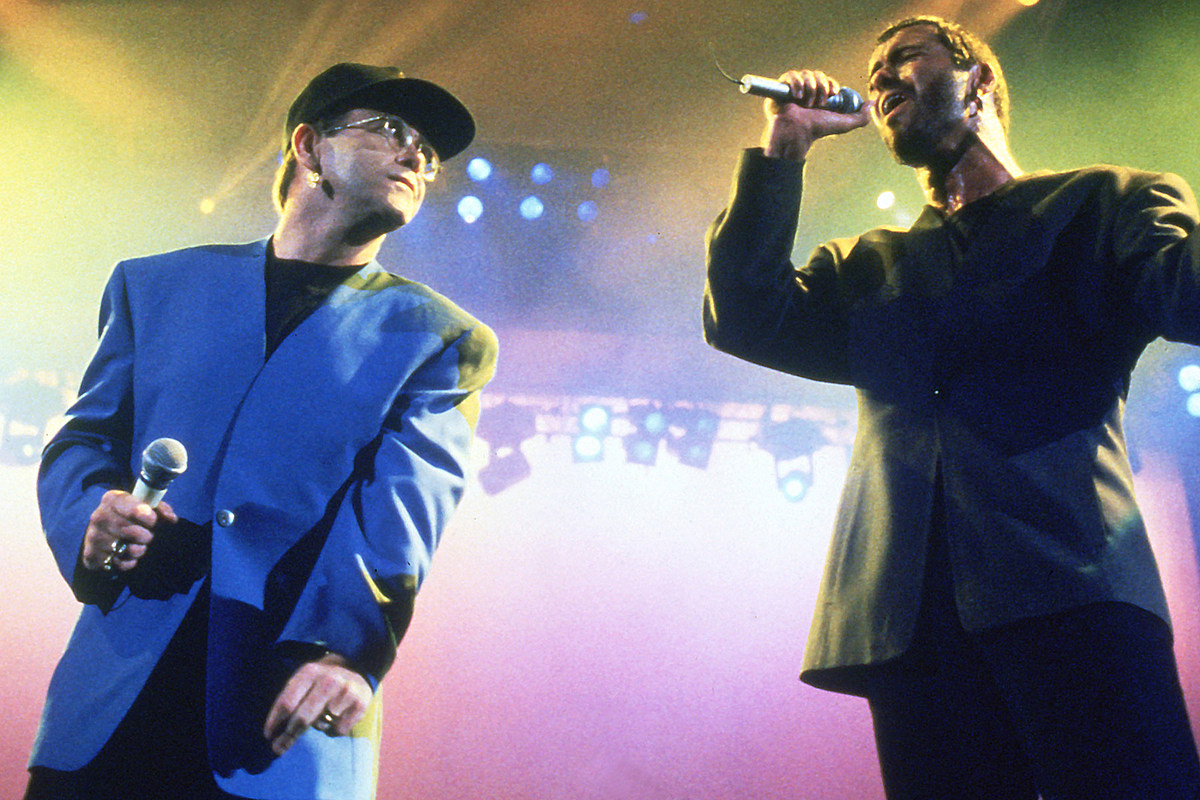
It starts off as George Michael doing a cover of a 1974 Elton John hit. It’s nice enough – Michael is an excellent singer, especially considering that it’s a live recording – but I’m not sure if live recordings are ever better than studio versions. They’re great at capturing the essence of an artist, and sound fine as long as you’re a singer as competent as George Michael. But unless you were there, in the crowd at Wembley Arena in March 1991, is this as enjoyable as it would have been in the studio?
What happens at the end of the first chorus, though, elevates it above most other live singles. The crowd noise rises… something’s happening… and George utters the immortal line: Ladies and gentlemen, Mr Elton John! The crowd’s reaction suggests it was a surprise, arranged for the closing night of Michael’s tour. From then on, this record becomes a moment in pop history. They had already performed the song together at Live Aid in 1985, while at Elton’s recent Glastonbury headline show he touchingly dedicated the song to his late partner in this duet.
What I will say in its favour is that, despite being almost six minutes in length, this cover doesn’t drag. The slow build of the intro and first verse, the revelation, and then the duet are all propelled along by the crowd’s reaction. There’s real drama there. Were this a studio recording then it may well have dragged (which the original does, a bit, despite it eventually reaching a pretty rousing climax, and despite having two out of the five Beach Boys on backing vocals…)
Like the artist they knocked from top spot, Michael Jackson, the 1990s would be among Elton and George’s ‘best’ periods for #1s, despite them being synonymous with earlier decades. It’s only Elton’s second chart-topper of the decade, and that’s already better than his ‘70s and ‘80s returns combined. Meanwhile, apart from his duet with Aretha Franklin, none of Michael’s ‘Faith’ era smashes made number one in the UK.
Aside from the fact that it featured two of the nation’s biggest pop stars, another reason for this record’s instant success (it entered at the top) was that all money raised went to AIDS charities. And our very next chart-topper might explain why, sadly, the disease was at the forefront of the public’s consciousness in late 1991.
Hot on the heels of The Clash, can we also claim this next number one as part of the recent rock revival…?
The Stonk, by Hale & Pace and The Stonkers (their 1st and only #1)
1 week, from 17th – 24th March 1991
Hear me out! There’s a boogie-woogie rhythm, and a honky-tonk piano… The lyrics are somewhat anarchic, vaguely saucy even, if you try hard enough… OK. No, I admit. This isn’t rock and/or roll. This is the return of the chart phenomenon that brought us such treats as Cliff Richard and the Young Ones remake of ‘Living Doll’: the Comic Relief single.
Those of you who live beyond British shores may never have enjoyed this bi-annual TV fundraiser, in which the great and the good of British light entertainment come together for an evening of forced merriment. Hence why the video for ‘The Stonk’ features Bruce Forsyth, Rowan Atkinson as Mr Bean, and (if my eyes didn’t deceive me) David Baddiel, while it opens with newsreader Angela Rippon being whacked out the way by a red-nosed Big Ben. (It is compulsory for Comic Relief to feature newsreaders doing stupid things. It’s funny, you see, because they are usually so serious.)
If this all sounds completely insufferable, then you’d be right. The gags, such as they are, all land flat. Ich bin ein Stonker… announces JFK, while Neil Armstrong claims one giant Stonk for mankind… Even Shakespeare isn’t safe: Shall I compare thee to a summer’s Stonk? someone asks, which makes no sense on any level. It’s shit, and completely unbothered about it. Proud of it, even. Maybe I’m a miserable sod, but I firmly believe that Red Nose Day would make even more money if people donated on the proviso that it would end an hour earlier for every million raised.
(Note the fact that this is advertised as a double-‘A’ side, alongside the much-loved Victoria Wood. The charts only mention Hale & Pace, however. Perhaps this record’s success had something to do with the other song on offer…)
And yet… I can’t list ‘The Stonk’ as one of the all-time worst chart-toppers. It’s not plumbing the depths alongside ‘Star Trekkin’ (which raised not a penny for charity) or ‘No Charge’ (the least humorous ‘novelty’ record of all time). That cheap, relentless boogie-woogie beat, and the chorus’s strong whiff of ‘The Timewarp’, does sort of hook me in. I didn’t want to, honestly I didn’t, but I’ve ended up tapping my feet.
It was written by comedy duo Gareth Hale and Norman Pace who, despite being TV mainstays throughout the 1990s, somehow never managed to become a part of my childhood. I couldn’t name a single one of their sketches or characters. Meanwhile, despite sounding as cheap and cheerful as a Butlin’s ‘knobbly knees’ contest, it does feature ‘proper’ musicians: British rock royalty even, in Queen’s Brian May and Roger Taylor, Black Sabbath’s Tommy Iommi, and Pink Floyd’s David Gilmour.
In wrapping this post up, I have no desire to ever hear this song again. I doubt anybody has actively listened to it since it left the Top 40 (as is the way with most charity singles). It isn’t on Spotify, and all that’s left as proof that this nonsense was, for one week in March 1991, the best-selling single in the country is this grainy YouTube video…
And so we reach the end of the 1980s. And, in some ways, the decade’s final number one single is quite perfect.
Do They Know It’s Christmas?, by Band Aid II
3 weeks, from 17th December 1989 – 7th January 1990
It’s a charity single, for a start, a ‘genre’ that has dominated the charts since the middle of the eighties. It’s a cover, of course, of the charity single, the one that kicked the whole trend off. Plus, it was produced by Stock, Aitken and Waterman, giving the trio their seventh #1 of the year. But beyond the good cause, and the production team, the tag ‘perfect’ quickly wears thin.
There’s a reason why none of the three subsequent Band Aids have ever been much played after their original chart runs; while the first is seen as a classic, a perennial returnee to the charts every Christmas. There’s a novelty factor each time, and the urge for people to be seen to be doing something for charity, that means a new Band Aid single will always chart highly. But beyond that initial burst of enthusiasm, there’s always the slow realisation that the new versions simply aren’t as good.
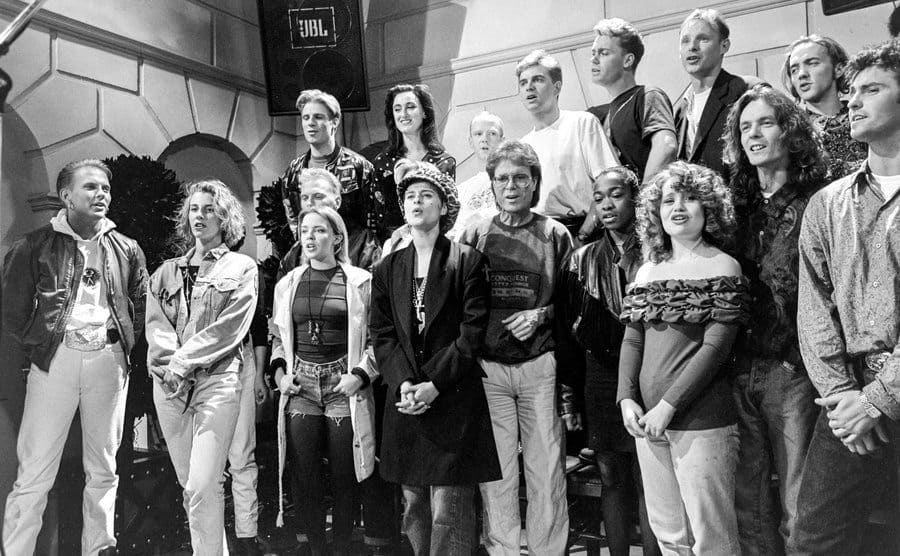
Here, we swap Bono, Boy George, Sting and Paul Young for a considerably younger crowd. Kylie is on opening line duties, followed by Chris Rea and Jimmy Somerville. We meet Jason Donovan, Sonia, Lisa Stansfield, Bros and Wet Wet Wet again, after their recent chart-topping successes. The only singers to reprise their roles from 1984 are two-thirds of Bananarama (Siobhan Fahey having left the year before). To be honest, I struggled to recognise many voices without watching the video, which isn’t a problem you have with the original. One voice stands out above the rest, though: Sir Cliff, who makes it two Xmas #1s in a row (and who will, without wanting to give too much away, soon be making it three).
The production is muted and respectful by SAW’s usual standards, which was probably to be expected. The video is standard: Michael Buerk reporting from Ethiopia, horrifying images of malnutritional babies spliced with footage of Marti Pellow and Matt Goss goofing about. We’ll leave Band Aid II to play out here, bringing the 1980s to a close, and instead muse on the final year of the decade.
1989 has been, I’m going to stick my neck out here, a game-changing year. It’s set the template for modern pop music, in various ways. Firstly, on a purely technical level, songs have started to enter regularly at #1. They’ll continue to do so throughout the 1990s, speeding up the turnover of chart-toppers. As well as that, we’ve had the first ‘modern’ dance #1 from Black Box, from which almost every subsequent dance smash can be traced. We’ve met the first ‘modern’ boy band too, in New Kids on the Block.
Meanwhile, rock music is no longer the force that it has been since the late ‘50s. Rock groups will still make #1, as U2 and Simple Minds have recently done, but often for one week only, thanks to fanbase support rather than genuine cultural heft. And finally, Madonna has defined the ‘modern’ female pop star, and the pop comeback (and comeback video) as a massive event that every pop star since 1989 has tried to mimic.
Next up, we’ll be embarking on the 1990s – the decade in which I came of age, among Britpop, dance, the Spice Girls and boy-bands. I’m looking forward to reliving it. But, you could argue that the nineties began a year earlier, in the final year of the decade that taste forgot…
Of all the charity chart-toppers we’ve met in recent years – and we’ve met a fair few since Band Aid kicked it all off at Xmas 1984 – I’m most uncomfortable approaching this next one with anything like my usual light-hearted tone…
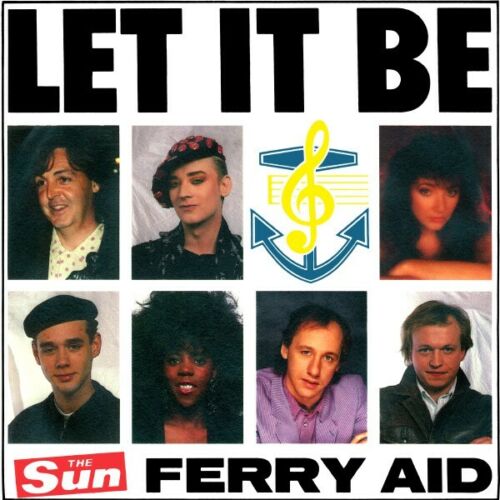
Ferry ‘Cross the Mersey, by The Christians (their only #1), Holly Johnson (his only solo #1), Paul McCartney (his 3rd and final solo #1), Gerry Marsden (his only solo #1) & Stock Aitken Waterman
3 weeks, from 14th May – 4th June 1989
We’ve had records raising money for famine in Africa, children’s charities, and a ferry disaster. We’ve already had one charity single for a disaster in a football stadium, when I was able to comment blithely on the fact that the Nolans and Lemmy from Motorhead were singing along together happily. But this one somehow hits deeper.
Three weeks before this record was released, Liverpool and Nottingham Forest were due to contest an FA Cup semi-final at Hillsborough stadium, in Sheffield. One of the stadium concourses, next to a stand housing the Liverpool supporters, had become dangerously overcrowded. To alleviate crowds outside the ground, with kick-off fast approaching, an exit gate was opened, which meant that people could enter the stand more quickly. This created an even bigger crush inside the stadium, from which there was no escape. The match was abandoned after five minutes, but by the end of the day ninety-four Liverpool supporters had been crushed to death. That number would rise in the coming months and years to ninety-seven. A further three hundred were hospitalised.
So far, so tragic. Of course what makes it worse, and what makes Hillsborough resonate to this day, was that South Yorkshire Police blamed the disaster on drunken hooligans rather than police mismanagement and incompetence, aided by sensationalism from various newspapers. Subsequent reports and inquests over the years uncovered that the crush wasn’t down to hooliganism, and that the police, the ambulance services and the stadium design were the main factors. It took almost thirty years for criminal charges to be brought against those responsible.
I’m not sure why this tragedy hits deeper, and I’m not sure if this is the place to ponder that question. Perhaps it’s because I’m a football fan, have been to many football stadiums, though usually in a seat (following the Hillsborough disaster, football stadiums used in the upper tiers of British football were required to transition from standing to seating). Then there’s the fact that it took so long for justice to be served. And the fact that crushes like this still happen at football matches (see last year’s Champions League final) and elsewhere (in Seoul, last Halloween). They tend to happen at what should be fun occasions – sporting events, concerts, nights out – and the people who die what must be excruciating deaths are never the ones to blame.
Musically this song is as you’d expect of a hastily-assembled charity single in 1989. It’s an interesting chart moment: a group of the biggest Liverpudlian pop stars claiming their only ‘solo’ #1s (Holly Johnson of Frankie Goes to Hollywood and Gerry & The Pacemakers’ Gerry Marsden) as well as the biggest songwriting team of the day (Stock Aitken Waterman) getting a rare credit. Oh, and an ex-Beatle scoring his last (officially credited) #1. Unlike previous charity singles the video doesn’t feature the stars – instead it features old footage of Liverpool, of the football team, of Hillsborough flooded with flowers in the aftermath of the disaster, with the name of each victim running by at the bottom of the screen.
‘Ferry Cross the Mersey’ had originally been a #8 hit for The Pacemakers in early 1965, their final Top 10 record after a burst of success at the start of the Merseybeat boom. It’s a nice enough song, though you’d assume that had ‘You’ll Never Walk Alone’ not been used by The Crowd then it would have been the chosen song, given its association with Liverpool FC. Anyway, here ends this sombre interlude, both in terms of the charts and this blog. Jason Donovan will be keeping things light and fluffy next, so until then…
Our next #1 is an interesting concept, and (I think) the only chart-topping example of it: a double-‘A’ side with songs by two different artists…
With a Little Help from My Friends / She’s Leaving Home, by Wet Wet Wet (their 1st of three #1s) / Billy Bragg with Cara Tivey (their 1st and only #1s)
4 weeks, from 15th May – 12th June 1988
Actually, the songs on the recent M/A/R/R/S double-‘A’ were by two different bands in all but name, but OK… This definitely is. A fun pop-soul cover by a hot new lad-band (that presumably got most of the airplay at the time), and a more introspective offering on the flip side. Both are Beatles covers – ‘Sgt Pepper’s’ covers, no less – and were recorded for children’s charity Childline.
Which means we have to sound the Charity Record alarm! But, actually, this is one of the best charity singles of the decade. Perhaps ever. There’s no gimmick, nobody is dicking about, there are no misguided attempts at comedy. Just two solid Beatles covers. Wet Wet Wet’s take on ‘With a Little Help…’ is fine, though not a patch on either the original or Joe Cocker’s OTT version. It’s perky, fast-paced, with a soaring organ, and a little bit of over-singing from Marti Pellow… The ‘friends’ in this version are the kind folks at Childline (as the video makes clear). Though I’m not sure they’re the sort you’d ‘get high’ with… No matter, Pellow glides past that line without blinking.
It’s nothing special, but when you think of some of the horrors inflicted on classic rock songs by X Factor alumni in the name of charity then you’ll take ‘nothing special’ all day long. In fact, it’s a pretty low-key intro for a band who will go on to have one of the biggest number one singles of all time. But that particular beast can wait… For now, Wet Wet Wet were a likeable bunch of lads from Clydebank, who’d had a run of Top 10 hits following their 1987 breakthrough ‘Wishing I Was Lucky’ (and who make it two Scottish chart-toppers in a row, following Fairground Attraction’s Eddi Reader).
And on the other side? Well, considering that the charity album this single came from was produced by the NME, and featured covers from The Fall (‘A Day in the Life’) The Wedding Present (‘Getting Better’) and Sonic Youth (‘Within You Without You’), perhaps Wet Wet Wet were actually the surprise inclusion? Billy Bragg is an activist, a left-wing folk-punk songwriter, and possibly the ultimate Pointless answer to ‘Artists with a UK #1 single’.
His take on ‘She’s Leaving Home’ with his long-time collaborator Cara Tivey on piano, is something different – both in terms of the peppy song on the flip-side, and in terms of chart-topping singles in general. Few pop hits can have featured an accent as uncompromising as Bragg’s, for example. Though the kitchen-sink drama in the lyrics… She’s leaving home after living alone for so many years… is very on-brand for him. It’s a pretty take on the original, and another win for ‘80s indie which, after The Housemartins and Fairground Attraction, is actually getting more of a crack at the top spot than I’d have anticipated.
I like the concept, and the contrast between the two songs… but neither comes close to its original. And I say that as someone who doesn’t even rate ‘Sgt. Pepper’s’ as much as certain of the Beatles’ other studio albums (at least the two before and the two that followed it…) There now, I feel like I’ve outed myself as a complete Philistine… Up next, perhaps a post on why I’ve always found Bob Dylan overrated… Or maybe not.
OK. That intro might have been slightly tasteless, especially given the disaster that prompted this latest charity chart-topper. On 6th March 1987, a passenger ferry left Zeebrugge in Belgium bound for Dover. The bow door, the one that lets cars drive on, was left open as the ship set off, and it capsized almost immediately. One hundred and ninety three people lost their lives.
Undoubtedly tragic. But the nautical analogy holds up, I think. You’re floating along through the mid-to-late eighties, when along comes a hulking iceberg of a record. Charity songs, with their casts of thousands, their cramming of different styles and voices into one, their overlong runtimes, really do knock the charts off course. And when the record in question is a cover of ‘Let It Be’, one of the world’s best-loved songs, by the world’s best-loved band, you can’t help but wince, no matter how worthy the cause.
But we must listen, and ponder. The best part of an charity ensemble singalong is seeing how many people you can identify. It kicks off with the song’s writer, Paul McCartney, doing his best chirpy Uncle Macca impersonation. Then there’s the still heroin-husky Boy George, carrying the first verse. There’s Andy Bell from Erasure. There’s someone who looks like Marti Pellow (it’s not…) There’s Mel & Kim, again! They (sort of) join the exclusive club of acts who have replaced themselves at #1. There’s Kim Wilde and Nik Kershaw. There’s Kate Bush, who purrs her way through a couple of lines, sounding like she’s been spliced on from a completely different recording. There’s Edwin Starr, of ‘War!’ fame.
There are two guitar solos, from Gary Moore, and Mark Knopfler. Moore’s in particular is pretty blistering, marking this out from the usual charity single fare. There are two guys – one with a bottle of beer, the other smoking a fag – who aren’t quite giving the occasion the respect it deserves. Turns out they’re one half of Curiosity Killed the Cat. This is the second best aspect of a charity single: flash in the pan acts immortalised by being in the right place at the right time. (Also present here is Taffy – no, me neither – who qualified for a line or two thanks to her recent #6 hit ‘I Love My Radio’.)
By the end it’s descended into a pub-singalong, as all charity singles must. I refer to Wikipedia, because it looks like there are at least five-hundred people in the throng, to find it’s actually a ‘Who’s Who’ of previous chart-topping acts: Bucks Fizz, Suzi Quatro, Alvin Stardust, Bonnie Tyler, Doctor and the Medics, Frankie Goes to Hollywood and The New Seekers. Alongside The Drifters… the actual Drifters??… Gloria Hunniford, and Anne Diamond. Of course. They all look far happier than they should, given that it was the deaths of almost two hundred people that brought them all together.
I haven’t commented much on the music, because what’s the point? Charity singles aren’t bought to be listened to. Before you press play, imagine what a cover version of ‘Let It Be’, recorded for charity, in the late-eighties, would sound like. I’ll bet you come pretty close. (Oh and don’t forget to throw in a completely incongruous, but brilliant, guitar solo.) It is what it is. We listen once, and we move on.
The newest addition to our chart-topping roster – the charity record – returns. But it has shapeshifted. Morphed into a form that will terrorise the charts from here until the end of time… The comedy charity record…
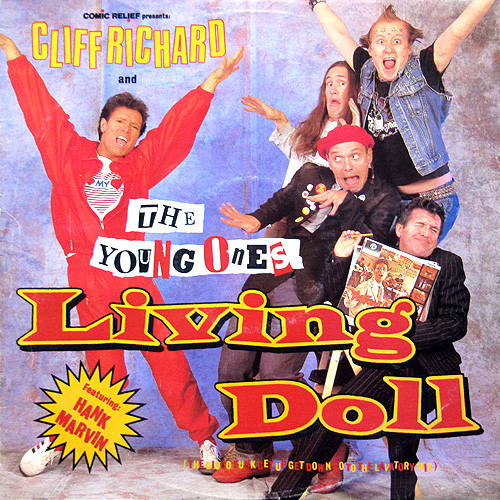
Living Doll, by Cliff Richard (his 11th of fourteen #1s) & the Young Ones ft. Hank Marvin
3 weeks, from 23rd March – 13th April 1986
As with most charity records – which tend to be very rooted in their particular time and place – this needs a bit of explaining. ‘The Young Ones’ was a sitcom, about a group of flat-sharing undergraduate students of Scumbag College: Rick, an anarchist; Vyvyan, a psychopathic metalhead; Neil, a hippie; and Mike, the ‘cool’ one. The show’s theme tune was Cliff Richard & The Shadows’ 1962 #1 ‘The Young Ones’ and Rick, played by Rik Mayall, was a proud Cliff fan, despite his anarchist leanings. In-jokes on top of in-jokes…
This one isn’t on Spotify, which actually ends up being in the record’s favour – it works better as a video. As a song, it’s fairly unlistenable. Cliff does a straight, very soporific cover of his 1959 #1, while the four actors prat about over the top. Meanwhile, Hank Marvin emerges from behind a door to perform the solo.
It is undoubtedly hard to write a song that is as funny as it is catchy. And this is not how you do it… ‘The Young Ones’ is a funny programme, and Cliff is Cliff. But they’ve had to paint their anarchic humour in very broad strokes here. There are funny(ish) bits… At one point Vyvyan calls Cliff ‘Shaky’. And they call out the creepy ‘gonna lock her up in a trunk’ line: I still feel that locking girls in trunks is politically unsound… Well I feel sorry for the elephant… (groan)
It reminds me – and I’m not sure how I even remember this song – of ‘I See the Moon’, The Stargazers’ 1954 chart-topper. That also featured voice actors pratting about – in a very proper, pre-rock ‘n’ roll kind of way – over a well-known tune. It also reminds me of just about every other ‘comedy’ record to come: ‘Spirit in the Sky’, ‘Islands in the Stream’, ‘500 Miles’ will all be subjected to the same treatment in the years to come, and that’s just off the top of my head.
This was recorded for the very first Comic Relief (AKA Red Nose Day), a BBC charity telethon. Like Band Aid, it was set up in response to the famine in Ethiopia and has since gone on to raise 1.4 billion pounds for charity over the last thirty years. For all the musical chaos it has unleashed, it has undoubtedly done a lot of good for the world. Four minutes of Cliff, and Adrian Edmondson bashing everyone on the head with a mallet, is perhaps a small price to pay…
At the end of my last post I promised you an all-star duet at #1. Well, has there ever been a more all-star duet atop the charts than this? It’s only David Bowie and Mick Jagger…
Dancing in the Street, by David Bowie (his 5th and final #1) & Mick Jagger (his only solo #1)
4 weeks, from 1st – 29th September 1985
I also promised that this wouldn’t be underwhelming. And this record may be many things, but underwhelming it is not. It starts with a giant whistle, the sort shepherds use to summon their dogs from three fields away, and a rollcall of cities and continents. OK! Toky-oh…! Jagger bellows. South Ameriiiiicaaaa…! Bowie replies.
It sets the tone for the entire song. Every dial here is set to eleven: the horns, the handclaps, the riff… But nothing more so than its two stars. This should have been listed as David Bowie Vs Mick Jagger, as they spend the entire three and a half minutes trying to outdo one another for sheer ridiculousness. It makes for a tremendously fun listen.
Bowie does his best, sounding all white soul on the they’ll be swinging, swaying, records playing line, and doing his best Noel Coward with on the streets of Brazil… But Bowie, even David Bowie, cannot compete with Mick Jagger when he’s in the mood. The way he soars through just as long as you are there…, the way he makes Philadelphia PA sound like a sexual position, and the piece de resistance: his ridiculously aggressive Back! In! The! USSR! It’s good to hear his voice again, sixteen years on from the Stones’ last chart-topper. It’s great to hear him on such fine form.
The video is even more extra. The two middle aged men (Jagger was forty-two, Bowie thirty-eight) prance and flounce around like the campest of pantomime dames. At one point they appear on the verge of a proper smoochy kiss. Again Bowie tries his best, again he is blown away by the force of nature that is Sir Michael of Jagger. The boy was unplayable, as they say on Match of the Day. On YouTube some wag has made a music-less version of the video, and it is as hilarious/terrifying as you’d imagine. It is a completely random, and yet somehow perfect, way for both of these stars to bow out from the top of the charts. And this curio, this borderline novelty single, ends up being one of the biggest hits either man ever had…
But why? I hear you asking. Why now? Why ‘Dancing in the Street?’, which was originally a #4 for Martha Reeves & the Vandellas in 1969. Well, why did most records make #1 in 1985…? For charity, of course. It was for Live Aid, and therefore for those affected by famine in Africa, like Band Aid and USA for Africa before it. The pair were originally meant to perform the song via video-link during the Live Aid concerts, but that would have involved one of them miming to a backing track. Neither was willing to do that, so they went to Abbey Road studios and recorded it instead.
In many way this is the template for how to do a charity record. Don’t bother writing some overblown twaddle about how we’re all God’s children, don’t bother getting everyone from Bobby Davro to Engelbert Humperdinck in the same room… Just get two genuine icons of popular music singing along to a well-loved classic, having the time of their lives. Sadly, very few future charity records will actually take this advice. This is a decent pop record, but I think it might actually be the pinnacle of its particular genre: the greatest charity single of all time…









 The UK Number Ones Blog