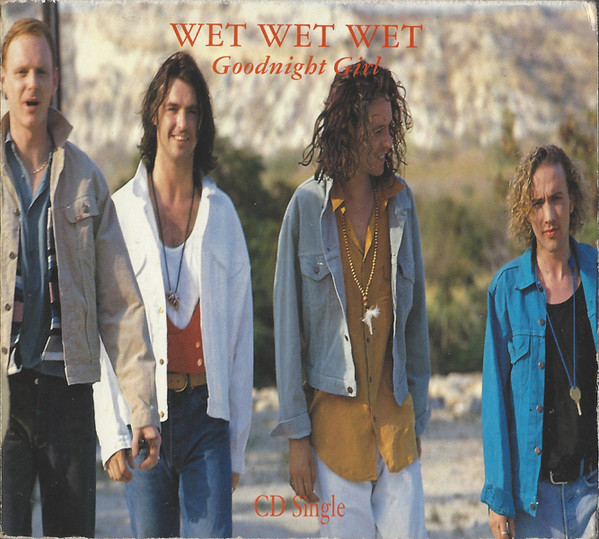
673. ‘Goodnight Girl’, by Wet Wet Wet

Into 1992 we go, then. A year that it won’t take us long to get through, as it only has twelve #1s – the lowest turnover of chart-toppers for thirty years. Why the charts slowed down so much as we move towards the mid-‘90s is something we might chat about in the coming posts…

Goodnight Girl, by Wet Wet Wet (their 2nd of three #1s)

4 weeks, from 19th January – 16th February 1992

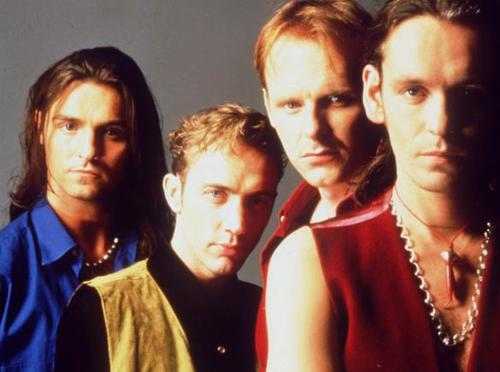
We kick off with Clydebank lads Wet Wet Wet, last heard four years ago singing a peppy cover of ‘With a Little Help from My Friends’ for charity. Since then they’ve grown up: the hair is longer, the mood much more serious… Was this the original boy-band to man-band transition, a path since followed by Take That, Westlife and more…?

It’s a nice enough ballad. Lots of strings, a bit of piano, and an almost a cappella feel to the vocals. Marti Pellow takes the lead of course, but the three others whose names I don’t know weave themselves around him. It could have crumpled into bland, MOR mush; but the chorus is an earworm, with real purpose to it: Caught up in your wishing well, Your hopes inside it…

The video is very 1992, and not nearly as clever as it thinks it is. Why is there a priest swinging on a pendulum? Why indeed? The same applies to the lyrics, really, but if you allow them to just wash over you then the melodies, and Pellow’s voice, are enough to make this an enjoyable, if low-key, start to the year. It seems that Wet Wet Wet had managed to grow old(er) gracefully. It was also my 6th birthday #1, and perhaps that means I give it extra fondness points.

‘Goodnight Girl’ is a bit of an anomaly in the Wet Wet Wet discography. As well as being their only self-penned number one, it was the only Top 10 hit the band managed between 1989 and 1994. It’s pleasant enough, but I’m not sure I can explain why it so spectacularly broke their slump. Was it as simple as it being released in January, traditionally the quietest time for new singles? Anyway, they’ll come back properly in a couple of years, with an (almost) record-breaking mega-hit that will set them up for the rest of the decade, and beyond.

671. ‘Don’t Let the Sun Go Down on Me’, by George Michael & Elton John

It’s been a while since we’ve had a live number one. And here’s one featuring two of Britain’s best-loved pop stars…

Don’t Let the Sun Go Down on Me, by George Michael (his 4th of seven #1s) & Elton John (his 3rd of ten #1s)

2 weeks, from 1st December – 15th December 1991

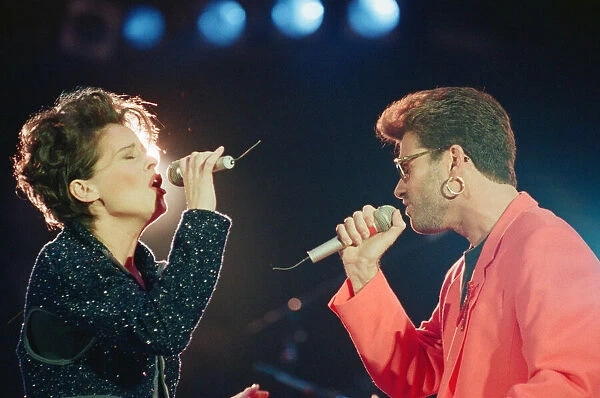
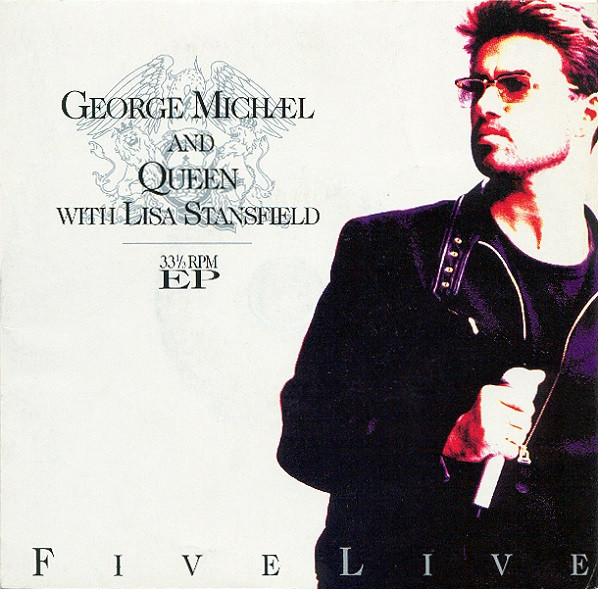
It starts off as George Michael doing a cover of a 1974 Elton John hit. It’s nice enough – Michael is an excellent singer, especially considering that it’s a live recording – but I’m not sure if live recordings are ever better than studio versions. They’re great at capturing the essence of an artist, and sound fine as long as you’re a singer as competent as George Michael. But unless you were there, in the crowd at Wembley Arena in March 1991, is this as enjoyable as it would have been in the studio?

What happens at the end of the first chorus, though, elevates it above most other live singles. The crowd noise rises… something’s happening… and George utters the immortal line: Ladies and gentlemen, Mr Elton John! The crowd’s reaction suggests it was a surprise, arranged for the closing night of Michael’s tour. From then on, this record becomes a moment in pop history. They had already performed the song together at Live Aid in 1985, while at Elton’s recent Glastonbury headline show he touchingly dedicated the song to his late partner in this duet.

What I will say in its favour is that, despite being almost six minutes in length, this cover doesn’t drag. The slow build of the intro and first verse, the revelation, and then the duet are all propelled along by the crowd’s reaction. There’s real drama there. Were this a studio recording then it may well have dragged (which the original does, a bit, despite it eventually reaching a pretty rousing climax, and despite having two out of the five Beach Boys on backing vocals…)

Like the artist they knocked from top spot, Michael Jackson, the 1990s would be among Elton and George’s ‘best’ periods for #1s, despite them being synonymous with earlier decades. It’s only Elton’s second chart-topper of the decade, and that’s already better than his ‘70s and ‘80s returns combined. Meanwhile, apart from his duet with Aretha Franklin, none of Michael’s ‘Faith’ era smashes made number one in the UK.

Aside from the fact that it featured two of the nation’s biggest pop stars, another reason for this record’s instant success (it entered at the top) was that all money raised went to AIDS charities. And our very next chart-topper might explain why, sadly, the disease was at the forefront of the public’s consciousness in late 1991.

667. ‘(Everything I Do) I Do It for You’, by Bryan Adams

Oh Lordy, here we go…

(Everything I Do) I Do It for You, by Bryan Adams (his 1st of two #1s)

16 weeks, from 7th July – 27th October 1991

The 1980s gets the rep as the era of the power-ballad, when big drums and even bigger hair stalked the pop landscape. And yes, the ‘80s gave us ‘Total Eclipse of the Heart’, ‘Take My Breath Away’, ‘The Power of Love’… All gigantic anthems. All of them, to me at least, pretty good. But the 1990s was when power ballads really started to bulk up, to hit the gym, to mutate, Jurassic World-style, into the beast that stands before us now…

Everything about this record is colossal. The slow-build intro, the strained vocals, the sentiment, the production… Nothing is subtle, nothing left to chance. The title, even, tells you exactly what sort of song this will be before you even press play. The listener is not required to think; they merely have to submit to its awesome power. I bet very few of the couples who’ve chosen this as a first dance at their wedding actually like the song; they’ve just been bludgeoned into submission, a sort of musical Stockholm syndrome.

I could pick any line from ‘(Everything I Do…)’ and bask in its cliched stupidity. It’s all the sort of the stuff even a lovestruck fourteen-year-old would think was too overwrought. Take me as I am, Take my life, I would give it all, I would sacrifice… Bryan Adams growls. I get that we live nowadays in a more cynical age, but did anyone actually take this seriously at the time?

Well, probably. Because a record this overblown couldn’t just have a couple of weeks at #1. Not even a couple of months would suffice. No, ‘(Everything I Do) I Do It for You’ needed sixteen long weeks at the top to get its message across. It famously holds the record for the most consecutive weeks at number one (though not the most weeks in total: Frankie Laine’s ‘I Believe’ racked up eighteen over three different runs in 1953). And the UK wasn’t alone in suffering through a summer (and autumn) of Adams. It was #1 for seven weeks in the US, nine in his homeland of Canada, eleven in Australia, and twelve in Sweden.

But there’s a reason why this record, despite its success, has been semi-forgotten, and earlier power ballads by Bonnie Tyler and co remain well-loved. ‘(Everything I Do)…’ just isn’t fun. There’s nothing here that isn’t full-on, one-hundred percent sincerity. And for a power ballad to truly work, you need to feel that the singer is aware, on some level, that what they’re singing is ridiculous. And yet here’s this behemoth, with all the charm of a constipated brontosaurus. Adams isn’t an insufferable guy – he’s recorded plenty of fun, upbeat songs – but this one…? It’s way too earnest.

It’s also probably an indicator of where we are, in pop music terms. The fun of glam metal has fizzled out, and grunge hasn’t quite broken through yet. (Symbolically, ‘Nevermind’ was released right in the middle of this record’s long, long run at the top…) Glam metal hadn’t made much impact at the top of the British charts (neither would grunge for that matter), but it did mean that guitars slowly returned to the mainstream and allowed huge hit singles like this. (Compare this with a power-ballad from the mid-eighties, and it’s much more ‘rock’.)

This single was of course from the soundtrack to ‘Robin Hood: Prince of Thieves’, the ginormous box-office hit of that summer. Chart-toppers from movie soundtracks have been around since the dawn of the charts, but it does feel as if they are taking over in the early nineties. Of the last five #1s, all have been from soundtracks (if we count stage shows as well as films). And this won’t be the last theme song to make it to double-figures at the top of the charts. We’ve got plenty more of these mutant power-ballads to come soon… Brace yourselves.

(For some reason, the single-edit version of the video to ‘(Everything I Do)…’ seems to have been erased from history in favour of the six and a half minute album version.)

653. ‘Unchained Melody’, by The Righteous Brothers

And so the slew of random re-releases, that have been peppering the number one slot since the late ‘80s, peaks here, towards the end of 1990. And I mean ‘peaks’ both in the sense that we’ve literally just waved a Steve Miller Band tune from 1973 off top spot, and in the sense that nothing can top this gilt-edged beauty of a love song.

Unchained Melody, by The Righteous Brothers (their 2nd and final #1)

4 weeks, from 28th October – 25th November 1990

That’s not to say that ‘Unchained Melody’, in the hands of the Righteous Brothers, isn’t a preposterous, overblown nonsense of a record. It is completely over-the-top, the sort of display of affection that would put most women off a man were he to belt it out ‘neath her window of an evening. How does a lonely river sigh, exactly…? And yet, it is irresistible.

Irresistible because of the vocal performance of Bobby Hatfield (who won the right to record it in a coin-toss with his Righteous partner Bill Medley). It’s spectacular singing all the way through, a true tour-de-force, that culminates in that outrageous note he hits in the final chorus. The strings swell, the percussion crashes, creating a tempest of emotion that will wash over even the most cynical of listener.

Irresistible, too, because it is so different to what has come before it. I’ve enjoyed the recent transition to dance, more than I thought I might, but it’s interesting to hear a big sixties beast cutting through the drum machines and the samples. And despite coming from long before the era of the power-ballad, ‘Unchained Melody’ can compete with contemporary classics like ‘Nothing Compares 2 U’ and ‘Show Me Heaven’ in the chest-thumping melodrama stakes. In fact, could the case be made for this being the very first ‘power ballad’?

It found itself back in the charts thanks to its use in the movie ‘Ghost’, in a famous sex scene involving Patrick Swayze and a pottery wheel (I’ve never seen the film, and don’t intend to, so don’t try to persuade me that this isn’t what happens…) The Brothers did a re-record, which charted in the US, but it was their original that took off again in Britain (it had previously made #14 in 1965). It means that the duo have a twenty-five year gap between their two #1s – beating The Hollies’ previous record of twenty-three years – and that ‘Unchained Melody’ itself has a huge thirty five year span since Jimmy Young took his version to the top in 1955.

Young’s version is half the song that this is, though it feels unfair to judge him against what has since become a standard. A standard that, sadly, subsequent singers have felt the need to compare themselves against. ‘Unchained Melody’ has two further, Righteous Brothers aping versions to come atop the charts… And this also increases the irresistibility of this version: the depths that I know the song will be brought down to.

This record cemented itself as the peak of the re-release era by becoming the highest-selling single of the year. Folks lapped it up (‘Ghost’ was, for a spell, the highest-grossing film of all time in the UK), though I’d say it’s now moved into the realms of cliché, thanks no doubt to the subsequent karaoke cover versions, to the point that any use in a movie today would be done with tongue firmly in cheek.

Before I go, I have to give a shout out to the one version that can compete with the Righteous Brothers’: Elvis’s. It was used to great effect in the recent film biopic (that I thought was OK, but nowhere near as good as some said), and when they spliced it with the famous footage of him singing it a few weeks before his death… Well some dust just went and got in my eye, didn’t it?

651. ‘Show Me Heaven’, by Maria McKee

It’s been a while – a whole six months at least. Time for a power ballad!

Show Me Heaven, by Maria McKee (her 1st and only #1)

4 weeks, from 23rd September – 21st October 1990

I love the opening chords, like a wheezy accordion played by the fireside. I also like Maria McKee’s sultry voice, as if she’s just inhaled a lungful of smoke from said campfire. But most of all I love the bridge, a real gear-shift before the thumping chorus: I’m not denying, We’re flying above it all… I’ve never felt this way!

Then the chorus takes a surprising turn. Yes, the vocals are big and the sentiment overwrought: Show me heaven… Leave me breathless… etc. But under that there’s a folky edge to it, with what sound like banjos being lightly plucked. It’s a post-Enya power ballad, perhaps, with a new-age influence being felt in the background. It’s not much, but might I make the same bold claim I seem to make every couple of chart-years, that guitars are making a comeback…?

My favourite bit, though, is the middle eight: If you know what it’s like, To dream a dream… McKee breathes, before embarking on one of the most impressive ten seconds of singing we’ve ever heard in a number one single. I’m pretty sure she does it all in one breath, unless a more trained ear than mine can hear when she sneaks a gulp of air.

From there this most classy of ballads glides to a finish. As the eighties become the nineties, the power ballads are just going to get glossier. But ‘Show Me Heaven’ melds all the OTT fist clenching that we expect – nay, need – from a power-ballad, with genuine credibility and grit. 1990 has already given us ‘Nothing Compares 2 U’, and this provides that record with some proper competition in the ‘ultimate power ballad’ stakes.

It probably helped that Maria McKee was an accomplished songwriter. who refused to record the song unless she could rewrite some of the original version’s ‘appalling’ (her words) lyrics. She already has one writing credit on a number one – Feargal Sharkey’s ‘A Good Heart’ – and had been the lead singer of country rock (or ‘cowpunk’, according to Wiki, which is amazing) band Lone Justice. None of her subsequent hits came anywhere near to matching her only #1; but she seems to be a free spirit, doing whatever she pleases, be it recording music, making short films, or writing fiction.

‘Show Me Heaven’ featured on the soundtrack to the Tom Cruise-Nicole Kidman, NASCAR racing film ‘Days of Thunder’ (Cruise and Kidman met on set, and were married barely a year later.) This makes it the second song from a Tom Cruise movie to make #1, after ‘Take My Breath Away’ (sadly ‘Kokomo’ couldn’t replicate it’s US success on British shores…) And, lest we forget, Nicky Kidman has her own chart-topping moment in the sun to come…

647. ‘Sacrifice’ / ‘Healing Hands’, by Elton John

It’s amazing to think that Elton John went the entirety of the eighties without a number one single. It’s amazing to think that, twenty years into a stellar career, this was his first solo UK chart-topper. But perhaps most surprisingly, it’s amazing that this particular record was a hit at all.

Sacrifice / Healing Hands, by Elton John (his 2nd of ten #1s)

5 weeks, from 17th June – 22nd July 1990

It’s a decent enough song. Elton and Bernie could still knock out a good tune, even this far into their partnership. But it’s very middle-of-the-road, very made-for-Radio-2, very much Elton John reinventing himself for middle age (he was approaching forty-five when it eventually made #1).

And, given that this is adult-oriented soft rock, the lyrics are on a fittingly grown-up theme. Into the boundary, Of each married man, Sweet deceit comes calling, And negativity lands… Ergo, men are men, and they all cheat. I’m pretty sure he blames the frigid woman: Cold, cold heart, Hard done by you… Bernie Taupin was coming to the end of his second marriage at the time of writing, and you do wonder if that might have been an influence.

Away from the lyrics, this has all the glossy touches you’d expect of a soft rock ballad in 1990. I don’t dislike it – in many ways it’s a sophisticated piece of song writing befitting of the nation’s (second?) most prolific hit making partnership – but it also gives me the feeling of mineral water poured over ice: crisp, and clear, and pretty cold. Yet it’s lingered on in the Elton John canon, seemingly held in higher regard than I afford it, and the Cold, cold heart line formed the basis of a 2021 #1, thirty-one years on…

The flip side of this double-‘A’, ‘Healing Hands’, is a bit more lively. It’s a bouncy rocker: a little bluesy, a little gospel. It was apparently inspired by the Four Top’s ‘Reach Out, I’ll Be There’, and you can hear it in the chorus: Reach out, For her healing hands… Is it just me, or is he suggesting that God is a woman…? Anyway, it’s a great vocal performance from John and, while he gets plenty of praise for his showmanship and his presence, I’m not sure he always gets enough credit for his voice.

Again, though, it’s very mum-friendly. Why now? Why, on the verge of being a very old man (in pop star terms) did Elton score the biggest British hit of his career? We have time to ponder this as ‘Healing Hands’ meanders towards its conclusion (seriously, it has one of the longest fade-outs ever). ‘Sacrifice’ had been released nine months before, making a lowly #55. Steve Wright then started playing it on Radio 1 (crushing my Radio 2 theory from four paragraphs ago), it was re-released with ‘Healing Hands’, and the rest was history. Proceeds from the record’s sales went to four different AIDS charities, which again probably help boost sales.

We can perhaps see this record as a dividing point in Elton John’s career. Long gone were the hit-filled, rhinestoned, giant spectacled days of the seventies. The eighties had brought addiction, rehab, a doomed marriage, fewer hits… By 1990, he’d had one Top 10 single in five years. If this hadn’t caught fire, would Elton have faded into obscurity and the nostalgia circuits? Maybe that’s a stretch, but it definitely set him up for a huge career renaissance in the 1990s. Superstar duets, Disney themes, and the planet’s biggest-selling single of all time, were all about to follow…

641. ‘Nothing Compares 2 U’, by Sinéad O’Connor

Just four weeks, and three number one singles, into the new decade and the 1990s have their first iconic moment…

Nothing Compares 2 U, by Sinéad O’Connor (her 1st and only #1)

4 weeks, from 28th January – 25th February 1990

First things first, I hate overuse of the word ‘iconic’. Yass! Slay! Dresses are ‘iconic’, memes are ‘iconic’, everything’s bloody ‘iconic’. But I think the term is valid here. From the sustained opening note, to the Orwellian opening line: It’s been seven hours and fifteen days… the song grabs you, makes you sit up and listen.

And that is pretty much all down to Sinead O’Connor’s vocal performance. She hits every note perfectly – the soft ones, the angry ones, the ones you don’t expect. Some favourite lines: I went to the doctor, And guess what he told me, Guess what he told me… or All the flowers that you planted mama… Or the way Nothing can take away these blues… hits a really bluesy note at the end. To tell the truth, without O’Connor’s heroics, with a different, less committed singer, this could be a flat, maybe even dull song. The synths are slow, the beat is steady, with a trip-hop edge that will become ubiquitous as this decade goes on.

The most famous of her vocal tricks has to be the key-change in the title line: No-Thing compares, To you… It’s the one hook that ultimately sells the entire song. But we can’t pretend that this song did well on vocals alone. There’s the famous video, another iconic aspect of this whole business (I promise that’s the last time I’ll use that word), in which O’Connor remains in close-up, her face strikingly cat-like, head shaved, a tear rolling down either cheek. (The tears were unplanned, and brought on by the ‘mama’ line, her mum having died in a car crash several years earlier.)

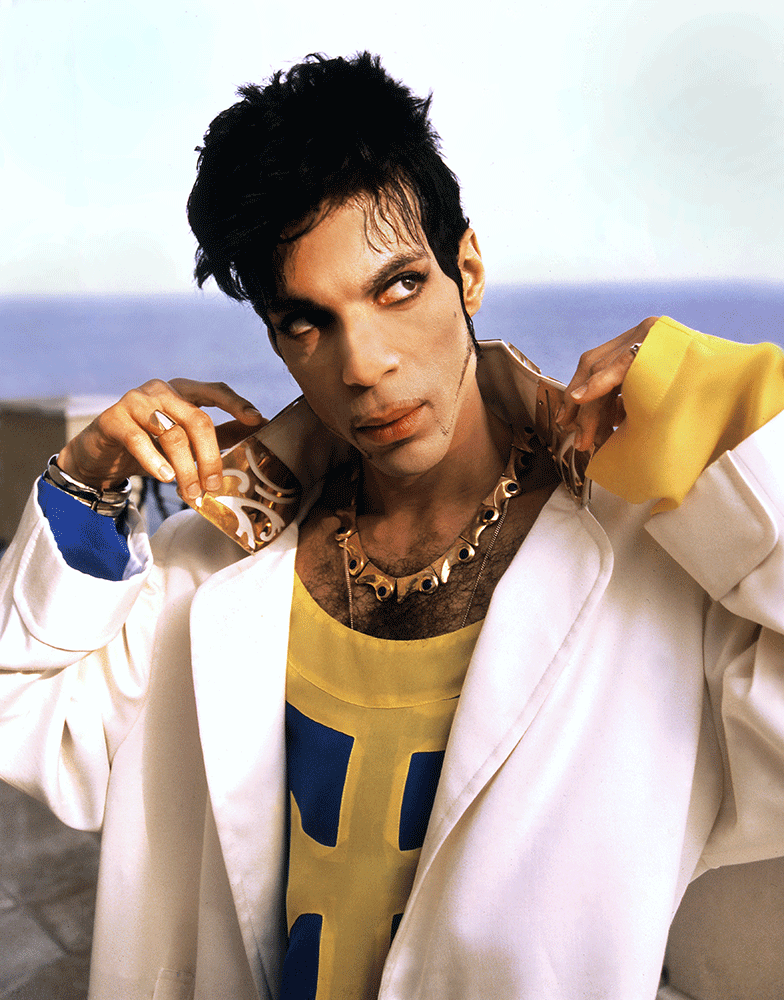
‘Nothing Compares 2 U’ was famously written by Prince, though his version was never released. O’Connor’s version was also famously disliked by its author, perhaps because it outperformed pretty much every song he ever released. It was #1 in thirteen countries, and Top 10 in countless others, overshadowing everything that she has done since. I’d never heard the Prince original, which was finally released in 2018, and it’s nowhere near as good – cluttered with fiddly guitar and a wild sax solo, completely missing the sparse beauty of this definitive version.

Is it surprising that this song did so well? I say that because it is unremittingly miserable: the singer counts down the hours since her break-up, listing all the things that won’t help her get over her loss, all the flowers that have wilted since. And yet, I asked a silly question, really. All the best ballads aren’t about love; they’re about lost love: ‘Without You’, ‘The Winner Takes It All’… Misery hits home. It’s the hopeful, positive ones that often lack an edge: ‘Nothing’s Gonna Change My Love for You’, or ‘Hello’, to name but two.

Sinead O’Connor wasn’t a complete unknown when this, the second single from her second album came out; but none of her earlier, or her subsequent releases, made the Top 10. Her career in the US ended abruptly when she ripped up a picture of the pope on ‘Saturday Night Live’ as a protest against child abuse in the Catholic church, and she has courted controversy in statements about her sexuality, her religion, and her views on Irish politics. She is an eccentric, a contrarian, one who is hard to define. Except everyone can agree that her biggest hit kickstarted the 1990s, and remains one of the decade’s most iconic (sorry) songs.

629. ‘Sealed With a Kiss’, by Jason Donovan

From an extremely harrowing chart-topper, to one as lightweight, as ephemeral, as they come…

Sealed With a Kiss, by Jason Donovan (his 3rd of four #1s)

2 weeks, from 4th – 18th June 1989

I am glad that I don’t have to ponder life, death and injustice as I listen to Jason Donovan’s take on ‘Sealed With a Kiss’. I don’t have to think much at all, for this is basically karaoke. Perfectly good karaoke, I mean that as no slight on the singing abilities of Mr Donovan, but it’s karaoke nonetheless. The production (Stock Aitken Waterman yet again, as was almost mandatory in 1989) is exactly what you would hear in a Japanese karaoke booth: a cheap replication of the early-sixties original.

It is an odd choice of cover for the hottest young pop star in the country. The melancholy chords, the tempo, and the tone of the song feel very out of step for the Hi-NRG late eighties. I suppose, though, it’s a current teen idol singing a former teen idol’s hit from nearly thirty years before (the song tells the story of two lovebirds separated for an agonisingly long summer) thereby appealing to both kids and their parents. Yet part of me wishes SAW had tarted the song up in their usual tinny Eurodisco dressing – that might have been quite fun. As it is, the song washes past almost unnoticed.

‘Sealed With a Kiss’ had been a #3 hit in 1962 for Brian Hyland, his biggest British record, as well as making #7 on re-release in the seventies. (Hyland’s breakthrough hit, ‘Itsy Bitsy Teenie Weenie Yellow Polka Dot Bikini’ will also soon be reappearing at the top of the charts, in truly traumatic fashion… I can’t wait!) This cover gave Donovan his 3rd #1 in under six months, which is some going. For me, though, it’s a step down from the classic (yes, classic) ‘Especially for You’ and the perfectly fine ‘Too Many Broken Hearts’.

It was also the 3rd SAW #1 in a row, and I’m not sure how many (if any) other producers have done that. Plus, it’s the second consecutive cover of a golden-oldie to make #1. And, even more interestingly for chart nerds like myself, it was the second chart-topper in a row to enter in top spot. That had only happened once before, in 1973. Pre-1990, entering at the top pretty much announced you as the biggest act in the country (or a charity single). As we move into the 1990s, songs are going to enter at the top of the charts more often, and the turnover of #1s is going to increase. The ‘90s are going to take a while to get through, that’s for sure…

626. ‘Eternal Flame’, by The Bangles

The school disco is almost at an end. Time to pluck up the courage to finally leave the safety of the shadows, and to ask your crush if they might, you know, maybe, like, want to dance…?

Eternal Flame, by The Bangles (their 1st and only #1)

4 weeks, from 9th April – 7th May 1989

‘Eternal Flame’ is a classic last-dance smoocher, from the days when a last dance was a thing. In fact, I’d rank this in second place behind Spandau Ballet’s ‘True’ in the very niche ‘Classic 80s Last Dance Number Ones’ category. (When did last dances stop? Or are they still around, and it’s just been a good decade and a half since I stayed in a nightclub until closing time…?) Anyway, this one’s got a good formula: start off simple, with Susanna Hoff’s crystal-clear voice (legend has it she recorded her vocals in the nude, which lent her voice that trembling vulnerability), and a slightly annoying typewriter’s ting, before building.

The ‘eternal flame’ of the title is reported to have been the one that burns at Graceland, in Elvis’s memory, and where The Bangles had recently been given a tour. Mixing this image into a traditional love song leads to some slightly creepy lyrics: I watch you when you are sleeping, You belong with me… It still works, though, because the rest of the song is so overwrought.

It’s not really The Bangles traditional sound – think ‘Manic Monday’ or ‘Walk Like an Egyptian’ – and since female rock bands are rarer than hens’ teeth, it’s a shame that it took such a departure for them to make number one around the globe. It’s a decent ballad, one that comes together well when the four members start to harmonise like a gospel choir; but quite conservative. It would work well in an Andrew Lloyd-Webber musical.

By the final chorus, as those big eighties drums come pounding in for yet another encore, ‘Eternal Flame’ has become a power-ballad. In fact, the moment the drums enter is custom made for finally leaning in for that long-imagined snog. It should be a big moment… But it’s 1989, and we’ve heard a lot of this before. There’s nothing wrong with the song, but I’m not enjoying it as much as I thought I would…

It was The Bangles’ biggest hit – the world’s biggest-ever hit by an all-female band, no less – but it also hastened their break-up. The pushing of Hoffs as the lead singer meant that the other members were keen to break away. They split later in 1989, and although they’ve since reformed, none of their subsequent singles have come close to troubling the Top 10.

621. ‘Especially for You’, by Kylie Minogue & Jason Donovan

As much a festive tradition as endless turkey sandwiches between Boxing Day and New Year’s, the singles chart has its own version of Christmas leftovers…

Especially for You, by Kylie Minogue (her 2nd of seven #1s) & Jason Donovan (his 1st of four #1s)

3 weeks, from 1st – 22nd January 1989

There’s no way ‘Especially for You’ was supposed to be #1 in late January. It had been lodged behind Cliff’s ‘Mistletoe and Wine’ (has there ever been a more saccharine festive Top 2?) for all four weeks of that record’s chart-topping run, before ascending to its rightful place at #1 on the first day of 1989.

I say ‘rightful’, for yes, as saccharine as this ballad is, there’s something, especially in the verses, that tugs at the heartstrings. It’s not the lyrics, which are the type you knock-out on the back of a napkin: Especially for you, I wanna tell you you mean all the world to me, How I’m certain that our love was meant to be… Or the production, which is as cheap and cheerful as Stock Aitken Waterman ever got.

It’s something I’ve just noticed, after sitting down to listen to this song properly for the first time in decades… It’s a rip-off of ABBA’s 1981 hit ‘One of Us’. Just listen: the intro, the reggae-ish beat, the harmonies…! And when you base a song on one of the best pop group ever’s best hits, then you’re not going to go far wrong.

Though to call it a complete rip-off is harsh – the chorus is its own beast, and a real earworm – and of course there’s the star quality of Queen Kylie, who can carry any old tripe when she’s in the mood. And then there’s Jason Donovan, who will go on to be 1989’s biggest chart star (well, him and a cartoon rabbit…) It was released in the wake of the couple’s wedding on Australian soap opera ‘Neighbours’– one of the most watched episodes of any soap – amid lots of speculation about a romance in real-life, and so it was bound to be a gigantic hit. The most impressive thing is that old Cliff Richard was able to hold off this juggernaut for so long!

No matter, it eventually made #1 and became SAW’s biggest ever hit. (And, I believe, their only release to sell a million copies.) 1989 will be the year that the production trio peak – they’ll helm a quite incredible seven chart-toppers this year – so it’s only proper that they kick the year off with their best (OK, second best, after Dead or Alive). Sadly, that means that the final year of the decade will probably pale in comparison to 1988, which unexpectedly became my best year for chart-toppers since 1980-81.