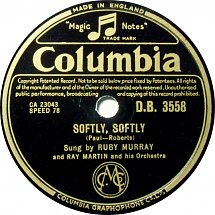
29. ‘Softly, Softly’, by Ruby Murray

ruby-murray-softly-softly-1955-3-78-s

Softly Softly, by Ruby Murray (her 1st and only #1)

3 weeks, from 18th Feb to 11th Mar 1955

Aaaah…

That wasn’t a cry of anguish you just heard; more an exhalation of boredom. Or an extended pause while I tried to think of something to stop this from being my shortest post yet.

But maybe it should be a short post. Ruby Murray, claiming the twenty-ninth UK #1 with a perfectly forgettable song. It’s basically an amalgamation of what’s gone before: the string intro to ‘Secret Love’, Mantovani’s violins, Eddie Fisher’s ethereal backing singers, plus a sprinkle of Kitty Kallen and a half-teaspoonful of Kay Starr… Almost as if someone was using an algorithm specifically designed to write a mid-1950s chart hit. However they did it; it worked – ‘Softly Softly’ logged a very respectable three weeks at the top.

Softly, softly, Miss Murray purrs, come to me, touch my lips, so tenderly… The lyrics are all about kissing and caressing, about her lover taking his time to open up her heart. But it’s not a sexy song at all. It’s a bit nursery ryhme-ish, and a bit dull after ‘Mambo Italiano’.

Murray has a nice enough voice and, notably, this is the second example, after Dickie Valentine, of a British singer trying to sound like an American. She breathes and tickles the lines in a way that Vera Lynn most certainly would not have approved of. Actually, Ruby Murray was from Belfast and, by my reckoning, this makes her the first in a very long line of Irish crooners to have topped the UK Singles Chart.

2016-10-31_lif_25887021_I1

Ruby Murray is also (and this is the only thing that I knew about her prior to writing this post) cockney rhyming slang for curry. As in: It’s Friday night, we’re off dahn the Taj Mahal for a cheeky little Ruby Murray, innit. She is therefore the second chart topping artist so far, after Mantovani, to have remained enshrined in the public consciousness less for her music and more for the way her surname sounds. But her music was very popular. Though this was her sole #1, she recorded eight further Top 10 hits between 1954-59. Only two of her releases failed to make the Top 10, actually. I guess it’s a bit of a shame that she’s now remembered solely for having a name that rhymes with curry.

I’m pretty sure I could go out on a limb and declare that I’m the only person in the world who has listened to a Ruby Murray song today. ‘Softly Softly’ is by far her most listened to song on Spotify, at 104,676 plays. A quick bit of maths, dividing that number by the 70 million total users on Spotify, gives you 0.00014 plays of ‘Softly Softly’ per user. And that’s after I’ve played it five times in the past half hour.

Still – it is pretty amazing that every single one of these prehistoric chart toppers is available nowadays at the click of a button. Had I tried to do this blog a decade or so earlier I would have had to rely on wading through weird re-recordings on YouTube, or to opening my laptop up to all sorts of viruses on Pirate Bay. Had I attempted this twenty or thirty years ago (before blogging existed, I know, but bear with me) I’d have had to spend a fortune in ‘Sounds of the 50s’ compilations. These are enlightened times in which we live. And there, that wasn’t such a short post after all.

28. ‘Mambo Italiano’, by Rosemary Clooney & The Mellomen

images

Mambo Italiano, by Rosemary Clooney (her 2nd of two #1s) & the Mellomen

1 week, from 14th to 21st Jan / 2 Weeks, from 4th to 18th Feb 1955 (3 weeks total)

Just like that, Rosemary Clooney’s pops up again. She had two number ones, within a couple of months, and then she was done. (I’m being a little disingenuous here – she was a chart force for several years – but we are only concerning ourselves with number ones hits here, no room for second best).

And good old Rosie – her time at the top may have been fleeting, but at least she had a bit of fun while she was there. This is an even more frenzied bop than ‘This Ole House’. We start out with a bit of nonsense about a girl going back to Napoli, because she misses the scenery. And then… Hey Mambo!

On first listen I thought she was really singing in Italian, but she is just listing food: Hey mambo… try an enchilada with the fish bacalla and other cod-Italian phrases. Something something mozzarella, something something Calabrese… I think there’s a Como se dice in there. To be honest, Miss Clooney doesn’t know como se dice very much at all. And anyway, that’s Spanish. But it’s OK – you can’t help but want to dance to this. For the solo, the bouncy piano from ‘This Ole House’ returns, and it ends with a brilliant That’s Nice! OOH! As for ‘The Mellomen’… who knows? They do little more than your average ’50s backing singers – a few ‘Hey Mambo’s here and there – so I’m not sure why they got a credit. But, just like that, they have a UK Number One single.

clooney-94b833378517905808a9405ad88dff3bcfe05e4b-s900-c85

If this were released today, people might pick up on the gibberish mix of English and Italian, and the picture it paints of Italian-Americans, and they may perhaps view it in an unfavourable light. Remember how Justin Bieber got in trouble for singing about Doritos to the tune of ‘Despacito’? But actually, this is a song about a girl returning to a native land where she now feels confused and out of touch. The lyrics are meant to be mumbo-jumbo. We’re not meant to understand them… Kinda clever when you think about it.

The song also features the line: If you gonna be a square, you ain’t a-gonna go nowhere, ‘Square’, as far as I’m concerned, is the archetypal ’50s slang word: Be there or be square… You’re so square, baby I don’t care… So, while this is a mambo record, sung by an easy-listening singer-slash-actress, this is rock ‘n’ roll. It may be fun and funky, but it just about manages to retain an air of cool around all the silliness. While we were waiting for Bill Haley to come along and kick-off things off, the ideals and attitudes, if not the actual sounds, of rock ‘n’ roll were being sneaked in right under our noses.

As with her previous chart topper, I knew this song already. Most people do. I have vague memories of a late-90s remix. Plus, Miss Clooney is remembered nowadays as the aunt of housewives’ heartthrob George Clooney. But – remixes and celebrity descendants aside – we should all take a minute to appreciate her for the few weeks, in late ’54/early ’55, when she slapped a good dollop of fun into an otherwise pretty staid and stuffy UK singles chart.

27. ‘The Finger of Suspicion’, by Dickie Valentine with The Stargazers

dickie-valentine-the-finger-of-suspicion-decca-78-s

The Finger of Suspicion, by Dickie Valentine (his first of two #1s) with the Stargazers (their 3rd of 3 #1s)

1 week, from 7th to 14th Jan / 2 Weeks, from 21st Jan to 4th Feb 1955 (3 weeks total)

We race on into 1955 with a song that sounds like it could be very interesting. The Finger of Suspicion! Dickie Valentine calls out his unfaithful love. He knows what she did! And he’ll stand for it no longer!

Except, no. This isn’t an era of surprises, of shocks… of excitement (with a few notable exceptions). This is a cloying little love song, putting the ‘easy’ into easy-listening. The crimes for which the accusing finger points are things like stealing a beat or two from the singer’s heart, robbing him of sleep etc. etc… All very smooth, Dickie, but the title promised so much more.

Musically it’s right down the middle of the road. Not too dull; but far from thrilling. There are snatches of film-noir soundtrack between the verses, and an extremely sedate guitar-cum-trumpet solo. Peak pre-rock!

Perhaps the most interesting thing about the song – and perhaps I’m clutching at straws here – is that Dickie Valentine is a Brit who sings like an American. Bear with me… So far in the British chart-toppers corner we’ve had folks such as David Whitfield, Vera Lynn, and Eddie Calvert. All very proper, all very sedate, all very… pleasant. They’ve sang their number one hits in a restrained, decidedly British fashion. Calvert even played his trumpet in a restrained, decidedly British fashion. Whilst the Americans – the Frankie Laines, the Guy Mitchells, the Rosemary Clooneys – have all had a bit of a swagger about them. And Valentine, here, has clearly learned from them. He doesn’t have the greatest voice, but it’s a bit louche, and slightly knowing. He sounds like he’s having a good time singing this song. Even the name, Dickie Valentine, sounds fun and stagey (his real name was the far more prosaic Richard Maxwell). We are witnessing the birth of the British pop star here, the first in a long line of cheeky, yet loveable faces that ranges from Cliff to Olly Murs, via Rod Stewart and Robbie Williams. It’s a moment of some significance.

85334960

Almost as interesting is the manner in which Valentine ends the song. It seems that we are set up for the big, overly-dramatic finish so beloved of this era’s biggest stars. The finger of suspicion – dum dum dum dum dum dum – you’re ready for it, no matter the fact that it won’t suit the song – and then we get an ever so gentle points… at… you… Expectations well and truly subverted.

We are, of course, meeting The Stargazers again as well. Their first chart-topper was dire, their second was bizarre, and their final one is this standard little ditty. In truth, they barely feature here, save for a few backing lines. You wouldn’t even know they were involved if they weren’t credited. When this hit the top they became the act with the most UK Number Ones – joint with Frankie Laine. Best leave them there. They won’t hold onto this record for long, and will soon fade into the mists of chart history as an act very much of their time.

26. ‘Let’s Have Another Party’, by Winifred Atwell

R-5006820-1381952789-2495.jpeg

Let’s Have Another Party, by Winifred Atwell (her first of two #1s)

5 weeks, from 3rd Dec. 1954 to 7th Jan. 1955

I wrote in the intro to my last post that Rosemary Clooney was finally getting our pulses racing – or our toes tapping, at least – and here comes Winifred Atwell to keep up the momentum.

It’s another piano-led song. Well, I say ‘piano-led’; it’s nothing but piano. Winnie and her piano, bashing out a selection of boogie-woogie and ragtime standards in extremely short order. According to Wikipedia we are getting classics such as ‘Broken Doll’, ‘Lily of Laguna’ and the ‘Sheik of Araby’ served up with a verse here, a snatch of chorus there, then on to the next one. I don’t recognise any of the featured tunes – though I’m pretty sure one of them was played by an ice-cream van in days of childhood yore.

It’s jaunty enough, but the effect of squeezing so many different tunes into a couple of minutes means it’s a bit of an odd listen. They’re all played in the same ragtime tempo, so there are no segues: it’s straight from one song into another with no time to draw breath, before we screech to a halt with dum-didley-dum-dum… dum-dum. But hey, it’s the first medley to top the charts, and off the top of my head, I’m not sure if there will be another one until Jive Bunny in thirty-five years’ time. On Spotify, the track is listed as having a Part I and Part II, the former being all of these old hits strung together while the latter is a much-more sedate number, even featuring a bit of guitar. I think, though I’m unable to confirm, that only the first part counts as the record that hit #1. Maybe Part II was the B-side.

1954-winifred-atwell-lets-have-another-party-1353313393-view-0

Anyway, all of this nonsense about which part is blah blah blah pales wildly into insignificance when it is revealed that Ms. Atwell was… black! Born in Trinidad & Tobago, before moving to the States and then to London, she becomes, a little over two years into their existence, the first black artist to hit the top of the charts. It’s a big moment, and worth taking a moment to reflect on this happening at a time when, say, landlords could stick a ‘No Blacks’ sign in their windows with impunity and, in the USA at least, Winifred Atwell wouldn’t have been allowed on the same public transport as her fellow chart-toppers. Just because this is the frothiest of throw-away records shouldn’t render it any less significant.

In fact, it’s almost ironic that she achieved this historic landmark with a medley full of old music-hall hits. The sort of hits that were big in even less enlightened times. The sort that might have been sung by men in black-face, to howls of laughter (seriously, Google ‘Lily of Laguna’ to see just what kind of song it is…) In a way, she is reclaiming them, and making them popular on her own terms.

And with that, I’ll descend from my high-horse, and conclude by saying that we will be hearing from Winfred Atwell again soon. She was huge in the early to mid-1950s (played for the Queen, didn’t you know!), and definitely seemed to have a winning formula. Hey, if it ain’t broke… ‘Let’s Have Another Party’ was the follow-up (somewhat inevitably) to ‘Let’s Have a Party’, and was followed up by another medley, the wonderfully titled ‘Let’s Have a Ding-Dong’. All good, (very) old-fashioned fun!


25. ‘This Ole House’, by Rosemary Clooney

R-803732-1160416687.jpeg

This Ole House, by Rosemary Clooney (her first of two #1s)

1 week, from 26th Nov. to 3rd Dec. 1954

Now this is more like it! After an incredibly sedate run of number ones – seriously, nothing since early-May of this year has been enough to get even a toe tapping – we are rocking and a-rolling!

You probably know this song. I certainly knew of it, for a couple of reasons. One is that Shakin’ Stevens revived it in the early ’80s. The other is that I can recall, way back in the mists of time, reading an ‘Oor Wullie’ comic (link provided for non-Scottish readers) in which this song was playing at a party, the words changed to something suitably Scottish (‘This ole house ain’t got no lino’, perhaps). My grandparents kept piles of old ‘Oor Wullie’ annuals lying about, and so have no idea whether it was a new-ish comic strip parodying the Shaky version, or a vintage comic parodying this version. Amazing, isn’t it? Anyone who tries to tell you that the charts don’t matter, and that the songs which make number one don’t form the backdrop to our lives, is very, very wrong. Anyway. You will know this song, I assure you – it’s got a sort of nursery rhyme feel to it and goes a little something like this:

            * raucous piano, or maybe a harpsichord (???) or an organ *

        This ole house once knew his children, This ole house once knew his wife, This ole house was home and comfort as they fought the storms of life, This ole house once rang with laughter, This ole house heard many shouts, Now he trembles in the darkness when the lightnin’ walks about…

Yes, it’s the tale of a lonely old man. Clooney then goes on to detail the repair work that this house needs – the floor, the hinges, the windowpane, even the shingles (I’m pretty confident that this is the only #1 hit to reference shingle). But he needn’t bother, this lonely old man, as he: Ain’t gonna need this house no longer, He’s getting ready to meet the saints…

This is a strange ole song. In a musical landscape of mopey, flowery, boringly chaste love-songs this is a best-selling song about a man sitting in his dilapidated house, waiting for the sweet embrace of death. The piece de resistance is the line: Oh his knees are a-gettin shaky, But he feels no fear or pain, ‘Cause he sees an angel peekin’, Through a broken windowpane…

Like, seriously. WTF? – as they most certainly didn’t say in 1954. I love it. It’s weird, morbid, almost sadistic. It’s quite modern, in a way, the juxtaposition of upbeat music with some with very downbeat, depressing lyrics. It’s interesting, anyway, and a lot better than some of the guff we’ve had to listen to recently. The gulf between this record and ‘My Son, My Son’ – its predecessor at #1 – is what makes a singles chart so interesting. The next chart-topper can always be something completely different.

thisolehouse1

Rosemary Clooney’s voice is standard, mid-1950s American. Polished, glossy, accessible. She even throws in a Westlife style key-change after the twangy piano solo which, if I’m not mistaken, is the first we’ve heard in this rundown. I, for my sins, love a good key-change. And we must mention her brilliantly deep-voiced backing singer – with his ain’t a-gonna need this house no longer, ain’t a-gonna need this house no more – who adds an even more bizarre edge to an already pretty bizarre record.

This was Clooney’s first of two number ones, the second of which will be coming up very shortly indeed. And, I can tell you now, it’s another cracker!

24. ‘My Son, My Son’, by Vera Lynn

hqdefault

My Son, My Son, by Vera Lynn (her first and only #1)

2 weeks, from 5th to 19th Nov. 1954

You don’t meet many Vera’s nowadays, do you? You’d meet a Frank, a David and a Johnnie quite easily on your local high street. But a Vera’d be hard to come by. And a song titled ‘My Son, My Son’, which sounds like the name of a hymn? Sung by a Vera? I knew before ever pressing play that this would be a crusty relic of a record.

This is ‘If’, by Rudyard Kipling, set to music. My son, my son, you’re all I hoped you’d be. My son, my son, my only pride and joy… My son, my son, just do the best you can, Then in my heart I’m sure, You’ll face life like a man… I’m fairly sure that this song stands alone, out of the thousand plus UK number ones, in taking the form of a love letter from a mother to her son. So points for originality at least.

All the British-Recorded-Hit-Song-From-The-Early-1950s hallmarks that we’ve grown oh so familiar with by now are present: cut-glass diction, earnest delivery, sombre – oh so sombre – tone. I mused last time on why so many of these early chart toppers were by Americans. And on top of all the glamour, glitz and razzamatazz it probably just boils down to them being more fun. Listen to this, then the Kitty Kallen record from a few posts ago, and tell me which of the two singers you’d rather have with you on a night out…

b84410a3-7096-4b86-980c-c8956bf65f12_1.c7c6a9a9b2e4554e552980fa76bd09ca

It’s clear, although it’s just occurred to me this very minute, that the record buying demographic in the pre-rock age were middle-aged. How else do you explain this, and David Whitfield? The music charts will soon be driven by youngsters, but not quite yet. Of course, in fairness Vera Lynn was a huge star, and had been since the 1930s. I mentioned Sinatra, and Doris Day, as still resonating today and, in the UK at least, Vera Lynn – the ‘Forces Sweetheart’ – has left a big old mark on popular culture. It’s only right that she grabbed her solitary #1 hit (she would have had a load more if charts existed for the ’40s) and I should try to find something nice to say about it. But…

One big problem with this song is that it sounds like a wartime release. A mother, tears in her eyes, watches as her son shoulders his rucksack and heads for the frontline, and mulls over how proud she is of him. But this was recorded nearly a decade after VE day! Maybe Vera knew her audience. More of that stoic ‘We’ll Meet Again’, off to the trenches stuff, eh Vera? Give ’em what they want! Maybe she was dying to re-invent herself, to try out some of this rock ‘n’ roll that everyone was banging on about, but the suits wouldn’t let her…?

Anyway, one final reason why I should try saying something nicer about this track is that Dame Vera Lynn is still alive at the impressive age of 100, and there is a chance (admittedly a very minute chance, but still) that she may read this. But… Nope, I can’t. Next!

23. ‘Hold My Hand’, by Don Cornell

don-cornell-hold-my-hand-vogue-coral

Hold My Hand, by Don Cornell (his first and only #1)

4 weeks, from 8th Oct to 5th Nov / 1 week, from 19th to 26th Nov 1954 (5 weeks total)

So this is the Kingdom of Heaven? Is this is the sweet promised land? While angels tell of love, don’t break the spell of love. Hold my hand.

Right. Listen. This is the problem with a lot of these early number ones. It’s not that they are too old-fashioned, or too slow, or simply too boring (though plenty of them have been too old-fashioned, too slow and simply too boring) … It’s that most of them take this bizarrely extravagant approach to describing basic romantic feelings.

This is a song about asking someone to hold your hand. And I get that in 1954 there were strict limits on how suggestive you could get with your lyrics but… This is a three-minute extended metaphor explaining how holding someone’s hand can bring forth angels, plant you in the Garden of Eden, bring on the rapture, blah, blah, blah. It doesn’t mean anything.

Musically we’re accompanied by violins and a strumming guitar. I’ll let you know when this changes. And… I’m running out of things to write. Next!

No, that’s a bit harsh. This is Don Cornell’s moment. We won’t be hearing from him again. But, and I’m really sorry to say this Don, you are also part of the problem…

This song has a pretty playful, cheeky lilt to it, written in snappy little couplets. The line: This is the secret of what bliss is… is quite cute when you say it out loud. And at one point ‘portal’ is rhymed with ‘immortal’, which is clever. Guy Mitchell would have made a good job of this song. Sinatra would have given this number a little nod and a wink (it’s a much more Sinatra-y song than ‘Three Coins in the Fountain’) Cornell, though, maintains a firm baritone, and never quite relaxes into the song.

don_cornell

The name Don Cornell sounds like that of a small-time gangster and, going by pictures from the time, he may well have been a (pretty smiley) small-time gangster. The same goes for Al Martino, Perry Como, Frank Sinatra (naturally) … Half the number one singles over the first two years of the UK charts seem to have been recorded by Italian-Americans. In fact, out of the eighteen acts to have topped the charts by November 1954, twelve were American. And I think this is historically significant – we weren’t just importing US-made music; Britain – war-ravaged, austerity-hit, nylon-rationed, Blitz-broken Britain – was importing American escapism in all it’s glitzy, white-teethed, suave glory. We were being sold the American dream, record by record.

22. ‘Three Coins in the Fountain’, by Frank Sinatra

s-l300 (2)

Three Coins in the Fountain, by Frank Sinatra (his first of three #1s)

3 weeks, from 17th Sept to 8th Oct 1954

From a one-hit wonder to a… lots-of-hits wonder?

We’ve flirted with fame so far in this countdown – Doris Day is a household name, Johnnie Ray, Perry Como and Frankie Laine were very big in their day. But this is different. This is Sinatra.

I feel I should give him a fanfare, or something. Maybe emboss this post with a gold border (does WordPress run to such extravagances?) When I scan down my list of Number Ones, certain artists stand out. Artists that I should perhaps put a little more effort into introducing. You know who I mean: Elvis, the Beatles, the Stones, Michael Jackson, Madonna, Busted… The biggies.

But then, these stars don’t need no intro, really. Everyone knows who they are. Frank Sinatra died when I was twelve. His last real chart presence was twenty years before that. His music is old. But still your average Joe off the streets could have a stab at naming three of his hits: you’ve got your ‘My Way’, your ‘New York, New York’, your ‘Fly Me to the Moon’… Your ‘Three Coins in the Fountain’?

Has anyone listened to ‘Three Coins in the Fountain’ since 1954? I certainly wouldn’t have heard it, had it not popped up on this list. And, to be honest, it’s a very low-key first appearance for Ol’ Blue Eyes. It’s not a very Sinatra-y song.

It starts with a flourish of cymbals, which makes it sound as if it’s from a film soundtrack (it was). And then, musically, it’s nothing that we haven’t heard before. Maybe that’s the problem – twenty-two songs in and, with a few notable exceptions (for better or for worse) they’re starting to merge into a gloopy, sentimental mush.

Three coins in the fountain, Each one seeking happiness, Thrown by three hopeful lovers, Which one will the fountain bless?

The song tells the story of three lovelorn young men, chucking coins into the Trevi Fountain. I do like the fact that we get a bit of a story, in amongst the usual trite lines. The line: Three coins in the fountain, Through the ripples, how they shine, is a particularly nice one, painting a picture of a summer’s night in Rome.

Sinatra keeps us in suspense. Who will be the lucky lover? Just one wish will be granted, One heart will wear a Valentine, Make it mine, Make it mine, Make it mine! But we never find out. The song ends on a cliffhanger. It’s probably for the best – keep ’em wanting more, eh?

0337_05071

Personally, I don’t think this song suits Sinatra’s voice. When you think of Sinatra you think of the laid-back delivery, the knowing eye, the glass of brandy in hand… This number is a little too earnest, and I don’t think he’s giving it his all. The line: Which one will the fountain bless? is particularly awkward. This was a strange time for Sinatra, career-wise: he was no longer a teen-idol but hadn’t yet gone down the Vegas residency, Rat-Pack road. ‘Three Coins in the Fountain’ encapsulates this strange mid-career limbo quite well.

And that’s it, really. I feel I should write more… This is Frank Sinatra, for God’s sake. But it’s a lacklustre song. Which begs the question: why was this one of only three chart toppers for the guy? Hitting the top-spot is often a question of timing, I suppose, and plenty of other acts have also reached #1 with efforts far from their best.

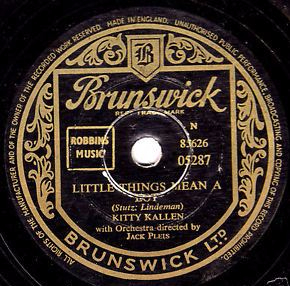
21. ‘Little Things Mean a Lot’, by Kitty Kallen

s-l300-1.jpg

Little Things Mean a Lot, by Kitty Kallen (her first and only #1)

1 week, from 10th to 17th Sept 1954

And so we arrive at mid-September, eight and a half months into 1954, and we have had but five number ones this year. In my capacity as a fully qualified chart geek, I have the means by which to compare and contrast this with other years. And, for example, by this point in 1953 we had had 10 #1s. By the 10th September 2000 (the year with the highest turnover of chart toppers in chart history) we’d had an unbelievable 30 #1s! And in 2017 we were back down to 10 #1s. Interesting? I’ll let you be the judge of that.

Anyway, the 6th number one of 1954 takes a low-key approach. Kitty Kallen has a dusky voice, and little in the way of accompaniment aside from a – thankfully understated – violin and something that tinkles (a timpani?). Oh, and there’s a trumpet. Still, though, this is a nice respite after the fervour of ‘Such a Night’ and the mini-operetta that was ‘Cara Mia’.

Lyrically, the idea is that small signs of affection are more important than grand gestures: Give me you arm as we cross the street… Call me at six on the dot… Touch my hair, as you pass my chair… Little things mean a lot… This girl don’t need diamonds or pearls, champagne, sables or such. No, Sir. Cos honestly honey, they just cost money. And since we’ve had song after song full of strangely metaphorical approaches to describing love – seeing little birds, talking to stars – as well as the usual soppy stuff – hearts melting, longing or breaking – this is an interesting detour. It’s cute and knowing, and quite ahead of its time. Modern love songs go in for a lot of the ‘savouring the little moments’ kind of stuff: sitting on the grass, drinking wine out the bottle, holding your loved one’s hair back as they puke (c.f. James Arthur, 2016). Perhaps we can class this record as ahead of its time.

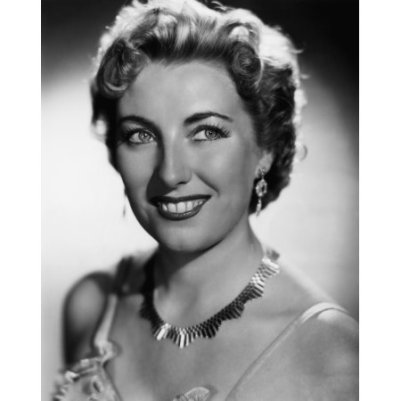
Kitty Kallen 1944 Metronome Archive Photos

The only time that Kallen gets serious is for what is as close as the song gets to a chorus: Give me your hand when I’ve lost the way, Give me a shoulder to cry on… And she is guilty of singing these lines in a THIS IS THE IMPORTANT BIT SO I’M SINGING A BIT LOUDER way that literally everyone seems to be doing in 1954. But at least the ending is sedate: repeat the title, bit of trumpet, fade. Nice

And so that was Kitty Kallen’s first and only UK Number One. I like that – one song, one week. Done. Your name goes down in history. Had she stalled at #2 – perfectly respectable, that, a number two hit – I might never have heard of her. Not that she’s the first – we’ve already covered Jo Stafford’s and Lita Roza’s solitary weeks at the summit – and she won’t be the last. But, unlike Stafford and Roza, this was Kallen’s only ever UK hit. Ladies and Gentlemen, we have our first one-hit wonder. She was much more popular in the US, this being her fourth number one over there. It was her last, though. ‘Little Things Mean a Lot’ seems to have been pretty much it for Miss Kallen. And it almost goes without saying by this point that she died at the grand old age of ninety-six, just two years ago.

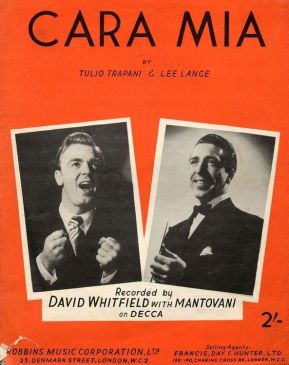
20. ‘Cara Mia’, by David Whitfield with Mantovani & His Orchestra

david-whitfield-with-mantovani-cara-mia-decca

Cara Mia, by David Whitfield with Mantovani & His Orchestra (both Whitfield and Mantovani’s 2nd of two #1s)

10 weeks, from 2nd July to 10th Sept 1954

The last time I wrote about David Whitfield, when his first number one followed on from Frankie Laine’s rockabilly number ‘Hey Joe’, I might have mentioned something about it being one step forward and two steps back…

But for this to follow on from rock ‘n’ roll pioneer Johnnie Ray, and the gloriously suggestive ‘Such a Night’ (OK, yes, Doris Day did return to the top for a big old spell in between but let’s not allow that to get in the way of my indignation!) – it’s more a case of one step forward, ten steps back! One step for every week this record spent at the top! The difference between this and ‘Such a Night’ is massive. This is pre-rock. If such a thing ever existed, if it could be captured and bottled or defined in a dictionary, then this would be it. The Sex Pistols were punk, Oasis were Britpop, David Whitfield was pre-rock.

Shrill backing singers? Check. Overwrought vocals? Got it. Proper enunciation? Yep. Big bastard of an ending? Oh boy. Seriously, check out this ending. It has three stages. Whitfield comes in for the final verse like he means it, an octave up on previous lines: All I want is you, for ever more… Then comes the final line for which he amps it up even more: TILL THE END OF… And the note that he hits for the final TIIIIIMMMMMMEEEEE!!! cannot be natural. Its impressive, yet horrifying.

I have nothing new to write about David Whitfield. He’s of his time, and who am I to judge? People at the time clearly enjoyed it: very, very few records have ever reached double figures in terms of weeks at #1. ‘Such a Night’ only got one week. And he died young, unlike so few of his contemporaries, aged just fifty-four in 1980. We should also drop a mention for Mantovani, of violin and rhyming-slang fame, from whom we won’t be hearing again in this countdown. The violins in this song sound identical to those in his first chart topper. Mantovani’s signature strings.

cara-mia-song-featuring-david-whitfield-mantovani-englebert

Though the sharp-eyed among you will currently no doubt be thinking ‘Now just wait a minute here!’ Because back a few posts ago I mentioned that every record thus far had been conducted by someone and their orchestra, and that these conductors – Paul Weston, Hugo Winterhalter et al, never seemed to get credited and were deleted from any chart statistics. So why is Mantovani getting a credit here? To be brutally honest… I dunno. Maybe it’s because this, more than any, is a super operatic, orchestral record and they feel that that should be recognised. Maybe it’s because Mantovani already sneaked a week at the top with his own song, ‘Moulin Rouge’, and so was slightly more renowned than your run-of-the-mill conductors. Maybe Mantovani was just really concerned about his legacy and so paid someone to stick him in the records. Who know? But if I were Paul Weston, I’d be pretty pissed off.

Before finishing, I want to mention a thought that struck me a few posts ago. It seems that in the mid-1950s there were very few ways for people to hear the music that was in the charts without buying it. No MTV (duh!), no Top of the Pops, no YouTube, no nothing. Radio consisted of a handful of stations, very few of which played pop music. Pirate Radio hadn’t got going yet. Perhaps you could have listened to ‘Pick of the Pops’, on the BBC Light Programme, but even that wasn’t first broadcast until 1955. It just seems so alien to me, to us, that you might only know of a record as a listing in a magazine and have no idea how it sounded until you went out and bought it.

Although, this might explain how certain songs managed to top the charts in the first place…