87. ‘Dream Lover’, by Bobby Darin

Now this is more like it. This is a chart-topping single!

BOBBY_DARIN_DREAM+LOVER+-+1ST-547817

Dream Lover, by Bobby Darin (his 1st of two  #1s)

4 weeks, from 3rd – 31st July 1959

It’s been a while since I listened to this song, or to any Bobby Darin songs, but slipping the needle to hear ‘Dream Lover’ is like slipping into a silk dressing gown and settling down by the fire: Every night I hope and pray, A dream lover will come my way, A girl to hold in my arms, And know the magic of her charms…

We get not one but two groups of backing singers: girls for the ‘oohs’ and boys for the ‘wadda waddas’. We get strings and we get some oh-so-fifties staccato guitars. In fact, I’d put this up there with ‘Diana’ and ‘When’ as the most fifties, most rock ‘n’ rolly, doo-woppy #1 yet. But ‘Dream Lover’ is a much better song than either of those.

And that’s down to Bobby Darin. His voice is as crisp and as clear as a bell, and he lends the song a sort of… gravitas, that places it a cut above pure teeny-bopper fluff. He sounds older than his twenty-three years, and sounds suave where Paul Anka and the Kalin Twins sounded puppyish. Does this then represent the pinnacle of late fifties rock ‘n’ roll-as-pop? Maybe something to consider in our upcoming re-cap.

For all that, it’s a simple song. The singer wants a dream lover, so he doesn’t have to dream alone. Someday, I don’t know how, I hope she’ll hear my plea, Some way, I don’t know, She’ll bring her love to me… The listener knows where the song is going, but is more than happy to be taken along for the ride.

I don’t want to really write any more about this record. I want to leave it there. Minimalist. This is where easy-listening and pop collide to create a seriously classy song. And we’ll be hearing from Bobby D again very soon, so we can delve into his backstory then. For now, just sit back, relax, and enjoy.
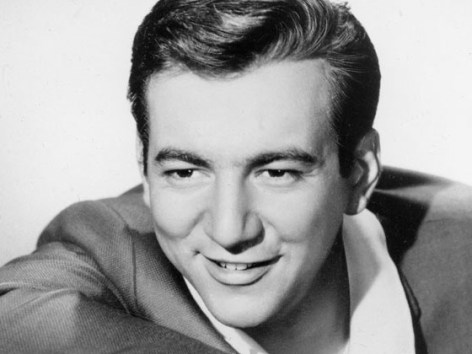
Bobby-Darin

There are two little things of note, though, that we should point out here. I mentioned in my post on ‘Hoots Mon’, back in November ’58, that the production on these chart-topping singles was getting more substantial, beefier. And I have to admit that on ‘Dream Lover’, and to a lesser extent on ‘When’, I’m getting a hint of the ‘Wall of Sound’ technique – Phil Spector and all that – which will be all the rage in three or four years. Listen to the crashing symbols that precede the final verse and chorus here, and you’ll see what I mean. Interestingly, this song was engineered by Tom Dowd, a pioneer of multi-track recording. So there could be something in that…

And finally, while this is a wonderful record more than worthy of a month atop the UK Singles Charts… something has been nagging at me for a while now. Are our #1 singles growing more and more lyrically banal? Let’s explore. Drag your minds back to the dark and smoggy days of pre-rock and yes, song lyrics were probably pondering weightier issues: I believe for every drop of rain that falls, A flower grows… Or Three coins in the fountain, Which one will the fountain bless…? Or I saw her face and ascended out of the common place, into the rare, somewhere in space… from ‘Brainiest #1 Yet’ ‘Stranger in Paradise’. Or they at least talked of love in slightly flowerier, more abstract terms. And there haven’t been any out-of-place, soundtrack songs like ‘Hernando’s Hideaway’ or ‘The Man from Laramie’ with lyrics about sharp-shooters and speakeasies hitting the stop spot recently.

In 1958-9, while there are anomalies like ‘Smoke Gets in Your Eyes’ and ‘The Day the Rains Came’, it’s mainly all Dream lover, where are you…? All I have to do is dream… And Goodness gracious great balls of fire…! Simple, immediate stuff. Is this a bad thing? Rock ‘n’ roll may have dumbed things down a bit, but its brought an immediacy to our chart-topping hits. Everyone can relate to someone sitting at home wishing for a dream lover. Not everyone can relate to She wears red feathers and a huly-huly skirt… I’m all for it really. And that’s probably a good thing, as our next #1 takes simple to the next level.

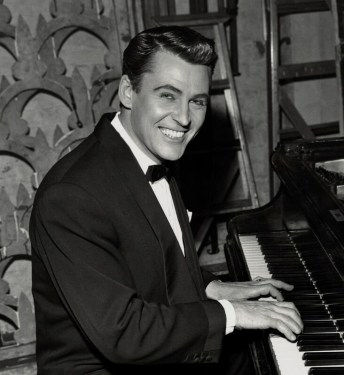
86. ‘Roulette’, by Russ Conway

I think we’ve heard this record before… ‘Roulette’ may, in fact, be identical to Russ Conway’s first number one. Or it may sound completely different. Who knows? Who even cares?

71zX-m93JPL._SX355_

Roulette, by Russ Conway (his 2nd of two  #1s)

2 weeks, from 19th June – 3rd July 1959

Actually, they do sound the same. Same perky piano, same lightly strummed guitar as accompaniment. In fact, to illustrate my point, let me quote verbatim from my post on ‘Side Saddle’ (which was #1 barely two months before):

“Upon first listen of this latest chart-topping record, two questions spring immediately to mind: What is this? And why did it spend a whole month at the top of the charts? It’s an instrumental, Mr. Russ Conway tinkling away at his piano, and… that’s about it. It’s got a melody, which plods along pleasantly enough without going anywhere very far, and then it ends, in under two minutes.”

Swap ‘whole month’ for ‘two weeks’- and ‘pleasantly’ for ‘irritatingly’ because that’s the mood I’m in today – but you’re still pretty much there. This record is equally short, similarly jaunty, and is still searching for a tune that never quite seems to materialise. And why ‘Roulette’? Is it because the cascading notes that tumble at intervals throughout the song sound like a rolling roulette wheel? Or is that me putting way too much though in?

I think I hate this more than I did Conway’s first #1. It was bland; this is criminally perky and is played in an irritatingly high key. Plus those little flourishes at the end of every second note are starting to make me feel a little sick. Way, way back in one of my early posts I claimed the idea of the ‘shadow number one’ – the chart topping record that only gets there due to the reflected glow of a preceding hit. Frankie Laine had one when ‘Hey Joe’ followed the chart-humping ‘I Believe’. Rosemary Clooney had one with ‘Mambo Italiano’ hot on the heels of ‘This Ole House’ (though ‘Mambo…’ was probably the bigger record). Guy Mitchell had one in ‘Rock-A-Billy’ after his huge hit ‘Singing the Blues’. And now we have to suffer a second dose of Russ Conway because grannies across the land liked ‘Side Saddle’, and probably thought he looked like a nice boy.

roulette-featuring-russ-conway-piano-solo

In fact, for a ‘nice boy’ Conway led a fairly troubled life. Let’s face it, anyone who records songs of such fake jollity and forced perkiness is going to be a little screwed-up inside… Alcoholism, crippling self-doubt, a reliance on anti-depressants, an eighty (80!) a day cigarette habit – all of which can probably be attributed to his being gay but having to keep it hidden for fear of losing everything (shades of Johnnie Ray there). Unlike Ray, however, Conway remained fairly popular throughout his career, and was still performing publicly just two weeks before he died in 2000. He had actually sliced the tip of a finger off during the war, so it’s pretty impressive that he could play the piano at all I suppose.

God, I have been a little harsh on ole Russ here, haven’t I? I just had a quick listen to some of the other hits from his late fifties heyday – the likes of ‘China Tea’ and ‘Party Pops’ – in an attempt to redeem his chart career. But. I’m sorry to confirm that they ALL. SOUND. THE BLOODY. SAME! In desperation I tried to look for some clue as to the inspiration for ‘Roulette’, but the Wiki entry is one line long and there ain’t much else out there. What little I could find all seemed to prefer this disc to ‘Side Saddle’ (come on, people!) But then I found this, and I started with a quote so I’ll end with one too.

Thanks to the guy(s) at fiftiesnumberones.blogspot.com – which I will wholeheartedly recommend as long as you promise to still read my blog – for their brilliant description of ‘Roulette’ as an ice-cream van jingle… “albeit an ice cream van plying its trade around the dusk tinged streets of a council estate on a late October evening. In the rain.”

<kiss fingers gif>

End post

85. ‘A Fool Such As I’ / ‘I Need Your Love Tonight’, by Elvis Presley

The King is back in the building. Buddy Holly replaced at the top by Elvis himself. What halcyon days!

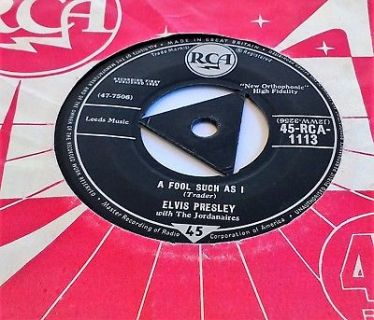
ELVIS-PRESLEY-A-FOOL-SUCH-AS-I-45-RCA-1113-1st-PRESS-7-VINYL

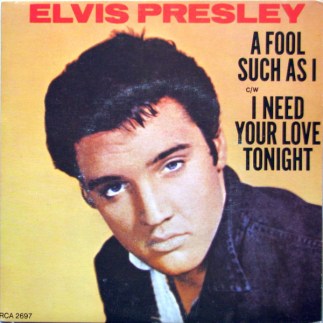
A Fool Such as I / I Need Your Love Tonight, by Elvis Presley (his 4th of twenty-one #1s)

5 weeks, from 15th May – 19th June 1959

One of these songs I’ve known for a very long time – since I got my first Elvis ‘Best Of’ way back when –so let’s start there. Now and then, There’s a fool, Such as I… I used to think that the scarily deep baritone that opens and closes this record was Elvis himself. It wasn’t, unfortunately. A chap called Ray Walker provided the voice, and it makes this whole track.

I really like this song. At least… I thought I did. I had it marked as one of my favourite ‘fifties-Elvis’ numbers, better than the silliness of ‘Teddy Bear’ or the mumbling verses of ‘King Creole’. Listening back to it now, though, I’m not so sure. The way Elvis sings it – he’s slightly restrained, slightly clipped… The vocals are weirdly ‘posh’, if you can imagine what I mean. There’s none of the growl he was giving us on ‘Jailhouse Rock’, and none of the saucy wink from ‘One Night’. It seems to me, listening to the song fresh after such a long absence, that Elvis might have been phoning it in here.

‘A Fool Such as I’ had been recorded before – back in the depths of the pre-rock era (AKA 1952), so perhaps Elvis had the original in the back of his mind as he enunciated, giving birth to the previously undiscovered Plummy Elvis. And while obviously everyone knows that Elvis phoned in pretty much everything he did between 1961 and ’68, it’s distressing to think that Elvis’s ‘phoning it in’ period might have started as early as 1959!

Still, the solo swings like I remember. And, to be fair, Elvis does let loose a little in the final verse. I’m a fool, But I love you dear, Until the day I die… And he just about redeems the whole thing by belting these lines out towards the end. He should, though, have been very grateful to Mr. Walker for his deep voice and to whoever was playing the guitar. They definitely helped paper over the cracks.

This record, and in fact all of Elvis’s early chart-toppers, are sometimes co-credited to The Jordanaires, AKA his backing singers. They also pick up some of the slack here (though I can’t remember even noticing them on songs like ‘All Shook Up’.) The Official Charts company don’t recognise them, however, so I won’t. But they’re there on the vinyl above, if you squint hard enough. I suppose it’s a case similar to the days when every record was ‘accompanied’ by an orchestra. I mentioned in a post a while back how the conductors of these orchestras had been airbrushed out of history, and it seems to be happening with backing groups now too.

R-3000802-1311243588.jpeg

On then to the song I don’t know so well. Tell the truth I’d never heard this before and, when I saw that it was called ‘I Need Your Love Tonight’, I feared the worst. Maudlin ballad ahoy! But no…

The piano comes blasting in, rolling like a runaway train. And Elvis? Well, he needs your love tonight. And not in a mopey, crooning-in-the-window-at-the-moon kind of way (as we recently heard in Connie Francis’s flip-side ‘Carolina Moon’). No siree. I’ve been waiting just for tonight, To do some lovin’ and hold you tight, Don’t tell me baby you needa go, I got the Hi-Fi high and the lights down low…

This is fun stuff. This is rock ‘n’ roll. This possibly should have been the lead track. And Elvis does sound like he’s having a little more fun here. I count an ‘Oh-oh’, an ‘Uh-uh’, an ‘Ooh-ooh’, an ‘Oh Gee’, a ‘Wowee’, a ‘Wow’, and a ‘Pow-Pow’ among the lyrics. There’s even a bit of a rhumba during the bridge. But it really is the flip-side of ‘A Fool Such as I’ – they were well-placed together – as in the former he is lamenting the woman he loved while in this he’s pulled himself together and is promising her a night she won’t forget. G’wan yourself Elvis!

I still, though, get the faintest tang of him phoning it in here, even on this little rocker. I may be wrong – I may be listening for something that just isn’t there – but I can’t help but feel like I’m getting a whiff. He still isn’t quite going for it in the same way he did just a few months ago on ‘I Got Stung.’

As a little aside, ‘I Need Your Love Tonight’ is listed several times on Spotify as being ‘Live’, though there is nothing in the recording to suggest that it was performed in front of an audience. The link below is, to the very best of my knowledge, the version that topped the UK charts in the spring of ’59.

This #1 pulls Mr. Presley level with Guy Mitchell and Frankie Laine as the acts with the most UK chart-toppers. They all have four, though Frankie Laine is still well out in front in terms of weeks-at-number-one (Elvis has eighteen weeks from four #1s; Frankie Laine got that many just from ‘I Believe’). And if you think that this means Elvis will be boosting ahead any time soon you’d be wrong – we won’t be seeing him again for well over a year.

Thus, we bid farewell to rock ‘n’ roll Elvis. It’s been nice meeting him, or rather rediscovering him. He’s off into the army now; and when we hear from him next it will be with something rather different.

84. ‘It Doesn’t Matter Anymore’, by Buddy Holly

First, a bit of history… On February 2nd 1959, a group of popular rock ‘n’ roll stars played a show in Clear Lake, Iowa, as part of ‘The Winter Dance Party’ tour. In order to avoid a long, cold bus journey to their next concert in Moorhead, Minnesota, some of the musicians chartered a plane. Though the weather that night was poor, the visibility terrible and the pilot unqualified to fly using only instruments, they took off regardless and minutes after take-off, just gone 1am on the morning of the 3rd, the plane slammed into a cornfield. All four aboard were killed instantly. They were the pilot Roger Peterson, J.P. Richardson (AKA The Big Bopper), Ritchie Valens, and Buddy Holly.

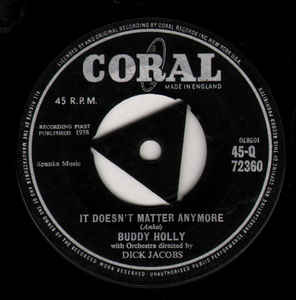
R-493764-1314372312.jpeg

It Doesn’t Matter Anymore, by Buddy Holly (his 1st and only solo #1)

3 weeks, from 24th April – 15th May 1959

All of which means that the eighty-fourth UK #1 single is the first ever to do so posthumously. Released a couple of weeks after Holly’s death, and hitting the top a full two months later, ‘It Doesn’t Matter Anymore’ gives The Father of Modern Pop Music (I know, I know, I’ve literally just made this title up; but I dare you to challenge me on it!) one final hurrah. Would it have topped the listings anyway – given that Holly was only twenty-two when he died and at the peak of his powers? Maybe… The manner in which it meandered up the charts suggests that this wasn’t some flash in the pan reaction to his death, while the peak positions of his previous two singles (#17 and #30) beg to suggest otherwise.

To the song… Some people make a lot of the rather nihilistic title as being somehow appropriate in the wake of his death. But it wasn’t suicide; so that’s always seemed a slightly strange angle to view this record from. No, this is a song about a break up: There you go and baby, Here am I, Well you’ve left me here, So I could sit and cry, We-ell golly-gee, What have you done to me, Well I guess it doesn’t matter anymore… His girl’s up and left him, but Buddy’s putting on a brave face: There’s no use in me a-cryin’, I’ve done everything and now I’m sick of tryin’, I’ve thrown away my nights, And wasted all my days over you…

The lines come thick and fast, the song rattles to a conclusion in a mere two minutes, and in the end BH has decided to shrug it off and move on: You go your way and, I’ll go mine, Now and forever till the end of time, I’ll find, Somebody new and baby, We’ll say we’re through, And you won’t matter anymore…

And it’s not what you would immediately imagine a Buddy Holly record to sound like. The only instruments here are violins and a lightly-tickled guitar – far removed from his more recognisable rock ‘n’ roll hits like ‘Oh Boy!’ and ‘Rave On’. Plus, despite all his fame as a songwriter and composer, this record was actually written by our friend Paul Anka.

investigators-may-reopen-buddy-holly-plane-crash-fdrmx

Despite the minimalist instrumental accompaniment and the fact that he didn’t write it, Holly still makes this record his own. Because? That voice. In the space of two minutes he finds room for all the tricks in his repertoire. Hiccups (…over you-ou-ou-ou-Ah-hoo…), snarls, times when his voice has a deep, gloopy quality and times when it is light as a feather. For all his talents as a guitarist and composer, Mr. Holly was a pretty decent singer too. And in the context of Buddy Holly’s solo songs, away from The Crickets, this slips in nicely along with other non-guitar led tracks such as ‘Everyday’, ‘Raining in My Heart’, and ‘True Love Ways’ (I know I’m going a bit link-heavy, but really everyone should take a moment out of their days to appreciate What Buddy Did For Us. Not for nothing did acts like The Beatles and The Rolling Stones start out by playing covers of his songs…)

You could also argue that this is, as well as being the first posthumous #1, the first ‘popular band member gone solo’ chart-topper. OK, ok, this was nowhere near Buddy Holly’s first single release as a solo-act but still… The fact that he did it paved the way for, let me see… Diana Ross, Michael Jackson, George Michael, Sting, Robbie, Geri, Zayn and many, many more.

But to finish, let’s go back to the night of February 2nd, 1959. The Day the Music Died. Some of the tales are semi (or perhaps completely) legendary. The fact that Holly only commissioned the plane because his drummer had caught frostbite on the freezing tour bus. That the Big Bopper only took a seat on the plane because he had the flu and wanted to get a good night’s sleep. (Let me include a link here to his biggest hit ‘Chantilly Lace’, featuring the filthiest laugh ever captured on record). Ritchie Valens won his seat on the plane in a coin toss with Holly’s guitarist Tommy Allsop. Allegedly – and I so hope that this is all true – Valens claimed it was the first thing he’d ever won, while Allsop went on to open a restaurant called ‘Heads Up’ (he’d called tails…) It was all immortalised in song by Don McLean some twelve years later. We won’t be meeting his version of ‘American Pie’ in this countdown, unfortunately, but we will be meeting the Madonna version. Which will be fun.

Anyway, let me leave you with one final link. Proof, perhaps, of Buddy Holly’s magic. Not only did he write gorgeous, timeless and immeasurably influential songs, but thirty five years after his death all Weezer had to do was stick his name on a song and they were blessed with a classic of their own.

83. ‘Side Saddle’, by Russ Conway

And so, The Winter of the Ballad, which I took such pains to introduce in my previous post, experiences a sudden thaw. Spring has sprung, and has brought with it a perky piece of piano-pop.

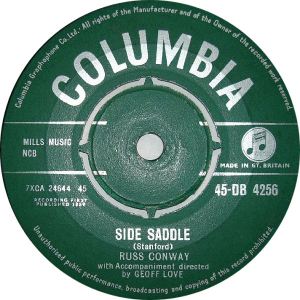
russ-conway-side-saddle-columbia

Side Saddle, by Russ Conway (his 1st of two #1s)

4 weeks, from 27th March – 24th April 1959

Upon a first listen of this latest chart-topping record, two questions spring immediately to mind: What is this? And why did it spend a whole month at the top of the charts? It’s an instrumental, Mr. Russ Conway tinkling away at his piano, and… that’s about it. It’s got a melody (of sorts), which plods along without going anywhere very far, and then it ends, in under two minutes.

The obvious comparison to draw here is with Winifred Atwell, who has already claimed two UK chart-topping singles with records sounding very similar to this. But Atwell at least had a kind of frantic energy about her piano-playing – you could picture her bashing out the hits with a smile and a bead of sweat rolling down her temple. Whereas you can only imagine Conway plodding his way through ‘Side Saddle’ with a cheesy grin-slash-wink combo. The other piano-led #1 single which springs to mind at this time is, of course, ‘Great Balls of Fire’. But to compare that record to this record is, to my mind, heresy of the highest order. There is a slight concession to rock ‘n’ roll here, in that someone in the background is tickling a drum kit in time to Conway’s piano, but that’s strictly it.

It’s a strange chart-topping record, this. At best I’d describe it as incidental music, or silent movie music: you can imagine it going down quite well as an accompaniment to Buster Keaton running down a railroad track. It is very 1932. Which means we have to pose a 3rd question: Why now? Why did this curio of a record zoom to the top of the charts in the spring of 1959? My research has thrown up no answers. It wasn’t an old song; it was written and released in ’59, apparently recorded for a TV adaptation of ‘Beauty and the Beast’ – which at least helps explain the olde-worlde feel of the song. There’s no clue as to how the melody concerns a horse-riding style popular with posh old ladies. According to Wiki “the song was a staple of the BBC’s ‘Housewives Choice’ radio programme”, which perhaps says more than anything I could ever write.

mw148586

Due to summer holiday commitments, this is the first time in over a fortnight that I have sat down to write one of these posts. In that time, I’ve listened to very little music, and the music I have heard has been radio-friendly, modern pop. Perhaps ‘Side Saddle’, then, is suffering from being the oldest record I’ve heard for a while. Perhaps if I were in the swing of things – in my mid-season form of writing a post every couple of days – it wouldn’t stand out so much. But then again… maybe not. I fear that, whatever way you look at it, this track is simply a relic. And, glancing down my list o’ number one singles… Oh, goody. There’s more to come from our Russ in very short order.

One final thing of note… If you click on the video below and discover a hitherto unrevealed love of bland, piano-based background Muzak, Spotify has the most extensive collection of Russ Conway back-catalogue ever seen. Like, seriously. There must be fifty-odd albums on there. Knock yourselves out!

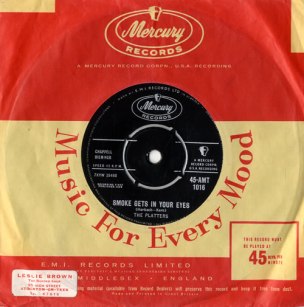
82. ‘Smoke Gets In Your Eyes’, by The Platters

I feel it is time to make one of my semi-regular proclamations about just where we are in popular music history. Remember back in March ’56 when I announced the beginning of the ‘The Post-Pre-Rock Age’ (i.e. after the pre-rock era but before the rock era had really got going)? Or when we killed off the first wave of rock ‘n’ roll in early ’57? Or when we passed through the ‘Age of Whistling’ a year or so ago? Well… What with The Platters’ stately ‘Smoke Gets in Your Eyes’ now grabbing a week at the top, all but one of 1959’s four chart-toppers have been ballads.

THE_PLATTERS_SMOKE+GETS+IN+YOUR+EYES-562934

Smoke Gets in Your Eyes, by The Platters (their 1st and only #1)

1 week, from 20th – 27th March 1959

Elvis aside, we’ve had Jane Morgan’s ‘The Day the Rains Came’ (very jazzy, but still what I’d class as a ballad) and Shirley Bassey’s ‘As I Love You’, plus Conway Twitty’s ‘It’s Only Make Believe’ from the tail-end of last year further slowing things down at the top, and this record does nothing to change the tempo. I’m not sure that this four-month stretch qualifies as an ‘Age’ or an ‘Era’, but I feel confident enough in christening it ‘The Winter of the Ballad’.

I’ve been a bit harsh on ballads recently. I didn’t hate either the Jane Morgan or the Shirley Bassey efforts, but they did rather pass by without grabbing me. I think it’s because, while you can chuck a load of guitars and drums at a rock song and usually come out with something passable, ballads are a lot more delicate. They can be great, or they can go really, really wrong. Lay the strings on a bit thick, let the singer go a little too wild with the vocal gymnastics, or have the writers get too schmaltzy with the lyrics, and you’ve got a mess on your hands. But this… now this is a ballad that gets it RIGHT.

It starts slowly. No dramatic swirl of violins or crashing cymbals. Just a piano, and a voice. They… Ask me how I knew, My true love was true, Oh…. I of course replied, Something here inside, Cannot be denied… The singer is sure that his woman loves him; his friends are less convinced. The singer scoffs. But…

Yet today, My love has flown away, I am without… My… Love… His friends – who sound like dicks, by the way – laugh at him and his misplaced confidence. His reply? I smile and say, When a lovely flame dies, Smoke gets in your eyes…

the-platters

What’s the difference then, between this ballad and the one it replaced at #1: ‘As I Love You’? If pressed, I’d have to say the lyrics. While Shirley Bassey was singing – albeit very beautifully – some trite lines about the thrill of being in love; this song employs some great imagery. Your heart’s on fire – smoke gets in your eyes and stops you from seeing clearly. The flame is extinguished; smoke gets in your eyes and makes you cry…

Still, though, there is a big, bombastic ending – the title of the song belted out at the top of the singer’s voice – which spoils things slightly. I just have to accept that it was the style of the time. It’s a great song, however; a classy song. A classy classic. And a ‘classic’ it truly is, having first been recorded back in 1933. It seems to have been something of a tactic in the late fifties – getting modern singers to record updated versions of songs from the twenties and thirties (Connie Francis did it on ‘Who’s Sorry Now’ and ‘Carolina Moon’, while Tommy Edwards borrowed an old melody for ‘It’s All in the Game’) to lure in both the kids and their parents.

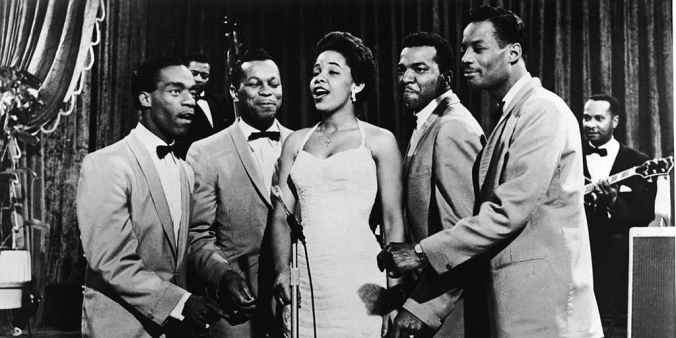
This is The Platters’ one and only appearance at the top of the UK charts, but that does their reputation something of an injustice. They had had several Top 10 hits before this, and were the foremost vocal group in the US – quite an achievement considering that they were five black guys and a girl, and that this is the 1950s we’re talking about. They are still rolling on to this day, albeit with enough line-up changes to make The Sugababes look steady (Wiki lists ten past members).

Unlike the earlier tear-jerkers that have made up this ‘Winter of the Ballad’, I had heard this one before. I’m sure most people will have. It’s one of those songs that have become part of life’s backing track. And to know a song without knowing how you know it – as I’ve said before – is a sure-fire sign that said song is a stone-cold classic.

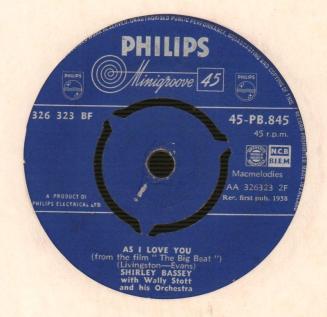
81. ‘As I Love You’, by Shirley Bassey

And so – as happens every once in a while on this countdown – we meet a legend. A British legend, at least. And not ‘British Legend’ as in Robin Hood or Merlin or anything like that. No, no, no. I mean ‘British Living Legend’ – as in Barbara Windsor, or David Attenborough, or Sir Clifford of Richard. People so woven in to the very fabric of British life – of Saturday evenings on ITV and audiences with the Queen – that everybody upon everybody upon everybody knows them.

7M_1369_2

As I Love You, by Shirley Bassey (her 1st of two #1s)

4 weeks, from 20th February – 20th March 1959

Dame Shirley Bassey is one of these people (she is a Dame after all), and the foundations of her ‘National Treasure’ status were laid right here: in the singles charts of the late 1950s, and in this polished and expertly sung record. It’s a very good song: a grown-up ballad of a pop song. But, and after that big old build up I feel a bit bad writing this… I’m not really feeling it.

It starts with a flourish, and then: I will love you, As I love you, All my life… Ev’ry moment spent with you, Makes me more content with you… She loves a guy. Loves him a lot! Ev’ry single, Touch and tingle, I adore… Ev’ry kiss from you to me, Always seems so new to me… Each one warmer, Than the one before… It’s a love song in the very purest sense – in that it’s a song about being utterly in love. Which is nice, I suppose. There’s certainly a real sparkle in her voice, with just the cutest whiff of a Welsh accent, and if the quality of her singing were being judged by a panel then she might just sweep the board. And the ending… My that ending. She gives it everything, and then some. AND MOOOORRRREEEE…. It’s another real throwback of a record, following hot on the heels of Jane Morgan’s – albeit somewhat jazzier – ‘The Day the Rains Came’.

18

Why, then, am I struggling to like this song? Well, it wouldn’t be the first time I’ve failed to really ‘get’ one of the many old-time ballads that we’ve featured thus far. ‘Stranger in Paradise’, ‘Secret Love’ and ‘Three Coins in the Fountain’ were all records that somewhat passed me by, and that’s before we get to the God-awful Eddie Fisher and David Whitfield efforts. ‘As I Love You’ is nowhere near as terrifying as anything by either of those chaps, but I’ll have to file it under ‘Can appreciate; Can’t enjoy.’

The situation isn’t helped by the fact that I originally found a version of ‘As I Love You’ that was much jazzier, much snazzier, and sung at a much higher tempo. I was all prepared to write a post championing it as one of the best tracks so far – it really was that good. It sounded so modern that I was going to announce it as the first ‘1960s Number One’. But something nagged at me as I listened. Something sounded too good to be true… And it was. The version I had been listening to – click here for a listen, it’s good isn’t it? – was a re-recording from, I’m guessing, the late sixties / early seventies. Sigh.

But! We shouldn’t judge a record by what it is not. ‘As I Love You’ is the first chart topper by Dame Shirley of Bassey, the foremost British female voice of the past half-century, the yin to Sir Cliff’s yang (and note that she got to the top a good few months before Cliff ever did). She will only get one (one!) more chart-topper and I will perhaps shock you when I reveal that it is neither ‘Goldfinger’ (#21), nor ‘Big Spender’ (#21) nor ‘Diamonds Are Forever’ (#38!), but something else entirely. Stay tuned.

It is also the very first Welsh #1, meaning that we finally complete our ‘British Isles Chart-Toppers Map’ by adding Dame Shirley to hits from The Stargazers (England), Ruby Murray (Northern Ireland) and Lonnie Donegan (Scotland). So – this record is many things. And yet… It could have been, and later was, so much more!

80. ‘One Night’ / ‘I Got Stung’, by Elvis Presley

Elvis would like a night with you. One night, with you, Is what I’m now prayin’ for, The things that we two can plan, Would make my dreams come true… How could you resist?

71bdldPnkYL._SX355_

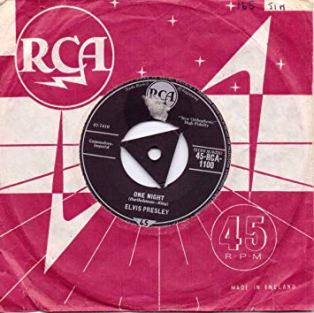
One Night / I Got Stung, by Elvis Presley (his 3rd of twenty-one #1s)

3 weeks, from 30th January – 20th February 1959

I bemoaned the fact that our last #1 promised raunch but failed to deliver. Here, though… Well, Elvis doesn’t let us down. We’re calling out names, demanding helping hands, and worrying about a love that’s ‘too strong to hide’ (Oo-er. Does he mean he can’t hide his feelings; or a more physical manifestation of his amour…?) Lyrically, this is a cousin of Johnnie Ray’s barnstorming ‘Such a Night’, with the listener left in no doubt about what the singer intends to do all night. Except Johnnie had had his night and was wallowing in the memory; Elvis is still waiting and praying.

The highlight of this song is the bridge, where Elvis really lets loose: Always lived, A very quiet life, I ain’t never, Did no wrong… Now I know, That a life without you, Has been too lonely too long… It’s such an accepted fact – that Elvis Presley had a great voice – that you take it for granted. And if you picture him in his later years, when his throat was all clogged up with junk food and prescription drugs, you might wonder if he really did have that wonderful a voice. But listening to those lines, the way he snarls and howls, you realise that he was indeed a very fine singer. Listening to him like this, amongst his 1950s contemporaries, he really does stand out. He sounds like a modern rock star, while his peers often still sound clipped and plummy. His only true rival in the voice stakes, from the eighty numbers ones we’re covered so far, is the aforementioned Mr. Johnnie Ray.

Beyond the voice, however, this is a pretty simple record. A guitar, a bass and some drums. I haven’t really listened to it in years, and had misremembered it as being rockier, somewhat heavier. It’s something I’ve mentioned already, how these ancient records sound much more lightweight than you expect – probably thanks to bass heavy, headphone filling modern pop.

And ‘One Night’ brings to an end our mini-run of ‘one’-hit wonders topping the charts. Because, frankly, Elvis Presley is the polar opposite of a one-hit wonder. He’s the most-hits wonder, this being his 3rd of twenty-odd number ones. Actually, ‘One Night’ was also his 20th number one single, what with it hitting the top on re-release in 2005. It’s nice to think – lazy sod that I am – that I can just copy/paste this whole post when we arrive at January 2005. Which should be sometime in 2027, if I keep up my current pace… I’ll be in my forties… That’s not a daunting thought at all…

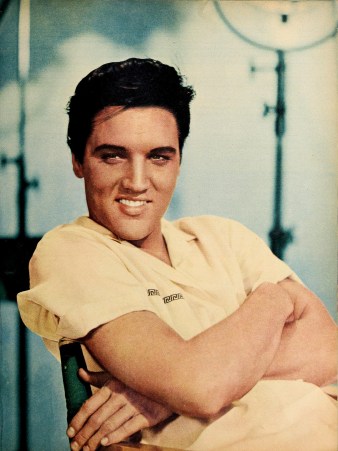
Elvis_Presley_-_Modern_Screen,_June_1958

To the other song, then, on this double ‘A’ disc: ‘I Got Stung’. I complained when covering Connie Francis’s recent double ‘A’-side that the insipid flip side (‘Carolina Moon’) failed to in any way live up to the corking ‘Stupid Cupid’. No such worries here, though. Elvis ain’t takin’ it easy…It begins with an exclamation: Holy smokes and snakes alive I never thought this could happen to me! Hello! Yes! We’re awake!

I know my Elvis, but I wasn’t so familiar with this little rocker. It’s simple enough: girl as honey bee; guy gets stung. There’s a rollicking piano, a chugging rhythm (the bass here being really deep and pretty scuzzy), lots of uh-huh-huhs and oh yeahs. This is what you might imagine an Elvis record sounding like if you had never really listened to him before.

Well now don’t think I’m complainin’, I’m mighty pleased we met, But you gimme, One little peck on the back o’ my neck, And I break out in a cold, cold sweat… There’s a great balance in these words – they’re down-home American enough without ever sounding corny. I’d transcribe more of them if I could, but El is mumbling away here. They’re possibly the most difficult-to-make-out lyrics we’ve met so far on this countdown. And it’s also the shortest record we’ve encountered: he races through several verses, bridges and choruses in a little under one minute fifty.

And so – Holy smokes and snakes alive! – our third meeting with The King careers to an abrupt end. Uh-huh-huh! Yeah! Done. Our night with Elvis is over. He might call you again; but he probably won’t…

79. ‘The Day the Rains Came’, by Jane Morgan

So what do we have here, then, for the first #1 of 1959? Well, the intro is promising: trumpets, saxophones…? Some kind of brass section at least. Ba-da-da-da-da-da-da…Bum-bum-bum… I would describe it as an intro you could strip to, if that weren’t being slightly tasteless.

s-l300 (2)

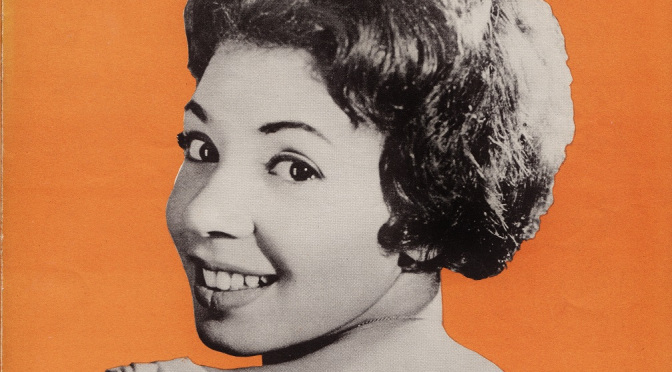
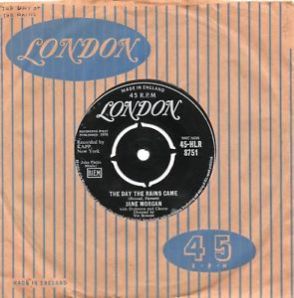
The Day the Rains Came, by Jane Morgan (her 1st and only #1)

1 week, from 23rd – 30th January 1959

Does the rest of the song live up to this saucy promise? Well, no. Not if you truly were expecting some kind of chanson d’amour. The title kind of gives that much away. It’s a song about rain, flowers, and crop cycles: The day that the rains came down, Mother Earth smiled again… Now the lilacs could bloom, Now the fields could grow greener… Further lyrics follow about buds being born and rivers swelling.

It’s an extended metaphor of a song – all the nature that is blooming is mirrored in the love blooming between the singer and her beau. As the young buds will grow… So our young love will grow… Love sweet love… Morgan’s voice is prim and clipped, harking back to the era of Doris Day and Vera Lynn. She sings it crisply, and properly, but it does come across as rather old-fashioned. She’s no Connie Francis, that’s for sure.

It’s reminiscent in many ways of singers like Jo Stafford and Kitty Kallen, jazz-pop from the very earliest days of the chart. Listen to the bridge in particular, the lines that begin: A robin sang a song of love, A willow tree reached out to the heavens… and tell me that it doesn’t reek of 1954. And the ending… Oh the ending. Ms. Morgan absolutely belts it out – Raaaaiiiiinnn Sweeeeet Raaaaaaaaaaiiiiiinnnnnn! – in a way that nobody else on a chart topping record has done for years. Is this perhaps our first throwback record? The first chart-topper that is intentionally harking back to days gone by, years before acts like Showaddywaddy, Shakin’ Stevens and, erm, Oasis? It certainly wasn’t an old song, having been written, originally in French, and recorded in 1958.

EDZ_mereyjanemorgan

I don’t dislike this record. The instrumentation is great, with a real swagger to the drums and brass. It’s just a shame that the lyrics are so wishy-washy. It’s technically ‘The Day the Rains Came Pt I’, as Part II is the same song sang by Morgan in the original French. Which is better to listen to, in a way (as long as you don’t understand French), as you can imagine that she is singing the saucy lyrics that the music is crying out for.

This may also be the first occurrence in the UK singles charts of a ‘January Number One’ – a record that takes advantage of the usual post-Christmas drop in sales to sneak a week or two at the top. It was a regular thing from the seventies through to the nineties, and can still happen today – see Eminem’s ‘River’ from January this year. And I’ve mentioned before how much I admire a good ‘one song-one week’ chart-topping record. Jane Morgan hadn’t troubled the upper reaches of the UK charts, let alone the number one spot, before this and wouldn’t do so again. And – following on from Tommy Edwards, Lord Rockingham’s XI and Conway Twitty – I make her the fourth consecutive one (ish) -hit wonder chart topper!

To conclude, then. This is a nice enough diversion, a snazzy little jazz pop number; but one which sounds pretty out of place as the first #1 of 1959. Let’s get back on track, shall we…

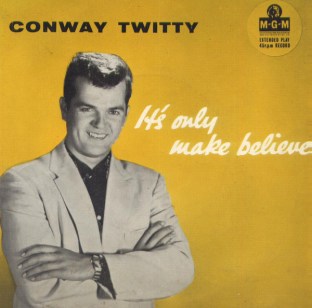
78. ‘It’s Only Make Believe’, by Conway Twitty

Before we begin writing anything about this record, let’s take a minute to appreciate the name of the man who recorded it… Mr. Conway Twitty. It’s a strange name – ‘Conway’ being quite rugged and windswept, and ‘Twitty’ being somewhat less so. It’s a name you don’t forget in a hurry; which I suppose is a good thing in show-business.

R-7902310-1451306561-6539.jpeg

It’s Only Make Believe, by Conway Twitty (his 1st and only #1)

5 weeks, from 19th December 1958 – 23rd January 1959

And note! I’ve finally – seventy-eight number ones in! – managed to locate some genuine cover art to stick at the top of my post. This, I am strongly led to believe, was the genuine cover that people would have seen in British record stores when they went to pick up their copies of ‘It’s Only Make Believe’.

To the song. A guitar strums… People see us everywhere… Another strum… They think you really care… Strum… But myself I can’t deceive… I know it’s only… Make… Believe… Conway loves a gal, but she ain’t lovin’ him back. Bizarrely enough, it sounds quite like the intro to ‘Runaround Sue’ – but that’s a story for another day.

My only prayer will be, Some day you’ll care for me, But it’s only Make… Believe… Is she using him to get back at an ex? Is she leading him on? Is she just a tease…? The reasons as to why they are leading this pretend-life remain tantalisingly out of reach. But Conway’s got it bad. His heart is a-achin’.

This is a rock ‘n’ roll ballad. We’ve toyed with the concept up to now. Was ‘It’s Almost Tomorrow’ the first? Or was it ‘Young Love’? Or was it neither? Because this is heart on your sleeve balladry. This is the real deal, and the starting point for all manner of Bon Jovi / Aerosmith-type fist clenching, air-punching soft-RAWK. Not that it actually sounds anything like a late ’80s power ballad; but mark my words – the seeds are being sown. The lyrics are super-overwrought: lots of my all, my everything, I’d give my life for you etc. etc. But Twitty sells it, just about, with some top-notch wailing. You really believe that his heart is cracking in twain as he sings.

This is also, I’m pretty confident in saying, our first slice of country rock at the top of the UK charts. We’ve had country before – a bit of Frankie Laine here, a little Slim Whitman there – but this is rock ‘n’ roll with a country twang. The Eagles, Dolly and Shania, even Tay-Tay before she went basic, stem from this kind of thing.

I know, I know… That’s a very bold statement. But it’s useful, as we reach the end of 1958, to take a step back and admire the bigger picture. We’re over two years into the ‘rock’ age and, as I’ve commented on several recent chart-toppers, there is more and more of a fusion going on. Songs like ‘The Story of My Life’, ‘All I Have to Do Is Dream’ and ‘It’s All in the Game’ topped the charts this year, and were all pop songs – hummable, easy listening numbers – with a distinct whiff of rock ‘n’ roll. The year started out with two utter classics – tracks one and two on Now That’s What I Call Rock N Roll: ‘Great Balls of Fire’ and ‘Jailhouse Rock’. Since then, though, the overriding theme of 1958 has been one of much ‘blander’ rock ‘n’ roll. And so ‘It’s Only Make Believe’, is in many ways the perfect track to round the year off – a rock song much more likely to appeal to mum, and gran, than the kids.

twitty2

The worst thing about this whole record is that Conway Twitty was not the singer’s real name. Boo! He was actually one Harold Jenkins, and apparently got his stage name after blindly opening a map and finding a town named Conway in Arkansas and one called Twitty in Texas. So far, so C&W. ‘It’s Only Make Believe’ was his only big success on the UK charts, so I make it three-in-a-row in the one-hit wonders stakes. He stumbled through the 1960s before becoming an absolute demon on the US Country Charts in the ’70s and ’80s, with hits like ‘Tight Fittin’ Jeans’ and ‘Red Neckin’ Love Makin’ Night’. Yee-haw! Best of all, he lived in a self-built multi-million dollar ‘country music entertainment complex’ called, wait for it… ‘Twitty City’. He died in 1993, aged but fifty-nine.

We’ll leave him here, caterwaulin’ us into 1959, the final year of the decade that gave us rock ‘n’ roll, Elvis, Buddy and Jerry Lee. Beyond that lie the 1960s, and nothing much of musical interest happened then. Did it?