Another trip back in time then, with my second ever ‘Today’s Top 10’ (we went back to 1970 a few months ago – check it out if you have the time). This time I thought we’d go back to the summer of 1967… AKA The Summer of Love, in which for a few months the hippy ideal looked like perhaps becoming reality. Three very famous flower-power anthems topped the charts that summer, and all three are on this chart, dated 26th July-1st August 1967. But was the rest of the Top 10 as awash with peace and love? Let’s find out…


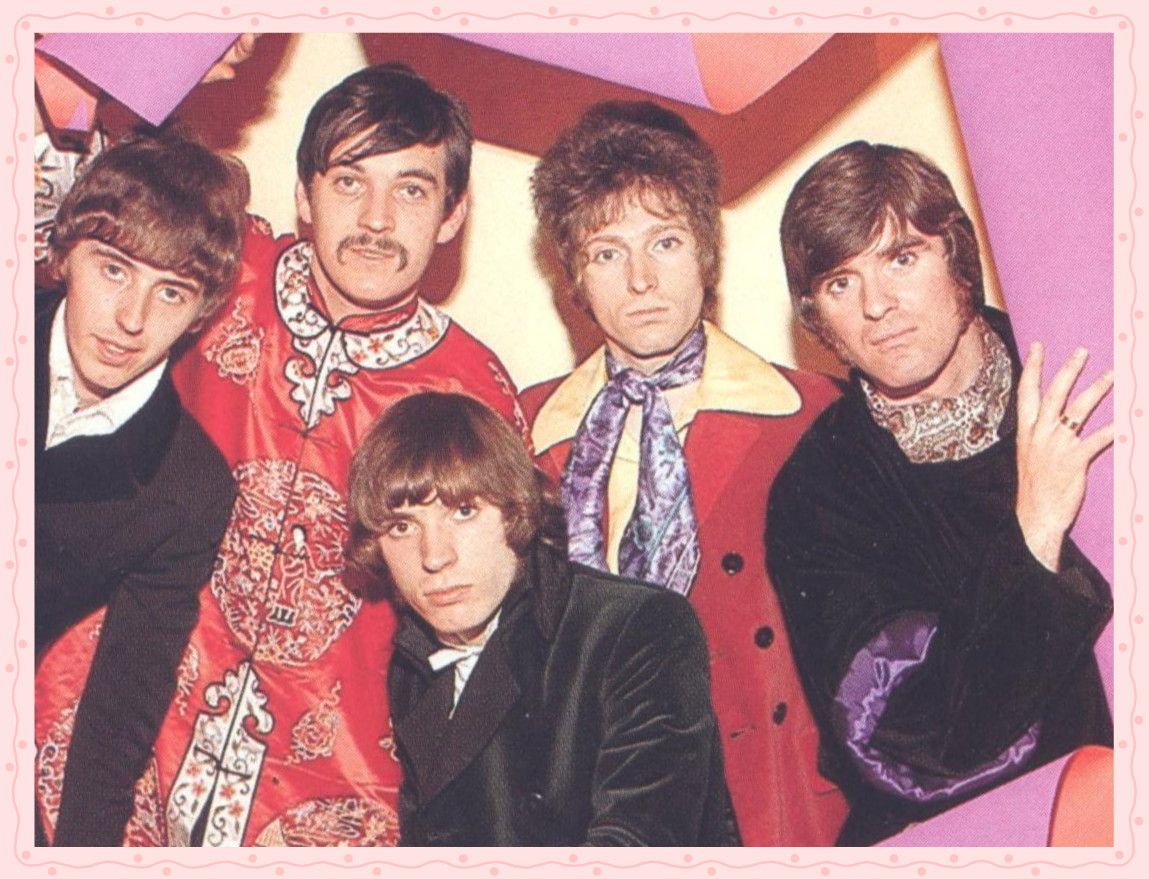
#10 – ‘Death of a Clown’, by Dave Davies (up 13 / 2 weeks on chart)
We start with a couple of big climbers, as Dave Davies’ debut solo effort enters the Top 10 this week. ‘Death of a Clown’ often gets classed as a Kinks’ song, and in fairness it does feature all four Kinks playing on it, and it did appear on the album ‘Something Else by the Kinks’. But it charted as a Dave solo number, with Ray contributing the la-la-la refrain, sung by his then wife. Its subject matter is that old rock ‘n’ roll chestnut – the grind of endless touring: I’m drownin’ my sorrows in whisky and gin… Dave Davies, who often chafed under his big brother’s domination of the group’s songwriting, had hoped that this song’s success (it would peak at #3) might lead to a solo album, but it didn’t. As a starter for our 1967 countdown it doesn’t scream ‘Summer of Love’, but Davies’ cravate in the video below is possibly the perfect encapsulation of the phrase ‘baroque pop’.
#9 – ‘Up, Up and Away’, by the Johnny Mann Singers (up 17 / 3 weeks on chart)
A bit more like it, now. An appropriately high climb for the Johnny Mann Singers going ‘Up, Up and Away’ in their beautiful balloons. It’s hardly the height of psychedelia, and it has much more of an upbeat, cabaret cheesiness to it, but it could also serve as a metaphor for indulging in some mind-bending substances. Most of the world knows it as a hit for the 5th Dimension but their version didn’t chart in the UK, leaving the coast clear for composer/arranger Johnny Mann and his singers.
#8 – ‘There Goes My Everything’, by Engelbert Humperdinck (down 2 / 10 weeks on chart)
Hang around the charts of 1967 long enough, and sooner rather than later you’ll come across Engelbert Humperdinck. He had two monster #1s, ‘Release Me’ and ‘The Last Waltz’, with this #2 smash sandwiched in between. ‘There Goes My Everything’ had been a huge US country hit for Jack Greene, before The Hump brought it to the pop charts. There’s more than a whiff of ‘The Green, Green Grass of Home’, a massive success for Tom Jones a few months earlier. Not very ‘Summer of Love’ but, let’s be honest, who could say no to a night of passion with this magnificent pillow-lipped crooner.
#7 – ‘A Whiter Shade of Pale’, by Procol Harum (down 3 / 10 weeks on chart)
Aha! Here we are then. One of the big three Summer of Love anthems, which had been at number one for six weeks and was now on its way down the chart. A stone cold, all-time classic which I’ve already named as one the Very Best #1s. Not much more to say, other than read my original post on it here, and give it a play regardless of how many times you’ve heard it before.
#6 – ‘See Emily Play’, by Pink Floyd (up 2 / 6 weeks on chart)
And if Procol Harum weren’t trippy enough, here is some true psychedelica from up and comers Pink Floyd. Written by founder member Syd Barrett, about a girl that he had seen in a forest while tripping on LSD. It is a deeply strange pop single, with lyrics about losing your mind, a demented harpsichord break, and a discordant, feedback-drenched solo. It was only their second single, and Barrett was opposed to releasing it as he didn’t think it was up to scratch. He would leave the band only a few months later, with mental health problems possibly brought on by drug use, and became a famous recluse. Pink Floyd meanwhile went on to release some of the biggest albums of the ’70s. They didn’t release many singles, though, and the next time they visited the Top Ten was with their surprise 1979 Christmas number one, ‘Another Brick in the Wall Pt. II’.
#5 – ‘She’d Rather Be With Me’, by The Turtles (up 2 / 7 weeks in chart)
Into the Top 5, with one of the decade’s great forgotten pop records, by one of the decade’s great forgotten pop groups. If the Turtles have made it into the public consciousness, then it’s for the single that they released just before this, the Billboard #1 ‘Happy Together’. Surprisingly for a song that constantly pops up in movies and on TV as shorthand for ‘The Swinging Sixties!’, ‘Happy Together’ only made #12 in the UK. Perhaps buoyed by that song’s greatness, ‘She’d Rather Be With Me’ went all the way to #4 later in August ’67. And for my money, it’s even better. Chunky production, unashamedly cheerful lyrics, cowbells, and a big, brassy marching band finish crammed into a little over two minutes. The Turtles would have one further Top 10, ‘Elenore’, which they wrote as a parody of ‘Happy Together’, but which manages to be even more ludicrously catchy.
#4 – ‘Alternate Title’, by The Monkees (down 2 / 4 weeks on chart)
Even The Monkees get into the spirit of the time, releasing a record as trippy as anything a better respected band might have put out. ‘Alternate Title’ is a very literal name for this record, as it was released elsewhere as ‘Randy Scouse Git’. (RCA refused to put it out in the UK with that name, as it sounded “somewhat rude to a British audience”.) Micky Dolenz had heard the phrase on the sitcom ‘Till Death Do Us Part’, which British audiences had somehow managed to watch without reaching for the smelling salts. If the Monkees were better respected, then the lyrics to this might warrant as much chin scratching as ‘American Pie’. It’s a bonkers record, with the verses telling the story of a party, referencing The Beatles (the four kings of EMI), the model – and Dolenz’s future wife – Samantha Juste (the being known as ‘Wonder Girl’), and Mama Cass in a yellow dress. The shouty chorus meanwhile represents the establishment yelling at the youth of the day (why don’t you cut your hair?!). And when I call it ‘bonkers’, I mean it in the best possible sense of the word.
#3 – San Francisco (Be Sure to Wear Some Flowers in Your Hair), by Scott McKenzie (up 2 / 3 weeks on chart)
On its way to the top, another anthem for the Summer of Love: an ode to the city where it all began. In fact, ‘San Francisco’ was written as promotion for the Monterey International Pop Festival, held in June that year. So it’s basically an advert… which isn’t super compatible with the hippy ethos, but hey ho. It worked, and young folks flocked to the city that summer, many with the requisite flowers in their hair. Of the three Summer of Love anthems, this one is perhaps the most stuck in that time, and hasn’t transcended to become an all-time classic. But it’s hard to argue with that sweet, wistful melody. Read my original post on it here.
#2 – It Must Be Him (Seul Sur Son Etoile), by Vikki Carr (up 1 / 9 weeks on chart)
Just to remind us that the singles chart is at heart a collection of songs ordered by cold, hard data, with no interest in the trends of the time, this was the #2 single as the Summer of Love reached its peak. American Vikki Carr provides the easy-listening filling between two hippy anthems, with a tune originally written and sung in French. In ‘It Must Be Him’, Carr – who has a lovely, strident voice – waits by the phone hoping her ex will call: Let it please be him, Oh dear God, It must be him, Or I shall die... I’d suggest Vikki might have played it a bit cooler, if only because all that talk of death and God probably brought this close to a BBC ban…
#1 – ‘All You Need Is Love’, by The Beatles (non-mover / 3 weeks on chart)
In the middle of a 3-week run at the top, this chart’s third, and perhaps ultimate, flower-power anthem. You can read my original post here. (I can’t remember what I wrote five years ago, but I’m sure it was largely positive!) Listening again now, I’m struck by how much fun this record is. From the opening bars of La Marseillaise, through Paul’s ‘all together now’s, the snatches of Bach, ‘Greensleeves’, and ‘In the Mood’, to brief glimpses of ‘Yesterday’ and ‘She Loves You’, the worthy message is dressed up in a lot of singalong fun. Brian Epstein, who would die just a few weeks later, described the band’s performance of the song for the ‘Our World’ television link-up as their finest moment.
So I’d say half the Top 10 for this week in July 1967 does the Summer of Love (and LSD) proud. The other half is more standard sixties: middle-of-the-road ballads, quality pop, and some high-grade crooning. Hope you enjoyed this detour, and I’ll do another one before the year is out.
 The UK Number Ones Blog
The three MOR tunes are pretty so-so, but you can’t find much fault with the others. I remember going totally nuts on ’She’d Rather Be With Me’ (always wish it had been a little bit longer), earlier this year found a very poor quality clip from TOTP on Youtube which I remember seeing the day it went out, it brought back all those memories again – and still sounds great. And ‘Death of a Clown’, I learned this and worked out the chords on guitar at the time (it must have been one of the first songs I did that wasn’t an old folk standard). I’d more or less forgotten about it for years when I suddenly remembered it at one of our music sessions a couple of weeks ago and, blow me down, I remembered every word and chord. Most of these songs are absolutely timeless.
>
Yes, this is a very strong chart. I don’t know if it’s because they very deliberately set out to do so, but The Turtles could seemingly conjur up the perfect pop song whenever needed. Even ‘Elenore’, with its intentionally lazy songwriting, works perfectly. And like you said, the only problem with ‘She’d Rather Be With Me’ is that it’s too short. Still, always leave them wanting more…
I’m very conservative personally, but I’m fascinated with the ebbs and flows of social and cultural history. Considering that, at every moment, there are millions of people having completely different life experiences, it’s wonderful (in both senses) that they all don’t just cancel each other out and that a distinct “mood” can arise. Especially in particularly distinctive moments such as the Summer of Love.
I literally only discovered See Emily Play this week, wonderful song. Also A Whiter Shade of Pale. But for some reason, doubtless irrational, I’ve always hated All You Need is Love.
My favourite psychedelic song is Hall of Mirrors by the Celtic rock group Horslips, I recommend it.
Thanks for commenting! I can see why ‘All You Need Is Love’ might grate, but for me personally I think The Beatles pull it off well, even with the cheap and cheesy message. I shall check out your psychedelic recommendation!
What a great top 10, even Englebert sounds so much better than his modern day contemporaries like Sheeran. How sad to compare it with the charts of 30 years later that you’re working through at the moment, when the children or grandchildren of the generation that put the Beatles, Pink Floyd and Procol Harum in the top 10 were patronising the likes of Groanin Ronan, with the horrors of Westlife and B*Witched just around the corner. Only a handful of good number ones left in the 90’s, and, apart from the debut of a certain Miss Spears , they’re all by artists who’ve been around for years in one guise or another. What happened?
As much as I don’t want to defend Sheeran, or Boyzone for that matter, this was a particularly strong Top 10. Search for a slightly different week in 1967 and you’d probably get a lot more Engelbert, Des O’Connor, Tom Jones, Andy Williams clogging things up… What I want to work out is why the charts of the late nineties went so all-out, cheesy, primary coloured, bubblegum pop. I have one theory, which I might write about in an upcoming post, but really I’m not sure…
Interesting point. Must take issue with you putting Tom Jones and Andy Williams in the same category as Ed and Ronan though 😂! I know they were ‘easy listening’ and not in the same league as the Beatles etc but the more recent acts I’ve been bitching about aren’t fit to clean their shoes
Haha ok, Tom Jones has some genuine classics (as well as some utter kitschy nonsense), while Andy Williams – who I admit to not knowing so well – seems also to have some famous tunes, plus a lot of crooning… I think had Ronan Keating been around in the 60s he could have carved out a decent, easy-listening niche for himself.
“Death of a Clown” is great. The Beatles are The Beatles. I love both the Procol Harum and Scott McKenzie songs (I completely disagree that the McKenzie song is not a classic and has not transcended it’s era). The Monkees song is goofy, I like it. The Turtles song is absolutely fantastic, though “Happy Together” I like a bit better since it’s basically a masterclass of how to write and record a pop song. “See Emily Play” is so catchy – I’m surprised it wasn’t a bigger hit in the US despite the band promoting the song on American Bandstand. You had weirder, darker and trippier songs than that get Top 20 success in the US at this time like “I Had Too Much to Dream Last Night” by The Electric Prunes.
The less said about the Carr and Humperdinck songs – the coolest thing about the latter is his name – the better.
What I mean with ‘San Francisco’ not transcending its era is that Procol Harum and the Beatles would appear in a ‘Top 100 of all time’ list, while Scott McKenzie would probably feature on a ‘Top 100 songs of the sixties’ or ‘Top 20 flower-power anthems’ list. It’s still a great song, but it’s one that remains very much rooted in 1967.
I have to say too that of the Turtles three biggest hits, I like ‘Happy Together’ the least. That one goes almost too far in its catchiness.
I can see The Beatles issue. Wonderful though the records are, they’re too over-exposed – it’s the ‘how can we miss you when you never go away’ problem. I also adored ‘See Emily Play’ and loved it just as much at the time. Why could Floyd have not continued honing their skills into further decent songs of a digestible length instead of plaguing us with the self-indulgent snoozefests like ‘Ummagumma’ and ‘Atom Heart Mother’?
I’m glad I’m not the only one who struggles with much of Pink Floyd’s music… I’ve tried, but quite often ‘self-indulgent snoozefests’ feels like the only way to describe it…
Possibly the best song of 1967 is on here for me anyway…no it’s not The Beatles, Monkees, or Pink Floyd….or Kinks for that matter… it’s Procol Harum. That song never gets old…ever.
I will say this…this is the Pink Floyd I actually like! Syd Barrett….they needed him.
Randy Scouse Git…is probably the best thing they ever done….that and Listen To The Band.
Yep! No Casio here!!!!
I’d make it the second best song of 1967… after Waterloo Sunset : ) This is a really strong chart, but the funny thing is that I remember the number ones for 1967 being a mixed bunch. Lots of Engelbert, and some other middle of the road ballads. Not as strong as other years in the decade.
I do love Waterloo Sunset! Yea this one is really strong. Hey…I think artists like Engelbert made it interesting…when you have him and Strawberry Fields on the same chart…that is variety….I’m not a big fan but I respect it.
classic top 10, I like all of them and adore most of them. Engelbert is the least, but Scott Mckenzie probably just edges out Beatles and Monkees for me, with The Turtles not far behind. I was 9 and I remember them all, and some of are indelibly linked with Isle Of Anglesey summer memories and nostalgia. Happy days!
In terms of why the 90’s charts got bubblegum in comparison to 1967 and the 60’s generally, I’d say it was down to cost of records vs cost of living – albums were very expensive, so singles were the dominant format, if you liked a record you had to buy the single or save up for an album. It’s no co-incidence that MOR older-appealing acts sold well on albums, cos they had the cash, so kiddie-appealing acts were more limited to the odd novelty single while teens could save up their pocket money to buy a fave,
In the 90’s CD’s were being chucked out at 99p or 1.99 by 1998, vs 9 shillings or 10 shillings (50p) in the late 60’s for vinyl, so that was about 2 or 3 weeks pocket money for one vinyl single vs 1 or 2 CD’s for one week’s pocket money, and there were lots of outlets to promote pop on way more TV channels, radio stations in the 90’s than there were in the very limited 60’s. So kids had more purchase power to influence the charts and grown-ups tended to buy albums for “serious” music as they were cheap relative to income. That’s my theory! 🙂
I like your very practical, economic theory, and it is probably the most likely reason. Growing up in the 90s, singles were what kids bought. Even as a teen you were looked upon a little strangely if you still bought singles, rather than albums (that was my experience anway). I bought singles well into the 2000s, which also meant people looked at you strangely because why weren’t you just bit torrenting songs for free…?
Me, too, I kept buying singles (but also albums) and Ive continued buying music to this day, acts get bugger-all from streaming unless they are massive global superstars, so I’m happy to toss 50p royalties their way for a great record, it’s still peanuts in comparison to cost of living but it’s better than 0.00009p – All About Eve’s biggest track brought in £1.35 or so last year which is ridiculous. Spotify is a disaster for older and new acts that they aren’t actively promoting on big playlists… But fine, if people want to drive fave acts into getting out of the music biz to survive, that’s a choice.